|
시장보고서
상품코드
2123557
욕창 치료 시장 : 점유율 분석, 업계 동향과 통계, 성장 예측(2026-2031년)Pressure Ulcers Treatment - Market Share Analysis, Industry Trends & Statistics, Growth Forecasts (2026 - 2031) |
||||||
 Mordor Intelligence
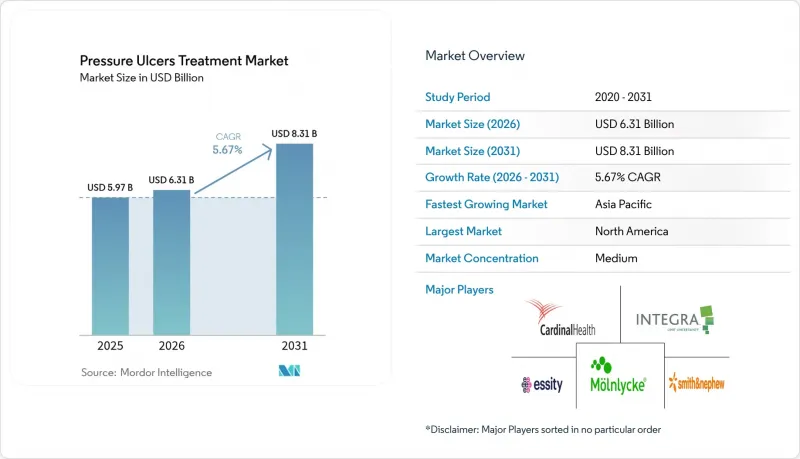
Mordor Intelligence에 의하면, 2026년 욕창 치료 시장 규모는 63억 1,000만 달러로 추정되고 있어 2025년 59억 7,000만 달러에서 확대되어, 2031년에는 83억 1,000만 달러에 이를 것으로 예측됩니다.
2026년부터 2031년까지 연평균 성장률(CAGR) 5.67%로 성장할 것으로 전망됩니다.
본 보고서는 제품 유형(상처 관리 드레싱, 능동적 상처 관리 요법, 음압 상처 요법, 성장 인자 및 생물학적 제제 등), 욕창 단계(1단계, 2단계 등), 최종 사용자(병원 및 진료소, 장기 요양 시설 등), 지역(북미, 유럽 등)별로 분류되어 있습니다. 시장 예측은 금액(달러) 기준으로 제시되어 있습니다.
전 세계 욕창 치료 시장 동향 및 인사이트
고령화 및 만성 질환 유병률
세계 평균 수명의 연장에 따라, 욕창 위험에 노출되기 쉬운 운동 기능이 저하된 동반 질환을 가진 환자층이 증가하고 있습니다. 전 세계적으로 볼 때, 2024년에는 수술 대상 환자 중 당뇨병 유병률이 15.3%에 달하여 조직 복원의 복잡성이 증가하고 있습니다. 이에 따라 병원에서는 만성 상처의 상피화를 촉진하는 것으로 입증된 표피 성장 인자(EGF)를 방출하는 생체 활성 드레싱에 대한 투자를 확대되고 있습니다. 성숙한 의료 시스템에서는 이미 상환 코드가 광범위한 성장 인자 요법을 포괄하고 있어, 치유 기간을 단축하는 고품질 제품의 도입이 임상의들에게 권장되고 있습니다. 반면, 신흥 시장에서는 유사한 인구통계학적 압박에 대처하기 위해 간소화되고 저렴한 생리활성 솔루션이 채택되고 있습니다. 이러한 채택 상황의 차이는 현지 수용 능력에 따라 가격 책정 및 제품의 복잡성을 유연하게 조정할 수 있는 공급업체에게 단계적인 세계 비즈니스 기회를 창출하고 있습니다.
상처의 조기 봉합 및 조기 퇴원에 대한 수요 증가
의료 서비스 제공업체에 대한 지불 제도 개혁으로 인해 보상이 입원 일수 지표와 연동되게 되면서, 치료 성과를 저해하지 않으면서 신속하게 상처를 봉합하는 데 운영상의 중점이 두어지고 있습니다. 전기 반창고 프로토타입은 기존 방법에 비해 치유 속도가 30% 더 빠른 것으로 입증되어, 원격 모니터링이 가능한 에너지 기반 치료법의 상업적 잠재력을 시사하고 있습니다. 생체 유래 드레싱은 살아있는 세포가 함침되어 있어 육아 조직 형성을 더욱 촉진하며, 특정 욕창 환자의 경우 그 주 내 퇴원을 가능하게 합니다. 마이크로 센서가 탑재된 스마트 붕대는 습윤도 및 pH 데이터를 임상의에게 전송하여 불필요한 드레싱 교체와 간호사의 업무 부담을 줄여줍니다. 이러한 진전은 입원 자원을 중증도 높은 치료에 재분배하려는 보험사의 목표와 부합합니다. 그 결과, 실시간 분석 기능을 비용 효율적인 소모품에 통합한 의료기기 제조업체는 통합 의료 네트워크 전반에 걸쳐 신속하게 보험 적용 목록에 등재될 수 있을 것으로 보입니다.
고급 상처 치료 제품의 높은 초기 비용
세포 조직 제품은 1회 적용당 1,500달러를 초과하는 경우도 있어, 정액제 하에서 운영되는 병원에게는 장벽이 되고 있습니다. 메디케어·메디케이드 서비스 센터(CMS)가 2025년에 보험 적용 대상 피부 대체재 목록을 17개 제품으로 축소하고 보상 범위를 좁힘에 따라, 임상의들은 고가의 치료법 사용을 제한할 수밖에 없게 되었습니다. 마찬가지로, 자본 집약적인 비침습적 상처 치료(NPWT) 콘솔 역시 수년에 걸친 가치 분석을 통해 도입의 타당성을 입증해야 하기 때문에 자금 사정이 어려운 의료 기관에서는 도입이 지연되고 있습니다. 이에 대응해 각 공급업체들은 구독형 가격 책정이나 1회당 비용을 절감하는 재포장된 일회용 키트 도입을 통해 대처하고 있습니다. 하지만 경제적 장벽은 자원이 부족한 환경에서 빠른 보급을 위한 여전히 큰 걸림돌로 남아 있습니다.
부문 분석
2025년, 욕창 치료 시장 규모의 21.37%를 능동적 상처 관리 요법이 차지했습니다. 이는 염증을 조절하고 조직 재생을 촉진하는 생물학적 활성 용액에 대한 임상 현장의 강한 선호도를 반영한 것입니다. 성장 인자, 다혈소판 혈장(PRP), 세포 접종 매트릭스가 이 부문의 주력 제품으로, 통합 의료 네트워크 전반에 걸쳐 프리미엄 가격을 유지하고 있습니다. 각 제조업체는 상용화까지의 기간을 단축하는 규제상의 신속 승인 제도를 활용하여 동종 세포 치료의 생산 규모를 확대되고 있습니다. 음압상처치료는 외래 및 재택 치료 환경에서 신속한 도입을 가능하게 하는 일회용 플랫폼에 힘입어 연평균 성장률(CAGR) 8.02%로 다른 모든 치료법을 능가하는 성장을 이어가고 있습니다. 한편, 기존의 폼이나 하이드로겔 드레싱은 비용 효율이 뛰어난 보조 요법으로서의 입지를 유지하기 위해, 수분 반응성 폴리머나 항균성 나노 입자 등의 개량이 반복되고 있습니다. 예측 기간 동안, 활성 생물학적 제제와 센서가 탑재된 투여 시스템을 결합한 공급업체는 병원의 추가 지출을 확보하는 데 있어 가장 유리한 입장에 있을 것으로 보입니다.
음압상처치료는 혁신 파이프라인을 주도하고 있으며, 차세대 시스템에서는 관류 사이클과 이온 은 메쉬를 결합하여 대기압 이하의 압력을 유지하면서 바이오필름 형성을 억제하고 있습니다. 2025년 FDA가 승인한 ‘떼어내서 붙이기만 하면 되는’ 드레이프 덕분에 설치 시간이 5분 미만으로 단축되어 간호 현장에서의 채택이 확대되고 있습니다. 필름 드레싱과 콜라겐 패드는 초기 단계 또는 표재성 궤양에서 틈새 시장 역할을 유지하고 있으며, 비용에 민감한 의료 제공업체에게 임상적으로 검증된 선택지를 제공합니다. 가격 압박이 심화되는 가운데, 각 공급업체들은 치유 시간 단축 실적을 바탕으로 보상액을 결정하는 성과 연계형 계약을 통해 차별화를 꾀할 것입니다. 이는 욕창 치료 시장 전체의 동향을 반영한 것입니다.
지역별 분석
북미는 견고한 보험 환급 제도, AI를 활용한 예방 기술의 높은 보급률, 그리고 유리한 규제 환경에 힘입어 2025년에는 매출 점유율 45.12%로 욕창 치료 시장을 주도했습니다. 미국의 병원들은 병원 내 욕창과 관련된 268억 달러의 벌금 부담을 안게 되면서 스마트 서포트 서피스에 대한 설비 투자를 가속화했습니다. 캐나다는 이에 뒤이어 재택 간호 프로그램 내 NPWT 키트를 위해 주 차원의 자금이 배정되면서 환자의 접근성이 더욱 확대되었습니다.
유럽에서는 예산 편성 체계에 따라 비용 대비 효과에 관한 자료 제출이 의무화되어 있어, 공급업체들은 자원 조정을 거친 후의 이점을 입증하는 실용적인 임상시험을 후원하도록 장려받고 있습니다. 독일과 네덜란드 등 일부 국가에서는 현재 DRG(진단 관련군) 추가 지급 한도 내에서 NPWT에 대한 환급이 이루어지고 있는 반면, 영국의 NICE(국립의료기술평가기구)는 2024년에 수술 부위용 일회용 NPWT를 승인했습니다. 이 지역의 근거 기반 조달 노력 덕분에 시장 침투율은 성숙 단계에 접어들었으며, 완만한 성장이 유지되고 있습니다.
아시아태평양은 가장 성장세가 두드러지는 지역으로, 중국과 인도의 건강보험 확대 및 정형외과·심혈관 외과 수술 건수 증가를 배경으로 연평균 성장률(CAGR) 8.34%가 예상됩니다. 각국의 보건부는 감염 관리와 조기 활동 재개를 우선시하는 상처 관리 지침을 수립하고 있으며, 이에 따라 은 함유 폼 및 휴대용 NPWT 시스템의 수입이 촉진되고 있습니다. 현지 수탁 제조업체들이 다국적 공급업체와 라이선스 계약을 체결함에 따라 최종 제품의 비용이 낮아지고, 더 광범위한 보급이 촉진되고 있습니다. 중동 및 아프리카 및 남미는 총 시장 점유율은 작지만, 미충족 수요가 높은 지역입니다. 다자간 개발 프로그램을 통해 3차 의료기관에 AI 탑재 체압 분포 측정 침대의 시범 도입에 자금이 지원되고 있어, 2027년까지 광범위한 확산을 위한 수요의 씨앗이 뿌려질 가능성이 있습니다.
기타 혜택:
- 엑셀 형식 시장 예측(ME) 시트
- 3개월간의 애널리스트 지원
자주 묻는 질문
목차
제1장 서론
제2장 조사 방법
제3장 주요 요약
제4장 시장 구도
제5장 시장 규모와 성장 예측
제6장 경쟁 구도
제7장 시장 기회와 향후 전망
JHS 26.09.07According to Mordor Intelligence, the pressure ulcer treatment market size in 2026 is estimated at USD 6.31 billion, growing from 2025 value of USD 5.97 billion with 2031 projections showing USD 8.31 billion, growing at 5.67% CAGR over 2026-2031.
This report is Segmented by Product Type (Wound Care Dressings, Active Wound Care Therapies, Negative Pressure Wound Therapy, Growth Factors & Biologics, and More), Ulcer Stage (Stage I Stage II, and More), End User (Hospitals & Clinics, Long-Term Care Facilities, and More), and Geography (North America, Europe, and More). The Market Forecasts are Provided in Terms of Value (USD).
Global Pressure Ulcers Treatment Market Trends and Insights
Aging Population & Prevalence of Chronic Diseases
Global life expectancy gains are producing a larger cohort of immobile, comorbid patients who remain susceptible to pressure injuries. World-wide, diabetes prevalence among surgical candidates reached 15.3% in 2024, intensifying tissue-repair complexity. Hospitals are therefore scaling investment in biologically active dressings that deliver epidermal growth factor, a modality shown to accelerate re-epithelialization in chronic wounds. In mature health systems, reimbursement codes already cover a spectrum of growth-factor therapies, encouraging clinicians to adopt premium products that shorten healing time. Emerging markets, meanwhile, are adopting simplified, lower-cost bioactive solutions to manage the same demographic pressures. The differential adoption framing is creating a tiered global opportunity for suppliers able to flex pricing and product complexity according to local capacity.
Rising Demand for Faster Wound Closure & Early Discharge
Provider payment reforms now link compensation to length-of-stay metrics, prompting an operational focus on closing wounds quickly without compromising outcomes. Electric bandage prototypes have demonstrated 30% faster healing versus conventional approaches, signalling commercial potential for energy-based therapies that can be monitored remotely. Biologic dressings impregnated with viable cells further boost granulation tissue formation, enabling same-week discharge for selected pressure-ulcer patients. Smart bandages equipped with micro-sensors transmit moisture and pH data to clinicians, cutting unnecessary dressing changes and nurse workload. These advances dovetail with payer objectives to reallocate inpatient resources toward high-acuity care. Consequently, device makers that integrate real-time analytics into cost-effective consumables stand to gain rapid formulary access across integrated delivery networks.
High Upfront Cost of Advanced Wound Products
Cellular tissue products can exceed USD 1,500 per application, a hurdle for hospitals operating under fixed-payment bundles. The Centers for Medicare & Medicaid Services (CMS) pruned its covered-skin-substitute list to 17 products in 2025, narrowing the reimbursable field and forcing clinicians to ration premium therapies. Capital-intensive NPWT consoles likewise demand justification through multi-year value analyses, delaying adoption in cash-constrained facilities. Suppliers are countering by introducing subscription-based pricing and repackaged single-use kits that lower per-episode spending. Nonetheless, the economic hurdle remains a significant dampener on rapid penetration in low-resource settings.
Other drivers and restraints analyzed in the detailed report include:
- Higher Surgical Volumes and Trauma Incidence Worldwide
- Increasing Adoption of Negative Pressure Wound Therapy (NPWT)
- Uneven Reimbursement Coverage in Emerging Economies
For complete list of drivers and restraints, kindly check the Table Of Contents.
Segment Analysis
Active wound-care therapies accounted for 21.37% of the pressure ulcer treatment market size in 2025, reflecting strong clinical preference for biologically active solutions that modulate inflammation and stimulate tissue regrowth. Growth factors, platelet-rich plasma, and cell-seeded matrices headline this category and command premium pricing across integrated delivery networks. Manufacturers are scaling production of allogeneic cell therapies, leveraging regulatory fast tracks that shorten commercialization timelines. Negative pressure wound therapy continues to outpace all other modalities at an 8.02% CAGR, buoyed by single-use platforms that allow rapid deployment in outpatient and home-care environments. Meanwhile, conventional foam and hydrogel dressings undergo iterative improvements-such as moisture-responding polymers and antimicrobial nanoparticles-to sustain relevance as cost-effective adjuncts. Over the forecast horizon, suppliers that pair active biologics with sensor-enabled delivery systems stand best positioned to capture incremental hospital spend.
Negative pressure wound therapy leads innovation pipelines, with next-generation systems combining instillation cycles and ionic-silver meshes to suppress biofilm formation while maintaining sub-atmospheric pressure. The FDA's 2025 clearance of a peel-and-place drape reduced setup time to under five minutes, widening nursing adoption. Film dressings and collagen pads retain niche roles in early-stage or superficial ulcers, providing cost-conscious providers with clinically validated options. As pricing pressure intensifies, vendors will differentiate through outcomes-based contracts that tie reimbursement to documented reductions in healing time, mirroring trends in the broader pressure ulcer treatment market.
Complete Report Scope:
- By Product Type
- Wound-Care Dressings
- Film Dressings
- Foam Dressings
- Hydrogel Dressings
- Collagen Dressings
- Active Wound-Care Therapies
- Skin Substitutes
- Growth Factors & Biologics
- Wound-Care Devices
- Negative Pressure Wound Therapy
- Hyperbaric Oxygen Equipment
- Pressure-Relieving Devices
- Other Devices
- By Ulcer Stage
- Stage I
- Stage II
- Stage III
- Stage IV
- Unstageable / Deep-Tissue Injury
- By End User
- Hospitals & Clinics
- Long-Term Care Facilities
- Home-Care Settings
- Ambulatory Surgical Centers
- Geography
- North America
- United States
- Canada
- Mexico
- Europe
- Germany
- United Kingdom
- France
- Italy
- Spain
- Rest of Europe
- Asia-Pacific
- China
- Japan
- India
- South Korea
- Australia
- Rest of Asia-Pacific
- Middle East and Africa
- GCC
- South Africa
- Rest of Middle East and Africa
- South America
- Brazil
- Argentina
- Rest of South America
- North America
Geography Analysis
North America led the pressure ulcer treatment market with 45.12% revenue share in 2025, supported by robust reimbursement schemes, high adoption of AI-enabled preventive technologies, and favorable regulatory pathways. Hospitals in the United States accelerated capital outlays for smart support surfaces following a USD 26.8 billion penalty burden tied to hospital-acquired pressure injuries. Canada followed with province-level funding earmarked for NPWT kits in home-care programs, further broadening patient access.
In Europe, budgeting frameworks require cost-effectiveness dossiers, motivating suppliers to sponsor pragmatic trials that demonstrate resource-adjusted benefits. Countries such as Germany and the Netherlands now reimburse NPWT under DRG add-on payments, while the United Kingdom's NICE validated single-use NPWT for surgical sites in 2024. The region's embrace of evidence-based procurement sustains moderate growth despite mature penetration levels.
Asia-Pacific is the fastest-growing territory, projected at an 8.34% CAGR, fueled by health-insurance expansion in China and India and rising orthopedic and cardiovascular surgery volumes. Regional ministries are launching wound-management guidelines that prioritize infection control and rapid mobilization, stimulating imports of silver-impregnated foam and portable NPWT systems. Local contract manufacturers are entering licensing deals with multinational suppliers, lowering final-product costs and facilitating wider adoption. The Middle East & Africa and South America collectively account for a smaller share but present high unmet need; multilateral development programs are funding pilot deployments of AI-enabled pressure-mapping beds in tertiary hospitals, potentially seeding demand for broader rollouts by 2027.
List of Companies Covered in this Report:
- Smiths Group
- Integra LifeSciences Holdings Corp.
- Solventum Corporation
- Molnlycke Health Care
- Cardinal Health
- Essity
- B. Braun
- Convatec
- Coloplast
- Baxter
- Medline Industries
- Hartmann Group
- Urgo Medical
- Medela
- Tissue Regenix Group
- Advanced Medical Solutions Group PLC
- DermaRite Industries
- Hollister
- Kinetic Concepts Inc.
- Aroa Biosurgery Ltd
- Joerns Healthcare
Additional Benefits:
- The market estimate (ME) sheet in Excel format
- 3 months of analyst support
TABLE OF CONTENTS
1 Introduction
- 1.1 Study Assumptions & Market Definition
- 1.2 Scope of the Study
2 Research Methodology
3 Executive Summary
4 Market Landscape
- 4.1 Market Overview
- 4.2 Market Drivers
- 4.2.1 Aging Population & Prevalence Of Chronic Diseases
- 4.2.2 Rising Demand For Faster Wound Closure & Early Discharge
- 4.2.3 Higher Surgical Volumes And Trauma Incidence Worldwide
- 4.2.4 Increasing Adoption Of Negative Pressure Wound Therapy (NPWT)
- 4.2.5 Real-Time AI Pressure-Mapping Beds Driving Preventive Spend
- 4.2.6 Value-Based Reimbursement Penalties For Hospital-Acquired Pressure Injuries
- 4.3 Market Restraints
- 4.3.1 High Upfront Cost Of Advanced Wound Products
- 4.3.2 Uneven Reimbursement Coverage In Emerging Economies
- 4.3.3 Silver-Based Dressing Raw-Material Supply Volatility
- 4.3.4 Home-Care Skill Gap Limiting Correct Device Usage
- 4.4 Porter's Five Forces Analysis
- 4.4.1 Threat of New Entrants
- 4.4.2 Bargaining Power of Buyers
- 4.4.3 Bargaining Power of Suppliers
- 4.4.4 Threat of Substitutes
- 4.4.5 Intensity of Competitive Rivalry
5 Market Size & Growth Forecasts (Value, USD)
- 5.1 By Product Type
- 5.1.1 Wound-Care Dressings
- 5.1.2 Film Dressings
- 5.1.3 Foam Dressings
- 5.1.4 Hydrogel Dressings
- 5.1.5 Collagen Dressings
- 5.1.6 Active Wound-Care Therapies
- 5.1.7 Skin Substitutes
- 5.1.8 Growth Factors & Biologics
- 5.1.9 Wound-Care Devices
- 5.1.10 Negative Pressure Wound Therapy
- 5.1.11 Hyperbaric Oxygen Equipment
- 5.1.12 Pressure-Relieving Devices
- 5.1.13 Other Devices
- 5.2 By Ulcer Stage
- 5.2.1 Stage I
- 5.2.2 Stage II
- 5.2.3 Stage III
- 5.2.4 Stage IV
- 5.2.5 Unstageable / Deep-Tissue Injury
- 5.3 By End User
- 5.3.1 Hospitals & Clinics
- 5.3.2 Long-Term Care Facilities
- 5.3.3 Home-Care Settings
- 5.3.4 Ambulatory Surgical Centers
- 5.4 Geography
- 5.4.1 North America
- 5.4.1.1 United States
- 5.4.1.2 Canada
- 5.4.1.3 Mexico
- 5.4.2 Europe
- 5.4.2.1 Germany
- 5.4.2.2 United Kingdom
- 5.4.2.3 France
- 5.4.2.4 Italy
- 5.4.2.5 Spain
- 5.4.2.6 Rest of Europe
- 5.4.3 Asia-Pacific
- 5.4.3.1 China
- 5.4.3.2 Japan
- 5.4.3.3 India
- 5.4.3.4 South Korea
- 5.4.3.5 Australia
- 5.4.3.6 Rest of Asia-Pacific
- 5.4.4 Middle East and Africa
- 5.4.4.1 GCC
- 5.4.4.2 South Africa
- 5.4.4.3 Rest of Middle East and Africa
- 5.4.5 South America
- 5.4.5.1 Brazil
- 5.4.5.2 Argentina
- 5.4.5.3 Rest of South America
- 5.4.1 North America
6 Competitive Landscape
- 6.1 Market Concentration
- 6.2 Market Share Analysis
- 6.3 Company Profiles (includes Global level Overview, Market level overview, Core Segments, Financials as available, Strategic Information, Market Rank/Share for key companies, Products & Services, and Recent Developments)
- 6.3.1 Smith & Nephew PLC
- 6.3.2 Integra LifeSciences Holdings Corp.
- 6.3.3 Solventum Corporation
- 6.3.4 Molnlycke Health Care AB
- 6.3.5 Cardinal Health Inc.
- 6.3.6 Essity AB
- 6.3.7 B. Braun Melsungen AG
- 6.3.8 ConvaTec Group PLC
- 6.3.9 Coloplast A/S
- 6.3.10 Baxter International Inc.
- 6.3.11 Medline Industries LP
- 6.3.12 Paul Hartmann AG
- 6.3.13 Urgo Medical
- 6.3.14 Medela AG
- 6.3.15 Tissue Regenix Group
- 6.3.16 Advanced Medical Solutions Group PLC
- 6.3.17 DermaRite Industries
- 6.3.18 Hollister Incorporated
- 6.3.19 Kinetic Concepts Inc.
- 6.3.20 Aroa Biosurgery Ltd
- 6.3.21 Joerns Healthcare
7 Market Opportunities & Future Outlook
- 7.1 White-space & Unmet-need Assessment