

|
시장보고서
상품코드
2123576
초저온 냉동고 시장 : 점유율 분석, 업계 동향과 통계, 성장 예측(2026-2031년)Ultra Low Temperature Freezer - Market Share Analysis, Industry Trends & Statistics, Growth Forecasts (2026 - 2031) |
||||||
 Mordor Intelligence
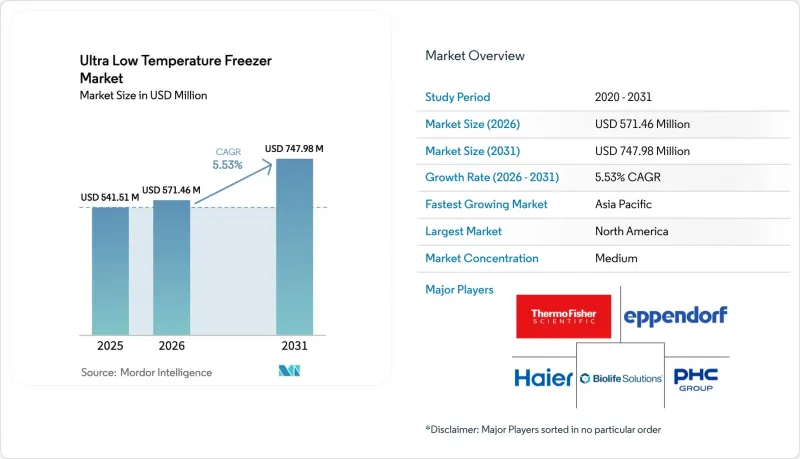
Mordor Intelligence에 의하면, 초저온 냉동고 시장 규모는 2025년에 5억 4,151만 달러로 평가되었고 2026년 5억 7,146만 달러에서 2031년까지 7억 4,798만 달러에 이를 것으로 예측되며, 예측 기간(2026-2031년) CAGR은 5.53%를 나타낼 전망입니다.
본 보고서는 제품 유형(세로형, 가로형), 최종 사용자(바이오뱅크, 제약·바이오기술 기업, 학술·연구 기관, CRO, 병원·혈액 센터),용량(300L 미만, 301-500L, 501-700L, 701-900L, 900L 초과) 및 지역(북미, 유럽, 아시아태평양, 기타)별로 분류되어 있습니다. 시장 예측은 금액(달러) 기준으로 제시되어 있습니다.
전 세계 초저온 냉동고 시장 동향 및 인사이트
전 세계 바이오뱅크 네트워크의 확대
각국의 유전체 이니셔티브에 따라 샘플 저장소가 학술 기관의 범위를 넘어 확대되고 있으며, 검증된 초저온 보존 장치에 대한 장기적인 수요가 증가하고 있습니다. 중국의 ‘국가 유전자 은행’은 5,000만 개 분량의 샘플 수용 능력을 증강하고 있으며, 일본의 ‘유전체 데이터 기반 프로젝트’는 AI 주도 신약 개발과 관련된 바이오 뱅킹에 자금을 지원하고 있는데, 두 프로젝트 모두 ISO 13485 품질 관리 기준을 충족하는 냉동고를 지정하고 있습니다. 인도의 ‘BioE3 정책’은 바이오 제조 허브와 1만 개 유전체이라는 목표를 연계하고 있으며, 잦은 정전에 직면한 연구소에 에너지 효율이 뛰어나고 배터리 지원이 가능한 장비를 발주하도록 압력을 가하고 있습니다. 아젠타 라이프 사이언시스(Azenta Life Sciences)가 영국 바이오센터와 체결한 ‘2025 BioArc Ultra’ 계약은 70%의 에너지 절감을 실현하고 있으며, 입찰 기준에서 지속가능성이 검체의 안전성과 동등하게 중요시되고 있음을 보여줍니다.
포스트 코로나 시대 백신 콜드체인 확충
mRNA 백신용으로 구축된 인프라는 단일클론 항체 및 차세대 치료제용으로 재사용되고 있습니다. DHL은 아시아태평양의 의료 물류에 5억 유로를 배정했고, UPS는 유사한 냉동 창고에 2억 5,000만 달러를 투자하여 바이오시밀러용 -80°C 보관 용량을 확보했습니다. 사우디아라비아의 생명공학 로드맵에서는 임상시험용 시료의 현지 초저온(ULT) 보관을 요구하고 있으며, 일본에서는 제약 기업이 수요 급증 시 대응 능력을 유지할 수 있도록 독려하는 긴급 승인 제도를 유지하고 있습니다. 업데이트된 WHO 가이드라인에서는 검증 규정이 강화되었으며, IoT 모니터링과 클라우드 아카이브 서비스를 결합한 제조업체가 우대받고 있습니다.
높은 설비 투자 및 운영 비용
구매 가격은 컴팩트 모델의 경우 8,000달러부터 대용량 듀얼 컴프레서 유닛의 경우 2만 5,000달러까지 폭이 넓으며, 연간 운영 비용으로 1,000-3,000달러가 추가됩니다. 나이지리아는 발전기에 대한 의존도가 높기 때문에 총 비용이 최대 60% 증가하는 한편, 고효율 유닛이라 하더라도 20-30%의 가격 프리미엄이 부과되어 공공 부문 예산에 부담을 주고 있습니다.
부문 분석
직립형 유닛은 효율적인 랙 배치와 뚜껑을 열고 시료를 꺼내는 데 걸리는 시간이 짧다는 점 덕분에 2025년 초저온 냉동고 시장 매출의 61.25%를 차지했습니다. 에너지 절약 성능, IoT 모니터링 및 ENERGY STAR 라벨이 현재 조달 체크리스트의 결정 요인으로 작용하고 있습니다. 한편, 상자형 냉동고의 뛰어난 보온성은 2031년까지 연평균 성장률(CAGR) 6.61%를 뒷받침하고 있습니다. Binder, Liebherr, Meling 각사는 벽의 단열층을 두껍게 함으로써 유효 용적을 줄이지 않고 진공 단열 패널을 통합하고 있습니다. 바이오뱅크가 수십 년에 걸쳐 대체 불가능한 유전체 아카이브를 보관함에 따라, 시료 접근 속도가 느려지는 상황에서 상자형 설계의 중요성이 재인식되고 있습니다.
경쟁적인 혁신이 두 카테고리의 양상을 변화시키고 있습니다. 수직형 냉동고에는 FDA 규정 준수 감사를 위해 경보를 기록하는 클라우드 대시보드가 통합되었으며, 상자형에는 로봇 피킹 앤 플레이스 모듈용 측면 접근 포트가 추가되었습니다. 또한 휴대용 마이크로 냉동고도 등장하여 이동식 백신 접종 클리닉을 지원하는 하위 시장을 개척하고 있지만, 보고 목적상으로는 여전히 더 광범위한 초저온 냉동고 시장에 포함되고 있습니다.
지역별 분석
북미는 2025년 초저온 냉동고 시장 매출의 42.45%를 차지했습니다. 600개가 넘는 바이오뱅크와 미국 국립보건원(NIH)의 ‘All of Us’ 프로그램으로 인해, 2025년 6월부터 적용되는 ENERGY STAR 버전 2.0 기준을 충족하지 못하게 된 구형 장비의 교체 수요가 꾸준히 발생하고 있습니다. 캐나다의 토론토-몬트리올 회랑에서는 검증된 초저온(ULT) 보관을 필요로 하는 재생의료 제품 제조가 확대되고 있으며, 니어쇼어링을 통해 라틴아메리카의 임상시험 거점을 지원하기 위해 수탁 제조가 멕시코로 이동하고 있습니다.
아시아태평양은 연평균 성장률(CAGR) 6.81%로 가장 높은 성장세가 예상됩니다. 중국의 ‘국가 유전자 은행’, 일본의 33억 달러 규모 ‘그레이터 도쿄 바이오 커뮤니티’, 그리고 인도의 ‘BioE3 정책’이 합쳐서 수십억을 바이오 리포지토리에 투자하고 있어, CE 및 GB 규격에 부합하는 탄화수소 냉매 유닛의 수주가 가속화되고 있습니다. 호주의 TGA가 FDA 및 EMA와 규정을 조율함에 따라 시장 진입은 용이해졌으나, 높은 물류 비용으로 인해 싱가포르와 홍콩의 유통 허브가 유리한 위치를 차지하고 있습니다.
유럽의 엄격한 프레온 가스(F-gas) 단계적 감축 정책이 교체 수요를 뒷받침하는 한편, 사우디아라비아와 브라질은 백신 자급자족을 위한 노력을 통해 중동 및 남미 지역의 성장을 주도하고 있습니다. 대조적으로, 사하라 이남 아프리카에서는 안정적인 전력 공급을 확보하지 못한 6억 명의 주민이 거주하고 있어 기계식 냉동고의 보급이 제한되고 있으며, 송전망의 신뢰성이 향상될 때까지는 일부 시설에서 액체 질소(LN2) 듀어 용기나 태양광·배터리 하이브리드 키트의 도입이 진행되고 있습니다.
기타 혜택:
- 엑셀 형식 시장 예측(ME) 시트
- 3개월간의 애널리스트 지원
자주 묻는 질문
목차
제1장 서론
제2장 조사 방법
제3장 주요 요약
제4장 시장 구도
제5장 시장 규모와 성장 예측
제6장 경쟁 구도
제7장 시장 기회와 향후 전망
JHS 26.09.07According to Mordor Intelligence, the ultra-low temperature freezer market size was valued at USD 541.51 million in 2025 and is estimated to grow from USD 571.46 million in 2026 to reach USD 747.98 million by 2031, at a CAGR of 5.53% during the forecast period (2026-2031).
This report is Segmented by Product Type (Upright, Chest), End User (Bio-Banks, Pharmaceutical & Biotechnology Companies, Academic & Research Laboratories, Cros, Hospitals & Blood Centers), Capacity (Less Than 300L, 301-500L, 501-700L, 701-900L, More Than 900L), and Geography (North America, Europe, Asia-Pacific, and More). Market Forecasts are Provided in Terms of Value (USD).
Global Ultra Low Temperature Freezer Market Trends and Insights
Expanding Biobank Networks World-Wide
National genomic initiatives are scaling sample repositories beyond academic settings, lifting long-term demand for validated ultra low temperature storage. China's National GeneBank added capacity for 50 million samples, and Japan's Genome and Data Infrastructure Project funds biobanking tied to AI-led drug discovery, both of which specify freezers that meet ISO 13485 quality controls. India's BioE3 Policy pairs biomanufacturing hubs with a 10,000-genome target, pressuring laboratories facing frequent power disruptions to order energy-efficient, battery-ready units. Azenta Life Sciences' 2025 BioArc Ultra deal with UK Biocentre, which delivers 70% energy savings, shows sustainability now ranks alongside specimen security in tender criteria.
Post-COVID Vaccine Cold-Chain Build-Out
Infrastructure built for mRNA vaccines is being repurposed for monoclonal antibodies and next-gen therapeutics. DHL earmarked EUR 500 million for Asia-Pacific healthcare logistics and UPS invested USD 250 million in similar freezer farms, ensuring -80 °C capacity for biosimilars. Saudi Arabia's biotechnology roadmap requires localized ULT storage for clinical-trial materials, and Japan keeps an emergency-approval pathway that encourages pharmaceutical firms to maintain surge capacity. Updated WHO guidelines strengthen validation rules, favoring manufacturers that bundle IoT monitoring and cloud archival services.
High Capital & Operating Costs
Purchase prices range from USD 8,000 for compact models to USD 25,000 for high-capacity dual-compressor units, and annual running costs add USD 1,000-3,000. Nigeria's heavy generator reliance lifts total costs by up to 60%, while even efficient units carry 20-30% price premiums that stress public-sector budgets.
Other drivers and restraints analyzed in the detailed report include:
- Rapid Adoption of Energy-Efficient Natural-Refrigerant ULT Models
- Growth of Cell & Gene Therapy Pipelines
- Complex Multi-Jurisdictional Regulatory Compliance
For complete list of drivers and restraints, kindly check the Table Of Contents.
Segment Analysis
Upright units comprised 61.25% of 2025 revenue for the ultra low temperature freezer market thanks to efficient racking and faster lid-to-specimen retrieval. Energy savings, IoT monitoring and ENERGY STAR labels now dictate procurement checklists. Conversely, chest freezers' superior thermal retention underpins a 6.61% forecast CAGR through 2031. Binder, Liebherr and Meling capitalize on thicker wall insulation to house vacuum-insulation panels without shrinking usable volume. As biobanks store irreplaceable genomic archives for decades, chest designs find renewed relevance despite slower sample access.
Competitive innovation is reshaping both categories. Uprights integrate cloud dashboards that log alarms for FDA-compliant audits, and chest designs add side-access ports for robotic pick-and-place modules. Portable micro-freezers are also emerging, carving out a sub-segment that supports mobile vaccination clinics, yet they still roll up under the broader ultra low temperature freezer market for reporting purposes.
Complete Report Scope:
- By Product Type
- Upright ULT Freezers
- Chest ULT Freezers
- By End User
- Bio-Banks
- Pharmaceutical & Biotechnology Companies
- Academic & Research Laboratories
- Contract Research Organizations (CROs)
- Hospitals & Blood Centers
- By Capacity
- Less than 300 Liters
- 301-500 Liters
- 501-700 Liters
- 701-900 Liters
- More than 900 Liters
- By Geography
- North America
- United States
- Canada
- Mexico
- Europe
- Germany
- United Kingdom
- France
- Italy
- Spain
- Rest of Europe
- Asia-Pacific
- China
- Japan
- India
- Australia
- South Korea
- Rest of Asia-Pacific
- Middle East and Africa
- GCC
- South Africa
- Rest of Middle East and Africa
- South America
- Brazil
- Argentina
- Rest of South America
- North America
Geography Analysis
North America generated 42.45% of 2025 revenue in the ultra low temperature freezer market. Over 600 biobanks and the NIH All of Us program create steady replacement demand as older units fail ENERGY STAR Version 2.0 thresholds that began in June 2025. Canada's Toronto-Montreal corridor expands regenerative-medicine manufacturing that relies on validated ULT storage, and nearshoring pushes contract manufacturing into Mexico to serve Latin American trial sites.
Asia-Pacific is set for the fastest 6.81% CAGR. China's National GeneBank, Japan's USD 3.3 billion Greater Tokyo Biocommunity and India's BioE3 Policy collectively pump billions into biorepositories, accelerating orders for hydrocarbon-refrigerant units compliant with CE and GB standards. Australia's TGA alignment with FDA and EMA eases market entry but high logistics costs favor Singapore-Hong Kong distribution hubs.
Europe's strict F-gas phasedown propels replacement demand, while Saudi Arabia and Brazil spearhead growth in the Middle East and South America through vaccine self-sufficiency drives. Conversely, Sub-Saharan Africa's 600 million residents without reliable power limit mechanical freezer uptake, steering some facilities toward LN2 dewars or solar/battery hybrid kits until grid reliability improves.
- Abzil Telstar
- Arctiko
- Azenta
- B Medical Systems
- Binder
- Biolife Solutions
- Bionics Scientific Technologies (P) Ltd.
- Eppendorf
- Esco Micro Pte Ltd.
- Froilabo
- Global Cooling Inc.
- Haier Biomedical
- Helmer Scientific
- K2 Scientific
- Labcold
- Liebherr Group
- Nuaire Inc.
- Panasonic Healthcare (legacy models)
- PHC Holdings Corporation (PHCbi)
- So-Low Environmental Equipment Co.
- Thermo Fisher Scientific
- VWR International (Avantor)
- Zhongke Meiling Cryogenics
Additional Benefits:
- The market estimate (ME) sheet in Excel format
- 3 months of analyst support
TABLE OF CONTENTS
1 Introduction
- 1.1 Study Assumptions & Market Definition
- 1.2 Scope of the Study
2 Research Methodology
3 Executive Summary
4 Market Landscape
- 4.1 Market Overview
- 4.2 Market Drivers
- 4.2.1 Expanding biobank networks world-wide
- 4.2.2 Post-COVID vaccine cold-chain build-out
- 4.2.3 Rapid adoption of energy-efficient natural-refrigerant ULT models
- 4.2.4 Growth of cell & gene therapy pipelines
- 4.2.5 ENERGY-STAR compliance-driven replacement demand
- 4.2.6 Emergence of freezer-as-a-service rental models
- 4.3 Market Restraints
- 4.3.1 High capital & operating costs
- 4.3.2 Complex multi-jurisdictional regulatory compliance
- 4.3.3 Grid-instability risks in emerging markets
- 4.3.4 Liquid-nitrogen cryogenic alternatives in niche segments
- 4.4 Value / Supply-Chain Analysis
- 4.5 Regulatory Landscape
- 4.6 Technological Outlook
- 4.7 Porter's Five Forces Analysis
- 4.7.1 Threat of New Entrants
- 4.7.2 Bargaining Power of Buyers
- 4.7.3 Bargaining Power of Suppliers
- 4.7.4 Threat of Substitute Products
- 4.7.5 Intensity of Competitive Rivalry
5 Market Size & Growth Forecasts(Value, USD)
- 5.1 By Product Type
- 5.1.1 Upright ULT Freezers
- 5.1.2 Chest ULT Freezers
- 5.2 By End User
- 5.2.1 Bio-Banks
- 5.2.2 Pharmaceutical & Biotechnology Companies
- 5.2.3 Academic & Research Laboratories
- 5.2.4 Contract Research Organizations (CROs)
- 5.2.5 Hospitals & Blood Centers
- 5.3 By Capacity
- 5.3.1 Less than 300 Liters
- 5.3.2 301-500 Liters
- 5.3.3 501-700 Liters
- 5.3.4 701-900 Liters
- 5.3.5 More than 900 Liters
- 5.4 By Geography
- 5.4.1 North America
- 5.4.1.1 United States
- 5.4.1.2 Canada
- 5.4.1.3 Mexico
- 5.4.2 Europe
- 5.4.2.1 Germany
- 5.4.2.2 United Kingdom
- 5.4.2.3 France
- 5.4.2.4 Italy
- 5.4.2.5 Spain
- 5.4.2.6 Rest of Europe
- 5.4.3 Asia-Pacific
- 5.4.3.1 China
- 5.4.3.2 Japan
- 5.4.3.3 India
- 5.4.3.4 Australia
- 5.4.3.5 South Korea
- 5.4.3.6 Rest of Asia-Pacific
- 5.4.4 Middle East and Africa
- 5.4.4.1 GCC
- 5.4.4.2 South Africa
- 5.4.4.3 Rest of Middle East and Africa
- 5.4.5 South America
- 5.4.5.1 Brazil
- 5.4.5.2 Argentina
- 5.4.5.3 Rest of South America
- 5.4.1 North America
6 Competitive Landscape
- 6.1 Market Concentration
- 6.2 Market Share Analysis
- 6.3 Company Profiles (includes Global level Overview, Market level overview, Core Segments, Financials as available, Strategic Information, Market Rank/Share for key companies, Products & Services, and Recent Developments)
- 6.3.1 Abzil Telstar S.L
- 6.3.2 Arctiko A/S
- 6.3.3 Azenta Life Sciences
- 6.3.4 B Medical Systems
- 6.3.5 Binder GmbH
- 6.3.6 Biolife Solutions
- 6.3.7 Bionics Scientific Technologies (P) Ltd.
- 6.3.8 Eppendorf SE
- 6.3.9 Esco Micro Pte Ltd.
- 6.3.10 Froilabo
- 6.3.11 Global Cooling Inc.
- 6.3.12 Haier Smart Home Co., Ltd (Haier Biomedical)
- 6.3.13 Helmer Scientific Inc.
- 6.3.14 K2 Scientific
- 6.3.15 Labcold Ltd.
- 6.3.16 Liebherr Group
- 6.3.17 Nuaire Inc.
- 6.3.18 Panasonic Healthcare (legacy models)
- 6.3.19 PHC Holdings Corporation (PHCbi)
- 6.3.20 So-Low Environmental Equipment Co.
- 6.3.21 Thermo Fisher Scientific Inc.
- 6.3.22 VWR International (Avantor)
- 6.3.23 Zhongke Meiling Cryogenics
7 Market Opportunities & Future Outlook
- 7.1 White-space & Unmet-Need Assessment


