

|
시장보고서
상품코드
2123578
수술대 시장 : 시장 점유율 분석, 업계 동향 및 통계, 성장 예측(2026-2031년)Surgical Tables - Market Share Analysis, Industry Trends & Statistics, Growth Forecasts (2026 - 2031) |
||||||
 Mordor Intelligence
Mordor Intelligence에 의하면, 수술대 시장 규모는 2025년에 15억 7,000만 달러로 평가되었고, 2026년 16억 5,000만 달러에서 2031년까지 21억 3,000만 달러에 이를 것으로 예측되며, 예측 기간(2026-2031년) CAGR은 5.24%를 나타낼 전망입니다.
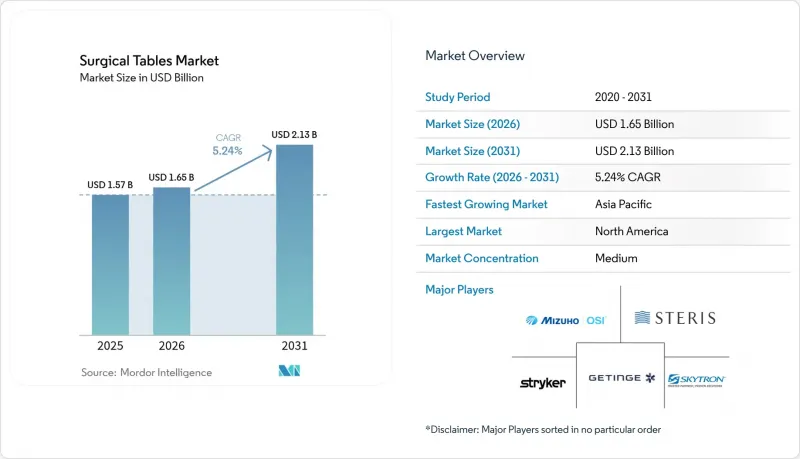
본 보고서는 수술 유형별(일반외과·전문 외과), 소재별(금속·탄소섬유 복합재료), 최종 사용자별(병원, 외래수술센터(ASC), 전문 클리닉), 지역별(북미, 유럽, 아시아태평양, 중동 및 아프리카, 남미)로 세분화되어 있습니다. 본 보고서에서는 상기 각 부문별 시장 규모(달러)를 제시하고 있습니다.
세계의 수술대 시장 동향 및 인사이트
수술 건수 증가와 외래수술센터(ASC)의 확대
미국에서 시행되는 수술의 대부분은 외래 시설에서 이루어지며, 병원 외래 부문에 비해 45-60% 낮은 비용으로 운영되고 평균 대기 시간을 20% 단축할 수 있어, 복잡한 정형외과 및 소화기과 사례를 계속해서 유치하고 있습니다. ASC의 성장에 따라 각 벤더들은 설치 면적이 작고, 수술 건간 전환이 신속하게 이루어지는 소형 다중 전문 분야 대응 수술대를 제공하게 되었습니다. 설비 투자를 줄이기 위해 각 제조업체는 현재 특수 테이블 상판을 장착할 수 있는 모듈식 베이스를 판매하고 있으며, 이를 통해 의료 기관은 수술 건수가 충분히 증가할 때까지 업그레이드를 미룰 수 있게 되었습니다. 공동 구매 계약이나 ‘EaaS(Equipment-as-a-Service)’를 통한 금융 지원도 도입 장벽을 더욱 낮추고 있습니다.
고령화로 인해 정형외과 및 심장외과 수술 건수 증가
인구 고령화에 따라 정확한 위치 결정과 비만 환자에 대응할 수 있는 하중 지지 능력이 필요한 관절 재건술, 골절 교정술, 심장 카테터 치료에 대한 수요가 증가하고 있습니다. 미국의 정형외과 수술 건수는 연간 660만 건에 달할 것으로 예측되며, 고하중 리프트와 욕창 방지 센서의 필요성이 더욱 높아지고 있습니다. XSENSOR의 ‘ForeSite OR’과 같이 압력 매핑 기능을 내장한 비만 환자용 수술대는 수술 환자의 최대 45%에 영향을 미치는 병원 내 욕창을 줄여줍니다.
중규모 병원의 프리미엄 가격 책정 및 설비 투자 동결
운영 비용 상승과 인플레이션으로 인해 소규모 병원에서는 설비 투자를 미루고, 재생 제품이나 다년 리스를 신중하게 선택하는 경향이 있습니다. 인공관절 전치환술 건수는 증가하고 있음에도 불구하고, 메디케어 환급액은 감소하고 있어 이익률이 압박받고 있으므로, 고급 영상 지원 수술대를 도입할 정당성을 입증하기가 어려워지고 있습니다. 이에 대응하여 각 벤더사는 의료기관이 기본 기계 모델을 도입한 후 나중에 연결 키트를 추가할 수 있는 단계적 업그레이드 플랜, 유지보수, 재생품 기준 준수, 소프트웨어 업데이트를 패키지로 묶은 서비스 계약을 제공함으로써 대응하고 있습니다.
부문 분석
2025년, 일반외과는 수술대 시장 점유율의 35.22%를 차지했습니다. 병원에서는 오전에는 충수절제술, 오후에는 비만 수술을 수행할 수 있는 범용성이 높고 신속하게 전환 가능한 플랫폼을 선호하고 있습니다. 이 부문의 광범위한 수술 조합은 교체 시 규모의 경제를 뒷받침하며, 그 워크플로는 탈부착식 암보드 및 결석 분쇄 자세용 레그 서포트 등 표준화된 부속품과 호환됩니다. 한편, 로봇 보조 담낭 절제술의 도입이 진행됨에 따라 많은 의료 기관이 수동식 유압 기반 시스템에서 속도와 일관성을 확보하기 위한 풋 스위치 방식의 메모리 프로파일을 갖춘 전동 컬럼 시스템으로의 교체를 추진하고 있습니다.
정형외과 및 외상 수술은 2031년까지 연평균 성장률(CAGR) 6.49%를 기록할 전망으로, 시장에서 가장 높은 성장률을 보이고 있습니다. Zimmer Biomet의 TMINI 미니어처 로봇 시스템과 같은 무릎 및 고관절 로봇 수술에서는 밀링 작업 중 서브 mm 단위의 정밀도를 유지할 수 있는 강성이 높고 진동이 적은 표면이 요구됩니다. 이에 대응하여 수술대 제조업체들은 체위를 변경하지 않고도 대퇴골 원위부를 노출할 수 있는 종방향 슬라이드 및 틸트 범위를 갖춘 제품을 제공함으로써 마취 시간과 X선 피폭 시간을 단축하고 있습니다. 신경외과 및 심혈관외과 부문의 점유율은 작지만, 탄소섬유 상판, 360° C-암 클리어런스, 내비게이션 시스템과 연동되는 두부 고정 인터페이스가 요구되기 때문에 고가 제품이 주류를 이루고 있습니다. 병원들이 학제간 하이브리드 수술실 도입을 추진함에 따라, 수요는 동일한 섀시 상에서 척추, 혈관, 두개골 각 워크플로우에 대응하는 범용 플랫폼으로 이동하고 있으며, 이를 통해 재고 및 서비스에 드는 간접비를 절감할 수 있습니다.
지역별 분석
북미는 높은 수술 건수와 첨단 로봇 기술의 조기 도입에 힘입어 2025년 매출의 38.30%를 차지했습니다. 미국 ASC 시장만 해도 2028년까지 매출이 590억 달러에 육박할 가능성이 있으며, 이에 따라 비용이 최적화되고 회전율이 높은 수술대 주문이 촉진될 전망입니다. 메디케어의 ‘시설 중립형’ 환급 제도 추진은 병원에서 ASC로의 장비 전환을 더욱 가속화하고 있는 반면, 게팅게(Getinge)와 스텔리스(Steris)의 지역 서비스 네트워크는 가동 중단 시간을 단축하고 브랜드 충성도를 높이고 있습니다.
유럽은 성숙하고 교체 수요가 주도하는 시장을 형성하고 있으며, 지속가능성과 엄격한 규제가 구매 행태를 좌우하고 있습니다. ASHRAE 189.3 가이드라인이 입찰 평가에 영향을 미치며, 구매자들이 에너지 효율이 높은 모터 드라이브와 재활용 가능한 포장재를 선택하도록 유도하고 있습니다. 게팅게의 ‘외과 워크플로우’ 부문은 병원들이 통합형 수술실 스위트에서 구형 장비를 교체한 데 힘입어 2023년 4분기에 15.6%의 매출 성장을 기록했습니다. 친환경 공공 조달 기준과 연계된 자본 보조금은 수술 건수 증가세가 정체되어 있음에도 불구하고 안정적인 수요를 유지할 것으로 전망됩니다.
아시아태평양은 가장 두드러진 성장을 보이고 있으며, 연평균 성장률(CAGR)은 6.56%로 예측됩니다. 의료 인프라에 대한 투자와 의료 관광의 확장으로 인해 중국, 인도, 아세안(ASEAN)에서는 하이브리드 수술실 도입이 진행되고 있습니다. 싱가포르에 위치한 메드트로닉의 ‘Robotics Experience Studio’는 교육 거점이 지역 전체에 걸쳐 첨단 수술실 기술의 보급을 어떻게 가속화하고 있는지 보여주고 있습니다. 벤처 자금 조달은 지난 2년간 22% 감소했으나, 베트남과 한국의 국내 생산 노력이 수입 관세와 공급 병목 현상을 상쇄하며 수술대 현지 생산을 뒷받침하고 있습니다.
기타 혜택
- 엑셀 형식 시장 예측(ME) 시트
- 3개월간의 애널리스트 지원
자주 묻는 질문
목차
제1장 서론
제2장 조사 방법
제3장 주요 요약
제4장 시장 구도
제5장 시장 규모 및 성장 예측
제6장 경쟁 구도
제7장 시장 기회 및 향후 전망
AJY 26.09.11According to Mordor Intelligence, the surgical tables market size was valued at USD 1.57 billion in 2025 and estimated to grow from USD 1.65 billion in 2026 to reach USD 2.13 billion by 2031, at a CAGR of 5.24% during the forecast period (2026-2031).
This report is Segmented by Type of Surgery (General and Specialty), Material (Metal and Composite), End User (Hospitals, Ambulatory Surgical Centers, and Clinics), and Geography (North America, Europe, Asia-Pacific, Middle East and Africa, and South America). The Report Offers the Value (USD) for the Above Segments.
Global Surgical Tables Market Trends and Insights
Rising surgical procedure volumes & ASC expansion
Outpatient sites perform the bulk of U.S. procedures and continue to attract complex orthopedic and gastroenterology cases because they operate at 45-60% lower costs than hospital outpatient departments and cut average wait times by 20% . ASC growth is encouraging vendors to deliver compact, multi-specialty tables that fit smaller footprints and rotate quickly between cases. To keep capital outlays down, manufacturers now market modular bases that accept specialty tops, letting centers defer upgrades until volumes justify them. Group-purchasing contracts and equipment-as-a-service financing further lower barriers to adoption.
Aging population driving higher orthopedic & cardiac caseload
Population aging elevates demand for joint reconstruction, fracture repair, and interventional cardiology procedures that require precise positioning and bariatric weight limits. U.S. orthopedic volumes are projected to reach 6.6 million procedures annually, reinforcing the need for heavy-load lifts and pressure-injury mitigation sensors. Bariatric-capable tables with integrated pressure mapping, such as XSENSOR's ForeSite OR, reduce hospital-acquired pressure injuries that affect up to 45% of surgical patients.
Premium pricing & capex freezes in mid-tier hospitals
Rising operating costs and inflation have caused smaller hospitals to delay capital purchases, selectively opting for refurbished equipment or multi-year leasing. Medicare reimbursement has slipped for total joint arthroplasty even as volumes climb, compressing margins and making high-end imaging-compatible tables harder to justify . Vendors are countering with staged upgrade paths that let facilities install a base and add connectivity kits later, plus service contracts that bundle maintenance, remanufacturing compliance, and software updates.
Other drivers and restraints analyzed in the detailed report include:
- Integrated-OR & robot-ready table upgrades
- Carbon-fiber radiolucent tops enabling intra-op imaging
- Surge in minimally invasive & robotic surgeries requiring advanced patient-positioning functionality
- Hospital sustainability mandates favoring energy-efficient, modular table platforms
- Shortage of skilled OR technologists for advanced tables
- Carbon-fiber supply chain volatility
- Stricter reprocessing and regulatory compliance raising lifetime ownership costs
For complete list of drivers and restraints, kindly check the Table Of Contents.
Segment Analysis
General surgery held 35.22% of the surgical tables market share in 2025. Hospitals favor versatile, quick-switch platforms that serve appendectomies in the morning and bariatric cases in the afternoon. The segment's broad procedural mix supports economies of scale for replacement purchases, and its workflows align with standardized accessories such as removable armboards and lithotomy leg supports. Meanwhile, robotic cholecystectomy adoption is nudging many providers to replace manual hydraulic bases with motorized column systems featuring footswitch memory profiles for speed and consistency.
Orthopedic & trauma procedures are set to log a 6.49% CAGR to 2031, the fastest in the market. Knee and hip robotics like Zimmer Biomet's TMINI Miniature Robotic System depend on rigid, low-vibration surfaces that maintain sub-millimeter accuracy during milling. Table manufacturers respond with longitudinal slide and tilt ranges that expose distal femurs without repositioning, shortening anesthesia times and radiographic exposure. Neurosurgery and cardiovascular specialties occupy smaller shares but command premium pricing because they demand carbon tops, 360° C-arm clearance, and head fixation interfaces that integrate with navigation systems. As hospitals pursue cross-disciplinary hybrid rooms, demand is shifting toward universal platforms that support spinal, vascular, and cranial workflows on the same chassis, reducing inventory and service overhead.
Complete Report Scope:
- By Type of Surgery
- General Surgery
- Orthopedic & Trauma
- Cardiovascular
- Neurosurgery
- Others
- By Material
- Metal
- Carbon-fiber Composite
- By End User
- Hospitals
- Ambulatory Surgical Centers
- Specialty Clinics
- By Geography
- North America
- United States
- Canada
- Mexico
- Europe
- Germany
- United Kingdom
- France
- Italy
- Spain
- Rest of Europe
- Asia-Pacific
- China
- Japan
- India
- South Korea
- Australia
- Rest of Asia-Pacific
- Middle East
- GCC
- South Africa
- Rest of Middle East
- South America
- Brazil
- Argentina
- Rest of South America
- North America
Geography Analysis
North America captured 38.30% of 2025 revenue, supported by high procedure volumes and early uptake of advanced robotics. The U.S. ASC market alone could reach nearly USD 59 billion in revenue by 2028, spurring orders for cost-optimized, quick-turnover tables. Medicare's push for site-neutral reimbursement further accelerates equipment migration from hospitals to ASCs, while regional service networks from Getinge and STERIS reduce downtime and reinforce brand stickiness.
Europe forms a mature, replacement-driven market where sustainability and regulatory rigor shape purchasing. ASHRAE 189.3 guidelines influence tender scores, nudging buyers toward energy-efficient motor drives and recyclable packaging. Getinge's Surgical Workflows segment posted 15.6% revenue growth in Q4 2023, helped by hospitals refreshing legacy fleets with integrated OR suites. Capital grants tied to green public-procurement criteria are likely to sustain steady demand despite flat procedural growth.
Asia-Pacific is the fastest-growing region, projected at a 6.56% CAGR. Healthcare infrastructure investment and widening medical-tourism flows drive adoption of hybrid rooms in China, India, and ASEAN states. Medtronic's Robotics Experience Studio in Singapore illustrates how training hubs accelerate diffusion of advanced OR technologies throughout the region. Venture funding dipped 22% over the past two years, yet domestic manufacturing initiatives in Vietnam and Korea help offset import tariffs and supply bottlenecks, supporting localized table production.
- Getinge
- Stryker
- Steris plc
- Trumpf Medical (Baxter/Hill-Rom)
- Mizuho
- Skytron
- Schaerer Medical AG
- Merivaara
- Alvo Medical
- LINET Group
- Mindray Medical Intl.
- Opt SurgiSystems Srl
- Eschmann Holdings
- Allengers Medical Systems
- Nuvo Inc.
- AGA Sanitatsartikel GmbH
- Meditek Canada
- Staan Bio-Med Engg. Pvt Ltd
Additional Benefits:
- The market estimate (ME) sheet in Excel format
- 3 months of analyst support
TABLE OF CONTENTS
1 Introduction
- 1.1 Study Assumptions & Market Definition
- 1.2 Scope of the Study
2 Research Methodology
3 Executive Summary
4 Market Landscape
- 4.1 Market Overview
- 4.2 Market Drivers
- 4.2.1 Rising surgical procedure volumes & ASC expansion
- 4.2.2 Aging population driving higher orthopedic & cardiac caseload
- 4.2.3 Integrated-OR & robot-ready table upgrades
- 4.2.4 Carbon-fiber radiolucent tops enabling intra-op imaging
- 4.2.5 Surge in minimally invasive & robotic surgeries requiring advanced patient-positioning functionality
- 4.2.6 Hospital sustainability mandates favoring energy-efficient, modular table platforms
- 4.3 Market Restraints
- 4.3.1 Premium pricing & capex freezes in mid-tier hospitals
- 4.3.2 Shortage of skilled OR technologists for advanced tables
- 4.3.3 Carbon-fiber supply chain volatility
- 4.3.4 Stricter reprocessing and regulatory compliance raising lifetime ownership costs for providers
- 4.4 Value / Supply-Chain Analysis
- 4.5 Regulatory Landscape
- 4.6 Technological Outlook
- 4.7 Porter's Five Forces Analysis
- 4.7.1 Threat of New Entrants
- 4.7.2 Bargaining Power of Buyers
- 4.7.3 Bargaining Power of Suppliers
- 4.7.4 Threat of Substitutes
- 4.7.5 Competitive Rivalry
5 Market Size & Growth Forecasts (Value, USD)
- 5.1 By Type of Surgery
- 5.1.1 General Surgery
- 5.1.2 Orthopedic & Trauma
- 5.1.3 Cardiovascular
- 5.1.4 Neurosurgery
- 5.1.5 Others
- 5.2 By Material
- 5.2.1 Metal
- 5.2.2 Carbon-fiber Composite
- 5.3 By End User
- 5.3.1 Hospitals
- 5.3.2 Ambulatory Surgical Centers
- 5.3.3 Specialty Clinics
- 5.4 By Geography
- 5.4.1 North America
- 5.4.1.1 United States
- 5.4.1.2 Canada
- 5.4.1.3 Mexico
- 5.4.2 Europe
- 5.4.2.1 Germany
- 5.4.2.2 United Kingdom
- 5.4.2.3 France
- 5.4.2.4 Italy
- 5.4.2.5 Spain
- 5.4.2.6 Rest of Europe
- 5.4.3 Asia-Pacific
- 5.4.3.1 China
- 5.4.3.2 Japan
- 5.4.3.3 India
- 5.4.3.4 South Korea
- 5.4.3.5 Australia
- 5.4.3.6 Rest of Asia-Pacific
- 5.4.4 Middle East
- 5.4.4.1 GCC
- 5.4.4.2 South Africa
- 5.4.4.3 Rest of Middle East
- 5.4.5 South America
- 5.4.5.1 Brazil
- 5.4.5.2 Argentina
- 5.4.5.3 Rest of South America
- 5.4.1 North America
6 Competitive Landscape
- 6.1 Market Concentration
- 6.2 Market Share Analysis
- 6.3 Company Profiles (includes Global level Overview, Market level overview, Core Segments, Financials, Strategic Information, Market Rank/Share, Products & Services, Recent Developments)
- 6.3.1 Getinge AB
- 6.3.2 Stryker Corporation
- 6.3.3 Steris plc
- 6.3.4 Trumpf Medical (Baxter/Hill-Rom)
- 6.3.5 Mizuho OSI
- 6.3.6 Skytron LLC
- 6.3.7 Schaerer Medical AG
- 6.3.8 Merivaara Corp.
- 6.3.9 Alvo Medical
- 6.3.10 LINET Group SE
- 6.3.11 Mindray Medical Intl.
- 6.3.12 Opt SurgiSystems Srl
- 6.3.13 Eschmann Holdings Ltd
- 6.3.14 Allengers Medical Systems
- 6.3.15 Nuvo Inc.
- 6.3.16 AGA Sanitatsartikel GmbH
- 6.3.17 Meditek Canada
- 6.3.18 Staan Bio-Med Engg. Pvt Ltd


