
|
시장보고서
상품코드
2123580
수의용 치과 장비 시장 : 점유율 분석, 업계 동향과 통계, 성장 예측(2026-2031년)Veterinary Dental Equipment - Market Share Analysis, Industry Trends & Statistics, Growth Forecasts (2026 - 2031) |
||||||
 Mordor Intelligence
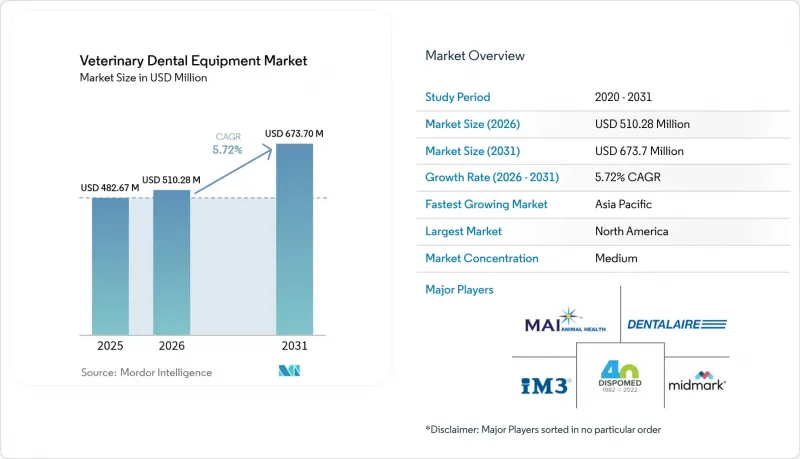
Mordor Intelligence에 의하면, 2026년 수의용 치과 장비 시장 규모는 5억 1,028만 달러로 추정되고 있어 2025년 4억 8,267만 달러에서 확대되어, 2031년에는 6억 7,370만 달러에 이를 것으로 예측됩니다.
2026년부터 2031년까지 연평균 성장률(CAGR) 5.72%로 성장할 것으로 전망됩니다.
본 보고서는 기기 유형(치과용 치료대, 치과용 X선 시스템, 치과용 구동 장치, 치과용 레이저, 치과용 전기수술 기기, 기타),소모품(치과용 소모품, 예방 치과용 제품, 기타), 지역(북미, 유럽, 아시아태평양, 중동 및 아프리카, 남미)별로 분류되어 있습니다. 상기 각 부문에 대한 시장 규모는(백만 달러) 단위로 표시되어 있습니다.
전 세계 수의용 치과 장비 시장 동향 및 인사이트
인증 수의치과 진료소의 급증
2024년에는 미국 수의치과 대학(American Veterinary Dental College)의 인증 의사가 지역별로 220명을 넘어섰고, 의뢰 환자 수가 급증함에 따라 일반 진료소가 영상 진단 장비 및 고속 치과 장비로 업그레이드를 추진하도록 촉진되고 있습니다. 기업 공급업체들은 장비 패키지에 실습 워크숍을 포함시킴으로써, 임상 기술의 향상이 하드웨어 수요를 촉진하는 선순환을 만들어내고 있습니다. 이러한 요인의 영향은 지방 도시에서 가장 두드러지며, 그곳에서 얼리 어답터들이 인근 5-7곳의 진료소로 신속하게 확산시켜 수의학 치과 장비 시장을 서서히 끌어올리고 있습니다.
말 전문 병원에서 디지털 치과 엑스레이 촬영의 보급 확대
큰 두개골에 맞게 설계된 직접 디지털 플레이트 덕분에 즉시 진단이 가능해졌고, 재촬영률이 감소함에 따라 말 전문 병원에서는 필름 시스템의 폐지가 진행되고 있습니다. 2025년 연구에 따르면, 인공지능(AI) 소프트웨어는 일반적인 병변을 식별하는 데 있어 공인 치과 의사와 높은 판독자 간 일치율을 달성했습니다. 민감도는 여전히 인간의 전문 지식에는 미치지 못하지만, 이 기술은 치료 계획의 질을 높이고 판독 시간을 단축하기 때문에 수의학 치과 장비 시장에서 디지털 센서와 콘솔의 이용이 확대되고 있습니다.
주요 도시 외 지역의 인증 수의치과 전문의 부족
대도시권 이외 지역에서는 전문의 수가 제한적이어서 첨단 기술을 접할 기회가 제한되고, 고급 기종의 도입이 주춤하고 있습니다. 지리적 접근성에 관한 조사에 따르면, 교외 진료소에서는 의료 격차가 두드러지며, 이것이 장비 도입을 저해하고 있습니다. 공급업체 측은 조작을 간소화하거나 원격 지도를 제공하는 등 대응하고 있지만, 전문의의 만성적인 부족은 여전히 수의학 치과 장비 시장 전체에 걸림돌이 되고 있습니다.
부문 분석
수동 기구는 수의학 치과 장비 시장의 39.12%를 차지하고 있으며, 수의사가 종별로 특화된 병변에 대응하기 위해 색상으로 구분된 스케일러, 큐렛, 윙이 달린 엘리베이터를 채택함에 따라 연평균 성장률(CAGR) 6.72%로 확대되고 있습니다. 3세 이상의 개 중 80-90% 이상에서 치주 병변이 관찰되므로, 끝이 가느다란 기구는 필수적입니다. 현재 각 공급업체는 시술자의 피로를 줄여주는 인체공학적으로 설계된 실리콘 손잡이를 제공하고 있으며, 이로 인해 진료소에서는 기존 기구 세트를 더 자주 교체하고 있습니다. 조명 및 확대 기구의 경우, 인간 치과에서 미세 수술 기술이 도입됨에 따라 꾸준한 수요 증가가 이어지고 있는 반면, 폐기물 관리용 액세서리는 수의학 치과 장비 시장 전반에 걸쳐 감염 관리 기준이 엄격해지는 가운데 규제 측면의 호재를 누리고 있습니다.
디지털 X-ray 콘솔, 센서 및 위치 조정 보조 기구는 매출의 약 4분의 1을 차지하며, 필름 사용자들의 꾸준한 전환의 혜택을 받고 있습니다. 이러한 전환은 반려동물 보험과 전문의 의뢰가 겹치는 분야에서 가속화되고 있으며, 시술의 복잡성과 영상 진단에 대한 투자가 밀접하게 관련되어 있음을 여실히 보여주고 있습니다. 물림 압력을 견딜 수 있도록 강화된 수의학 전용 구강 내 센서가 최근 출시됨에 따라, 장기적인 내구성에 대한 신뢰가 높아져 수의학 치과 장비 시장에서 재구매가 촉진되고 있습니다.
2025년 매출 중 진단용 영상 진단이 33.45%를 차지하고 있으며, 진료소에서는 반려인과의 실시간 상담을 가능하게 하는 체어사이드 모니터 도입이 진행되고 있습니다. 이러한 선순환으로 인해 치주 치료에 대한 수용도가 높아지고 있으며, 성견의 80% 이상에서 치주질환이 확인됨에 따라 치주 치료는 가장 많은 증례 수를 유지하고 있습니다. 파워 엘리베이터와 정밀 바를 갖춘 발치 키트는 치아에 가해지는 부담을 줄이고 치유를 촉진하기 때문에 일반 개업의들 사이에서도 사용이 확산되고 있습니다. 예방용 연마 헤드, 불소 젤, 실란트는 지속적인 소모품 수익을 가져다주며, 수의용 치과 장비 시장에서 장기적인 고객 유지를 위한 기반이 되고 있습니다.
예전에는 소개 전문 시설로만 제한되었던 수복 치료나 근관 치료도, 교육 자료를 통해 신뢰할 수 있는 치료 결과가 입증됨에 따라 보급이 확대되고 있습니다. 인간 치과에서 응용된 복합레진용 주사기나 광중합 핸드피스를 통해, 반려인의 의향에 따라 치아를 보존하는 치료가 가능해졌습니다. 이국적인 동물의 치과 치료에서는 특수한 마이크로바의 필요성이 강조되고 있습니다. 2024년 토끼를 대상으로 한 연구에서는 구강 내 수술 중 합병증 발생률이 41%에 달하는 것으로 보고되어, 혁신적인 기업들이 현재 해결을 모색하고 있는 기기 부족 문제가 부각되고 있습니다. 이러한 각 하위 부문은 수의학용 치과 장비 시장을 뒷받침하는 서비스 범위를 지속적으로 확대되고 있습니다.
지역별 분석
북미는 매출 점유율 41.85%로 선두를 유지하고 있으며, 진료소당 장비 도입 밀도도 평균을 상회하고 있습니다. 전문의의 집중, 보험 적용 범위의 넓음, 그리고 장비 인증 의무화가 긍정적인 수요 동향을 만들어내고 있습니다. 치과 분야의 인증 후 연수 과정에 등록한 기술자 수는 2021년부터 2031년까지 20% 증가할 것으로 예측되며, 이로 인해 숙련된 인력이 늘어나 진료 공간 확장이 정당화될 것입니다. 진료소에서는 진료 의자를 1대에서 2대로 업그레이드하는 추세가 나타나고 있으며, 시설 면적을 확대하지 않고도 실질적으로 진료 능력을 두 배로 늘리고 있어, 이것이 수의학 치과 장비 시장에 대한 설비 투자를 촉진하고 있습니다.
아시아태평양은 가처분 소득 증가와 대도시권에 반려동물 사육이 집중되는 급속한 도시화에 힘입어 연평균 성장률(CAGR) 7.01%라는 가장 빠른 성장률을 기록하고 있습니다. 중국, 일본, 한국에서는 고급 제품에 대한 수요가 주를 이루는 반면, 인도와 동남아시아 국가들에서는 혼합 진료 환경에 적합한 휴대용 키트의 도입이 첫 물결로 확산되고 있습니다. 정부 주도의 광견병 예방 캠페인에는 구강 검사가 포함되어 있어, 현장의 수의사들이 기기의 장점을 직접 체험할 수 있는 기회가 되고 있습니다. 이러한 경험이 향후 민간 부문 수요로 이어지며, 수의용 치과 장비 시장의 확대로 연결되고 있습니다.
유럽은 성숙한 시장임에도 불구하고 혁신 지향적인 지역이며, 엄격한 안전 기준이 인증된 공급업체를 우대하고 있습니다. 가격 투명성에는 편차가 있으며, 2024년 다국간 조사에서는 요금의 큰 변동이 확인되어, 이것이 새로운 하드웨어의 투자 회수 모델에 영향을 미치고 있습니다. 진료비가 높은 지역에서는 클리닉이 조기에 고성능 영상 진단 기기를 도입하는 반면, 진료비가 낮은 지역에서는 단계적으로 도입이 진행되고 있습니다. 라틴아메리카 및 중동 및 아프리카는 전체적으로 시장 점유율이 소폭에 그치고 있지만, 도시 지역에서는 국지적으로 높은 성장세가 나타나고 있습니다. 라틴아메리카에서는 위조품 유통과 법 집행의 불균일성이 시장 확대를 억제하고 있는 반면, 아프리카에서는 인프라 제약으로 인해 많은 하위 시장이 제한되고 있지만, 부유층 반려인들에 의한 소규모 수요 클러스터가 유지되고 있습니다. 이러한 동향은 전반적으로 전 세계 수의용 치과 장비 시장의 성숙도 차이를 여실히 드러내고 있습니다.
기타 혜택:
- 엑셀 형식 시장 예측(ME) 시트
- 3개월간의 애널리스트 지원
자주 묻는 질문
목차
제1장 서론
제2장 조사 방법
제3장 주요 요약
제4장 시장 구도
제5장 시장 규모와 성장 예측
제6장 경쟁 구도
제7장 시장 기회와 향후 전망
JHS 26.09.07According to Mordor Intelligence, veterinary dental equipment market size market size in 2026 is estimated at USD 510.28 million, growing from 2025 value of USD 482.67 million with 2031 projections showing USD 673.7 million, growing at 5.72% CAGR over 2026-2031.
This report is Segmented by Equipment Type (Dental Stations, Dental X-Ray Systems, Dental Powered Units, Dental Lasers, Dental Electrosurgical Units, and Others), Consumables (Dental Supplies, Prophy Products, Others), and Geography (North America, Europe, Asia-Pacific, Middle East, and Africa, South America). The Value is Provided in (USD Million) for the Above Segments.
Global Veterinary Dental Equipment Market Trends and Insights
Surge in Board-Certified Veterinary Dentistry Practices
Regional clusters of American Veterinary Dental College diplomates surpassed 220 in 2024, multiplying referral flows that incentivize general practices to upgrade imaging and high-speed instrumentation. Corporate suppliers integrate hands-on workshops with equipment bundles, creating a virtuous loop where clinical mastery fuels hardware demand. The driver's impact is strongest in secondary cities, where early adopters quickly influence five to seven neighboring clinics to follow suit, gradually lifting the veterinary dental equipment market.
Rising Uptake of Digital Dental Radiography in Equine Hospitals
Direct digital plates engineered for large skulls enable immediate diagnostics and lower retake rates, encouraging equine practices to retire film systems. A 2025 study showed artificial-intelligence software reached high inter-rater agreement with board-certified dentists when identifying common lesions. Although sensitivity still trails human expertise, the technology enriches treatment planning and shortens reading times, raising utilization of digital sensors and consoles within the veterinary dental equipment market.
Shortage of Diplomate Dentists Beyond Tier-1 Cities
Limited specialist presence outside metropolitan hubs curbs exposure to advanced techniques, slowing adoption of premium units. Research on geographic access indicates significant care gaps that suppress equipment uptake in semi-urban clinics. Suppliers respond with simplified controls and remote coaching, but sustained specialist scarcity still drags on the broader veterinary dental equipment market.
Other drivers and restraints analyzed in the detailed report include:
- Expansion of Pet Insurance Policies Covering Dental Procedures
- Government-Sponsored Mass Rabies Drives
- Grey-Market Imports & Non-Certified Equipment
For complete list of drivers and restraints, kindly check the Table Of Contents.
Segment Analysis
Hand instruments represent 39.12% of the veterinary dental equipment market and are advancing at a 6.72% CAGR as practitioners adopt color-coded scalers, curettes, and winged elevators for species-specific pathology. Over 80-90% of dogs older than three years present periodontal lesions, making fine-tip instruments indispensable. Vendors now offer ergonomic silicone handles that reduce operator fatigue, prompting clinics to replace legacy sets more frequently. Lighting and magnification tools maintain robust incremental demand due to the migration of microsurgical techniques from human dentistry, while waste-management accessories enjoy regulatory tailwinds as infection-control standards tighten across the veterinary dental equipment market.
Digital X-ray consoles, sensors, and positioning aids comprise roughly one-quarter of revenue and benefit from steady conversion of film users. The shift accelerates where pet insurance and specialist referrals overlap, underscoring the linked nature of procedural complexity and imaging investment. Recent launches of veterinary-specific intra-oral sensors hardened against bite pressure amplify confidence in long-term durability, fostering repeat purchases in the veterinary dental equipment market.
Diagnostic imaging accounts for 33.45% of 2025 revenue, with clinics integrating chairside monitors that allow real-time owner consultations. The feedback loop drives higher acceptance of periodontal therapy, which retains the largest case volume because canine prevalence exceeds 80% in adult dogs. Extraction kits featuring power elevators and precision burs deliver less trauma and faster healing, encouraging broader use even among general practitioners. Preventive polishing heads, fluoride gels, and sealants add recurring consumable revenue, anchoring long-term client retention within the veterinary dental equipment market.
Restorative and endodontic procedures, once confined to referral centers, gain traction as training materials demonstrate reliable outcomes. Composite syringes and light-curing handpieces adapted from human dentistry allow tooth-saving therapies that align with owner sentiment. Exotic-animal dentistry underscores the need for specialized micro-burs; a 2024 rabbit study cited 41% complication rates during intra-oral surgeries, highlighting equipment gaps that innovators now target. Each of these sub-segments keeps broadening the scope of services that underpin the veterinary dental equipment market.
Complete Report Scope:
- By Product
- Equipment
- Dental X-ray Systems
- Dental Stations & Delivery Units
- Ultrasonic & Piezo Scalers
- High- & Low-Speed Handpieces
- Electrosurgical & Laser Units
- Other Equipment (Intra-oral Cameras, Compressors)
- Hand Instruments
- Extractions (Elevators, Luxators)
- Periodontal Instruments (Scalers, Curettes, Probes)
- Restorative Instruments
- Orthodontic Instruments
- Adjuvants/Accessories
- Instrument Cassettes & Sterilization Trays
- Lighting & Magnification Systems
- Waste Management & Suction Accessories
- Equipment
- By Animal Type
- Companion Animals
- Canines
- Felines
- Equines
- Other Companion Animals
- Livestock
- Bovines
- Swine
- Companion Animals
- By End User
- Veterinary Hospitals
- Veterinary Specialty & Referral Centers
- Veterinary Clinics
- Academic & Research Institutes
- By Geography
- North America
- United States
- Canada
- Mexico
- Rest of Asia-Pacific
- China
- Japan
- India
- South Korea
- Australia
- Rest of Asia-Pacific
- Europe
- Germany
- France
- United Kingdom
- Italy
- Spain
- Rest of Europe
- South America
- Brazil
- Argentina
- Rest of South America
- Middle East and Africa
- GCC
- South Africa
- Rest of Middle East and Africa
- North America
Geography Analysis
North America retains leadership with 41.85% revenue share and records above-average equipment density per practice. Specialist clusters, widespread insurance coverage, and mandatory device certifications create a favorable demand profile. Technician enrollment in dental post-certificates is projected to climb 20% from 2021-2031, adding skilled labor that justifies expanded operatory footprints. Clinics upgrade from single to dual chairs, effectively doubling capacity without enlarging real estate, which boosts capital investment in the veterinary dental equipment market.
Asia-Pacific posts the fastest growth, at a 7.01% CAGR, propelled by rising disposable incomes and rapid urbanization that concentrates pet ownership in megacities. China, Japan, and South Korea anchor premium purchases, while India and Southeast Asian nations exhibit first-wave adoption of portable kits suited to mixed-practice environments. Government-funded rabies campaigns integrate oral screenings, exposing field veterinarians to equipment benefits. This experience seeds future private-sector demand, expanding the veterinary dental equipment market.
Europe remains a mature yet innovation-oriented region where stringent safety standards favor certified suppliers. Price transparency varies: a 2024 multi-country study recorded wide fee swings, affecting payback models for new hardware. Clinics in higher-fee territories adopt premium imaging sooner, while lower-fee zones phase in gradually. Latin America and the Middle East-Africa collectively hold a modest share but display pockets of high growth in urban hubs. Counterfeit penetration and uneven enforcement temper expansion in Latin America, whereas infrastructure limitations constrain many African sub-markets, though elite owners sustain small clusters of demand. Collectively, these dynamics underscore the varied maturity levels across the global veterinary dental equipment market.
- iM3 Veterinary Dentistry
- Midmark
- Henry Schein
- Dentalaire International
- Patterson Companies
- Acteon Group Ltd.
- Planmeca
- Integra LifeSciences Holdings Corp.
- Jorgen Kruuse A/S
- Eickemeyer Veterinary Equipment
- B. Braun
- Covetrus
- Dispomed
- Heska
- DRE Veterinary
- Summit Veterinary Pharmacy
- Accesia AB
- Avante Health Solutions
- Cislak
- VetDent
Additional Benefits:
- The market estimate (ME) sheet in Excel format
- 3 months of analyst support
TABLE OF CONTENTS
1 Introduction
- 1.1 Study Assumptions & Market Definition
- 1.2 Scope of the Study
2 Research Methodology
3 Executive Summary
4 Market Landscape
- 4.1 Market Drivers
- 4.1.1 Surge in Board-Certified Veterinary Dentistry Practices in North America
- 4.1.2 Rising Uptake of Digital Dental Radiography in Equine Hospitals (U.S. & U.K.)
- 4.1.3 Expansion of Pet Insurance Policies Covering Dental Procedures in Europe
- 4.1.4 Government-Sponsored Mass Rabies Drives Triggering Routine Oral Check-ups in Asia
- 4.1.5 Launch of Feline-Specific Minimally-Invasive Dental Instrument Lines
- 4.1.6 Growth of Tele-Dentistry Triage Platforms for Rural Companion-Animal Clinics
- 4.2 Market Restraints
- 4.2.1 High Up-Front Cost of CBCT & Advanced Imaging in Emerging Markets
- 4.2.2 Shortage of Diplomate Veterinary Dentists Beyond Tier-1 Cities
- 4.2.3 Grey-Market Imports & Non-Certified Equipment in Latin America
- 4.2.4 Limited Reimbursement for Equine Dental Services in the Nordics
- 4.3 Value/ Supply-Chain Analysis
- 4.4 Regulatory or Technological Outlook
- 4.5 Porter's Five Forces
- 4.5.1 Threat of New Entrants
- 4.5.2 Bargaining Power of Suppliers
- 4.5.3 Bargaining Power of Buyers
- 4.5.4 Threat of Substitutes
- 4.5.5 Competitive Rivalry
5 Market Size & Growth Forecasts (Value & Volume)
- 5.1 By Product
- 5.1.1 Equipment
- 5.1.1.1 Dental X-ray Systems
- 5.1.1.2 Dental Stations & Delivery Units
- 5.1.1.3 Ultrasonic & Piezo Scalers
- 5.1.1.4 High- & Low-Speed Handpieces
- 5.1.1.5 Electrosurgical & Laser Units
- 5.1.1.6 Other Equipment (Intra-oral Cameras, Compressors)
- 5.1.2 Hand Instruments
- 5.1.2.1 Extractions (Elevators, Luxators)
- 5.1.2.2 Periodontal Instruments (Scalers, Curettes, Probes)
- 5.1.2.3 Restorative Instruments
- 5.1.2.4 Orthodontic Instruments
- 5.1.3 Adjuvants/Accessories
- 5.1.3.1 Instrument Cassettes & Sterilization Trays
- 5.1.3.2 Lighting & Magnification Systems
- 5.1.3.3 Waste Management & Suction Accessories
- 5.1.1 Equipment
- 5.2 By Animal Type
- 5.2.1 Companion Animals
- 5.2.1.1 Canines
- 5.2.1.2 Felines
- 5.2.1.3 Equines
- 5.2.1.4 Other Companion Animals
- 5.2.2 Livestock
- 5.2.2.1 Bovines
- 5.2.2.2 Swine
- 5.2.1 Companion Animals
- 5.3 By End User
- 5.3.1 Veterinary Hospitals
- 5.3.2 Veterinary Specialty & Referral Centers
- 5.3.3 Veterinary Clinics
- 5.3.4 Academic & Research Institutes
- 5.4 By Geography
- 5.4.1 North America
- 5.4.1.1 United States
- 5.4.1.2 Canada
- 5.4.1.3 Mexico
- 5.4.2 Rest of Asia-Pacific
- 5.4.2.1 China
- 5.4.2.2 Japan
- 5.4.2.3 India
- 5.4.2.4 South Korea
- 5.4.2.5 Australia
- 5.4.2.6 Rest of Asia-Pacific
- 5.4.3 Europe
- 5.4.3.1 Germany
- 5.4.3.2 France
- 5.4.3.3 United Kingdom
- 5.4.3.4 Italy
- 5.4.3.5 Spain
- 5.4.3.6 Rest of Europe
- 5.4.4 South America
- 5.4.4.1 Brazil
- 5.4.4.2 Argentina
- 5.4.4.3 Rest of South America
- 5.4.5 Middle East and Africa
- 5.4.5.1 GCC
- 5.4.5.2 South Africa
- 5.4.5.3 Rest of Middle East and Africa
- 5.4.1 North America
6 Competitive Landscape
- 6.1 Strategic Moves
- 6.2 Market Share Analysis
- 6.3 Company Profiles (includes Global level Overview, Market level overview, Core Segments, Financials as available, Strategic Information, Market Rank/Share for key companies, Products & Services, and Recent Developments)
- 6.3.1 iM3 Veterinary Dentistry
- 6.3.2 Midmark Corporation
- 6.3.3 Henry Schein, Inc.
- 6.3.4 Dentalaire International
- 6.3.5 Patterson Companies, Inc.
- 6.3.6 Acteon Group Ltd.
- 6.3.7 Planmeca Oy
- 6.3.8 Integra LifeSciences Holdings Corp.
- 6.3.9 Jorgen Kruuse A/S
- 6.3.10 Eickemeyer Veterinary Equipment
- 6.3.11 B. Braun Vet Care GmbH
- 6.3.12 Covetrus, Inc.
- 6.3.13 Dispomed Ltd.
- 6.3.14 Heska Corporation
- 6.3.15 DRE Veterinary
- 6.3.16 Summit Veterinary Pharmacy
- 6.3.17 Accesia AB
- 6.3.18 Avante Animal Health
- 6.3.19 Cislak
- 6.3.20 VetDent
7 Market Opportunities & Future Outlook
- 7.1 White-Space & Unmet-Need Assessment