

|
시장보고서
상품코드
2123581
구급차 서비스 시장 : 시장 점유율 분석, 업계 동향 및 통계, 성장 예측(2026-2031년)Ambulance Services - Market Share Analysis, Industry Trends & Statistics, Growth Forecasts (2026 - 2031) |
||||||
 Mordor Intelligence
Mordor Intelligence에 의하면, 구급차 서비스 시장 규모는 2025년에 604억 달러로 평가되었고, 2026년 651억 9,000만 달러에서 2031년까지 955억 5,000만 달러에 이를 것으로 추정되며, 예측 기간(2026-2031년) CAGR은 7.94%를 나타낼 전망입니다.
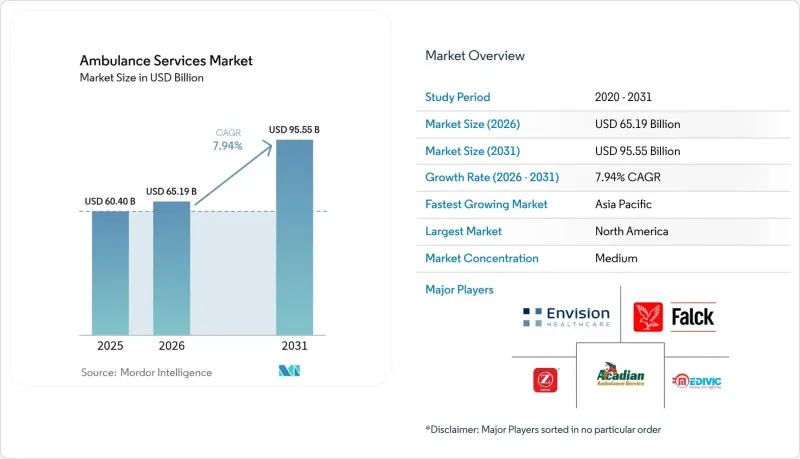
본 보고서는 운송 방식별(항공 구급, 수상 구급, 지상 구급), 장비별(기본 소생술(BLS) 서비스, 기타), 서비스 유형별(구급차 서비스, 비구급차 서비스), 소유 형태별(정부·지자체, 기타), 지역별(북미, 유럽, 아시아태평양, 기타)로 분류되어 있습니다. 시장 규모 및 전망은 금액(달러) 기준으로 제시되어 있습니다.
세계의 구급차 서비스 시장 동향 및 인사이트
전 세계 외상 및 심혈관계 응급 상황 증가
2024년, 미국 각 관할 구역에서 발생한 심정지 건수는 13만 7,119건에 달했으며, 인구 10만 명당 78.7건의 발생률을 기록했습니다. 일반 시민의 심폐소생술(CPR) 실시율은 여전히 50% 미만에 머물러 있어, 구급대원의 신속한 대응에 대한 의존도가 높아지고 있습니다. 미국에서는 고령자의 낙상이 여전히 매년 약 300만 건의 응급실 내원 원인이 되고 있습니다. 2024년에는 미국의 교통사고로 4만 2,514명이 사망했으며, 외상 처치가 가능한 구급차의 필요성이 더욱 높아지고 있습니다. 이러한 급성 사건들이 복합적으로 작용하여 거시경제 변동의 영향을 거의 받지 않는 수요 기반을 형성하고 있습니다.
고령화와 만성 질환의 부담
2035년까지 65세 이상 성인이 미국 인구의 22%를 차지할 것으로 예상되며, 일본에서는 이미 고령자가 응급 이송의 62%를 차지하고 있습니다. 메디케어 수급자의 구급 이송 횟수는 연간 평균 1.8회인 반면, 일반 인구는 0.3회에 그치고 있습니다. 인도의 ‘108’ 네트워크에서는 2023-2025년 고령자의 신고 건수가 28% 증가했습니다. 만성폐쇄성폐질환(COPD),심부전, 당뇨병 합병증의 유병률 증가로 인해, 이송 중에 수액 투여나 CPAP(지속 양압 호흡 요법)을 실시할 수 있는 ALS(고도 구명 처치) 대응 차량이 필요해지고 있습니다. 이러한 인구 동태의 변화로 인해 차량의 수용 능력과 전문 인력에 대한 수요는 앞으로도 계속 증가할 전망입니다.
고액의 설비 투자와 운영비
ALS 대응 유형 III 밴은 15만-30만 달러, 항공 구급 헬리콥터는 격납고 투자 비용을 제외하고 300만-500만 달러가 소요됩니다. 소규모 시스템의 경우 연간 운영비는 150만-300만 달러이며, 그중 최대 70%를 인건비가 차지합니다. 메디케어의 2024년도 요금표에 따른 1.3% 인상은 미국 구급차 협회가 보고한 연간 4.2%의 비용 상승률보다 낮은 수치입니다. 전기자동차는 수명 주기 비용의 감소를 기대할 수 있지만, 여전히 고가의 구매 대상입니다. 지방 사업자들은 경영을 유지하기 위해 지자체의 보조금이나 자원봉사 인력에 의존하는 경우가 많습니다.
부문 분석
2025년 구급차 서비스 시장의 매출 중 70.55%를 지상 차량이 차지했으며, 도시 지역에서의 응급 대응에서 그 중요성이 두드러집니다. 지방에서 외상 환자나 시설 간 이송이 필요한 중증 환자 수요가 증가함에 따라, 항공 구급대는 연평균 성장률(CAGR) 10.25%로 확대되고 있습니다. 대도시권의 옥상 헬보고서가 개설되고, 지상 이송을 통한 고급 생명 유지 처치(ALS)와의 보상 격차가 해소됨에 따라, 회전익기를 이용한 구급차 서비스 시장은 확대될 것으로 예측됩니다. 모듈식 차량 내부를 갖춘 유형 III 밴은 중증도가 다양한 환자군을 수송하는 차량 군에서 주류를 차지하고 있는 반면, 대형 트럭을 기반으로 한 유형 I 모델은 교외에서 ALS 출동 시 부피가 큰 심장 치료 기기를 수송하는 데 기여하고 있습니다. 뉴욕과 런던에서 진행된 전기 추진 시스템의 시험 운영을 통해, 배터리 비용이 200달러/kWh 이하로 떨어지면 디젤 엔진을 대체할 가능성이 있는 것으로 나타났습니다. 항공기 편대는 야간 투시 항공 전자 장비와 비행 중 의사의 모니터링을 가능하게 하는 위성 텔레-ICU 링크 등을 통해 차별화를 꾀하고 있습니다. 고정익 항공기는 150해리를 넘는 장거리 환자 이송을 담당하며, 군도나 사막 지대의 3차 의료 격차를 해소하고 있습니다.
항공 구급 사업자들은 AI를 활용한 경로 최적화를 도입하고, 기상 조건에 따른 우회 비행을 최소화함으로써 출동 신뢰성을 높이고 있습니다. FAA 파트 135 개정에 따른 규제 완화로 의료진의 주(州)를 넘나드는 면허 취득 절차가 간소화되어, 다중 거점 네트워크의 확대가 촉진될 것으로 예측됩니다. 한편, 수상 구급차는 베네치아와 같은 틈새 지역에서 운영되고 있으며, 연간 3만 건의 출동에 대응하여 수로로 분단된 도시에 있어 없어서는 안 될 존재가 되었습니다. 전기 구동 차량군은 비용 구조를 완전히 바꿀 가능성이 있지만, 높은 초기 도입 비용은 세수 제약이 있는 지자체에 여전히 장벽으로 작용하고 있습니다.
2025년, 구급차 서비스 시장 전체에서 BLS(기본 소생술) 차량은 매출의 45.53%를 차지한 것으로 평가되었으며, 이는 이용 빈도가 높고 중증도가 낮은 이송 건수에 따라 보수가 지급되는 점을 반영한 것입니다. ALS(고급 생명 유지술) 부문은 연평균 성장률(CAGR) 9.75%의 궤도에 올라 있으며, 지급 기관이 병원 전 심전도(ECG) 전송 및 고급 기도 관리를 평가함으로써 확대되는 보상 격차를 반영하고 있습니다. 결과와 조기 치료 시작을 연계하는 종합적 정산 제도가 도입되면, ALS 부문에서 구급차 서비스 시장의 우위는 더욱 높아질 것입니다. 전문 의료 이송(SCT)은 총 이송 건수에서 차지하는 비율은 극히 미미하지만, ECMO 환자나 신생아 중환자실(ICU) 환자를 3차 의료기관 간에 이송함으로써 1회당 수익이 가장 높습니다. 포인트 오브 케어 초음파의 도입으로 기존 BLS와 ALS의 경계가 모호해지고 있으며, 이는 가격 책정 모델의 재구축으로 이어질 가능성이 있습니다. CAMTS 인증을 통해 SCT 기준이 전 세계적으로 통일되어 국경을 넘는 환자 이송이 원활해지고 있습니다.
재무적 측면에서는 ALS용 장비 일체의 비용이 5만-8만 달러로 BLS용 장비의 3배에 달하지만, 가치 기반 상환 제도 하에서는 더 빨리 투자 회수가 가능합니다. 휴대용 검사 장비와 기계식 CPR 장치는 생존율 향상에 기여하고 있으며, 이는 보험사가 할증 요금으로 상환하는 데 긍정적인 태도를 보이게 하는 근거가 되고 있습니다. 반면, 저기술 BLS 차량군은 병원 퇴원 시 포괄 계약과 연계하지 않는 한, 라이드셰어형 NEMT(비응급 의료 수송) 경쟁사들에 의해 이익률이 압박받을 위험이 있습니다.
지역별 분석
북미는 1인당 지출액이 높고 종합적인 보험 적용 범위에 힘입어 2025년에는 전 세계 매출의 35.23%를 차지했습니다. 미국만 해도 2만 개가 넘는 응급 의료 기관이 존재하며, 소방서, 병원, 민간 등 소유 형태가 다양합니다. 캐나다에서는 브리티시컬럼비아주에서 2024년에 이루어진 통합을 계기로 주 차원의 재편을 통해 관리 비용이 22% 절감되어 규모의 경제 효과가 입증되었습니다. 멕시코에서는 재정적 제약으로 인해 확장 속도에 편차가 나타나고 있습니다.
아시아태평양의 연평균 성장률(CAGR) 9.12% 상승은 중국과 인도의 인프라 정비 방침에 의해 주도되고 있습니다. 중국에서는 2027년에 도입 예정인 도시 지역의 ‘10분 이내 대응’ 기준에 따라 차량 발주가 각 성의 예산에 반영되었습니다. 인도에서는 120개 신규 지역에 ‘108’ 네트워크를 구축함으로써 농촌 지역의 서비스 커버리지가 도시 지역과 동등한 수준에 도달했습니다. 일본에서는 고령자가 이미 응급 이송의 62%를 차지하고 있어, 인구 구조 변화에 따른 압박에 대응하고 있습니다. 호주의 ‘로열 플라잉 닥터 서비스’는 광활한 지역에서 항공 의료 서비스의 중요성을 부각시키고 있습니다.
유럽에서는 국민건강보험 제도와 규제의 조화가 효과를 거두고 있습니다. 독일의 원격 진료 프로그램은 현장 도착 시간을 단축하고 생존율을 향상시키고 있습니다. 영국에서는 대기 오염 규제를 충족하기 위해 전기 구급차의 시험 운행이 이루어지고 있으며, 향후 차량의 전면적인 전환이 진행될 것으로 예측됩니다. 아랍에미리트(UAE) 등 걸프협력회의(GCC) 국가들에서는 통합된 지휘 센터를 통해 도시 지역의 출동 시간을 8분 이하로 단축하고 있습니다. 남미에서는 여전히 체계가 분절되어 있어, 브라질의 SAMU는 연방 정부의 자금에 의존하는 반면, 아르헨티나와 칠레에서는 민간 사업자가 주류를 이루고 있습니다.
기타 혜택
- 엑셀 형식 시장 예측(ME) 시트
- 3개월간의 애널리스트 지원
자주 묻는 질문
목차
제1장 서론
제2장 조사 방법
제3장 주요 요약
제4장 시장 구도
제5장 시장 규모 및 성장 예측
제6장 경쟁 구도
제7장 시장 기회 및 향후 전망
AJY 26.09.11According to Mordor Intelligence, the ambulance services market size was valued at USD 60.40 billion in 2025 and estimated to grow from USD 65.19 billion in 2026 to reach USD 95.55 billion by 2031, at a CAGR of 7.94% during the forecast period (2026-2031).
This report is Segmented by Mode of Transport (Air Ambulance, Water Ambulance, and Ground Ambulance), Equipment (Basic Life Support Services, and More), Type of Service (Emergency Services, and Non-Emergency Services), Ownership (Government/Municipal, and More), and Geography (North America, Europe, Asia-Pacific, and More). The Market Sizes and Forecasts are Provided in Terms of Value (USD).
Global Ambulance Services Market Trends and Insights
Rising Global Trauma & Cardiovascular Emergencies
Cardiac arrest incidents reached 137,119 across U.S. jurisdictions in 2024, equating to an incidence of 78.7 per 100,000 population. Bystander CPR rates remain below 50%, heightening reliance on rapid paramedic response. Older-adult falls continue to drive roughly 3 million emergency department visits each year in the United States. U.S. traffic collisions caused 42,514 fatalities in 2024, reinforcing the need for trauma-capable fleets. Together, these acute events form a demand baseline that is largely immune to macroeconomic swings.
Ageing Demographics & Chronic-Disease Burden
By 2035, adults aged 65 and older will account for 22% of the U.S. population, and in Japan, older adults already account for 62% of ambulance transports. Medicare beneficiaries average 1.8 ambulance rides per year, compared with 0.3 in the general population. India's 108 network logged a 28% increase in geriatric calls between 2023 and 2025. The prevalence of COPD, heart failure, and diabetes complications necessitates ALS-equipped vehicles able to administer IV drugs and CPAP during transport. This demographic shift is set to maintain upward pressure on fleet capacity and specialized staffing.
High Capital & Operating Expenditure
ALS-ready Type III vans cost USD 150,000-300,000, and air ambulance helicopters require USD 3-5 million, excluding hangar investments. Operating outlays range from USD 1.5 to 3 million annually for small systems, with labor accounting for up to 70% of the spend. Medicare's 2024 fee-schedule bump of 1.3% trails the 4.2% annual cost rise reported by the American Ambulance Association. Electric units promise lower lifetime expenses yet remain price-premium purchases. Rural providers often depend on municipal subsidies or volunteer staffing to remain solvent.
Other drivers and restraints analyzed in the detailed report include:
- Public-Private Funding Programmes Expanding EMS Networks
- Tele-EMS Integration & Real-Time Clinical Decision Support
- Shortage of Trained Paramedics & Pilots
For complete list of drivers and restraints, kindly check the Table Of Contents.
Segment Analysis
Ground vehicles accounted for 70.55% of 2025 revenue in the ambulance services market, underscoring their primacy in urban response. Air units are expanding at a 10.25% CAGR as rural trauma and interfacility critical-care needs multiply. The ambulance services market for rotary-wing missions is projected to expand as metropolitan rooftop helipads open and reimbursement parity with ground ALS trips is achieved. Type III vans dominate mixed-acuity fleets owing to modular interior space, whereas heavy truck-based Type I models support bulky cardiac equipment in suburban ALS calls. Electric propulsion trials in New York and London indicate diesel displacement potential once battery costs fall below USD 200/kWh. Air fleets are differentiating via night-vision avionics and satellite tele-ICU links that extend physician oversight mid-flight. Fixed-wing craft cater to long-range repatriations beyond 150 nautical miles, bridging tertiary-care gaps in archipelagos and desert regions.
Aerial providers are integrating AI-driven route optimization to minimize weather diversions, boosting dispatch reliability. Regulatory acceleration under FAA Part 135 amendments is expected to streamline cross-state licensing of medical crews, promoting multi-base network scaling. Meanwhile, water ambulances serve niche geographies such as Venice, handling 30,000 annual calls and proving essential for cities bisected by waterways. Electric fleets could reshape cost structures, but initial procurement premiums remain a hurdle for tax-constrained municipalities.
BLS rigs retained 45.53% revenue in 2025 across the ambulance services market, reflecting high-frequency, low-acuity transports paid on volume. ALS configurations are on a 9.75% CAGR trajectory, capturing expanding reimbursement differentials as payers reward pre-hospital ECG transmission and advanced airway interventions. The ambulance services market's advantage in ALS size grows when bundled payments tie outcomes to early treatment initiation. Specialty Care Transport, although a fraction of total runs, commands the highest per-trip revenue by moving ECMO and neonatal ICU patients between tertiary centers. Point-of-care ultrasound adoption is blurring traditional BLS-ALS boundaries and could recalibrate pricing models. CAMTS accreditation is aligning SCT standards globally, easing cross-border patient transfers.
Financially, ALS equipment packages cost USD 50,000-80,000, triple BLS equivalents, yet pay back faster under value-based reimbursement. Portable lab analyzers and mechanical CPR devices enhance survival metrics, underpinning payer willingness to reimburse at premium rates. Lower-tech BLS fleets risk margin erosion from rideshare NEMT competitors unless paired with bundled hospital discharge contracts.
Complete Report Scope:
- By Mode of Transport
- Air Ambulance
- Rotary-Wing
- Fixed-Wing
- Water Ambulance
- Ground Ambulance
- Type III Van
- Type I/II Modular
- Hybrid-Electric/EV Ambulance
- Air Ambulance
- By Equipment
- Basic Life Support (BLS) Services
- Advanced Life Support (ALS) Services
- Specialty Care Transport (SCT)
- By Type of Service
- Emergency Services
- Non-Emergency Services
- By Ownership
- Government/Municipal
- Private Corporate
- Hospital-Based
- Volunteer/NGO
- By Geography
- North America
- United States
- Canada
- Mexico
- Europe
- Germany
- United Kingdom
- France
- Italy
- Spain
- Rest of Europe
- Asia-Pacific
- China
- India
- Japan
- Australia
- South Korea
- Rest of Asia-Pacific
- Middle East and Africa
- GCC
- South Africa
- Rest of Middle East and Africa
- South America
- Brazil
- Argentina
- Rest of South America
- North America
Geography Analysis
North America captured 35.23% of global revenue in 2025, driven by high per-capita spend and comprehensive insurance coverage. The United States alone fields more than 20,000 EMS agencies with heterogeneous fire, hospital, and private ownership patterns. Provincial consolidation in Canada trimmed administrative overhead by 22% following British Columbia's 2024 integration, evidence of scale benefits. Mexico's expansion remains uneven due to fiscal constraints.
Asia-Pacific's 9.12% CAGR rise is propelled by Chinese and Indian infrastructure mandates. China's 10-minute urban response standard, due in 2027, has moved fleet orders to provincial budgets. India's 108 network deployment across 120 new districts brings rural coverage into parity with urban centers. Japan manages demographic pressure, as older adults already account for 62% of ambulance transports. Australia's Royal Flying Doctor Service underscores the importance of aeromedical coverage over vast geographies.
Europe benefits from universal insurance and regulatory harmonization. Germany's tele-physician program trims on-scene times and boosts survival odds. The United Kingdom trialed electric ambulances to satisfy clean-air rules, foreshadowing wider fleet conversions. GCC states such as the UAE achieve sub-eight-minute urban response through centralized command centers. South America remains fragmented; Brazil's SAMU relies on federal funding while private players dominate in Argentina and Chile.
- Acadian Ambulance Service
- Aero Asahi Corporation
- Air Charter Services Ltd
- Air Medical Group Holdings
- Air Methods
- American Medical Response
- BVG India
- CareFlight International
- Dutch Health B.V.
- EMS Group
- Envision Healthcare
- Express Ambulances India
- Falck A/S
- Global Medical Response (GMR)
- GVK EMRI
- Lifeline Ambulance Services
- London Ambulance Service NHS Trust
- Medivic Aviation
- National Ambulance LLC
- PHI Air Medical
- REVA Air Ambulance
- SA Ambulance Service
- Scandinavian AirAmbulance
- St John Ambulance Australia
- Ziqitza Health Care Ltd
Additional Benefits:
- The market estimate (ME) sheet in Excel format
- 3 months of analyst support
TABLE OF CONTENTS
1 Introduction
- 1.1 Study Assumptions & Market Definition
- 1.2 Scope of the Study
2 Research Methodology
3 Executive Summary
4 Market Landscape
- 4.1 Market Overview
- 4.2 Market Drivers
- 4.2.1 Rising Global Trauma & Cardiovascular Emergencies
- 4.2.2 Ageing Demographics & Chronic-Disease Burden
- 4.2.3 Public-Private Funding Programmes Expanding EMS Networks
- 4.2.4 Tele-EMS Integration & Real-Time Clinical Decision Support
- 4.2.5 Emergence of Electric/EV Ambulances Lowering Life-Cycle Cost
- 4.2.6 Drone-Enabled Rapid First-Response Kits in Remote Zones
- 4.3 Market Restraints
- 4.3.1 High Capital & Operating Expenditure
- 4.3.2 Shortage of Trained Paramedics & Pilots
- 4.3.3 Competitive Pressure from Rideshare Health-Transport Services
- 4.3.4 Fragmented Multi-Jurisdictional Accreditation Inflating Compliance Cost
- 4.4 Value Chain Analysis
- 4.5 Regulatory Landscape
- 4.6 Technological Outlook
- 4.7 Porter's Five Forces
- 4.7.1 Threat of New Entrants
- 4.7.2 Bargaining Power of Buyers
- 4.7.3 Bargaining Power of Suppliers
- 4.7.4 Threat of Substitutes
- 4.7.5 Intensity of Competitive Rivalry
5 Market Size & Growth Forecasts (Value, USD)
- 5.1 By Mode of Transport
- 5.1.1 Air Ambulance
- 5.1.1.1 Rotary-Wing
- 5.1.1.2 Fixed-Wing
- 5.1.2 Water Ambulance
- 5.1.3 Ground Ambulance
- 5.1.3.1 Type III Van
- 5.1.3.2 Type I/II Modular
- 5.1.3.3 Hybrid-Electric/EV Ambulance
- 5.1.1 Air Ambulance
- 5.2 By Equipment
- 5.2.1 Basic Life Support (BLS) Services
- 5.2.2 Advanced Life Support (ALS) Services
- 5.2.3 Specialty Care Transport (SCT)
- 5.3 By Type of Service
- 5.3.1 Emergency Services
- 5.3.2 Non-Emergency Services
- 5.4 By Ownership
- 5.4.1 Government/Municipal
- 5.4.2 Private Corporate
- 5.4.3 Hospital-Based
- 5.4.4 Volunteer/NGO
- 5.5 By Geography
- 5.5.1 North America
- 5.5.1.1 United States
- 5.5.1.2 Canada
- 5.5.1.3 Mexico
- 5.5.2 Europe
- 5.5.2.1 Germany
- 5.5.2.2 United Kingdom
- 5.5.2.3 France
- 5.5.2.4 Italy
- 5.5.2.5 Spain
- 5.5.2.6 Rest of Europe
- 5.5.3 Asia-Pacific
- 5.5.3.1 China
- 5.5.3.2 India
- 5.5.3.3 Japan
- 5.5.3.4 Australia
- 5.5.3.5 South Korea
- 5.5.3.6 Rest of Asia-Pacific
- 5.5.4 Middle East and Africa
- 5.5.4.1 GCC
- 5.5.4.2 South Africa
- 5.5.4.3 Rest of Middle East and Africa
- 5.5.5 South America
- 5.5.5.1 Brazil
- 5.5.5.2 Argentina
- 5.5.5.3 Rest of South America
- 5.5.1 North America
6 Competitive Landscape
- 6.1 Market Concentration
- 6.2 Market Share Analysis
- 6.3 Company Profiles (includes Global-level Overview, Market-level Overview, Core Segments, Financials as available, Strategic Information, Market Rank/Share, Products & Services, Recent Developments)
- 6.3.1 Acadian Ambulance Service Inc.
- 6.3.2 Aero Asahi Corporation
- 6.3.3 Air Charter Services Ltd
- 6.3.4 Air Medical Group Holdings
- 6.3.5 Air Methods Corporation
- 6.3.6 American Medical Response
- 6.3.7 BVG India Ltd
- 6.3.8 CareFlight International
- 6.3.9 Dutch Health B.V.
- 6.3.10 EMS Group
- 6.3.11 Envision Healthcare Corporation
- 6.3.12 Express Ambulances India
- 6.3.13 Falck A/S
- 6.3.14 Global Medical Response (GMR)
- 6.3.15 GVK EMRI
- 6.3.16 Lifeline Ambulance Services
- 6.3.17 London Ambulance Service NHS Trust
- 6.3.18 Medivic Aviation
- 6.3.19 National Ambulance LLC
- 6.3.20 PHI Air Medical
- 6.3.21 REVA Air Ambulance
- 6.3.22 SA Ambulance Service
- 6.3.23 Scandinavian AirAmbulance
- 6.3.24 St John Ambulance Australia
- 6.3.25 Ziqitza Health Care Ltd
7 Market Opportunities & Future Outlook
- 7.1 White-Space & Unmet-Need Assessment


