|
시장보고서
상품코드
2123585
정맥 스텐트 시장 : 점유율 분석, 업계 동향과 통계, 성장 예측(2026-2031년)Venous Stents - Market Share Analysis, Industry Trends & Statistics, Growth Forecasts (2026 - 2031) |
||||||
 Mordor Intelligence
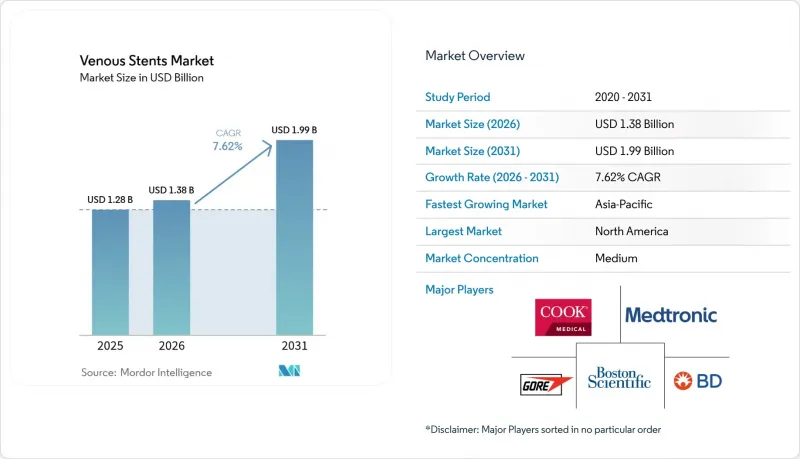
Mordor Intelligence에 의하면, 정맥 스텐트 시장 규모는 2025년 12억 8,000만 달러에서 2026년에는 13억 8,000만 달러로 확대되어 2026년부터 2031년까지 CAGR 7.62%로 성장을 지속하여, 2031년에는 19억 9,000만 달러에 이를 것으로 예측됩니다.
본 보고서는 용도별(하지, 골반, 복부, 흉부, 기타), 질환별(만성 심부정맥 혈전증, 혈전 후 증후군 등), 스텐트 유형별(자가 팽창형 니티놀 스텐트, 풍선 팽창형 스텐트 등), 재질별(니티놀, 스테인리스 스틸 등), 최종 사용자(병원, 외래수술센터(ASC) 등) 및 지역별로 분류되어 있습니다. 시장 예측은 금액(달러) 기준으로 제시되어 있습니다.
전 세계 정맥 스텐트 시장 동향 및 인사이트
만성 증상을 동반하는 정맥 질환의 유병률 증가
심부정맥 혈전증 후 환자의 최대 50%가 혈전 후 증후군을 발병하고 있으며, 조기 발견으로 인해 치료 대상이 되는 환자가 증가하고 있습니다. VERNACULAR 연구에 따르면, 최신형 스텐트의 36개월 시점 1차 개존율이 84.0%로 보고되어, 어려운 증례에서 그 가치가 강조되고 있습니다. 젊은 성인층에서 메이-서너 증후군에 대한 인식이 높아짐에 따라 치료 대상 환자층이 확대되고 있습니다. 이러한 역학적 변화는 혈관 전문 의료가 충실해지고 고령화가 진행되는 시장에서 가장 두드러지게 나타나고 있습니다. 그 결과, 정맥 스텐트 시장은 예측 기간 동안 지속적인 시술 건수 증가의 혜택을 받을 것으로 전망됩니다.
고령화가 정맥 중재술을 촉진
65세 이상 인구에서는 만성 정맥 부전의 유병률이 높으며, 보존적 치료가 효과를 보이지 않을 경우 조기 스텐트 삽입을 권장하는 지침 개정이 진행되고 있습니다. 고령 환자는 종종 여러 질환을 동반하고 있기 때문에 시술 시간을 단축하거나 항응고 요법의 필요성을 줄이도록 설계된 의료기기가 지지를 얻고 있습니다. 일본과 서유럽은 초고령 사회가 저침습 정맥 치료의 보급을 어떻게 가속화하고 있는지를 보여주는 좋은 예입니다. 이러한 거시적인 인구 동향이 정맥 스텐트 시장에 지속적이고 장기적인 성장의 기반을 마련해 주고 있습니다.
높은 치료비와 환자의 낮은 인지도
보험 적용 범위가 충분하지 않은 시스템에서는 총 치료비가 1만 5,000달러를 초과하기도 하여, 저소득 지역에서의 접근성이 제한되고 있습니다. 많은 환자들이 여전히 저침습 정맥 치료의 존재를 인식하지 못하고 있으며, 지역 진료소에는 진단에 필요한 영상 진단 장비가 부족한 경우가 많습니다. 정맥 스텐트 시장을 확대하기 위해서는 1차 진료 의사 및 일반 시민을 대상으로 한 인식 제고 캠페인이 필수적입니다. 이러한 노력이 없다면, 임상적 유효성이 있음에도 불구하고 진단 부족이 계속해서 수요를 억제하는 요인이 될 것입니다.
부문 분석
2025년에는 하지에 대한 시술이 가장 큰 수익을 창출하여 정맥 스텐트 시장 규모의 43.16%를 차지했습니다. 이는 혈전 후 장골대퇴동맥 폐색이 여전히 가장 흔한 적응증이기 때문입니다. 메이-서너 증후군에 대한 인식이 높아짐에 힘입어, 골반 부위 수술은 연평균 성장률(CAGR) 12.28%를 기록하며 다른 모든 부문을 능가하는 성장을 이룰 전망입니다. 공통 장골동맥 압박 사례에서 사행 니티놀 스텐트의 12개월간 개존율이 90%임을 보여준 TOPOS 임상시험 데이터가 이러한 추세를 뒷받침하고 있습니다. 만성 골반통에 대한 전용 프로토콜의 등장으로 젊은 연령대의 환자들이 치료를 받게 되면서 잠재 시장 규모(TAV)가 확대되고 있습니다.
진료소 내 검사실에서 IVUS 및 정맥 조영술의 활용이 증가함에 따라 골반 병변의 진단 정확도가 높아지고, 환자 선별 및 치료 성과 향상에 기여하고 있습니다. ASC(외래수술센터)는 회복 기간이 짧다는 장점을 활용하여 이러한 사례를 유치함으로써, 정맥 스텐트 시장에서 외래 치료의 확대를 뒷받침하고 있습니다. 한편, 복부 하대정맥 및 신정맥 수술은 여전히 틈새 영역에 머물러 있으며, 상대정맥 증후군에 대한 흉부 중재술은 주로 3차 의료기관으로 한정되어 있습니다. 이러한 동향들이 맞물려 시술 구성이 다양화되고, 시장의 장기적인 활력을 강화하고 있습니다.
2025년 시점에서 만성 심부정맥 혈전증은 정맥 스텐트 시장의 39.20% 점유율을 유지했으나, 임상의들에 의한 압박의 조기 진단이 진전됨에 따라 비혈전성 장골정맥 병변은 2031년까지 연평균 성장률(CAGR) 11.17%를 기록할 전망입니다. NIVL 환자에서 3년 개존율이 97.1%임을 보여주는 Abre 스텐트 데이터는 이러한 전망에 대한 신뢰를 더욱 공고히 하고 있습니다. 우회 혈류의 부담을 동반하는 혈전 후 증후군은 여전히 치료 건수의 상당 부분을 차지하고 있지만, 알고리즘의 개선으로 인해 혈전성 사례와 비혈전성 사례를 보다 효과적으로 구분할 수 있게 되었습니다.
적응증 확대에는 현재 정맥성 파행 및 만성 골반통이 포함되어 있어, 치료 대상이 되는 환자층이 넓어지고 있습니다. 급성 심부정맥 혈전증(DVT) 사례에서는 혈류를 유지하기 위해 혈전 제거술 후 보조적인 스텐트 삽입이 점점 더 많이 이루어지고 있습니다. 향후 성장은 이러한 새로운 적응증에 대한 보험사의 승인 여부와, 병변의 유형에 관계없이 전용 기기가 지속적으로 우수한 성능을 발휘할 수 있는지에 달려 있습니다.
지역별 분석
북미는 성숙한 보험 지급 제도, 광범위한 ASC(외래수술센터) 네트워크, 그리고 새로 승인된 스텐트의 급속한 보급에 힘입어 2025년 매출의 38.25%를 차지했습니다. 전용 레지스트리 및 시판 후 조사를 통해 안전성이 입증되면서, 복잡한 질환에 대한 조기 사용이 촉진되고 있습니다. 다학제적 혈관 팀이 스텐트 삽입술을 종합적인 치료 경로에 통합하여, 병원 및 외래 환경 모두에서 시술 건수를 뒷받침하고 있습니다.
유럽은 상당한 과학적 성과를 거두고 있으며, 2024년 ESVS 가이드라인에 명시된 표준화된 치료 알고리즘을 따르고 있습니다. 그러나 국가별 환급 제도의 격차로 인해 도입 현황에 편차가 발생하고 있습니다. 독일과 영국이 임상 연구를 주도하며 인근 시장에 영향을 미치고 있습니다. 브렉시트에 따른 규제 차이로 인해 승인 관련 불확실성이 발생하고 있으나, 인구통계학적 요인과 확고한 근거 덕분에 꾸준한 성장이 유지되고 있습니다.
아시아태평양에서는 인프라 개선과 인지도 향상에 힘입어 연평균 성장률(CAGR) 11.24%라는 가장 높은 성장률을 기록할 전망입니다. 중국의 보험 제도 개혁과 일본의 고령화가 주요 촉진요인이지만, 전문의 수가 제한적이라는 점이 일부 지역의 보급을 제약하고 있습니다. 국제적인 제조업체들은 복잡한 규제 절차를 극복하기 위해 의사 교육 및 현지 생산에 대한 투자를 추진하고 있습니다. 인도와 동남아시아는 시술 역량이 확대된다면 장기적인 기회가 될 것입니다.
기타 혜택:
- 엑셀 형식 시장 예측(ME) 시트
- 3개월간의 애널리스트 지원
자주 묻는 질문
목차
제1장 서론
제2장 조사 방법
제3장 주요 요약
제4장 시장 구도
제5장 시장 규모와 성장 예측
제6장 경쟁 구도
제7장 시장 기회와 향후 전망
JHS 26.09.07According to Mordor Intelligence, the venous stents market size is expected to grow from USD 1.28 billion in 2025 to USD 1.38 billion in 2026 and is forecast to reach USD 1.99 billion by 2031 at 7.62% CAGR over 2026-2031.
This report is Segmented by Application (Leg, Pelvic, Abdomen, Chest and Others), Disease (Chronic Deep Vein Thrombosis, Post-Thrombotic Syndrome and More), Stent Type (Self-Expanding Nitinol Stents, Balloon-Expandable Stents and More), Material (Nitinol, Stainless Steel and More), End User (Hospitals, Ambulatory Surgical Centres and More) and Geography. The Market Forecasts are Provided in Terms of Value (USD).
Global Venous Stents Market Trends and Insights
Rising Prevalence of Chronic Symptomatic Venous Diseases
Post-thrombotic syndrome affects up to 50% of patients after deep vein thrombosis, and earlier detection is funneling more candidates toward intervention. The VERNACULAR study reported 84.0% primary patency at 36 months for modern stents, underscoring their value in difficult cases. Growing awareness of May-Thurner syndrome among younger adults is widening the treated population. These epidemiologic shifts are most evident in markets with robust vascular specialization and aging demographics. As a result, the venous stents market is poised to benefit from sustained procedure growth over the forecast horizon.
Ageing Population Boosting Venous Interventions
Populations aged 65+ experience higher chronic venous insufficiency, prompting guideline updates that advocate earlier stenting when conservative therapy fails. Geriatric patients often present with multimorbidity, so devices designed for shorter procedure times and lower anticoagulation needs are gaining favor. Japan and Western Europe exemplify how super-aged societies accelerate adoption of minimally invasive venous treatments. These macro-demographics give the venous stents market a durable, long-term growth underpinning.
High Procedure Cost & Limited Patient Awareness
Total treatment cost can exceed USD 15,000 in systems without strong coverage, limiting access in lower-income regions. Many patients remain unaware that minimally invasive venous therapies exist, and community clinics often lack the imaging needed for diagnosis. Education campaigns aimed at primary care and the public are critical to expanding the venous stents market. Without them, underdiagnosis will continue to suppress demand despite clinical efficacy.
Other drivers and restraints analyzed in the detailed report include:
- Dedicated Nitinol Venous Stents Gaining Regulatory Approvals
- Favourable Reimbursement for Outpatient Venous Procedures
- In-Stent Restenosis / Re-Occlusion Risk
For complete list of drivers and restraints, kindly check the Table Of Contents.
Segment Analysis
Leg interventions generated the largest revenue in 2025, capturing 43.16% of the venous stents market size because post-thrombotic iliofemoral obstruction remains the most common indication. Pelvic procedures, fueled by heightened recognition of May-Thurner syndrome, will outpace all other segments at a 12.28% CAGR. TOPOS trial data showing 90% 12-month patency for oblique nitinol stents in common iliac compression underpin this momentum.Emergence of dedicated protocols for chronic pelvic pain is channeling younger patients toward intervention, expanding total addressable volume.
Rising use of IVUS and venography in office-based labs elevates diagnostic accuracy for pelvic lesions, improving patient selection and outcomes. ASCs leverage shorter recovery times to attract these cases, supporting outpatient expansion within the venous stents market. Meanwhile, abdominal IVC and renal vein work remains niche, and chest interventions for superior vena cava syndrome are largely confined to tertiary centers. Collectively, these trends diversify procedural mix and reinforce long-term market vitality.
Chronic deep vein thrombosis retained 39.20% venous stents market share in 2025, but non-thrombotic iliac vein lesions will log an 11.17% CAGR through 2031 as clinicians diagnose compression earlier. Abre stent data revealing 97.1% three-year patency in NIVL patients bolsters confidence. Post-thrombotic syndrome, with its collateral burden, still commands large volumes, yet improved algorithms segregate thrombotic from non-thrombotic cases more effectively.
Expanding indications now include venous claudication and chronic pelvic pain, broadening the candidate pool. Acute DVT cases increasingly see adjunctive stenting following thrombectomy to maintain flow. Future growth will depend on payer recognition of these new indications and continued performance of dedicated devices across lesion types.
Complete Report Scope:
- By Application
- Leg (Ilio-femoral)
- Pelvic
- Abdomen (IVC / Renal)
- Chest (SVC)
- Others
- By Disease
- Chronic Deep Vein Thrombosis
- Post-Thrombotic Syndrome
- Non-Thrombotic Iliac Vein Lesion / May-Thurner
- Acute DVT
- Others
- By Stent Type
- Self-expanding Nitinol Stents
- Balloon-expandable Stents
- Covered Stents
- Drug-eluting Stents
- Bioresorbable Scaffolds
- Others
- By Material
- Nitinol
- Elgiloy / Co-Cr Alloy
- Stainless Steel
- Polymer-based
- Others
- By End-user
- Hospitals
- Ambulatory Surgical Centres
- Specialty Vein Clinics
- Others
- By Geography
- North America
- United States
- Canada
- Mexico
- Europe
- Germany
- United Kingdom
- France
- Italy
- Spain
- Rest of Europe
- Asia-Pacific
- China
- Japan
- India
- Australia
- South Korea
- Rest of Asia-Pacific
- Middle East and Africa
- GCC
- South Africa
- Rest of Middle East and Africa
- South America
- Brazil
- Argentina
- Rest of South America
- North America
Geography Analysis
North America retained 38.25% of 2025 revenue thanks to mature reimbursement, extensive ASC networks and rapid uptake of newly approved stents. Dedicated registries and post-market studies reinforce safety, encouraging early use in complex disease. Multidisciplinary vascular teams integrate stenting into comprehensive care pathways, supporting procedure volumes across both hospital and outpatient settings.
Europe contributes substantial scientific output and follows standardized treatment algorithms laid out by the 2024 ESVS guidelines. Country-level reimbursement disparities, however, create uneven adoption. Germany and the United Kingdom spearhead clinical research, influencing neighboring markets. Brexit-related regulatory divergence introduces some approval uncertainty, yet demographic drivers and robust evidence maintain steady growth.
Asia-Pacific will post the fastest 11.24% CAGR as infrastructure improves and awareness rises. China's insurance reforms and Japan's aging demographic are key catalysts, though limited specialist density restrains some local uptake. International manufacturers are investing in physician education and localized production to navigate complex regulatory pathways. India and Southeast Asia represent longer-term opportunities once procedural capacity broadens.
- Abbott Laboratories
- Beckton Dickinson
- Bentley InnoMed GmbH
- Boston Scientific
- Cook Group
- Cordis
- W. L. Gore & Associates
- plus medica GmbH & Co. KG
- Medtronic
- MicroPort
- Optimed Medizinische Instrumente GmbH
- Koninklijke Philips
- Sinomed
- Terumo Corp.
- Zinas Medical
- Zylox-Tonbridge
- Merit Medical Systems
Additional Benefits:
- The market estimate (ME) sheet in Excel format
- 3 months of analyst support
TABLE OF CONTENTS
1 Introduction
- 1.1 Study Assumptions and Market Definition
- 1.2 Scope of the Study
2 Research Methodology
3 Executive Summary
4 Market Landscape
- 4.1 Market Overview
- 4.2 Market Drivers
- 4.2.1 Rising Prevalence of Chronic Symptomatic Venous Diseases
- 4.2.2 Ageing Population Boosting Venous Interventions
- 4.2.3 Dedicated Nitinol Venous Stents Gaining Regulatory Approvals
- 4.2.4 Favourable Reimbursement For Outpatient Venous Procedures
- 4.2.5 IVUS-Guided Sizing Improving Primary Patency
- 4.2.6 Surge In Ambulatory Vascular Centres
- 4.3 Market Restraints
- 4.3.1 High Procedure Cost & Limited Patient Awareness
- 4.3.2 In-Stent Restenosis / Re-Occlusion Risk
- 4.3.3 Nitinol Supply-Chain Disruptions (Geo-Political)
- 4.3.4 Early Product Recalls Dampening Clinician Confidence
- 4.4 Value / Supply-Chain Analysis
- 4.5 Regulatory Landscape
- 4.6 Technology Outlook
- 4.7 Porter's Five Forces Analysis
- 4.7.1 Bargaining Power of Suppliers
- 4.7.2 Bargaining Power of Buyers
- 4.7.3 Threat of New Entrants
- 4.7.4 Threat of Substitutes
- 4.7.5 Intensity of Competitive Rivalry
5 Market Size and Growth Forecasts (Value-USD)
- 5.1 By Application
- 5.1.1 Leg (Ilio-femoral)
- 5.1.2 Pelvic
- 5.1.3 Abdomen (IVC / Renal)
- 5.1.4 Chest (SVC)
- 5.1.5 Others
- 5.2 By Disease
- 5.2.1 Chronic Deep Vein Thrombosis
- 5.2.2 Post-Thrombotic Syndrome
- 5.2.3 Non-Thrombotic Iliac Vein Lesion / May-Thurner
- 5.2.4 Acute DVT
- 5.2.5 Others
- 5.3 By Stent Type
- 5.3.1 Self-expanding Nitinol Stents
- 5.3.2 Balloon-expandable Stents
- 5.3.3 Covered Stents
- 5.3.4 Drug-eluting Stents
- 5.3.5 Bioresorbable Scaffolds
- 5.3.6 Others
- 5.4 By Material
- 5.4.1 Nitinol
- 5.4.2 Elgiloy / Co-Cr Alloy
- 5.4.3 Stainless Steel
- 5.4.4 Polymer-based
- 5.4.5 Others
- 5.5 By End-user
- 5.5.1 Hospitals
- 5.5.2 Ambulatory Surgical Centres
- 5.5.3 Specialty Vein Clinics
- 5.5.4 Others
- 5.6 By Geography
- 5.6.1 North America
- 5.6.1.1 United States
- 5.6.1.2 Canada
- 5.6.1.3 Mexico
- 5.6.2 Europe
- 5.6.2.1 Germany
- 5.6.2.2 United Kingdom
- 5.6.2.3 France
- 5.6.2.4 Italy
- 5.6.2.5 Spain
- 5.6.2.6 Rest of Europe
- 5.6.3 Asia-Pacific
- 5.6.3.1 China
- 5.6.3.2 Japan
- 5.6.3.3 India
- 5.6.3.4 Australia
- 5.6.3.5 South Korea
- 5.6.3.6 Rest of Asia-Pacific
- 5.6.4 Middle East and Africa
- 5.6.4.1 GCC
- 5.6.4.2 South Africa
- 5.6.4.3 Rest of Middle East and Africa
- 5.6.5 South America
- 5.6.5.1 Brazil
- 5.6.5.2 Argentina
- 5.6.5.3 Rest of South America
- 5.6.1 North America
6 Competitive Landscape
- 6.1 Market Concentration
- 6.2 Market Share Analysis
- 6.3 Company profiles (includes Global level Overview, Market level overview, Core Segments, Financials as available, Strategic Information, Market Rank/Share for key companies, Products and Services, and Recent Developments)
- 6.3.1 Abbott Laboratories
- 6.3.2 Becton, Dickinson and Company
- 6.3.3 Bentley InnoMed GmbH
- 6.3.4 Boston Scientific Corporation
- 6.3.5 Cook Medical
- 6.3.6 Cordis Inc.
- 6.3.7 W. L. Gore & Associates
- 6.3.8 plus medica GmbH & Co. KG
- 6.3.9 Medtronic plc
- 6.3.10 MicroPort Scientific Corporation
- 6.3.11 Optimed Medizinische Instrumente GmbH
- 6.3.12 Koninklijke Philips N.V.,
- 6.3.13 Sinomed
- 6.3.14 Terumo Corp.
- 6.3.15 Zinas Medical
- 6.3.16 Zylox-Tonbridge
- 6.3.17 Merit Medical Systems
7 Market Opportunities and Future Outlook
- 7.1 White-Space and Unmet-Need Assessment