

|
시장보고서
상품코드
2123586
오염 방지 마스크 시장 : 시장 점유율 분석, 업계 동향 및 통계, 성장 예측(2026-2031년)Anti-Pollution Mask - Market Share Analysis, Industry Trends & Statistics, Growth Forecasts (2026 - 2031) |
||||||
 Mordor Intelligence
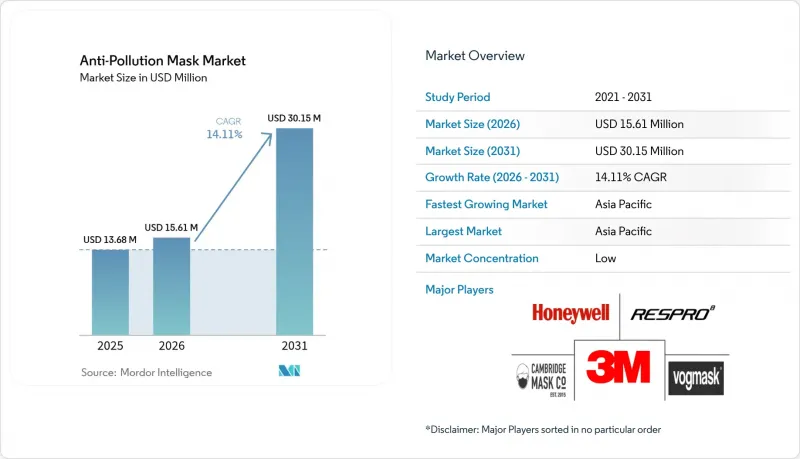
Mordor Intelligence에 의하면, 오염 방지 마스크 시장 규모는 2025년 1,368만 달러로 평가되었고, 2026년에는 1,561만 달러로 추정되고, 2026-2031년 CAGR 14.11%로 성장을 지속할 전망이며, 2031년에는 3,015만 달러에 이를 것으로 예측됩니다.
본 보고서에서는 산업을 제품 유형별(재사용 가능, 일회용), 필터 유형별(미세먼지, 가스·악취, 복합), 소재별(합성섬유, 면, 활성탄, 부직포), 유통 채널별(슈퍼마켓 및 하이퍼마켓, 드럭스토어·약국, 온라인 소매점, 기타), 지역별(북미, 기타)로 분류하고 있습니다. 시장 예측은 금액(달러) 기준으로 제시되어 있습니다.
세계의 오염 방지 마스크 시장 동향 및 인사이트
호흡기 질환 유병률 증가
대기질 악화에 따라 호흡기 질환의 유병률과 중증도 모두 상승함에 따라, 사람들은 점점 더 예방 조치를 취하고 있습니다. 도시화가 진행됨에 따라 노출 위험이 높아지는 가운데, 호흡기 질환으로 인한 부담이 보호 장비에 대한 지속적인 수요를 창출하고 있습니다. 헬스 이펙츠 인스티튜트(Health Effects Institute)의 2024년판 ‘세계 대기 현황(State of Global Air)’ 보고서에 따르면, 대기 오염으로 인한 연간 사망자 수는 810만 명에 달하며, 세계 인구의 99%가 WHO의 PM2.5 기준치를 초과하는 지역에 거주하고 있는 것으로 밝혀졌습니다. 이러한 역학적 현실이 예방 의학의 보급을 뒷받침하고 있습니다. 특히 아시아태평양에서는 급속한 산업화가 기존 오염원을 더욱 가속화하고 있습니다. 대기질 악화와 호흡기 질환 발병률 간의 상관관계로 인해 마스크 착용은 ‘선택적 보호 조치’가 아닌 ‘의료적 필요성’으로 자리 잡았으며, 시장 역학은 일시적인 수요에서 지속적인 수요 패턴으로 근본적으로 변화하고 있습니다.
대기 오염으로 인한 건강 위험에 대한 인식 제고
대기 오염이 건강에 미치는 영향에 대한 일반 시민의 인식은 전환점에 도달했으며, 마스크 착용은 사후 대응적 행동에서 예방적 행동으로 변화하고 있습니다. 델리에서는 2024년에 ‘양호-보통’ 수준의 대기질을 기록한 날 수가 역대 최다인 209일에 달했으나, 아이러니하게도 주민들이 매일의 AQI(대기질 지수) 변동에 민감해지면서 마스크 판매량이 증가했습니다. 이러한 현상은 인식 제고 캠페인을 통해 무증상 노출 위험에 대한 사람들의 이해가 깊어지는 가운데, 대기질 개선이 보호구 사용을 줄이는 대신 오히려 늘리게 한다는 정교한 소비자 행동을 반영하고 있습니다. 위기 대응형에서 예방 중시형으로의 구매 패턴 전환은 제조업체에게 더 안정적인 수익원을 창출하는 동시에, 기존의 심각한 오염 사건에 국한되지 않는 대상 시장 부문을 확대되고 있습니다. 오염 물질이 초래하는 숨겨져 있고 누적되는 위험에 대한 인식이 높아짐에 따라, 사람들은 유해한 입자로부터 몸을 보호하기 위해 개인 보호 조치를 취하고 있습니다.
저품질 마스크와 불충분한 여과 성능
대기 오염 대책 장비의 품질 관리 미비는 소비자의 신뢰를 훼손하고, 시장 성장을 제한하는 규제 당국의 감시를 초래합니다. 제조업체는 공급망 전반에 걸쳐 일관된 제품 품질을 유지하는 데 어려움을 겪고 있으며, 이로 인해 성능 편차가 발생하고 시장의 신뢰를 잃는 결과를 낳고 있습니다. 코로나19 팬데믹 기간 동안 저품질 마스크가 널리 유통되면서 보호 효과가 불충분하다는 소비자의 불신이 생겼고, 그 결과 여과 성능에 대한 주장에 대한 검증이 엄격해졌습니다. 많은 소비자가 인증된 마스크를 사용하고 있음에도 호흡기 문제를 겪고 있으며, 시장에 위조품이 유통되고 있는 사실도 밝혀졌습니다. 이러한 품질 관련 과제는 대형 제조업체의 규정 준수 비용을 증가시키는 한편, 중소기업의 혁신을 저해할 수 있는 시장 진입 장벽을 조성하고 있습니다. 기업들은 현재 시장에서 입지를 유지하고 규제를 준수하기 위해 품질 보증 시스템, 제3자 기관의 검사, 인증 절차에 막대한 투자를 해야 합니다.
부문 분석
일회용 마스크는 확립된 공급망과 일회용 보호 장비의 광범위한 소비자 보급에 힘입어 2025년에는 53.20%의 시장 점유율을 차지한 것으로 예측됩니다. 일회용 부문은 명확한 규제 체계, 특히 NIOSH 42 CFR 84에 따라 운영되며, 이 규격은 미국 산업안전보건연구소(NIOSH)가 제조업체에 대해 명확한 규정 준수 기준을 제시하고 있습니다. 이 마스크들은 사용 후 폐기가 용이하여 편의성이 높으며, 세척이나 유지보수의 필요성을 없애줍니다. 의료시설, 산업 현장, 공공기관에서는 안정적인 성능, 교차 오염 위험 감소, 재고 관리 간소화 등의 이유로 일회용 마스크가 선호되고 있습니다. 이 부문의 성장은 소재 기술의 지속적인 향상, 여과 능력 강화, 제품 품질을 유지하면서도 경쟁력 있는 가격 책정이 가능한 비용 효율적인 제조 공정에 의해 더욱 가속화되고 있습니다.
재사용형 마스크 부문은 지속가능성에 관한 규제와 총소유비용(TCO) 절감에 힘입어 2031년까지 연평균 성장률(CAGR) 14.34%로 성장할 전망입니다. 이러한 성장은 구매 결정 시 환경적 책임을 중시하는 소비자가 늘어남에 따라, 지속 가능한 제품에 대한 소비자 선호도가 변화하고 있음을 반영합니다. 이러한 변화는 환경 의식이 높고 지속 가능한 대체품에 대한 규제적 지원이 강력한 선진국 시장에서 특히 두드러집니다. 재사용 가능 제품 제조업체들은 환경적 이점에 대한 인식 제고 캠페인을 전개하며 프리미엄 가격 전략을 뒷받침하고 있습니다. 이러한 캠페인에서는 폐기물 발생 감소, 탄소 발자국 저감, 장기적인 비용 절감이 강조되고 있습니다. 또한, 인식 제고 활동에서는 재사용 가능 제품의 내구성과 품질도 강조되며, 초기 비용이 높음에도 불구하고 그 가치 제안이 제시되고 있습니다.
미세 입자 필터는 도시 환경에서 PM2.5 및 PM10 입자를 효과적으로 제거하기 때문에 2025년에는 57.80%의 시장 점유율을 차지할 것으로 예측됩니다. 이 필터들은 먼지, 꽃가루, 연기 및 기타 부유 오염 물질을 포함한 미세 입자를 공기 중에서 포집하고 제거하도록 설계되었습니다. 이러한 높은 시장 점유율은 특히 오염 수준이 일반적으로 높은 인구 밀집 도시 지역에서 대기 질 문제를 해결하는 데 중요한 역할을 하고 있음을 반영합니다. 2.5 마이크로미터에 달하는 미세한 입자까지 포집할 수 있는 이 필터의 효과 덕분에, 가정용 공기청정기부터 산업용 공조 장치에 이르기까지 다양한 공기 여과 시스템에서 필수적인 구성 요소로 자리 잡고 있습니다.
가스 및 악취 여과 부문은 미세먼지 이외의 휘발성 유기 화합물(VOC) 및 화학 오염 물질에 대한 인식이 높아지는 것을 배경으로 연평균 성장률(CAGR) 14.42%를 기록하며 성장하고 있습니다. 활성탄 기술의 통합은 특히 흡착 능력과 오염 물질의 선택성 향상 측면에서 이 부문의 기술적 진보를 보여줍니다. 이러한 진보 덕분에 제조업체는 벤젠, 포름알데히드 및 기타 유해 가스를 포함한 여러 오염 물질을 동시에 처리할 수 있게 되었습니다. 하이브리드 여과 시스템 개발에서는 활성탄을 다른 소재와 결합함으로써 전반적인 효율과 내구성을 향상시키고 있습니다. 현재 각 제조업체는 다층 여과 메커니즘, 특수 코팅 기술, 표면적을 증가시키는 처리 기술을 통해 종합적인 보호 기능을 제공하는 제품을 개발하고 있습니다. 이러한 여과 기술의 진화로 인해, 눈에 보이는 오염 물질과 보이지 않는 오염 물질을 모두 더 효과적으로 제거하면서도 필터의 전체 수명 주기 동안 일관된 성능을 유지할 수 있게 되었습니다.
지역별 분석
아시아태평양은 2025년에 시장 점유율의 34.10%를 차지한 것으로 평가되었으며, 2031년까지 연평균 성장률(CAGR) 15.05%로 성장할 것으로 전망됩니다. 이러한 성장은 해당 지역의 높은 오염 수준, 방대한 인구, 규제 강화에 기인합니다. 이 지역에 확립된 제조 거점과 원자재에 대한 접근성은 비용 면에서 우위를 제공하며, 국내 수요와 수출을 모두 뒷받침하고 있습니다. 특히 중국, 베트남, 말레이시아 등의 국가에서는 제조 능력이 뛰어나며, 광범위한 생산 네트워크와 공급망이 구축되어 있습니다.
중국에서는 대기질 개선으로 인해 소비자 의식이 높아지면서 마스크 보급이 확대되고 있습니다. 이 나라의 도시 지역에서는 계속해서 엄격한 대기질 대책이 시행되고 있는 한편, 소비자들은 심각한 대기 오염 시기에 형성된 마스크 착용 습관을 유지하고 있습니다. 일본과 한국은 세계 기준에 영향을 미치는 프리미엄 제품의 기술 혁신을 통해 시장 확대에 기여하고 있습니다. 이들 국가는 여과 능력 향상, 스마트 기능, 착용 편의성 향상을 갖춘 마스크 개발에 주력하고 있습니다. 이러한 혁신에는 교체 가능한 필터, 착용감 조절 기능, 항균 기능을 갖춘 마스크 등이 포함됩니다. 이 시장에서의 기술 개발은 특히 프리미엄 부문에서 전 세계 제조업체들에게 종종 벤치마크가 되고 있습니다.
북미와 유럽은 성숙한 시장이지만, 규제 준수 요건과 지속가능성에 대한 의무가 주요 요인으로 작용하여 상당한 성장률을 보이고 있습니다. 이 지역에는 보호 장비의 보급을 촉진하는 확립된 인프라와 엄격한 환경 규제가 존재합니다. 첨단 모니터링 시스템의 도입과 안전 기준의 정기적인 갱신도 시장 성장을 더욱 뒷받침하고 있습니다. 중동 및 아프리카에서는 도시화와 산업 발전의 진전으로 인해 오염 노출 위험이 높아지고 있어 성장 가능성이 전망됩니다. 이 지역에서는 급속한 산업 확장, 인프라 정비, 도시 지역의 인구 증가가 진행되고 있으며, 대기 질과 환경 보호에 대한 관심이 높아지고 있습니다. 새로운 제조 시설 및 에너지 생산 플랜트의 건설로 인해 근로자 안전과 환경 규제 준수에 대한 관심이 더욱 높아지고 있습니다.
기타 혜택
- 엑셀 형식 시장 예측(ME) 시트
- 3개월간의 애널리스트 지원
자주 묻는 질문
목차
제1장 서론
제2장 조사 방법
제3장 주요 요약
제4장 시장 구도
제5장 시장 규모 및 성장 예측
제6장 경쟁 구도
제7장 시장 기회 및 향후 전망
AJY 26.09.11According to Mordor Intelligence, the anti-pollution mask market size is expected to grow from USD 13.68 million in 2025 to USD 15.61 million in 2026 and is forecast to reach USD 30.15 million by 2031 at 14.11% CAGR over 2026-2031.
This report Segments the Industry Into Product Type (Reusable, Disposable), Filter Type (Particulate, Gas and Odour, Combination), Material (Synthetic Fibers, Cotton, Activated Carbon, Non-Woven Fabric), Distribution Channel (Supermarkets/Hypermarkets, Drug Stores/Pharmacies, Online Retail Stores, Others), and Geography (North America and More). The Market Forecasts are Provided in Terms of Value (USD).
Global Anti-Pollution Mask Market Trends and Insights
Increasing Prevalence of Respiratory Diseases
With worsening air quality leading to a rise in both the prevalence and severity of respiratory diseases, individuals are increasingly turning to protective measures. Respiratory disease burden creates sustained demand for protective equipment as urbanization accelerates exposure risks. The Health Effects Institute's 2024 State of Global Air report documents 8.1 million deaths annually from air pollution, with 99% of the global population living in areas exceeding WHO PM2.5 . This epidemiological reality drives preventive healthcare adoption, particularly in Asia-Pacific, where rapid industrialization compounds traditional pollution sources. The correlation between air quality deterioration and respiratory morbidity establishes mask usage as a medical necessity rather than discretionary protection, fundamentally altering market dynamics from episodic to continuous demand patterns.
Growing Awareness of Health Risks from Air Pollution
Public consciousness regarding air pollution health impacts has reached a tipping point, transforming mask adoption from reactive to proactive behavior. Delhi's achievement of 209 'Good to Moderate' air quality days in 2024, the highest on record, paradoxically coincided with increased mask sales as residents became more attuned to daily AQI fluctuations . This phenomenon reflects sophisticated consumer behavior where improved air quality increases rather than decreases protective equipment usage, as awareness campaigns educate populations about sub-clinical exposure risks. The shift from crisis-driven to prevention-focused purchasing patterns creates more stable revenue streams for manufacturers while expanding addressable market segments beyond traditional high-pollution episodes. As awareness grows about the hidden and accumulating dangers of pollutants, individuals are turning to personal protective measures to shield themselves from harmful particles.
Poor Quality Masks and Ineffective Filtration
Quality control failures in pollution control equipment reduce consumer confidence and trigger regulatory oversight that limits market growth. Manufacturers face challenges in maintaining consistent product quality across their supply chains, leading to performance variations that erode market trust. The widespread distribution of low-quality masks during the COVID-19 pandemic generated consumer distrust due to insufficient protection, resulting in heightened examination of filtration performance claims. Many consumers experience respiratory issues despite using certified masks, while others discover counterfeit products in the market. This quality-related challenge increases compliance costs for established manufacturers while creating market entry barriers that potentially restrict innovation from smaller companies. Companies must now invest significantly in quality assurance systems, third-party testing, and certification processes to maintain market presence and regulatory compliance.
Other drivers and restraints analyzed in the detailed report include:
- Technological Advancements in Mask Design
- Government and NGO Awareness Programs
- Environmental Concerns Related to Disposable Masks
For complete list of drivers and restraints, kindly check the Table Of Contents.
Segment Analysis
Disposable masks hold a 53.20% market share in 2025, supported by established supply chains and widespread consumer adoption of single-use protective equipment. The disposable segment operates under clear regulatory frameworks, particularly NIOSH 42 CFR 84, which provides manufacturers with defined compliance standards from the National Institute for Occupational Safety and Health. These masks offer convenience through easy disposal after use, eliminating the need for cleaning and maintenance. Healthcare facilities, industrial workplaces, and public institutions prefer disposable masks for their consistent performance, reduced risk of cross-contamination, and simplified inventory management. The segment's growth is further driven by continuous improvements in material technology, enhanced filtration capabilities, and cost-effective manufacturing processes that maintain product quality while ensuring competitive pricing.
The reusable segment is growing at a CAGR of 14.34% through 2031, driven by sustainability regulations and lower total cost of ownership. This growth reflects changing consumer preferences toward sustainable products, as more consumers prioritize environmental responsibility in their purchasing decisions. The shift is particularly evident in developed markets where environmental awareness is high and regulatory support for sustainable alternatives is strong. Manufacturers of reusable products are using educational campaigns about environmental benefits to support premium pricing strategies. These campaigns emphasize reduced waste generation, lower carbon footprint, and long-term cost savings. The educational initiatives also highlight the durability and quality of reusable products, demonstrating their value proposition despite higher initial costs.
Particulate filters hold a 57.80% market share in 2025, as they effectively remove PM2.5 and PM10 particles in urban environments. These filters are designed to capture and remove microscopic particles from the air, including dust, pollen, smoke, and other airborne contaminants. Their high market share reflects their crucial role in addressing air quality concerns, particularly in densely populated urban areas where pollution levels are typically higher. The filters' effectiveness in trapping particles as small as 2.5 micrometers has made them essential components in various air filtration systems, from residential air purifiers to industrial air handling units.
The gas and odor filtration segments are growing at a CAGR of 14.42%, driven by increased awareness of volatile organic compounds and chemical pollutants beyond particulate matter. The integration of activated carbon technology demonstrates the segment's technical progress, particularly in enhancing absorption capacity and pollutant selectivity. These advancements allow manufacturers to target multiple pollutants simultaneously, including benzene, formaldehyde, and other harmful gases. The development of hybrid filtration systems combines activated carbon with other materials to improve overall efficiency and longevity. Manufacturers are now developing products offering comprehensive protection through multi-layer filtration mechanisms, specialized coating technologies, and enhanced surface area treatments. This evolution in filtration technology enables better removal of both visible and invisible contaminants while maintaining consistent performance throughout the filter's lifecycle.
Complete Report Scope:
- By Product Type
- Reusable
- Disposable
- By Filter Type
- Particulate
- Gas and Odour
- Combination
- By Material
- Synthetic Fibers
- Cotton
- Activated Carbon
- Non-woven Fabric
- By Distribution Channel
- Supermarkets/Hypermarkets
- Drug Stores/Pharmacies
- Online Retail Stores
- Other Distribution Channels
- By Geography
- North America
- United States
- Canada
- Mexico
- Rest of North America
- Europe
- Germany
- United Kingdom
- Italy
- France
- Spain
- Netherlands
- Poland
- Belgium
- Sweden
- Rest of Europe
- Asia-Pacific
- China
- India
- Japan
- Australia
- Indonesia
- South Korea
- Thailand
- Singapore
- Rest of Asia-Pacific
- South America
- Brazil
- Argentina
- Colombia
- Chile
- Peru
- Rest of South America
- Middle East and Africa
- South Africa
- Saudi Arabia
- United Arab Emirates
- Nigeria
- Egypt
- Morocco
- Turkey
- Rest of Middle East and Africa
- North America
Geography Analysis
Asia-Pacific accounts for 34.10% of the market share in 2025 and is projected to grow at a CAGR of 15.05% through 2031. This growth stems from high pollution levels, large populations, and stricter regulations in the region. The area's established manufacturing base and access to raw materials create cost advantages that support both domestic use and exports. Manufacturing capabilities are particularly strong in countries like China, Vietnam, and Malaysia, which have developed extensive production networks and supply chains.
In China, air quality improvements have increased consumer awareness, leading to higher mask adoption. The country's urban areas continue to implement stringent air quality measures, while consumers maintain mask-wearing habits developed during periods of severe pollution. Japan and South Korea contribute to market expansion through technological advancements in premium products, which influence global standards. These countries focus on developing masks with enhanced filtration capabilities, smart features, and improved comfort. Their innovations include masks with replaceable filters, adjustable fits, and antimicrobial properties. The technological developments from these markets often set benchmarks for manufacturers worldwide, particularly in the premium segment.
North America and Europe are mature markets with significant growth rates, primarily due to regulatory compliance requirements and sustainability mandates. These regions have established infrastructure and stringent environmental regulations that drive the adoption of protective equipment. The implementation of advanced monitoring systems and regular updates to safety standards further support market growth. The Middle East and Africa demonstrate growth potential due to increasing urbanization and industrial development, which raises pollution exposure risks. These regions are experiencing rapid industrial expansion, infrastructure development, and population growth in urban centers, leading to heightened concerns about air quality and environmental protection. The establishment of new manufacturing facilities and energy production plants has intensified the focus on worker safety and environmental compliance.
- 3M
- Honeywell International Inc.
- Respro Ltd.
- Cambridge Mask Co.
- Vogmask (Ohlone Press LLC)
- RESPILON Ltd.
- AMD Medicom Inc.
- Makrite
- idMASK Co., Ltd.
- Dragerwerk AG & Co. KGaA
- Airinum AB
- Guangzhou Harley Commodity Co., Ltd.
- VENUS Safety & Health Pvt. Ltd.
- RZ Industries
- Moldex-Metric Inc.
- Aero Pro Co., Ltd
- Ansell Ltd.
- Shanghai Dasheng Health Products
- UVEX Safety Group
- Alpha Pro Tech Ltd.
Additional Benefits:
- The market estimate (ME) sheet in Excel format
- 3 months of analyst support
TABLE OF CONTENTS
1 INTRODUCTION
- 1.1 Study Assumptions and Market Definition
- 1.2 Scope of the Study
2 RESEARCH METHODOLOGY
3 EXECUTIVE SUMMARY
4 MARKET LANDSCAPE
- 4.1 Market Overview
- 4.2 Market Drivers
- 4.2.1 Increasing Prevalence of Respiratory Diseases
- 4.2.2 Growing Awareness of Health Risks from Air Pollution
- 4.2.3 Technological Advancements in Mask Design
- 4.2.4 Government and NGO Awareness Programs
- 4.2.5 Heightened Awareness Due to COVID-19 Pandemic
- 4.2.6 Increased Demand for Reusable and Eco-Friendly Masks
- 4.3 Market Restraints
- 4.3.1 Poor Quality Masks and Ineffective Filtration
- 4.3.2 Volatile Demand Due to Health Crises and Seasonal Factors
- 4.3.3 Environmental Concerns Related to Disposable Masks
- 4.3.4 Regulatory Hurdles and Certification Requirements
- 4.4 Consumer Behaviour Analysis
- 4.5 Regulatory Outlook
- 4.6 Porter's Five Forces Analysis
- 4.6.1 Bargaining Power of Suppliers
- 4.6.2 Bargaining Power of Buyers
- 4.6.3 Threat of New Entrants
- 4.6.4 Threat of Substitutes
- 4.6.5 Degree of Competition
5 MARKET SIZE AND GROWTH FORECASTS (VALUE)
- 5.1 By Product Type
- 5.1.1 Reusable
- 5.1.2 Disposable
- 5.2 By Filter Type
- 5.2.1 Particulate
- 5.2.2 Gas and Odour
- 5.2.3 Combination
- 5.3 By Material
- 5.3.1 Synthetic Fibers
- 5.3.2 Cotton
- 5.3.3 Activated Carbon
- 5.3.4 Non-woven Fabric
- 5.4 By Distribution Channel
- 5.4.1 Supermarkets/Hypermarkets
- 5.4.2 Drug Stores/Pharmacies
- 5.4.3 Online Retail Stores
- 5.4.4 Other Distribution Channels
- 5.5 By Geography
- 5.5.1 North America
- 5.5.1.1 United States
- 5.5.1.2 Canada
- 5.5.1.3 Mexico
- 5.5.1.4 Rest of North America
- 5.5.2 Europe
- 5.5.2.1 Germany
- 5.5.2.2 United Kingdom
- 5.5.2.3 Italy
- 5.5.2.4 France
- 5.5.2.5 Spain
- 5.5.2.6 Netherlands
- 5.5.2.7 Poland
- 5.5.2.8 Belgium
- 5.5.2.9 Sweden
- 5.5.2.10 Rest of Europe
- 5.5.3 Asia-Pacific
- 5.5.3.1 China
- 5.5.3.2 India
- 5.5.3.3 Japan
- 5.5.3.4 Australia
- 5.5.3.5 Indonesia
- 5.5.3.6 South Korea
- 5.5.3.7 Thailand
- 5.5.3.8 Singapore
- 5.5.3.9 Rest of Asia-Pacific
- 5.5.4 South America
- 5.5.4.1 Brazil
- 5.5.4.2 Argentina
- 5.5.4.3 Colombia
- 5.5.4.4 Chile
- 5.5.4.5 Peru
- 5.5.4.6 Rest of South America
- 5.5.5 Middle East and Africa
- 5.5.5.1 South Africa
- 5.5.5.2 Saudi Arabia
- 5.5.5.3 United Arab Emirates
- 5.5.5.4 Nigeria
- 5.5.5.5 Egypt
- 5.5.5.6 Morocco
- 5.5.5.7 Turkey
- 5.5.5.8 Rest of Middle East and Africa
- 5.5.1 North America
6 COMPETITIVE LANDSCAPE
- 6.1 Market Concentration
- 6.2 Strategic Moves
- 6.3 Market Ranking Analysis
- 6.4 Company Profiles (Includes Global-level Overview, Market-level Overview, Core Segments, Financials, Strategic Info, Market Rank/Share, Products and Services, Recent Developments)
- 6.4.1 3M
- 6.4.2 Honeywell International Inc.
- 6.4.3 Respro Ltd.
- 6.4.4 Cambridge Mask Co.
- 6.4.5 Vogmask (Ohlone Press LLC)
- 6.4.6 RESPILON Ltd.
- 6.4.7 AMD Medicom Inc.
- 6.4.8 Makrite
- 6.4.9 idMASK Co., Ltd.
- 6.4.10 Dragerwerk AG & Co. KGaA
- 6.4.11 Airinum AB
- 6.4.12 Guangzhou Harley Commodity Co., Ltd.
- 6.4.13 VENUS Safety & Health Pvt. Ltd.
- 6.4.14 RZ Industries
- 6.4.15 Moldex-Metric Inc.
- 6.4.16 Aero Pro Co., Ltd
- 6.4.17 Ansell Ltd.
- 6.4.18 Shanghai Dasheng Health Products
- 6.4.19 UVEX Safety Group
- 6.4.20 Alpha Pro Tech Ltd.


