|
시장보고서
상품코드
2123590
요관경 시장 : 점유율 분석, 업계 동향과 통계, 성장 예측(2026-2031년)Ureteroscopes - Market Share Analysis, Industry Trends & Statistics, Growth Forecasts (2026 - 2031) |
||||||
 Mordor Intelligence
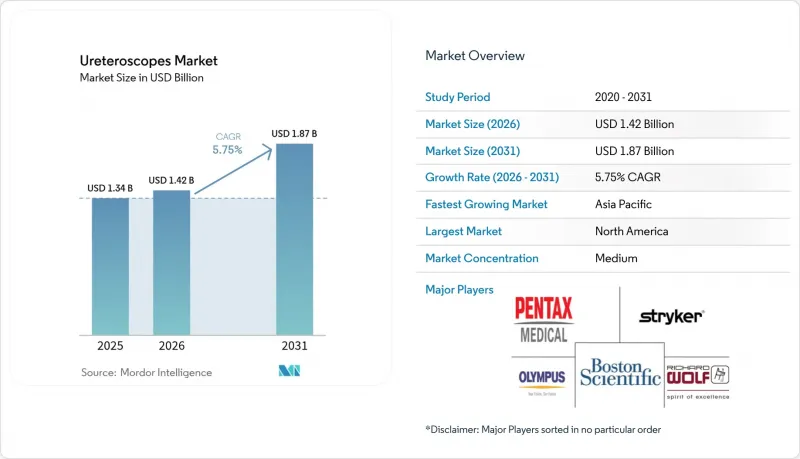
Mordor Intelligence에 의하면, 요관경 시장 규모는 2025년에 13억 4,000만 달러로 평가되었고 2026년 14억 2,000만 달러에서 2031년까지 18억 7,000만 달러에 이를 것으로 예측되며, 예측 기간(2026-2031년) CAGR은 5.75%를 나타낼 전망입니다.
본 보고서는 제품별(유연 요관경 및 반경성 요관경), 사용 방식별(일회용 요관경 및 재사용 가능 요관경), 용도(요로결석증 등), 최종 사용자(병원 등),지역(북미, 유럽, 아시아태평양, 중동 및 아프리카, 남미)별로 분류되어 있습니다. 시장 예측은 금액(달러) 기준으로 제시되어 있습니다.
전 세계 요관경 시장 동향 및 인사이트
전 세계적으로 증가하는 요로결석증 및 관련 비뇨기 질환의 부담
신장 결석 환자 수는 2021년에 1억 600만 건에 달했으며, 현재도 계속 증가하고 있어 내시경을 통한 결석 제거가 필요한 환자가 끊임없이 발생하고 있습니다. 남녀 간 격차는 해마다 줄어들고 있으며, 미국의 여성 유병률은 2007-2008년 6.5%에서 2017-2020년 9.1%로 상승했습니다. 이에 따라 각 업체들은 더 다양한 체형에 적합한 인체공학적 설계 개선을 추진하고 있습니다. 지역별 동향은 각기 다릅니다. 동유럽과 중앙아시아에서는 사례 수가 증가하는 반면, 동아시아의 일부 국가에서는 완만한 감소세가 나타나고 있으며, 이에 따라 판매 목표가 조정되고 있습니다. 소아 결석증은 연간 300만 건을 넘어, 요관 손상을 최소화하는 초소형 샤프트에 대한 수요를 견인하고 있으며, 이것이 요관경 시장의 장기적인 성장을 뒷받침하고 있습니다.
저침습적 결석 치료법으로의 전환
유럽 비뇨기과학회(EAU)의 지침에 따르면, 현재 20mm 미만의 결석에 대해 81%-94%에 달하는 결석 제거율을 근거로 체외 충격파 쇄석술(ESWL)보다 요관경 검사를 권장하고 있습니다. 당일 퇴원으로 시설 비용이 절감되고 외래수술센터(ASC)의 처리 능력이 향상되는 한편, 머신러닝 알고리즘을 통한 사례 선정의 효율화로 수술 중 예상치 못한 상황이 감소하고 있습니다. 이러한 요인들이 맞물려 시술 건수가 증가하며 요관경 시장의 확장을 뒷받침하고 있습니다.
디지털 요관경의 높은 도입 및 유지 비용
최신 디지털식 연성 요관경은 대부분의 경우 2만 달러를 초과하고, 연간 6,000-8,000달러의 유지보수 비용이 들기 때문에 자금 사정이 어려운 병원에게는 장벽이 되고 있습니다. 일회용 유형이라면 수리 비용은 들지 않지만, 신흥국에서는 1건당 비용이 현지 진료 보수를 초과하는 경우가 있어, 이로 인해 도입이 지연되고 요관경 시장의 확장이 억제되고 있습니다.
부문 분석
2025년, 요관경 시장에서 유연형이 57.68%의 점유율을 차지했습니다. 이는 신우의 가시성을 높이는 고화소 센서와, 사전 확장 없이 삽입을 용이하게 하는 초미세 직경 7.5 Fr 샤프트에 힘입은 결과입니다. 2025년 5월에 발표된 6.3 Fr과 7.5 Fr 일회용 요관경을 비교한 다기관 공동 연구에서는 결석 제거율이 각각 95%와 92.9%를 기록했으며, 더 얇은 기기를 사용함으로써 수술 시간이 4.5분 단축되었습니다. 내구성이 뛰어나다고 평가받는 반경성 시스템은 예산에 민감한 병원들로부터 저위험 도입 수단으로 간주되어 연평균 성장률(CAGR) 8.89%로 성장하고 있으며, 요관경 시장 전체 규모를 완만하게 끌어올리고 있습니다.
각 제조업체는 현재 광학 시스템뿐만 아니라 소프트웨어를 통해 차별화를 꾀하고 있습니다. 보스턴 사이언티피크(Boston Scientific)의 압력 모니터링 기능과 올림푸스(Olympus)의 EDOF 이미징은 치료 결과에 영향을 미치는 부가가치 창출 경로를 보여주고 있습니다. 메타 분석 결과, 샤프트 직경의 세대별 축소가 요관 확장술 횟수의 감소 및 입원 기간 단축과 상관관계가 있으며, 이는 요관경 시장 전체에서 건전한 교체 주기를 촉진하고 있음을 보여줍니다.
재사용 가능한 내시경은 70.85%의 점유율을 유지하고 있습니다. 이는 사례 수가 많은 의료 기관이 설비 투자를 신속하게 상각할 수 있고, 확립된 재처리 프로토콜을 중시하기 때문입니다. 반면, 일회용 기기는 연평균 성장률(CAGR) 9.78%로 확대되고 있습니다. 이는 일회용 제품이 수술 후 감염률 감소 및 수리로 인한 가동 중단 시간을 제로로 만든다는 데이터에 힘입은 결과입니다. 휴대형 폼 팩터 덕분에 오토클레이브가 없는 외래수술센터(ASC)에서도 고도의 결석 분쇄술이 가능해져, 분산형 의료 지역 내 요관경 시장 규모를 확대시키고 있습니다.
비용에 대해서는 의견이 엇갈리고 있습니다. 비뇨기과 의사의 59.11%가 가격을 가장 큰 장벽으로 꼽고 있지만, 수리비, 멸균 작업비, 내시경 분실 등을 포함한 총 소유 비용(TCO) 조사에서는 두 제품의 비용이 동등한 것으로 나타났습니다. 광학 성능의 동등성에 대한 논의는 잠잠해졌으며, LithoVue Elite의 270° 굽힘 각도와 Full HD센서는 현재 많은 재사용형 제품의 기준치에 필적하여 도입 확산 곡선을 완만하게 만들고 있습니다.
지역별 분석
북미는 2025년에도 요관경 시장에서 37.75%의 점유율을 유지했습니다. 이는 미국 성인의 9.25%가 신장 결석을 앓고 있다는 점과 디지털 내시경에 대한 광범위한 보험 적용이 뒷받침한 결과입니다. 2025년 외래 진료비 인상은 투자 수익률(ROI)을 향상시켜 대학 병원과 외래수술센터(ASC) 모두에서 장비 교체를 촉진하고 있습니다. LithoVue Elite와 같이 실시간 압력 모니터링 기능을 갖춘 모델은 복잡한 증례 관리에 도움이 되어 프리미엄 제품에 대한 수요를 공고히 하고 있습니다.
유럽은 2위를 차지했습니다. 영국과 독일에서는 일회용 제품의 채택이 빠르게 진행되고 있는 반면, 스칸디나비아 국가의 구매자들은 환경 지표를 중시하여 일회용 제품의 성장이 억제되고 있습니다. 남유럽 및 동유럽에서는 현대화 자금을 통해 잠재 수요가 자극되어 대륙 전체에서 요관경 시장의 입지가 확대되고 있습니다.
아시아태평양은 2031년까지 연평균 성장률(CAGR)이 6.85%로 가장 빠르게 성장하는 지역입니다. 중국에서는 중앙 집중식 가치 기반 조달로 인해 가격 압박이 발생하고 있지만, 한편으로는 대량 발주를 촉진하고 있습니다. 일본과 한국에서는 초슬림형 디지털 내시경이 조기에 도입된 반면, 인도에서는 민간 병원의 급증으로 판매량이 증가하고 있습니다. 가격대의 다양화로 인해 공급업체들은 제품 포트폴리오를 맞춤화해야 할 필요에 직면하고 있으며, 이로 인해 프리미엄 부문과 비용 중심 부문 모두에서 요관경 시장 규모가 확대되고 있습니다.
기타 혜택:
- 엑셀 형식 시장 예측(ME) 시트
- 3개월간의 애널리스트 지원
자주 묻는 질문
목차
제1장 서론
제2장 조사 방법
제3장 주요 요약
제4장 시장 구도
제5장 시장 규모와 성장 예측
제6장 경쟁 구도
제7장 시장 기회와 향후 전망
JHS 26.09.07According to Mordor Intelligence, the ureteroscope market size was valued at USD 1.34 billion in 2025 and estimated to grow from USD 1.42 billion in 2026 to reach USD 1.87 billion by 2031, at a CAGR of 5.75% during the forecast period (2026-2031).
This report is Segmented by Product (Flexible Ureteroscopes and Semi-Rigid Ureteroscopes), Usability (Single-Use/Disposable Ureteroscopes and Reusable Ureteroscopes), Application (Urolithiasis, and More), End User (Hospitals, and More), Geography (North America, Europe, Asia-Pacific, The Middle East and Africa, and South America). The Market Forecasts are Provided in Terms of Value (USD).
Global Ureteroscopes Market Trends and Insights
Rising Global Burden of Urolithiasis & Related Urological Disorders
Kidney-stone incidence hit 106 million cases in 2021 and continues to climb, providing a constant pipeline of candidates for endoscopic stone removal. The gender gap narrows each year; U.S. prevalence among women rose from 6.5% in 2007-2008 to 9.1% in 2017-2020, prompting vendors to refine ergonomics that suit broader anatomies. Regional dynamics vary: Eastern Europe and Central Asia register rising case loads, whereas several East-Asian nations report modest declines, steering sales targets accordingly. Pediatric stone disease, exceeding 3 million annual cases, fuels demand for ultra-miniature shafts that limit ureteral trauma, underpinning long-term growth in the ureteroscope market.
Shift Toward Minimally Invasive Stone-Management Procedures
European Association of Urology guidelines now recommend ureteroscopy ahead of shock-wave therapy for stones under 20 mm, citing stone-free rates between 81%-94%. Same-day discharge cuts facility costs and boosts ASC throughput, while machine-learning algorithms streamline case selection, reducing intra-operative surprises. Combined, these factors enlarge procedural volume, reinforcing expansion of the ureteroscope market.
High Acquisition & Maintenance Cost of Digital Ureteroscopes
A modern digital flexible scope often exceeds USD 20,000 and carries USD 6,000-8,000 in annual service, deterring cash-strapped hospitals. Although disposables bypass repair bills, their per-procedure expense can outstrip local tariffs in emerging economies, slowing uptake and tempering ureteroscope market expansion.
Other drivers and restraints analyzed in the detailed report include:
- Advancements in Digital Flexible & Single-Use Ureteroscope Technology
- Increasing Healthcare Spending & Reimbursement Support for Endourology
- Environmental & Waste-Management Concerns over Disposable Scopes
For complete list of drivers and restraints, kindly check the Table Of Contents.
Segment Analysis
Flexible designs held 57.68% of the ureteroscope market in 2025, buoyed by pixel-dense sensors that boost calyceal visualization and ultra-slim 7.5 Fr shafts that ease access without prior dilation. A multicenter study published in May 2025 comparing a 6.3 Fr and 7.5 Fr disposable scope logged stone-free rates of 95% and 92.9%, respectively, and shaved operative time by 4.5 minutes with the smaller device. Semi-rigid systems, prized for durability, grow at 8.89% CAGR because budget-sensitive hospitals regard them as a low-risk entry point, subtly lifting overall ureteroscope market size.
Manufacturers now differentiate through software rather than optics alone. Boston Scientific's pressure-monitoring layer and Olympus's EDOF imaging illustrate value-add pathways that influence tender outcomes. Meta-audits show a generational decline in shaft diameter correlating with fewer ureteral dilations and shorter hospital stays, fostering healthy replacement timelines across the ureteroscope market.
Reusable scopes retain 70.85% share because high-volume centers amortize capital quickly and value established reprocessing protocols. Yet single-use devices expand at a 9.78% CAGR, propelled by data linking disposables to lower post-operative infection rates and zero repair downtime. Portable form factors allow ASCs lacking autoclaves to perform advanced lithotripsy, widening ureteroscope market size in decentralized corridors.
Cost divides opinion: 59.11% of urologists cite price as the prime barrier, but total-cost-of-ownership studies show parity once repair, sterilization labor, and scope loss are tallied. Optical parity debates have subsided; LithoVue Elite's 270° deflection and full-HD sensor now match many reusable benchmarks, smoothing adoption curves.
Complete Report Scope:
- By Product
- Flexible Ureteroscopes
- Digital Flexible Ureteroscopes
- Fiber-optic Flexible Ureteroscopes
- Semi-Rigid Ureteroscopes
- Flexible Ureteroscopes
- By Usability
- Single-Use / Disposable Ureteroscopes
- Reusable Ureteroscopes
- By Application
- Urolithiasis
- Kidney Cancer
- Urinary Stricture
- Other Applications
- By End User
- Hospitals
- Ambulatory Surgical Centers
- Other End Users
- Geography
- North America
- United States
- Canada
- Mexico
- Europe
- Germany
- United Kingdom
- France
- Italy
- Spain
- Rest of Europe
- Asia-Pacific
- China
- Japan
- India
- Australia
- South Korea
- Rest of Asia-Pacific
- Middle East & Africa
- GCC
- South Africa
- Rest of Middle East & Africa
- South America
- Brazil
- Argentina
- Rest of South America
- North America
Geography Analysis
North America retained a 37.75% share of the ureteroscope market in 2025, fueled by 9.25% kidney-stone prevalence among U.S. adults and broad coverage for digital scopes. The 2025 outpatient payment bump bolsters ROI, encouraging both academic hospitals and ASCs to refresh fleets. Realtime pressure-monitoring models such as LithoVue Elite help manage complex cases, cementing premium-product demand.
Europe ranks second. Single-use uptake is brisk in the United Kingdom and Germany; conversely, Scandinavian buyers weigh environmental metrics, tempering disposable growth. Southern and Eastern Europe unlock latent demand via modernization funds, broadening ureteroscope market presence across the continent.
Asia-Pacific is the fastest-growing region at a 6.85% CAGR through 2031. China's centralized value-based procurement compresses pricing yet drives bulk orders; Japan and South Korea adopt ultra-slim digital scopes early, while India's private-hospital boom fuels volume growth. Divergent price tiers oblige suppliers to tailor portfolios, enlarging ureteroscope market size across both premium and cost-sensitive segments.
- Olympus
- Boston Scientific
- Stryker
- Karl Storz
- Richard Wolf
- PENTAX Medical (Hoya Corp.)
- Dornier MedTech
- EMS Electro Medical Systems S.A.
- Cook Group
- Vimex
- Elmed Medical Industry & Trade Inc.
- Opcom Inc.
- AED.MD, Inc.
- Prosurg
- Coloplast
- Pusen Medical
- OTU Medical
- Zhuhai Kangji Medical
- Urotech GmbH
Additional Benefits:
- The market estimate (ME) sheet in Excel format
- 3 months of analyst support
TABLE OF CONTENTS
1 Introduction
- 1.1 Study Assumptions & Market Definition
- 1.2 Scope of the Study
2 Research Methodology
3 Executive Summary
4 Market Landscape
- 4.1 Market Overview
- 4.2 Market Drivers
- 4.2.1 Rising Global Burden of Urolithiasis & Related Urological Disorders
- 4.2.2 Shift Toward Minimally Invasive Stone-Management Procedures
- 4.2.3 Advancements in Digital Flexible & Single-Use Ureteroscope Technology
- 4.2.4 Increasing Healthcare Spending & Reimbursement Support for Endourology
- 4.2.5 Growth of Ambulatory Surgical Centers Performing Ureteroscopy
- 4.2.6 Integration of High-Power Laser Lithotripsy & Imaging Enhancements
- 4.3 Market Restraints
- 4.3.1 High Acquisition & Maintenance Cost of Digital Ureteroscopes
- 4.3.2 Limited Availability of Trained Endourologists in Developing Regions
- 4.3.3 Stringent Device Sterilization & Regulatory Compliance Requirements
- 4.3.4 Environmental & Waste-Management Concerns over Disposable Scopes
- 4.4 Regulatory Outlook
- 4.5 Porter's Five Forces Analysis
- 4.5.1 Threat of New Entrants
- 4.5.2 Bargaining Power of Buyers
- 4.5.3 Bargaining Power of Suppliers
- 4.5.4 Threat of Substitutes
- 4.5.5 Competitive Rivalry
5 Market Size & Growth Forecasts (Value, USD)
- 5.1 By Product
- 5.1.1 Flexible Ureteroscopes
- 5.1.1.1 Digital Flexible Ureteroscopes
- 5.1.1.2 Fiber-optic Flexible Ureteroscopes
- 5.1.2 Semi-Rigid Ureteroscopes
- 5.1.1 Flexible Ureteroscopes
- 5.2 By Usability
- 5.2.1 Single-Use / Disposable Ureteroscopes
- 5.2.2 Reusable Ureteroscopes
- 5.3 By Application
- 5.3.1 Urolithiasis
- 5.3.2 Kidney Cancer
- 5.3.3 Urinary Stricture
- 5.3.4 Other Applications
- 5.4 By End User
- 5.4.1 Hospitals
- 5.4.2 Ambulatory Surgical Centers
- 5.4.3 Other End Users
- 5.5 Geography
- 5.5.1 North America
- 5.5.1.1 United States
- 5.5.1.2 Canada
- 5.5.1.3 Mexico
- 5.5.2 Europe
- 5.5.2.1 Germany
- 5.5.2.2 United Kingdom
- 5.5.2.3 France
- 5.5.2.4 Italy
- 5.5.2.5 Spain
- 5.5.2.6 Rest of Europe
- 5.5.3 Asia-Pacific
- 5.5.3.1 China
- 5.5.3.2 Japan
- 5.5.3.3 India
- 5.5.3.4 Australia
- 5.5.3.5 South Korea
- 5.5.3.6 Rest of Asia-Pacific
- 5.5.4 Middle East & Africa
- 5.5.4.1 GCC
- 5.5.4.2 South Africa
- 5.5.4.3 Rest of Middle East & Africa
- 5.5.5 South America
- 5.5.5.1 Brazil
- 5.5.5.2 Argentina
- 5.5.5.3 Rest of South America
- 5.5.1 North America
6 Competitive Landscape
- 6.1 Market Concentration
- 6.2 Market Share Analysis
- 6.3 Company Profiles (includes Global level Overview, Market level overview, Core Business Segments, Financials, Headcount, Key Information, Market Rank, Market Share, Products and Services, and analysis of Recent Developments)
- 6.3.1 Olympus Corporation
- 6.3.2 Boston Scientific Corporation
- 6.3.3 Stryker Corporation
- 6.3.4 Karl Storz SE & Co. KG
- 6.3.5 Richard Wolf GmbH
- 6.3.6 PENTAX Medical (Hoya Corp.)
- 6.3.7 Dornier MedTech
- 6.3.8 EMS Electro Medical Systems S.A.
- 6.3.9 Cook Medical LLC
- 6.3.10 Vimex Sp. z o.o.
- 6.3.11 Elmed Medical Industry & Trade Inc.
- 6.3.12 Opcom Inc.
- 6.3.13 AED.MD, Inc.
- 6.3.14 Prosurg Inc.
- 6.3.15 Coloplast A/S
- 6.3.16 Pusen Medical
- 6.3.17 OTU Medical
- 6.3.18 Zhuhai Kangji Medical
- 6.3.19 Urotech GmbH
7 Market Opportunities & Future Outlook
- 7.1 White-space & Unmet-Need Assessment