|
시장보고서
상품코드
2123591
생물 안전 캐비닛 시장 : 점유율 분석, 업계 동향과 통계, 성장 예측(2026-2031년)Biological Safety Cabinet - Market Share Analysis, Industry Trends & Statistics, Growth Forecasts (2026 - 2031) |
||||||
 Mordor Intelligence
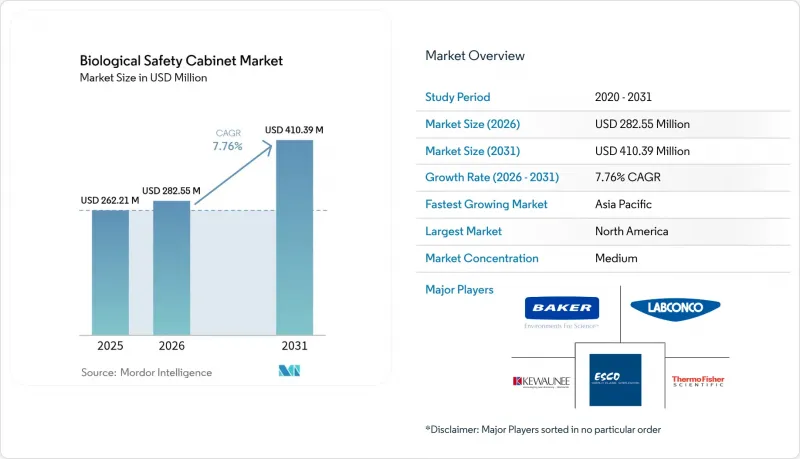
Mordor Intelligence에 의하면, 생물 안전 캐비닛 시장 규모는 2025년에 2억 6,221만 달러로 평가되었고 2026년 2억 8,255만 달러에서 2031년까지 4억 1,039만 달러에 이를 것으로 예측되며, 예측 기간(2026-2031년) CAGR은 7.76%를 나타낼 전망입니다.
본 보고서는 유형별(클래스 I, 클래스 II, 클래스 III), 배기 시스템별(덕트식(하드 연결) 및 재순환식/덕트리스), 용도별(신약 개발 및 전임상 연구 개발 등), 최종 사용자별(학술·연구 기관 등), 지역별(북미, 유럽, 아시아태평양 등)로 분류되어 있습니다. 시장 예측은 금액(달러) 기준으로 제시되어 있습니다.
전 세계 생물 안전 캐비닛 시장 동향 및 인사이트
확대되는 제약·바이오기술 분야의 연구비
견실한 신약 개발 파이프라인을 배경으로, 대기업들은 새로운 격리 설비가 필요한 중복화된 연구 거점 건설을 추진하고 있습니다. 서모피셔 사이언티픽(Thermo Fisher Scientific)은 4개년 미국 투자 프로그램 중 15억 달러를 생물 안전 캐비닛을 포함한 실험실 인프라에 할당하고 있습니다. 후기 단계 자산을 추가하는 합병을 통해 시설 개조가 더욱 촉진되고 있으며, AI를 활용한 신약 개발 플랫폼은 여전히 작업자의 보호가 필요한 자동화된 고처리량 분석에 대응하기 위해 작업 공간 재구성을 진행하고 있습니다. 그 결과, 새롭게 설비가 갖춰진 연구시설 하나하나가 생물 안전 캐비닛 시장에 대한 추가적인 견인력을 창출하고 있습니다. 대학은 생물 안전 대책 업그레이드를 지원하는 보조금 확대의 혜택을 받고 있으며, 이는 공공 부문의 안정적인 수요를 뒷받침하고 있습니다. 이러한 추세는 북미에서 가장 두드러지지만, 서유럽에서도 유사한 설비 확충이 진행되고 있습니다.
신종 감염병에 대한 전 세계적 대비 강화
각국 정부는 2024년 이후, 탄탄한 실험실 네트워크 구축을 우선 과제로 삼아 왔습니다. 미국 질병통제예방센터(CDC)가 발행한 『미생물학 및 생의학 실험실의 생물 안전』 제6판에서는 기류 및 필터의 무결성에 관한 성능 기준이 엄격해졌으며, 이로 인해 생물 안전 캐비닛의 교체 주기가 촉진되고 있습니다. 또한, 미국 직업안전보건청(OSHA)이 조만간 공표할 감염병 관련 신규 규정에서는 유사한 요건이 임상 실험실에도 적용될 예정이어서, 국내 수주가 가속화될 전망입니다. 바이오 에어로졸의 위협을 연구하는 국방 프로그램도 HEPA 필터가 장착된 워크스테이션에 의존하고 있어, 이는 부문 전반에 걸친 수요를 여실히 보여주고 있습니다. 신속 대응형 검사 인프라의 국가 비축품에는 현재 바이오세이프티 캐비닛이 항상 포함되어 있으며, 감염 확산 시 즉시 배치할 수 있도록 확보되어 있습니다. 이러한 대비 태세에 대한 집중이 단기적인 성장을 뒷받침하고 있으며, 특히 공중보건연구소의 규모 확대가 진행되고 있는 아시아태평양에서 두드러집니다.
높은 설비 투자 비용과 인증 비용
검증, 시설 개조, GMP 문서 작성 비용을 합산하면 총 도입 비용이 정가의 2배에 달하는 경우가 흔합니다. 연구 보조금이 인프라 비용을 충당하는 경우는 드물기 때문에 학술 연구소는 설비 갱신 자금 조달에 어려움을 겪고 있습니다. ISO 14644-4와 관련된 향후 인증 규정의 불확실성으로 인해 일부 구매자들은 발주를 연기하고 있습니다. 소규모 생명공학 기업들은 공유 실험실 공간을 임대하여 비용을 절감하고 있으며, 이로 인해 장비의 직접 판매가 지연되고 있습니다. 고활성 화합물 취급에 관한 맞춤형 검증은 특히 CDMO를 처음 이용하는 기업에서 비용을 더욱 상승시키고 있습니다.
부문 분석
클래스 II 유닛은 일상적인 연구 및 진단 요구 사항의 대부분을 충족하기 때문에 2025년 생물 안전 캐비닛 시장 점유율의 60.88%를 유지했습니다. 그러나 고활성 의약품(HPAPI) 및 바이러스 벡터 취급 요건이 높아짐에 따라 클래스 III 글러브박스형 시장은 연평균 성장률(CAGR) 10.01%의 성장 궤도에 올랐습니다. Esco사의 기밀성이 높은 클래스 III 시리즈는 작업자의 노출을 완벽하게 방지하면서 항암제 조제 및 백신 제제 조제를 지원합니다. CRISPR 및 종양 용해성 바이러스의 파이프라인이 확대됨에 따라, 클래스 III 유닛의 생물 안전 캐비닛 시장 규모는 급속히 성장할 것으로 예측됩니다. 모든 등급에서 제조업체들은 터치스크린 방식의 기류 분석 기능과 자동 압력 강하 시험 기능을 탑재하여 연간 재인증 절차를 간소화하고 있습니다. ISO 기준에 따른 수명 주기 비용 요건을 충족하기 위해 에너지 최적화는 계속해서 모든 등급에 공통된 설계상의 중점 사항으로 남아 있습니다.
기술적 격차는 점차 좁혀지고 있지만, 클래스 I 장비는 여전히 틈새 시장으로 남아 있으며, 상위 클래스가 제공하는 제품 차폐 기능을 갖추지 않은 상태로, 인력과 환경 보호가 필요한 교육용 실험실에서 사용되고 있습니다. 소프트웨어 통합을 통해 사용 데이터가 빌딩 관리 시스템으로 전송되게 되어, 실험실 관리자는 환기 기준 준수 여부를 실시간으로 입증할 수 있게 되었습니다. 기류 속도 목표값에 대한 전 세계적 조화를 통해 개보수 공사가 촉진되고, 생물 안전 캐비닛 시장의 모든 등급에 대한 수요가 유지될 것으로 예측됩니다.
2025년에는 GMP 시설의 규제상 우선순위로 인해 덕트식 구성이 매출의 57.92%를 차지했습니다. 이러한 구성은 특히 대규모 바이오의약품 캠퍼스에서 유해 공기의 직접 배출이 의무화된 장소에서는 여전히 필수적입니다. 그럼에도 불구하고, 덕트리스형 유닛은 공간이 제한된 건물에서 고비용의 공조 설비 개조를 피할 수 있기 때문에 연평균 성장률(CAGR) 10.28%로 성장하고 있습니다. 덕트리스 모델의 생물 안전 캐비닛 시장 규모는 실험실 개조 규모가 신축 프로젝트를 상회하는 신흥국에서 가속화될 전망입니다. Better Basics Laborbedarf사의 ‘SmartIntegrate’ 모듈은 워크스테이션의 효율을 30% 향상시키고, 도구 없이 필터를 교체할 수 있게 함으로써 이 부문에서 혁신의 한 예가 되고 있습니다.
넷 제로 빌딩을 목표로 하는 에너지 규제로 인해 덕트리스형 유닛은 공조 공기의 손실을 최소화한다는 장점이 있습니다. 각 공급업체는 현재, 향후 덕트식과 재순환식 간 전환이 가능한 하이브리드 모델을 제공하여 규제 변화에 따라 고객의 투자를 보호하고 있습니다. 이러한 발전에도 불구하고, 고위험 HPAPI 시설의 경우 음압을 보장하기 위해 여전히 하드 덕트식 배기가 지정되고 있으므로, 생물 안전 캐비닛 시장에서는 두 시스템이 공존하게 될 것입니다.
지역별 분석
2025년, 북미는 매출 점유율 41.98%로 생물 안전 캐비닛 시장을 주도했습니다. 노보노르디스크의 140만 평방피트 규모의 무균 시설, 써모피셔 사이언티피크의 다년간에 걸친 설비 투자 계획과 같은 대규모 프로젝트는 설비 수요의 지속성을 뒷받침하고 있습니다. FDA의 ISO 14644-4 채택과 더불어, OSHA가 향후 도입할 예정인 감염병 관련 규정에 따라 규정 준수 대응 주기가 잇달아 발생하고 있어 캐비닛 업그레이드가 시급해지고 있습니다. 또한, 제약 공급망의 국내 복귀를 촉진하는 연방 정부의 인센티브로 인해, 높은 격리 설계를 요건으로 하는 미국의 CDMO 캠퍼스에 대한 투자도 유도되고 있습니다.
아시아태평양은 2031년까지 연평균 성장률(CAGR)이 9.22%로 가장 빠르게 성장하고 있는 지역입니다. 미국의 ‘바이오시큐어 법’에 따라 아웃소싱 대상이 인도로 이동하고 있으며, 인도의 CDMO 시장은 2023년 156억 3,000만 달러에서 2028년까지 267억 3,000만 달러로 확대될 전망입니다. 싱가포르에 건설된 1억 5,000만 달러 규모의 Pall Corporation 제조 여과 플랜트는 업스트림 공정의 소모품과 캐비닛 제조를 통합하는 이 지역의 진화하는 생태계를 구현하고 있습니다. 중국에서 진행 중인 제약 시설 확충과 일본의 백신 자급자족 계획이 수요를 더욱 끌어올리고 있습니다. 규제 조화를 통해 수입 절차가 간소화되면서, 다국적 공급업체들이 고객 인근에 최종 조립 거점을 마련하도록 장려되고 있습니다.
유럽에서는 엄격한 규제 요건과 그린 빌딩 지침을 배경으로 꾸준한 확장이 관찰되고 있습니다. ‘기계 규정’과 ‘에코디자인 규정’에 따라 실험실에서는 디지털 패스포트가 탑재된 에너지 효율이 높은 장비의 도입이 촉진되고 있습니다. 렌츨러 바이오파마(Lenzler Biopharma)의 완충액·배지 복합 시설 및 기타 바이오의약품 관련 투자는 고성능 캐비닛의 교체 수요를 뒷받침하고 있습니다. 이 지역의 활성 성분(API) 시장 성장은 최신 GMP 대응 시설을 뒷받침하며, 생물 안전 캐비닛 시장의 확장을 주도하고 있습니다. 2050년까지 순배출 제로를 달성하라는 지속가능성 목표에 따라 조달 동향은 덕트리스 또는 저압 설계로 기울고 있으며, 공급업체 간의 기술적 차별화가 더욱 강화되고 있습니다.
기타 혜택:
- 엑셀 형식 시장 예측(ME) 시트
- 3개월간 애널리스트 지원
자주 묻는 질문
목차
제1장 서론
제2장 조사 방법
제3장 주요 요약
제4장 시장 구도
제5장 시장 규모와 성장 예측
제6장 경쟁 구도
제7장 시장 기회와 향후 전망
JHS 26.09.07According to Mordor Intelligence, the biological safety cabinets market size was valued at USD 262.21 million in 2025 and estimated to grow from USD 282.55 million in 2026 to reach USD 410.39 million by 2031, at a CAGR of 7.76% during the forecast period (2026-2031).
This report is Segmented by Type (Class I, Class II, and Class III), Exhaust System (Ducted (Hard-Connected) and Recirculating / Ductless), Application (Drug Discovery & Pre-Clinical R&D, and More), End-User (Academic & Research Institutes, and More), Geography (North America, Europe, Asia-Pacific, and More). The Market Forecasts are Provided in Terms of Value (USD).
Global Biological Safety Cabinet Market Trends and Insights
Expanding Pharmaceutical and Biotechnology Research Expenditure
Robust drug-development pipelines are prompting large companies to build redundant research hubs that need new containment suites. Thermo Fisher Scientific is allocating USD 1.5 billion of its four-year U.S. investment program to laboratory infrastructure that includes biological safety cabinets. Mergers that add late-stage assets further boost facility retrofits, and AI-enabled discovery platforms are re-configuring workspaces for automated, high-throughput assays that still require operator protection. As a result, the biological safety cabinets market gains additional pull-through from every newly equipped research laboratory. Universities benefit from expanded grant funding that covers biosafety upgrades, supporting steady public-sector demand. The trend is most visible in North America, but similar capacity builds are underway in Western Europe.
Escalating Global Preparedness for Emerging Infectious Diseases
Governments have prioritized resilient laboratory networks since 2024. The CDC's sixth edition of the Biosafety in Microbiological and Biomedical Laboratories outlines tighter performance criteria for airflow and filter integrity, prompting cabinet replacement cycles. OSHA's forthcoming infectious-disease rule will extend similar requirements to clinical laboratories, accelerating domestic orders. Defense programs that study bioaerosol threats also rely on HEPA-filtered workstations, underlining cross-sector demand. National stockpiles of rapid-response testing infrastructure now routinely include biosafety cabinets, ensuring immediate deployment during outbreaks. This focus on readiness sustains short-term growth, particularly in Asia-Pacific where public-health laboratories are scaling up.
High Capital and Certification Costs
Total installed cost often doubles list price once validation, construction modifications, and GMP documentation are added. Academic laboratories struggle to fund upgrades because research grants rarely cover infrastructure. Uncertainty over future certification rules tied to ISO 14644-4 has prompted some buyers to postpone orders. Smaller biotech firms mitigate expense by leasing shared lab space, which delays direct equipment sales. Custom validation for potent-compound handling pushes expenses higher, particularly for first-time CDMOs.
Other drivers and restraints analyzed in the detailed report include:
- Stringent Occupational Health and Safety Regulations
- Accelerating Cell and Gene Therapy Manufacturing Expansion
- Emergence of Alternative Closed Isolator Systems
For complete list of drivers and restraints, kindly check the Table Of Contents.
Segment Analysis
Class II units retained 60.88% of the biological safety cabinets market share in 2025 because they meet the majority of routine research and diagnostic needs. However, Class III glove-box designs are on a 10.01% CAGR trajectory thanks to rising HPAPI and viral-vector handling requirements. Esco's leak-tight Class III series supports chemotherapy compounding and vaccine formulation while ensuring zero operator exposure. The biological safety cabinets market size for Class III units is projected to grow rapidly as CRISPR and oncolytic-virus pipelines expand. Across all classes, manufacturers embed touch-screen airflow analytics and automatic pressure-decay tests that simplify annual recertification. Energy-optimization remains a cross-class design focus to satisfy ISO-driven lifecycle cost mandates.
Technological parity is narrowing, yet Class I equipment remains niche, serving teaching labs that require personnel and environmental protection without the product shielding offered by higher classes. Software integrations now push usage data to building-management systems, enabling laboratory managers to demonstrate ventilation compliance in real time. Global harmonization of airflow velocity targets is expected to drive retrofits, sustaining demand for all classes within the biological safety cabinets market.
Ducted configurations captured 57.92% of revenue in 2025 due to regulatory preference in GMP suites. They remain indispensable where direct hazardous-air removal is mandated, especially in large biopharmaceutical campuses. Even so, ductless units are advancing at a 10.28% CAGR because they avoid costly HVAC rework in space-constrained buildings. The biological safety cabinets market size for ductless models will accelerate in emerging economies where laboratory retrofits exceed new-build projects. Better Basics Laborbedarf's SmartIntegrate module boosts workstation efficiency by 30% and allows tool-free filter swaps, illustrating innovation in this segment.
Energy codes pushing toward net-zero buildings give ductless units an advantage by minimizing conditioned-air losses. Suppliers now offer hybrid models that allow future conversion between ducted and recirculating modes, protecting customer capital as regulations evolve. Despite these gains, high-risk HPAPI suites still specify hard-ducted exhaust to guarantee negative pressure, so both systems will coexist in the biological safety cabinets market.
Complete Report Scope:
- By Type
- Class I
- Class II
- Class III
- By Exhaust System
- Ducted (Hard-Connected)
- Recirculating / Ductless
- By Application
- Drug Discovery & Pre-Clinical R&D
- Clinical / Diagnostic Testing Labs
- Biopharmaceutical Manufacturing & Fill-Finish
- By End-User
- Pharmaceutical & Biotechnology Companies
- Academic & Research Institutes
- Contract Research / CDMOs
- Other End Users
- Geography
- North America
- United States
- Canada
- Mexico
- Europe
- Germany
- United Kingdom
- France
- Italy
- Spain
- Rest of Europe
- Asia-Pacific
- China
- Japan
- India
- Australia
- South Korea
- Rest of Asia-Pacific
- Middle East & Africa
- GCC
- South Africa
- Rest of Middle East & Africa
- South America
- Brazil
- Argentina
- Rest of South America
- North America
Geography Analysis
North America led the biological safety cabinets market at 41.98% revenue share in 2025. Large-scale projects such as Novo Nordisk's 1.4-million-square-foot aseptic facility and Thermo Fisher Scientific's multiyear capital program underscore sustained equipment pull. FDA adoption of ISO 14644-4 plus OSHA's forthcoming infectious-disease rule create back-to-back compliance cycles that compel cabinet upgrades. Federal incentives for reshoring pharmaceutical supply chains also channel investment into U.S. CDMO campuses that specify high-containment designs.
Asia-Pacific is the fastest-growing region at a 9.22% CAGR through 2031. The US Biosecure Act is redirecting outsourcing toward India, where the CDMO market will climb from USD 15.63 billion in 2023 to USD 26.73 billion by 2028. Singapore's USD 150 million Pall Corporation filtration plant demonstrates the region's evolving ecosystem that integrates upstream consumables with cabinet manufacturing. China's ongoing pharmaceutical build-out and Japan's vaccine self-sufficiency plans further elevate demand. Harmonized standards simplify imports, encouraging multinational suppliers to locate final assembly closer to customers.
Europe shows steady expansion anchored by strict regulatory mandates and green-building directives. The Machinery Regulation and Ecodesign rules push laboratories to adopt energy-efficient units with digital passports. Rentschler Biopharma's buffer-media complex and other biologics investments bolster replacement demand for high-performance cabinets. The region's active-pharmaceutical-ingredient market growth supports modern GMP suites, lifting the biological safety cabinets market. Sustainability targets that require net-zero emissions by 2050 are tilting procurement toward ductless or low-pressure designs, reinforcing technology differentiation among suppliers.
- Thermo Fisher Scientific
- Esco Lifesciences
- Labconco
- The Baker Company
- NuAire
- Kewaunee Scientific
- Germfree Laboratories
- Air Science
- BIOBASE
- Telstar (Azbil)
- Faster Srl
- Haier Biomedical
- PHCbi (Panasonic Healthcare)
- Erlab
- Bigneat
- Shanghai Boxun
- Heal Force
- Angelantoni Life Science
- AireLab Systems
- Astec Microflow
Additional Benefits:
- The market estimate (ME) sheet in Excel format
- 3 months of analyst support
TABLE OF CONTENTS
1 Introduction
- 1.1 Study Assumptions & Market Definition
- 1.2 Scope Of The Study
2 Research Methodology
3 Executive Summary
4 Market Landscape
- 4.1 Market Overview
- 4.2 Market Drivers
- 4.2.1 Expanding Pharmaceutical and Biotechnology Research Expenditure
- 4.2.2 Escalating Global Preparedness for Emerging Infectious Diseases
- 4.2.3 Stringent Occupational Health and Safety Regulations
- 4.2.4 Accelerating Cell and Gene Therapy Manufacturing Expansion
- 4.2.5 Rising Adoption of Smart Energy-Efficient Cabinet Technologies
- 4.3 Market Restraints
- 4.3.1 High Capital and Certification Costs
- 4.3.2 Emergence of Alternative Closed Isolator Systems
- 4.3.3 Supply Chain Vulnerabilities In HEPA / ULPA Filtration Components
- 4.3.4 Intensifying Energy Efficiency Compliance Pressure
- 4.4 Regulatory Landscape
- 4.5 Porter's Five Forces Analysis
- 4.5.1 Threat Of New Entrants
- 4.5.2 Bargaining Power Of Buyers
- 4.5.3 Bargaining Power Of Suppliers
- 4.5.4 Threat Of Substitutes
- 4.5.5 Intensity Of Competitive Rivalry
5 Market Size & Growth Forecasts (Value, USD)
- 5.1 By Type
- 5.1.1 Class I
- 5.1.2 Class II
- 5.1.3 Class III
- 5.2 By Exhaust System
- 5.2.1 Ducted (Hard-Connected)
- 5.2.2 Recirculating / Ductless
- 5.3 By Application
- 5.3.1 Drug Discovery & Pre-Clinical R&D
- 5.3.2 Clinical / Diagnostic Testing Labs
- 5.3.3 Biopharmaceutical Manufacturing & Fill-Finish
- 5.4 By End-User
- 5.4.1 Pharmaceutical & Biotechnology Companies
- 5.4.2 Academic & Research Institutes
- 5.4.3 Contract Research / CDMOs
- 5.4.4 Other End Users
- 5.5 Geography
- 5.5.1 North America
- 5.5.1.1 United States
- 5.5.1.2 Canada
- 5.5.1.3 Mexico
- 5.5.2 Europe
- 5.5.2.1 Germany
- 5.5.2.2 United Kingdom
- 5.5.2.3 France
- 5.5.2.4 Italy
- 5.5.2.5 Spain
- 5.5.2.6 Rest of Europe
- 5.5.3 Asia-Pacific
- 5.5.3.1 China
- 5.5.3.2 Japan
- 5.5.3.3 India
- 5.5.3.4 Australia
- 5.5.3.5 South Korea
- 5.5.3.6 Rest of Asia-Pacific
- 5.5.4 Middle East & Africa
- 5.5.4.1 GCC
- 5.5.4.2 South Africa
- 5.5.4.3 Rest of Middle East & Africa
- 5.5.5 South America
- 5.5.5.1 Brazil
- 5.5.5.2 Argentina
- 5.5.5.3 Rest of South America
- 5.5.1 North America
6 Competitive Landscape
- 6.1 Market Concentration
- 6.2 Market Share Analysis
- 6.3 Company Profiles (includes Global level Overview, Market level overview, Core Business Segments, Financials, Headcount, Key Information, Market Rank, Market Share, Products and Services, and analysis of Recent Developments)
- 6.3.1 Thermo Fisher Scientific, Inc.
- 6.3.2 Esco Micro
- 6.3.3 Labconco
- 6.3.4 The Baker Company
- 6.3.5 NuAire
- 6.3.6 Kewaunee Scientific
- 6.3.7 Germfree Laboratories
- 6.3.8 Air Science
- 6.3.9 BIOBASE
- 6.3.10 Telstar (Azbil)
- 6.3.11 Faster Srl
- 6.3.12 Haier Biomedical
- 6.3.13 PHCbi (Panasonic Healthcare)
- 6.3.14 Erlab
- 6.3.15 Bigneat
- 6.3.16 Shanghai Boxun
- 6.3.17 Heal Force
- 6.3.18 Angelantoni Life Science
- 6.3.19 AireLab Systems
- 6.3.20 Astec Microflow
7 Market Opportunities & Future Outlook
- 7.1 White-Space & Unmet-Need Assessment