|
시장보고서
상품코드
2123598
바이러스 제거 서비스 시장 : 점유율 분석, 업계 동향과 통계, 성장 예측(2026-2031년)Global Viral Clearance Services - Market Share Analysis, Industry Trends & Statistics, Growth Forecasts (2026 - 2031) |
||||||
 Mordor Intelligence
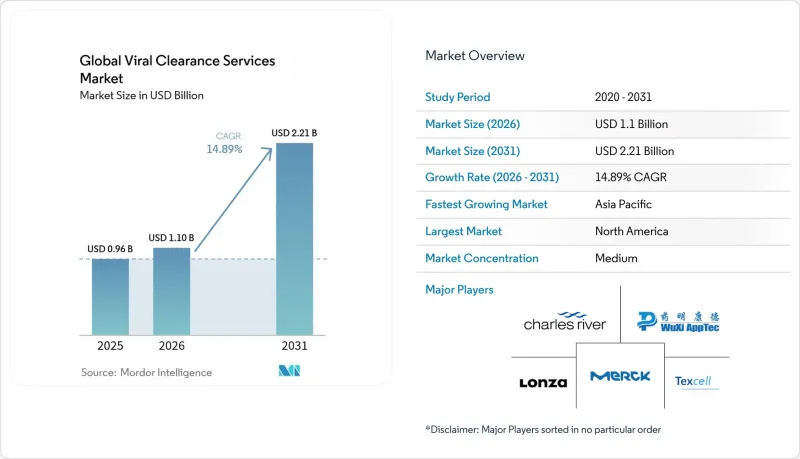
Mordor Intelligence에 의하면, 바이러스 제거 서비스 시장 규모는 2025년 9억 6,000만 달러에서 2026년에는 11억 달러로 확대되어 2026년부터 2031년까지 CAGR 14.89%로 성장을 지속하여, 2031년에는 22억 1,000만 달러에 이를 것으로 예측됩니다.
본 보고서는 방법별(바이러스 제거(크로마토그래피 등), 바이러스 불활성화(용매/계면활성제 처리 등), 하이브리드 전략), 용도별(재조합 단백질, 단일클론 항체 등), 최종 사용자별(대형 제약사 등), 지역별(북미, 유럽, 아시아태평양 등)로 분류되어 있습니다. 시장 예측은 금액(달러) 기준으로 제시되어 있습니다.
전 세계 바이러스 제거 서비스 시장 동향 및 인사이트
고분자 화합물 제조에서 바이러스 안전성 검증 수요 증가
고분자 화합물 제조에서 바이러스 제거 공정이 공정 설계의 업스트림 단계로 이동하고 있습니다. 현재 FDA 지침에서는 플랫폼형 접근 방식이 권장되고 있으며, 제조업체는 안전성을 확보하면서 단일클론 항체 프로그램 간에 바이러스 제거 데이터를 재사용할 수 있게 되었습니다. 연속 바이오프로세스 라인에는 실시간 보증을 제공하는 인라인 바이러스 필터가 통합되어 있어, 수율 향상과 재검증 비용 절감을 실현하고 있습니다. 이러한 통합 역량을 갖춘 기업은 제품 출시를 앞당기고 규제 당국의 문의를 최소화할 수 있어, 바이러스 제거 능력을 명확한 경쟁 우위로 전환하고 있습니다. 장비 혁신 기업들은 처리량을 저하시키지 않으면서 제품 품질을 보호하는 고유량 필터를 개발함으로써 이러한 요구에 부응하고 있습니다.
전 세계적으로 확대되는 생물학적 제제 및 바이오시밀러 파이프라인
700건 이상의 유전자 치료제와 수백 건의 바이오시밀러가 개발 중이며, 신규 진입 제품마다 엄격한 바이러스 제거가 요구됩니다. 국제조화회의(ICH)의 노력으로 요건이 표준화되어, 단일 검증 패키지로 여러 대륙에 신청할 수 있게 되었습니다. 그 결과, 서비스 제공업체들은 개발 예산에서 더 큰 비중을 차지하고 있습니다. 예를 들어, 유로핀 사이언티픽(Eurofins Scientific)은 대규모 위탁 연구의 회복세를 보고하며, 바이러스 안전성 업무에 추가 생산 능력을 배정하고 있습니다.
다중 바이러스 검증 시험의 높은 비용과 복잡성
종합적인 조사에서는 대개 3-5종의 모델 바이러스가 사용되며, 각각은 여러 공정 단계를 거쳐 시험됩니다. 총 조사 비용은 50만 달러에서 200만 달러에 달하여 중소규모 생명공학 기업의 예산을 압박하고, 자원이 제한된 지역의 혁신가들을 주저하게 만들고 있습니다. 시약 공급망은 취약하며, 인증된 시드 스톡의 리드타임도 길어지고 있습니다. 서비스 제공업체들은 비감염성 대체 바이러스나 규제 당국이 현재 승인하고 있는 데이터가 풍부한 플랫폼 검증 방식을 채택함으로써 비용 절감에 나서고 있습니다.
부문 분석
2025년, 바이러스 제거법은 바이러스 제거 서비스 시장 규모의 60.12%를 차지하며, 바이오프로세스 안전성의 기반으로서의 입지를 다시 한번 확고히 다졌습니다. 크로마토그래피, 심층 여과 및 바이러스 보유막은 단일클론 항체와 재조합 단백질에서 예측 가능한 대수적 감소율을 제공합니다. 현재 연속 다운스트림 공정에서는 이러한 단계를 일회용 밀폐 시스템에 통합하여 무균 상태를 유지하면서 체류 시간을 최소화하고 있습니다.
하이브리드 전략은 시장 규모 면에서는 아직 작지만, 2031년까지 연평균 성장률(CAGR) 16.79%로 확대되고 있으며, 서비스 포트폴리오 재구성이 진행되고 있습니다. 각 공급업체는 용매 및 계면활성제에 의한 불활성화, 낮은 pH 유지, UV-C 조사를 물리적 제거와 결합하여, 외피형 및 비외피형 위협 모두에 대처할 수 있도록 의도된 순서로 통합하고 있습니다. 아사히카세이의 ‘Planova FG1’ 필터는 고유량 막이 바이러스 대수 감소율을 저해하지 않으면서 처리 능력을 향상시키는 실제 사례를 보여주고 있습니다. 하이브리드 프로토콜을 활용한 바이러스 제거 서비스 시장 규모는 2025년 1억 4,000만 달러에서 2031년에는 3억 5,500만 달러로 확대될 것으로 예측되며, 이는 다중 내성에 대한 업계의 높은 수요를 뒷받침하고 있습니다.
2세대 하이브리드 기술은 강인한 파르보바이러스에 대응하기 위해 기존 절차에 고압 처리 및 나노 여과를 결합하고 있습니다. AI를 활용한 설계 도구가 최적의 공정 조합을 제안함으로써 실험 횟수를 최대 30%까지 줄일 수 있습니다. 이러한 혁신은 예측 가능성을 높이고, 규제 당국이 추진하는 위험 기반이자 과학에 입각한 검증 프레임워크를 뒷받침합니다. 연속 제조가 보편화됨에 따라, 하이브리드 모듈을 인라인으로 통합할 수 있는 공급업체는 배치 처리를 주로 하는 경쟁사를 앞지르며 시장 점유율을 확대할 것입니다.
지역별 분석
북미는 2025년 바이러스 제거 서비스 시장의 38.85%를 차지하며, 규제 측면에서의 리더십, 벤처 자금, 대규모 플랜트 확장 면에서 여전히 세계적 중심지 역할을 하고 있습니다. 후지필름의 12억 달러 규모의 노스캐롤라이나 프로젝트로 인해 2031년까지 바이오리액터 생산 능력이 3배로 확대되어, 통합형 제거 검증에 대한 새로운 수요가 창출될 전망입니다. 인증된 모델 바이러스의 견고한 공급망에 더해, FDA 심사관과의 지리적 근접성이 이 지역의 전략적 중요성을 높이고 있습니다. 북미 바이러스 제거 서비스 시장 규모는 2025년 3억 8,000만 달러에서 2031년에는 8억 달러로 확대될 것으로 예측됩니다.
유럽은 유럽의약품청(EMA)의 종합적인 바이러스 안전성 지침과 유럽위원회의 2024년 생명공학 전략에 힘입어 여전히 큰 존재감을 유지하고 있습니다. 독일에 위치한 로슈사의 9,000만 유로 규모의 유전자 치료 허브와 슬로베니아에 위치한 노바티스사의 4,000만 유로 규모의 벡터 제조 시설이 해당 지역의 생산 능력을 확대되고 있습니다. 그러나 유럽의 다국적 규제 상황과 인건비 급등으로 인해 성장률은 한 자릿수 연평균 성장률(CAGR)에 그치고 있으며, 시장 점유율은 확대라기보다는 안정된 상태를 유지하고 있습니다.
아시아태평양은 가장 빠르게 성장하고 있으며, CAGR은 16.22%로 성장을 지속하고, 있습니다. 중국이 자유무역지역 내 세포 및 유전자 치료에 대한 외국 자본 보유 제한을 철폐하고, 일본의 ‘사키가케’ 제도에 따른 신속 승인 절차가 도입됨에 따라 승인까지의 기간이 단축되어 다국적 스폰서 기업들을 유치하고 있습니다. WuXi Biologics나 Takara Bio와 같은 지역 CDMO 기업들은 벡터 제조 시설과 대용량 바이러스 여과 라인에 투자하고 있습니다. 아시아태평양의 바이러스 제거 서비스 시장 규모는 2025년 2억 1,000만 달러에서 2031년까지 5억 1,800만 달러로 급증하여, 이미 확고히 자리 잡은 유럽 및 미국의 거점과의 격차를 좁힐 것으로 예측됩니다. 인력 부족은 여전히 지속되고 있지만, 정부 보조금 및 대학과의 제휴를 통해 바이러스학 분야의 인재 풀을 확대하기 위한 노력이 진행되고 있습니다.
기타 혜택:
- 엑셀 형식 시장 예측(ME) 시트
- 3개월간의 애널리스트 지원
자주 묻는 질문
목차
제1장 서론
제2장 조사 방법
제3장 주요 요약
제4장 시장 구도
제5장 시장 규모와 성장 예측
제6장 경쟁 구도
제7장 시장 기회와 향후 전망
JHS 26.09.07According to Mordor Intelligence, the viral clearance services market size is expected to grow from USD 0.96 billion in 2025 to USD 1.10 billion in 2026 and is forecast to reach USD 2.21 billion by 2031 at 14.89% CAGR over 2026-2031.
This report is Segmented by Method (Viral Removal [Chromatography and More], Viral Inactivation [Solvent/Detergent Treatment and More], and Hybrid Strategies), Application (Recombinant Proteins, Monoclonal Antibodies, and More), End-User (Large Pharma and More), and Geography (North America, Europe, Asia-Pacific, and More). The Market Forecasts are Provided in Terms of Value (USD).
Global Viral Clearance Services Market Trends and Insights
Rising Demand for Viral Safety Validation in Large-Molecule Manufacturing
Large-molecule production has shifted viral clearance upstream into process design. FDA guidance now rewards platform approaches, letting manufacturers reuse clearance data across monoclonal antibody programs while preserving safety. Continuous bioprocessing lines incorporate in-line virus filters that provide real-time assurance, improving yields and lowering re-validation costs. Companies with such integrated capabilities launch products sooner and limit regulatory queries, turning viral clearance capacity into a clear competitive advantage. Equipment innovators have responded with high-flux filters that safeguard product quality without compromising throughput.
Expanding Biologics & Biosimilar Pipeline Worldwide
More than 700 gene therapies and hundreds of biosimilars are under development, and each new entrant needs rigorous clearance. International Council for Harmonisation (ICH) efforts have standardized requirements so that a single validation package can underpin submissions on multiple continents. Service providers therefore capture a larger slice of development budgets. Eurofins Scientific, for example, has reported a rebound in large contracted studies and allocated additional capacity to viral safety work.
High Cost & Complexity of Multi-Virus Validation Studies
Comprehensive studies often involve three to five model viruses, each tested across multiple process steps. The total research outlays range from USD 500,000 to USD 2 million, straining smaller biotech budgets and deterring innovators in resource-limited regions. Reagent supply chains are fragile, with long lead times for qualified seed stocks. Service providers are countering costs by adopting non-infectious surrogates and data-rich platform validations that regulators now accept.
Other drivers and restraints analyzed in the detailed report include:
- Cell & Gene Therapy Boom Requiring Bespoke Protocols
- Outsourcing Surge to Specialist CRO/CDMOs
- Shortage of Skilled Virology and Biosafety Workforce
For complete list of drivers and restraints, kindly check the Table Of Contents.
Segment Analysis
Viral removal methods captured 60.12% of the viral clearance services market size in 2025, reaffirming their status as the backbone of bioprocess safety. Chromatography, depth filtration, and virus-retentive membranes deliver predictable log-reduction values across monoclonal antibodies and recombinant proteins. Continuous downstream trains now weave these steps into single-use, closed systems that maintain sterility while minimizing hold times.
Hybrid strategies, though accounting for a smaller base, are growing at 16.79% CAGR through 2031 and are reshaping service portfolios. Providers integrate solvent/detergent inactivation, low-pH hold, and UV-C irradiation with physical removal in deliberate sequences that address both enveloped and non-enveloped threats. Asahi Kasei's Planova FG1 filter demonstrates how high-flux membranes accelerate throughput without sacrificing virus log-reduction factors. The viral clearance services market size for hybrid protocols is projected to expand from USD 140 million in 2025 to USD 355 million in 2031, underscoring industry appetite for multimodal resilience.
Second-generation hybrids layer high-pressure processing or nanofiltration onto legacy steps to combat robust parvoviruses. AI-guided design tools suggest optimal step combinations, reducing experimental runs by up to 30%. These innovations enhance predictability and support regulators' push toward risk-based, science-driven validation frameworks. As continuous manufacturing gains traction, providers able to integrate hybrid modules inline will gain share at the expense of batch-oriented competitors.
Complete Report Scope:
- By Method
- Viral Removal
- Chromatography
- Protein A Capture
- Ion-Exchange
- Affinity & Mixed-Mode
- Filtration
- Nanofiltration
- Depth Filtration
- Membrane Adsorbers
- Precipitation (PEG/Ethanol)
- Chromatography
- Viral Inactivation
- Solvent/Detergent Treatment
- Low-pH Incubation
- UV-C Irradiation
- Heat / Pasteurization
- High-Pressure Processing
- Hybrid Strategies
- Viral Removal
- By Application
- Recombinant Proteins
- Monoclonal Antibodies
- Tissue & Blood-derived Products
- Vaccines
- Gene & Cell Therapies
- Viral Vectors
- Other Applications
- By End-User
- Large Pharma
- Small & Mid-size Biotech
- Contract Development & Manufacturing Organizations (CDMOs)
- Contract Research & Testing Organizations (CROs)
- Academic & Government Research Institutes
- By Geography
- North America
- United States
- Canada
- Mexico
- Europe
- Germany
- United Kingdom
- France
- Italy
- Spain
- Rest of Europe
- Asia-Pacific
- China
- India
- Japan
- Australia
- South Korea
- Rest of Asia-Pacific
- Middle East and Africa
- GCC
- South Africa
- Rest of Middle East and Africa
- South America
- Brazil
- Argentina
- Rest of South America
- North America
Geography Analysis
North America controlled 38.85% of the viral clearance services market in 2025 and remains the global nexus for regulatory leadership, venture funding, and large-scale plant expansions. Fujifilm's USD 1.2 billion North Carolina project will triple bioreactor output by 2031, creating new demand for integrated clearance validation. Robust supply networks for qualified model viruses, plus proximity to FDA reviewers, enhance the region's strategic importance. The viral clearance services market size in North America is expected to climb from USD 380 million in 2025 to USD 800 million in 2031.
Europe maintains a substantial presence underpinned by the European Medicines Agency's comprehensive viral safety guidance and the European Commission's 2024 biotechnology strategy. Roche's €90 million gene therapy hub in Germany and Novartis's €40 million vector facility in Slovenia expand regional capacity. Yet Europe's multi-country regulatory landscape and rising labor costs temper growth to single-digit CAGRs, keeping its share stable rather than expansionary.
Asia Pacific is the fastest mover, advancing at a 16.22% CAGR. China's decision to lift foreign ownership limits for cell and gene therapy within free-trade zones and Japan's expedited Sakigake pathway shorten approval windows and attract multinational sponsors. Regional CDMOs like WuXi Biologics and Takara Bio are investing in vector suites and high-capacity virus filtration trains. The viral clearance services market size in Asia Pacific is projected to leap from USD 210 million in 2025 to USD 518 million by 2031, closing the gap with established Western hubs. Talent shortages persist, yet government grants and university partnerships aim to broaden the virology talent pool.
- BioOutsource Ltd (Sartorius)
- BIOSCIENCE LABORATORIES
- BSL BioService
- Catalent
- Charles River
- Clean Cells
- Creative Biolabs
- Cygnus Technologies
- Eurofins
- FUJIFILM
- Lonza Group
- Merck
- Microbac Laboratories
- Pall Corporation (Cytiva)
- Sartorius
- SGS
- Texcell
- Vironova
- ViruSure GmbH
- WuXi App Tec
Additional Benefits:
- The market estimate (ME) sheet in Excel format
- 3 months of analyst support
TABLE OF CONTENTS
1 Introduction
- 1.1 Study Assumptions & Market Definition
- 1.2 Scope of the Study
2 Research Methodology
3 Executive Summary
4 Market Landscape
- 4.1 Market Overview
- 4.2 Market Drivers
- 4.2.1 Rising demand for viral safety validation in large-molecule manufacturing
- 4.2.2 Expanding biologics & biosimilar pipeline worldwide
- 4.2.3 Cell & gene therapy boom requiring bespoke protocols
- 4.2.4 Outsourcing surge to specialist CRO/CDMOs
- 4.2.5 Continuous bioprocessing drives in-line clearance technologies
- 4.2.6 AI-enabled predictive validation platforms shorten study timelines
- 4.3 Market Restraints
- 4.3.1 High cost & complexity of multi-virus validation studies
- 4.3.2 Shortage of skilled virology and biosafety workforce
- 4.3.3 Fragmented global guidance for novel modalities (e.g., AAV)
- 4.3.4 Supply-chain gaps in qualified model viruses & reference standards
- 4.4 Value Chain Analysis
- 4.5 Technological Outlook
- 4.6 Porter's Five Forces Analysis
- 4.6.1 Threat of New Entrants
- 4.6.2 Bargaining Power of Buyers/Consumers
- 4.6.3 Bargaining Power of Suppliers
- 4.6.4 Threat of Substitute Products
- 4.6.5 Intensity of Competitive Rivalry
5 Market Size & Growth Forecasts (Value)
- 5.1 By Method
- 5.1.1 Viral Removal
- 5.1.1.1 Chromatography
- 5.1.1.1.1 Protein A Capture
- 5.1.1.1.2 Ion-Exchange
- 5.1.1.1.3 Affinity & Mixed-Mode
- 5.1.1.2 Filtration
- 5.1.1.2.1 Nanofiltration
- 5.1.1.2.2 Depth Filtration
- 5.1.1.2.3 Membrane Adsorbers
- 5.1.1.3 Precipitation (PEG/Ethanol)
- 5.1.1.1 Chromatography
- 5.1.2 Viral Inactivation
- 5.1.2.1 Solvent/Detergent Treatment
- 5.1.2.2 Low-pH Incubation
- 5.1.2.3 UV-C Irradiation
- 5.1.2.4 Heat / Pasteurization
- 5.1.2.5 High-Pressure Processing
- 5.1.3 Hybrid Strategies
- 5.1.1 Viral Removal
- 5.2 By Application
- 5.2.1 Recombinant Proteins
- 5.2.2 Monoclonal Antibodies
- 5.2.3 Tissue & Blood-derived Products
- 5.2.4 Vaccines
- 5.2.5 Gene & Cell Therapies
- 5.2.6 Viral Vectors
- 5.2.7 Other Applications
- 5.3 By End-User
- 5.3.1 Large Pharma
- 5.3.2 Small & Mid-size Biotech
- 5.3.3 Contract Development & Manufacturing Organizations (CDMOs)
- 5.3.4 Contract Research & Testing Organizations (CROs)
- 5.3.5 Academic & Government Research Institutes
- 5.4 By Geography
- 5.4.1 North America
- 5.4.1.1 United States
- 5.4.1.2 Canada
- 5.4.1.3 Mexico
- 5.4.2 Europe
- 5.4.2.1 Germany
- 5.4.2.2 United Kingdom
- 5.4.2.3 France
- 5.4.2.4 Italy
- 5.4.2.5 Spain
- 5.4.2.6 Rest of Europe
- 5.4.3 Asia-Pacific
- 5.4.3.1 China
- 5.4.3.2 India
- 5.4.3.3 Japan
- 5.4.3.4 Australia
- 5.4.3.5 South Korea
- 5.4.3.6 Rest of Asia-Pacific
- 5.4.4 Middle East and Africa
- 5.4.4.1 GCC
- 5.4.4.2 South Africa
- 5.4.4.3 Rest of Middle East and Africa
- 5.4.5 South America
- 5.4.5.1 Brazil
- 5.4.5.2 Argentina
- 5.4.5.3 Rest of South America
- 5.4.1 North America
6 Competitive Landscape
- 6.1 Market Concentration
- 6.2 Competitive Benchmarking
- 6.3 Market Share Analysis
- 6.4 Company Profiles (includes Global level Overview, Market level overview, Core Segments, Financials as available, Strategic Information, Market Rank/Share for key companies, Products & Services, and Recent Developments)
- 6.4.1 BioOutsource Ltd (Sartorius)
- 6.4.2 Bioscience Laboratories
- 6.4.3 BSL BioService
- 6.4.4 Catalent Inc.
- 6.4.5 Charles River Laboratories
- 6.4.6 Clean Cells
- 6.4.7 Creative Biolabs
- 6.4.8 Cygnus Technologies
- 6.4.9 Eurofins Scientific
- 6.4.10 Fujifilm Diosynth Biotechnologies
- 6.4.11 Lonza Group
- 6.4.12 Merck KGaA
- 6.4.13 Microbac Laboratories
- 6.4.14 Pall Corporation (Cytiva)
- 6.4.15 Sartorius AG
- 6.4.16 SGS SA
- 6.4.17 Texcell SA
- 6.4.18 Vironova AB
- 6.4.19 ViruSure GmbH
- 6.4.20 WuXi AppTec
7 Market Opportunities & Future Outlook
- 7.1 White-space & Unmet-need Assessment