

|
시장보고서
상품코드
2123601
자동차용 스마트 안테나 시장 : 시장 점유율 분석, 업계 동향 및 통계, 성장 예측(2026-2031년)Automotive Smart Antenna - Market Share Analysis, Industry Trends & Statistics, Growth Forecasts (2026 - 2031) |
||||||
 Mordor Intelligence
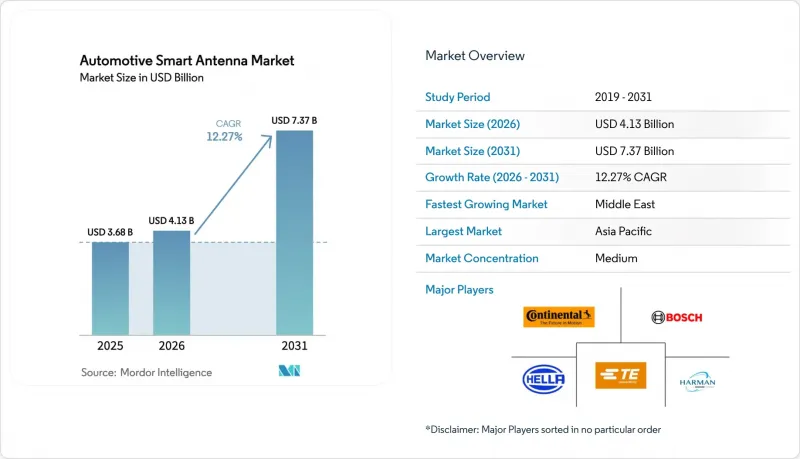
Mordor Intelligence에 의하면, 자동차용 스마트 안테나 시장 규모는 2025년 36억 8,000만 달러로 평가되었고, 2026년에는 41억 3,000만 달러로 추정되고, 2031년까지 73억 7,000만 달러에 이를 것으로 예측되며, 예측 기간(2026-2031년) CAGR은 12.27%를 나타낼 전망입니다.
본 보고서는 안테나 유형별(샤크핀형, 고정 마스트형, 유리 일체형, 내장형 안테나 모듈, 기타), 주파수 대역별(고주파(HF), 기타), 연결 기술별(3G/4G/LTE, 기타), 차종별(승용차, 기타), 차량 추진 방식별(내연기관(ICE), 기타), 설치 위치별(루프, 기타), 지역별로 분류되어 있습니다. 시장 예측은 금액(달러)으로 제시되어 있습니다.
세계의 자동차용 스마트 안테나 시장 동향 및 인사이트
5G의 급속한 확산이 안테나 교체 주기를 가속화
통신 사업자 EE는 대규모 업그레이드를 실시하여 영국에서 가장 신뢰할 수 있는 모바일 기술인 5G 스탠드얼론을 더 많은 마을과 도시에서 이용할 수 있게 했습니다. 2024년 9월, EE는 5G 스탠드얼론 네트워크를 개시하며 그 커버리지를 더욱 확대했습니다. 이 첨단 네트워크는 현재 영국 전역의 50개 주요 도시와 마을에서 2,800만 명 이상에게 서비스를 제공합니다. 차이나 모바일은 300개 도시에서 5G-Advanced 기지국을 가동하여, 초고신뢰성 통신을 실현하기 위한 전용 RF 채널을 활용한 네트워크 슬라이싱을 가능하게 했습니다. 고사양 모델에는 위상 배열 빔 포밍이 탑재되어 있으며, 비용 최적화 모델에서는 소프트웨어를 통한 조정이 가능한 단일 소자 설계가 채택되었습니다. 애프터마켓에서도 유사한 움직임이 관찰되며, 차량 운영 사업자들은 실시간 진단 및 트래픽 분석을 확보하기 위해 5G 모듈의 사후 장착을 추진하고 있습니다.
배선 중량 감소를 위해 OEM 각사의 루프 일체형 TCU 채택이 확대되고 있습니다.
폭스바겐(Volkswagen)의 MEB 아키텍처에서는 텔레매틱스 제어 장치(TCU)를 샤크핀 하우징 아래에 내장함으로써 동축 케이블을 4.2m 단축하고, 하네스 무게를 1.8kg 줄였습니다. 테슬라(Tesla)도 2025년 ‘모델 3’ 업데이트에서 유사한 접근 방식을 채택했으며, 무선 업데이트(OTA) 성공률 향상을 그 이유로 꼽고 있습니다. 현재 Tier 1 공급업체들은 모듈 내에 파워 앰프를 함께 배치하고 있으며, 이를 통해 부품 수를 최대 40% 줄이는 동시에, 1kg의 경량화마다 이점을 얻을 수 있는 BEV의 주행 거리 목표 달성을 지원하고 있습니다.
엔트리 모델에서 스마트 안테나의 높은 부품 원가와 기존 마스트형 안테나와의 비교
고정식 마스트 안테나의 비용이 3-5달러인 반면, 통합형 설계는 35-50달러가 소요되기 때문에 인도 및 동남아시아 전역의 엔트리 레벨 차량에서의 채택이 주춤하고 있습니다. 마루티 스즈키의 ‘알토’와 현대자동차의 ‘그랜드 i10’은 2025년 모델 변경에서도 기존 마스트 안테나를 채택했습니다. 공급업체들은 18-22달러의 저비용형 스마트 안테나 개발을 목표로 하고 있지만, 이러한 단일 대역 유닛에는 향후 업그레이드 경로가 없어 연결 환경이 양극화될 위험이 있습니다.
부문 분석
2025년, 샤크핀형 유닛은 자동차용 스마트 안테나 시장 점유율의 58.79%를 차지했습니다. 이는 셀룰러, GNSS, 방송의 각 요소를 공기역학적 특성이 뛰어난 단일 하우징에 통합할 수 있는 능력을 반영한 것입니다. 이러한 구성 덕분에 도입 대수가 증가했으며, 해당 부문의 자동차용 스마트 안테나 시장 규모는 기준 연도에 21억 달러를 넘어섰습니다. 항력 계수 감소와 와이어 하네스 경량화를 목표로 하는 유럽의 자동차 제조업체들은 현재 범퍼, 스포일러,미러에 내장하는 형태의 임베디드 모듈을 선호하고 있습니다. 콘티넨탈이 2025년에 출시한, OEM이 2-8개의 방사 소자를 자유롭게 조합할 수 있는 구성 가능한 임베디드 플랫폼은 엔지니어링 부담을 경감하는 도구 독립형 설계로의 전환을 여실히 보여주고 있습니다.
내장형 모듈은 현재 가격이 20-30% 더 비싸지만, 규모의 경제에 따라 비용 격차가 줄어들 것으로 예상되어 2031년까지 연평균 성장률(CAGR) 12.53%로 성장할 것으로 전망됩니다. 특히 독일과 한국의 BEV 제조업체들은 공기 저항을 2-3% 낮출 때마다 주행 거리의 구체적인 향상을 기대할 수 있어 조기에 도입을 추진하고 있습니다. 중국에서는 수명 주기 중반에 교체가 용이하다는 점 때문에 샤크핀형 안테나가 여전히 주류를 이루고 있지만, 북미의 픽업 트럭 플랫폼에서는 액세서리와의 호환성을 확보하기 위해 일반적으로 루프 마운트형 디자인이 채택되고 있습니다. 지역별 차이는 내장형 솔루션이 2028-2029년경 비용 평준화에 도달할 때까지 지속될 전망입니다. 그때쯤이면 전 세계 BEV 플랫폼 생산 대수 증가로 인해 금형 상각비가 대당 1달러 미만으로 떨어질 것으로 예측됩니다.
2025년, 자동차용 스마트 안테나 시장에서 초단파(VHF) 안테나는 45.87%의 점유율을 유지했습니다. 이는 긴급 경보에 대응하기 위한 AM/FM 수신 요건에 힘입은 결과입니다. 차내 음악 청취가 스트리밍으로 전환되는 가운데서도 이 부문의 견조한 성장세는 그 중요성을 유지하고 있으며, 기준 연도 기준 자동차용 스마트 안테나 시장 규모의 약 17억 달러를 차지하고 있습니다. 한편,초고주파(mm파) 제품은 고도 인포테인먼트 및 무선 지도 업데이트를 위한 기가비트급 데이터 전송 속도를 가능하게 하는 24-40GHz 대역의 5G 뉴 라디오(NR) 도입에 힘입어, 2031년까지 연평균 성장률(CAGR) 13.62%로 성장이 가속화될 것으로 예측됩니다.
그러나 밀리파의 통신 범위가 200-400m에 그치기 때문에 차량은 밀리파와 서브 6GHz 통신 링크를 전환해야 하며, 듀얼 밴드 튜닝 및 위상 노이즈 제어의 중요성이 높아지고 있습니다. 2025년 퀄컴(Qualcomm)이 실시한 ‘Snapdragon Auto’ 시연에서는 4GB의 지도 데이터를 90초 이내에 다운로드하는 데 성공했습니다. 이는 LTE에서는 15-20분이 소요되었던 것과 현저한 대조를 이룹니다. 한편, VHF 대역의 경우 향후 10년 동안 규제 요건이 철폐될 전망은 낮은 상황입니다. 따라서 각 OEM 업체들은 기존 방송, sub-6GHz 셀룰러, mm파를 지원하는 멀티밴드 아키텍처가 필요하며, 규제 준수나 지방 지역의 통신 커버리지를 희생하지 않으면서도 미래에 대비할 수 있도록 해야 합니다.
지역별 분석
2025년, 아시아태평양은 자동차용 스마트 안테나 시장 점유율의 41.62%를 차지했습니다. 중국에서는 연간 생산 대수의 확대에 더해, 도시 지역의 5G 커버리지율이 95%에 달한 것이 맞물려, 중국은 가장 많은 도입 대수를 자랑하며 시장을 독점하게 되었습니다. 일본에서는 2028년까지 V2X 보급률을 과반수로 끌어올리겠다는 목표가 안테나 업그레이드 수요의 급증을 뒷받침하고 있습니다. 한국에서는 12억 달러를 투자하여 현대자동차의 E-GMP 플랫폼에 안테나를 탑재하고 있습니다. 인도는 가격에 민감한 것으로 알려져 있지만, 상용차에 대한 텔레매틱스 도입 의무화가 임박해 있어 2027년 이후 연간 90만 대의 추가 수요가 발생할 가능성이 있습니다.
북미와 유럽에서는 성장 속도가 완만하지만, 차량 1대당 안테나 탑재 수는 많아지고 있습니다. 미국의 진전은 2021년 법안에 따른 인프라 자금 조달에 달려 있으며, 캐나다는 미국과 마찬가지로 극한의 추위 조건에서 검증하기 위해 추운 주에서 도입률이 특히 높은 지역이 나타납니다.
중동은 사우디아라비아의 NEOM이 2031년까지 고정밀 GNSS가 필요한 자율주행차 1만 대를 도입할 계획인 만큼, 연평균 성장률(CAGR) 12.18%로 가장 높은 성장세를 보이고 있습니다. 또한 아랍에미리트가 2030년까지 자율주행 비율 25%를 목표로 하고 있어, 지상파 전파 상황이 열악한 사막 지대에서 멀티밴드에 대한 수요가 주도되고 있습니다. 남미에서는 성장에 편차가 보입니다. 브라질의 ANATEL은 2024년에 C-V2X용 주파수 대역을 승인하고 상파울루에서 실증 실험을 시작했습니다. 아프리카는 여전히 비교적 초기 단계이지만, 남아프리카의 광산에서는 안전성 향상을 위해 운반 트럭에 텔레메트리 장치를 사후 장착하고 있습니다.
기타 혜택
- 엑셀 형식 시장 예측(ME) 시트
- 3개월간의 애널리스트 지원
자주 묻는 질문
목차
제1장 서론
제2장 조사 방법
제3장 주요 요약
제4장 시장 구도
제5장 시장 규모 및 성장 예측
제6장 경쟁 구도
제7장 시장 기회 및 향후 전망
AJY 26.09.11According to Mordor Intelligence, the automotive smart antenna market size is expected to grow from USD 3.68 billion in 2025 to USD 4.13 billion in 2026 and is forecast to reach USD 7.37 billion by 2031, representing a 12.27% CAGR during the forecast period (2026-2031).
This report is Segmented by Antenna Type (Shark-Fin, Fixed Mast, Glass/Integrated, Embedded Module, Others), Frequency Band (High Frequency (HF), and More), Connectivity Technology (3G/4G/LTE, and More), Vehicle Type (Passenger Cars, and More), Vehicle Propulsion (ICE, and More), Installation Location (Roof, and More), and Geography. Market Forecasts are Provided in Value (USD).
Global Automotive Smart Antenna Market Trends and Insights
Rapid 5G Roll-outs Accelerating Antenna Replacement Cycles
Mobile operator EE has rolled out major upgrades, expanding the availability of the UK's most reliable mobile technology, 5G standalone, to more towns and cities. In September 2024, EE launched its 5G standalone network, further expanding its reach. This advanced network now serves over 28 million individuals in 50 prominent towns and cities across the UK. China Mobile activated 5G-Advanced sites in 300 cities, enabling network slicing that relies on dedicated RF paths for ultra-reliable communications. Premium models now integrate phased-array beamforming, while cost-optimized variants adopt single-element designs with software tuning. The aftermarket follows suit, with fleet operators retrofitting 5G modules to secure real-time diagnostics and traffic analytics.
Increasing OEM Adoption of Roof-Integrated TCUs to Cut Wiring Weight
Volkswagen's MEB architecture trims 4.2 m of coaxial cable and 1.8 kg of harness weight by embedding the telematics control unit beneath the shark-fin housing. Tesla mirrored the approach in its 2025 Model 3 update, citing higher over-the-air success rates. Tier-1 suppliers now co-locate power amplifiers inside the module, reducing component counts by up to 40% and supporting BEV range targets that reward every kilogram saved.
High Smart-Antenna BOM Cost vs. Legacy Mast in Entry-Level Models
Fixed-mast antennas cost USD 3-5, versus USD 35-50 for integrated designs, stalling adoption in entry-level cars across India and Southeast Asia. Maruti Suzuki Alto and Hyundai Grand i10 retained legacy masts in 2025 revisions. Suppliers are targeting USD 18-22 stripped-down smart antennas, yet these single-band units lack future upgrade paths and risk a two-tier connectivity landscape.
Other drivers and restraints analyzed in the detailed report include:
- OEM Mandates for V2X Antenna Integration from 2026 in EU Passenger Cars
- Electrified Vehicle Platforms Needing Multi-band Antennas to Reduce EMI
- RF Performance Degradation Caused by Metallic Paint and Roof Rails
For complete list of drivers and restraints, kindly check the Table Of Contents.
Segment Analysis
Shark-fin units captured 58.79% of the automotive smart antenna market share in 2025, reflecting their ability to integrate cellular, GNSS, and broadcast elements into a single, aerodynamic housing. This configuration supported an installed base that drove the segment's automotive smart antenna market size to exceed USD 2.1 billion in the base year. European brands aiming to lower drag coefficients and reduce wiring harness weight are now favoring embedded modules that slot into bumpers, spoilers, and mirrors. Continental's 2025 launch of a configurable embedded platform that lets OEMs mix two to eight radiating elements illustrates the pivot toward tool-agnostic designs that reduce engineering overhead.
Embedded modules, although priced 20-30% higher today, are projected to grow at a 12.53% CAGR through 2031 as scale economies narrow the cost gap. BEV makers, particularly in Germany and South Korea, are early adopters because every 2-3% drag reduction translates into tangible range gains. In China, shark fins remain prevalent due to easier mid-cycle swaps, whereas North American pickup platforms typically retain roof-mounted designs for accessory compatibility. Regional divergence will persist until embedded solutions reach cost parity around 2028-2029, when volume ramps on global BEV platforms are expected to drive tooling amortization below USD 1 per unit.
Very high frequency (VHF) antennas maintained a 45.87% share of the automotive smart antenna market in 2025, driven by the requirement for AM/FM reception to support emergency alerts. The segment's resiliency keeps it relevant even as in-car listening shifts to streaming, preserving roughly USD 1.7 billion of the automotive smart antenna market size in the base year. At the same time, super-high frequency (mmWave) products are projected to accelerate at a 13.62% CAGR through 2031, driven by 24-40 GHz 5G New Radio (NR) deployments that enable gigabit data rates for advanced infotainment and over-the-air map updates.
Yet mmWave's 200-400 m range forces vehicles to hop between mmWave and sub-6 GHz links, raising the importance of dual-band tuning and phase-noise control. Qualcomm's Snapdragon Auto demo in 2025 showed a 4 GB map download in under 90 seconds-a stark contrast to the 15-20 minutes required on LTE. The VHF segment, meanwhile, rests on regulatory mandates unlikely to disappear this decade. OEMs, therefore, need multi-band architectures that support legacy broadcasts, sub-6 GHz cellular, and mmWave, ensuring future proofing without sacrificing compliance or rural coverage.
Complete Report Scope:
- By Antenna Type
- Shark-fin Antenna
- Fixed Mast Antenna
- Glass/Integrated Antenna
- Embedded Antenna Module
- Others (Pillar, Element)
- By Frequency Band
- High Frequency (HF)
- Very High Frequency (VHF)
- Ultra-High Frequency (UHF)
- Super High Frequency (SHF/mmWave)
- By Connectivity Technology
- 3G/4G/LTE
- 5G NR
- V2X - DSRC/C-V2X
- GNSS/GPS
- Wi-Fi/Bluetooth
- By Vehicle Type
- Passenger Cars
- Hatchback
- Sedan
- Sports Utility Vehicles (SUVs)
- Multi-Utility Vehicles (MUVs)
- Light Commercial Vehicles
- Medium and Heavy Commercial Vehicles
- Off-Highway Vehicles
- Passenger Cars
- By Vehicle Propulsion
- Internal Combustion Engine (ICE)
- Battery Electric Vehicle (BEV)
- Hybrid and Plug-in Hybrid (HEV/PHEV)
- By Installation Location
- Roof-Mounted
- Windshield/Glass-Mounted
- Embedded in TCU/Bumper
- Geography
- North America
- United States
- Canada
- Rest of North America
- South America
- Brazil
- Argentina
- Rest of South America
- Europe
- Germany
- United Kingdom
- France
- Italy
- Spain
- Rest of Europe
- Asia Pacific
- China
- Japan
- India
- South Korea
- Rest of Asia Pacific
- Middle East and Africa
- Saudi Arabia
- United Arab Emirates
- Turkey
- South Africa
- Rest of Middle East and Africa
- North America
Geography Analysis
Asia Pacific accounted for 41.62% of the automotive smart antenna market share in 2025. China's expanding annual builds, coupled with 95% urban 5G coverage, have culminated in the nation's dominance with the largest installed base. In Japan, the ambition to achieve majority V2X penetration by 2028 is driving a surge in antenna upgrades. South Korea, with an investment of USD 1.2 billion, is embedding antennas into Hyundai's E-GMP platform. While India is known for its price sensitivity, a looming telematics mandate for commercial vehicles could introduce an additional 900,000 units annually starting in 2027.
North America and Europe show slower growth but higher antenna counts per vehicle. The United States' progress hinges on infrastructure funding under the 2021 law, while Canada mirrors the United States with pockets of high adoption in colder provinces for extreme-weather validation.
The Middle East posts the quickest CAGR at 12.18% as Saudi Arabia's NEOM orders 10,000 autonomous vehicles requiring precision GNSS by 2031. The UAE's target for 25% autonomous travel by 2030 drives multi-band demand in desert regions with sparse terrestrial coverage. South America grows unevenly; Brazil's ANATEL cleared C-V2X spectrum in 2024, seeding pilots in Sao Paulo. Africa remains relatively nascent, although South African mines are retrofitting haul trucks with telemetry packages for enhanced safety.
- Continental AG
- TE Connectivity
- Harman International Industries, Inc.(Samsung)
- Hella GmbH & Co. KGaA
- Robert Bosch GmbH
- Ficosa International SA
- Abracon LLC
- Ficosa Internacional SA
- INPAQ Technology Co., Ltd.
- Harxon Corporation
- Molex LLC
- Taoglas Group
- Amphenol RF (Pulse Electronics)
- Hirschmann Car Communication
- Ace Tech (Shenzhen) Co., Ltd.
Additional Benefits:
- The market estimate (ME) sheet in Excel format
- 3 months of analyst support
TABLE OF CONTENTS
1 Introduction
- 1.1 Scope of the Study
2 Research Methodology
3 Executive Summary
4 Market Landscape
- 4.1 Market Drivers
- 4.1.1 Rapid 5G Roll-outs Accelerating Antenna Replacement Cycles
- 4.1.2 Increasing OEM Adoption of Roof-Integrated TCUs to Cut Wiring Weight
- 4.1.3 OEM Mandates for V2X (C-V2X and DSRC) Antenna Integration from 2026 in EU Passenger Cars
- 4.1.4 Electrified Vehicle Platforms Needing Multi-band Antennas
- 4.1.5 Emerging Demand for Satellite-Based Connectivity
- 4.1.6 Autonomous Driving Sensors Requiring Precision Antenna Positioning
- 4.2 Market Restraints
- 4.2.1 High Smart-Antenna BOM Cost vs. Legacy Mast in Entry-Level Models
- 4.2.2 RF Performance Degradation Caused by Metallic Paint and Roof Rails
- 4.2.3 Complex Global Homologation
- 4.2.4 Shortage of RF Substrates and Phase-Array Chipsets
- 4.3 Value Chain Analysis
- 4.4 Regulatory and Technological Outlook
- 4.5 Porter's Five Forces
- 4.5.1 Threat of New Entrants
- 4.5.2 Bargaining Power of Buyers/Consumers
- 4.5.3 Bargaining Power of Suppliers
- 4.5.4 Threat of Substitute Products
- 4.5.5 Intensity of Competitive Rivalry
5 Market Size and Growth Forecasts (Value (USD))
- 5.1 By Antenna Type
- 5.1.1 Shark-fin Antenna
- 5.1.2 Fixed Mast Antenna
- 5.1.3 Glass/Integrated Antenna
- 5.1.4 Embedded Antenna Module
- 5.1.5 Others (Pillar, Element)
- 5.2 By Frequency Band
- 5.2.1 High Frequency (HF)
- 5.2.2 Very High Frequency (VHF)
- 5.2.3 Ultra-High Frequency (UHF)
- 5.2.4 Super High Frequency (SHF/mmWave)
- 5.3 By Connectivity Technology
- 5.3.1 3G/4G/LTE
- 5.3.2 5G NR
- 5.3.3 V2X - DSRC/C-V2X
- 5.3.4 GNSS/GPS
- 5.3.5 Wi-Fi/Bluetooth
- 5.4 By Vehicle Type
- 5.4.1 Passenger Cars
- 5.4.1.1 Hatchback
- 5.4.1.2 Sedan
- 5.4.1.3 Sports Utility Vehicles (SUVs)
- 5.4.1.4 Multi-Utility Vehicles (MUVs)
- 5.4.2 Light Commercial Vehicles
- 5.4.3 Medium and Heavy Commercial Vehicles
- 5.4.4 Off-Highway Vehicles
- 5.4.1 Passenger Cars
- 5.5 By Vehicle Propulsion
- 5.5.1 Internal Combustion Engine (ICE)
- 5.5.2 Battery Electric Vehicle (BEV)
- 5.5.3 Hybrid and Plug-in Hybrid (HEV/PHEV)
- 5.6 By Installation Location
- 5.6.1 Roof-Mounted
- 5.6.2 Windshield/Glass-Mounted
- 5.6.3 Embedded in TCU/Bumper
- 5.7 Geography
- 5.7.1 North America
- 5.7.1.1 United States
- 5.7.1.2 Canada
- 5.7.1.3 Rest of North America
- 5.7.2 South America
- 5.7.2.1 Brazil
- 5.7.2.2 Argentina
- 5.7.2.3 Rest of South America
- 5.7.3 Europe
- 5.7.3.1 Germany
- 5.7.3.2 United Kingdom
- 5.7.3.3 France
- 5.7.3.4 Italy
- 5.7.3.5 Spain
- 5.7.3.6 Rest of Europe
- 5.7.4 Asia Pacific
- 5.7.4.1 China
- 5.7.4.2 Japan
- 5.7.4.3 India
- 5.7.4.4 South Korea
- 5.7.4.5 Rest of Asia Pacific
- 5.7.5 Middle East and Africa
- 5.7.5.1 Saudi Arabia
- 5.7.5.2 United Arab Emirates
- 5.7.5.3 Turkey
- 5.7.5.4 South Africa
- 5.7.5.5 Rest of Middle East and Africa
- 5.7.1 North America
6 Competitive Landscape
- 6.1 Strategic Moves (M&A, JV, Funding)
- 6.2 Market Share Analysis
- 6.3 Company Profiles (Includes Global level Overview, Market level overview, Core Segments, Financials as available, Strategic Information, Market Rank/Share for key companies, Products and Services, and Recent Developments)
- 6.3.1 Continental AG
- 6.3.2 TE Connectivity
- 6.3.3 Harman International Industries, Inc.(Samsung)
- 6.3.4 Hella GmbH & Co. KGaA
- 6.3.5 Robert Bosch GmbH
- 6.3.6 Ficosa International SA
- 6.3.7 Abracon LLC
- 6.3.8 Ficosa Internacional SA
- 6.3.9 INPAQ Technology Co., Ltd.
- 6.3.10 Harxon Corporation
- 6.3.11 Molex LLC
- 6.3.12 Taoglas Group
- 6.3.13 Amphenol RF (Pulse Electronics)
- 6.3.14 Hirschmann Car Communication
- 6.3.15 Ace Tech (Shenzhen) Co., Ltd.


