|
시장보고서
상품코드
2123604
글루코사민 시장 : 점유율 분석, 업계 동향과 통계, 성장 예측(2026-2031년)Glucosamine - Market Share Analysis, Industry Trends & Statistics, Growth Forecasts (2026 - 2031) |
||||||
 Mordor Intelligence
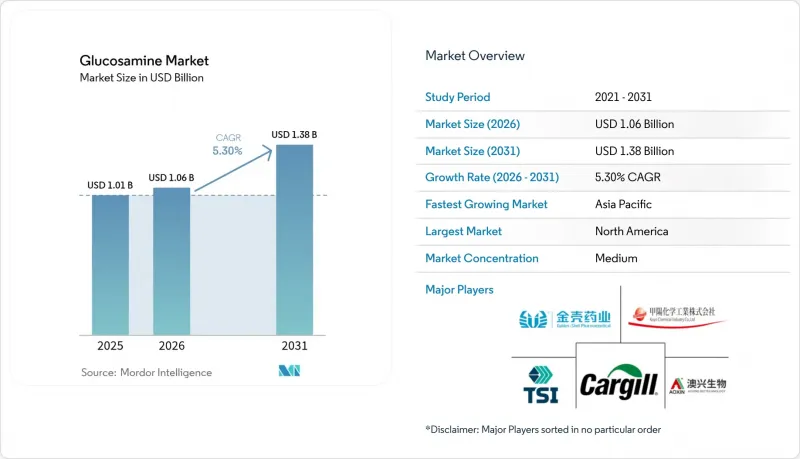
Mordor Intelligence에 의하면, 글루코사민 시장 규모는 2025년에 10억 1,000만 달러로 평가되었고 2026년 10억 6,000만 달러에서 2031년까지 13억 8,000만 달러에 이를 것으로 예측되며, 예측 기간(2026-2031년) CAGR은 5.30%를 나타낼 전망입니다.
본 보고서는 유형(글루코사민 황산염, 글루코사민 염산염(HCl), 기타), 원료 출처(갑각류 유래, 발효 유래, 기타), 용도(영양 보조 식품, 반려동물·수의용 보충제, 기타), 지역(북미, 유럽, 아시아태평양, 남미, 기타)별로 분류되어 있습니다. 시장 규모는 상기 모든 부문에 대해 달러 기준 금액으로 제시되어 있습니다.
전 세계 글루코사민 시장 동향 및 인사이트
퇴행성 관절염 유병률 증가 및 고령화
세계적으로 퇴행성 관절염 환자 수가 크게 증가하고 있으며, 선진국 및 개발도상 지역에서 유병률이 높아지고 있습니다. 이 질환은 주로 여성과 고령자에게 영향을 미치며, 이들은 평생에 걸쳐 관절 관리용 보충제가 필요합니다. 전 세계 장애의 주요 원인인 퇴행성 관절염은 직장 내 생산성 저하, 의료비 증가, 장기적인 의료 서비스 필요성을 통해 경제적 손실을 초래하고 있습니다. 이러한 지속적인 건강상의 부담, 전 세계 인구의 고령화, 그리고 관절 건강에 대한 인식 제고가 글루코사민 제품에 대한 안정적인 수요를 뒷받침하고 있습니다. 퇴행성 관절염은 만성 질환이기 때문에 지속적인 관리가 필요하며, 이것이 시장의 안정성에 기여하고 있습니다.
영양 보충제 소비 확대
미국인들은 건강 관리의 일환으로 일상적으로 영양 보충제를 섭취하고 있습니다. 젊은 층부터 고령층에 이르기까지 예방적 건강 관리를 중시하는 경향이 있어, 글루코사민, 콘드로이틴, 메틸설포닐메탄(MSM)이 함유된 복합 관절 보충제의 매출이 증가하고 있습니다. 이러한 보충제는 특히 활동적인 사람들과 고령층의 관절 건강과 가동성을 지원합니다. 맞춤형 영양 앱, 정기 구독 서비스, 원격 약국 플랫폼의 부상은 보충제 소비를 촉진하고, 디지털 채널을 통해 글루코사민 시장을 확대시키고 있습니다. 이러한 디지털 플랫폼을 통해 소비자는 자신의 건강 목표와 요구 사항에 기반한 맞춤형 추천을 받으며 편리하게 보충제를 구입할 수 있습니다.
갑각류 유래 원료공급 변동
주로 새우와 게 등 갑각류를 원료로 하는 글루코사민은 갑각류 공급량의 변동으로 인해 생산 차질과 비용 상승에 직면해 있습니다. 해양 오염, 기후 변화, 해수 온도 상승과 같은 환경 문제로 인해 많은 지역에서 서식 환경이 악화되고, 갑각류의 개체 수가 감소하고 있습니다. 지속 불가능한 어획과 남획은 글루코사민 추출에 필수적인 갑각류의 껍질을 더욱 고갈시키고 있습니다. 동남아시아에서는 새우 양식장이 질병 발생으로 어려움을 겪고 있으며, 그 결과 갑각류 생산량이 현저히 감소하고 있습니다. 해양 생태계를 보호하기 위해 어획 할당량이나 계절별 어업 금지 등의 규제 조치가 시행되고 있지만, 이는 공급 억제으로도 이어지고 있습니다. 게다가 주요 수출국, 특히 중국과 베트남에서의 지정학적 긴장과 무역 혼란이 시장에 불확실성을 초래하고 있습니다. 이러한 요인들이 복합적으로 작용하여 글루코사민 생산자들에게는 공급 불안정, 비용 급등, 생산 계획 수립에 따른 과제가 발생하고 있습니다.
부문 분석
2025년 기준, 갑각류 유래 글루코사민은 확립된 공급망과 소비자의 친숙도라는 장점 덕분에 79.10%의 시장 점유율을 유지하고 있습니다. 게나 새우 껍질에서 추출하는 기존 방식은 기존의 수산 가공 폐기물을 활용하고 있어, 폐기물 활용을 통해 비용 효율성과 환경적 이점을 제공합니다. 그러나 알레르기 회피, 지속가능성에 대한 우려, 그리고 공급망 다각화 전략에 힘입어 발효 유래 대체품은 2031년까지 연평균 성장률(CAGR) 7.74%를 나타낼 것으로 예측됩니다.
인공 효소 바이오 시스템을 포함한 첨단 생산 방식의 개발로, 발효를 통해 전분을 글루코사민으로 높은 전환 효율을 실현하고 있습니다. 이 혁신적인 생산 방식은 제품의 품질을 유지하면서 환경에 미치는 영향을 대폭 줄여줍니다. 발효 공정에서는 재생 가능한 자원을 활용하고 제조 조건을 엄격하게 관리함으로써 안정적인 제품 품질을 확보합니다. 이 생산 방식은 공급 안정성에 대한 우려와 특히 친환경 제품을 선호하는 소비자의 기호 모두에 부응하는 지속 가능한 대안을 제공합니다.
지역별 분석
북미는 확립된 헬스케어 인프라, 관절 건강 보충제에 대한 소비자의 높은 인식, 그리고 FDA의 감독 하에 있는 유리한 규제 체계를 바탕으로 2025년에는 38.85%의 점유율을 유지하며 시장을 선도하고 있습니다. 이 지역은 주요 의료 기관에서 수행되는 광범위한 임상 연구와 약국 체인 및 전문 소매업체를 통한 강력한 유통 네트워크의 혜택을 받고 있습니다. 소비자의 지출 패턴에는 글루코사민이 일상적인 건강 관리에 통합되어 있는 점이 반영되어 있으며, 의약품 등급 제제의 경우 경우에 따라 보험 적용을 받을 수도 있습니다. 베이비붐 세대의 고령화가 지속적인 수요를 창출하는 한편, 젊은 소비자층도 피트니스 및 웰니스 트렌드의 영향을 받아 예방적 보충제 섭취 전략을 점점 더 많이 채택하고 있습니다.
아시아태평양은 중산층의 확대, 헬스케어 비용 증가, 그리고 서유럽식 영양 접근법에 대한 인식 제고에 힘입어 2031년까지 연평균 성장률(CAGR) 7.99%로 가장 빠르게 성장하는 지역으로 부상하고 있습니다. 중국과 인도는 국내 생산 능력과 전통 의학에 기반한 천연 건강 제품에 대한 수용에 힘입어 특히 활기찬 시장을 형성하고 있습니다. 또한 일본에는 정교한 기능성 식품 시장이 존재합니다. 이 지역이 가진 제조 비용 우위, 특히 발효 유래 제품 생산에서의 우위 덕분에 아시아태평양은 세계 글루코사민 공급망에서 소비와 수출의 거점으로서의 입지를 확고히 하고 있습니다.
유럽은 엄격한 규제 감독과 증거 기반 의료 접근 방식을 특징으로 하는 성숙한 시장입니다. 유럽식품안전청(EFSA)의 건강 표시에 대한 엄격한 평가 절차는 신규 시장 진출기업에게는 장벽이 되는 반면, 승인된 표시를 가진 기존 제품을 보호하고 있습니다. 소비자들의 선호는 임상 데이터로 뒷받침되는 의약품 등급 제제를 선호하는 경향을 보이며, 이는 이 지역이 근거 기반 의료를 중시하고 있음을 반영합니다. 이 시장은 퇴행성 관절염 연구를 수행하는 강력한 연구 기관과 약국 채널을 통한 확고한 유통망의 혜택을 받고 있습니다. 브렉시트의 영향은 계속해서 규제 조화에 영향을 미치고 있으며, 영국에서는 영양보충제 및 기능성 식품에 대한 독자적인 평가 체계가 마련되고 있습니다.
기타 혜택:
- 엑셀 형식 시장 예측(ME) 시트
- 3개월간의 애널리스트 지원
자주 묻는 질문
목차
제1장 서론
제2장 조사 방법
제3장 주요 요약
제4장 시장 구도
제5장 시장 규모와 성장 예측
제6장 경쟁 구도
제7장 시장 기회와 향후 전망
JHS 26.09.07According to Mordor Intelligence, the glucosamine market size was valued at USD 1.01 billion in 2025 and estimated to grow from USD 1.06 billion in 2026 to reach USD 1.38 billion by 2031, at a CAGR of 5.30% during the forecast period (2026-2031).
This report is Segmented by Type (Glucosamine Sulfate, Glucosamine Hydrochloride (HCl), and More), Source (Shellfish-Derived, Fermentation-Derived, and Others), Application (Nutritional Supplements, Pet and Veterinary Supplements, and More), and Geography (North America, Europe, Asia-Pacific, South America, and More). Market Sizing is Presented in USD Value Terms for all the Abovementioned Segments.
Global Glucosamine Market Trends and Insights
Rising Prevalence of Osteoarthritis and Aging Population
Osteoarthritis cases worldwide have increased significantly, with higher prevalence rates in developed and developing regions. The condition predominantly affects women and older adults, who require joint-care supplements throughout their lives. As a major cause of global disability, osteoarthritis results in economic losses through reduced workplace productivity, higher healthcare costs, and long-term medical care needs. The persistent health burden, aging global population, and growing awareness of joint health maintain consistent demand for glucosamine products. The chronic nature of osteoarthritis requires continuous management, supporting market stability.
Increasing consumption of nutraceuticals
The United States population regularly incorporates dietary supplements into their health routines. Both young and older adults emphasize preventive healthcare, which increases the sales of combination joint supplements containing glucosamine, chondroitin, and Methylsulfonylmethane (MSM). These supplements support joint health and mobility, particularly among active individuals and aging populations. The rise of personalized nutrition applications, subscription services, and tele-pharmacy platforms drives supplement consumption and expands the glucosamine market through digital channels. These digital platforms enable consumers to access supplements conveniently while receiving personalized recommendations based on their health goals and requirements.
Volatile supply of shellfish-based raw materials
Glucosamine, primarily sourced from shellfish like shrimp and crabs, faces production disruptions and cost inflation due to fluctuations in shellfish availability. Environmental challenges, including ocean pollution, climate change, and rising sea temperatures, have degraded habitats and diminished shellfish populations in numerous regions. Unsustainable harvesting and overfishing practices further deplete the shellfish shells essential for glucosamine extraction. In Southeast Asia, shrimp farms have grappled with disease outbreaks, leading to marked declines in shellfish production. To safeguard marine ecosystems, regulatory measures such as harvesting quotas and seasonal bans have been implemented, but they also curtail supply. Moreover, geopolitical tensions and trade disruptions in major exporting nations, particularly China and Vietnam, introduce unpredictability to the market. Collectively, these factors contribute to supply instability, escalating costs, and challenges in production planning for glucosamine producers.
Other drivers and restraints analyzed in the detailed report include:
- Growing awareness of preventive healthcare and joint health
- Expansion of functional foods and fortified products market
- Availability of Effective Alternatives
For complete list of drivers and restraints, kindly check the Table Of Contents.
Segment Analysis
Shellfish-derived glucosamine maintains 79.10% market share in 2025, benefiting from established supply chains and consumer familiarity. Traditional extraction methods from crab and shrimp shells leverage existing seafood processing waste streams, creating cost efficiencies and environmental benefits through waste utilization. However, fermentation-derived alternatives exhibit 7.74% CAGR growth through 2031, driven by allergy avoidance, sustainability concerns, and supply chain diversification strategies.
The development of advanced production methods, including artificial enzymatic biosystems, enables high conversion efficiency from starch to glucosamine through fermentation. This innovative production method significantly reduces environmental impact while maintaining product quality. The fermentation process utilizes renewable resources and controlled manufacturing conditions, resulting in consistent product quality. This production method offers a sustainable alternative that addresses both supply security concerns and consumer preferences, particularly among those seeking environmentally responsible products.
Complete Report Scope:
- By Type
- Glucosamine Sulfate
- Glucosamine Hydrochloride (HCl)
- N-Acetyl-glucosamine
- Other Types
- By Source
- Shellfish-derived
- Fermentation-derived
- Others
- By Application
- Nutritional Supplements
- Pet and Veterinary Supplements
- Functional Foods and Fortified Products
- Other Applications
- By Geography
- North America
- United States
- Canada
- Mexico
- Rest of North America
- Europe
- Germany
- United Kingdom
- Italy
- France
- Spain
- Netherlands
- Rest of Europe
- Asia-Pacific
- China
- India
- Japan
- Australia
- Rest of Asia-Pacific
- South America
- Brazil
- Argentina
- Rest of South America
- Middle East and Africa
- South Africa
- Saudi Arabia
- United Arab Emirates
- Rest of Middle East and Africa
- North America
Geography Analysis
North America maintains market leadership with 38.85% share in 2025, supported by established healthcare infrastructure, high consumer awareness of joint health supplements, and favorable regulatory frameworks under FDA oversight. The region benefits from extensive clinical research conducted at major medical institutions and strong distribution networks through pharmacy chains and specialized retailers. Consumer spending patterns reflect integration of glucosamine into routine healthcare regimens, with insurance coverage occasionally available for pharmaceutical-grade formulations. The aging baby boomer demographic creates sustained demand, while younger consumers increasingly adopt preventive supplementation strategies influenced by fitness and wellness trends.
Asia-Pacific emerges as the fastest-growing region with 7.99% CAGR through 2031, driven by expanding middle-class populations, increasing healthcare expenditure, and growing awareness of Western nutritional approaches. China and India represent particularly dynamic markets, benefiting from domestic manufacturing capabilities and acceptance of traditional medicine natural health products. Japan's sophisticated functional foods market. The region's manufacturing cost advantages, particularly for fermentation-derived production, position Asia-Pacific as both a consumption and export hub for global glucosamine supply chains.
Europe represents a mature market characterized by stringent regulatory oversight and evidence-based healthcare approaches. The European Food Safety Authority's rigorous evaluation processes for health claims create barriers for new entrants while protecting established products with approved claims. Consumer preferences favor pharmaceutical-grade formulations with clinical documentation, reflecting the region's emphasis on evidence-based medicine. The market benefits from strong research institutions conducting osteoarthritis studies and established distribution through pharmacy channels. Brexit implications continue affecting regulatory harmonization, with the UK developing independent evaluation frameworks for dietary supplements and functional foods.
- Koyo Chemical Co., Ltd.
- Cargill, Inc.
- Zhejiang Aoxing Biotechnology Co., Ltd.
- TSI Group Ltd.
- Golden-Shell Pharmaceutical Co., Ltd.
- Panvo Organics Pvt. Ltd.
- Ethical Naturals, Inc.
- Bioiberica S.A.U.
- Gnosis by Lesaffre
- Alchemy Industries Pvt. Ltd.
- Jiaxing Hengjie Biopharm Co., Ltd.
- Rochem International, Inc.
- Lifecore Biomedical
- Merck KGaA (Chondro-additive)
- Zhengzhou Alfa Chemical Co.,Ltd
- Bio-gen Extracts Pvt. Ltd.
- CAPTEK Softgel International Inc.
- Kraeber & Co GmbH
- Xi'an Tian Guangyuan Biotech Co., Ltd.
- Lifecore Biomedical
Additional Benefits:
- The market estimate (ME) sheet in Excel format
- 3 months of analyst support
TABLE OF CONTENTS
1 INTRODUCTION
- 1.1 Study Assumptions and Market Definition
- 1.2 Scope of the Study
2 RESEARCH METHODOLOGY
3 EXECUTIVE SUMMARY
4 MARKET LANDSCAPE
- 4.1 Market Overview
- 4.2 Market Drivers
- 4.2.1 Rising prevalence of osteoarthritis and aging population
- 4.2.2 Increasing consumption of nutraceuticals
- 4.2.3 Growing awareness of preventive healthcare and joint health
- 4.2.4 Expansion of functional foods and fortified products market
- 4.2.5 Adoption of vegan-fermented glucosamine
- 4.2.6 Growth in pet humanization and veterinary supplements
- 4.3 Market Restraints
- 4.3.1 Risk of shellfish allergies and volatile supply of shellfish-based raw materials
- 4.3.2 Availability of effective alternatives
- 4.3.3 Stringent regulatory frameworks for novel foods and dietary supplements
- 4.3.4 High production costs of vegan/fermentation-derived glucosamine
- 4.4 Value Chain Analysis
- 4.5 Regulatory Landscape
- 4.6 Technological Outlook
- 4.7 Porter's Five Forces Analysis
- 4.7.1 Bargaining Power of Suppliers
- 4.7.2 Bargaining Power of Buyers
- 4.7.3 Threat of New Entrants
- 4.7.4 Threat of Substitutes
- 4.7.5 Intensity of Competitive Rivalry
5 MARKET SIZE AND GROWTH FORECASTS (VALUE)
- 5.1 By Type
- 5.1.1 Glucosamine Sulfate
- 5.1.2 Glucosamine Hydrochloride (HCl)
- 5.1.3 N-Acetyl-glucosamine
- 5.1.4 Other Types
- 5.2 By Source
- 5.2.1 Shellfish-derived
- 5.2.2 Fermentation-derived
- 5.2.3 Others
- 5.3 By Application
- 5.3.1 Nutritional Supplements
- 5.3.2 Pet and Veterinary Supplements
- 5.3.3 Functional Foods and Fortified Products
- 5.3.4 Other Applications
- 5.4 By Geography
- 5.4.1 North America
- 5.4.1.1 United States
- 5.4.1.2 Canada
- 5.4.1.3 Mexico
- 5.4.1.4 Rest of North America
- 5.4.2 Europe
- 5.4.2.1 Germany
- 5.4.2.2 United Kingdom
- 5.4.2.3 Italy
- 5.4.2.4 France
- 5.4.2.5 Spain
- 5.4.2.6 Netherlands
- 5.4.2.7 Rest of Europe
- 5.4.3 Asia-Pacific
- 5.4.3.1 China
- 5.4.3.2 India
- 5.4.3.3 Japan
- 5.4.3.4 Australia
- 5.4.3.5 Rest of Asia-Pacific
- 5.4.4 South America
- 5.4.4.1 Brazil
- 5.4.4.2 Argentina
- 5.4.4.3 Rest of South America
- 5.4.5 Middle East and Africa
- 5.4.5.1 South Africa
- 5.4.5.2 Saudi Arabia
- 5.4.5.3 United Arab Emirates
- 5.4.5.4 Rest of Middle East and Africa
- 5.4.1 North America
6 COMPETITIVE LANDSCAPE
- 6.1 Market Concentration Analysis
- 6.2 Strategic Moves and Developments
- 6.3 Market Ranking Analysis
- 6.4 Company Profiles (includes Global Level Overview, Market Level Overview, Core Segments, Financials, Strategic Info, Market Rank/Share, Products and Services, Recent Developments)
- 6.4.1 Koyo Chemical Co., Ltd.
- 6.4.2 Cargill, Inc.
- 6.4.3 Zhejiang Aoxing Biotechnology Co., Ltd.
- 6.4.4 TSI Group Ltd.
- 6.4.5 Golden-Shell Pharmaceutical Co., Ltd.
- 6.4.6 Panvo Organics Pvt. Ltd.
- 6.4.7 Ethical Naturals, Inc.
- 6.4.8 Bioiberica S.A.U.
- 6.4.9 Gnosis by Lesaffre
- 6.4.10 Alchemy Industries Pvt. Ltd.
- 6.4.11 Jiaxing Hengjie Biopharm Co., Ltd.
- 6.4.12 Rochem International, Inc.
- 6.4.13 Lifecore Biomedical
- 6.4.14 Merck KGaA (Chondro-additive)
- 6.4.15 Zhengzhou Alfa Chemical Co.,Ltd
- 6.4.16 Bio-gen Extracts Pvt. Ltd.
- 6.4.17 CAPTEK Softgel International Inc.
- 6.4.18 Kraeber & Co GmbH
- 6.4.19 Xi'an Tian Guangyuan Biotech Co., Ltd.
- 6.4.20 Lifecore Biomedical