
|
시장보고서
상품코드
2123610
자동차 배터리 관리 시스템 시장 : 점유율 분석, 업계 동향과 통계, 성장 예측(2026-2031년)Automotive Battery Management Systems - Market Share Analysis, Industry Trends & Statistics, Growth Forecasts (2026 - 2031) |
||||||
 Mordor Intelligence
Mordor Intelligence에 의하면, 2026년 자동차 배터리 관리 시스템 시장 규모는 186억 6,000만 달러로 추정되고 있어 2025년 152억 1,000만 달러에서 확대되어, 2031년에는 518억 5,000만 달러에 이를 것으로 예측됩니다.
2026년부터 2031년까지 연평균 성장률(CAGR) 22.68%로 성장할 것으로 전망됩니다.
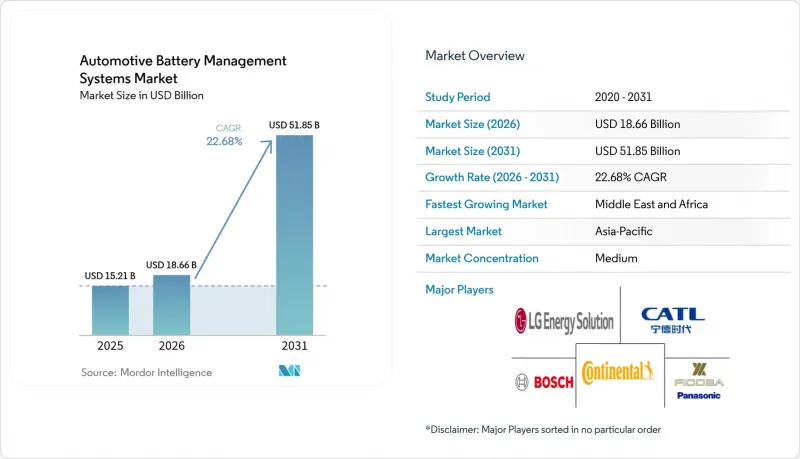
본 보고서는 구성 요소별(배터리 IC, 배터리 센서 등), 토폴로지별(집중형, 모듈형 등), 구동 방식별(하이브리드 전기차(HEV), 배터리 전기차(BEV) 등),차종별(승용차, 소형 상용차 등), 지역별(북미 등)로 분류되어 있습니다. 시장 예측은 금액(달러) 기준으로 제시되어 있습니다.
전 세계 자동차 배터리 관리 시스템 시장 동향 및 인사이트
전 세계적으로 확대되는 전기차(EV) 판매 의무화
EU 및 캘리포니아주 등 지역에서의 ZEV(제로 배출 차량) 정책 의무화로 인해, 배터리의 내구성, 주행 거리 유지율 및 배터리 상태 투명성에 관한 기준이 높아지고 있습니다. 유로 7 규제는 2026년에 시행되며, 캘리포니아주의 ‘Advanced Clean Cars II’에서는 15만 마일 주행 후 주행 거리의 80% 유지를 요구하고 있어, BMS 공급업체들은 더욱 정밀한 배터리 상태 분석 및 열화 모델링의 도입을 촉구받고 있습니다. 규제의 조화로 인해 세계 플랫폼에서는 규정 준수가 완료된 단일 아키텍처의 채택이 촉진되고 있으며, 각 OEM 업체들이 지역별 고유 설계를 피함에 따라 자동차 배터리 관리 시스템 시장은 확대되고 있습니다. 이미 적응형 알고리즘을 통합한 공급업체는 선점 우위를 확보하는 반면, 기존 공급업체는 추가적인 검증 주기와 비용에 직면하고 있습니다.
배터리 팩의 비용 감소
리튬 이온 배터리 팩의 가격이 급격히 하락함에 따라 비용 구조가 재편되고 있습니다. 2024년에는 주류인 LFP 팩의 평균 가격이 1kWh당 75달러가 될 전망이며, 나트륨 이온 배터리의 시범 생산에서는 1kWh당 10달러라는 낮은 비용이 입증되었습니다. 셀 가격이 하락함에 따라, 각 OEM 업체들은 하드웨어 비용 절감에만 집중하는 것이 아니라, 예측 분석 및 무선 연결과 같은 보다 고도화된 BMS 기능에 배터리 예산의 더 큰 비중을 할당할 수 있게 되었습니다. 팩당 부가가치를 높이는 이러한 변화는 자동차 배터리 관리 시스템 시장 전체에서 첨단 배터리 관리 솔루션에 대한 수요를 촉진하고 있습니다.
열 폭주로 인한 리콜이 보증 충당금을 끌어올려
주목을 받은 발화 사고는 대규모 리콜로 이어졌으며, 자동차 제조업체들은 보증 충당금을 증액하고 보수적인 팩 설계를 채택할 수밖에 없게 되었습니다. 삼성SDI의 여러 브랜드에 걸친 리콜과 현대모비스의 자가 소화형 모듈 개발은 업계가 직면한 시급성을 여실히 드러내고 있습니다. 단열, 소화, 이중화 센서에 드는 추가 비용은 실험적인 BMS 기능의 도입을 지연시켜, 자동차 배터리 관리 시스템 시장의 단기적인 성장을 둔화시킬 가능성이 있습니다.
부문 분석
2025년, 배터리 센서는 자동차 배터리 관리 시스템 시장 점유율의 35.02%를 차지하며, 이 부문은 2031년까지 연평균 성장률(CAGR) 24.12%를 나타낼 것으로 전망됩니다. 온도, 압력, 배기 가스,습도를 포괄하는 다중 물리 센싱의 보급으로 인해, OEM 각사는 수동적인 보호에서 실시간 예측 진단으로 전환할 수 있게 될 것입니다. 규제 당국이 열 폭주 감지 기능 강화를 요구하고, 차량 운영 사업자가 가동 주기 및 보증 범위를 최적화하기 위한 상세한 데이터를 요구함에 따라 도입이 가속화되고 있습니다. CO₂ 및 H₂ 센서를 모듈 수준의 기판에 통합함으로써 조기 경보 기능이 향상되어 막대한 비용이 소요되는 리콜이나 가동 중단을 방지하는 데 도움이 됩니다. EV 팩의 전압이 800V를 초과함에 따라, 정확한 충전 상태(SOC) 및 건전성(SOH) 추정을 위해서는 고분해능 션트 센서나 홀 효과 센서가 필수적이며, 이는 이 부문의 장기적인 성장 궤도를 확고히 하고 있습니다.
셀 수준의 전압 정확도가 현재 ±2 mV에 도달함에 따라, 보다 정밀한 충전 밸런스 조정과 배터리 팩의 수명 연장이 가능해졌으며, IC의 정확도가 구매의 결정적인 기준이 되고 있습니다. 주요 칩 제조업체들은 측정, 밸런스 조정, 통신 각 블록을 단일 다이에 집적하여 기판의 실적를 축소하는 동시에 자동차용 인증 절차를 간소화하고 있습니다. 열전도성 갭 필러, 에어로겔 시트, 상변화 복합재료 등을 포함하는 나머지 ‘기타 전자 부품 및 재료’ 분야는 에너지 밀도의 상승에 따라 계속 확대되고 있으며, 우수한 열 확산 및 단열 솔루션이 요구되고 있습니다.
2025년에는 모듈식 구성이 자동차 배터리 관리 시스템 시장 점유율의 48.42%를 차지했습니다. 이는 OEM 각사가 전면적인 재설계를 거치지 않고도 재배치가 가능한 확장성이 높은 서브 배터리 모듈을 선호하고 있음을 반영합니다. 센싱과 액추에이션의 박스 수준 분리를 통해 상용 차량이나 이용 빈도가 높은 라이드셰어 차량에 적합한 내결함성이 실현됩니다. 또한, 증설 가능한 하드웨어 블록을 통해 라인 사이드에서 신속한 교체가 가능해져 차량 가동률이 향상됩니다.
무선 설계는 급속히 확대되고 있으며, 안테나의 소형화, 보안이 강화된 메시 프로토콜, 그리고 인증된 RF 스택이 양산 단계에 도달함에 따라 2026년부터 2031년까지 연평균 성장률(CAGR) 33.82%를 기록할 전망입니다. 데이지 체인 방식의 하네스를 제거함으로써 팩의 무게를 줄이고, 능동형 냉각 플레이트나 추가 셀을 수용할 귀중한 공간을 확보할 수 있습니다. 엔트리급 승용차의 경우 확장성보다 최소한의 부품 구성이 우선시되므로, 중앙 집중형 토폴로지가 계속해서 채택되고 있습니다. 반면, 모터스포츠 및 항공우주 분야의 크로스오버 프로그램에서는 틈새 시장인 분산형 아키텍처가 매우 높은 중복성 요건을 충족하고 있어, 자동차 배터리 관리 시스템 시장의 제품 다양성을 뒷받침하고 있습니다.
지역별 분석
2025년, 아시아태평양은 자동차 배터리 관리 시스템 시장에서 여전히 60.77%라는 압도적인 점유율을 유지했습니다. 중국에서는 업스트림 정제부터 최종 차량 조립에 이르기까지 수직 통합된 배터리 밸류체인을 통해 비용 구조가 압축되고 설계 반복 주기가 가속화되고 있습니다. 정부의 구매 인센티브, 대도시의 유리한 번호판 정책, 그리고 성숙한 충전 생태계가 전기차 보급률을 높이고 BMS 출하량을 끌어올리고 있습니다. 중국의 셀 및 모듈 공급업체들이 관세 없는 시장 접근을 확보하고 물류 경로를 단축하기 위해 폴란드, 헝가리, 네바다주에 공장을 설립함에 따라, 공급망의 우위는 유럽과 북미까지 미치고 있습니다.
중동 및 아프리카은 낮은 수준에서 출발하고 있음에도 불구하고, 2031년까지 연평균 성장률(CAGR)이 26.9%에 달하고, 가장 빠르게 성장하고 있는 지역입니다. 두바이, 리야드,카이로에서는 내열성을 갖춘 BMS 설계가 요구되는 전기 버스 전용 노선 및 라스트 마일 배송의 전기화 목표가 도입되고 있습니다. 민관 협력을 통해 계통 연계형 축전지에 대한 투자가 촉진되면서, 재사용된 차량용 배터리 팩 및 세컨드 라이프용 BMS 소프트웨어의 부수적인 판매 기회가 창출되고 있습니다.
북미에서는 ‘인플레이션 억제법(Inflation Reduction Act)’이 국내 배터리 셀 및 모듈 제조를 활성화하며 성장세가 가속화되고 있습니다. BMW, 토요타, 현대자동차의 캐롤라이나주, 조지아주, 온타리오주 투자로 인해 아시아산 수입에 대한 의존도가 낮아지면서 BMS 기판의 현지 조달이 뒷받침되고 있습니다. 유럽은 계속해서 규제 면에서 선구자적 역할을 하고 있으며, 도입이 예정된 ‘배터리 패스포트’를 통해 추적성 기능이 추진되면서 시스템의 복잡성과 소프트웨어 함량이 증가하고 있습니다. 이러한 요건으로 인해 차량당 수익이 증가하고, 안전한 클라우드 파이프라인을 구축한 공급업체가 차별화됨에 따라 자동차 배터리 관리 시스템 시장 전체의 건전한 전망이 유지되고 있습니다.
기타 혜택:
- 엑셀 형식 시장 예측(ME) 시트
- 3개월간의 애널리스트 지원
자주 묻는 질문
목차
제1장 서론
제2장 조사 방법
제3장 주요 요약
제4장 시장 구도
제5장 시장 규모와 성장 예측
제6장 경쟁 구도
제7장 시장 기회와 향후 전망
JHS 26.09.07According to Mordor Intelligence, the automotive battery management system market size in 2026 is estimated at USD 18.66 billion, growing from 2025 value of USD 15.21 billion with 2031 projections showing USD 51.85 billion, growing at 22.68% CAGR over 2026-2031.
This report is Segmented by Component (Battery IC, Battery Sensors, and More), Topology (Centralized, Modular, and More), Propulsion Type (Hybrid Electric Vehicle (HEV), Battery Electric Vehicle (BEV), and More), Vehicle Type (Passenger Cars, Light Commercial Vehicles, and More), and Geography (North America, and More). The Market Forecasts are Provided in Terms of Value (USD).
Global Automotive Battery Management Systems Market Trends and Insights
EV sales mandates widening globally
Binding ZEV policies in regions such as the EU and California raise the baseline for durability, range retention, and transparency of battery health. Euro 7 rules will be effective in 2026, and California's Advanced Clean Cars II demands 80% range retention for 150,000 miles, compelling BMS suppliers to incorporate more refined state-of-health analytics and degradation modeling. Harmonizing rules incentivize global platforms to adopt one compliance-ready architecture, elevating the automotive battery management system market as OEMs avoid region-specific designs. Suppliers that already embed adaptive algorithms gain a head start, whereas legacy providers face added validation cycles and cost.
Falling cost of battery packs
Rapid declines in lithium-ion battery-pack prices are reshaping cost structures. Mainstream LFP packs averaged USD 75 per kWh in 2024, and pilot sodium-ion runs have demonstrated costs as low as USD 10 per kWh. As cells get cheaper, OEMs can allocate larger portions of the battery budget to smarter BMS functions, such as predictive analytics and wireless connectivity, rather than focusing solely on hardware cost reduction. This shift toward higher value content per pack reinforces demand for advanced battery management solutions across the automotive battery management system market.
Thermal-runaway recalls raising warranty reserves
High-profile fire events have led to sizable recalls, forcing automakers to boost warranty accruals and adopt conservative pack design. Samsung SDI's multi-brand recall and Hyundai Mobis' development of self-extinguishing modules underscore industry urgency. Added cost for insulation, fire suppression, and redundant sensors can slow deployment of experimental BMS functions, tempering near-term growth in the automotive battery management system market.
Other drivers and restraints analyzed in the detailed report include:
- Shift from centralized to modular and wireless topologies
- Soaring demand for LFP chemistry requiring advanced active balancing
- Acute power-semiconductor shortages
For complete list of drivers and restraints, kindly check the Table Of Contents.
Segment Analysis
Battery Sensors captured 35.02% of the automotive battery management system market share in 2025, and the segment is forecast to post a 24.12% CAGR through 2031. Wider deployment of multi-physics sensing, covering temperature, pressure, off-gas, and humidity, allows OEMs to move from passive protection toward real-time predictive diagnostics. Adoption accelerates as regulators demand enhanced thermal-runaway detection and as fleet operators seek granular data to optimize duty cycles and warranty coverage. Integrating CO2 and H2 sensors into module-level boards improves early-warning capabilities, helping avoid costly recalls and downtime. As EV packs scale above 800 V, high-resolution shunt and Hall-effect sensors become indispensable for accurate state-of-charge and state-of-health estimation, cementing the segment's long-term expansion path.
Tight cell-level voltage accuracy, now reaching +-2 mV, enables finer charge balancing and extended pack life, making IC precision a decisive purchase criterion. Leading chipmakers have fused measurement, balancing, and communication blocks onto single dies, shrinking board footprints and simplifying automotive qualifications. The residual "Other electronics and materials" bucket, encompassing thermally conductive gap fillers, aerogel sheets, and phase-change composites, continues to broaden as energy density rises, calling for superior heat-spreading and insulation solutions.
In 2025, Modular arrangements accounted for 48.42% of the automotive battery management system market share, reflecting OEM preference for scalable sub-battery modules that can be rearranged without wholesale redesign. Box-level isolation of sensing and actuation delivers fault tolerance suited to commercial fleets and high-utilization ride-hailing vehicles. Incremental hardware blocks also facilitate rapid line-side replacement, lifting vehicle uptime.
Wireless designs are scaling rapidly, showing a 33.82% CAGR across 2026-2031 as antenna miniaturization, secure mesh protocols, and certified RF stacks reach production maturity. Eliminating daisy-chain harnesses cuts pack weight and opens valuable cubic centimeters for active cooling plates or extra cells. Centralized topologies continue in entry-price passenger cars, where minimal components trump expandability, whereas niche distributed architectures meet extreme redundancy mandates in motorsports and aerospace crossover programs, cushioning product diversity inside the automotive battery management system market.
Complete Report Scope:
- By Component
- Battery IC
- Battery Sensors
- Other Electronics and Materials
- By Topology
- Centralized
- Modular
- Distributed
- Wireless
- By Propulsion Type
- Hybrid Electric Vehicle (HEV)
- Plug-in Hybrid Electric Vehicle (PHEV)
- Battery Electric Vehicle (BEV)
- Fuel-Cell Electric Vehicle (FCEV)
- By Vehicle Type
- Passenger Cars
- Light Commercial Vehicles
- Medium and Heavy Commercial Vehicles
- Two and Three-Wheelers
- Off-Highway and Specialty Vehicles
- By Geography
- North America
- United States
- Canada
- Rest of North America
- South America
- Brazil
- Argentina
- Rest of South America
- Europe
- Germany
- United Kingdom
- France
- Spain
- Italy
- Russia
- Rest of Europe
- Asia-Pacific
- China
- Japan
- India
- South Korea
- Australia
- Rest of Asia-Pacific
- Middle East and Africa
- Saudi Arabia
- United Arab Emirates
- Turkey
- Egypt
- South Africa
- Rest of Middle East and Africa
- North America
Geography Analysis
Asia-Pacific retained a commanding 60.77% share of the automotive battery management system market in 2025. China's vertically integrated battery value chain-from upstream refining to final vehicle assembly-compresses cost structures and quickens design iterations. Government purchase incentives, favorable license-plate policies in megacities, and a mature charging ecosystem lift EV penetration and reinforce BMS unit shipments. Supply-chain leverage even extends to Europe and North America, as Chinese cell and module suppliers open factories in Poland, Hungary, and Nevada to secure tariff-free access and shorten logistics lanes.
The Middle East and Africa region, although emerging from a low base, is the fastest-growing region with a 26.9% CAGR through 2031. Dubai, Riyadh, and Cairo are rolling out e-bus corridors and last-mile delivery electrification targets that demand heat-tolerant BMS designs. Public-private alliances channel investment into grid-tied battery storage, creating adjacent sales for repurposed vehicle packs and second-life BMS software.
North America gains momentum as the Inflation Reduction Act galvanizes domestic cell and module manufacturing. Investments by BMW, Toyota, and Hyundai in the Carolinas, Georgia, and Ontario shrink reliance on Asian imports and underpin local sourcing of BMS boards. Europe remains a regulatory trailblazer, with the upcoming battery passport pushing traceability features that increase system complexity and software content. Such requirements elevate per-vehicle revenue and differentiate suppliers ready with secure cloud pipelines, sustaining a healthy overall outlook for the automotive battery management system market.
- LG Energy Solution
- CATL
- Panasonic (Ficosa)
- Robert Bosch GmbH
- Continental AG
- Texas Instruments
- Analog Devices
- Infineon Technologies
- NXP Semiconductors
- Renesas Electronics
- Hitachi Astemo
- Mitsubishi Electric
- Denso Corporation
- Preh GmbH
- Eaton Mobility (Eatron)
- Lithium Balance
- Sensata Technologies
- Eberspacher Vecture
- Rimac Technology
Additional Benefits:
- The market estimate (ME) sheet in Excel format
- 3 months of analyst support
TABLE OF CONTENTS
1 Introduction
- 1.1 Study Assumptions & Market Definition
- 1.2 Scope of the Study
2 Research Methodology
3 Executive Summary
4 Market Landscape
- 4.1 Market Overview
- 4.2 Market Drivers
- 4.2.1 EV sales mandates widening globally
- 4.2.2 Falling cost of battery packs
- 4.2.3 Shift from centralized to modular and wireless topologies
- 4.2.4 Soaring demand for LFP chemistry requiring advanced active balancing
- 4.2.5 ISO 21434-driven "cyber-secure BMS" demand
- 4.2.6 OEM move to in-house BMS ASIC design to cut IP royalty cost
- 4.3 Market Restraints
- 4.3.1 Thermal-runaway recalls raising warranty reserves
- 4.3.2 Acute power-semiconductor shortages
- 4.3.3 Post-2027 EU "battery-passport" traceability overheads
- 4.3.4 AI-based predictive BMS still lacks functional-safety certification
- 4.4 Value / Supply-Chain Analysis
- 4.5 Regulatory Landscape
- 4.6 Technological Outlook
- 4.7 Porter's Five Forces
- 4.7.1 Threat of New Entrants
- 4.7.2 Bargaining Power of Buyers
- 4.7.3 Bargaining Power of Suppliers
- 4.7.4 Threat of Substitutes
- 4.7.5 Competitive Rivalry
5 Market Size & Growth Forecasts (Value in USD)
- 5.1 By Component
- 5.1.1 Battery IC
- 5.1.2 Battery Sensors
- 5.1.3 Other Electronics and Materials
- 5.2 By Topology
- 5.2.1 Centralized
- 5.2.2 Modular
- 5.2.3 Distributed
- 5.2.4 Wireless
- 5.3 By Propulsion Type
- 5.3.1 Hybrid Electric Vehicle (HEV)
- 5.3.2 Plug-in Hybrid Electric Vehicle (PHEV)
- 5.3.3 Battery Electric Vehicle (BEV)
- 5.3.4 Fuel-Cell Electric Vehicle (FCEV)
- 5.4 By Vehicle Type
- 5.4.1 Passenger Cars
- 5.4.2 Light Commercial Vehicles
- 5.4.3 Medium and Heavy Commercial Vehicles
- 5.4.4 Two and Three-Wheelers
- 5.4.5 Off-Highway and Specialty Vehicles
- 5.5 By Geography
- 5.5.1 North America
- 5.5.1.1 United States
- 5.5.1.2 Canada
- 5.5.1.3 Rest of North America
- 5.5.2 South America
- 5.5.2.1 Brazil
- 5.5.2.2 Argentina
- 5.5.2.3 Rest of South America
- 5.5.3 Europe
- 5.5.3.1 Germany
- 5.5.3.2 United Kingdom
- 5.5.3.3 France
- 5.5.3.4 Spain
- 5.5.3.5 Italy
- 5.5.3.6 Russia
- 5.5.3.7 Rest of Europe
- 5.5.4 Asia-Pacific
- 5.5.4.1 China
- 5.5.4.2 Japan
- 5.5.4.3 India
- 5.5.4.4 South Korea
- 5.5.4.5 Australia
- 5.5.4.6 Rest of Asia-Pacific
- 5.5.5 Middle East and Africa
- 5.5.5.1 Saudi Arabia
- 5.5.5.2 United Arab Emirates
- 5.5.5.3 Turkey
- 5.5.5.4 Egypt
- 5.5.5.5 South Africa
- 5.5.5.6 Rest of Middle East and Africa
- 5.5.1 North America
6 Competitive Landscape
- 6.1 Market Concentration
- 6.2 Strategic Moves
- 6.3 Market Share Analysis
- 6.4 Company Profiles (Includes Global Level Overview, Market Level Overview, Core Segments, Financials as Available, Strategic Information, Market Rank/Share for Key Companies, Products and Services, SWOT Analysis, and Recent Developments)
- 6.4.1 LG Energy Solution
- 6.4.2 CATL
- 6.4.3 Panasonic (Ficosa)
- 6.4.4 Robert Bosch GmbH
- 6.4.5 Continental AG
- 6.4.6 Texas Instruments
- 6.4.7 Analog Devices
- 6.4.8 Infineon Technologies
- 6.4.9 NXP Semiconductors
- 6.4.10 Renesas Electronics
- 6.4.11 Hitachi Astemo
- 6.4.12 Mitsubishi Electric
- 6.4.13 Denso Corporation
- 6.4.14 Preh GmbH
- 6.4.15 Eaton Mobility (Eatron)
- 6.4.16 Lithium Balance
- 6.4.17 Sensata Technologies
- 6.4.18 Eberspacher Vecture
- 6.4.19 Rimac Technology
7 Market Opportunities & Future Outlook
- 7.1 White-space & Unmet-Need Assessment