|
시장보고서
상품코드
2123616
세포 분리 시장 : 점유율 분석, 업계 동향과 통계, 성장 예측(2026-2031년)Cell Isolation - Market Share Analysis, Industry Trends & Statistics, Growth Forecasts (2026 - 2031) |
||||||
 Mordor Intelligence
Mordor Intelligence에 의하면, 세포 분리 시장 규모는 2025년 157억 6,000만 달러에서 2026년에는 179억 1,000만 달러로 확대되어 2026년부터 2031년까지 CAGR 13.62%로 성장을 지속하여, 2031년에는 339억 1,000만 달러에 이를 것으로 예측됩니다.
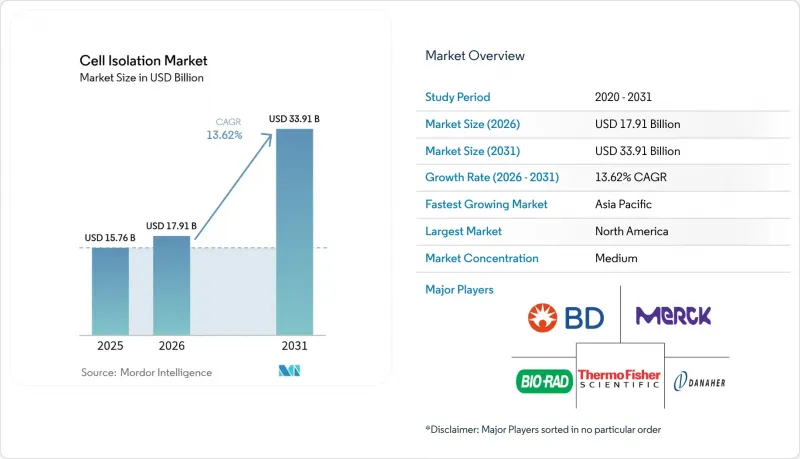
본 보고서는 제품별(소모품 및 장비), 방법별(밀도 구배 원심분리법 등), 세포 유형별(인간 및 동물), 세포 유래별(말초혈액, 골수 등),최종 사용자별(연구 기관, 생명공학 기업, CRO, 진단 검사 기관), 지역별(북미, 유럽, 아시아태평양, 중동 및 아프리카, 남미)로 분류되어 있습니다. 시장 예측은 금액(달러) 기준으로 제시되어 있습니다.
세계 세포 분리 시장 동향 및 인사이트
세포 치료법 채택 확대
2024년에 37개의 세포 및 유전자 치료 제품이 FDA 승인을 받은 것은 정밀한 세포 분리 워크플로우가 필요한 ‘살아있는 의약품’으로의 임상적 전환을 여실히 보여주고 있습니다. CAR-T 프로그램이 증가하고 있으며, 비용 최적화된 동종 이식 플랫폼이 3상 임상시험 단계로 진입함에 따라 림프구 하위 집합의 표준화된 고처리량 선별에 대한 수요가 증가하고 있습니다. 브라질에서 3만 5,000달러 규모의 CAR-T 프로그램은 지역별 비용 혁신이 어떻게 새로운 환자 집단을 개척하고, 대상 세포 분리 시장을 확대할 수 있는지를 보여줍니다. 파이프라인의 규모가 확대됨에 따라 확장성과 배치 간 균일성은 장비 및 시약 구매에 있어 결정적인 기준이 되고 있습니다.
생명과학 연구에 대한 자금 지원 증가
NIH의 하이엔드 장비(HEI) 및 공유 장비 보조금 프로그램은 유세포 분석기 및 세포 분석 장치에 대해 건당 최대 200만 달러를 지원하며, 예측 가능한 국내 수요 주기를 뒷받침하고 있습니다. 벤처 투자자들도 이러한 공공 기관의 열의에 호응하고 있습니다. Garuda Therapeutics는 기성(오프 더 셸프) 줄기세포 플랫폼을 위해 시리즈 A-1 자금 조달을 통해 5,000만 달러를 확보하며, 혁신적인 분리 기술에 대한 민간 부문의 신뢰를 입증했습니다. 코발리스 마이크로플루이딕스 기술 허브(2033년까지 5,000-12,000개의 일자리 창출 계획)와 같은 지역 기술 허브는 인재, 인프라, 자본을 집약하여 제품의 상용화를 가속화하고 있습니다.
첨단 장비의 높은 비용
최고급 세포 선별 장치는 종종 100만 달러를 넘는 가격으로 책정되어 있어, 소규모 연구 기관이나 신흥 시장의 연구소에서는 이용이 제한되고 있습니다. 2026년 2월까지 FDA가 ISO 13485를 준수하게 됨에 따라, 제조업체는 품질 관리 체계를 근본적으로 재검토해야 하며, 이로 인해 규정 준수 관련 비용이 증가하여 가격 급등으로 이어질 가능성이 있습니다. 자격을 갖춘 중소기업을 위한 510(k) 신청 수수료가 6,084달러로 인하되기는 했으나, 스타트업의 예산으로서는 여전히 큰 부담이 됩니다. 이러한 자금적 장벽으로 인해 사용자들은 리스 모델이나 중앙 집중형 핵심 시설을 이용하는 방향으로 전환하고 있습니다.
부문 분석
항체, 자성 비드, 밀도 매체, 일회용 카트리지의 지속적인 보충으로 인해 2025년 매출의 61.72%를 소모품이 차지했습니다. CAR-T 워크플로우에 맞춤화된 시약 및 GMP 등급 완충액은 고가대로 거래되어 공급업체에게 안정적이고 지속적인 수익원이 되고 있습니다. 장비 시장의 성장률은 규모는 작지만, 사용자들이 수동 원심분리기를 세포 세척, 부피 감소, 농축을 한 번의 공정으로 통합하는 밀폐형 자동 시스템으로 대체함에 따라 연평균 성장률(CAGR) 15.12%를 나타낼 것으로 예측됩니다. 조기 도입 기업들로부터 최대 40%의 노동력 절감과 오염 사고 감소가 보고되어, ROI 전망이 뒷받침되고 있습니다.
장비에 기인한 세포 분리 시장 규모는 멀티모달 플랫폼이 자기, 음향, 빛의 힘을 하나의 콤팩트한 케이스에 통합하고 기존 레이아웃에 비해 설치 면적을 30% 줄임에 따라 급격히 확대될 전망입니다. 각 벤더사는 현재 소모품을 구독 플랜에 포함시켜 첫해 자본 지출을 평준화함으로써 중규모 병원에 대한 접근성을 확대되고 있습니다. 이 전략은 시약의 지속적인 구매도 확보하여 벤더에 대한 고객 충성도를 높이고 있습니다.
MACS는 검증된 프로토콜, 광범위한 항체 메뉴, 확장 가능한 컬럼 형식을 강점으로 삼아 2025년에도 세포 분리 시장 점유율 45.02%를 유지했습니다. 한편, 희귀 세포 집단의 정밀한 포획이 필수적인 단일 세포 오믹스 연구를 원동력으로, 마이크로플루이딕스식 랩온칩 장치는 연평균 성장률(CAGR) 15.58%로 성장을 지속하고, 있습니다. 연구자들은 시료 및 시약 소비량이 75% 감소할 뿐만 아니라, 작업자의 생물학적 위험 노출이 줄어든다는 점을 꼽고 있습니다.
AI 제어 방식의 액적 생성 장치가 100µm 미만의 정밀도를 달성하고, 하이컨텐츠 시퀀싱을 위한 다운스트림 공정에서 바코드 부여가 가능해짐에 따라, 마이크로플루이딕스 기술에 기인한 세포 분리 시장 규모는 더욱 확대될 전망입니다. 현재 하이브리드 플랫폼에서는 유전영동을 통한 사전 농축과 자성 비드를 이용한 정제를 결합함으로써, 단일 연속 흐름에서 98% 이상의 순도를 달성하고 있으며, 설정 시간을 단축하는 동시에 고감도 응용 분야에서 세포 생존율을 유지하고 있습니다.
지역별 분석
북미는 NIH의 보조금 주기와 임상시험의 높은 밀도에 힘입어 2025년 매출의 40.86%를 차지했습니다. 써모피셔(Thermo Fisher)의 2025년 1분기 매출 103억 6,000만 달러는 41억 달러 규모의 Solventum 인수에 힘입어, 장비 판매의 견고한 성장세를 뒷받침하고 있습니다. 그러나 이 지역에서는 2만-2만 5천 명의 기술자가 부족하여, 규제 감사를 용이하게 하는 AI 기반 품질 검사 기능을 통합한 턴키 플랫폼에 대한 수요가 증가하고 있습니다.
아시아태평양은 중국, 한국, 인도의 정부 보조금 및 생산 능력 확충에 힘입어 연평균 성장률(CAGR) 14.21%를 기록하며, 모든 지역 중 가장 높은 성장률을 보이고 있습니다. 중국은 2024년에 전 세계 임상시험의 37%를 주관하며, 국내 GMP를 준수하는 마이크로플루이딕스 아이솔레이터의 도입을 촉진하고 있습니다. 한국의 재생의료를 위한 ‘패스트트랙’ 제도는 승인까지의 기간을 최대 12개월 단축함으로써 현지 CDMO의 조기 장비 구매를 촉진하고 있습니다. 인도의 국내 CAR-T 진출기업들은 지역 공급망으로의 전환을 시사하고 있어, 중저가 장비의 잠재적 고객 기반을 확대되고 있습니다.
유럽에서는 EU 임상시험 규정에 따른 규제 당국의 감독이 강화되고 있음에도 불구하고, 견조한 수요가 유지되고 있습니다. 산학 컨소시엄은 ‘호라이즌 유럽’ 보조금을 활용해 분광 유동 세포계 업그레이드 자금을 조달하고 있으며, 안정적인 교체 주기가 확보되고 있습니다. 한편, 라틴아메리카에서는 브라질의 3만 5,000달러 규모의 CAR-T 프로그램이 비용 효율성을 중시하는 혁신을 부각시키고 있어 유망한 시장으로 주목받고 있지만, 상환에 대한 불확실성으로 인해 당분간 보급은 제한되고 있습니다. 중동 및 아프리카 수요는 이제 막 시작되었지만, 각국 정부가 이식 센터 및 면역종양학 허브에 대한 투자를 추진하고 있어 증가 추세를 보이고 있습니다.
기타 혜택:
- 엑셀 형식 시장 예측(ME) 시트
- 3개월간의 애널리스트 지원
자주 묻는 질문
목차
제1장 서론
제2장 조사 방법
제3장 주요 요약
제4장 시장 구도
제5장 시장 규모와 성장 예측
제6장 경쟁 구도
제7장 시장 기회와 향후 전망
JHS 26.09.07According to Mordor Intelligence, the cell isolation market size is expected to grow from USD 15.76 billion in 2025 to USD 17.91 billion in 2026 and is forecast to reach USD 33.91 billion by 2031 at 13.62% CAGR over 2026-2031.
This report is Segmented by Product (Consumables and Instruments), Technique (Density-Gradient Centrifugation, and More), Cell Type (Human and Animal), Cell Source (Peripheral Blood, Bone Marrow, and More), End-User (Research Labs, Biotech Companies, Cros, and Diagnostic Labs), and Geography (North America, Europe, Asia-Pacific, MEA, South America). The Market Forecasts are Provided in Terms of Value (USD).
Global Cell Isolation Market Trends and Insights
Growing Adoption of Cell-Based Therapies
FDA approvals for 37 cell and gene therapy products in 2024 underscore a clinical shift toward living medicines that require precise cell isolation workflows. CAR-T programs are multiplying, and cost-optimized, allogeneic platforms are moving into pivotal trials, magnifying demand for standardized, high-throughput selection of lymphocyte subsets. Brazil's USD 35,000 CAR-T program illustrates how regional cost innovation can unlock new patient cohorts and expand the addressable cell isolation market. As pipeline volume rises, scalability and batch-to-batch consistency become decisive purchase criteria for instruments and reagents.
Rising Funding for Life-Science Research
NIH High-End Instrumentation (HEI) and Shared Instrumentation Grant programs collectively disburse up to USD 2 million per award for flow cytometers and cell analyzers, anchoring a predictable domestic demand cycle. Venture investors echo public enthusiasm: Garuda Therapeutics raised USD 50 million in Series A-1 financing for off-the-shelf stem-cell platforms, underscoring private-sector confidence in innovative isolation technologies. Regional technology hubs such as the Corvallis Microfluidics Technology Hub (planned 5,000-12,000 jobs by 2033) pool talent, infrastructure, and capital, accelerating product commercialization.
High Cost of Advanced Instruments
Top-end cell sorters often list above USD 1 million, limiting access for smaller institutes and emerging-market labs. FDA alignment with ISO 13485 by February 2026 will oblige manufacturers to overhaul quality systems, adding compliance overhead and potentially inflating price tags. Even reduced 510(k) fees of USD 6,084 for qualified small businesses strain startup budgets. This capital barrier nudges users toward leasing models and centralized core facilities.
Other drivers and restraints analyzed in the detailed report include:
- Technological Advancements in Cell Separation Platforms
- Increasing Prevalence of Chronic Diseases
- Stringent Regulatory and Compliance Requirements
For complete list of drivers and restraints, kindly check the Table Of Contents.
Segment Analysis
Consumables generated 61.72% of 2025 revenues owing to continual replenishment of antibodies, magnetic beads, density media, and disposable cartridges. Reagents customized for CAR-T workflows and GMP-grade buffers command premium pricing, ensuring stable annuity streams for suppliers. Instrument growth, though from a smaller base, is forecast at 15.12% CAGR as users replace manual centrifuges with closed, automated systems that integrate cell washing, volume reduction, and enrichment in a single run. Early adopters report labor savings of up to 40% and lower contamination events, validating ROI assumptions.
The cell isolation market size derived from instruments is set to rise sharply as multi-modal platforms blend magnetic, acoustic, and optical forces within one compact chassis, reducing footprint by 30% relative to legacy layouts. Vendors now bundle consumables under subscription plans that flatten year-one capital outlay, broadening access for mid-tier hospitals. The strategy also locks in reagent pull-through, reinforcing vendor stickiness.
MACS retained 45.02% of cell isolation market share in 2025 on account of proven protocols, wide antibody menus, and scalable column formats. Yet microfluidic lab-on-chip devices are recording a 15.58% CAGR, fueled by single-cell omics where precise capture of scarce populations is essential. Researchers cite 75% lower sample and reagent consumption alongside reduced operator exposure to biohazards.
The cell isolation market size attributable to microfluidics will grow further as AI-guided droplet generators achieve sub-100 µm precision, enabling downstream barcoding for high-content sequencing. Hybrid platforms now marry dielectrophoretic pre-enrichment with magnetic-bead polishing to reach >98% purity in one continuous flow, shortening setup time and preserving cell viability for sensitive applications.
Complete Report Scope:
- By Product
- Consumables
- Reagents & Kits
- Beads (Magnetic, Polymer)
- Disposables (Tubes, Columns, Filters)
- Instruments
- Centrifuges
- Flow Cytometers / FACS
- Magnetic-Activated Cell Separator Systems
- Microfluidic & Acoustic Isolation Systems
- Filtration Platforms
- Consumables
- By Technique
- Density-Gradient Centrifugation
- Magnetic-Activated Cell Separation (MACS)
- Fluorescence-Activated Cell Sorting (FACS)
- Microfluidics & Lab-On-Chip Isolation
- Filtration & Sieving
- Dielectrophoresis & Acoustic Sorting
- By Cell Type
- Human Cells
- Animal Cells
- By Cell Source
- Peripheral Blood
- Bone Marrow
- Cord Blood & Perinatal Tissues
- Tumor Tissue / Solid Tissue Digests
- By End-User
- Research Laboratories & Academic Institutes
- Biotechnology & Biopharmaceutical Companies
- Contract Research & Manufacturing Organizations
- Diagnostic & Reference Laboratories
- Geography
- North America
- United States
- Canada
- Mexico
- Europe
- Germany
- United Kingdom
- France
- Italy
- Spain
- Rest of Europe
- Asia-Pacific
- China
- Japan
- India
- Australia
- South Korea
- Rest of Asia-Pacific
- Middle East & Africa
- GCC
- South Africa
- Rest of Middle East & Africa
- South America
- Brazil
- Argentina
- Rest of South America
- North America
Geography Analysis
North America generated 40.86% of 2025 revenue, sustained by NIH grant cycles and high clinical-trial density. Thermo Fisher's USD 10.36 billion first-quarter 2025 revenue, bolstered by its USD 4.1 billion Solventum acquisition, confirms robust instrument pull-through. Yet the region's 20,000-25,000 technologist shortfall lifts demand for turnkey platforms that embed AI-driven quality checks to ease regulatory audits.
Asia-Pacific posts a 14.21% CAGR, the fastest among all regions, buoyed by state subsidies and capacity additions across China, South Korea, and India. China hosted 37% of global clinical trials in 2024, catalyzing uptake of microfluidic isolators aligned with domestic GMP. South Korea's Fast Track pathway for regenerative medicines accelerates approval timelines by up to 12 months, motivating early equipment purchases by local CDMOs. Indigenous CAR-T entrants in India signal a shift toward regional supply chains, expanding the prospective customer base for mid-priced instruments.
Europe maintains solid demand despite tighter regulatory scrutiny under the EU Clinical Trials Regulation. Academic-industry consortia leverage Horizon Europe grants to finance spectral-cytometry upgrades, ensuring steady replacement cycles. Meanwhile, Latin America shows promise as Brazil's USD 35,000 CAR-T program spotlights cost-conscious innovation, although reimbursement uncertainties temper immediate uptake. Middle East & Africa demand is nascent but rising as governments invest in transplant centers and immuno-oncology hubs.
- Thermo Fisher Scientific
- Beckton Dickinson
- Miltenyi Biotec
- Merck KGaA (MilliporeSigma)
- Danaher
- Bio-Rad Laboratories
- Stem Cell Technologies
- Terumo
- Corning
- Akadeum Life Sciences
- Sony Biotechnology
- NanoCellect Biomedical
- Union Biometrica
- Owl Biomedical
- Invent Biotechnologies Inc.
- Bio-Techne (R&D Systems)
- RareCyte Inc.
- Precision Biosciences
- Zeiss Group (Cell Observer)
- PluriSelect Life Science UG
- DeNovo Software
Additional Benefits:
- The market estimate (ME) sheet in Excel format
- 3 months of analyst support
TABLE OF CONTENTS
1 Introduction
- 1.1 Study Assumptions & Market Definition
- 1.2 Scope Of The Study
2 Research Methodology
3 Executive Summary
4 Market Landscape
- 4.1 Market Overview
- 4.2 Market Drivers
- 4.2.1 Growing Adoption of Cell-Based Therapies
- 4.2.2 Rising Funding for Life Science Research
- 4.2.3 Technological Advancements in Cell Separation Platforms
- 4.2.4 Increasing Prevalence of Chronic Diseases
- 4.2.5 Expansion of Biopharmaceutical Manufacturing Capacity
- 4.2.6 Emergence of Personalized Medicine And Precision Diagnostics
- 4.3 Market Restraints
- 4.3.1 High Cost of Advanced Instruments
- 4.3.2 Stringent Regulatory and Compliance Requirements
- 4.3.3 Limited Skilled Workforce in Flow Cytometry
- 4.3.4 Ethical Concerns and Sample Sourcing Challenges
- 4.4 Regulatory Landscape
- 4.5 Technological Outlook
- 4.6 Porter's Five Forces Analysis
- 4.6.1 Threat Of New Entrants
- 4.6.2 Bargaining Power Of Buyers
- 4.6.3 Bargaining Power Of Suppliers
- 4.6.4 Threat Of Substitutes
- 4.6.5 Intensity Of Competitive Rivalry
5 Market Size & Growth Forecasts (Value, USD)
- 5.1 By Product
- 5.1.1 Consumables
- 5.1.1.1 Reagents & Kits
- 5.1.1.2 Beads (Magnetic, Polymer)
- 5.1.1.3 Disposables (Tubes, Columns, Filters)
- 5.1.2 Instruments
- 5.1.2.1 Centrifuges
- 5.1.2.2 Flow Cytometers / FACS
- 5.1.2.3 Magnetic-Activated Cell Separator Systems
- 5.1.2.4 Microfluidic & Acoustic Isolation Systems
- 5.1.2.5 Filtration Platforms
- 5.1.1 Consumables
- 5.2 By Technique
- 5.2.1 Density-Gradient Centrifugation
- 5.2.2 Magnetic-Activated Cell Separation (MACS)
- 5.2.3 Fluorescence-Activated Cell Sorting (FACS)
- 5.2.4 Microfluidics & Lab-On-Chip Isolation
- 5.2.5 Filtration & Sieving
- 5.2.6 Dielectrophoresis & Acoustic Sorting
- 5.3 By Cell Type
- 5.3.1 Human Cells
- 5.3.2 Animal Cells
- 5.4 By Cell Source
- 5.4.1 Peripheral Blood
- 5.4.2 Bone Marrow
- 5.4.3 Cord Blood & Perinatal Tissues
- 5.4.4 Tumor Tissue / Solid Tissue Digests
- 5.5 By End-User
- 5.5.1 Research Laboratories & Academic Institutes
- 5.5.2 Biotechnology & Biopharmaceutical Companies
- 5.5.3 Contract Research & Manufacturing Organizations
- 5.5.4 Diagnostic & Reference Laboratories
- 5.6 Geography
- 5.6.1 North America
- 5.6.1.1 United States
- 5.6.1.2 Canada
- 5.6.1.3 Mexico
- 5.6.2 Europe
- 5.6.2.1 Germany
- 5.6.2.2 United Kingdom
- 5.6.2.3 France
- 5.6.2.4 Italy
- 5.6.2.5 Spain
- 5.6.2.6 Rest of Europe
- 5.6.3 Asia-Pacific
- 5.6.3.1 China
- 5.6.3.2 Japan
- 5.6.3.3 India
- 5.6.3.4 Australia
- 5.6.3.5 South Korea
- 5.6.3.6 Rest of Asia-Pacific
- 5.6.4 Middle East & Africa
- 5.6.4.1 GCC
- 5.6.4.2 South Africa
- 5.6.4.3 Rest of Middle East & Africa
- 5.6.5 South America
- 5.6.5.1 Brazil
- 5.6.5.2 Argentina
- 5.6.5.3 Rest of South America
- 5.6.1 North America
6 Competitive Landscape
- 6.1 Market Concentration
- 6.2 Market Share Analysis
- 6.3 Company Profiles (includes Global level Overview, Market level overview, Core Business Segments, Financials, Headcount, Key Information, Market Rank, Market Share, Products and Services, and analysis of Recent Developments)
- 6.3.1 Thermo Fisher Scientific Inc.
- 6.3.2 Becton, Dickinson & Company
- 6.3.3 Miltenyi Biotec
- 6.3.4 Merck KGaA (MilliporeSigma)
- 6.3.5 Danaher Corporation (Cytiva)
- 6.3.6 Bio-Rad Laboratories Inc.
- 6.3.7 STEMCELL Technologies Inc.
- 6.3.8 Terumo Corporation
- 6.3.9 Corning Inc.
- 6.3.10 Akadeum Life Sciences Inc.
- 6.3.11 Sony Biotechnology Inc.
- 6.3.12 NanoCellect Biomedical
- 6.3.13 Union Biometrica Inc.
- 6.3.14 Owl Biomedical
- 6.3.15 Invent Biotechnologies Inc.
- 6.3.16 Bio-Techne (R&D Systems)
- 6.3.17 RareCyte Inc.
- 6.3.18 Precision Biosciences
- 6.3.19 Zeiss Group (Cell Observer)
- 6.3.20 PluriSelect Life Science UG
- 6.3.21 DeNovo Software
7 Market Opportunities & Future Outlook
- 7.1 White-Space & Unmet-Need Assessment