

|
시장보고서
상품코드
2123633
중증 하지 허혈 치료 시장 : 시장 점유율 분석, 업계 동향 및 통계, 성장 예측(2026-2031년)Critical Limb Ischemia Treatment - Market Share Analysis, Industry Trends & Statistics, Growth Forecasts (2026 - 2031) |
||||||
 Mordor Intelligence
에 의하면, 중증 하지 허혈 치료 시장 규모는 2025년에 51억 9,000만 달러로 평가되었고, 2026년 54억 7,000만 달러에서 2031년까지 70억 3,000만 달러에 이를 것으로 예측되며, 예측 기간(2026-2031년) CAGR은 5.15%를 나타낼 전망입니다.
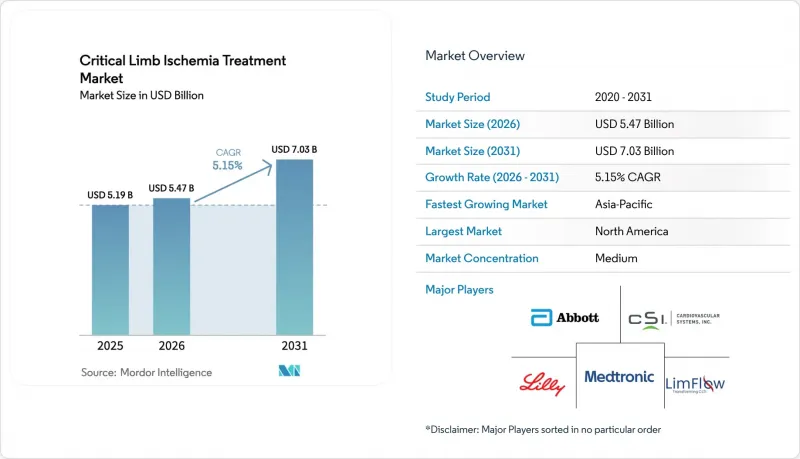
본 보고서는 치료 유형별(의료기기, 의약품, 재생의학·세포 치료), 최종 사용자별(병원, 외래수술센터(ASC), 혈관·상처 관리 전문 클리닉), 지역별(북미, 유럽, 아시아태평양, 중동 및 아프리카, 남미)로 분류되어 있습니다. 시장 예측은 금액(달러) 단위로 제시되어 있습니다.
세계의 중증 하지 허혈 치료 시장 동향 및 인사이트
당뇨병 및 말초동맥질환(PAD) 유병률 증가
국제당뇨병연맹(IDF)의 추정에 따르면, 2024년 성인 당뇨병 환자 수는 5억 3,700만 명이며, 2030년까지 6억 4,300만 명에 달할 것으로 예측됩니다. 신규 환자의 5분의 4는 개발도상 지역에 집중되어 있습니다. 말초동맥질환(PAD)은 고령 당뇨병 환자의 12%-15%에서 합병증을 유발하고 있으며, 미국 질병통제예방센터(CDC)는 당뇨병 환자의 절단 위험이 비당뇨병 환자에 비해 15배 높다는 사실을 확인했습니다. 인도에서는 1차 진료 현장에서 발목-팔꿈치 혈압비(ABI) 검사가 실시되는 경우가 드물기 때문에 도시 지역 당뇨병 환자 중 진단되지 않은 PAD 유병률이 25%를 초과하고 있습니다. 그러나 새로운 공공 검진 의무화로 인해 이 숨겨진 환자 집단이 조만간 드러날 것으로 보입니다. 중국도 유사한 급증에 직면해 있으며, 2025년에는 당뇨병 환자 수가 1억 4,000만 명에 달한 것으로 보고되었지만, 스타틴을 투여받고 있는 환자는 30% 이하에 그치고 있어, 이로 인해 중증 하지 허혈로의 진행이 촉진되고 있습니다. 이러한 데이터는 혈관 재건 기기, 보조 약물 요법, 그리고 궁극적으로는 재생 의학에 대한 지속적인 수요의 원동력이 될 것임을 시사합니다.
저침습 혈관 재건 기기의 보급 확대
경피적 혈관 성형술과 스텐트 삽입술은 회복 기간 단축과 입원 비용 절감으로 인해, 2025년에는 미국에서 중증 하지 허혈에 대한 전체 치료의 78%를 차지했으며, 5년 전의 62%에서 증가했습니다. 보스턴 사이언티피크(Boston Scientific)사의 파클리탁셀이 함유되지 않은 ‘레인저(Ranger)’ 풍선은 무릎 아래 병변에서 12개월간 1차 개통률 82%를 달성하며, 기존 파클리탁셀 제제로부터 시장 점유율을 빼앗았습니다. 메드트로닉(Medtronic)사의 ‘IN.PACT Admiral’ 풍선은 무릎 위 병변 분야에서 여전히 선두 자리를 유지하고 있으며, 2025년 매출액은 6억 8,000만 달러에 달할 것으로 전망됩니다. 그러나 이 회사는 안전성에 대한 면밀한 검토에 대응하기 위해 시롤리무스 코팅 제품으로의 다각화를 추진하고 있습니다. 따라서 신규 바이오의약품이 부상하는 상황 속에서도 사업 부문의 다각화와 신속한 제품 사이클이 이 의료기기 사업의 기반을 계속해서 지탱하고 있습니다.
신흥국의 높은 비용과 제한된 보험 환급
인도에서는 약물 방출형 풍선 및 스텐트의 가격이 1,800-3,200달러이지만, 정부 보험 제도에 따른 환급액은 고작 600달러에 불과하여 환자는 1년치 평균 소득을 초과하는 금액을 본인 부담해야만 합니다. 브라질에서는 공립병원에서 보험 적용이 가능하지만, 평균 대기 시간이 180일에 달하기 때문에 경제적으로 여유가 있는 환자들은 건당 4만 5,000브라질 레알(약 9,000달러)을 지불하고 민간 의료기관을 이용하고 있습니다. 걸프협력회의(GCC) 회원국에서는 자국민에 대해 중증 하지 허혈(CLI) 치료비를 전액 부담하고 있지만, 외국인 거주자에 대한 보상 상한액은 연간 5,000달러로 설정되어 있어 실제 치료비보다 훨씬 적습니다. 위험 완화 방안으로 단계적인 상품 포트폴리오 구축과 현지 생산이 주목받고 있습니다.
부문별 분석
2025년 매출액 중 디바이스 부문이 62.81%를 차지했으며, 그 중심은 약물 방출형 스텐트, 플레인 벌룬, 아테렉토미 시스템이었습니다. 색전 방지 디바이스는 주로 고위험 원위부 치료에 한정되어 있어 디바이스 매출의 불과 3%에 그쳤습니다. Cardiovascular Systems의 ‘Diamondback 360’과 같은 말초 혈관 확장 시스템은 전년 대비 14%의 성장세를 보이며, 석회화 병변에 대한 기존 혈관 성형술을 대체했습니다. 혈관용 스텐트와 약물 방출형 스텐트의 성장률은 파클리탁셀로 인한 역풍의 영향을 받아 연평균 성장률(CAGR) 3.2%로 둔화되었습니다. 재생의학 및 세포 치료는 2025년에 8%의 점유율을 차지했으나, 연평균 성장률(CAGR) 10.06%라는 수치에서 알 수 있듯이, 생물학적 회복의 성공으로 재시술률이 낮아짐에 따라 의료기기의 반복 매출을 잠식하는 입장에 있습니다.
지역별 분석
북미는 의료기기 사용을 뒷받침하는 미국 메디케어의 관대한 보상 제도 덕분에 2025년에는 44.32%의 점유율을 차지하며 시장을 독점했습니다. 그러나 파클리탁셀에 대한 엄격한 모니터링과 시장의 성숙도가 성장 가속화를 억제하고 있습니다. 캐나다에서는 CLI의 환급액이 8,500캐나다 달러(6,300달러)로, 미국의 환급액보다 25% 낮게 설정되어 있어 프리미엄 제품의 도입이 억제되고 있습니다. 멕시코에서는 2023년부터 2025년에 걸쳐 혈관 치료 수용 능력이 18% 확대되었습니다. 그러나 전문의 부족으로 인해 지침 준수율은 여전히 40% 미만에 머물고 있습니다. 원격의료를 통해 제공되는 미국의 사지 보존 프로토콜로 인해 인근 라틴아메리카 시장이 미국산 기기에 문을 열기 시작하면서 공급업체의 우위가 더욱 강화되고 있습니다.
독일에서는 2024년에 파클리탁셀에 대한 광범위한 보험 적용이 중단되면서 국내 매출이 3분의 1로 감소했습니다. 반면, 영국에서는 2026년에 LimFlow의 심부정맥 동맥화 시스템에 대해 긍정적인 지침이 제시되어 4,500만 파운드(5,700만 달러) 규모의 비즈니스 기회가 창출되고 있습니다.
아시아태평양은 연평균 성장률(CAGR) 11.53%를 기록하며 성장의 원동력이 되고 있습니다. 중국에서는 2024-2025년 국산 약물 방출형 의료기기 14가지 기종이 승인되었고, 현지 가격이 60% 하락함에 따라 지방 수요가 촉진되어 해당 지역의 중증 하지 허혈 치료 시장 규모가 확대되었습니다. 일본에서는 2025년 세포 치료의 보험 적용이 18% 증가함에 따라 시장이 5.2% 성장했습니다. 호주의 TGA는 2025년 Cynata의 Cymerus 요법을 특별 사용으로 승인하여, 호주가 재생 의학의 시험대 역할을 강화했습니다.
사우디아라비아는 2028년까지 50곳의 사지 보존 클리닉 설립을 위해 120억 사우디아라비아 리얄(약 32억 달러)을 예산으로 편성했습니다. 아랍에미리트(UAE)에서는 2024년에 도입된 신속 승인 절차에 따라 의료기기 승인 기간이 18개월에서 6개월로 단축되어 다국적 기업의 제품 출시가 촉진되었습니다. 사하라 이남 아프리카에서는 여전히 의료 서비스가 충분히 제공되지 않고 있으며, 남아프리카공화국에서는 비용 및 의료 체계의 제약으로 인해 환자의 불과 22%만이 혈관 재건술을 받고 있습니다.
기타 혜택
- 엑셀 형식 시장 예측(ME) 시트
- 3개월간의 애널리스트 지원
자주 묻는 질문
목차
제1장 서론
제2장 조사 방법
제3장 주요 요약
제4장 시장 구도
제5장 시장 규모 및 성장 예측
제6장 경쟁 구도
제7장 시장 기회 및 향후 전망
AJY 26.09.11According to Mordor Intelligence, the critical limb ischemia treatment market size was valued at USD 5.19 billion in 2025 and is estimated to grow from USD 5.47 billion in 2026 to reach USD 7.03 billion by 2031, at a CAGR of 5.15% during the forecast period (2026-2031).
This report is Segmented by Treatment Type (Devices, Drugs, Regenerative & Cell-Based Therapies), End-User (Hospitals, Ambulatory Surgical Centers, Specialty Vascular & Wound-Care Clinics), and Geography (North America, Europe, Asia-Pacific, Middle East & Africa, South America). The Market Forecasts are Provided in Terms of Value (USD).
Global Critical Limb Ischemia Treatment Market Trends and Insights
Rising Diabetes and PAD Prevalence
The International Diabetes Federation estimated 537 million adults living with diabetes in 2024 and forecasts 643 million by 2030, with four-fifths of new cases clustered in developing regions. Peripheral artery disease complicates 12%-15% of older diabetics, and the Centers for Disease Control and Prevention confirmed a 15-fold higher amputation risk for diabetic patients compared with non-diabetics. In India, undiagnosed PAD prevalence exceeds 25% among urban diabetics because primary care rarely performs ankle-brachial index testing, but new public screening mandates will soon expose this hidden cohort. China faces a similar surge, reporting 140 million diabetics in 2025, yet fewer than 30% receive statins, fueling progression to critical limb ischemia. These data point to a durable demand driver for revascularization devices, adjunct pharmacotherapy, and ultimately regenerative therapeutics.
Growing Adoption of Minimally Invasive Revascularization Devices
Percutaneous transluminal angioplasty and stenting represented 78% of all U.S. critical limb ischemia interventions in 2025, up from 62% five years earlier, due to shorter recovery times and lower hospital costs. Boston Scientific's paclitaxel-free Ranger balloon achieved an 82% 12-month primary patency rate in below-the-knee lesions, capturing market share from legacy paclitaxel products. Medtronic's IN.PACT Admiral balloon remains the leader in above-the-knee disease, with 2025 sales of USD 680 million; however, the company is diversifying into sirolimus coatings to navigate safety scrutiny. Segment diversification and rapid product cycles are therefore sustaining the device franchise even as novel biologics rise.
High Cost and Limited Reimbursement in Emerging Economies
Drug-eluting balloons and stents cost USD 1,800-3,200 in India, but government schemes reimburse just USD 600, forcing patients to pay more than a year's median income out of pocket. Brazil offers coverage in public hospitals, yet waiting times average 180 days, prompting wealthier patients to seek private centers at BRL 45,000 (approximately USD 9,000) per case. Gulf Cooperation Council nations cover CLI fully for their citizens, but expatriate coverage caps at USD 5,000 per year, which is well below real-world costs. Tiered product portfolios and local manufacturing are emerging as mitigation strategies.
Other drivers and restraints analyzed in the detailed report include:
- Aging Population Intensifying CLI Incidence
- FDA Breakthrough Designations Speeding BTK Device and Cell-Therapy Launches
- Underdiagnosis and Late Presentation
For complete list of drivers and restraints, kindly check the Table Of Contents.
Segment Analysis
Devices accounted for 62.81% of 2025 revenue, anchored by drug-eluting stents, plain balloons, and atherectomy systems. Embolic protection devices accounted for just 3% of device revenue, as they are primarily reserved for high-risk distal work. Peripheral dilatation systems, such as Cardiovascular Systems' Diamondback 360, grew 14% year-over-year, displacing plain angioplasty in calcified lesions. The growth of vascular and drug-eluting stents softened to a 3.2% CAGR amid headwinds from paclitaxel. Regenerative and cell-based therapies held an 8% share in 2025, but their 10.06% CAGR positions them to erode repeat device revenue, as successful biologic repair lowers re-intervention rates.
Complete Report Scope:
- By Treatment Type
- Devices
- Embolic Protection Devices
- Peripheral Dilatation Systems
- Balloon Dilators
- Vascular & Drug-Eluting Stents
- Drugs
- Antiplatelet Agents
- Antihypertensive Agents
- Lipid-Lowering Agents
- Antithrombotic Agents
- Regenerative & Cell-Based Therapies
- Devices
- By End-User
- Hospitals
- Ambulatory Surgical Centers
- Specialty Vascular & Wound-Care Clinics
- By Geography
- North America
- United States
- Canada
- Mexico
- Europe
- Germany
- United Kingdom
- France
- Italy
- Spain
- Rest of Europe
- Asia-Pacific
- China
- Japan
- India
- Australia
- South Korea
- Rest of Asia-Pacific
- Middle East & Africa
- GCC
- South Africa
- Rest of Middle East & Africa
- South America
- Brazil
- Argentina
- Rest of South America
- North America
Geography Analysis
North America dominated with a 44.32% share in 2025, due to U.S. Medicare's generous reimbursement, which underpins device usage. However, scrutiny of paclitaxel and a mature installed base temper the acceleration. Canada reimburses CLI at CAD 8,500 (USD 6,300), which is 25% below U.S. rates, thereby restraining premium adoption. Mexico expanded its vascular capacity by 18% between 2023 and 2025; however, specialist scarcity continues to keep guideline adherence below 40%. U.S. limb-preservation protocols delivered via telehealth are opening adjacent Latin markets to American devices, further consolidating supplier advantage.
Germany halted broad paclitaxel reimbursement in 2024, resulting in a one-third reduction in national sales. Conversely, the United Kingdom issued positive guidance for LimFlow's deep vein arterialization system in 2026, creating a GBP 45 million (USD 57 million) opportunity.
Asia-Pacific is the growth driver with an 11.53% CAGR. China's approval of 14 home-grown drug-eluting devices between 2024 and 2025 reduced local prices by 60%, unlocking rural demand and expanding the critical limb ischemia treatment market size in the region. Japan grows 5.2% as reimbursement for cell therapies rose 18% in 2025. Australia's TGA green-lit Cynata's Cymerus therapy for compassionate use in 2025, reinforcing its role as a regenerative test bed.
Saudi Arabia has earmarked SAR 12 billion (approximately USD 3.2 billion) for 50 limb-preservation clinics by 2028. The UAE's 2024 fast-track pathway shrank device approval times from 18 to 6 months, encouraging multinational launches. Sub-Saharan Africa remains underserved, with only 22% of patients in South Africa receiving revascularization due to cost and capacity constraints.
- Abbott Laboratories
- AngioDynamics
- B. Braun
- Biotronik SE & Co.
- Boston Scientific
- Cardiovascular Systems
- Cesca Therapeutics (ThermoGenesis)
- Cook Group
- Cynata Therapeutics
- Eli Lilly and Company
- LimFlow
- Medtronic
- Micro Medical Solutions
- Koninklijke Philips
- Pluristem Therapeutics
- Rexgenero
- Smiths Group
- Teva Pharmaceutical Industries
- Terumo Corp.
- W. L. Gore & Associates
Additional Benefits:
- The market estimate (ME) sheet in Excel format
- 3 months of analyst support
TABLE OF CONTENTS
1 Introduction
- 1.1 Study Assumptions & Market Definition
- 1.2 Scope of the Study
2 Research Methodology
3 Executive Summary
4 Market Landscape
- 4.1 Market Overview
- 4.2 Market Drivers
- 4.2.1 Rising Diabetes & PAD Prevalence
- 4.2.2 Growing Adoption of Minimally Invasive Revascularization Devices
- 4.2.3 Aging Population Intensifying CLI Incidence
- 4.2.4 FDA Breakthrough Designations Speeding BTK Device & Cell-Therapy Launches
- 4.2.5 Expansion of Multispecialty Limb-Preservation Centers
- 4.2.6 AI-Enabled Perfusion Imaging Improving Patient Selection
- 4.3 Market Restraints
- 4.3.1 High Cost & Limited Reimbursement in Emerging Economies
- 4.3.2 Underdiagnosis and Late Presentation
- 4.3.3 Paclitaxel Device Safety Controversy
- 4.3.4 Shortage of Trained Vascular Specialists
- 4.4 Regulatory Landscape
- 4.5 Technological Outlook
- 4.6 Porter's Five Forces Analysis
- 4.6.1 Threat of New Entrants
- 4.6.2 Bargaining Power of Buyers
- 4.6.3 Bargaining Power of Suppliers
- 4.6.4 Threat of Substitutes
- 4.6.5 Competitive Rivalry
5 Market Size & Growth Forecasts
- 5.1 By Treatment Type
- 5.1.1 Devices
- 5.1.1.1 Embolic Protection Devices
- 5.1.1.2 Peripheral Dilatation Systems
- 5.1.1.3 Balloon Dilators
- 5.1.1.4 Vascular & Drug-Eluting Stents
- 5.1.2 Drugs
- 5.1.2.1 Antiplatelet Agents
- 5.1.2.2 Antihypertensive Agents
- 5.1.2.3 Lipid-Lowering Agents
- 5.1.2.4 Antithrombotic Agents
- 5.1.3 Regenerative & Cell-Based Therapies
- 5.1.1 Devices
- 5.2 By End-User
- 5.2.1 Hospitals
- 5.2.2 Ambulatory Surgical Centers
- 5.2.3 Specialty Vascular & Wound-Care Clinics
- 5.3 By Geography
- 5.3.1 North America
- 5.3.1.1 United States
- 5.3.1.2 Canada
- 5.3.1.3 Mexico
- 5.3.2 Europe
- 5.3.2.1 Germany
- 5.3.2.2 United Kingdom
- 5.3.2.3 France
- 5.3.2.4 Italy
- 5.3.2.5 Spain
- 5.3.2.6 Rest of Europe
- 5.3.3 Asia-Pacific
- 5.3.3.1 China
- 5.3.3.2 Japan
- 5.3.3.3 India
- 5.3.3.4 Australia
- 5.3.3.5 South Korea
- 5.3.3.6 Rest of Asia-Pacific
- 5.3.4 Middle East & Africa
- 5.3.4.1 GCC
- 5.3.4.2 South Africa
- 5.3.4.3 Rest of Middle East & Africa
- 5.3.5 South America
- 5.3.5.1 Brazil
- 5.3.5.2 Argentina
- 5.3.5.3 Rest of South America
- 5.3.1 North America
6 Competitive Landscape
- 6.1 Market Concentration
- 6.2 Market Share Analysis
- 6.3 Company Profiles (includes Global level Overview, Market-level Overview, Core Segments, Financials, Strategic Information, Market Rank/Share, Products & Services, Recent Developments)
- 6.3.1 Abbott Laboratories
- 6.3.2 AngioDynamics
- 6.3.3 B. Braun Melsungen AG
- 6.3.4 Biotronik SE & Co.
- 6.3.5 Boston Scientific Corporation
- 6.3.6 Cardiovascular Systems Inc.
- 6.3.7 Cesca Therapeutics (ThermoGenesis)
- 6.3.8 Cook Medical
- 6.3.9 Cynata Therapeutics
- 6.3.10 Eli Lilly and Company
- 6.3.11 LimFlow SA
- 6.3.12 Medtronic
- 6.3.13 Micro Medical Solutions
- 6.3.14 Philips Healthcare
- 6.3.15 Pluristem Therapeutics
- 6.3.16 Rexgenero Ltd.
- 6.3.17 Smith & Nephew
- 6.3.18 Teva Pharmaceuticals
- 6.3.19 Terumo Corp.
- 6.3.20 W. L. Gore & Associates
7 Market Opportunities & Future Outlook
- 7.1 White-space & Unmet-need Assessment


