
|
시장보고서
상품코드
2123635
휴대용 초음파 방광 스캐너 시장 : 점유율 분석, 업계 동향과 통계, 성장 예측(2026-2031년)Portable Ultrasound Bladder Scanner - Market Share Analysis, Industry Trends & Statistics, Growth Forecasts (2026 - 2031) |
||||||
 Mordor Intelligence
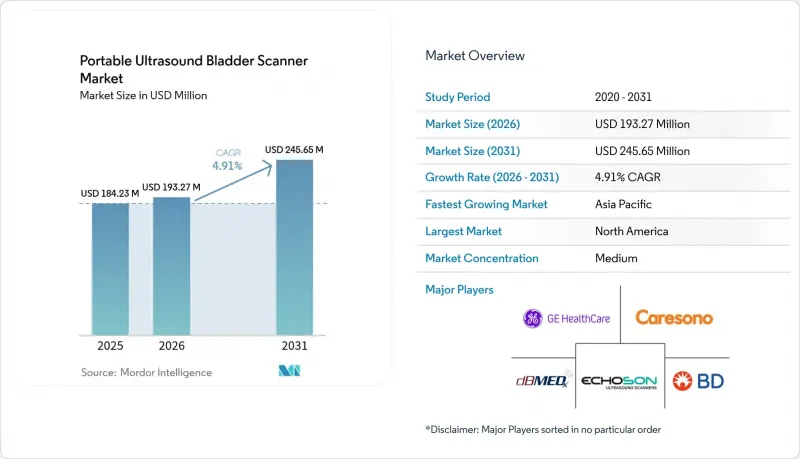
Mordor Intelligence에 의하면, 2026년 휴대용 초음파 방광 스캐너 시장 규모는 1억 9,327만 달러로 추정되고 있어 2025년 1억 8,423만 달러에서 성장하여 2031년에는 2억 4,565만 달러에 이를 것으로 예측됩니다.
2026년부터 2031년까지의 연평균 성장률(CAGR)은 4.91%가 될 것으로 전망됩니다.
본 보고서는 유형별(2D 휴대용 초음파 방광 스캐너, 3D 휴대용 초음파 방광 스캐너), 기기 유형별(핸드헬드형, 모바일 카트형, 벤치탑형), 최종 사용자별(병원 및 진료소, 영상진단센터 등), 지역별(북미, 유럽,아시아태평양, 중동 및 아프리카, 남미)로 분류되어 있습니다. 시장 예측은 금액(달러) 기준으로 제시되어 있습니다.
전 세계 휴대용 초음파 방광 스캐너 시장 동향 및 인사이트
급속한 고령화로 인해 방광 용량 모니터링 수요가 증가하고 있으며
65세 이상 고령자 수는 유례없는 속도로 증가하고 있으며, 양성 전립선 비대증(BPH) 및 관련 요로 합병증의 발생률이 높아지고 있습니다. 『Scientific Reports』에 따르면, 2024년 전 세계 전립선 비대증(BPH) 환자 수는 1억 1,250만 명에 달하며, 동유럽, 중미·라틴아메리카, 안데스 지역 라틴아메리카에서 유병률이 가장 높습니다. 또한 메디케어 데이터에 따르면, 수급자의 11.2%가 요실금을 앓고 있으며, 요양 시설에서는 그 비율이 20.6%로 상승하고 있습니다. 이러한 인구 통계학적 변화로 인해 일상적인 방광 용량 모니터링의 중요성이 커지고 있으며, 이는 휴대용 초음파 방광 스캐너 시장에 있어 임상적 및 경제적으로 설득력 있는 근거가 되고 있습니다.
비침습적 현장 진단으로의 의료 전환
현재의 임상 프로토콜에서는 감염 감소, 환자의 편안함, 신속한 의사 결정이 우선시되고 있습니다. 2024년 급성 뇌졸중 관련 연구에 따르면, 휴대용 초음파 방광 스캐너 도입 후 요로 감염(UTI) 발생률이 4.0%로 감소했으며, 동시에 입원 일수도 단축된 것으로 나타났습니다. 메디케어의 2025년 의사 보수 일정표에는 원격 진단 도구 활용을 촉진하는 원격의료 및 간병인 교육 코드가 도입되었습니다. 이러한 개혁은 재택 간호 및 지역 의료 현장에서의 도입 가속화를 직접적으로 뒷받침하고 있습니다.
초음파 영상을 해석할 수 있는 숙련된 조작자 부족
1차 의료 및 장기 요양 시설에서 정식 초음파 교육은 여전히 제한적입니다. 방광 윤곽의 자동 묘사와 같은 AI 기능 덕분에 학습 곡선은 완화되고 있지만, 이러한 도구를 도입하려면 시스템 통합에 드는 비용과 사용자의 신뢰가 필요합니다. 소규모 의료 제공업체들은 즉각적인 수익 확보가 보장되지 않는 한 투자를 주저하고 있습니다.
부문 분석
2025년 휴대용 초음파 방광 스캐너 시장에서 3D 스캐너는 매출의 61.85%를 차지했습니다. 이 스캐너의 체적 정확도는 카테터 삽입 오류 위험이 높은 탈출증 사례를 포함한 복잡한 해부학적 구조에 적합합니다. 그러나 알고리즘 업그레이드로 인해 정확도 범위가 좁아짐에 따라, 2D 스캐너는 2026년부터 2031년까지 연평균 성장률(CAGR) 8.61%로 성장하고 있습니다. 메모리 효율이 뛰어난 분할 처리가 현재 저비용 프로세서에서 실행 가능해지면서, 평균 판매 가격 하락과 대상 수요 증가를 뒷받침하고 있습니다. 조달 담당자들은 절대적인 정확도보다 가격 대비 성능 비율을 중시하는 경향이 강해지고 있으며, 이에 따라 2D 시스템은 자원이 제한된 환경에도 점차 보급되고 있습니다. 따라서 휴대용 초음파 방광 스캐너 시장에서 2D 시스템 시장 규모는 3D 시스템보다 빠르게 확대될 것으로 예상되지만, 중증 환자 병동에서는 여전히 병원 측에서 3D 시스템을 선호하는 경향이 있습니다.
핸드헬드 단말기의 진화가 2D 시장의 기회를 더욱 확대되고 있습니다. AI 통합을 통해 직교 뷰 촬영이 조작자의 숙련도에 덜 좌우되게 되었으며, Wi-Fi 연결을 통해 기록 데이터 전송이 효율화되었습니다. 이에 대응하여 주요 3D 벤더들은 소프트웨어 라이선스나 연장 보증을 세트로 판매하는 방식으로 대응하고 있습니다. 그 결과 발생하는 경쟁으로 인해 모든 스캐너 유형의 총 소유 비용이 개선되었으며, 신흥 경제국 전반에서 두 자릿수의 출하 대수 성장이 지속되고 있습니다.
지역별 분석
북미는 메디케어 수급자의 요실금 유병률이 높고, 기기 보험 적용을 뒷받침하는 코딩 제도에 힘입어 2025년 휴대용 초음파 방광 스캐너 시장 매출의 39.25%를 차지하며 선두 자리를 유지하고 있습니다. FDA의 분류 하향 조정으로 시장 출시 기간이 단축되면서 제품 라인업의 갱신이 가속화되고 있습니다. 캐나다는 미국에 이어 유사한 보급 추세를 보이고 있는 반면, 라틴아메리카에서는 멕시코의 민간 병원이 수요를 주도하고 있습니다.
유럽은 2위를 차지하고 있습니다. 독일은 체류 카테터 보급률이 13.4%에 달하는 여러 시설을 보유한 요양 시설에서의 도입에 힘입어 가장 높은 판매 대수를 기록하고 있습니다. 영국과 프랑스가 그 뒤를 이어, 병원 내 감염 감소를 목표로 하는 각국의 의료 정책을 활용해 시장을 확대되고 있습니다. 남유럽에서는 고령화로 인해 공공 의료 예산이 핍박하는 가운데, 비용 대비 효과가 높은 방광 모니터링에 대한 관심이 높아지면서 시장이 가속화되고 있습니다.
아시아태평양은 연평균 성장률(CAGR) 9.57%로 가장 빠른 성장세를 보이고 있습니다. 중국은 1차 의료 기관에 대한 국가 투자와 세계 최대 규모의 고령 인구를 배경으로 혜택을 보고 있습니다. 국내 업체들이 합리적인 가격의 스캐너를 공급하고 있지만, 다국적 기업들은 여전히 고급 병원 시장을 독점하고 있습니다. 일본의 초고령 사회는 1인당 이용률을 높이고 있는 반면, 인도에서는 확대되는 중산층이 도시 지역에서의 보급을 뒷받침하고 있습니다. 삼성메디슨의 AI 활용 추진과 같은 전략적 인수는 해당 지역의 휴대용 초음파 방광 스캐너 시장을 더욱 활성화시키고 있습니다.
중동 및 아프리카 및 남미에서는 꾸준하지만 지역별로 편차가 있는 발전 양상이 나타나고 있습니다. GCC 국가들의 병원 현대화에는 초음파 방광 스캐너 도입도 포함되어 있으나, 농촌 지역에서의 이용은 뒤처지고 있습니다. 남미에서는 브라질과 아르헨티나가 도시 지역의 민간 의료기관 네트워크 내에서 매출을 주도하고 있습니다. 따라서 도시와 농촌 간의 격차가 지역별 마케팅 전략과 사후 서비스 체계를 형성하고 있습니다.
기타 혜택:
- 엑셀 형식 시장 예측(ME) 시트
- 3개월간의 애널리스트 지원
자주 묻는 질문
목차
제1장 서론
제2장 조사 방법
제3장 주요 요약
제4장 시장 구도
제5장 시장 규모와 성장 예측
제6장 경쟁 구도
제7장 시장 기회와 향후 전망
JHS 26.09.07According to Mordor Intelligence, portable ultrasound bladder scanner market size in 2026 is estimated at USD 193.27 million, growing from 2025 value of USD 184.23 million with 2031 projections showing USD 245.65 million, growing at 4.91% CAGR over 2026-2031.
This report is Segmented by Type (2D Portable Ultrasound Bladder Scanner, 3D Portable Ultrasound Bladder Scanner), Device Type (Handheld Portable, Mobile-Cart, Bench-Top), End-User (Hospitals & Clinics, Diagnostic Imaging Centers, and More), and Geography (North America, Europe, Asia-Pacific, Middle East & Africa, South America). The Market Forecasts are Provided in Terms of Value (USD).
Global Portable Ultrasound Bladder Scanner Market Trends and Insights
Ageing Population Surge Elevating Demand for Bladder-Volume Monitoring
The number of people aged 65 years and older is climbing at an unprecedented pace, escalating incidence of benign prostatic hyperplasia and related urinary complications. Scientific Reports highlighted 112.5 million BPH cases globally in 2024, with highest prevalence in Eastern Europe, Central Latin America and Andean Latin America. Medicare data further indicate urinary incontinence in 11.2% of beneficiaries, rising to 20.6% in skilled nursing facilities. These demographics elevate routine bladder-volume monitoring, making a compelling clinical and economic case for the portable ultrasound bladder scanner market.
Healthcare Shift Toward Non-Invasive Point-of-Care Diagnostics
Clinical protocols now prioritize infection reduction, patient comfort and rapid decision-making. A 2024 acute-stroke study showed UTIs falling to 4.0% after portable bladder ultrasound adoption, while length-of-stay dropped simultaneously. Medicare's 2025 Physician Fee Schedule introduced telehealth and caregiver-training codes that encourage remote diagnosis tools. These reforms directly support accelerated uptake in home-care and community settings.
Shortage of Skilled Operators for Ultrasound Interpretation
Formal ultrasound training remains limited across primary-care and long-term care facilities. Although AI features such as automated bladder outlining cut learning curves, these tools still require integration spending and user confidence. Smaller providers hesitate to invest without immediate reimbursement certainty.
Other drivers and restraints analyzed in the detailed report include:
- Continuous Innovation in Portable & Handheld Ultrasound Platforms
- Growing Adoption of POCUS in Emergency, Critical-Care & Primary Settings
- Variable Reimbursement & Coding Frameworks Across Regions
For complete list of drivers and restraints, kindly check the Table Of Contents.
Segment Analysis
3D scanners held 61.85% of 2025 revenue within the portable ultrasound bladder scanner market. Their volumetric precision suits complex anatomy, including prolapse cases where catheterization error risk is high. Nonetheless, 2D scanners are scaling at 8.61% CAGR during 2026-2031 as algorithmic upgrades tighten accuracy bands. Memory-efficient segmentation now runs on lower-cost processors, driving down average selling prices and widening addressable demand. Procurement teams increasingly compare price-performance ratios rather than absolute accuracy, allowing 2D to penetrate resource-constrained settings. The portable ultrasound bladder scanner market size for 2D systems is therefore projected to expand faster than for 3D, though the latter retains hospital preference for high-acuity wards.
Advances in handheld form factors compound the 2D opportunity. Integrated AI makes capturing orthogonal views less operator-dependent, while Wi-Fi connectivity streamlines record transfer. Leading 3D vendors respond by bundling software licenses and extended warranties. Resulting competition improves total cost of ownership for all scanner types, sustaining double-digit shipment growth across emerging economies.
Complete Report Scope:
- By Scanner Type
- 2D Portable Ultrasound Bladder Scanner
- 3D Portable Ultrasound Bladder Scanner
- By Device Type
- Handheld Portable
- Mobile-Cart
- Bench-top
- By End User
- Hospitals & Clinics
- Diagnostic Imaging Centers
- Ambulatory Surgical Centers
- Home-Care & Long-Term Care Facilities
- By Geography
- North America
- United States
- Canada
- Mexico
- Europe
- Germany
- United Kingdom
- France
- Italy
- Spain
- Rest of Europe
- Asia-Pacific
- China
- Japan
- India
- Australia
- South Korea
- Rest of Asia-Pacific
- Middle East & Africa
- GCC
- South Africa
- Rest of Middle East & Africa
- South America
- Brazil
- Argentina
- Rest of South America
- North America
Geography Analysis
North America leads with 39.25% 2025 revenue in the portable ultrasound bladder scanner market, powered by Medicare beneficiaries' high urinary-incontinence prevalence and supportive device coding. FDA down-classification has shortened time-to-market, fostering quicker portfolio refreshes. Canada trails the United States yet follows similar adoption trajectories, whereas Mexico's private hospitals spearhead demand within Latin America.
Europe ranks second. Germany posts the highest unit volumes, driven by multi-facility nursing home adoption where indwelling catheter prevalence reached 13.4%. The United Kingdom and France follow, leveraging national health priorities that target hospital-acquired infection reduction. Southern Europe accelerates as aging demographics stretch public healthcare budgets, elevating interest in cost-effective bladder monitoring.
Asia-Pacific delivers the swiftest growth at 9.57% CAGR. China benefits from state investments in primary clinics and the world's largest elderly cohort. Domestic vendors supply affordable scanners, but multinationals retain premium hospital tiers. Japan's super-aged society drives high per-capita utilization, while India's growing middle class catalyzes urban uptake. Strategic acquisitions, such as Samsung Medison's AI push, further stimulate the regional portable ultrasound bladder scanner market.
Middle East & Africa and South America show steady but uneven progress. GCC states' hospital modernizations include bladder-scanner deployments, yet rural access lags. Brazil and Argentina dominate South American sales within private urban networks. Urban-rural divides therefore shape localized marketing tactics and after-sales footprints.
- Verathon
- GE Healthcare Technologies Inc.
- LABORIE Medical Technologies Corp.
- dBMEDx
- Caresono Technology Co., Ltd.
- Vitacon US LLC
- EchoNous (Signostics Inc.)
- Sonostar Technologies
- Beckton Dickinson
- Wuhan Tianyi Electronic
- MCube Technology Co., Ltd.
- SRS Medical Systems Inc.
- Echo-Son SA
- Butterfly Network, Inc.
- Clarius Mobile Health Corp.
- SonoScape Medical Corp.
- Vave Health
- Mindray Bio-Medical Electronics Co., Ltd.
- Koninklijke Philips
- Meike Co., Ltd. (CubeScan)
Additional Benefits:
- The market estimate (ME) sheet in Excel format
- 3 months of analyst support
TABLE OF CONTENTS
1 Introduction
- 1.1 Study Assumptions & Market Definition
- 1.2 Scope of the Study
2 Research Methodology
3 Executive Summary
4 Market Landscape
- 4.1 Market Overview
- 4.2 Market Drivers
- 4.2.1 Ageing Population Surge Elevating Demand for Bladder-Volume Monitoring
- 4.2.2 Healthcare Shift Toward Non-Invasive Point-of-Care Diagnostics
- 4.2.3 Continuous Innovation in Portable & Handheld Ultrasound Platforms
- 4.2.4 Growing Adoption of POCUS in Emergency, Critical-Care & Primary Settings
- 4.2.5 Rising Prevalence of Urological Disorders
- 4.2.6 Integration of AI & Smart Imaging Technologies
- 4.3 Market Restraints
- 4.3.1 Shortage of Skilled Operators for Ultrasound Interpretation
- 4.3.2 Variable Reimbursement & Coding Frameworks Across Regions
- 4.3.3 Complex Regulatory Approval Processes
- 4.3.4 Limited Accuracy in Complex Cases
- 4.4 Technological Outlook
- 4.5 Porter's Five Forces Analysis
- 4.5.1 Threat of New Entrants
- 4.5.2 Bargaining Power of Buyers
- 4.5.3 Bargaining Power of Suppliers
- 4.5.4 Threat of Substitutes
- 4.5.5 Competitive Rivalry
5 Market Size & Growth Forecasts (Value in USD)
- 5.1 By Scanner Type
- 5.1.1 2D Portable Ultrasound Bladder Scanner
- 5.1.2 3D Portable Ultrasound Bladder Scanner
- 5.2 By Device Type
- 5.2.1 Handheld Portable
- 5.2.2 Mobile-Cart
- 5.2.3 Bench-top
- 5.3 By End User
- 5.3.1 Hospitals & Clinics
- 5.3.2 Diagnostic Imaging Centers
- 5.3.3 Ambulatory Surgical Centers
- 5.3.4 Home-Care & Long-Term Care Facilities
- 5.4 By Geography
- 5.4.1 North America
- 5.4.1.1 United States
- 5.4.1.2 Canada
- 5.4.1.3 Mexico
- 5.4.2 Europe
- 5.4.2.1 Germany
- 5.4.2.2 United Kingdom
- 5.4.2.3 France
- 5.4.2.4 Italy
- 5.4.2.5 Spain
- 5.4.2.6 Rest of Europe
- 5.4.3 Asia-Pacific
- 5.4.3.1 China
- 5.4.3.2 Japan
- 5.4.3.3 India
- 5.4.3.4 Australia
- 5.4.3.5 South Korea
- 5.4.3.6 Rest of Asia-Pacific
- 5.4.4 Middle East & Africa
- 5.4.4.1 GCC
- 5.4.4.2 South Africa
- 5.4.4.3 Rest of Middle East & Africa
- 5.4.5 South America
- 5.4.5.1 Brazil
- 5.4.5.2 Argentina
- 5.4.5.3 Rest of South America
- 5.4.1 North America
6 Competitive Landscape
- 6.1 Strategic Moves
- 6.2 Market Share Analysis
- 6.3 Company Profiles (includes Global level Overview, Market level overview, Core Segments, Financials as available, Strategic Information, Market Rank/Share for key companies, Products & Services, and Recent Developments)
- 6.3.1 Verathon Inc.
- 6.3.2 GE Healthcare Technologies Inc.
- 6.3.3 LABORIE Medical Technologies Corp.
- 6.3.4 dBMEDx Inc.
- 6.3.5 Caresono Technology Co., Ltd.
- 6.3.6 Vitacon US LLC
- 6.3.7 EchoNous (Signostics Inc.)
- 6.3.8 Sonostar Technologies Co., Limited
- 6.3.9 Becton, Dickinson and Company
- 6.3.10 Wuhan Tianyi Electronic Co., Ltd.
- 6.3.11 MCube Technology Co., Ltd.
- 6.3.12 SRS Medical Systems Inc.
- 6.3.13 Echo-Son SA
- 6.3.14 Butterfly Network, Inc.
- 6.3.15 Clarius Mobile Health Corp.
- 6.3.16 SonoScape Medical Corp.
- 6.3.17 Vave Health
- 6.3.18 Mindray Bio-Medical Electronics Co., Ltd.
- 6.3.19 Koninklijke Philips N.V. (Philips Healthcare)
- 6.3.20 Meike Co., Ltd. (CubeScan)