

|
시장보고서
상품코드
2123637
체외진단(IVD) 품질관리 시장 : 시장 점유율 분석, 업계 동향 및 통계, 성장 예측(2026-2031년)In-Vitro Diagnostics Quality Control - Market Share Analysis, Industry Trends & Statistics, Growth Forecasts (2026 - 2031) |
||||||
 Mordor Intelligence
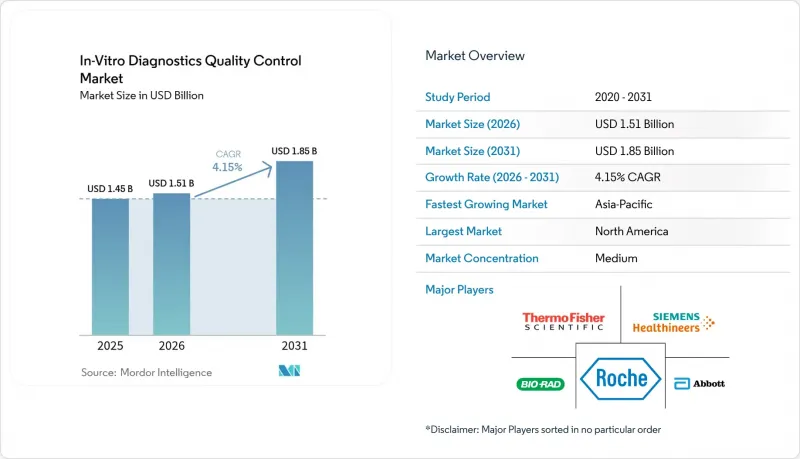
Mordor Intelligence에 의하면, 체외진단(IVD) 품질관리 시장 규모는 2025년에 14억 5,000만 달러로 평가되었고, 2026년 15억 1,000만 달러에서 2031년까지 18억 5,000만 달러에 이를 것으로 예측되며, 예측 기간(2026-2031년) CAGR은 4.15%를 나타낼 전망입니다.
본 보고서는 제품 및 서비스별(품질 관리 제품, 데이터 관리 솔루션, 품질 보증 서비스), 용도별(면역화학, 기타), 최종 사용자별(병원, 독립 임상검사기관, IVD 제조업체·CRO, 학술기관 및 연구기관, 외래·진료소 내 검사실), 지역별(북미, 유럽, 아시아태평양, 중동 및 아프리카, 남미)로 분류되어 있습니다. 시장 예측은 금액(달러)으로 표시되어 있습니다.
세계의 체외진단(IVD) 품질관리 시장 동향 및 인사이트
전 세계 질병 부담 증가
만성 질환 및 감염병 증가에 따라, 일상적인 품질 관리가 필요한 검사 건수가 증가하고 있으며, 이것이 체외진단(IVD) 품질관리 시장의 직접적인 성장을 견인하고 있습니다. 2024년에는 비감염성 질환이 전 세계 사망자의 74%를 차지했으며, 당뇨병 유병률의 상승에 따라 검사실이 매일 여러 단계에서 수행해야 하는 당화 헤모글로빈 관리에 대한 수요가 증가하고 있습니다. 2025년에는 종양학 검사실의 액체 생검 검사 건수가 28% 증가했으나, 정의된 대립유전자 빈도를 가진 순환 종양 DNA 검체를 재고로 보유한 시설은 40% 미만에 그쳐, 규제 당국이 의문을 제기하기 시작한 규정 준수상의 격차가 남아 있습니다. 브라질과 태국의 공공 의료 기관에서는 2024-2025년 감염 확산 기간 동안 분자 검사용 표준 물질의 재고를 3배로 늘렸습니다. 이는 역학적 변동이 검사 건당 품질 관리 비용을 어떻게 끌어올리는지를 여실히 보여줍니다. 현재 품질 관리에 대한 지출은 일상적인 성장세보다는 질병의 변동성에 따라 결정되는 경향이 있으며, 다항목 분석용 기준 키트를 신속하게 확대할 수 있는 공급업체가 유리한 입장에 있습니다. 이러한 추세로 인해 검사실이 데이터 플랫폼을 도입하더라도 소모품 수요에는 계속해서 상승 압력이 가해질 것으로 보입니다.
인증된 임상 실험실의 확대
인증 제도의 도입으로 품질 관리는 선택적 지출에서 필수 지출로 전환되었으며, 성숙한 지역 전반에 걸쳐 체외진단(IVD) 품질관리 시장이 확대되고 있습니다. 미국 병리학자 협회(College of American Pathologists)의 집계에 따르면, 메디케어가 환급 자격을 ‘인증 상태’ 승인 여부와 연계함에 따라 2025년 12월 기준 미국의 인증 검사실은 8,200개소에 달하고, 2023년 대비 6% 증가했습니다. ISO 15189는 독일과 프랑스에서 공공 조달의 필수 요건이 되었으며, 이에 따라 1,400개의 민간 검사 기관이 모든 플랫폼에서 문서화된 관리를 의무화하는 규정 준수 프로그램을 시작했습니다. 중국은 모든 3차 병원에 2027년까지 ISO 15189 인증을 취득하도록 명령했습니다. 이로 인해 약 3,000개 시설이 영향을 받았으며, 단기간에 대량의 표준 시료 구매가 급증했습니다. 또한, 인증은 국제 기준법에 따라 추적 가능한 인증서를 제공할 수 있는 공급업체에 대한 구매를 촉진하여 다국적 공급업체 시장 점유율을 공고히 하고 있습니다. 현재 검사 기관들은 대조 시료의 문서화를 보험사와의 협상이나 공공 조달 시 자격 증명으로 활용하고 있습니다.
엄격한 환급 환경
지급액 삭감으로 인해 검사 기관은 대조용 시료 사용을 제한할 수밖에 없게 되었으며, 이는 체외진단(IVD) 품질관리 시장의 단기적 성장에 큰 부담으로 작용하고 있습니다. 메디케어의 요금 개정에 따라 2021년 이후 검사 요금은 누적 8.5% 인하되었으며, 2027년까지 추가 인하가 예정되어 있습니다. 이로 인해 2025년 조사에서 미국 병원 검사실의 42%가 안정적인 분석 대상 물질에 대해 하루 2회 검사에서 하루 1회 검사로 전환한 것으로 나타났습니다. 민간 보험사는 분자 검사에 대해 사전 승인 제도를 도입하여 검사 건수를 18% 감소시켰을 뿐만 아니라, 고비용의 차세대 염기서열 분석용 대조 시약 구매를 지연시켰습니다. 독일의 공적 보험사는 2025년에 3.2%의 요금 인하를 협상했는데, 이는 전국 체인이 누리고 있는 수량 할인이 없는 소규모 독립 검사실에 가장 큰 타격을 주었습니다. 이익률 축소로 인해 단독으로 품질 관리 프로그램을 유지하기 어려워지면서, 2025년에는 미국에서 127개의 독립 검사 기관이 인수되는 등 산업 재편이 가속화되었습니다. 공급업체들은 검사 건당 비용을 절감해야 하는 압박에 직면해 있으며, 그렇지 않을 경우 병원 내 전자 품질 관리 시스템으로 대체될 위험이 있습니다.
부문 분석
2025년 매출 중 품질 관리 제품이 71.32%를 차지했으며, 이는 체외 진단(IVD) 품질 관리 시장의 약 3분의 2에 해당합니다. 이는 검사실에서 매일 장비 점검에 사용하는 다단계 액체 시약 및 동결건조 시약에 대한 수요가 여전히 높음을 반영합니다. 데이터 관리 솔루션은 여전히 시장 점유율은 작지만, 검사 기관들이 웨스트가드 규칙의 적용을 자동화하고 장비의 드리프트를 실시간으로 감지하는 클라우드 플랫폼을 도입함에 따라 연평균 성장률(CAGR) 6.75%로 확대되고 있습니다. 로슈(Roche)의 ‘navify Quality Control Management’는 오류가 환자에게 영향을 미치기 전에 서비스 요청의 우선순위를 정함으로써, 34개 병원에서 예정에 없던 가동 중단 시간을 19% 줄인 것으로 입증되었습니다. Bio-Rad는 Liquichek 제품 라인을 바이알당 42가지 분석 항목으로 확대하여 재고 관리의 복잡성을 줄이는 동시에 시약 수요를 유지했습니다. 동시에, 구독형 분석 서비스는 바이알 판매 성장 둔화를 상쇄하는 지속적인 수익을 창출하고 있습니다.
현재 검사실에서는 시약, 미들웨어, 능력 검사 프로그램의 종합적인 가치를 바탕으로 공급업체를 평가하고 있으며, 이러한 변화로 인해 조달 기준이 엔드투엔드 생태계로 재편되고 있습니다. 그 결과, 데이터 플랫폼은 오류 사전 방지를 통한 비용 절감 효과를 정량화할 수 있기 때문에 프리미엄 가격으로 판매되더라도 시장 점유율을 확대되고 있습니다. 젊은 검사실장들이 바이알당 비용보다 워크플로우의 효율성을 우선시하는 경향이 있기 때문에 체외진단(IVD) 품질관리 시장에서 순수 소프트웨어 기업의 점유율은 상승할 전망입니다. 시약에 예측 분석 기능을 결합할 수 없는 공급업체는 2류로 밀려날 위험이 있습니다. 따라서 수요는 ISO-17025 인증을 획득한 제조 시설과 소프트웨어 개발 팀을 모두 갖춘 기업으로 쏠리고 있으며, 다국적 기업은 규모 면에서 우위를 점하고 있습니다.
지역별 분석
북미는 2025년 매출의 44.12%를 차지했습니다. 이는 문서화된 품질을 평가하는 엄격한 CAP 인증과 CMS의 지급 규정에 힘입은 것이지만, 현재 환급액 삭감으로 인해 검사실이 일상적인 검사 빈도를 줄일 수밖에 없는 상황에 놓여 있어 성장이 둔화되고 있습니다. 미국만으로도 해당 지역의 지출의 4분의 3 이상을 차지하고 있지만, 비용 절감 추세로 인해 공급업체들은 가격을 장비 가동률에 연동시키는 금액 기준 계약을 제안하도록 압박받고 있습니다. 캐나다에서는 각 주의 의료보험 제도가 2028년까지 검사실 예산을 보장하고 있어 보다 안정적인 성장세를 보이고 있습니다.
유럽은 두 번째로 큰 규모를 자랑하는 지역으로, 독일, 프랑스, 영국이 주도적인 역할을 하고 있습니다. EU의 IVDR(체외진단용 의료기기 규정)에 따라 모든 관리용 시료 출하 시 로트별 모니터링이 의무화된 결과, 이 3개국은 2025년 매출의 약 62%를 차지할 것으로 전망됩니다. 검사 기관들은 공공 입찰 자격을 얻기 위해 ISO 15189 인증 취득을 서둘러 진행했으며, 2024-2025년 약 1,400곳의 새로운 인증 시설이 추가되었습니다. 남유럽은 지불 제도가 분절되어 있어 뒤처지고 있지만, 2028년까지는 북유럽의 기준에 수렴할 것으로 예측됩니다. 유럽의 공립 병원과 관련된 체외진단약(IVD) 품질 관리 시장 규모는 디지털 품질 기록이 의무화됨에 따라 점차 확대될 것으로 보입니다.
아시아태평양은 2031년까지 연평균 성장률(CAGR) 5.65%로 성장할 것입니다. 이러한 성장의 원동력은 중국이 2027년까지 모든 3차 병원에 ISO 15189 인증 취득을 의무화한 데 있으며, 이 조치는 약 3,000개의 의료 기관에 영향을 미칠 것입니다. 인도의 민간 체인업체들은 2급 도시로 검사실 확장을 지속하고 있으며, 인구 10만 명당 검사실 1개 미만의 시설 밀도를 보이는 지역에서의 서비스 범위를 확대되고 있습니다. 일본과 한국은 여전히 성숙한 시장이지만, 각 부처가 일일 품질 관리(QC) 기록 제출을 의무화하고 있어 높은 수준의 다단계 관리가 요구되고 있습니다. 신흥 아세안 시장에서는 냉장 설비 부족이 과제로 대두되고 있어, 상온 보관이 가능한 키트가 주문의 대부분을 차지하고 있습니다. 중동 및 아프리카 시장 점유율은 여전히 작지만, 걸프협력회의(GCC) 국가들의 기준 검사실 관련 지출로 인해 해당 지역은 한 자릿수 중반대의 성장이 예상됩니다. 남미의 전망은 브라질과 아르헨티나에 달려 있으며, 두 나라에서는 환율 변동이 자본재 구매를 저해하고 있지만 소모품 구매는 견조한 추세를 보이고 있어, 해당 지역의 체외진단(IVD) 품질관리 시장 점유율 기반을 지탱하고 있습니다.
기타 혜택
- 엑셀 형식 시장 예측(ME) 시트
- 3개월간의 애널리스트 지원
자주 묻는 질문
목차
제1장 서론
제2장 조사 방법
제3장 주요 요약
제4장 시장 구도
제5장 시장 규모 및 성장 예측
제6장 경쟁 구도
제7장 시장 기회 및 향후 전망
AJY 26.09.11According to Mordor Intelligence, the in-Vitro diagnostics quality control market size was valued at USD 1.45 billion in 2025 and is estimated to grow from USD 1.51 billion in 2026 to reach USD 1.85 billion by 2031, at a CAGR of 4.15% during the forecast period (2026-2031).
This report is Segmented by Products & Services (Quality Control Products, Data Management Solutions, and Quality Assurance Services), Application (Immunochemistry, and More), End User (Hospitals, Independent Labs, IVD Manufacturers, Academic Institutes, and Ambulatory Labs), and Geography (North America, Europe, Asia-Pacific, MEA, and South America). Market Forecasts are in Value (USD).
Global In-Vitro Diagnostics Quality Control Market Trends and Insights
Growing Global Disease Burden
Chronic and infectious diseases are expanding test volumes that need daily quality oversight, driving direct growth in the in-vitro diagnostics quality control market. Non-communicable ailments accounted for 74% of global deaths in 2024, and rising diabetes prevalence boosts demand for glycated hemoglobin controls that laboratories must run at multiple levels each day. Oncology laboratories increased liquid biopsy volumes by 28% in 2025, yet fewer than 40% stock circulating tumor DNA materials with defined allele frequencies, leaving a compliance gap regulators have begun to question. Public health facilities in Brazil and Thailand tripled molecular control inventories during 2024-2025 outbreaks, underscoring how epidemiological swings escalate per-test quality costs. Quality spending now aligns more with disease volatility than routine growth, favoring vendors that can scale multi-analyte reference kits quickly. This trend will keep upward pressure on consumable demand even as laboratories adopt data platforms.
Expansion of Accredited Clinical Laboratories
Accreditation has shifted quality control from optional to mandatory spending, enlarging the in-vitro diagnostics quality control market across mature regions. The College of American Pathologists counted 8,200 accredited U.S. labs by December 2025, a 6% rise since 2023, after Medicare tied reimbursement eligibility to deemed-status recognition. ISO 15189 became a prerequisite for public procurement in Germany and France, prompting 1,400 private labs to launch compliance programs that require documented controls on every platform. China ordered all tertiary hospitals to secure ISO 15189 status by 2027, influencing roughly 3,000 facilities and fueling short-term spikes in bulk control purchases. Accreditation also pushes buyers toward suppliers that can provide certificates traceable to international reference methods, consolidating share among multinational vendors. Laboratories now treat control documentation as a credential for payer negotiations and public tenders.
Unfavorable Reimbursement Landscape
Payment cuts force laboratories to ration control use, weighing on near-term growth of the in-vitro diagnostics quality control market. Medicare's schedule has reduced test fees by a cumulative 8.5% since 2021 and more reductions are scheduled through 2027, prompting 42% of U.S. hospital labs to move from twice-daily to once-daily runs for stable analytes in 2025 surveys. Commercial insurers introduced prior authorization on molecular tests, shrinking volumes by 18% and delaying purchases of high-cost next-generation sequencing controls. German statutory payers negotiated a 3.2% tariff cut in 2025 that hit small independent labs hardest, as they lack the volume discounts enjoyed by national chains. Consolidation accelerated, with 127 U.S. independents acquired in 2025 because shrinking margins made standalone quality programs unsustainable. Suppliers face pressure to lower per-test costs or risk being replaced by in-house electronic quality schemes.
Other drivers and restraints analyzed in the detailed report include:
- Technological Advancements in IVD Platforms
- Shift Toward Decentralized and Point-of-Care Testing
- Limited Laboratory Infrastructure in Emerging Regions
For complete list of drivers and restraints, kindly check the Table Of Contents.
Segment Analysis
Quality control products accounted for 71.32% of 2025 revenue, equal to about two-thirds of the in-vitro diagnostics quality control market, reflecting laboratories' continuing need for multi-level liquid and lyophilized reagents for daily instrument checks. Data management solutions, although still a smaller slice, are expanding at a 6.75% CAGR as laboratories adopt cloud platforms that automate Westgard rule application and flag instrument drift in real time. Roche's navify Quality Control Management demonstrated a 19% cut in unplanned downtime across 34 hospitals by triaging service calls before errors reached patients. Bio-Rad broadened its Liquichek line to 42 analytes per vial, lowering inventory complexity and sustaining reagent demand. At the same time, subscription analytics generate recurring revenue that offsets slowing vial growth.
Laboratories now evaluate suppliers on the combined value of reagents, middleware, and proficiency testing programs, a shift that re-orders procurement criteria toward end-to-end ecosystems. As a result, data platforms win share even when offered at premium prices because they quantify cost avoidance from prevented errors. The in-vitro diagnostics quality control market share for pure-play software is poised to rise as younger lab directors prioritize workflow efficiency over per-vial cost. Suppliers that cannot complement reagents with predictive analytics risk being relegated to second-tier status. Demand therefore tilts toward companies owning ISO-17025 plants plus software development teams, giving multinationals a scale edge.
Complete Report Scope:
- By Products & Services
- Quality Control Products
- Data Management Solutions
- Quality Assurance Services
- By Application
- Immunochemistry
- Clinical Chemistry
- Hematology
- Molecular Diagnostics
- Coagulation / Hemostasis
- Microbiology & Infectious Disease
- Point-Of-Care Testing
- By End User
- Hospitals
- Independent Clinical Laboratories
- IVD Manufacturers & CROs
- Academic & Research Institutes
- Ambulatory & Physician Office Labs
- Geography
- North America
- United States
- Canada
- Mexico
- Europe
- Germany
- United Kingdom
- France
- Italy
- Spain
- Rest of Europe
- Asia-Pacific
- China
- Japan
- India
- Australia
- South Korea
- Rest of Asia-Pacific
- Middle East & Africa
- GCC
- South Africa
- Rest of Middle East & Africa
- South America
- Brazil
- Argentina
- Rest of South America
- North America
Geography Analysis
North America captured 44.12% of 2025 revenue, underpinned by stringent CAP accreditation and CMS payment rules that reward documented quality, but growth now moderates as reimbursement cuts pressure laboratories to reduce daily control frequency. The United States alone accounts for more than three-quarters of regional spending, yet its cost-containment climate is pushing suppliers to offer value-based contracts that tie price to instrument uptime. Canada shows steadier momentum because provincial health plans have ring-fenced laboratory budgets through 2028.
Europe is the second-largest region, driven by Germany, France, and the United Kingdom, which together contributed roughly 62% of 2025 sales after the EU IVDR mandated lot-to-lot surveillance for every control shipment. Laboratories fast-tracked ISO 15189 certification to qualify for public tenders, adding about 1,400 new accredited sites in 2024-2025. Southern Europe lags due to fragmented payer systems, but convergence toward Northern standards is expected by 2028. The in-vitro diagnostics quality control market size tied to European public hospitals will likely edge higher as digital quality records become compulsory.
Asia-Pacific advances at a 5.65% CAGR through 2031, led by China's mandate that all tertiary hospitals secure ISO 15189 status by 2027, a move that touches about 3,000 institutions. India's private chains continue rolling out tier-2 city labs, broadening reach where facility density is under one lab per 100,000 people. Japan and South Korea remain mature but demand premium multi-level controls as ministries enforce daily QC logs. Emerging ASEAN markets wrestle with refrigeration gaps, so ambient-stable kits dominate orders. The Middle East and Africa still represent a small share, yet Gulf Cooperation Council spending on reference labs positions the region for mid-single-digit growth. South America's outlook hinges on Brazil and Argentina, where currency swings hinder capital equipment buys but keep consumable purchases resilient, anchoring a baseline for the in-vitro diagnostics quality control market share in the region.
- Abbott Laboratories
- Alpha Laboratories Ltd.
- Bio-Rad Laboratories
- Bio-Techne
- bioMerieux
- Danaher
- DiaSorin
- Roche
- Fortress Diagnostics Ltd.
- Grifols Diagnostic Solutions
- Instand e.V.
- LGC Clinical Diagnostics (SeraCare & Maine Standards)
- Maine Molecular Quality Controls
- Microbiologics
- Qnostics Ltd.
- QuidelOrtho
- Randox Laboratories
- Seegene
- Seronorm AS
- Siemens Healthineers
- Streck Inc.
- Sun Diagnostics LLC
- Sysmex
- Technopath Clinical Diagnostics
- Thermo Fisher Scientific
- ZeptoMetrix
Additional Benefits:
- The market estimate (ME) sheet in Excel format
- 3 months of analyst support
TABLE OF CONTENTS
1 Introduction
- 1.1 Study Assumptions & Market Definition
- 1.2 Scope of the Study
2 Research Methodology
3 Executive Summary
4 Market Landscape
- 4.1 Market Overview
- 4.2 Market Drivers
- 4.2.1 Growing Global Disease Burden
- 4.2.2 Expansion of Accredited Clinical Laboratories
- 4.2.3 Technological Advancements in IVD Platforms
- 4.2.4 Shift Toward Decentralized and Point-of-Care Testing
- 4.2.5 Increasing Regulatory Focus on Diagnostic Accuracy
- 4.2.6 Digital Transformation and Data Integration in Laboratories
- 4.3 Market Restraints
- 4.3.1 Unfavorable Reimbursement Landscape
- 4.3.2 Limited Laboratory Infrastructure in Emerging Regions
- 4.3.3 High Compliance and Validation Costs
- 4.3.4 Supply Chain Vulnerabilities and Material Shortages
- 4.4 Value / Supply-Chain Analysis
- 4.5 Regulatory Landscape
- 4.6 Technological Outlook
- 4.7 Porter's Five Forces Analysis
- 4.7.1 Threat Of New Entrants
- 4.7.2 Bargaining Power Of Buyers
- 4.7.3 Bargaining Power Of Suppliers
- 4.7.4 Threat Of Substitutes
- 4.7.5 Competitive Rivalry
5 Market Size & Growth Forecasts (Value, USD)
- 5.1 By Products & Services
- 5.1.1 Quality Control Products
- 5.1.2 Data Management Solutions
- 5.1.3 Quality Assurance Services
- 5.2 By Application
- 5.2.1 Immunochemistry
- 5.2.2 Clinical Chemistry
- 5.2.3 Hematology
- 5.2.4 Molecular Diagnostics
- 5.2.5 Coagulation / Hemostasis
- 5.2.6 Microbiology & Infectious Disease
- 5.2.7 Point-Of-Care Testing
- 5.3 By End User
- 5.3.1 Hospitals
- 5.3.2 Independent Clinical Laboratories
- 5.3.3 IVD Manufacturers & CROs
- 5.3.4 Academic & Research Institutes
- 5.3.5 Ambulatory & Physician Office Labs
- 5.4 Geography
- 5.4.1 North America
- 5.4.1.1 United States
- 5.4.1.2 Canada
- 5.4.1.3 Mexico
- 5.4.2 Europe
- 5.4.2.1 Germany
- 5.4.2.2 United Kingdom
- 5.4.2.3 France
- 5.4.2.4 Italy
- 5.4.2.5 Spain
- 5.4.2.6 Rest of Europe
- 5.4.3 Asia-Pacific
- 5.4.3.1 China
- 5.4.3.2 Japan
- 5.4.3.3 India
- 5.4.3.4 Australia
- 5.4.3.5 South Korea
- 5.4.3.6 Rest of Asia-Pacific
- 5.4.4 Middle East & Africa
- 5.4.4.1 GCC
- 5.4.4.2 South Africa
- 5.4.4.3 Rest of Middle East & Africa
- 5.4.5 South America
- 5.4.5.1 Brazil
- 5.4.5.2 Argentina
- 5.4.5.3 Rest of South America
- 5.4.1 North America
6 Competitive Landscape
- 6.1 Market Concentration
- 6.2 Market Share Analysis
- 6.3 Company Profiles {(Includes Global Level Overview, Market Level Overview, Core Segments, Financials as Available, Strategic Information, Market Rank/Share for Key Companies, Products & Services, and Recent Developments)}
- 6.3.1 Abbott Laboratories
- 6.3.2 Alpha Laboratories Ltd.
- 6.3.3 Bio-Rad Laboratories Inc.
- 6.3.4 Bio-Techne Corporation
- 6.3.5 bioMerieux SA
- 6.3.6 Danaher Corporation (Beckman Coulter)
- 6.3.7 DiaSorin S.p.A.
- 6.3.8 F. Hoffmann-La Roche AG
- 6.3.9 Fortress Diagnostics Ltd.
- 6.3.10 Grifols Diagnostic Solutions
- 6.3.11 Instand e.V.
- 6.3.12 LGC Clinical Diagnostics (SeraCare & Maine Standards)
- 6.3.13 Maine Molecular Quality Controls
- 6.3.14 Microbiologics Inc.
- 6.3.15 Qnostics Ltd.
- 6.3.16 QuidelOrtho Corporation
- 6.3.17 Randox Laboratories Ltd.
- 6.3.18 Seegene Inc.
- 6.3.19 Seronorm AS
- 6.3.20 Siemens Healthineers AG
- 6.3.21 Streck Inc.
- 6.3.22 Sun Diagnostics LLC
- 6.3.23 Sysmex Corporation
- 6.3.24 Technopath Clinical Diagnostics
- 6.3.25 Thermo Fisher Scientific Inc.
- 6.3.26 ZeptoMetrix Corporation
7 Market Opportunities & Future Outlook
- 7.1 White-Space & Unmet-Need Assessment


