

|
시장보고서
상품코드
2123640
관상동맥 우회술 시장 : 점유율 분석, 업계 동향과 통계, 성장 예측(2026-2031년)Coronary Artery Bypass Grafting - Market Share Analysis, Industry Trends & Statistics, Growth Forecasts (2026 - 2031) |
||||||
 Mordor Intelligence
Mordor Intelligence에 의하면, 관상동맥 우회술(CABG) 시장 규모는 2025년 177억 6,000만 달러에서 2026년에는 185억 7,000만 달러로 확대되어 2026년부터 2031년까지 CAGR 5.44%로 성장을 지속하여, 2031년에는 242억 달러에 이를 것으로 예측됩니다.
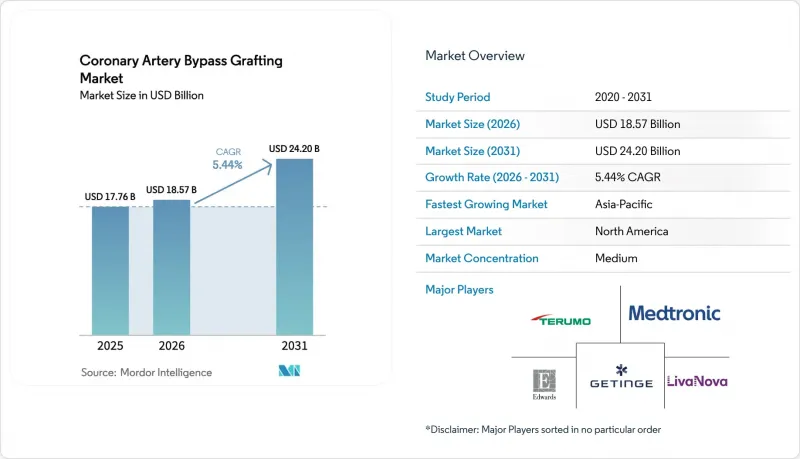
본 보고서는 수술 유형(온펌프 CABG, 오프펌프 CABG 등), 제품 및 서비스(심폐 우회 장치 등),이식편/도관 재료(복재정맥 이식편 등), 수술 난이도(싱글 우회 등), 최종 사용자(병원 등), 지역(북미 등)별로 분류되어 있습니다. 시장 전망은 금액(달러) 기준으로 제시되어 있습니다.
전 세계 관상동맥 우회술(CABG) 시장 동향 및 인사이트
복잡한 다지 관상동맥 질환(CAD) 및 당뇨병 유병률 증가
당뇨병은 혈관 질환의 복잡성을 현저히 높이며, 두 질환을 모두 앓고 있는 환자의 경우 PCI보다 수술의 생존율이 더 높습니다. 국제당뇨병연맹(IDF)은 2045년까지 성인 당뇨병 환자 수가 7억 8,300만 명에 달할 것으로 예측하고 있으며, 그 증가분의 대부분은 저·중소득 국가에서 발생할 것으로 예측됩니다. 이와 더불어 아시아에서는 2050년까지 심혈관 질환으로 인한 사망률이 91.2% 급증할 것으로 예측되며, 수술 수요는 급격한 상승 추세를 유지할 전망입니다. 당뇨병을 동반한 다지 관상동맥 질환은 SYNTAX 점수가 22를 초과하는 경우가 많기 때문에 현재 가이드라인에서는 이러한 증례를 심장 전문 팀에 의뢰하여 관상동맥 우회술(CABG)의 적응증으로 삼도록 규정하고 있습니다. 선별 검사의 개선과 인구 고령화에 따라, 관상동맥 우회술 시장에는 고도로 복잡한 증례의 후보자들이 상당수 유입되고 있습니다.
G20 국가들의 고령화가 진행되면서 수술 적응증 환자층이 확대
2050년까지 65세 이상 인구는 G20 국가 전체 인구의 24.3%를 차지할 것으로 전망됩니다. 고령 환자에서는 확산성 병변이나 좌주관동맥 병변이 많이 관찰되며, 이 모두는 완전한 외과적 혈류 재건술의 적응증이 됩니다. 일본, 독일, 이탈리아, 한국은 가장 급격한 인구 동태 변화에 직면하고 있는 반면, 미국에서는 2008년 이후 심흉부외과 레지던트 양성 인원이 2배로 증가했습니다. 그러나 심폐 우회술 기술자의 수는 이를 따라가지 못하고 있으며, 현재 미국 인력의 절반이 2031년까지 은퇴할 가능성이 있습니다. 이러한 불균형으로 인해 캐나다와 영국에서는 대기 목록이 길어지고 있으며, 병원에는 수술 일정의 효율화를 요구하는 압력이 높아지고 있습니다.
PCI: 약물 방출형 스텐트의 개선으로 재시술률 감소
최근 무작위 임상시험에서 생분해성 폴리머 스텐트를 사용한 결과, 4년간의 주요 이상반응 발생률이 23.0%에서 14.2%로 감소했습니다. 2세대 에베로리무스 스텐트는 5년 고장률을 10% 미만으로 달성했으며, SYNTAX 임상시험의 중간 결과에서는 현재 PCI로 전환되는 추세가 나타나고 있습니다. 존슨앤드존슨이 2024년에 쇼크웨이브 메디컬을 인수함에 따라, 과거에는 외과 수술로만 치료되던 석회화 병변을 치료할 수 있는 체외 충격파 분쇄술이 중재의학 전문의의 치료법에 추가되었습니다. 이 기술이 보급됨에 따라, 서유럽 시장의 소개 패턴에서 관상동맥 우회술 시장은 점차 환자 수를 빼앗기는 상황에 직면하고 있습니다.
부문 분석
2025년에는 온펌프 수술법이 매출의 54.73%를 차지하며, 관상동맥 우회술 시장에서 가장 큰 점유율을 유지했습니다. 한편, 최소 침습 및 로봇 플랫폼을 이용한 관상동맥 우회술 시장 규모는 2031년까지 연평균 성장률(CAGR) 9.24%로 성장할 전망입니다. 병원 측은 3지 병변 치료에 있어 온펌프 CABG가 심근 보호 측면에서 신뢰성이 높다는 점을 높이 평가했습니다. 오프펌프 수술은 대동맥 석회화증에 대해 틈새 수요가 있지만, 통합 데이터에서는 생존율의 우월성이 입증되지 않았습니다. 로봇 시스템은 PCI와의 미적 차이를 좁히고, 개흉술에 따른 불편감을 경감시키며, 48시간 이내에 중환자실 병상을 비워줍니다. 숙련 곡선은 약 20건까지 단축되었으며, 새로운 리스 모델을 통해 자본 지출을 5년까지 분산할 수 있게 되었습니다.
로봇 수술의 보급으로 인해 외래수술센터(ASC)에서도 특정 사례, 특히 심실 기능이 유지되고 있는 단일 가지 또는 이중 가지 병변 사례도 처리할 수 있게 되었습니다. CMS는 단일 포괄 보상을 지급하기 때문에 수술 후 3일 이내에 퇴원시키는 시설일수록 이익률을 높일 수 있습니다. 병원이 이러한 비용 절감을 추구함에 따라, ‘관상동맥 우회술 시장’이라는 용어는 수술 건수가 아닌 중증도 계층화가 수익을 좌우하는 생태계를 가리키게 될 것입니다.
2025년 매출액에서는 심장 포지셔너와 조직 안정기가 26.63%를 차지하며 1위를 기록했으나, 2031년까지는 내시경식 채취 기기가 8.13%의 성장률로 가장 빠르게 확대될 전망입니다. 최신 사례 시리즈에서는 이러한 기기를 사용함으로써 하지 절개 부위의 감염률을 2% 미만으로 억제하고, 수술 시간을 25분 가까이 단축할 수 있었습니다. 심폐 우회 콘솔은 공급업체가 모듈식 산소화기 업그레이드를 제공하고 있기 때문에 교체 주기가 길어지고 있으며, 많은 경우 15년을 초과합니다. 이 콘솔과 관련된 서비스는 게팅게(Getinge)사의 심혈관 관련 매출의 30%를 차지하며, 전체 구매 주기 전반에 걸쳐 수요를 평준화하고 있습니다.
문합 보조 기구는 기구의 가동 범위가 제한되는 로봇 수술 분야에서 보급이 확대되고 있습니다. 한편, 특히 인도와 브라질에서는 지역 공급업체들이 캐뉼라 가격을 놓고 경쟁을 벌이고 있지만, 미국의 의료 기관에서는 용혈을 줄여주는 헤파린 코팅 튜브에 대해 상대적으로 높은 가격을 지불하고 있습니다. 공급업체 통합은 계속되고 있으며, 미국 프로그램의 62%가 2021년 이후 공급업체 목록을 최소 20% 축소했습니다. 이러한 변화로 인해 공급 기업의 협상력이 집중되면서, 관상동맥 우회술 시장에서 다국적 브랜드의 우위가 더욱 강화되고 있습니다.
지역별 분석
북미는 2025년 매출의 36.44%를 차지하고 있으며, 그 배경에는 미국 내 연간 약 20만 건의 수술 건수와 로봇 콘솔의 조기 도입이 있습니다. 다지 동맥 우회술에 대한 메디케어 환급에 더해, BPCI Advanced에 기반한 번들 지급 방식 덕분에 수술 건수가 정체되어 있음에도 불구하고 수익 기반은 여전히 매력적인 수준을 유지하고 있습니다. 캐나다에서는 심혈관 전문 기술자 부족으로 인해 2024년 중반까지 18개월 동안 퀘벡주에서 수술 지연으로 인한 사망 사례가 80건 발생했습니다. 멕시코에서는 복잡한 사례가 계속해서 미국으로 이송되고 있어 해당 지역의 사례 수가 증가하고 있습니다.
아시아태평양은 당뇨병 유병률 증가와 인프라 투자가 맞물려 2031년까지 연평균 성장률(CAGR) 7.03%를 기록하며, 다른 어떤 지역보다 빠른 성장률을 보일 전망입니다. 중국에서는 2020년 이후 200개 이상의 심장외과 병동이 신설되었습니다. 그 중 상당수는 관상동맥 우회술(CABG)과 경카테터 판막 교체술 모두를 수행할 수 있는 하이브리드 수술실을 갖추고 있습니다. 인도 시장은 대도시권의 높은 수술 건수를 자랑하는 민간 체인과, 기타 지역에 위치한 자원이 제한된 공립 병원 사이에서 양분되어 있습니다. 일본과 한국은 6년제 통합형 심흉부외과 레지던트 제도를 확대하여 인력 부족 문제를 해소하고자 하고 있으며, 고령자가 인구의 30% 이상의 고령화 사회에서도 수술 수행 능력을 유지하는 데 기여하고 있습니다.
유럽은 성장 속도 면에서는 뒤처지고 있지만, 독일의 연간 7만 건을 필두로 여전히 상당한 수술 건수를 유지하고 있습니다. EU 배출권 거래 제도(ETS)에 따라 병원들은 수술실의 이산화탄소 배출량을 줄여야 한다는 압력을 받고 있으며, 이는 재사용 가능한 기구의 조달을 촉진하고 있습니다. 영국에서는 5개 트러스트에서 VEST 외부 스텐트가 채택되어, EU 전역의 기술 평가에 선례가 되었습니다. 중동 걸프 국가들은 지역 허브를 구축하기 위해 국제적인 외과 팀을 초청하고 있는 반면, 브라질과 아르헨티나에서는 과거 미국 의료 센터로 보내졌던 환자들을 수용하기 위해 민간 부문의 로봇 수술 프로그램을 확대되고 있습니다.
기타 혜택:
- 엑셀 형식 시장 예측(ME) 시트
- 3개월간의 애널리스트 지원
자주 묻는 질문
목차
제1장 서론
제2장 조사 방법
제3장 주요 요약
제4장 시장 구도
제5장 시장 규모와 성장 예측
제6장 경쟁 구도
제7장 시장 기회와 향후 전망
JHS 26.09.07According to Mordor Intelligence, the coronary artery bypass grafting market size is expected to grow from USD 17.76 billion in 2025 to USD 18.57 billion in 2026 and is forecast to reach USD 24.20 billion by 2031 at 5.44% CAGR over 2026-2031.
This report is Segmented by Procedure Type (On-Pump CABG, Off-Pump CABG, and More), Product and Services (Cardiopulmonary Bypass Machines, and More), Graft / Conduit Material (Saphenous Vein Grafts, and More), Surgery Complexity (Single Bypass, and More), End User (Hospitals, and More), and Geography (North America, and More). The Market Forecasts are Provided in Terms of Value (USD).
Global Coronary Artery Bypass Grafting Market Trends and Insights
Rising Prevalence of Complex Multivessel CAD and Diabetes
Diabetes sharply increases vessel disease complexity, and patients with both conditions see better survival with surgery than with PCI.The International Diabetes Federation expects diabetic adults to climb to 783 million by 2045, with most of the growth in low- and middle-income countries. In parallel, Asia faces a projected 91.2% jump in cardiovascular mortality by 2050, keeping surgical demand on a steep upward slope. Because diabetic multivessel disease often exceeds SYNTAX 22, guidelines now direct such cases to heart teams for CABG referral. As screening improves and populations age, the coronary artery bypass grafting market gains a sizeable inflow of high-complexity candidates.
Aging Population in G-20 Economies Expanding Surgical Candidate Pool
Citizens aged 65 and older will represent 24.3% of the G-20 population by 2050. Older patients present diffuse disease and more left main involvement, both indications for complete surgical revascularization. Japan, Germany, Italy, and South Korea face the steepest demographic curves, while the U.S. training pipeline has doubled cardiothoracic residents since 2008. However, perfusionist numbers lag; half of the current U.S. workforce may retire by 2031. This imbalance fuels wait lists in Canada and the United Kingdom, intensifying pressure on hospitals to streamline case scheduling.
PCI Drug-Eluting Stent Iterations Lowering Repeat-Intervention Rates
Biodegradable-polymer stents cut four-year major adverse events to 14.2% from 23.0% in recent randomized work. With second-generation everolimus devices delivering sub-10% five-year failure, intermediate SYNTAX cases now lean toward PCI. Johnson & Johnson's 2024 purchase of Shockwave Medical adds lithotripsy that lets interventionalists tackle calcified lesions once sent to surgery. As the technology diffuses, the coronary artery bypass grafting market faces gradual patient leakage in Western referral patterns.
Other drivers and restraints analyzed in the detailed report include:
- Guideline Preference for CABG Over PCI in High SYNTAX-Score Disease
- Transition to Mini-Sternotomy and Robotic CABG Unlocking Day-7 Discharge
- Limited Global Stock of CABG-Skilled Surgeons and Perfusionists
For complete list of drivers and restraints, kindly check the Table Of Contents.
Segment Analysis
On-pump techniques retained 54.73% of revenue in 2025, maintaining the largest coronary artery bypass grafting market share, while the coronary artery bypass grafting market size for minimally invasive and robotic platforms is set to expand at a 9.24% CAGR through 2031. Hospitals value on-pump CABG for reliable myocardial protection when tackling three-vessel disease. Off-pump surgery holds niche appeal for calcified aortas but shows no survival edge in pooled data. Robotic systems close the cosmetic gap with PCI, reducing sternotomy discomfort and freeing ICU beds within 48 hours. Training curves have shortened to roughly 20 cases, and new leasing models spread capital outlays across five-year horizons.
Growth in robotic procedures also enables select cases in ambulatory centers, especially single- or double-vessel disease with preserved ventricular function. CMS pays a single bundled rate, so facilities that discharge on or before postoperative day 3 keep more of the margin. As hospitals chase these savings, the phrase coronary artery bypass grafting market will increasingly denote an ecosystem where acuity stratification, not volume, drives revenue.
Heart positioners and tissue stabilizers led 2025 sales at 26.63%, but endoscopic harvesting devices will grow fastest at 8.13% through 2031. Their use drops leg-wound infection to below 2% and trims operative time by nearly 25 minutes in contemporary series. Cardiopulmonary bypass consoles face elongated replacement cycles-often exceeding 15 years-as vendors deliver modular oxygenator upgrades. Services tied to those consoles generate 30% of Getinge's cardiovascular revenue, smoothing demand across purchase cycles.
Anastomosis assist tools gain traction in robotic cases where instrument articulation is limited. Meanwhile, regional suppliers compete on cannula price, especially in India and Brazil, although U.S. centers pay a premium for heparin-bonded tubing that reduces hemolysis. Vendor consolidation continues; 62% of U.S. programs have trimmed their supplier list by at least 20% since 2021. This shift concentrates bargaining power and reinforces the dominance of multinational brands in the coronary artery bypass grafting market.
Complete Report Scope:
- By Procedure Type
- On-pump CABG
- Off-pump CABG
- Minimally Invasive and Robotic-Assisted CABG
- By Product and Services
- Cardiopulmonary Bypass Machines
- Endoscopic Vessel Harvesting Systems
- Heart Positioners & Tissue Stabilizers
- Cannulas & Tubing Sets
- Anastomosis Assist Devices
- Services
- Others
- By Graft / Conduit Material
- Saphenous Vein Grafts
- Internal Thoracic Artery Grafts
- Radial Artery Grafts
- Synthetic & Bio-engineered Grafts
- By Surgery Complexity
- Single Bypass
- Double Bypass
- Triple Bypass
- Quadruple & Higher
- By End User
- Hospitals
- Cardiac Centres & Clinics
- Ambulatory Surgical Centres
- Academic & Research Institutes
- By Geography
- North America
- United States
- Canada
- Mexico
- Europe
- Germany
- France
- United Kingdom
- Italy
- Spain
- Rest of Europe
- Asia-Pacific
- China
- Japan
- India
- South Korea
- Australia
- Rest of Asia-Pacific
- Middle East & Africa
- GCC
- South Africa
- Rest of Middle East & Africa
- South America
- Brazil
- Argentina
- Rest of South America
- North America
Geography Analysis
North America generated 36.44% of 2025 revenue, rooted in roughly 200,000 annual U.S. procedures and early adoption of robotic consoles. Medicare reimbursement for multi-arterial grafting plus bundled payments under BPCI Advanced keep profit pools attractive despite stable case counts. Canada's perfusionist shortage produced 80 surgery-delay deaths in Quebec during the 18 months to mid-2024. Mexico continues to send complex cases north, bolstering regional volumes.
Asia-Pacific will record a 7.03% CAGR through 2031, the fastest of any region, as diabetes prevalence and infrastructure investment collide. China has added more than 200 cardiac surgery units since 2020; many feature hybrid suites capable of both CABG and transcatheter valve work. India's market splits between high-volume private chains in metros and resource-limited public hospitals elsewhere. Japan and South Korea aim to mitigate workforce gaps by expanding integrated six-year cardiothoracic residencies, helping preserve procedure capacity as populations age past 30% elderly.
Europe trails in growth but retains significant volume, led by Germany's 70,000 annual cases. The EU Emissions Trading System now pressures hospitals to curb OR carbon output, nudging procurement toward reusable instruments. The United Kingdom adopted the VEST external stent in five trusts, setting precedent for technology appraisal across the bloc. Gulf nations in the Middle East recruit international surgical teams to build regional hubs, while Brazil and Argentina ramp private-sector robotic programs to serve patients once bound for U.S. centers.
- Abbott Laboratories
- Artivion
- AtriCure
- B. Braun
- Boston Scientific
- Edward Lifesciences
- Genesee Biomedical
- Getinge
- Karl Storz
- LeMaitre Vascular
- LivaNova
- Medtronic
- MicroPort
- Novadaq Technologies
- Stryker
- Teleflex
- Terumo
- Vitalitec
- W. L. Gore & Associates
Additional Benefits:
- The market estimate (ME) sheet in Excel format
- 3 months of analyst support
TABLE OF CONTENTS
1 Introduction
- 1.1 Study Assumptions & Market Definition
- 1.2 Scope of the Study
2 Research Methodology
3 Executive Summary
4 Market Landscape
- 4.1 Market Overview
- 4.2 Market Drivers
- 4.2.1 Rising Prevalence of Complex Multivessel CAD and Diabetes
- 4.2.2 Ageing Population in G-20 Economies Expanding Surgical Candidate Pool
- 4.2.3 Guideline Preference for CABG Over PCI In High SYNTAX-Score Disease
- 4.2.4 Transition to Mini-Sternotomy & Robotic CABG Unlocking Day-7 Discharge
- 4.2.5 Commercialization Of External Stents for Saphenous Vein Grafts Enhancing Durability
- 4.2.6 Regional Bundled-Payment Pilots Rewarding Multi-Arterial Grafting Outcomes
- 4.3 Market Restraints
- 4.3.1 PCI Drug-Eluting Stent Iterations Lowering Repeat-Intervention Rates
- 4.3.2 Limited Global Stock of CABG-Skilled Surgeons & Perfusionists
- 4.3.3 Procedural CO2 Footprint Scrutiny in EU ETS Phase-In
- 4.3.4 Rising U.S. Tariffs on Precision CABG Components Inflating ASPs
- 4.4 Value / Supply-Chain Analysis
- 4.5 Regulatory Landscape
- 4.6 Technological Outlook
- 4.7 Porter's Five Forces Analysis
- 4.7.1 Threat of New Entrants
- 4.7.2 Bargaining Power of Suppliers
- 4.7.3 Bargaining Power of Buyers
- 4.7.4 Threat of Substitutes
- 4.7.5 Intensity of Competitive Rivalry
5 Market Size & Growth Forecasts (Value in USD)
- 5.1 By Procedure Type
- 5.1.1 On-pump CABG
- 5.1.2 Off-pump CABG
- 5.1.3 Minimally Invasive and Robotic-Assisted CABG
- 5.2 By Product and Services
- 5.2.1 Cardiopulmonary Bypass Machines
- 5.2.2 Endoscopic Vessel Harvesting Systems
- 5.2.3 Heart Positioners & Tissue Stabilizers
- 5.2.4 Cannulas & Tubing Sets
- 5.2.5 Anastomosis Assist Devices
- 5.2.6 Services
- 5.2.7 Others
- 5.3 By Graft / Conduit Material
- 5.3.1 Saphenous Vein Grafts
- 5.3.2 Internal Thoracic Artery Grafts
- 5.3.3 Radial Artery Grafts
- 5.3.4 Synthetic & Bio-engineered Grafts
- 5.4 By Surgery Complexity
- 5.4.1 Single Bypass
- 5.4.2 Double Bypass
- 5.4.3 Triple Bypass
- 5.4.4 Quadruple & Higher
- 5.5 By End User
- 5.5.1 Hospitals
- 5.5.2 Cardiac Centres & Clinics
- 5.5.3 Ambulatory Surgical Centres
- 5.5.4 Academic & Research Institutes
- 5.6 By Geography
- 5.6.1 North America
- 5.6.1.1 United States
- 5.6.1.2 Canada
- 5.6.1.3 Mexico
- 5.6.2 Europe
- 5.6.2.1 Germany
- 5.6.2.2 France
- 5.6.2.3 United Kingdom
- 5.6.2.4 Italy
- 5.6.2.5 Spain
- 5.6.2.6 Rest of Europe
- 5.6.3 Asia-Pacific
- 5.6.3.1 China
- 5.6.3.2 Japan
- 5.6.3.3 India
- 5.6.3.4 South Korea
- 5.6.3.5 Australia
- 5.6.3.6 Rest of Asia-Pacific
- 5.6.4 Middle East & Africa
- 5.6.4.1 GCC
- 5.6.4.2 South Africa
- 5.6.4.3 Rest of Middle East & Africa
- 5.6.5 South America
- 5.6.5.1 Brazil
- 5.6.5.2 Argentina
- 5.6.5.3 Rest of South America
- 5.6.1 North America
6 Competitive Landscape
- 6.1 Market Concentration
- 6.2 Market Share Analysis
- 6.3 Company Profiles (includes Global level Overview, Market level overview, Core Segments, Financials as available, Strategic Information, Market Rank/Share for key companies, Products and Services, and Recent Developments)
- 6.3.1 Abbott
- 6.3.2 Artivion
- 6.3.3 AtriCure
- 6.3.4 B. Braun Melsungen
- 6.3.5 Boston Scientific
- 6.3.6 Edwards Lifesciences
- 6.3.7 Genesee Biomedical
- 6.3.8 Getinge (Maquet)
- 6.3.9 KARL STORZ
- 6.3.10 LeMaitre Vascular
- 6.3.11 LivaNova PLC
- 6.3.12 Medtronic
- 6.3.13 MicroPort
- 6.3.14 Novadaq Technologies
- 6.3.15 Stryker
- 6.3.16 Teleflex
- 6.3.17 Terumo Corporation
- 6.3.18 Vitalitec
- 6.3.19 W. L. Gore & Associates
7 Market Opportunities & Future Outlook
- 7.1 White-space & Unmet-Need Assessment


