

|
시장보고서
상품코드
2123647
치료용 혈장 교환 시장 : 점유율 분석, 업계 동향과 통계, 성장 예측(2026-2031년)Therapeutic Plasma Exchange - Market Share Analysis, Industry Trends & Statistics, Growth Forecasts (2026 - 2031) |
||||||
 Mordor Intelligence
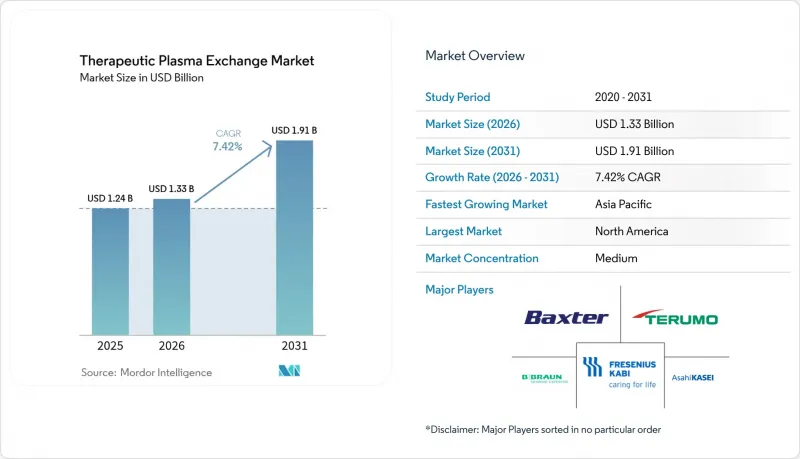
Mordor Intelligence에 의하면, 2026년 치료용 혈장 교환 시장 규모는 13억 3,000만 달러로 추정되고 있어 2025년 12억 4,000만 달러에서 확대되어, 2031년에는 19억 1,000만 달러에 이를 것으로 예측됩니다.
2026년부터 2031년까지의 연평균 성장률(CAGR)은 7.42%를 나타낼 전망입니다.
본 보고서는 제품별(아페레시스 장치, 필터, 컬럼 및 흡착제, 일회용 제품, 소프트웨어 및 서비스), 적응증별(신경계, 심혈관계, 혈액학,신장계, 이식 거부 반응, 기타 적응증), 최종 사용자별(병원 등), 지역별(북미, 유럽, 아시아태평양, 중동 및 아프리카, 남미)로 분류되어 있습니다. 시장 예측은 금액(달러) 기준으로 제시되어 있습니다.
전 세계 치료용 혈장 교환 시장 동향 및 인사이트
자가면역 질환 및 신경 질환의 부담 증가
만성 자가면역 질환의 전 세계 유병률은 계속 증가하고 있으며, 길랑-바레 증후군 및 중증 근력 약화증 환자는 치료용 혈장 교환 요법을 통해 치료받은 경우 각각 92% 및 81.25%의 반응률을 보이고 있습니다. 의료 현장에서는 난치성 악화에 대한 구제 요법으로 혈장 교환 요법이 점점 더 인정받고 있으며, 이러한 추세는 질환의 중증도가 높은 고소득 국가에서의 고령화로 인해 더욱 강화되고 있습니다. 초기 연구 결과에 따르면, 혈장 교환이 염증 매개체를 제거함으로써 장기 코로나 증상을 완화할 가능성도 시사되고 있어, 이에 따라 대상 환자층이 확대되고 있습니다. 이러한 역학적 및 임상적 요인들이 결합되어 지속적인 시술 수요를 창출하고 있으며, 수년에 걸친 장비 교체 주기를 뒷받침하고 있습니다.
적응증 확대를 뒷받침하는 임상적 근거 증가
미국 아페레시스 학회는 2024년 지침에서 87가지 질환에 대해 치료용 혈장 교환을 카테고리 I-III의 권고 사항으로 분류하며, 적응증 범위의 확대를 강조했습니다. 2025년에 발표된 무작위 대조 시험에서는 교환 요법 시행 후, 신경학적 합병증을 동반한 COVID-19 환자의 사이토카인 수치가 유의미하게 감소한 것으로 나타났습니다. 이집트 소아과학회 회보(Egyptian Pediatric Association Gazette)에 게재된 소아 데이터는 성인과의 동등한 안전성이 확인되어, 소아에 대한 조기 개입을 뒷받침하고 있습니다. 증거가 축적됨에 따라 처방 의사의 주저함이 줄어들고, 병원 프로토콜에의 도입이 가속화되며, 각 전문 분야에서의 시술 건수가 점차 증가하고 있습니다.
아페레시스 장치의 고액 설비 투자 및 소모품 비용
최고 수준의 장비는 1대당 10만 달러를 초과하는 반면, 일회용 키트는 1회 시술당 1,000-1,200달러의 추가 비용이 듭니다. 이러한 비용은 라틴아메리카나 아프리카의 소규모 병원 입장에서는 도입을 정당화하기 어려운 수준입니다. 팬데믹 이후 공급망 혼란으로 인해 수지 및 막 가격이 상승하여, 2024년에는 컬럼 비용이 15% 급등했습니다. 각 OEM 업체들은 리스, 종량제, 서비스 번들 등을 제공하고 있지만, 신흥국의 의료 예산 부족으로 인해 장비 교체 주기가 길어지고, 차세대 플랫폼 도입이 미뤄지고 있습니다.
부문 분석
2025년, 아페레시스 장치는 치료용 혈장 교환 시장 규모의 48.02%를 차지하여, 모든 질병 범주에서 이 장치가 치료의 중심적인 역할을 하고 있음을 뒷받침하고 있습니다. 한편, 임상의들이 혈장 교환을 최소화하면서 병원체를 선택적으로 제거하기를 요구하는 가운데, 컬럼 및 흡착 장치는 2031년까지 연평균 성장률(CAGR) 9.49%로 성장하고 있습니다. 현재 통합형 장치에는 원심 분리 및 흡착 카트리지가 결합되어 있어, 조작자는 동일한 콘솔 내에서 전혈장 제거와 항체 특이적 여과를 전환할 수 있습니다. 각 제조업체는 센서를 통한 항응고제 적정, 폐쇄형 시스템용 일회용 제품, 그리고 시술 시간을 35분 미만으로 단축하는 클라우드 기반 성능 분석 기능을 통해 차별화를 꾀하고 있습니다.
지속적인 소모품 매출은 여전히 매우 중요합니다. 튜브 세트, 생리식염수, 항응고제 및 교체액은 설치 기반당 고객 생애 가치의 60% 가까이 차지합니다. 따라서 시장의 기존 기업들은 하드웨어 임대와 장기 소모품 계약을 결합하여 예측 가능한 현금 흐름을 확보하고 있습니다. 원격 문제 해결 및 프로토콜 라이브러리를 가능하게 하는 소프트웨어 업데이트로 인해, 경쟁의 초점은 가격에서 플랫폼 생태계로의 정착으로 더욱 이동하고 있으며, 이는 고객의 의존도를 높이고 저비용 신규 시장 진출기업에 의한 시장 잠식의 가능성을 억제하고 있습니다.
지역별 분석
2025년, 북미는 치료용 혈장 교환 시장의 40.66%를 차지하며 시장을 선도했습니다. 이는 높은 소모품 비용을 상쇄하는 메디케어 및 민간 보험사의 견실한 보험 지급에 힘입은 결과입니다. 2025년 ‘Aurora Xi’ 혈장 교환 시스템이 FDA 승인을 받으면서 경쟁이 심화되었고, 기존 콘솔의 가격 인하가 촉진되었습니다. 캐나다 각 주는 최근 요금 체계를 미국의 요금 수준으로 통일하여 국경을 넘는 시술 유출을 줄이고 국내 수요를 안정시켰습니다.
아시아태평양은 300개 현립 병원의 혈장 교환 인프라에 자금을 지원하는 중국의 ‘건강 중국 2030’ 계획에 힘입어 연평균 성장률(CAGR) 8.31%로 가장 빠르게 성장하고 있는 지역입니다. 테르모(Terumo)가 1,500만 달러 규모의 항저우 시설 확장을 통해 ‘Spectra Optia’ 키트의 현지 공급을 확보함으로써, 수입 관세가 절감되고 납기 기간이 40% 단축되었습니다. 일본과 한국은 성숙한 도입 기반을 유지하고 있지만, 인구 고령화와 이식 프로그램의 확대로 인해 여전히 성장 여지가 있습니다. 인도의 의료 관광 성장에 힘입어, 경쟁력 있는 혈장 교환 패키지를 제공하는 사립 병원으로 해외 환자들이 유입되고 있습니다.
유럽에서는 꾸준하지만 완만한 확대세가 나타나고 있습니다. 국민 건강보험 제도로 의료 접근성은 쉬워졌지만, 2024년 혈장 공급 부족으로 인해 많은 EU 회원국은 생혈장의 40%를 미국에서 수입할 수밖에 없게 되었으며, 이에 따라 유럽혈액연맹은 200만 명의 추가 헌혈자를 모집하기로 결정했습니다. 중동 및 아프리카 시장은 아직 발전 단계에 있지만, 걸프협력회의(GCC)의 3차 의료 거점에 대한 투자에 힘입어 성장하고 있습니다. 한편, 브라질과 아르헨티나는 민관 협력 병원 네트워크를 통해 남미 지역의 도입을 주도하고 있습니다.
기타 혜택:
- 엑셀 형식 시장 예측(ME) 시트
- 3개월간의 애널리스트 지원
자주 묻는 질문
목차
제1장 서론
제2장 조사 방법
제3장 주요 요약
제4장 시장 구도
제5장 시장 규모와 성장 예측
제6장 경쟁 구도
제7장 시장 기회와 향후 전망
JHS 26.09.07According to Mordor Intelligence, therapeutic plasma exchange market size in 2026 is estimated at USD 1.33 billion, growing from 2025 value of USD 1.24 billion with 2031 projections showing USD 1.91 billion, growing at 7.42% CAGR over 2026-2031.
This report is Segmented by Product (Apheresis Machines, Filters, Columns & Adsorbers, Disposables, and Software & Services), Indication (Neurological, Cardiovascular, Hematology, Renal, Transplant Rejection, and Other Indications), End-User (Hospitals, and More), and Geography (North America, Europe, Asia-Pacific, MEA, South America). The Market Forecasts are Provided in Terms of Value (USD).
Global Therapeutic Plasma Exchange Market Trends and Insights
Rising Burden of Autoimmune and Neurological Disorders
Global incidence of chronic autoimmune diseases continues to climb, with Guillain-Barre syndrome and myasthenia gravis patients showing 92% and 81.25% response rates respectively when treated with therapeutic plasma exchange. Healthcare systems increasingly recognize plasma exchange as a rescue therapy for refractory flares, a trend amplified by aging populations in high-income countries where disease severity is greater. Early evidence also suggests plasma exchange may mitigate long-COVID symptoms by removing inflammatory mediators, thereby widening the patient pool. Collectively these epidemiological and clinical factors generate sustained procedure demand and underpin multi-year equipment replacement cycles.
Increasing Clinical Evidence Supporting Expanded Indications
The American Society for Apheresis assigned therapeutic plasma exchange a Category I-III recommendation across 87 diseases in its 2024 guidelines, highlighting broadening indication scope. Randomized studies published in 2025 demonstrated significant reductions in cytokine levels among COVID-19 patients with neurological complications following exchange sessions. Pediatric data from the Egyptian Pediatric Association Gazette confirmed safety outcomes comparable to adults, encouraging earlier intervention in children. Growing evidence base lowers prescriber hesitancy, accelerates hospital protocol integration, and fuels incremental procedural volume across specialties.
High Capital and Consumable Costs of Apheresis Systems
Best-in-class devices exceed USD 100,000 per unit, while single-use kits add USD 1,000-1,200 per procedure, costs that small hospitals in Latin America and Africa struggle to justify. Post-pandemic supply chain shocks elevated resin and membrane prices, inflating column costs by 15% in 2024. Although OEMs offer leasing, pay-per-use, and service bundles, strained health budgets in emerging economies translate into slower replacement cycles and deferred adoption of next-generation platforms.
Other drivers and restraints analyzed in the detailed report include:
- Favorable Reimbursement Policies in Developed Nations
- Growing Adoption of Therapeutic Plasma Exchange in Cardiac Surgery
- Limited Availability of Skilled Apheresis Personnel
For complete list of drivers and restraints, kindly check the Table Of Contents.
Segment Analysis
Apheresis machines generated 48.02% of the therapeutic plasma exchange market size in 2025, underscoring their status as the procedural hub across all disease categories. Columns and adsorbers, however, are advancing at a 9.49% CAGR to 2031 as clinicians demand selective pathogen removal with minimal plasma substitution. Integrated devices now combine centrifugal separation with adsorption cartridges, allowing operators to toggle between whole-plasma removal and antibody-specific filtration within the same console. Manufacturers differentiate through sensor-driven anticoagulant titration, closed-system disposables, and cloud-based performance analytics that cut procedure times below 35 minutes.
Recurring consumables revenue remains pivotal: tubing sets, saline, anticoagulants, and replacement fluids contribute nearly 60% of lifetime customer value per installed base. Market incumbents thus bundle hardware leases with long-term consumable contracts, locking in predictable cash flows. Software updates enabling remote troubleshooting and protocol libraries further shift competition from price to platform ecosystem residency, deepening customer dependence and throttling potential displacement by low-cost entrants.
Complete Report Scope:
- By Product
- Apheresis Machines
- Filters
- Columns & Adsorbers
- Disposables (Tubing, Kits)
- Software & Services
- By Indication
- Neurological Disorders
- Cardiovascular Disorders
- Hematology Disorders
- Renal Disorders
- Transplant Rejection
- Other Indications
- By End-User
- Hospitals
- Ambulatory Surgical Centers
- Specialty Clinics
- Home Care Settings
- Geography
- North America
- United States
- Canada
- Mexico
- Europe
- Germany
- United Kingdom
- France
- Italy
- Spain
- Rest of Europe
- Asia-Pacific
- China
- Japan
- India
- Australia
- South Korea
- Rest of Asia-Pacific
- Middle East & Africa
- GCC
- South Africa
- Rest of Middle East & Africa
- South America
- Brazil
- Argentina
- Rest of South America
- North America
Geography Analysis
North America dominated with 40.66% of therapeutic plasma exchange market share in 2025, buoyed by robust Medicare and private-payer reimbursement that offsets high consumable costs. FDA clearance of the Aurora Xi plasmapheresis system in 2025 added competition and fostered price moderation among incumbent consoles. Canada's provinces recently harmonized fee schedules with U.S. rates, reducing cross-border procedure leakage and stabilizing domestic demand.
Asia-Pacific is the fastest-growing region at an 8.31% CAGR, propelled by China's Healthy China 2030 plan that funds apheresis infrastructure in 300 county hospitals. Terumo's USD 15 million Hangzhou facility expansion secures local supply of Spectra Optia kits, lowering import tariffs and slashing delivery times by 40%. Japan and South Korea maintain mature installed bases, yet upside remains from demographic aging and transplant program expansions. India's medical tourism growth funnels international patients into private hospitals offering competitive plasma exchange packages.
Europe shows steady but slower expansion. Although universal insurance coverage facilitates access, plasma supply shortages in 2024 forced many EU countries to import 40% of their raw plasma from the United States, prompting the European Blood Alliance to seek two million additional donors. Middle East and Africa markets are nascent but supported by Gulf Cooperation Council investments in tertiary care hubs, while Brazil and Argentina spearhead South American adoption through public-private hospital networks.
- Asahi Kasei Corp.
- Baxter
- B. Braun
- Cerus Corp.
- Fresenius
- Haemonetics Corp.
- HemaCare
- Medica S.p.A.
- Kawasumi Laboratories
- Terumo Corp.
- Kaneka Corp.
- Nikkiso Co.
- MacoPharma
- ImmunoSystems
- Plasauto Biotech
- Sichuan Nigale
- Miltenyi Biotec
- Otsuka Medical Devices
- Biotest
- MediSieve
Additional Benefits:
- The market estimate (ME) sheet in Excel format
- 3 months of analyst support
TABLE OF CONTENTS
1 Introduction
- 1.1 Study Assumptions & Market Definition
- 1.2 Scope of the Study
2 Research Methodology
3 Executive Summary
4 Market Landscape
- 4.1 Market Overview
- 4.2 Market Drivers
- 4.2.1 Rising Burden of Autoimmune and Neurological Disorders
- 4.2.2 Increasing Clinical Evidence Supporting Expanded Indications
- 4.2.3 Favorable Reimbursement Policies in Developed Nations
- 4.2.4 Growing Adoption of Therapeutic Plasma Exchange in Cardiac Surgery
- 4.2.5 Surge In Adoption of Adsorption Columns in Asian Hospitals
- 4.2.6 Emergence of Portable Apheresis Devices for Out-Of-Hospital Care
- 4.3 Market Restraints
- 4.3.1 High Capital and Consumable Costs of Apheresis Systems
- 4.3.2 Limited Availability of Skilled Apheresis Personnel
- 4.3.3 Vulnerability of Plasma Supply Chain During Global Crises
- 4.3.4 Regulatory Uncertainty Regarding Pediatric Applications
- 4.4 Regulatory Landscape
- 4.5 Porter's Five Forces Analysis
- 4.5.1 Threat Of New Entrants
- 4.5.2 Bargaining Power Of Buyers
- 4.5.3 Bargaining Power Of Suppliers
- 4.5.4 Threat Of Substitutes
- 4.5.5 Competitive Rivalry
5 Market Size & Growth Forecasts (Value, USD)
- 5.1 By Product
- 5.1.1 Apheresis Machines
- 5.1.2 Filters
- 5.1.3 Columns & Adsorbers
- 5.1.4 Disposables (Tubing, Kits)
- 5.1.5 Software & Services
- 5.2 By Indication
- 5.2.1 Neurological Disorders
- 5.2.2 Cardiovascular Disorders
- 5.2.3 Hematology Disorders
- 5.2.4 Renal Disorders
- 5.2.5 Transplant Rejection
- 5.2.6 Other Indications
- 5.3 By End-User
- 5.3.1 Hospitals
- 5.3.2 Ambulatory Surgical Centers
- 5.3.3 Specialty Clinics
- 5.3.4 Home Care Settings
- 5.4 Geography
- 5.4.1 North America
- 5.4.1.1 United States
- 5.4.1.2 Canada
- 5.4.1.3 Mexico
- 5.4.2 Europe
- 5.4.2.1 Germany
- 5.4.2.2 United Kingdom
- 5.4.2.3 France
- 5.4.2.4 Italy
- 5.4.2.5 Spain
- 5.4.2.6 Rest of Europe
- 5.4.3 Asia-Pacific
- 5.4.3.1 China
- 5.4.3.2 Japan
- 5.4.3.3 India
- 5.4.3.4 Australia
- 5.4.3.5 South Korea
- 5.4.3.6 Rest of Asia-Pacific
- 5.4.4 Middle East & Africa
- 5.4.4.1 GCC
- 5.4.4.2 South Africa
- 5.4.4.3 Rest of Middle East & Africa
- 5.4.5 South America
- 5.4.5.1 Brazil
- 5.4.5.2 Argentina
- 5.4.5.3 Rest of South America
- 5.4.1 North America
6 Competitive Landscape
- 6.1 Market Concentration
- 6.2 Market Share Analysis
- 6.3 Company Profiles (includes Global level Overview, Market level overview, Core Business Segments, Financials, Headcount, Key Information, Market Rank, Market Share, Products and Services, and analysis of Recent Developments)
- 6.3.1 Asahi Kasei Corp.
- 6.3.2 Baxter International Inc
- 6.3.3 B. Braun Melsungen AG
- 6.3.4 Cerus Corp.
- 6.3.5 Fresenius Kabi AG
- 6.3.6 Haemonetics Corp.
- 6.3.7 HemaCare
- 6.3.8 Medica S.p.A.
- 6.3.9 Kawasumi Laboratories
- 6.3.10 Terumo Corp.
- 6.3.11 Kaneka Corp.
- 6.3.12 Nikkiso Co.
- 6.3.13 Macopharma
- 6.3.14 ImmunoSystems
- 6.3.15 Plasauto Biotech
- 6.3.16 Sichuan Nigale
- 6.3.17 Miltenyi Biotec
- 6.3.18 Otsuka Medical Devices
- 6.3.19 Biotest AG
- 6.3.20 MediSieve
7 Market Opportunities & Future Outlook
- 7.1 White-Space & Unmet-Need Assessment


