

|
시장보고서
상품코드
2123658
혈전 관리 기기 시장 : 시장 점유율 분석, 업계 동향 및 통계, 성장 예측(2026-2031년)Clot Management Devices - Market Share Analysis, Industry Trends & Statistics, Growth Forecasts (2026 - 2031) |
||||||
 Mordor Intelligence
Mordor Intelligence에 의하면, 혈전 관리 기기 시장 규모는 2025년 19억 6,000만 달러로 평가되었고, 2026년 20억 8,000만 달러에서 2031년까지 27억 7,000만 달러로 확대될 것으로 예측되며, 2026-2031년 CAGR 5.96%를 기록할 전망입니다.
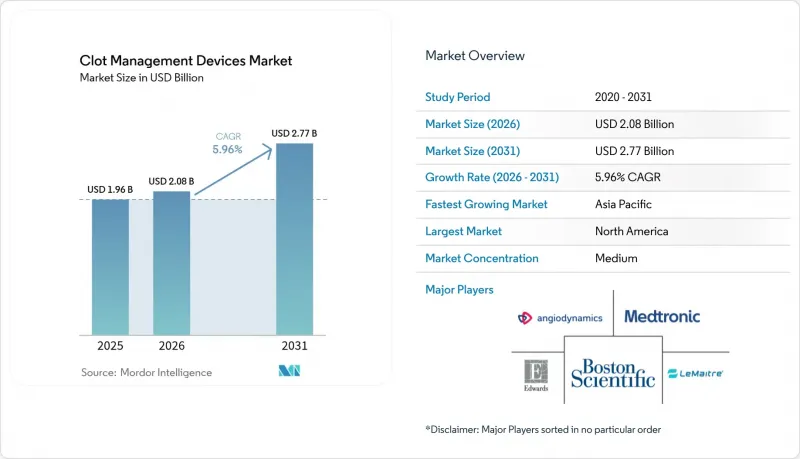
본 보고서는 제품별(색전 제거용 풍선 카테터, 카테터 유도형 혈전 용해 기기, 기계적·경피적 혈전 제거 기기, 하대정맥 필터, 기타), 최종 사용자별(병원, 기타), 지역별(북미, 유럽, 아시아태평양, 중동 및 아프리카, 남미)로 분류되어 있습니다. 시장 예측은 금액(달러) 기준으로 제시되어 있습니다.
세계의 혈전 관리 기기 시장 동향 및 인사이트
전 세계적으로 증가하는 혈전색전성 질환의 부담
허혈성 뇌졸중과 정맥 혈전색전증은 현재 매년 1,200만 건 이상의 급성 사례를 유발하고 있으며, 인구 고령화와 대사성 위험 요인 증가에 따라 1990-2019년 뇌졸중 발생률은 70% 증가했습니다. 미국에서는 연간 90만 건의 정맥 혈전색전증이 보고되고 있지만, 2021년 기준으로 적격 대혈관 폐색 사례 중 기계적 혈전 제거술이 시행된 경우는 고작 8%에 그쳐, 치료받지 못한 환자가 다수 남아 있습니다. 농촌 지역에서는 미국인의 3분의 1이 혈전 제거술이 가능한 시설에서 차로 60분 이상 떨어진 곳에 거주하고 있어 의료 격차가 더욱 심화되고 있으며, 이로 인해 치료 건수를 확대하는 ‘허브 앤 스포크’형 원격 뇌졸중 네트워크에 대한 수요가 높아지고 있습니다. 중국에는 300곳 이상의 종합 뇌졸중 센터가 있지만, 1인당 혈전 제거술 시행 건수는 여전히 미국보다 훨씬 낮은 수준입니다. 그러나 훈련을 받은 신경 중재 전문의가 증가하고 보험 환급 제도가 정비됨에 따라 이러한 격차는 줄어들 것으로 예측됩니다. 2030년까지 전 세계 사망 원인의 73%를 비감염성 질환이 차지할 것으로 예측되는 점을 감안할 때, 단기적인 경제 변동과 관계없이 이 요인의 영향력은 앞으로도 지속될 것으로 보입니다.
개두술을 대체하는 혈관내 치료의 보급 확대
미국에서 뇌졸중 입원 환자에 대한 기계적 혈전 제거술의 보급률은 2010년 0.75%에서 2021년에는 8.4%로 상승했습니다. 이는 주로 혈관내 치료가 개두 신경외과적 감압술에 수반되는 합병증이나 재활 비용을 피할 수 있기 때문입니다. 의료 경제 분석에 따르면, 혈전 제거술을 통해 6시간 이내에 재관류가 성공한 경우, 환자 1인당 1만 5,000-2만 5,000달러의 순절감 효과를 얻을 수 있는 것으로 나타났습니다. 2025년 FDA 승인을 받은 ‘Zoom 시스템’은 서혜부 천자부터 재관류까지의 시간을 중앙값 19분으로 단축하여, 소규모 병원에서 시술의 복잡성에 대한 우려를 해소했습니다. 테르모(Terumo)사가 추진하는 요골동맥 접근 기술을 통해 특정 증례에서는 당일 퇴원이 가능해졌으며, 병원의 카테터 치료로의 전환이 더욱 가속화되고 있습니다. 지역 의료 센터에서의 시술자 연수가 확대됨에 따라, 중기적으로는 전 세계적으로 혈관 내 치료 시행 건수가 증가할 것으로 예측됩니다.
엄격한 규제 및 임상 증거 요건
FDA의 2024년 지침에 따르면, 신경혈관 혈전 제거 기기에 대해 기존 제품과의 직접 비교를 통한 비열등성 데이터 제출이 요구되게 되었으며, 이로 인해 주요 임상시험 예산은 1,000만-2,000만 달러로 불어났고, 일정도 2년 연장되었습니다. 유럽에서도 동시에 ‘의료기기 규정(MDR)’으로의 전환이 진행되면서 재인증 수요가 쇄도하고 있습니다. 또한, 인증 기관의 처리 능력이 제한적이기 때문에 심사 대기 기간은 이미 12-18개월에 달하고 있습니다. 이러한 장벽은 스타트업 기업에 특히 큰 타격을 주고 있으며, 대기업들이 새로운 연구 개발에 착수하기보다는 이미 승인된 제품 포트폴리오를 인수하는 움직임이 가속화되고 있습니다. 보스턴 사이언티픽의 페남브라 인수나 스트라이커의 이전 이나리 메디컬 인수가 그 대표적인 예입니다. 더 명확한 증거는 궁극적으로 환자 안전으로 이어지겠지만, 단기적인 영향으로 혁신 속도가 둔화되고 혈전 관리 기기 시장의 성장이 일시적으로 주춤하게 될 것입니다.
부문 분석
신경혈관 혈전 제거 시스템은 2025년 매출의 36.42%를 차지했으며, 기계적 혈전 관리 기기 시장에서 가장 큰 점유율을 차지하고 있으며, 2031년까지 연평균 성장률(CAGR) 7.54%로 확대될 것으로 예측됩니다. 이러한 성장세는 확고한 근거에 뒷받침되고 있습니다. SELECT2 연구에 따르면, 라지 코어(광범위 경색) 환자의 20.3%가 혈전 제거술 후 기능적 자립을 달성한 반면, 약물 요법만으로는 7%에 그쳐 적응증 확대의 타당성이 입증되었습니다. Penumbra Lightning Flash 2.0과 같은 흡입 및 스텐트 병용형 하이브리드 솔루션은 40-48%의 초기 재개통률을 달성하고 있으며, 이는 90일 후의 예후와 가장 높은 상관관계를 보이는 성과 지표에서 현저한 향상을 보여줍니다.
한편, 하대정맥 필터나 카테터 유도형 혈전 용해 장치는 직접 작용형 경구용 항응고제가 많은 예방적 적응증을 다루고 있다는 점과, FDA가 회수율이 낮고 지연성 합병증을 지적하고 있다는 점 때문에 성장에 역풍을 맞고 있습니다. AngioDynamics의 AlphaVac PE와 같은 신규 진입 제품은 약물 요법과 순수한 기계적 접근법 사이의 틈새 시장을 개척했지만, 전반적인 성장은 여전히 완만한 수준에 머물러 있습니다. 색전 제거용 풍선 카테터는 여전히 말초동맥질환 치료에 사용되고 있지만, 내피를 보호하면서 혈전을 더 신속하게 제거할 수 있는 대구경 흡입 카테터로 점차 대체되고 있습니다.
지역별 분석
북미는 2025년 매출의 43.65%를 차지했지만, 허혈성 뇌졸중 입원 환자의 약 8%에서 이용률이 정체되어 있으며, 추가적인 확장을 위해서는 지방 지역의 접근성 격차 해소가 필수적이기 때문에 성장률은 세계 평균을 밑돌 것으로 전망됩니다. 캐나다에서는 전국적으로 혈전 제거술에 대한 보험 적용이 이루어지고 있지만, 의료 제공 능력의 병목 현상으로 인해 일부 주에서는 선택적 혈관 치료 대기 시간이 반년에 달하는 상황입니다. 멕시코 시장은 여전히 보급률이 낮아, 혈전 제거술 대상 뇌졸중 환자 중 실제로 수술을 받는 비율은 고작 2%에 그치고 있습니다. 이는 주로 1건당 1만 달러를 초과하는 본인 부담 비용이 주된 요인으로 작용하고 있습니다.
아시아태평양은 연평균 성장률(CAGR) 6.43%로 가장 빠른 성장 궤도를 보이고 있습니다. 중국의 300개 시설로 구성된 뇌졸중 네트워크는 여전히 1인당 환자 수가 미국보다 훨씬 적은 상황이며, 시술자의 교육과 각 성의 보험사 간 협력이 갖춰지면 막대한 잠재 수요가 표면화될 것으로 시사되고 있습니다. 인도의 민간 병원 체인은 수술실 증설을 급속도로 추진하고 있습니다. 인도 의료비의 62%가 여전히 본인 부담임에도 불구하고, 아폴로 그룹만 해도 2022년 이후 15개의 신경혈관 수술실을 개설했습니다. 일본에서는 65세 이상 인구가 전체 인구의 28%를 차지하는 인구 구조적 경향으로 인해, 엄격한 가격 상한선이 있음에도 불구하고 혈전 제거술은 공중보건상의 시급한 과제가 되고 있습니다.
유럽에서는 보험 급여 제도의 불균형이 도입의 걸림돌이 되고 있습니다. 독일에서는 DRG(진단 관련군)에 따른 보상 제도로 인해 수술 건수는 안정적이지만, 스페인이나 이탈리아에서는 예산 부족으로 인해 더 젊고 NIHSS 점수가 높은 환자에게만 수술이 배정되고 있습니다. 영국에서는 혈전 제거술을 시행할 수 있는 시설 수를 2015년 24곳에서 2025년까지 50곳 이상으로 늘렸으나, 웨일스나 스코틀랜드의 지방 지역에서는 여전히 수 시간에 달하는 이송 시간이 과제로 남아 있습니다. 걸프협력회의(GCC) 회원국에서는 서유럽 모델을 본뜬 고가의 가격 책정이 채택되고 있는 반면, 사하라 이남 아프리카의 대부분 지역에서는 바이플레인 혈관조영 장비가 부족하여 그 도입이 도시 지역의 사립 병원으로 한정되어 있습니다.
기타 혜택
- 엑셀 형식 시장 예측(ME) 시트
- 3개월간의 애널리스트 지원
자주 묻는 질문
목차
제1장 서론
제2장 조사 방법
제3장 주요 요약
제4장 시장 구도
제5장 시장 규모 및 성장 예측
제6장 경쟁 구도
제7장 시장 기회 및 향후 전망
AJY 26.09.11According to Mordor Intelligence, the clot management devices market size is projected to expand from USD 1.96 billion in 2025 and USD 2.08 billion in 2026 to USD 2.77 billion by 2031, registering a CAGR of 5.96% between 2026 to 2031.
This report is Segmented by Product (Embolectomy Balloon Catheters, Catheter-Directed Thrombolysis Devices, Mechanical/Percutaneous Thrombectomy Devices, Inferior Vena Cava Filters, and More), End User (Hospitals, and More), and Geography (North America, Europe, Asia-Pacific, Middle East & Africa, and South America). The Market Forecasts are Provided in Terms of Value (USD).
Global Clot Management Devices Market Trends and Insights
Escalating Global Burden of Thromboembolic Disorders
Ischemic stroke and venous thromboembolism now produce more than 12 million acute events every year, and stroke incidence rose 70% between 1990 and 2019 as populations aged and metabolic risk factors multiplied. The United States logs 900,000 venous-thromboembolism cases annually, yet mechanical thrombectomy reached only 8% of eligible large-vessel occlusions in 2021, leaving a vast untreated cohort. Rural communities compound the care gap because one-third of Americans live more than a 60-minute drive from a thrombectomy-capable center, pushing demand for hub-and-spoke telestroke networks that will expand procedure volume. China's 300-plus comprehensive stroke centers still deliver far fewer thrombectomies per capita than the United States, a lag that is expected to narrow as trained neurointerventionalists proliferate and reimbursement aligns. Given that non-communicable diseases are forecast to account for 73% of global deaths by 2030, the driver's influence endures regardless of short-term economic swings.
Increasing Adoption of Endovascular Therapies Over Open Surgery
Mechanical thrombectomy penetration in U.S. stroke admissions climbed from 0.75% in 2010 to 8.4% in 2021, chiefly because endovascular treatment avoids the morbidity and rehabilitation costs linked to open neurosurgical decompression. Health-economic analyses demonstrate net savings of USD 15,000-25,000 per patient when thrombectomy achieves successful recanalization within six hours. The Zoom System, cleared by the FDA in 2025, reduced the groin-puncture-to-reperfusion time to a median of 19 minutes, addressing concerns about procedural complexity in smaller hospitals. Radial-access techniques championed by Terumo now allow same-day discharge for select cases, further tilting hospitals toward catheter-based care. As operator training spreads through regional centers, endovascular volumes are forecast to rise worldwide over the medium term.
Stringent Regulatory and Clinical Evidence Requirements
The FDA's 2024 guidance now requests head-to-head non-inferiority data versus predicates for neurovascular thrombectomy devices, boosting pivotal-trial budgets to USD 10-20 million and stretching timelines by two years. Europe's simultaneous transition to the Medical Device Regulation triggered a wave of recertification demands, and limited notified-body capacity has already generated review backlogs of 12-18 months. Such hurdles disproportionately hurt start-ups, encouraging consolidation as majors buy cleared portfolios rather than pursue greenfield R&D. Boston Scientific's purchase of Penumbra and Stryker's earlier move for Inari Medical typify that response. Although clearer evidence ultimately benefits patient safety, the near-term impact trims innovation velocity and temporarily drags on clot management devices market growth.
Other drivers and restraints analyzed in the detailed report include:
- Technological Advancements in Mechanical Thrombectomy Platforms
- Expanding Reimbursement and Funding for Stroke and VTE Interventions
- High Procedural and Device Costs in Cost-Constrained Systems
For complete list of drivers and restraints, kindly check the Table Of Contents.
Segment Analysis
Neurovascular thrombectomy systems dominated the mechanical clot management devices market share at 36.42% of 2025 revenue and are forecast to expand at a 7.54% CAGR through 2031. This momentum stems from robust evidence: SELECT2 showed that 20.3% of large-core patients achieved functional independence after thrombectomy, compared with 7% with medical care alone, validating expanded indications. Hybrid aspiration-plus-stent solutions such as Penumbra Lightning Flash 2.0 deliver 40-48% first-pass rates, a material jump in the performance metric most correlated with 90-day outcomes.
Conversely, inferior vena cava filters and catheter-directed thrombolysis devices face growth headwinds as direct oral anticoagulants address many prophylactic indications, and the FDA highlights low retrieval rates and late complications. New entrants like AngioDynamics' AlphaVac PE have created a niche between pharmacologic and purely mechanical approaches, but overall growth remains modest. Mechanical embolectomy balloons remain in use for peripheral arterial disease but steadily yield to large-bore aspiration catheters that clear the clot more quickly while preserving the endothelium.
Complete Report Scope:
- By Product
- Embolectomy Balloon Catheters
- Catheter-Directed Thrombolysis Devices
- Mechanical/Percutaneous Thrombectomy Devices
- Inferior Vena Cava (IVC) Filters
- Neurovascular Embolectomy/Thrombectomy Devices
- By End User
- Hospitals
- Ambulatory Surgical Centers (ASCs)
- Specialty Clinics
- Geography
- North America
- United States
- Canada
- Mexico
- Europe
- Germany
- United Kingdom
- France
- Italy
- Spain
- Rest of Europe
- Asia-Pacific
- China
- Japan
- India
- Australia
- South Korea
- Rest of Asia-Pacific
- Middle East & Africa
- GCC
- South Africa
- Rest of Middle East & Africa
- South America
- Brazil
- Argentina
- Rest of South America
- North America
Geography Analysis
North America accounted for 43.65% of 2025 sales but will likely trail global averages in growth, as utilization has plateaued at roughly 8% of ischemic stroke admissions and further expansion depends on closing rural-access gaps. Canada reimburses thrombectomy nationwide yet suffers capacity bottlenecks that stretch elective vascular waits to a half-year in some provinces. Mexico's market remains under-penetrated; only 2% of eligible strokes receive thrombectomy, largely due to out-of-pocket cost exposure exceeding USD 10,000 per episode.
Asia-Pacific delivers the fastest trajectory with a 6.43% forecast CAGR. China's 300-center stroke network still serves far fewer cases per capita than the United States, signaling huge latent demand once operator training and provincial payers align. India's private chains are racing to add suites; Apollo alone opened 15 neurovascular labs since 2022, even though 62% of Indian health-care spending remains out of pocket. Japan's demographic tilt-28% of citizens over 65-makes thrombectomy a public-health imperative despite tight price caps.
Europe's heterogeneous pay landscape drags on adoption. Germany's DRG reimbursements keep volumes stable, but in Spain and Italy, tight budgets ration cases to younger, higher-NIHSS patients. The U.K. increased the number of thrombectomy-capable centers from 24 in 2015 to more than 50 by 2025, yet rural Wales and Scotland still face transfer times of several hours. Gulf Cooperation Council states mirror Western models with premium pricing, whereas most of sub-Saharan Africa lacks biplane angiography equipment, limiting uptake to urban private hospitals.
- Abbott Laboratories
- AngioDynamics
- BD (Becton, Dickinson & Co.)
- Boston Scientific
- Cook Group
- Inari Medical
- iVascular S.L.U.
- Johnson & Johnson (Cerenovus)
- LeMaitre Vascular
- Medtronic
- Merit Medical Systems
- Penumbra
- Rapid Medical
- Silk Road Medical
- Strub Medical
- Stryker
- Teleflex
- Terumo
Additional Benefits:
- The market estimate (ME) sheet in Excel format
- 3 months of analyst support
TABLE OF CONTENTS
1 Introduction
- 1.1 Study Assumptions & Market Definition
- 1.2 Scope of the Study
2 Research Methodology
3 Executive Summary
4 Market Landscape
- 4.1 Market Overview
- 4.2 Market Drivers
- 4.2.1 Escalating Global Burden of Thromboembolic Disorders
- 4.2.2 Increasing Adoption of Endovascular Therapies Over Open Surgery
- 4.2.3 Technological Advancements in Mechanical Thrombectomy Platforms
- 4.2.4 Expanding Reimbursement and Funding for Stroke and VTE Interventions
- 4.2.5 Growth of Ambulatory and Outpatient Vascular Care Settings
- 4.2.6 Rising Healthcare Investment in Emerging Markets
- 4.3 Market Restraints
- 4.3.1 Stringent Regulatory and Clinical Evidence Requirements
- 4.3.2 High Procedural and Device Costs in Cost-Constrained Systems
- 4.3.3 Therapeutic Competition from Pharmacologic Anticoagulation and Thrombolysis
- 4.3.4 Safety and Liability Concerns Related to Implantable Filters and Devices
- 4.4 Value / Supply-Chain Analysis
- 4.5 Regulatory Landscape
- 4.6 Technological Outlook
- 4.7 Porter's Five Forces Analysis
- 4.7.1 Threat of New Entrants
- 4.7.2 Bargaining Power of Buyers
- 4.7.3 Bargaining Power of Suppliers
- 4.7.4 Threat of Substitutes
- 4.7.5 Intensity of Competitive Rivalry
5 Market Size & Growth Forecasts (Value, USD)
- 5.1 By Product
- 5.1.1 Embolectomy Balloon Catheters
- 5.1.2 Catheter-Directed Thrombolysis Devices
- 5.1.3 Mechanical/Percutaneous Thrombectomy Devices
- 5.1.4 Inferior Vena Cava (IVC) Filters
- 5.1.5 Neurovascular Embolectomy/Thrombectomy Devices
- 5.2 By End User
- 5.2.1 Hospitals
- 5.2.2 Ambulatory Surgical Centers (ASCs)
- 5.2.3 Specialty Clinics
- 5.3 Geography
- 5.3.1 North America
- 5.3.1.1 United States
- 5.3.1.2 Canada
- 5.3.1.3 Mexico
- 5.3.2 Europe
- 5.3.2.1 Germany
- 5.3.2.2 United Kingdom
- 5.3.2.3 France
- 5.3.2.4 Italy
- 5.3.2.5 Spain
- 5.3.2.6 Rest of Europe
- 5.3.3 Asia-Pacific
- 5.3.3.1 China
- 5.3.3.2 Japan
- 5.3.3.3 India
- 5.3.3.4 Australia
- 5.3.3.5 South Korea
- 5.3.3.6 Rest of Asia-Pacific
- 5.3.4 Middle East & Africa
- 5.3.4.1 GCC
- 5.3.4.2 South Africa
- 5.3.4.3 Rest of Middle East & Africa
- 5.3.5 South America
- 5.3.5.1 Brazil
- 5.3.5.2 Argentina
- 5.3.5.3 Rest of South America
- 5.3.1 North America
6 Competitive Landscape
- 6.1 Market Concentration
- 6.2 Market Share Analysis
- 6.3 Company Profiles (Includes Global-Level Overview, Market-Level Overview, Core Segments, Financials As Available, Strategic Information, Market Rank/Share For Key Companies, Products & Services, And Recent Developments)
- 6.3.1 Abbott Laboratories
- 6.3.2 AngioDynamics Inc.
- 6.3.3 BD (Becton, Dickinson & Co.)
- 6.3.4 Boston Scientific Corporation
- 6.3.5 Cook Group Incorporated
- 6.3.6 Inari Medical
- 6.3.7 iVascular S.L.U.
- 6.3.8 Johnson & Johnson (Cerenovus)
- 6.3.9 LeMaitre Vascular Inc.
- 6.3.10 Medtronic
- 6.3.11 Merit Medical Systems
- 6.3.12 Penumbra Inc.
- 6.3.13 Rapid Medical
- 6.3.14 Silk Road Medical
- 6.3.15 Strub Medical GmbH & Co. KG
- 6.3.16 Stryker Corporation
- 6.3.17 Teleflex Incorporated
- 6.3.18 Terumo Corporation
7 Market Opportunities & Future Outlook
- 7.1 White-Space & Unmet-Need Assessment


