|
시장보고서
상품코드
2123664
내시경 협착 관리 시장 : 시장 점유율 분석, 업계 동향 및 통계, 성장 예측(2026-2031년)Endoscopic Stricture Management - Market Share Analysis, Industry Trends & Statistics, Growth Forecasts (2026 - 2031) |
||||||
 Mordor Intelligence
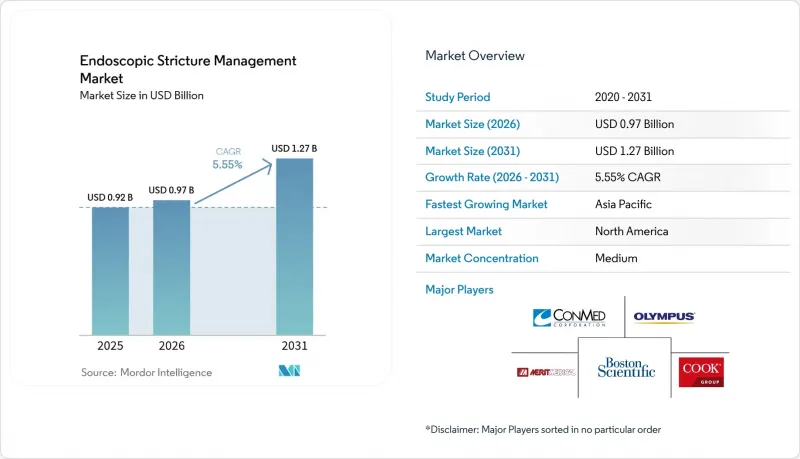
Mordor Intelligence에 의하면, 2026 연내시경 협착 관리 시장 규모는 9억 7,000만 달러로 추정되고, 2025년 9억 2,000만 달러에서 확대해, 2031년에는 12억 7,000만 달러에 이를 것으로 예측됩니다.
2026-2031년 연평균 성장률(CAGR)은 5.55%가 될 것으로 전망됩니다.
본 보고서는 제품 유형별(풍선 확장기, 부지 확장기, 스텐트, 기타), 협착 부위별(식도, 담도, 십이지장, 기타), 최종 사용자별(병원, 외래수술센터(ASC), 기타), 시술 환경(입원 환자, 외래 환자), 지역별(북미, 유럽, 아시아태평양, 기타)로 분류되어 있습니다. 시장 예측은 금액(달러) 기준으로 제시되어 있습니다.
세계의 내시경 협착 관리 시장 동향 및 인사이트
고령 인구 증가와 소화관 협착의 부담 증가
식도 협착의 유병률은 민간 보험에 가입한 성인의 경우 10만 명당 203.1건, 메디케어 수급자의 경우 10만 명당 1,123.5건에 달하며, 연간 13억 9,000만 달러의 의료비를 발생시키고 있습니다. 고령 환자에서는 역류성 식도 협착이나 문합부 흉터가 나타나는 경우가 많으며, 이러한 경우 반복적인 확장술이나 스텐트 삽입이 필요합니다. 치료되지 않은 협착은 영양실조나 흡인을 유발하여 추가적인 시스템 비용을 발생시킵니다. 선진국 전반에 걸쳐 평균 수명이 연장됨에 따라, 의료 기획 담당자들은 외과적 재건술보다 비용이 적게 들고 지속적인 결과를 가져오는 내시경적 치료법에 대한 의존도가 높아질 것으로 예측했습니다.
저침습 내시경 확장술의 선호
내시경 풍선 확장술은 요도 협착에서 67.1%의 성공률을 달성하며, 최대 요류를 개선합니다. 반면, 약물 코팅 풍선의 경우 2년 후 재시술이 필요하지 않은 비율이 77.8%였던 데 비해, 표준 요법에서는 23.6%에 그쳤습니다. 신속한 회복과 통증 완화를 원하는 환자들의 요구는 입원 기간을 단축하고자 하는 보험사 측의 압력과 일치합니다. 병원과 외래수술센터(ASC)는 첨단 내시경 및 확장 플랫폼에 대한 투자를 확대하고 있으며, 치료용 내시경 훈련을 충분히 받은 젊은 소화기내과 의사들이 일상 진료에서 이를 도입하는 속도를 높이고 있습니다.
높은 의료기기·시술 비용
고가인 LAMS나 약물 코팅 풍선은 많은 신흥 경제국에서 설비 투자 예산을 초과하고 있어, 장기적인 비용 절감 효과가 입증되지 않는 한 보험사는 신속한 보험 적용을 주저하는 경우가 많습니다. 병원은 순환기내과, 종양내과, 외과 수요를 조율해야 하므로 첨단 내시경 시스템 구매를 미루는 경우가 많습니다. 이용 관리 규제로 인해 접근이 제한되는 경우가 있으며, 비용에 민감한 지역에서는 내시경적 협착 관리 시장의 확대가 둔화되고 있습니다.
부문 분석
2025년, 스텐트는 복잡하거나 악성 협착에서 관강의 개통성을 유지하는 역할이 확립됨에 따라 내시경 협착 관리 시장의 45.02%를 차지했습니다. 풍선 확장기는 약물 코팅된 표면과 제어 가능한 팽창 프로파일 덕분에 연평균 성장률(CAGR) 6.31%로 성장을 주도하고 있습니다. 내시경 협착 관리 시장에서 스텐트 시장 규모는 꾸준히 확대될 것으로 예상되지만, 의사들이 천공 위험이 낮다고 평가함에 따라 풍선 확장기가 재시술 점유율을 점점 더 확대되고 있습니다. 보스턴 사이언티피크(Boston Scientific)의 CRE 풍선 플랫폼은 형광 투시 하에서 가시성을 향상시키는 반면, 메리트 메디컬(Merit Medical)의 Wrapsody 스텐트는 투석 접근 용도로 적용 범위를 확대하고 있어, 여러 분야를 아우르는 비즈니스 기회를 시사하고 있습니다. 반면, 부지 확장기는 일회용 제품의 경제성과 제어된 확장이 풍선에 유리하게 작용하기 때문에 계속해서 감소 추세를 보이고 있습니다. 파클리탁셀이 함유된 약물 코팅 풍선은 ROBUST III 임상시험에서 재시술이 필요하지 않은 비율이 77.8%로 나타나, 재발성 양성 협착증에 대한 의료진의 채택을 뒷받침하고 있습니다. 생분해성 스텐트는 제거 시술을 불필요하게 만들며, LAMS는 더 넓은 플랜지를 채택하여 스텐트 이동 문제를 해결하고 있습니다.
신흥 ‘기타’ 카테고리-절개 기기, 흉터 형성 억제 주사제, AI 유도 확장 플랫폼-는 여전히 시장 점유율은 작지만, 벤처 기업의 관심을 모으고 있습니다. 각 공급업체는 병원과 ASC(외래수술센터(ASC)) 모두의 워크플로우에 적합한 기기를 설계하고 있으며, 재사용성과 1건당 비용 절감에 중점을 둠으로써 소득 수준에 관계없이 채택을 확대하고자 하고 있습니다. 초기 세대 금속 스텐트의 특허 만료가 다가오는 가운데, 각 기업은 코팅, 삽입 편의성, 실제 임상에서의 비용 절감 효과를 입증하는 증거를 조합하여 차별화를 꾀하고 있습니다.
2025년에는 식도 질환 사례가 시장 점유율의 51.01%를 차지한 것으로 평가되었으며, 이는 역류성 식도염의 유병률과 수술 후 문합부 흉터를 반영한 것입니다. 식도 질환에서 내시경적 협착 관리 시장 점유율이 높은 수준을 유지하는 이유는 양성 협착의 경우 평생에 걸쳐 여러 차례의 확장 시술이 필요한 경우가 많기 때문입니다. 한편, 십이지장 수술은 영상 기술의 향상과 기기 지원형 소장 내시경 검사를 통해 소장 병변의 발견률이 높아지고 있어, 2031년까지 연평균 성장률(CAGR) 6.29%로 확대되고 있습니다. 올림푸스는 피사계 심도를 확대한 광학 시스템을 탑재한 ‘EZ1500 시리즈’ 내시경에 대해 FDA 승인을 획득하여 십이지장 병변의 가시성을 향상시켰습니다. 담도 협착은 정체 상태가 지속되고 있으며, 주로 스텐트 삽입을 통해 치료되고 있습니다.
비뇨기과, 간내과, 대장외과 등 기타 특수 분야에서의 도입이 진행되고 있어 ‘기타’ 부문을 지탱하고 있습니다. 이 부문에서는 요도나 췌장의 적응증에 대해 소화기내과의 풍선 및 스텐트 관련 노하우가 활용되고 있습니다. 치료법 선택은 병변의 부위에 따라 다릅니다. 양성 식도 협착의 경우 우선 풍선이 선택되는 반면, 악성 폐색에서는 직접 금속 스텐트가 사용됩니다. 아시아태평양에서는 담도 및 십이지장 협착의 유병률이 높기 때문에 이 지역 주민들에게서 흔히 나타나는 좁은 관강에 맞춘 크기의 의료기기 개발이 연구 개발의 중점 사항이 되고 있습니다.
지역별 분석
북미는 2025년에 내시경적 협착 관리 시장 매출의 40.97%를 차지했으며, 여전히 이 기술의 선두 주자 역할을 하고 있습니다. 메디케어의 ‘시설 중립’ 규칙과 민간 보험사의 폭넓은 대응이 외래 치료로의 전환을 촉진하는 한편, 탄탄한 펠로우십 파이프라인을 통해 중재 내시경 전문의의 풍부한 인력 기반이 확보되고 있습니다. 의료기기 제조업체들은 중요한 데이터를 생성하는 얼리 어답터(early adopter)인 클리닉을 활용하기 위해 종종 미국에서 먼저 제품을 출시합니다.
아시아태평양은 2031년까지 연평균 성장률(CAGR) 6.52%로 성장을 주도할 것으로 예측됩니다. 중국의 내시경 초음파 검사 연간 실시 건수는 2012년 20만 7,166건에서 2019년 46만 4,182건으로 증가했으며, 1인당 이용률은 선진국에 미치지 못하지만 첨단 기기의 급속한 보급이 엿보입니다. 인도에서는 AI를 활용한 검출 소프트웨어가 도입되어 시범 사이트에서 선종 검출률이 향상됨에 따라, 기술을 통한 비약적인 진전의 가능성이 시사되고 있습니다. 일본은 국민건강보험 제도와 협착을 조기에 발견하기 위한 계몽 캠페인의 뒷받침으로, 해당 지역에서 여전히 검사 건수 1위를 유지하고 있습니다. 호주와 한국은 고해상도 시스템과 의료 관광에 투자하여 지역 내 환자를 유치하고 있습니다.
유럽은 성숙한 시장이지만 성장 속도는 완만합니다. 인증을 받기 위해서는 지도 하에 250건의 EUS 사례 경험이 필요한 등 엄격한 연수 기준이 품질을 유지하고 있지만, 예산 상한선으로 인해 고급 DCB나 LAMS로의 전환은 억제되고 있습니다. 독일과 영국은 병원 내 시술 건수가 견조한 추세를 보이는 반면, 북유럽 국가들은 종합적 결제 제도를 통해 외래 시술 확대를 추진하고 있습니다.
남미, 중동 및 아프리카는 새로운 기회가 확대되고 있는 지역입니다. 브라질에서는 공립 병원용 통합 조달을 통해 가격 협상이 원활해지면서 스텐트에 대한 접근성이 향상되고 있습니다. 남아프리카는 공공 및 민간 병원 클러스터를 통해 사하라 이남 지역에서의 도입을 주도하고 있으나, 농촌 지역의 격차는 여전히 남아 있습니다. 이 지역들의 인력 부족 문제를 해소하기 위해 원격 지도 및 모듈식 내시경실 도입이 추진되고 있습니다.
기타 혜택
- 엑셀 형식 시장 예측(ME) 시트
- 3개월간 애널리스트 지원
자주 묻는 질문
목차
제1장 서론
제2장 조사 방법
제3장 주요 요약
제4장 시장 구도
제5장 시장 규모 및 성장 예측
제6장 경쟁 구도
제7장 시장 기회 및 향후 전망
AJYAccording to Mordor Intelligence, endoscopic stricture management market size in 2026 is estimated at USD 0.97 billion, growing from 2025 value of USD 0.92 billion with 2031 projections showing USD 1.27 billion, growing at 5.55% CAGR over 2026-2031.
This report is Segmented by Product Type (Balloon Dilators, Bougie Dilators, Stents, Others), Stricture Location (Esophageal, Biliary, Duodenal, Others), End-User (Hospitals, Ambulatory Surgical Centers, Others), Procedure Setting (Inpatient, Outpatient), and Geography (North America, Europe, Asia-Pacific, and More). The Market Forecasts are Provided in Terms of Value (USD).
Global Endoscopic Stricture Management Market Trends and Insights
Growing Geriatric Population & Rising GI-Stricture Burden
Esophageal stricture prevalence reached 203.1 cases per 100,000 among commercially insured adults and 1,123.5 cases per 100,000 in Medicare beneficiaries, driving USD 1.39 billion in annual costs . Older patients often present with reflux-induced strictures or anastomotic scarring that require repeated dilations or stenting. Untreated strictures lead to malnutrition and aspiration, creating additional system costs. As longevity rises across developed economies, healthcare planners anticipate heavier reliance on endoscopic treatment pathways that cost less than surgical reconstruction yet deliver durable results.
Preference for Minimally Invasive Endoscopic Dilation
Endoscopic balloon dilation achieves 67.1% success in urethral strictures and improves maximum urinary flow, while drug-coated balloons show 77.8% freedom from re-intervention at two years versus 23.6% for standard therapy. Patient demand for fast recovery and lower pain dovetails with payer pressure to limit inpatient stays . Hospitals and ASCs invest in advanced scopes and dilation platforms, and younger gastroenterologists-trained heavily in therapeutic endoscopy-are driving faster adoption in daily practice.
High Device & Procedure Costs
Premium-priced LAMS and drug-coated balloons exceed capital budgets in many emerging economies, and payers often hesitate to grant quick coverage when long-term savings remain unproven. Hospitals juggle needs across cardiology, oncology, and surgery, often delaying purchases of advanced endoscopy systems. Utilization management controls can restrict access, slowing the Endoscopic stricture management market in cost-sensitive regions.
Other drivers and restraints analyzed in the detailed report include:
- Continuous Product Innovation: Multi-Stage Balloons & Biodegradable Stents
- Expanding Reimbursement for Outpatient Stricture Procedures
- Shortage of Trained Interventional Endoscopists
For complete list of drivers and restraints, kindly check the Table Of Contents.
Segment Analysis
Stents controlled 45.02% of the Endoscopic stricture management market in 2025 owing to their established role in maintaining luminal patency when strictures are complex or malignant. Balloon dilators lead growth at a 6.31% CAGR thanks to drug-coated surfaces and controllable inflation profiles. The Endoscopic stricture management market size for stents is projected to expand steadily, yet balloons increasingly capture repeat procedures as physicians value their lower perforation risk. Boston Scientific's CRE balloon platform improves fluoroscopic visibility, while Merit Medical's Wrapsody stent extends use into dialysis access, signaling cross-specialty opportunity. Bougie dilators continue to decline as single-use economics and controlled dilation favor balloons. Drug-coated balloons incorporating paclitaxel showed 77.8% freedom from repeat procedure in the ROBUST III trial, encouraging physicians to adopt them in recurrent benign strictures. Biodegradable stents eliminate removal procedures, and LAMS address migration with wider flanges.
The emerging "others" category-incision devices, anti-scarring injectables, and AI-guided dilation platforms-remains a small slice but attracts venture interest. Suppliers design devices that fit both hospital and ASC workflows, focusing on reusability and lower per-case cost to widen adoption across income settings. As patent cliffs approach for early-generation metal stents, companies differentiate through coatings, delivery ergonomics, and evidence bundles that document real-world savings.
Esophageal cases held 51.01% share in 2025, reflecting reflux prevalence and post-surgical anastomotic scarring. The Endoscopic stricture management market share for esophageal disease stays high because benign strictures often require multiple dilations over a lifetime. Duodenal procedures, however, grow at a 6.29% CAGR through 2031 as improved imaging and device-assisted enteroscopy increase detection of small-bowel lesions. Olympus earned FDA clearance for its EZ1500 series scopes with extended depth-of-field optics, improving duodenal lesion visibility. Biliary strictures remain steady, treated mainly with stent placement.
Cross-specialty uptake in urology, hepatology, and colorectal surgery supports the "others" bucket, where urethral and pancreatic applications adopt balloon and stent know-how from gastroenterology. Location drives therapy choice: benign esophageal strictures prefer balloons first, while malignant obstructions move directly to metal stents. In Asia-Pacific, higher prevalence of biliary and duodenal strictures nudges R&D toward devices sized for narrower lumens common in that population set.
Complete Report Scope:
- By Product Type
- Balloon Dilators
- Bougie Dilators
- Stents
- Others
- By Stricture Location
- Esophageal
- Biliary
- Duodenal
- Others
- By End-user
- Hospitals
- Ambulatory Surgical Centers
- Others
- By Procedure Setting
- Inpatient
- Outpatient
- By Geography
- North America
- United States
- Canada
- Mexico
- Europe
- Germany
- United Kingdom
- France
- Italy
- Spain
- Rest of Europe
- Asia-Pacific
- China
- Japan
- India
- Australia
- South Korea
- Rest of Asia-Pacific
- Middle East and Africa
- GCC
- South Africa
- Rest of Middle East and Africa
- South America
- Brazil
- Argentina
- Rest of South America
- North America
Geography Analysis
North America captured 40.97% of Endoscopic stricture management market revenue in 2025 and remains the technology bellwether. Medicare site-neutral rules and broad private payor alignment nurture outpatient migration, while strong fellowship pipelines ensure a deep bench of interventional endoscopists. Device makers often launch first in the United States to leverage early adopter clinics that generate pivotal data.
Asia-Pacific is forecast to lead growth with a 6.52% CAGR through 2031. China's annual endoscopic ultrasound procedures rose from 207,166 in 2012 to 464,182 in 2019, revealing swift uptake of advanced tools even as per-capita usage trails developed nations. India rolled out AI-driven detection software that lifted adenoma detection rates in pilot sites, showing technology leapfrogging potential. Japan remains the region's procedure volume leader, aided by universal coverage and public awareness campaigns that catch strictures earlier. Australia and South Korea invest in high-definition systems and medical tourism, luring regional patients.
Europe holds a mature yet slower-growing position. Rigorous training standards-250 supervised EUS cases for credentialing-uphold quality, but budget caps temper switching to premium DCBs and LAMS. Germany and the United Kingdom maintain strong hospital-based volumes, while Nordic countries push outpatient growth via bundled payments.
South America and the Middle East & Africa are emerging opportunity zones. Brazil's unified procurement for public hospitals helps negotiate pricing, boosting stent access. South Africa leads sub-Saharan adoption through private-public hospital clusters, yet rural gaps remain. Tele-mentoring and modular endoscopy suites aim to solve workforce shortages in these regions.
- Boston Scientific
- Olympus
- Beckton Dickinson
- Cook Group
- Conmed
- STERIS
- Medi-Globe
- Hobbs Medical
- PanMed
- Merit Medical Systems
- Micro-tech
- Laborie
- Medtronic
- Karl Storz
- Taewoong Medical
- Endo-Flex
- PENTAX Medical (HOYA)
- ELLA-CS s.r.o.
- M.I. Tech Co., Ltd.
- Stryker
- Changzhou Health MicroPort Medical Device Co., Ltd.
Additional Benefits:
- The market estimate (ME) sheet in Excel format
- 3 months of analyst support
TABLE OF CONTENTS
1 Introduction
- 1.1 Study Assumptions & Market Definition
- 1.2 Scope of the Study
2 Research Methodology
3 Executive Summary
4 Market Landscape
- 4.1 Market Overview
- 4.2 Market Drivers
- 4.2.1 Growing Geriatric Population & Rising GI?Stricture Burden
- 4.2.2 Preference For Minimally Invasive Endoscopic Dilation
- 4.2.3 Continuous Product Innovation: Multi-Stage Balloons & Biodegradable Stents
- 4.2.4 Expanding Reimbursement for Outpatient Stricture Procedures
- 4.2.5 Early Clinical Success of Lumen-Apposing Metal Stents
- 4.2.6 Emergence Of Patient-Managed Self-Dilation Protocols
- 4.3 Market Restraints
- 4.3.1 High Device & Procedure Costs
- 4.3.2 Shortage Of Trained Interventional Endoscopists
- 4.3.3 Safety Concerns Over Off-Label LAMS Use in Benign Strictures
- 4.3.4 Limited Long-Term Data for Drug-Coated Balloon Approvals
- 4.4 Regulatory Landscape
- 4.5 Technological Outlook
- 4.6 Porters Five Forces Analysis
- 4.6.1 Threat of New Entrants
- 4.6.2 Bargaining Power of Buyers
- 4.6.3 Bargaining Power of Suppliers
- 4.6.4 Threat of Substitutes
- 4.6.5 Intensity of Competitive Rivalry
5 Market Size & Growth Forecasts (Value, USD)
- 5.1 By Product Type
- 5.1.1 Balloon Dilators
- 5.1.2 Bougie Dilators
- 5.1.3 Stents
- 5.1.4 Others
- 5.2 By Stricture Location
- 5.2.1 Esophageal
- 5.2.2 Biliary
- 5.2.3 Duodenal
- 5.2.4 Others
- 5.3 By End-user
- 5.3.1 Hospitals
- 5.3.2 Ambulatory Surgical Centers
- 5.3.3 Others
- 5.4 By Procedure Setting
- 5.4.1 Inpatient
- 5.4.2 Outpatient
- 5.5 By Geography
- 5.5.1 North America
- 5.5.1.1 United States
- 5.5.1.2 Canada
- 5.5.1.3 Mexico
- 5.5.2 Europe
- 5.5.2.1 Germany
- 5.5.2.2 United Kingdom
- 5.5.2.3 France
- 5.5.2.4 Italy
- 5.5.2.5 Spain
- 5.5.2.6 Rest of Europe
- 5.5.3 Asia-Pacific
- 5.5.3.1 China
- 5.5.3.2 Japan
- 5.5.3.3 India
- 5.5.3.4 Australia
- 5.5.3.5 South Korea
- 5.5.3.6 Rest of Asia-Pacific
- 5.5.4 Middle East and Africa
- 5.5.4.1 GCC
- 5.5.4.2 South Africa
- 5.5.4.3 Rest of Middle East and Africa
- 5.5.5 South America
- 5.5.5.1 Brazil
- 5.5.5.2 Argentina
- 5.5.5.3 Rest of South America
- 5.5.1 North America
6 Competitive Landscape
- 6.1 Market Concentration
- 6.2 Market Share Analysis
- 6.3 Company Profiles (includes Global level Overview, Market level overview, Core Segments, Financials as available, Strategic Information, Market Rank/Share for key companies, Products & Services, and Recent Developments)
- 6.3.1 Boston Scientific Corporation
- 6.3.2 Olympus Corporation
- 6.3.3 Becton, Dickinson and Company
- 6.3.4 Cook Medical LLC
- 6.3.5 CONMED Corporation
- 6.3.6 STERIS
- 6.3.7 Medi-Globe Corporation
- 6.3.8 Hobbs Medical Inc.
- 6.3.9 PanMed US
- 6.3.10 Merit Medical Systems
- 6.3.11 Micro-Tech Endoscopy
- 6.3.12 Laborie
- 6.3.13 Medtronic plc
- 6.3.14 Karl Storz SE & Co. KG
- 6.3.15 Taewoong Medical Co., Ltd.
- 6.3.16 Endo-Flex GmbH
- 6.3.17 PENTAX Medical (HOYA)
- 6.3.18 ELLA-CS s.r.o.
- 6.3.19 M.I. Tech Co., Ltd.
- 6.3.20 Stryker Corporation
- 6.3.21 Changzhou Health MicroPort Medical Device Co., Ltd.
7 Market Opportunities & Future Outlook
- 7.1 White-space & Unmet-Need Assessment