

|
시장보고서
상품코드
2123665
호르몬 피임약 시장 : 시장 점유율 분석, 업계 동향 및 통계, 성장 예측(2026-2031년)Hormonal Contraceptives - Market Share Analysis, Industry Trends & Statistics, Growth Forecasts (2026 - 2031) |
||||||
 Mordor Intelligence
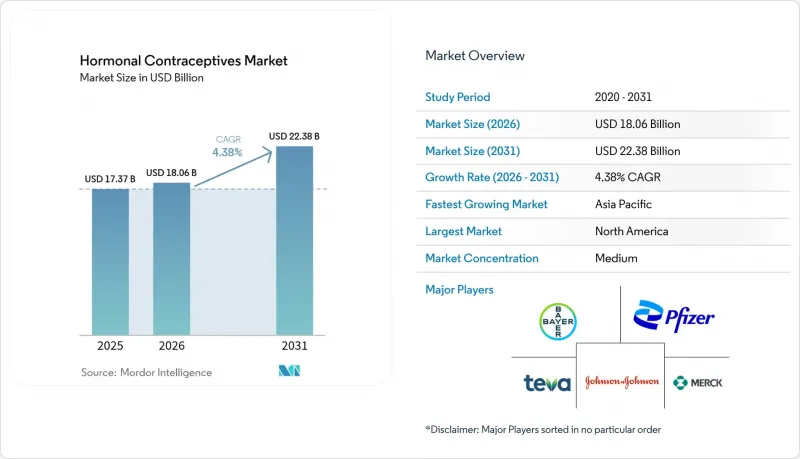
Mordor Intelligence에 의하면, 호르몬 피임약 시장 규모는 2025년에 173억 7,000만 달러로 평가되었고, 2026년 180억 6,000만 달러에서 2031년까지 223억 8,000만 달러에 이를 것으로 예측되며, 예측 기간(2026-2031년) CAGR은 4.38%를 나타낼 전망입니다.
본 보고서는 제품 유형별(경구 피임약, 주사제, 경피 흡수형 패치, 질 내 링, 기타), 호르몬 유형별(에스트로겐·프로게스틴 복합제, 프로게스틴 단독 제제, 저용량, 연장 주기 요법), 연령대별(15-24세, 25-34세, 35-44세, 45세 이상), 유통 채널별(병원 및 클리닉 부속 약국, 기타), 지역별(북미, 유럽, 아시아태평양, 중동 및 아프리카, 남미)로 분류되어 있습니다. 시장 전망은 금액(달러) 기준으로 제시됩니다.
세계의 호르몬 피임약 시장 동향 및 인사이트
경구 피임약의 OTC(일반의약품) 승인 증가
2023년 FDA가 노르게스트렐 계열 피임약 ‘Opill’을 일반의약품으로 전환하기로 결정하고, 2024년 3월 소매 시장에서 판매가 시작됨에 따라 처방전을 통한 구입 절차가 소매점에서 당일 구매로 단축되었습니다. 현재 각 제조업체들은 복합제에서도 이 모델을 재현하기 위해 경쟁하고 있으며, Cadence OTC는 2026년 하반기 승인을 목표로 하고 있습니다. 미국 소비자들은 거의 즉시 약을 구할 수 있게 되었지만, 유럽에서는 EMA가 심혈관계 검진에 대한 우려를 검토하고 있어 의사의 처방 절차가 여전히 유지되고 있으며, 대서양을 사이에 둔 수익 격차가 지속되고 있습니다. 호르몬 피임약 시장에서 활동하는 각 브랜드는 유럽의 경쟁사들이 동등한 OTC 판매 경로를 확보하기 전에, 소비자에게 직접 광고를 활용하여 충성도를 구축하고자 하고 있습니다.
의도파관 않은 임신 증가
2024년에는 전 세계 임신의 절반이 의도파관 않은 것이었으며, 가임기 여성 사이에서 충족되지 않은 수요는 8%에 달했습니다. 사하라 이남 아프리카와 남아시아의 지방 진료소 부족으로 인해 경구 피임약이나 주사제 등 자가 투여형 피임법에 대한 수요가 더욱 높아지고 있습니다. 이러한 부담은 15-24세 젊은 층에게 특히 무겁게 짓누르고 있으며, 일부 저소득 국가에서는 의도파관 않은 임신 비율이 60%를 초과하고 있습니다. 이러한 상황에 대응하여 공급업체와 NGO가 제휴하여 학교를 거점으로 한 프로그램을 전개하고 있습니다. 제품의 접근성은 높아지고 있지만, 그 수요의 탄력성은 피임을 ‘가족 계획’이 아닌 ‘인생 설계’로 재정의하는 인식 제고 캠페인에 달려 있습니다.
호르몬 관련 부작용에 대한 소셜 미디어상의 반발 고조
2024년 틱톡(TikTok)에 대한 조사에 따르면, 피임 관련 게시물의 54.4%가 부정적인 내용이며, 78.8%가 부작용에 초점을 맞추고 있어 효능에 관한 데이터는 묻혀버리고 있습니다. 이러한 컨텐츠에 노출되면, 입증된 노세보 효과를 통해 보고되는 기분 장애가 40% 증가합니다. 의약품 광고에 대한 규제적 제약으로 인해 브랜드 측의 대응책은 제한적이며, 위험과 이점의 균형을 되찾기 위해 의료계 인플루언서와의 제휴를 추진할 수밖에 없는 상황입니다.
부문 분석
경구 피임약은 2025년 매출의 41.02%를 차지한 것으로 평가되었으며, 5년 유효기간 연장으로 인해 총 의료비가 절감됨에 따라 연평균 성장률(CAGR) 5.96%로 호르몬 피임약 시장 평균을 상회하는 성장이 전망됩니다. 주사제의 이익률은 진행 중인 소송으로 인해 압박을 받고 있으며, 이에 따라 각국의 의약품 목록에서 임플란트 및 호르몬 방출형 IUD의 우선순위가 높아지고 있습니다. 경구 피임약은 절대액 기준으로는 여전히 호르몬 피임약 시장 규모를 주도하고 있지만, 이용자들이 지불자가 선호하는 ‘한 번 삽입하면 관리가 필요 없는’ 솔루션으로 전환함에 따라 성장은 둔화되고 있습니다. 이러한 점진적인 변화는 급격한 대체라기보다는 단계적인 구성 변화를 나타내며, 모든 제품 유형에서 다중 채널의 중요성이 유지되고 있습니다.
데포형 주사제에 대한 안전성 검토가 강화되는 가운데, 아시아태평양의 공공 입찰 시장에서는 임플란트의 보급이 가속화되고 있으며, 제네릭 의약품의 출시로 인해 보호되는 연간 비용은 현재 7달러 미만으로 떨어졌습니다. 경피 흡수형 패치와 질 내 링은 여전히 틈새 시장에 머물러 있지만, Annovera의 재사용형 디자인에 매력을 느끼는 환경 의식이 높은 소비자층 사이에서 입지를 다질 가능성이 있습니다. 응급 피임약은 낙태 접근이 제한된 지역에서 여전히 간헐적인 수요 급증이 나타나고 있지만, 총 매출에서 차지하는 비중은 3% 이하에 그치고 있어 호르몬 피임약 시장에서 전략적 중요성은 제한적입니다.
에스트로겐-프로게스틴 복합제는 2025년 매출의 47.17%를 계속 차지했습니다. 심혈관 위험에 대한 정보로 인해 복합 피임약의 적응 대상이 좁아지는 가운데, 프로게스틴 단독 제제는 2031년까지 연평균 성장률(CAGR) 6.13%를 나타낼 것으로 예측됩니다. 호르몬 피임약 시장 점유율 재분배에서는 출혈 패턴이나 주기의 규칙성 측면에서 차별화를 꾀할 수 있는 브랜드가 유리한 위치에 있습니다. 저용량 에스트로겐 제제는 처음 사용하는 여성들에게는 여전히 중요한 선택지이지만, 흡연자나 폐경 전후 여성들의 혈전 위험에 대한 인식이 높아짐에 따라 프로게스틴 단독 제제에 시장 점유율을 양보하고 있습니다.
유럽 규제 당국은 현재 복합 피임약을 주로 위험 요인이 없는 35세 이하 여성에게 권장하고 있어, 이로 인해 잠재적인 보급 범위가 제한되고 있습니다. 미국에서 노르게스트렐이 함유된 일반의약품(OTC)의 보급 상황은 편의성이 브랜드 충성도를 능가할 가능성이 있음을 보여주고 있으며, 미니필의 경쟁사들도 무월경을 완화하는 개선을 가하며 빠르게 뒤를 따르고 있습니다. 연장 주기 요법은 의료진의 지식 부족과 제한된 마케팅 예산으로 인해 아직 대규모 보급 단계에는 이르지 못했으나, 호르몬 피임약 시장에서 라이프사이클 혁신의 잠재적 원동력이 되고 있습니다.
지역별 분석
2025년 시점에서 북미는 매출 점유율의 34.78%를 차지했으나, 아시아태평양은 2030년까지 연평균 성장률(CAGR) 8.52%를 기록할 전망입니다. 다만, 이 수치 뒤에는 지역 간 편차가 숨어 있습니다. 인도에서는 피임법 보급률이 67%까지 상승했으나, 농촌 지역 수요를 여전히 따라잡지 못하고 있는 반면, 중국에서는 ‘출산 제한’에서 ‘출산 간격 조정’으로의 전환에 따라 장기 작용형 피임법의 보급이 진행되고 있습니다. 일본의 보조금 제도는 인구 동태상의 긴급성을 반영하고 있지만, 문화적인 우려로 인해 호르몬 제제의 보급이 저해되고 있습니다. 북미는 1인당 지출액이 높은 수준을 유지하고 있지만, OTC(일반의약품)로의 전환으로 인해 클리닉 방문이 정체되고, 또한 배란 주기 추적 앱이 신규 이용자의 점유율을 빼앗음에 따라 성장은 둔화될 것으로 전망됩니다.
유럽에서는 OTC용 복합 피임약의 규제 승인이 지연되면서 성장이 정체되고 있으며, 중동 및 아프리카는 고용주에 의한 보험 적용 범위가 확대되고 있는 GCC(걸프협력회의) 국가들의 외국인 거주자 거점을 제외하고는 여전히 문화적 규범에 제약을 받고 있습니다. 라틴아메리카에서는 입찰에 힘입어 안정적인 판매량이 나타나고 있으며, 제네릭 IUD의 출시로 가격대가 압축되고 있습니다. 이러한 동향을 종합해 볼 때, 호르몬 피임약 시장에서 증분 수익의 주요 원동력으로 아시아태평양이 다시 한번 확인됩니다.
기타 혜택
- 엑셀 형식 시장 예측(ME) 시트
- 3개월간의 애널리스트 지원
자주 묻는 질문
목차
제1장 서론
제2장 조사 방법
제3장 주요 요약
제4장 시장 구도
제5장 시장 규모 및 성장 예측
제6장 경쟁 구도
제7장 시장 기회 및 향후 전망
AJY 26.09.11According to Mordor Intelligence, the hormonal contraceptives market size was valued at USD 17.37 billion in 2025 and is estimated to grow from USD 18.06 billion in 2026 to reach USD 22.38 billion by 2031, at a CAGR of 4.38% during the forecast period (2026-2031).

This report is Segmented by Product Type (Oral Pills, Injectables, Patches, Vaginal Rings, and More), Hormone Type (Combined Estrogen-Progestin, Progestin-Only, Low-Dose, Extended-Cycle), Age Group (15-24, 25-34, 35-44, 45+), Distribution Channel (Hospital & Clinic, and More), and Geography (North America, Europe, Asia-Pacific, MEA, South America). Market Forecasts are Provided in Terms of Value (USD).
Global Hormonal Contraceptives Market Trends and Insights
Rising OTC Approval of Oral Contraceptive Pills
The FDA's 2023 decision to move the norgestrel-based Opill to over-the-counter status, followed by its March 2024 retail debut, condensed the prescription journey into a same-day retail interaction. Manufacturers are now racing to replicate this model for combined formulations, with Cadence OTC aiming for clearance in late 2026. U.S. consumers gain near-instant access, but Europe remains tethered to physician gatekeeping as the EMA weighs cardiovascular-screening concerns, preserving a trans-Atlantic revenue gap. Brands active in the hormonal contraceptives market are leveraging direct-to-consumer advertising to build loyalty before European competitors secure comparable OTC pathways.
Rising Prevalence of Unintended Pregnancies
Half of all global pregnancies were unintended in 2024, and unmet contraceptive need stood at 8% among women of reproductive age. Rural clinic shortages in Sub-Saharan Africa and South Asia magnify demand for self-administered methods such as pills and injectables. The burden falls disproportionately on 15-24-year-olds, where unintended pregnancy rates exceed 60% in several low-income countries, prompting partnerships between suppliers and NGOs to roll out school-based programs. While product availability rises, elasticity hinges on education campaigns that reframe contraception as life planning rather than family limitation.
Rising Social-Media Backlash on Hormone-Related Side Effects
A 2024 TikTok review showed 54.4% of posts on contraception skew negative, and 78.8% highlight side effects, overshadowing efficacy data. Exposure to such content increases reported mood disturbances by 40% through a documented nocebo effect. Regulatory limits on drug promotion leave brands with muted response options, pushing them to cultivate medical-influencer partnerships to restore risk-benefit balance.
Other drivers and restraints analyzed in the detailed report include:
- Favorable Government Family-Planning Initiatives
- Advancements in Long-Acting Reversible Contraceptives (LARC)
- Side-Effect Concerns & Litigation
For complete list of drivers and restraints, kindly check the Table Of Contents.
Segment Analysis
Oral contraceptive pills accounted for 41.02% of 2025 sales and will outpace the hormonal contraceptives market average with a 5.96% CAGR as the extended five-year efficacy lowers the total cost of care. Injectable margins are being compressed by ongoing litigation, prompting national formularies to elevate implants and hormonal IUDs. Oral pills still dominate the hormonal contraceptives market size in absolute dollars, yet growth is slowing as users migrate to set-and-forget solutions preferred by payers. The incremental shift indicates a gradual recomposition rather than abrupt displacement, preserving multichannel relevance for all product types.
Mounting safety scrutiny on depot injectables is accelerating implant penetration in Asia-Pacific public tenders, where the cost per protected year is now below USD 7 following generic launches. Transdermal patches and vaginal rings remain niche but may find a foothold among environmentally conscious consumers drawn to Annovera's reusable design. Emergency contraceptives retain episodic demand spikes in jurisdictions with restricted abortion access, but they contribute less than 3% of overall revenue, limiting their strategic weight in the hormonal contraceptives market.
Combined estrogen-progestin retained 47.17% of 2025 revenue. Progestin-only products are projected to 6.13% CAGR by 2031 as cardiovascular-risk messaging narrows candidate pools for combined pills. The hormonal contraceptives market share reallocation favors brands that can differentiate bleeding profiles and cycle regularity. Low-dose estrogen options remain relevant for first-time users, but rising awareness of clotting risk in smokers and perimenopausal women is ceding ground to progestin-only SKUs.
European regulators now advise combined pills mainly for women under 35 with no risk factors, restricting the potential fan-out. U.S. uptake of OTC norgestrel pills shows that convenience can outweigh brand loyalty, and mini-pill competitors are fast-following with amenorrhea-mitigating tweaks. Extended-cycle regimens have yet to achieve breakout scale, hindered by provider unfamiliarity and limited marketing budgets, yet they represent a latent lever for lifecycle innovation in the hormonal contraceptives market.
Complete Report Scope:
- By Product Type
- Oral Contraceptive Pills
- Injectable Contraceptives
- Transdermal Patches
- Vaginal Rings
- Implantable Contraceptives
- Hormonal IUDs
- Emergency Contraceptives
- By Hormone Type
- Combined Estrogen-Progestin
- Progestin-only
- Low-dose Formulations
- Extended-cycle Regimens
- By Age Group
- 15-24 Years
- 25-34 Years
- 35-44 Years
- 45+ Years
- By Distribution Channel
- Hospital & Clinic Pharmacies
- Retail Pharmacies
- Online Pharmacies
- Others
- By Geography
- North America
- United States
- Canada
- Mexico
- Europe
- Germany
- United Kingdom
- France
- Italy
- Spain
- Rest of Europe
- Asia-Pacific
- China
- Japan
- India
- Australia
- South Korea
- Rest of Asia-Pacific
- Middle East & Africa
- GCC
- South Africa
- Rest of Middle East & Africa
- South America
- Brazil
- Argentina
- Rest of South America
- North America
Geography Analysis
North America held 34.78% of the revenue share in 2025, while the Asia Pacific region had an 8.52% CAGR growth by 2030, masking heterogeneity: India's contraceptive prevalence climbed to 67% but still lags demand in rural districts, while China's shift from restriction to spacing boosts uptake of longer-acting methods. Japan's subsidy plan reflects demographic urgency, yet cultural reservations weigh on hormonal adoption. North America will maintain high per-capita spending, but growth moderates as OTC switchovers flatten clinic visits and as fertility-tracking apps cannibalize a share of new starts.
Europe's growth stalls amid regulatory delays for OTC combined pills, and the Middle East and Africa region remains constrained by cultural norms, except in GCC expatriate hubs, where employer coverage is broadening. Latin America sees steady tender-driven volume, and generic IUD launches are compressing price points. Collectively, these trends reconfirm Asia-Pacific as the primary driver of incremental revenue in the hormonal contraceptives market.
- Abbvie
- Agile Therapeutics Inc.
- Amneal Pharmaceuticals
- Bayer
- Cipla
- Endo International
- Exeltis
- Glenmark Pharmaceuticals
- HRA Pharma
- Johnson & Johnson
- Lupin
- Merck
- Mylan Laboratories Ltd.
- Organon
- Perrigo Company
- Pfizer
- Sanofi
- Shanghai Dahua Pharmaceutical
- Teva Pharmaceutical Industries
- TherapeuticsMD
- Viatris
- Zydus Lifesciences
Additional Benefits:
- The market estimate (ME) sheet in Excel format
- 3 months of analyst support
TABLE OF CONTENTS
1 Introduction
- 1.1 Study Assumptions & Market Definition
- 1.2 Scope of the Study
2 Research Methodology
3 Executive Summary
4 Market Landscape
- 4.1 Market Overview
- 4.2 Market Drivers
- 4.2.1 Rising OTC Approval of Oral Contraceptive Pills
- 4.2.2 Rising Prevalence of Unintended Pregnancies
- 4.2.3 Favorable Government Family-Planning Initiatives
- 4.2.4 Advancements In Long-Acting Reversible Contraceptives (LARC)
- 4.2.5 Expansion of Telehealth-Based Contraceptive Prescribing
- 4.2.6 Growing Employer-Funded Contraceptive Benefits in Emerging Markets
- 4.3 Market Restraints
- 4.3.1 Rising Social Media Backlash on Hormone-Related Side-Effects
- 4.3.2 Side-Effect Concerns & Litigation
- 4.3.3 Cultural And Religious Opposition in Key Regions
- 4.3.4 Algorithmic Fertility-Tracking Apps Cannibalizing Hormonal Demand
- 4.4 Regulatory Landscape
- 4.5 Technological Outlook
- 4.6 Porter's Five Forces Analysis
- 4.6.1 Threat of New Entrants
- 4.6.2 Bargaining Power of Buyers
- 4.6.3 Bargaining Power of Suppliers
- 4.6.4 Threat of Substitute Products
- 4.6.5 Intensity of Competitive Rivalry
5 Market Size & Growth Forecasts
- 5.1 By Product Type
- 5.1.1 Oral Contraceptive Pills
- 5.1.2 Injectable Contraceptives
- 5.1.3 Transdermal Patches
- 5.1.4 Vaginal Rings
- 5.1.5 Implantable Contraceptives
- 5.1.6 Hormonal IUDs
- 5.1.7 Emergency Contraceptives
- 5.2 By Hormone Type
- 5.2.1 Combined Estrogen-Progestin
- 5.2.2 Progestin-only
- 5.2.3 Low-dose Formulations
- 5.2.4 Extended-cycle Regimens
- 5.3 By Age Group
- 5.3.1 15-24 Years
- 5.3.2 25-34 Years
- 5.3.3 35-44 Years
- 5.3.4 45+ Years
- 5.4 By Distribution Channel
- 5.4.1 Hospital & Clinic Pharmacies
- 5.4.2 Retail Pharmacies
- 5.4.3 Online Pharmacies
- 5.4.4 Others
- 5.5 By Geography
- 5.5.1 North America
- 5.5.1.1 United States
- 5.5.1.2 Canada
- 5.5.1.3 Mexico
- 5.5.2 Europe
- 5.5.2.1 Germany
- 5.5.2.2 United Kingdom
- 5.5.2.3 France
- 5.5.2.4 Italy
- 5.5.2.5 Spain
- 5.5.2.6 Rest of Europe
- 5.5.3 Asia-Pacific
- 5.5.3.1 China
- 5.5.3.2 Japan
- 5.5.3.3 India
- 5.5.3.4 Australia
- 5.5.3.5 South Korea
- 5.5.3.6 Rest of Asia-Pacific
- 5.5.4 Middle East & Africa
- 5.5.4.1 GCC
- 5.5.4.2 South Africa
- 5.5.4.3 Rest of Middle East & Africa
- 5.5.5 South America
- 5.5.5.1 Brazil
- 5.5.5.2 Argentina
- 5.5.5.3 Rest of South America
- 5.5.1 North America
6 Competitive Landscape
- 6.1 Market Concentration
- 6.2 Market Share Analysis
- 6.3 Company Profiles (includes Global Level Overview, Market Level Overview, Core Segments, Financials as Available, Strategic Information, Market Rank/Share for Key Companies, Products & Services, and Recent Developments)
- 6.3.1 AbbVie Inc.
- 6.3.2 Agile Therapeutics Inc.
- 6.3.3 Amneal Pharmaceuticals
- 6.3.4 Bayer AG
- 6.3.5 Cipla Ltd.
- 6.3.6 Endo International plc
- 6.3.7 Exeltis
- 6.3.8 Glenmark Pharmaceuticals Ltd.
- 6.3.9 HRA Pharma
- 6.3.10 Johnson & Johnson
- 6.3.11 Lupin Limited
- 6.3.12 Merck & Co., Inc.
- 6.3.13 Mylan Laboratories Ltd.
- 6.3.14 Organon & Co.
- 6.3.15 Perrigo Company plc
- 6.3.16 Pfizer Inc.
- 6.3.17 Sanofi S.A.
- 6.3.18 Shanghai Dahua Pharmaceutical
- 6.3.19 Teva Pharmaceutical Industries Ltd.
- 6.3.20 TherapeuticsMD
- 6.3.21 Viatris Inc.
- 6.3.22 Zydus Lifesciences
7 Market Opportunities & Future Outlook
- 7.1 White-space & Unmet-Need Assessment


