|
시장보고서
상품코드
2123675
유전자 패널 시장 : 시장 점유율 분석, 업계 동향 및 통계, 성장 예측(2026-2031년)Gene Panel - Market Share Analysis, Industry Trends & Statistics, Growth Forecasts (2026 - 2031) |
||||||
 Mordor Intelligence
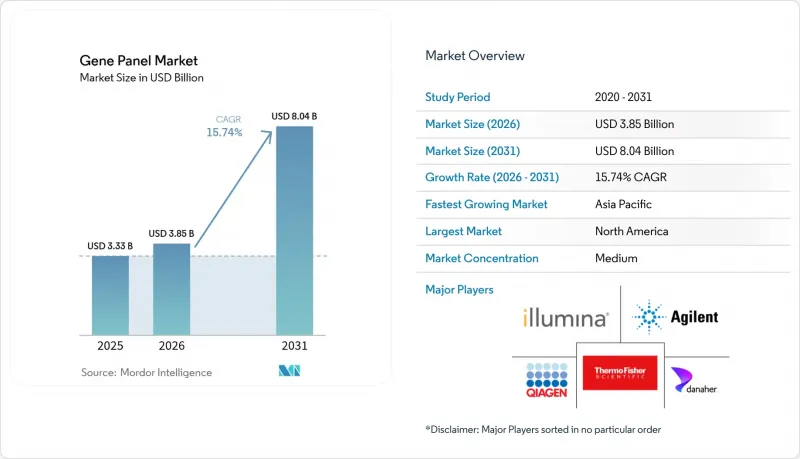
Mordor Intelligence에 의하면, 유전자 패널 시장 규모는 2025년 33억 3,000만 달러로 평가되었고, 2026년에는 38억 5,000만 달러로 추정되고, 2026-2031년 CAGR 15.74%로 성장을 지속할 전망이며, 2031년에는 80억 4,000만 달러에 이를 것으로 예측됩니다.
본 보고서는 제품 및 서비스별(검사 키트, 검사 서비스, 기타), 기술별(앰플리콘법, 하이브리다이제이션 캡처법, 기타), 용도별(암 위험 평가, 약리유전학, 기타), 최종 사용자별(병원 및 클리닉, 진단 검사 기관, 기타), 지역별(북미, 유럽, 아시아태평양, 기타)로 분류되어 있습니다. 시장 예측은 금액(달러) 기준으로 제시되어 있습니다.
세계의 유전자 패널 시장 동향 및 인사이트
NGS 보험 적용 확대에 따른, 종양학 부문을 중심으로 한 임상 도입 가속화
보험사의 적용 범위 확대는 종양학 검사의 경제성을 혁신하고, 순차적인 단일 유전자 검사에서 종합적인 패널 검사로의 전환을 가속화하고 있습니다. CMS의 지역 적용 결정(L37810)에서는 진행성 고형암이 적용 대상으로 지정되었습니다. 한편, 블루크로스 블루쉴드 네트워크에서는 검사 전 상담이나 관련 가족력 등 의료적 필요성 기준이 규정되어 있습니다. 가치 기반 의료 보상 제도는 초기 분자 수준에서의 계층화를 통해 후속 화학요법의 실패를 줄일 수 있으므로, 사전 유전체 프로파일링과 부합합니다. 지역 종양 진료 기관에서는 패널 검사를 표준 치료로 채택하여, 진단까지의 긴 과정을 단축하고 표적 치료의 활용을 촉진하고 있습니다. 검사 기관은 조직 및 혈액 기반 검사를 세트로 구성함으로써 이러한 수요 급증을 활용하여 환자 1인당 총 수주액을 확대되고 있습니다. 그 결과 발생하는 검사 건수 증가는 규모의 경제를 강화하고, 유전자 패널 시장 전체의 단위 비용 곡선을 낮춥니다.
AI 기반 해석 도구가 VUS 비율과 소요 시간을 대폭 단축
인공지능 엔진은 과거 사례의 변이 및 실제 임상 결과에 관한 수백만 건의 데이터를 분석하여, 원시 NGS 데이터를 몇 시간 이내에 간결한 임상 보고서로 변환합니다. Invitae의 ‘Clinical Variant Modeling’은 400만 건의 검체에서 린치 증후군 관련 유전자의 의의 불명 변이(VUS)를 24% 감소시켰습니다. QIAGEN의 ‘QCI Interpret’는 현재 연간 85만 건의 사례를 처리하고 있으며, 고성능 검사실을 위해 배치 단위의 해석 서비스를 제공합니다. 초기 도입 사례에서는 보고서 작성에 소요되는 노력이 30-50% 감소했으며, 환자 관리에 대한 의사 결정이 대폭 가속화된 것으로 나타났습니다. AI-MARRVEL 등의 학술 컨소시엄은 희귀질환의 변이 분류에서 98%의 정확도를 달성하여, 기존 큐레이션 워크플로우에 비해 진단 수율을 2배로 높였습니다. AI 모델이 연합형 임상 리포지토리에서 지속적으로 학습함에 따라, 알고리즘에 의한 해석은 유전자 패널 시장 전체에서 필수적인 차별화 요소로 자리 잡고 있습니다.
심화되는 바이오인포매틱스 인력 부족
검사의 복잡성이 증가함에 따라, 임상 실험실은 인증을 받은 변이 분석 전문가공급 부족에 직면해 있습니다. 인재 양성 파이프라인이 고용 증가를 따라가지 못하고 있어, 미국에서는 매년 고작 20명의 분자유전학 펠로우십 수료자만 배출되고 있습니다. AI 도구가 일상적인 해석 업무를 보완하고 있지만, 감독 업무에는 여전히 인증된 전문가가 필요하며, 검사 건수가 많은 시설에서는 병목 현상이 발생하고 있습니다. H3Africa의 주도 하에 진행되고 있는 아프리카의 노력에서도 유사한 격차가 나타나고 있으며, 현지 연구자들을 위한 원격 교육 프로그램이 도입되고 있습니다. 광범위한 역량 강화를 통해 이 격차가 해소되기 전까지는 시퀀싱 하드웨어를 통한 처리 시간 단축 효과에는 한계가 있어, 유전자 패널 시장의 확대는 둔화될 것으로 보입니다.
부문 분석
검사 서비스 매출은 2031년까지 연평균 성장률(CAGR) 16.55%로 증가할 전망입니다. 이는 검사 기관들이 키트 판매에서 시퀀싱과 분석을 결합한 패키지형 서비스로 사업 중심을 옮기고 있음을 반영합니다. 검사 서비스 분야의 유전자 패널 시장 규모는 보험 환급 및 임상의들의 이해도가 높아짐에 따라 외부 위탁 검사가 촉진됨에 따라 확대될 것으로 예측됩니다. 다유전자 암 패널이 발표 건수의 기반을 이루고 있으며, 이를 통해 검사 기관은 인프라 상각을 할 수 있게 되었고, 약리유전체 스크리닝의 교차 판매도 실현되고 있습니다.
검사 키트는 여전히 기반을 이루고 있으며, 2025년에는 매출 점유율의 64.72%를 차지한 것으로 평가되었습니다. 이는 병원이 여전히 검체 흐름에 대한 원내 관리를 중시하고 있기 때문입니다. 그러나 Labcorp과 같은 CLIA 인증 검사 기관이 Invitae의 종양학 관련 자산을 통합함에 따라, 복잡한 증례에서도 10일 이내에 결과를 보고하는 것을 보장하면서도 병원 내 검사실 비용보다 낮은 가격 책정이 가능한 규모를 확보하고 있습니다. ‘기타’ 부문으로 분류되는 바이오인포매틱스 전용 구독 서비스는 검사 기관들이 QIAGEN의 QCI Interpret와 같은 AI 파이프라인을 라이선싱하여 기존 FASTQ 파일을 처리하게 됨에 따라 성장하고 있으며, 지역 진출기업들에게 자산 부담이 적은 진입 채널을 열어주고 있습니다.
앰플리콘 방식은 FFPE 조직 및 액체 생검 용도에 적합한 고속 PCR 증폭 워크플로우에 힘입어 총 매출의 61.55%를 차지했습니다. 하이브리드화 캡처 시스템은 2031년까지 연평균 성장률(CAGR) 16.48%를 기록할 전망이며, 검사 기관들이 종합적인 유전체 프로파일링에서 속도보다 균일한 커버리지를 우선시함에 따라 그 기여도가 높아질 것으로 보입니다.
하이브리다이제이션 캡처는 고처리량 암 검사에서 GC 바이어스가 낮고, 복제수 변이 검출 성능이 뛰어나기 때문에 앰플리콘 플랫폼이 차지하는 유전자 패널 시장 점유율은 점차 축소되고 있습니다. 로슈(Roche)나 QIAGEN과 같은 벤더들은 순환 종양 DNA용 ‘즉시 사용 가능한’ 캡처 패널을 상용화하고 있으며, 이를 통해 지역 검사실에서도 최소한의 검증만으로 액체 생검을 도입할 수 있게 되었습니다. 효소를 이용한 DNA 합성은 아직 발전 단계에 있지만, 더 긴 올리고 길이와 친환경적인 화학 반응이 기대되며, 대규모 맞춤형 패널 제조의 기반을 마련하여 기술 선호도를 더욱 변화시킬 것으로 전망됩니다.
지역별 분석
2025년, 북미는 전 세계 매출의 42.10%를 차지한 것으로 평가되었으며, 이는 ‘National Coverage Determination 90.2’에 따른 CMS의 보험 적용 및 민간 보험사와의 동등성을 규정한 법률에 힘입은 결과입니다. 미국의 참조 실험실은 실시간 처방 결정 지원과 결합된 종양 비특이적 패널을 전개하여 정기적인 모니터링 검사 의뢰를 확보하고 있습니다. 캐나다에서는 약물 유발 유해사건을 완화하기 위해 전국을 아우르는 약리유전체학 보험 환급 체계에 따른 검사 도입이 진행되고 있는 반면, 멕시코의 전국 유전체학 컨소시엄은 국경을 넘는 검체 물류 및 돌연변이 데이터베이스 공유에 대해 협의를 진행하고 있습니다.
아시아태평양은 2031년까지 연평균 성장률(CAGR)이 16.58%로 가장 빠르게 성장하고 있는 지역입니다. 중국의 신생아 시퀀싱 시범 사업은 20개 이상의 성립 병원으로 확대되었으며, 바코드가 부착된 라이브러리를 통합함으로써 샘플 1개당 비용을 150달러 이하로 억제할 수 있음이 입증되었습니다. 인도의 ‘GenomeIndia’ 프로젝트는 지역별 검사 허브를 구축하는 한편, 2030년까지 예상되는 1,200만 건의 검체 처리 지연에 대응할 수 있도록 민간 검사 기관에 인센티브를 제공합니다. 한국의 ‘복지 유전체 프로젝트’에서는 생활습관 지도 앱과 시퀀싱 결과를 연계하여 검사 완료율과 검사 후 참여도를 높이고 있습니다. 한편, 일본에서는 국민건강보험이 환자 1인당 평생 2회의 종합적 암 패널 검사를 급여하고 있지만, 전문의가 대도시권에 집중되어 있어 지방에서의 접근성 격차는 여전히 남아 있습니다.
유럽에서는 ‘유럽 건강 데이터 공간(European Health Data Space)’이 2차 이용권을 명확히 함에 따라 도입이 착실히 진행되고 있습니다. 다만, 그 대가로 국경을 넘는 데이터 전송에 관한 규정 준수 요건이 엄격해지고 있습니다. 독일에서는 익명화된 유전체 데이터를 연방 정부가 관리하는 신뢰성 높은 연구 환경에 집약하고, 헬스테크 스타트업 기업과의 AI 모델 학습 관련 제휴를 촉진하고 있습니다. 스위스는 일본의 보험 적용 범위의 폭넓음에 필적하지만, 도시 지역 이외의 주에서는 환자의 인지도 부족이라는 과제에 직면해 있습니다. 중동 및 아프리카는 여전히 잠재적 시장이지만, H3Africa는 장기적인 유전자 패널 시장의 확대에 필요한 인재 기반을 육성하기 위해 현지 시퀀싱 핵심 시설과 원격 교육 프로그램을 구축하고 있습니다.
기타 혜택
- 엑셀 형식 시장 예측(ME) 시트
- 3개월간의 애널리스트 지원
자주 묻는 질문
목차
제1장 서론
제2장 조사 방법
제3장 주요 요약
제4장 시장 구도
제5장 시장 규모 및 성장 예측
제6장 경쟁 구도
제7장 시장 기회 및 향후 전망
AJY 26.09.11According to Mordor Intelligence, the gene panel market size is expected to grow from USD 3.33 billion in 2025 to USD 3.85 billion in 2026 and is forecast to reach USD 8.04 billion by 2031 at 15.74% CAGR over 2026-2031.
This report is Segmented by Products & Services (Test Kits, Testing Services, Others), Technique (Amplicon-Based, Hybridization Capture, Others), Application (Cancer Risk Assessment, Pharmacogenetics, and More), End User (Hospitals and Clinics, Diagnostic Laboratories, and More), and Geography (North America, Europe, Asia-Pacific, and More). The Market Forecasts are Provided in Terms of Value (USD).
Global Gene Panel Market Trends and Insights
Accelerating Oncology-Focused Clinical Adoption Through NGS Reimbursement Expansion
Expanded payer coverage transforms oncology testing economics and speeds the shift from sequential single-gene assays to comprehensive panels. CMS Local Coverage Determination L37810 now covers advanced solid tumors, while Blue Cross Blue Shield networks codify medical-necessity criteria such as pre-test counseling and relevant family histories. Value-based care reimbursement aligns with upfront genomic profiling because early molecular stratification reduces downstream chemotherapy failures. Community oncology practices adopt panel testing as standard of care, shortening diagnostic odysseys and boosting targeted-therapy utilization. Laboratories leverage this demand spike by bundling tissue and blood-based assays, thereby enlarging the total order value per patient. The resulting volume gains reinforce economies of scale and lower the unit cost curve across the gene panel market.
AI-Powered Interpretation Tools Slashing VUS Rates and Turnaround Times
Artificial-intelligence engines digest millions of prior case variants and real-world outcomes, converting raw NGS data into concise clinical reports within hours. Invitae's Clinical Variant Modeling lowered variants of uncertain significance by 24% for Lynch syndrome genes across 4 million samples . QIAGEN's QCI Interpret now handles 850,000 cases annually, delivering batch-level interpretation for high-throughput laboratories . Early deployments show 30-50% reductions in report-generation labor and meaningful acceleration of patient management decisions. Academic consortia such as AI-MARRVEL demonstrate 98% precision in rare-disease variant classification, doubling diagnostic yields over traditional curation workflows. As AI models continue to learn from federated clinical repositories, algorithmic interpretation becomes a must-have differentiator across the gene panel market.
Escalating Bioinformatics Workforce Shortage
Clinical labs confront a tight supply of accredited variant scientists as test complexity rises. Training pipelines lag behind job growth, with only 20 U.S. molecular genetics fellowship slots graduating annually. AI tools offset routine interpretation, but oversight roles still require certified professionals, creating bottlenecks in high-volume centers. African initiatives under H3Africa demonstrate similar gaps, prompting distance-learning programs for local researchers. Until broad upskilling closes the gap, turnaround-time gains from sequencing hardware will be capped, moderating expansion of the gene panel market.
Other drivers and restraints analyzed in the detailed report include:
- Increasing Prevalence of Multi-Gene Pharmacogenomic Labels in FDA Approvals
- Wider Integration Into Newborn and Carrier Screening Programs
- Data Sovereignty and Cross-Border Transfer Restrictions
For complete list of drivers and restraints, kindly check the Table Of Contents.
Segment Analysis
Testing Services revenue is on track for a 16.55% CAGR through 2031, reflecting laboratories' pivot from kit sales toward bundled sequencing-plus-interpretation offerings. The gene panel market size for Testing Services is projected to climb as reimbursement and clinician familiarity encourage send-out testing. Multi-gene oncology panels anchor referral volumes, enabling labs to amortize infrastructure and cross-sell pharmacogenomic screening.
Test Kits remain foundational, holding 64.72% revenue share in 2025 because hospitals still value in-house control over sample flows. Yet as CLIA-certified labs like Labcorp integrate Invitae's oncology assets, they gain the scale to undercut hospital lab costs while guaranteeing 10-day turnaround for complex cases. Bioinformatics-only subscriptions-classified in the Others segment-grow as laboratories license AI pipelines such as QIAGEN QCI Interpret to process legacy FASTQ files, opening an asset-light entry path for regional players.
Amplicon-based methods generated 61.55% of total revenue, underpinned by rapid PCR amplification workflows suited to FFPE tissue and liquid biopsy applications. Nevertheless, hybridization capture systems will deliver a 16.48% CAGR to 2031, increasing their contribution as laboratories prioritize even coverage over speed for comprehensive genomic profiling.
The gene panel market share held by amplicon platforms erodes gradually because hybrid capture demonstrates lower GC-bias and superior detection of copy-number variants in high-throughput oncology testing. Vendors like Roche and QIAGEN commercialize ready-to-run capture panels for circulating tumor DNA, allowing community labs to deploy liquid biopsy with minimal validation. Enzymatic DNA synthesis, while nascent, promises longer oligo length and greener chemistry, setting the stage for custom panel manufacturing at scale and further reshaping technique preferences.
Complete Report Scope:
- By Products and Services
- Test Kits
- Testing Services
- Others
- By Technique
- Amplicon-Based
- Hybridization Capture
- Others
- By Application
- Cancer Risk Assessment
- Pharmacogenetics
- Congenital & Rare Disorders Diagnosis
- Carrier Screening
- Others
- By End User
- Hospitals and Clinics
- Diagnostic Laboratories
- Pharmaceutical & Biotech Companies
- Others
- By Geography
- North America
- United States
- Canada
- Mexico
- Europe
- Germany
- United Kingdom
- France
- Italy
- Spain
- Rest of Europe
- Asia-Pacific
- China
- Japan
- India
- Australia
- South Korea
- Rest of Asia-Pacific
- Middle East and Africa
- GCC
- South Africa
- Rest of Middle East and Africa
- South America
- Brazil
- Argentina
- Rest of South America
- North America
Geography Analysis
North America contributed 42.10% of global revenue in 2025, buoyed by CMS coverage under National Coverage Determination 90.2 and private-payer parity laws. U.S. reference labs roll out tumor-agnostic panels paired with real-time prescription decision support, capturing recurrent monitoring orders. Canada trials pan-province pharmacogenomic reimbursement frameworks to mitigate adverse drug events, while Mexico's national genomics consortium negotiates cross-border sample logistics and shared variant databases.
Asia-Pacific is the fastest growing geography with a 16.58% CAGR to 2031. China's newborn sequencing pilots span more than 20 provincial hospitals, demonstrating cost per sample under USD 150 by pooling barcoded libraries. India's GenomeIndia project seeds regional testing hubs and incentivizes private labs to meet a projected 12-million sample backlog by 2030. South Korea's Welfare Genome Project links lifestyle coaching apps to sequencing results, increasing test completion rates and post-test engagement. Meanwhile, Japan's national insurance funds 2 comprehensive cancer panels per patient lifetime, though rural access disparities persist due to specialist concentration in metropolitan centers.
Europe posts steady adoption as the European Health Data Space clarifies secondary-use rights, albeit at the cost of stricter cross-border transfer compliance. Germany funnels de-identified genomic data into federally managed trusted research environments, catalyzing AI model training partnerships with health-tech start-ups. Switzerland mirrors Japanese reimbursement breadth but contends with patient-awareness gaps in non-urban cantons. Middle East and Africa remain latency markets; however, H3Africa builds local sequencing core facilities and distance-learning programs that nurture the talent base necessary for long-run gene panel market expansion.
- Illumina
- Thermo Fisher Scientific
- Agilent Technologies
- QIAGEN
- Roche
- Danaher
- BGI
- Eurofins
- Novogene Co.
- Guardant Health
- Invitae
- Myriad Genetics
- Color Genomics
- Twist Bioscience
- ArcherDX (Invitae)
- Sophia Genetics
- Personalis Inc.
- Helix OpCo
- Geneseeq Technology
- GENEWIZ (Azenta)
Additional Benefits:
- The market estimate (ME) sheet in Excel format
- 3 months of analyst support
TABLE OF CONTENTS
1 Introduction
- 1.1 Study Assumptions & Market Definition
- 1.2 Scope of the Study
2 Research Methodology
3 Executive Summary
4 Market Landscape
- 4.1 Market Overview
- 4.2 Market Drivers
- 4.2.1 Accelerating oncology-focused clinical adoption (NGS reimbursement expansion, 2025-2027)
- 4.2.2 Increasing prevalence of multi-gene pharmacogenomic labels in FDA approvals
- 4.2.3 Wider integration into newborn & carrier screening programs (post-2026 policy shifts)
- 4.2.4 AI-powered interpretation tools slashing VUS rates and turnaround times
- 4.2.5 Surge in custom gene-panel design demand from decentralized sequencing labs
- 4.2.6 Untapped demand from population-scale genomic initiatives
- 4.3 Market Restraints
- 4.3.1 Escalating bio-informatics workforce shortage
- 4.3.2 Data-sovereignty & cross-border transfer restrictions
- 4.3.3 Payer push-back on large hereditary panels with limited clinical utility
- 4.3.4 Supply-chain fragility for oligo/reagent-grade enzymes
- 4.4 Regulatory Landscape
- 4.5 Porters Five Forces Analysis
- 4.5.1 Threat of New Entrants
- 4.5.2 Bargaining Power of Buyers
- 4.5.3 Bargaining Power of Suppliers
- 4.5.4 Threat of Substitutes
- 4.5.5 Intensity of Competitive Rivalry
5 Market Size & Growth Forecasts (Value, USD)
- 5.1 By Products and Services
- 5.1.1 Test Kits
- 5.1.2 Testing Services
- 5.1.3 Others
- 5.2 By Technique
- 5.2.1 Amplicon-Based
- 5.2.2 Hybridization Capture
- 5.2.3 Others
- 5.3 By Application
- 5.3.1 Cancer Risk Assessment
- 5.3.2 Pharmacogenetics
- 5.3.3 Congenital & Rare Disorders Diagnosis
- 5.3.4 Carrier Screening
- 5.3.5 Others
- 5.4 By End User
- 5.4.1 Hospitals and Clinics
- 5.4.2 Diagnostic Laboratories
- 5.4.3 Pharmaceutical & Biotech Companies
- 5.4.4 Others
- 5.5 By Geography
- 5.5.1 North America
- 5.5.1.1 United States
- 5.5.1.2 Canada
- 5.5.1.3 Mexico
- 5.5.2 Europe
- 5.5.2.1 Germany
- 5.5.2.2 United Kingdom
- 5.5.2.3 France
- 5.5.2.4 Italy
- 5.5.2.5 Spain
- 5.5.2.6 Rest of Europe
- 5.5.3 Asia-Pacific
- 5.5.3.1 China
- 5.5.3.2 Japan
- 5.5.3.3 India
- 5.5.3.4 Australia
- 5.5.3.5 South Korea
- 5.5.3.6 Rest of Asia-Pacific
- 5.5.4 Middle East and Africa
- 5.5.4.1 GCC
- 5.5.4.2 South Africa
- 5.5.4.3 Rest of Middle East and Africa
- 5.5.5 South America
- 5.5.5.1 Brazil
- 5.5.5.2 Argentina
- 5.5.5.3 Rest of South America
- 5.5.1 North America
6 Competitive Landscape
- 6.1 Market Concentration
- 6.2 Market Share Analysis
- 6.3 Company Profiles (includes Global level Overview, Market level overview, Core Segments, Financials as available, Strategic Information, Market Rank/Share for key companies, Products & Services, and Recent Developments)
- 6.3.1 Illumina Inc.
- 6.3.2 Thermo Fisher Scientific
- 6.3.3 Agilent Technologies Inc.
- 6.3.4 QIAGEN
- 6.3.5 F. Hoffmann-La Roche AG
- 6.3.6 Danaher Corporation
- 6.3.7 BGI Group
- 6.3.8 Eurofins Scientific
- 6.3.9 Novogene Co.
- 6.3.10 Guardant Health
- 6.3.11 Invitae Corporation
- 6.3.12 Myriad Genetics
- 6.3.13 Color Genomics
- 6.3.14 Twist Bioscience
- 6.3.15 ArcherDX (Invitae)
- 6.3.16 Sophia Genetics
- 6.3.17 Personalis Inc.
- 6.3.18 Helix OpCo
- 6.3.19 Geneseeq Technology
- 6.3.20 GENEWIZ (Azenta)
7 Market Opportunities & Future Outlook
- 7.1 White-space & Unmet-Need Assessmen