

|
시장보고서
상품코드
2123676
특수 의료용 체어 시장 : 시장 점유율 분석, 업계 동향 및 통계, 성장 예측(2026-2031년)Specialty Medical Chairs - Market Share Analysis, Industry Trends & Statistics, Growth Forecasts (2026 - 2031) |
||||||
 Mordor Intelligence
에 의하면, 특수 의료용 체어 시장 규모는 2025년 44억 2,000만 달러로 평가되었고, 2026년 47억 1,000만 달러에서 2031년까지 64억 6,000만 달러로 확대될 것으로 예측되며, 2026-2031년 연평균 복합 성장률(CAGR)은 6.52%를 나타낼 전망입니다.
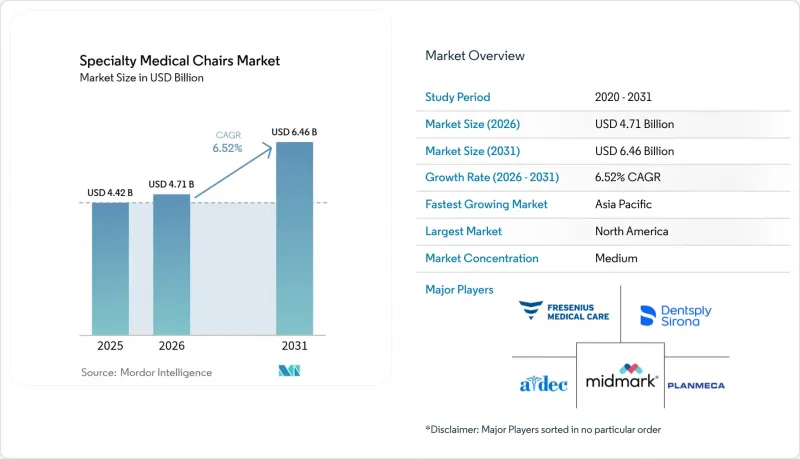
본 보고서는 제품 유형별(진찰용 의자, 치료용 의자, 기타), 최종 사용자별(병원, 클리닉·치과, 기타), 지역별(북미, 유럽, 아시아태평양, 중동 및 아프리카, 남미)로 분류되어 있습니다. 시장 예측은 금액(달러) 기준으로 제시되어 있습니다.
세계의 특수 의료용 체어 시장 동향 및 인사이트
고령 환자 및 다중 질환 환자 증가
65세 이상 성인은 2020년 9.3%에서 2030년까지 전 세계 인구의 16%를 차지할 것으로 예상되며, 이 환자들은 빈번한 진료가 필요한 만성 질환을 평균 2.9가지 앓고 있습니다. 최대 272kg까지 견디며 전동식 레그레스트 신축 기능을 갖춘 비만 환자용 의자는 의료진이 수작업으로 환자를 이동시키지 않고도 허약한 환자를 진찰할 수 있게 해주며, 미국 산업안전보건연구소(NIOSH)가 기록한 간병인의 요통 발생률 35%를 감소시킵니다. 일본에서는 2025년에 75세 이상 고령자가 외래 진료 환자의 38%를 차지할 것으로 보고되고 있으며, 휠체어와 높이를 맞추어 낙상 위험을 줄여주는 높이 조절형 진료용 의자에 대한 수요가 가속화되고 있습니다. 다중 질환을 앓고 있는 환자의 진료 시간이 길어짐에 따라, 클리닉에서는 내원 사이사이에 최적의 위치를 복원해 주는 메모리 프리셋 기능 도입이 확대되고 있습니다. 미국에서는 고령자의 68%가 적어도 2가지 만성 질환을 앓고 있으며, 수동식 의자가 인체공학적 한계에 도달함에 따라 꾸준한 교체 주기가 확보되고 있습니다.
임상 효율을 높이는 완전 전동식·IoT 대응 의자로의 전환
IoT 지원 진료 의자는 체중 센서와 기울기 인코더를 내장하고, 데이터를 전자 차트에 스트리밍함으로써 조인트 커미션의 문서화 요건을 충족합니다. 2024년 『Journal of Medical Internet Research』지의 조사에 따르면, 네트워크로 연결된 진료용 의자 덕분에 외래 클리닉의 진료실 회전 시간이 22% 단축되어 간호 인력이 직접적인 환자 돌봄에 전념할 수 있게 되었습니다. FDA가 2023년 10월에 발표한 사이버 보안 지침에서는 제조업체에 소프트웨어 부품 목록 제출 및 암호화 증명을 의무화하고 있으며, 이로 인해 임베디드 리눅스 및 안전한 업데이트 채널에 대한 투자가 촉진되고 있습니다. 스트라이커(Striker)사의 ‘ProCuity’ 플랫폼은 환자가 압력 임계치를 초과할 때 간병인에게 경고하는 예측 분석의 가치를 입증하고 있으며, 다수의 센서가 탑재된 의자를 보다 광범위한 표면 생태계의 일부로 자리매김하고 있습니다. 현재 유럽의 구매자들은 IEC 62304를 준수하는 소프트웨어 수명 주기에 대한 증명을 요구하고 있으며, 사이버 보안은 입찰의 결정적인 기준으로 포함되고 있습니다.
팬데믹 이후 병원 및 클리닉의 자본 예산 제약
헬스케어 재무 관리 협회(HFMA)에 따르면, 2024년에는 시설들이 임금 인상, 전자의무기록(EHR) 업그레이드, 부채 상환에 자금을 할당함에 따라 병원의 설비 예산이 12% 감소했습니다. 미국 데이터에 따르면, 2024년에는 병원의 36%가 적자 경영에 빠졌으며, 의자 교체 주기가 7년에서 10년 가까이 연장되었습니다. 독일 병원들은 2025년에 1.2%의 영업이익률을 보고했는데, 이는 지난 10년 동안 최저 수준이며, 이로 인해 가구 및 환자 이송 장비 주문이 위축되고 있습니다. 각 제조업체는 리스 투 오너(Lease-to-Own) 프로그램을 시험적으로 도입하고 있지만, 재무 부서는 개별 청구 코드가 없는 자산에 대한 대차대조표 외 거래에 여전히 신중한 태도를 보이고 있습니다. 그 결과, 인건비와 에너지 비용이 안정될 때까지 설비 투자가 미뤄지면서 수주 흐름이 둔화될 것입니다.
부문별 분석
치료용 의자는 종양학과, 투석, 당일 수술 시설에서 수동 리클라이닝 의자에서 체중계와 항균성 커버가 일체화된 의자로의 교체가 진행되고 있어, 2031년까지 연평균 성장률(CAGR) 8.43%로 확대될 전망입니다. 진찰용 의자는 2025년 매출의 38.03%를 차지했으며, 이는 1차 진료 및 전문의 클리닉에서의 보급 실태를 여실히 보여줍니다. 재활용 의자는 여전히 틈새 시장이지만, 조기 퇴원 및 외래 물리치료를 촉진하는 종합적 결제 프로그램의 혜택을 받고 있습니다.
이러한 성장세는 외래에서의 수액 치료 및 혈액 투석 세션으로의 구조적 전환을 부각시키고 있으며, 치료 현장용 특수 의료용 체어 시장 규모는 2031년까지 그 우위를 더욱 확대될 전망입니다. 프레제니우스 메디컬케어(Fresenius Medical Care)는 자사의 ‘CorDiax’ 의자 플랫폼을 통해 세션 준비 시간을 15% 단축하고, 의료 제공업체의 수익성을 향상시키고 있다고 보고했습니다. 아시아 제조업체들이 서유럽 브랜드보다 30% 저렴한 가격으로 유사 모델을 공급하고 있어 경쟁 압력이 심화되고 있으며, 기존 제조업체들은 IoT 연결 기능이나 연장 보증을 통해 차별화를 꾀할 수밖에 없는 상황입니다.
지역별 분석
북미는 시설에 압력 매핑 센서가 탑재된 의자 도입을 권장하는 조인트 커미션(Joint Commission)의 욕창 예방 기준에 따라 2025년 매출의 42.12%를 차지했습니다. 미국 재향군인부는 2024년에 8,700만 달러를 장비 교체에 배정했는데, 이는 공공 부문이 조달에 미치는 영향을 여실히 보여줍니다. 이익률 하락으로 인해 교체 주기는 장기화되고 있지만, 배상 책임 리스크의 존재로 인해 기초 수요는 견조한 추세를 보이고 있습니다.
아시아태평양은 2031년까지 연평균 성장률(CAGR) 7.54%로 확대될 전망이며, 지역별로는 가장 빠른 성장 속도를 보이고 있습니다. 중국의 ‘건강 중국 2030’ 계획에서는 인도 표준국(BIS) 기준을 준수하는 의자를 설치해야 하는 지역 보건소에 1,400억 달러가 배정된 반면,인도의 ‘아유슈만 바라트’ 계획은 5억 5,000만 명의 시민을 대상으로 보험 적용 범위를 확대하고, 프로그램 사용이 가능한 휠체어에 투자하는 인증된 데이케어 센터에 인센티브를 지급하고 있습니다. 일본에서는 초고령화가 진행됨에 따라, 휠체어에서 쉽게 승하차할 수 있도록 높이 조절이 가능한 모델의 도입이 진료소에 요구되고 있습니다.
유럽에서는 재정적 제약으로 인해 자본 예산이 제한되고 있어 성장이 완만합니다. 독일의 병원들은 사상 최저의 이익률을 보고하고 있으며, 영국의 넷제로 공급망 규제로 인해 일회용 설계보다 액추에이터를 교체할 수 있는 모듈식 휠체어가 선호되고 있습니다. 중동 및 아프리카 및 남미는 도시 지역 의료 거점의 신규 병원 건설과 연계된 프로젝트 주도형 시장을 유지하고 있습니다.
기타 혜택
- 엑셀 형식 시장 예측(ME) 시트
- 3개월간의 애널리스트 지원
자주 묻는 질문
목차
제1장 서론
제2장 조사 방법
제3장 주요 요약
제4장 시장 구도
제5장 시장 규모 및 성장 예측
제6장 경쟁 구도
제7장 시장 기회 및 향후 전망
AJY 26.09.11According to Mordor Intelligence, the specialty medical chairs market size is projected to expand from USD 4.42 billion in 2025 and USD 4.71 billion in 2026 to USD 6.46 billion by 2031, registering a CAGR of 6.52% between 2026 to 2031.
This report is Segmented by Product Type (Examination Chairs, Treatment Chairs, and More), End User (Hospitals, Clinics & Dental Practices, and More), and Geography (North America, Europe, Asia-Pacific, Middle East & Africa, and South America). The Market Forecasts are Provided in Terms of Value (USD).
Global Specialty Medical Chairs Market Trends and Insights
Growing Geriatric and Multimorbidity Patient Population
Adults aged 65 and older will represent 16% of the global population by 2030, up from 9.3% in 2020, and they show an average of 2.9 chronic illnesses that require frequent clinical encounters. Bariatric-rated chairs that lift up to 272 kg and feature powered leg-rest extensions help clinicians examine frail patients without manual handling, cutting the 35% incidence of caregiver back injuries recorded by the National Institute for Occupational Safety and Health. Japan reported that citizens aged 75 plus accounted for 38% of outpatient visits in 2025, accelerating demand for height-adjustable examination chairs that align with wheelchairs and reduce fall risk. Longer appointment times for multimorbid patients drive clinics to adopt memory presets that restore optimal positions between visits. In the United States, 68% of seniors manage at least two chronic diseases, ensuring a steady replacement cycle as manual chairs reach ergonomic limits.
Shift Toward Fully Electric and IoT-Enabled Chairs Enhancing Clinical Efficiency
IoT-ready chairs integrate weight sensors and tilt encoders that stream data to electronic health records, satisfying Joint Commission documentation requirements. A 2024 Journal of Medical Internet Research study showed that connected chairs trimmed room turnover time by 22% in ambulatory clinics, freeing nursing staff for direct care. The FDA's October 2023 cybersecurity guidance obliges manufacturers to submit a software bill of materials and prove encryption, driving investment in embedded Linux and secure update paths. Stryker's ProCuity platform demonstrates the value of predictive analytics that alert caregivers when a patient exceeds pressure thresholds, positioning sensor-rich chairs as part of a wider surface ecosystem. European buyers now require IEC 62304-compliant software life-cycle evidence, embedding cybersecurity as a decisive tender criterion.
Post-Pandemic Capital Budget Constraints in Hospitals and Clinics
Hospital equipment budgets fell 12% in 2024 as facilities diverted funds to wage inflation, EHR upgrades, and debt service, according to the Healthcare Financial Management Association. US data show that 36% of hospitals ran at negative margins in 2024, extending chair replacement cycles from 7 to almost 10 years. German hospitals reported operating margins of 1.2% in 2025, the lowest in a decade, limiting orders for furniture and patient-handling equipment. Manufacturers are piloting lease-to-own programs, yet finance teams remain wary of off-balance-sheet arrangements for assets lacking a discrete billing code. As a result, capital deferment will dampen order flow until labor and energy costs stabilize.
Other drivers and restraints analyzed in the detailed report include:
- Rising Outpatient Surgery and Day-Care Centers in Emerging Economies
- Mandatory Pressure Injury Prevention Guidelines in Acute Care Facilities
- Limited Reimbursement Coverage for Specialty Chairs in Non-Hospital Settings
For complete list of drivers and restraints, kindly check the Table Of Contents.
Segment Analysis
Treatment chairs are expanding at an 8.43% CAGR to 2031 as oncology, dialysis, and day-surgery sites replace manual recliners with chairs offering integrated scales and antimicrobial upholstery. Examination chairs retained 38.03% of 2025 revenue, a testament to their ubiquity in primary-care and specialist offices. Rehabilitation chairs remain niche but are benefitting from bundled payment programs that incentivize faster discharge and outpatient physical therapy.
This growth spread underscores the structural pivot toward outpatient infusion and hemodialysis sessions, where the specialty medical chairs market size for treatment settings is projected to widen its lead through 2031. Fresenius Medical Care reports its CorDiax chair platform trims session preparation by 15%, strengthening provider economics. Competitive pressure is intensifying as Asian manufacturers supply look-alike models at prices 30% lower than Western brands, compelling incumbents to differentiate via IoT connectivity and extended warranties.
Complete Report Scope:
- By Product Type
- Examination Chairs
- Cardiac Chairs
- Birthing Chairs
- Blood-Drawing Chairs
- Dialysis Chairs
- Mammography Chairs
- Other Examination Chairs
- Treatment Chairs
- ENT Chairs
- Ophthalmic Chairs
- Dental Chairs
- Infusion / Oncology Chairs
- Other Treatment Chairs
- Rehabilitation Chairs
- Geriatric Chairs
- Pediatric Chairs
- Bariatric Chairs
- Other Rehabilitation Chairs
- Examination Chairs
- By Technology
- Manual
- Semi-Electric / Hydraulic
- Fully-Electric / Programmable
- IoT / Connected & Sensor-Enabled
- By End User
- Hospitals
- Clinics & Dental Practices
- Ambulatory Surgery & Day-Care Centers
- Home-Care & Long-Term Care Settings
- Geography
- North America
- United States
- Canada
- Mexico
- Europe
- Germany
- United Kingdom
- France
- Italy
- Spain
- Rest of Europe
- Asia-Pacific
- China
- Japan
- India
- Australia
- South Korea
- Rest of Asia-Pacific
- Middle East & Africa
- GCC
- South Africa
- Rest of Middle East & Africa
- South America
- Brazil
- Argentina
- Rest of South America
- North America
Geography Analysis
North America accounted for 42.12% of 2025 revenue owing to Joint Commission pressure-injury standards that push facilities toward chairs with pressure-mapping sensors. The US Department of Veterans Affairs earmarked USD 87 million in 2024 for fleet renewal, illustrating public-sector influence on procurement. Margin erosion has stretched replacement cycles, yet liability risk keeps baseline demand resilient.
Asia-Pacific is advancing at a 7.54% CAGR to 2031, the fastest regional pace. China's Healthy China 2030 allocates USD 140 billion to community health stations that must install Bureau of Indian Standards-compliant seating, while India's Ayushman Bharat extends coverage to 550 million citizens, rewarding accredited day-care centers that invest in programmable chairs. Japan's super-aging cohort pushes clinics to adopt height-adjustable models that facilitate wheelchair transfers.
Europe shows moderate growth as fiscal constraints limit capital budgets. German hospitals report record-low margins, and the United Kingdom's net-zero supply chain rules now favor modular chairs with replaceable actuators over single-use designs. Middle East, Africa, and South America remain project-driven markets tied to new hospital construction in urban medical hubs.
- Acime SAS
- ActiveAid Inc.
- A-dec
- Atmos MedizinTechnik GmbH
- Champion Manufacturing Inc.
- Danaher Corp. (KaVo Dental)
- DentalEZ
- Dentsply Sirona
- Drive DeVilbiss Healthcare
- Forest Dental
- Fresenius
- Greiner GmbH
- Heinemann Medizintechnik GmbH
- Hill-Rom
- Invacare
- Likamed GmbH
- Midmark
- PLANMECA Oy
- Stryker
Additional Benefits:
- The market estimate (ME) sheet in Excel format
- 3 months of analyst support
TABLE OF CONTENTS
1 Introduction
- 1.1 Study Assumptions & Market Definition
- 1.2 Scope Of The Study
2 Research Methodology
3 Executive Summary
4 Market Landscape
- 4.1 Market Overview
- 4.2 Market Drivers
- 4.2.1 Growing Geriatric and Multimorbidity Patient Population
- 4.2.2 Shift Toward Fully Electric and IoT-Enabled Chairs Enhancing Clinical Efficiency
- 4.2.3 Rising Outpatient Surgery and Day-Care Centers in Emerging Economies
- 4.2.4 Mandatory Pressure Injury Prevention Guidelines in Acute Care Facilities
- 4.2.5 Procurement Policies Favoring Low-VOC And Recyclable Upholstery Materials
- 4.2.6 Imaging-Suite Demand for MRI-Compatible and Anti-Static Chair Designs
- 4.3 Market Restraints
- 4.3.1 Post-Pandemic Capital Budget Constraints in Hospitals And Clinics
- 4.3.2 Limited Reimbursement Coverage for Specialty Chairs in Non-Hospital Settings
- 4.3.3 Supply Chain Bottlenecks for UL-94 Fire-Safe Actuator Components
- 4.3.4 Lengthy Cybersecurity Certification Cycles for Connected Chair Software
- 4.4 Value / Supply-Chain Analysis
- 4.5 Regulatory Landscape
- 4.6 Technological Outlook
- 4.7 Porter's Five Forces Analysis
- 4.7.1 Threat Of New Entrants
- 4.7.2 Bargaining Power Of Buyers
- 4.7.3 Bargaining Power Of Suppliers
- 4.7.4 Threat Of Substitutes
- 4.7.5 Competitive Rivalry
5 Market Size & Growth Forecasts (Value, USD)
- 5.1 By Product Type
- 5.1.1 Examination Chairs
- 5.1.1.1 Cardiac Chairs
- 5.1.1.2 Birthing Chairs
- 5.1.1.3 Blood-Drawing Chairs
- 5.1.1.4 Dialysis Chairs
- 5.1.1.5 Mammography Chairs
- 5.1.1.6 Other Examination Chairs
- 5.1.2 Treatment Chairs
- 5.1.2.1 ENT Chairs
- 5.1.2.2 Ophthalmic Chairs
- 5.1.2.3 Dental Chairs
- 5.1.2.4 Infusion / Oncology Chairs
- 5.1.2.5 Other Treatment Chairs
- 5.1.3 Rehabilitation Chairs
- 5.1.3.1 Geriatric Chairs
- 5.1.3.2 Pediatric Chairs
- 5.1.3.3 Bariatric Chairs
- 5.1.3.4 Other Rehabilitation Chairs
- 5.1.1 Examination Chairs
- 5.2 By Technology
- 5.2.1 Manual
- 5.2.2 Semi-Electric / Hydraulic
- 5.2.3 Fully-Electric / Programmable
- 5.2.4 IoT / Connected & Sensor-Enabled
- 5.3 By End User
- 5.3.1 Hospitals
- 5.3.2 Clinics & Dental Practices
- 5.3.3 Ambulatory Surgery & Day-Care Centers
- 5.3.4 Home-Care & Long-Term Care Settings
- 5.4 Geography
- 5.4.1 North America
- 5.4.1.1 United States
- 5.4.1.2 Canada
- 5.4.1.3 Mexico
- 5.4.2 Europe
- 5.4.2.1 Germany
- 5.4.2.2 United Kingdom
- 5.4.2.3 France
- 5.4.2.4 Italy
- 5.4.2.5 Spain
- 5.4.2.6 Rest of Europe
- 5.4.3 Asia-Pacific
- 5.4.3.1 China
- 5.4.3.2 Japan
- 5.4.3.3 India
- 5.4.3.4 Australia
- 5.4.3.5 South Korea
- 5.4.3.6 Rest of Asia-Pacific
- 5.4.4 Middle East & Africa
- 5.4.4.1 GCC
- 5.4.4.2 South Africa
- 5.4.4.3 Rest of Middle East & Africa
- 5.4.5 South America
- 5.4.5.1 Brazil
- 5.4.5.2 Argentina
- 5.4.5.3 Rest of South America
- 5.4.1 North America
6 Competitive Landscape
- 6.1 Market Concentration
- 6.2 Market Share Analysis
- 6.3 Company Profiles {(Includes Global Level Overview, Market Level Overview, Core Segments, Financials as Available, Strategic Information, Market Rank/Share for Key Companies, Products & Services, and Recent Developments)}
- 6.3.1 Acime SAS
- 6.3.2 ActiveAid Inc.
- 6.3.3 A-dec Inc.
- 6.3.4 Atmos MedizinTechnik GmbH
- 6.3.5 Champion Manufacturing Inc.
- 6.3.6 Danaher Corp. (KaVo Dental)
- 6.3.7 DentalEZ Inc.
- 6.3.8 Dentsply Sirona
- 6.3.9 Drive DeVilbiss Healthcare
- 6.3.10 Forest Dental
- 6.3.11 Fresenius Medical Care AG & Co. KGaA
- 6.3.12 Greiner GmbH
- 6.3.13 Heinemann Medizintechnik GmbH
- 6.3.14 Hill-Rom Holdings Inc.
- 6.3.15 Invacare Corporation
- 6.3.16 Likamed GmbH
- 6.3.17 Midmark Corporation
- 6.3.18 PLANMECA Oy
- 6.3.19 Stryker Corporation
7 Market Opportunities & Future Outlook
- 7.1 White-Space & Unmet-Need Assessment


