

|
시장보고서
상품코드
2123678
면역조직화학 시장 : 시장 점유율 분석, 업계 동향 및 통계, 성장 예측(2026-2031년)Immunohistochemistry - Market Share Analysis, Industry Trends & Statistics, Growth Forecasts (2026 - 2031) |
||||||
 Mordor Intelligence
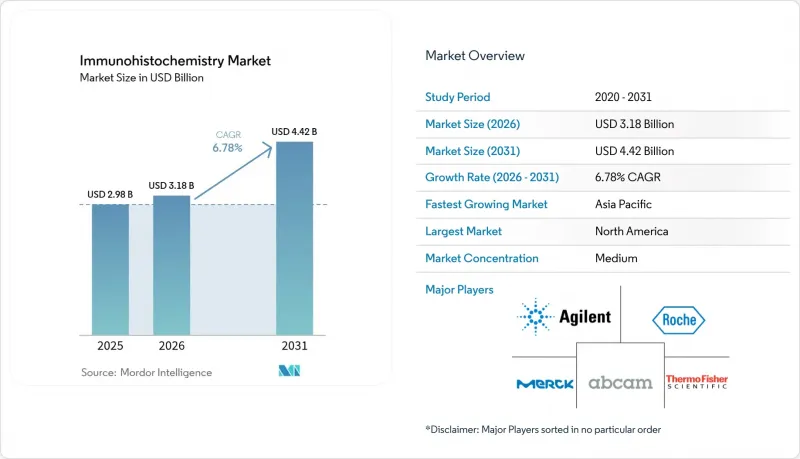
Mordor Intelligence에 의하면, 면역조직화학 시장 규모는 2025년에 29억 8,000만 달러로 평가되었고, 2026년 31억 8,000만 달러에서 2031년까지 44억 2,000만 달러에 이를 것으로 예측되며, 예측 기간(2026-2031년) CAGR은 6.78%를 나타낼 전망입니다.
본 보고서는 제품별(항체(1차 항체, 2차 항체), 기기, 기타), 용도별(진단, 신약 개발 및 검사), 최종 사용자별(병원 및 진단센터, 기타), 검출 방법별(직접법, 간접법), 지역별(북미, 유럽, 아시아태평양, 중동 및 아프리카, 기타)로 분류되어 있습니다. 시장 예측은 금액(달러) 기준으로 제시되어 있습니다.
세계의 면역조직화학 시장 동향 및 인사이트
암 유병률 증가
암 발병률의 급증으로 인해, 단일 세포 수준에서 종양의 생물학적 특성을 규명하는 면역조직화학 검사에 대한 수요가 증가하고 있습니다. 다중 염색을 통해 면역계와 종양의 상호작용이 밝혀져, 체크포인트 억제제 치료법 선택에 활용되고 있습니다. 동반 진단을 통해 치료 대상 범위가 확대되고 있습니다. FDA는 HER2 초저발현 검사를 승인했으며, 자니다타맙의 담도계 적응증은 확실한 HER2 염색 결과를 기반으로 합니다. 직접 면역형광법을 대체하는 천포창 진단 등 희귀암의 이용 사례도 면역조직화학 시장을 더욱 확대시키고 있습니다.
고령화와 만성 질환의 부담
평균 수명의 연장에 따라 만성 동반 질환이 증가하면서, 사례 수 증가가 기존 조직병리학적 검사 능력의 한계에 다다르고 있습니다. 전 세계적으로 인구 100만 명당 병리 전문의 수가 14명 이하이며, 업무 부담 증가(많은 지역에서 연간 4,000건 이상)로 인해 자동화에 대한 의존도가 높아지고 있습니다. 병원 검사실에서 의뢰하는 면역조직화학 검사 건수는 10년 전보다 20% 증가했으나, 자금적 제약으로 인해 디지털 병리를 도입한 임상 시설은 3분의 1에 그치고 있습니다. 이러한 격차로 인해, 염색 강도와 점수 산정을 표준화하고 품질 저하 없이 처리 능력을 향상시키는 AI 탑재 슬라이드 스캐너의 도입이 가속화되고 있습니다.
고가의 프리미엄 항체와 검출 키트
시판되는 항체의 3분의 2가 기본적인 특이성 검사를 통과하지 못해, 검사실은 고액의 원내 검증을 수행할 수밖에 없으며, 이로 인해 검사 1건당 지출이 증가하고 있습니다. YCharOS가 실시한 1,000종 항체에 대한 조사에 따르면, 재현성 부족으로 인한 손실은 미국에서만 연간 최대 18억 달러에 달할 것으로 추정됩니다. 단일클론 항체 치료제의 정가 중앙값은 여전히 1만 5,624달러에서 14만 3,833달러 사이를 유지하고 있으며, 제조 공정의 개선에도 불구하고 제조 규모의 한계가 반영되고 있습니다. 메디케어의 ‘지역별 적용 결정(Local Coverage Determinations)’(2024년 7월부터 시행)에 따라, 면역조직화학 염색에 대해 엄격한 의학적 필요성 입증이 요구되게 되어, 광범위한 패널 검사에 대한 보험 적용이 제한되고 있습니다.
부문 분석
2025년에도 항체 하위 부문은 여전히 면역조직화학 시장의 41.74%를 차지했으며, 모든 분석 수행에 있어 그 기초적인 역할이 입증되고 있습니다. 그러나 실험실이 여러 기관에서 알고리즘 도입을 가능하게 하는 클라우드 호스팅형 이미지 분석으로 전환함에 따라, 소프트웨어 부문은 연평균 성장률(CAGR) 7.58%로 확대되고 있습니다. 로슈(Roche)의 ‘VENTANA DP 200’ 슬라이드 스캐너는 ‘navify Digital Pathology’와 통합되어, 염색부터 AI를 통한 스코어링에 이르기까지 원활한 프로세스를 구현하고 있습니다. 항체 카테고리 자체도 진화하고 있습니다. 1차 단일클론 항체의 검증 투명성이 높아지는 한편, 멀티플렉스 대응 2차 항체가 저발현 표적의 검출 감도를 향상시키고 있습니다. 장비 업그레이드도 이러한 변화와 병행하여 진행되고 있습니다. 자동 염색 장치는 수작업으로 인한 실수를 줄여주고, 숙련된 인력을 판독 업무에 배치할 수 있게 해줍니다. QuPath나 HistoQC와 같은 오픈소스 도구가 이미지 표준화를 촉진함에 따라, 중소득국의 검사실에서는 디지털 플랫폼 도입이 가속화되고 있으며, 면역조직화학 시장 전체에서 소프트웨어의 전략적 중요성이 더욱 높아지고 있습니다.
키트 및 시약 부문에서는 종양 전문의들이 로트 간 엄격한 재현성을 요구함에 따라, 동반 진단(companion diagnostics)의 승인이 구매 결정에 영향을 미치고 있습니다. 슬라이드 스캐너와 조직 마이크로어레이 장치는 고성능의 중개 연구(translational research)를 지원하기 위해 융합되고 있습니다. 각 제조업체는 FDA의 의료기기 재분류 규정에 따른 규정 준수를 용이하게 하기 위해 품질이 보증된 시약 번들을 제공합니다. 이러한 상호 작용을 통해 소프트웨어는 단순한 보조 도구에서 핵심 수익원으로 위상을 높였으며, 2031년까지 면역조직화학 시장이 두 자릿수 성장을 달성할 수 있는 기반이 마련되었습니다.
2025년, 진단 부문은 면역조직화학 시장 규모의 60.92%를 차지했으며, 병원의 일상적인 종양학 워크플로우를 반영하고 있습니다. 한편, 신약 개발 및 검사 부문은 제약 기업들이 조직 분석을 계약 연구 기관(CRO)에 아웃소싱하는 추세에 힘입어 연평균 성장률(CAGR) 7.72%로 가장 빠른 성장세를 보이고 있습니다. ICON plc는 이러한 변화의 대표적인 사례로, CAP 인증을 받은 실험실에서 Ventana Benchmark ULTRA 플랫폼을 활용한 맞춤형 면역조직화학 분석법 개발을 제공합니다. 아웃소싱은 면역조직화학 시장 규모의 경제 혜택을 누리고 있습니다. 중앙 집중화된 시설에서는 매일 수천 장의 슬라이드를 처리하고, AI를 활용하여 이상치를 식별함으로써 바이오마커 적격성 평가에 소요되는 사이클 타임을 단축하고 있습니다.
종양학 외에도 조직 기반 분석법은 감염증 및 자가면역 질환 연구에 유용한 정보를 제공합니다. 스페이셜 오믹스는 면역조직화학 및 고플렉스 RNA 매핑을 결합하여 표적 발견을 가속화하는 멀티오믹스의 맥락을 제시합니다. 실험실 자동화와 알고리즘 기반 채점 방식을 통해 재현성이 향상되어, 의뢰사에 데이터의 무결성이 보장됩니다. 규제 당국이 의약품 승인 신청 서류에서 조직학적 증거를 중시함에 따라, 위탁 검사 기관들은 처리 능력을 확대하고 있으며, 예측 기간 동안 이 부문의 성장세가 더욱 강해질 전망입니다.
지역별 분석
북미는 확립된 보험 환급 제도, AI의 조기 도입, 동반 진단의 빈번한 승인에 힘입어 2025년 매출의 40.92%를 차지했습니다. 그러나 검사 기관은 FDA의 2024년 ‘실험실 개발 검사(LDT) 규정’에 따라 5억 6,600만-35억 6,000만 달러의 규정 준수 관련 비용을 부담해야 하므로, 이에 따라 주요 IVD 제조업체와의 전략적 제휴가 진행되고 있습니다. 현재 임상 시설의 33%에 도입된 디지털 병리학은 원격지에 있는 세부 전문의의 판독을 가능하게 하는 영상 관리 플랫폼으로 자본 예산이 이동함에 따라 그 보급이 가속화될 것으로 예측됩니다.
아시아태평양은 암 발병률 상승, 바이오 제조 능력 확대, 공립 병원 시설 현대화에 힘입어 연평균 성장률(CAGR) 7.84%로 가장 높은 성장률을 보이고 있습니다. 중국과 인도에서는 경기 부양책을 통해 자금이 자동 슬라이드 염색 장비를 갖춘 암 센터에 투입되고 있지만, 인력 부족 문제는 여전히 심각한 상황입니다. 파키스탄의 병리 전문의 밀도는 인구 45만 명당 1명에 그치고 있어, 이로 인해 고도의 면역조직화학 시장의 확산 속도가 억제되고 있습니다. AI를 활용한 스코어링 도구에 대한 투자를 통해 이 문제는 부분적으로 완화되어, 경험이 부족한 직원도 단순한 사례를 선별할 수 있게 되었습니다.
유럽에서는 CE-IVDR의 통합 및 정밀 의학의 도입 확대를 배경으로 꾸준한 성장이 나타나고 있습니다. 독일과 프랑스가 디지털 플랫폼 도입을 주도하고 있는 반면, 남유럽 및 동유럽 국가들은 보험 급여 격차로 인해 뒤처지고 있습니다. 불가리아에서는 보험 적용이 제한된 유방암 바이오마커로만 국한되어 있어, 비용이 환자에게 전가되고 있습니다. NordiQC와 같은 지역적 품질 관리 프로그램을 통해 바이오마커 합격률은 2017년 71%에서 2021년 79%로 향상되었으며, 검사 표준화를 위한 유럽 전역의 노력이 부각되었습니다.
기타 혜택
- 엑셀 형식 시장 예측(ME) 시트
- 3개월간의 애널리스트 지원
자주 묻는 질문
목차
제1장 서론
제2장 조사 방법
제3장 주요 요약
제4장 시장 구도
제5장 시장 규모 및 성장 예측
제6장 경쟁 구도
제7장 시장 기회 및 향후 전망
AJY 26.09.11According to Mordor Intelligence, the immunohistochemistry market size was valued at USD 2.98 billion in 2025 and estimated to grow from USD 3.18 billion in 2026 to reach USD 4.42 billion by 2031, at a CAGR of 6.78% during the forecast period (2026-2031).
This report is Segmented by Product (Antibodies [Primary Antibodies, Secondary Antibodies], Equipment, and More), Application (Diagnostics, Drug Discovery and Testing), End-User (Hospitals and Diagnostic Centres, and More), Detection Method (Direct, Indirect), and Geography (North America, Europe, Asia-Pacific, Middle East and Africa, and More). The Market Forecasts are Provided in Terms of Value (USD).
Global Immunohistochemistry Market Trends and Insights
Rising Prevalence of Cancer
Surging cancer incidence sustains high demand for immunohistochemistry market tests that clarify tumor biology with single-cell resolution . Multiplex staining reveals immune-tumor interactions, guiding checkpoint inhibitor therapy selection. Companion diagnostics broaden treatment eligibility: the FDA cleared HER2-ultralow testing, and zanidatamab's biliary tract indication relies on robust HER2 staining. Rare cancer use cases, such as pemphigus diagnosis via direct immunofluorescence replacement, further expand the immunohistochemistry market .
Ageing Population & Chronic Disease Burden
Longer life expectancy multiplies chronic comorbidities, driving case volumes that stretch existing histopathology capacity. Fewer than 14 pathologists per million population globally and escalating workloads (over 4,000 cases annually in many regions) increase reliance on automation. Hospital laboratories request 20% more immunohistochemistry tests than a decade earlier, while only one-third of clinical sites have implemented digital pathology due to capital constraints. This gap accelerates adoption of AI-enabled slide scanners that standardize staining intensity and scoring, improving throughput without lowering quality.
High Cost of Premium Antibodies & Detection Kits
Two-thirds of commercially available antibodies fail basic specificity tests, forcing labs to run costly in-house validations that inflate per-test expenditure. The YCharOS review of 1,000 antibodies pegged unreproducibility losses at up to USD 1.8 billion annually in the United States alone. Median list prices for monoclonal therapeutics remain between USD 15,624 and USD 143,833, reflecting manufacturing scale limitations despite process improvements. Medicare's Local Coverage Determinations (in force since July 2024) now require rigorous medical-necessity documentation for immunohistochemistry stains, crimping reimbursement for extended panels.
Other drivers and restraints analyzed in the detailed report include:
- Advancements in Multiplex & AI-Assisted Workflows
- Expansion of Companion-Diagnostic Approvals
- Scarcity of Skilled Histopathologists in Low-Income Regions
For complete list of drivers and restraints, kindly check the Table Of Contents.
Segment Analysis
The antibodies subsegment still anchors 41.74% of immunohistochemistry market share in 2025, confirming its foundational role in every assay run. Software, however, is advancing at an 7.58% CAGR as laboratories migrate to cloud-hosted image analytics that enable multi-institutional algorithm deployment. Roche's VENTANA DP 200 slide scanner integrated with navify Digital Pathology illustrates a seamless pathway from staining through AI scoring. The antibodies category itself evolves: primary monoclonal clones gain validation transparency, while multiplex-ready secondary antibodies amplify low-abundance targets. Equipment upgrades parallel these shifts; automated stainers reduce manual errors and free skilled labor for interpretation tasks. As open-source tools such as QuPath and HistoQC improve image standardization, laboratories in mid-income countries adopt digital platforms more swiftly, reinforcing software's strategic importance across the immunohistochemistry market.
In kits and reagents, companion diagnostic approvals influence purchasing decisions because oncologists require strict lot-to-lot reproducibility. Slide scanners and tissue microarrayers converge to support high-throughput translational research. Manufacturers respond with quality-assured reagent bundles to ease compliance under the FDA's device re-classification rule. This interplay secures software's elevation from ancillary tool to core revenue contributor, setting the stage for double-digit growth through 2031 in the immunohistochemistry market.
Diagnostics retained 60.92% of immunohistochemistry market size in 2025, mirroring routine oncology workflows across hospitals. Yet drug discovery and testing climbs fastest at an 7.72% CAGR as pharmaceutical sponsors externalize tissue analysis to contract research organizations. ICON plc exemplifies this pivot, offering custom immunohistochemistry assay development on Ventana Benchmark ULTRA platforms within CAP-licensed labs. Outsourcing benefits from immunohistochemistry market economies of scale: centralized sites process thousands of slides daily and deploy AI to flag outliers, reducing cycle time for biomarker qualification.
Beyond oncology, tissue-based assays inform infectious disease and autoimmune research. Spatial omics couples immunohistochemistry with high-plex RNA mapping, affording multi-omic context that accelerates target discovery. Laboratory automation and algorithm-driven scoring boost reproducibility, assuring sponsors of data integrity. As regulatory agencies emphasize tissue evidence in drug approval packages, contract labs expand capacity, reinforcing the segment's momentum throughout the forecast period.
Complete Report Scope:
- By Product
- Antibodies
- Primary Antibodies
- Secondary Antibodies
- Equipment
- Automated Slide Stainers
- Tissue Microarrayers
- Slide Scanners
- Others
- Kits and Reagents
- Software
- Antibodies
- By Application
- Diagnostics
- Cancer
- Infectious Diseases
- Auto-immune Diseases
- Others
- Drug Discovery and Testing
- Diagnostics
- By End-User
- Hospitals and Diagnostic Centres
- Academic and Research Institutes
- Contract Research Organizations
- Others
- By Detection Method
- Direct
- Indirect
- By Geography
- North America
- United States
- Canada
- Mexico
- Europe
- Germany
- United Kingdom
- France
- Italy
- Spain
- Rest of Europe
- Asia-Pacific
- China
- Japan
- India
- Australia
- South Korea
- Rest of Asia-Pacific
- Middle East and Africa
- GCC
- South Africa
- Rest of Middle East and Africa
- South America
- Brazil
- Argentina
- Rest of South America
- North America
Geography Analysis
North America commands 40.92% of 2025 revenue, buoyed by established reimbursement, early AI deployment, and frequent companion diagnostic approvals. However, laboratories must absorb compliance spending of USD 566 million-3.56 billion under the FDA's 2024 laboratory-developed test rule, prompting strategic partnerships with larger IVD manufacturers. Digital pathology adoption, currently 33% of clinical sites, is expected to accelerate as capital budgets migrate toward image management platforms that unlock remote sub-specialist reads.
Asia-Pacific exhibits the highest growth at 7.84% CAGR, driven by rising oncology incidence, expanding biomanufacturing capacity, and public hospital upgrades. China and India channel stimulus funds into cancer centers outfitted with automated slide stainers, though workforce shortages remain acute. Pathologist density in Pakistan stands at one per 450,000 people, restraining the speed of advanced immunohistochemistry market adoption. Investment in AI-enabled scoring tools offers partial mitigation, allowing less-experienced staff to triage simple cases.
Europe grows steadily on the back of CE-IVDR alignment and expanding precision medicine rollouts. Germany and France lead in digital platform deployments, while Southern and Eastern states lag due to reimbursement gaps: Bulgaria restricts coverage to limited breast malignancy markers, shifting costs to patients. Regional quality programs such as NordiQC boosted biomarker pass rates from 71% in 2017 to 79% in 2021, underscoring a continental push toward assay standardization.
- Roche
- Agilent Technologies
- Thermo Fisher Scientific
- Danaher Corp. (Leica Biosystems)
- Merck
- Abcam
- Bio-Rad Laboratories
- PerkinElmer
- Cell Signaling Technology
- Bio SB
- Sakura Finetek Japan Co.
- Biocare Medical
- Enzo Biochem
- Lunaphore Technologies SA
- Vector Laboratories
- 3DHistech
- Fluidigm (Standard BioTools)
- Qritive Pte Ltd.
- Miltenyi Biotec
- Genemed Biotechnologies
Additional Benefits:
- The market estimate (ME) sheet in Excel format
- 3 months of analyst support
TABLE OF CONTENTS
1 Introduction
- 1.1 Study Assumptions & Market Definition
- 1.2 Scope of the Study
2 Research Methodology
3 Executive Summary
4 Market Landscape
- 4.1 Market Overview
- 4.2 Market Drivers
- 4.2.1 Rising Prevalence of Cancer
- 4.2.2 Ageing Population & Chronic Disease Burden
- 4.2.3 Advancements In Multiplex & AI-Assisted IHC Workflows
- 4.2.4 Expansion Of Companion-Diagnostic Approvals for Targeted Oncology Drugs
- 4.2.5 Growth Of Tissue-Based Biomarker Discovery in Pharma Outsourcing
- 4.2.6 Accessibility Of Low-Cost Automated Slide Stainers in Emerging Labs
- 4.3 Market Restraints
- 4.3.1 High Cost of Premium Antibodies & Detection Kits
- 4.3.2 Scarcity Of Skilled Histopathologists in Low-Income Regions
- 4.3.3 Reimbursement Gaps for Advanced IHC Panels
- 4.3.4 Supply-Chain Fragility for Critical Reagents
- 4.4 Regulatory Landscape
- 4.5 Technological Outlook
- 4.6 Porters Five Forces Analysis
- 4.6.1 Threat of New Entrants
- 4.6.2 Bargaining Power of Buyers
- 4.6.3 Bargaining Power of Suppliers
- 4.6.4 Threat of Substitutes
- 4.6.5 Intensity of Competitive Rivalry
5 Market Size & Growth Forecasts (Value, USD)
- 5.1 By Product
- 5.1.1 Antibodies
- 5.1.1.1 Primary Antibodies
- 5.1.1.2 Secondary Antibodies
- 5.1.2 Equipment
- 5.1.2.1 Automated Slide Stainers
- 5.1.2.2 Tissue Microarrayers
- 5.1.2.3 Slide Scanners
- 5.1.2.4 Others
- 5.1.3 Kits and Reagents
- 5.1.4 Software
- 5.1.1 Antibodies
- 5.2 By Application
- 5.2.1 Diagnostics
- 5.2.1.1 Cancer
- 5.2.1.2 Infectious Diseases
- 5.2.1.3 Auto-immune Diseases
- 5.2.1.4 Others
- 5.2.2 Drug Discovery and Testing
- 5.2.1 Diagnostics
- 5.3 By End-User
- 5.3.1 Hospitals and Diagnostic Centres
- 5.3.2 Academic and Research Institutes
- 5.3.3 Contract Research Organizations
- 5.3.4 Others
- 5.4 By Detection Method
- 5.4.1 Direct
- 5.4.2 Indirect
- 5.5 By Geography
- 5.5.1 North America
- 5.5.1.1 United States
- 5.5.1.2 Canada
- 5.5.1.3 Mexico
- 5.5.2 Europe
- 5.5.2.1 Germany
- 5.5.2.2 United Kingdom
- 5.5.2.3 France
- 5.5.2.4 Italy
- 5.5.2.5 Spain
- 5.5.2.6 Rest of Europe
- 5.5.3 Asia-Pacific
- 5.5.3.1 China
- 5.5.3.2 Japan
- 5.5.3.3 India
- 5.5.3.4 Australia
- 5.5.3.5 South Korea
- 5.5.3.6 Rest of Asia-Pacific
- 5.5.4 Middle East and Africa
- 5.5.4.1 GCC
- 5.5.4.2 South Africa
- 5.5.4.3 Rest of Middle East and Africa
- 5.5.5 South America
- 5.5.5.1 Brazil
- 5.5.5.2 Argentina
- 5.5.5.3 Rest of South America
- 5.5.1 North America
6 Competitive Landscape
- 6.1 Market Concentration
- 6.2 Market Share Analysis
- 6.3 Company Profiles (includes Global level Overview, Market level overview, Core Segments, Financials as available, Strategic Information, Market Rank/Share, Products & Services, Recent Developments)
- 6.3.1 F. Hoffmann-La Roche AG
- 6.3.2 Agilent Technologies Inc.
- 6.3.3 Thermo Fisher Scientific Inc.
- 6.3.4 Danaher Corp. (Leica Biosystems)
- 6.3.5 Merck KGaA
- 6.3.6 Abcam plc
- 6.3.7 Bio-Rad Laboratories Inc.
- 6.3.8 PerkinElmer Inc.
- 6.3.9 Cell Signaling Technology Inc.
- 6.3.10 Bio SB Inc.
- 6.3.11 Sakura Finetek Japan Co.
- 6.3.12 Biocare Medical LLC
- 6.3.13 Enzo Life Sciences Inc.
- 6.3.14 Lunaphore Technologies SA
- 6.3.15 Vector Laboratories Inc.
- 6.3.16 3DHISTECH Ltd.
- 6.3.17 Fluidigm (Standard BioTools)
- 6.3.18 Qritive Pte Ltd.
- 6.3.19 Miltenyi Biotec
- 6.3.20 Genemed Biotechnologies Inc.
7 Market Opportunities & Future Outlook
- 7.1 White-space & Unmet-Need Assessment


