

|
시장보고서
상품코드
2123680
갱년기 안면 홍조 시장 : 시장 점유율 분석, 업계 동향 및 통계, 성장 예측(2026-2031년)Menopausal Hot Flashes - Market Share Analysis, Industry Trends & Statistics, Growth Forecasts (2026 - 2031) |
||||||
 Mordor Intelligence
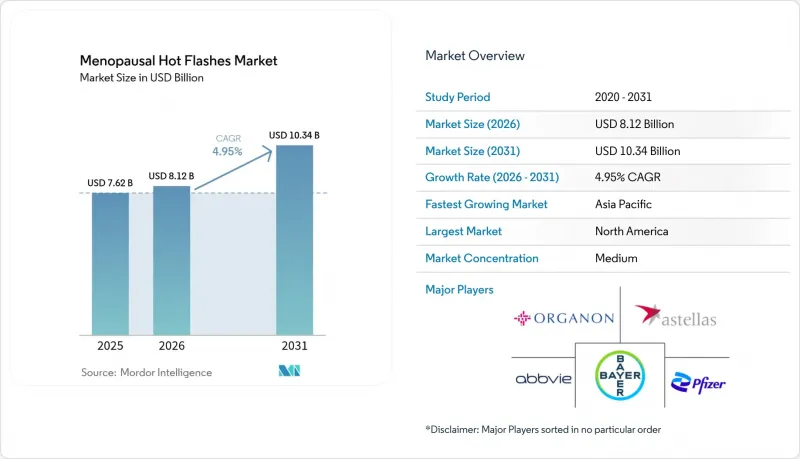
Mordor Intelligence에 의하면, 갱년기 안면 홍조 시장 규모는 2025년에 76억 2,000만 달러로 평가되었고, 2026년에 81억 2,000만 달러로 추정되고, 2031년까지 103억 4,000만 달러에 이를 것으로 예측되며, 2026-2031년 CAGR 4.95%로 성장할 전망입니다.
본 보고서는 치료 유형별(호르몬 요법(에스트로겐 등) 및 비호르몬 요법(SSRI 등)), 투여 경로별(경구, 기타), 유통 채널별(병원 약국, 기타), 갱년기 단계별(폐경 전후기, 기타), 지역별(북미, 유럽, 아시아태평양, 기타)로 분류되어 있습니다. 시장 전망은 금액(달러) 기준으로 제시되어 있습니다.
세계의 갱년기 안면 홍조 시장 동향 및 인사이트
폐경 후 여성 인구 증가
평균 수명의 연장에 따라 폐경 후 기간이 길어지면서 치료 수요가 지속되고 있습니다. 일본에서는 2024-2030년 65세 이상 여성 인구가 180만 명 증가할 것으로 예상되는 반면, 미국에서는 2030년까지 50세 이상 여성이 5,800만 명 이상에 달할 것으로 예측됩니다. 이러한 인구 동태의 변화에 따라 메디케어 파트 D는 2025년 1월 페졸리네탄트를 보험 적용 목록에 추가했으나, HRT 치료의 사전 실패를 조건으로 하는 사전 승인 기준이 마련되어 있습니다. 한국과 이탈리아에서도 유사한 인구 동향의 추이가 나타나고 있으며, 보험사들의 재검토가 진행되면서 경피 흡수형 HRT와 NK-3 길항제 모두에 대한 보험 적용 범위가 점차 확대되고 있습니다.
여성 건강 부문에 대한 제약 투자 확대
여성 건강 부문에 대한 전 세계 벤처 자금 조달은 2024년에 31억 달러에 달했고, 전년 대비 42% 증가했습니다. 바이엘은 핀란드에서 ‘클리마라(Climara)’ 패치의 생산 능력 확대에 1억 5,000만 유로를 투자하여, 2027년까지 생산량을 25% 늘리는 것을 목표로 하고 있습니다. 올가논(Organon)은 2024년 갱년기 관련 매출이 6억 8,000만 달러(총 매출의 18%)에 달했다고 밝혔으며, 2025년에는 두 자릿수 성장을 전망하고 있습니다. ARPA-H가 새로 자금을 지원한 프로젝트에는 AI를 활용한 증상 추적 및 새로운 NK-3 전달 시스템이 포함되어 있으며, 이를 통해 개발 주기를 최대 2년 단축할 수 있을 것으로 보입니다.
NK-3 길항제에 대한 장기적인 간 안전성 우려
FDA는 약 2,400명의 페졸리네탄트 사용자 중 3건의 급성 간손상 사례를 기록했으며, 이에 따라 박스 경고가 발령되었습니다. 이에 따라 환자 1인당 150-200달러의 비용이 드는 정기적인 간 기능 검사가 의무화되었습니다. 아스테라스사에 따르면, 이 경고 이후 처방 건수가 전분기 대비 22% 감소했으며, 특히 사전 승인 요건을 강화한 메디케어 어드밴티지 플랜에서 그 감소세가 두드러졌습니다. EMA(유럽의약품청)는 2026년 2분기에 예정된 병행 안전성 검토의 중간 단계에 있으며, 제한 조치가 취해질 경우 그 영향은 유럽 전역으로 파급될 가능성이 있습니다.
부문 분석
2025년, 갱년기 안면 홍조 시장 점유율의 62.55%를 호르몬 요법이 차지했으며, 그 배경에는 널리 알려진 존재감과 강력한 유효성 데이터가 있습니다. 주로 NK-3 길항제, 선택적 세로토닌 재흡수 억제제(SSRI), 가바펜티노이드로 구성된 비호르몬제는 에스트로겐이 금기인 환자층 및 암 생존자 수요를 바탕으로 연평균 성장률(CAGR) 7.25%로 성장할 전망입니다. 메디케어 파트 D에 등재됨에 따라 페졸리네탄트의 보험 적용이 확대되고 있어, 갱년기 안면 홍조 시장에서 비호르몬계 제품 시장 규모는 HRT(호르몬 대체 요법)보다 빠르게 확대될 것으로 예측됩니다. 프로게스테론 단독 요법은 2024년 코크란 리뷰에 의한 뒷받침되는 증거를 바탕으로 부상하고 있지만, 허브 보충제는 효능의 편차와 임상적 유효성에 대한 입증이 불충분하여 여전히 시장 점유율은 제한적입니다.
유럽과 인도에서 바이오시밀러 에스트라디올 패치가 보급됨에 따라, 기존 HRT의 가격 하락은 불가피합니다. 응고 경향이 낮은 태아성 에스트로겐인 에스테트롤·드로스피레논의 FDA 승인으로 인해 호르몬 요법 부문의 축소 속도는 둔화될 가능성이 있지만, 암 생존자나 심혈관 질환 고위험군 환자들은 에스트로겐을 완전히 피하려는 경향이 강해짐에 따라 비호르몬 요법의 기세는 더욱 강해질 것으로 보입니다. 미국의 120만 건의 진료 기록에 기반한 실세계 데이터에 따르면, NK-3 길항제 사용은 HRT에 절대적 금기 사항이 있는 여성에게 편중되어 있으며, 이는 수요가 기존 시장을 잠식하는 것이 아니라 추가적인 수요임을 시사합니다.
경구 요법은 2025년 시장 규모의 57.53%를 차지했으며, 정가가 낮고 처방의 관성이 작용하기 때문에 선호되고 있습니다. 경피 흡수형 젤, 스프레이, 패치는 정맥혈전색전증의 위험이 낮고 투여량 조절이 용이하다는 장점을 살려, 2031년까지 연평균 성장률(CAGR) 7.75%의 성장 궤도에 올라 있습니다. 14건의 코호트 연구를 대상으로 한 메타분석에 따르면, 패치 제제는 정제와 비교하여 정맥혈전색전증(VTE) 발병률을 2.1분의 1로 낮추는 것으로 밝혀졌습니다. 2024년에 실시된 마이크로니들 및 이온토포레시스 전달 시스템에 대한 시험 결과, 피부 자극을 유발하지 않으면서 2시간 이내에 치료 효과가 있는 에스트라디올 농도에 도달한 것으로 나타나, 차세대 복약 순응도 솔루션으로서의 가능성을 시사하고 있습니다.
경피 패치가 비경구 제제 시장을 독점하고 있는 반면, 용해형 마이크로니들 어레이는 땀으로 인해 패치가 쉽게 떨어지는 열대 기후에 최적화된, 통증이 없고 눈에 띄지 않는 적용 방법을 제공함으로써 시장 점유율에 변화를 가져올 가능성이 있습니다. 가격에 민감한 시장에서는 경구용 에스트롤이 경피 제제 시장 점유율 확대를 일부 상쇄할 수도 있겠지만, 물류 환경의 개선에 따라 콜드체인이 필요 없는 마이크로니들 시스템이 아시아태평양 및 아프리카 전역에서 경피 제제 시장 침투율을 높일 가능성이 높습니다.
지역별 분석
북미는 2025년 매출의 42.23%를 차지했으며, 2031년까지 연평균 성장률(CAGR) 4.2%로 성장할 전망입니다. 이는 페졸리네탄트가 메디케어 파트 D에 등재된 점과 전문 클리닉의 견고한 네트워크에 힘입은 결과입니다. 캐나다 각 주에서는 2024년 말에 유리한 환급 제도가 도입되었으나, 멕시코의 경우 IMSS(멕시코 사회보험원)의 제공 품목이 제한적이어서 민간 부문이 미국에서 경피 패치를 수입하여 이를 보완하고 있습니다. 이 지역에서는 기업의 갱년기 프로그램이 가장 성숙해져 있으며, 치료 시작까지의 기간 중앙값이 1개월로 단축되었습니다. 2024년에 발표된 증상 완화제의 임상시험 부담을 경감하는 FDA 지침에 따라, 파이프라인의 진행 속도는 더욱 가속화될 전망입니다.
아시아태평양에서는 규제 체계가 통일되고 고령화가 가속화됨에 따라 연평균 성장률(CAGR)이 7.42%로 전 세계에서 가장 빠른 성장세를 보일 것으로 예측됩니다. 일본에서는 2024년에 65세 이상 여성 비율이 28.9%로 상승하면서 패치 사용이 지속적으로 증가하고 있습니다. 중국에서는 NMPA가 2025년에 에스트라디올-프로게스테론 복합제에 대한 신속 승인을 실시하고, 에린자네탄트에 대해서도 우선 심사를 진행하고 있지만, 문화적 요인에 의한 지연은 여전히 남아 있어, 증상이 있는 여성 중 처방전을 통한 치료를 원하는 사람은 2% 이하에 그치고 있습니다. 인도에서는 Veera Health를 필두로 한 원격의료의 급증으로 인해, 현지 언어로 현지화된 가상 진료가 제공되면서 농촌 지역에서의 이용이 확대되고 있습니다. 한국에서는 2024년에 패치제의 보험 본인부담률이 30%로 인하됨에 따라 이용률이 47% 급증했습니다.
유럽에서는 EMA의 일원화된 승인 제도로 인해 시장 출시가 효율화되고 있습니다. 페졸리네탄트는 2024년 11월에 승인을 받았으며, 독일과 프랑스에서는 바이오시밀러 패치 덕분에 가격이 최대 35% 인하되었습니다. 영국 국민보건서비스(NHS)의 시범 사업을 통해 대기 시간이 5일 이하로 단축되었고, HRT 시작률이 31% 상승했습니다. 이탈리아와 스페인에서는 혈관운동성 증상에 대한 치료가 여전히 전액 본인 부담 시장이어서 도입에 걸림돌이 되고 있습니다. 동유럽에서는 인지도는 낮은 상황이지만, EU의 결속 기금을 통해 폴란드와 루마니아에서 인식 제고 활동이 지원되고 있습니다.
중동 및 아프리카는 소규모 기반에서 점차 확대되고 있습니다. 사우디아라비아의 보험 패키지에는 현재 HRT 급여가 의무화되어 있으며, SFDA는 2025년 1월에 페졸리네탄트의 신속 승인을 실시했습니다. 아랍에미리트에서는 민간 보험 플랜이 갱년기 치료를 보장하지 않기 때문에 외국인 여성들은 일반적으로 현금으로 지불하고 있습니다. 한편, 남아프리카공화국에서는 120 남아프리카 랜드라는 환급 상한선으로 인해 브랜드 제품의 보급이 제한되고 있습니다. 케냐와 나이지리아에서 진행 중인 원격의료 시범 사업은 문화적 저항이나 의료 제공업체 부족을 극복하는 데 있어 초기 단계임에도 유망한 성과를 보이고 있습니다. 남미에서는 브라질이 주도적인 입지를 차지하고 있으며, 브라질의 SUS(브라질 연방 공적 의료 제도)는 제네릭 에스트라디올 정제를 급여 대상으로 포함하고 있지만, 패치나 NK-3 길항제는 대상에서 제외되어 있습니다. 콜드체인의 제약으로 인해 아마존 지역 각 주에서 패치의 물류가 복잡해지고 있으며, 최첨단 치료법의 대부분은 자비 진료가 이루어지는 도시 지역 시장으로 한정되어 있습니다.
기타 혜택
- 엑셀 형식 시장 예측(ME) 시트
- 3개월간의 애널리스트 지원
자주 묻는 질문
목차
제1장 서론
제2장 조사 방법
제3장 주요 요약
제4장 시장 구도
제5장 시장 규모 및 성장 예측
제6장 경쟁 구도
제7장 시장 기회 및 향후 전망
AJY 26.09.11According to Mordor Intelligence, the menopausal hot flashes therapeutics market size is projected to be USD 7.62 billion in 2025, USD 8.12 billion in 2026, and reach USD 10.34 billion by 2031, growing at a CAGR of 4.95% from 2026 to 2031.
This report is Segmented by Treatment Type (Hormonal Treatment [Estrogen, and More], and Non-Hormonal Treatment [SSRIs, and More]), Route of Administration (Oral, and More), Distribution Channel (Hospital Pharmacies, and More), Menopausal Stage (Perimenopause and More), and Geography (North America, Europe, Asia-Pacific, and More). The Market Forecasts are Provided in Terms of Value (USD).
Global Menopausal Hot Flashes Market Trends and Insights
Rise in Post-Menopausal Female Population Base
Longer life expectancy is lengthening the post-menopausal window, generating sustained prescription need. Japan expects its 65+ female cohort to expand by 1.8 million between 2024-2030, while the United States projects more than 58 million women aged 50+ by 2030. These population shifts persuaded Medicare Part D to list fezolinetant in January 2025, albeit with prior-authorization hurdles that reference prior HRT failure. Similar demographic curves in South Korea and Italy motivate payer reviews that gradually widen reimbursement for both transdermal HRT and NK-3 antagonists.
Growing Pharmaceutical Investment in Women's-Health Portfolios
Global venture funding for women's health touched USD 3.1 billion in 2024, a 42% jump year over year. Bayer is spending EUR 150 million on additional Climara patch capacity in Finland, targeting 25% output growth by 2027. Organon disclosed USD 680 million menopause-related revenue in 2024, 18% of total sales, and guided to double-digit expansion for 2025. ARPA-H's newly funded projects include AI-driven symptom-tracking and novel NK-3 delivery systems, potentially trimming development cycles by up to two years.
Long-Term Hepatic Safety Concerns for NK-3 Antagonists
The FDA recorded three acute liver-injury cases among roughly 2,400 fezolinetant users, prompting a boxed warning that now mandates serial liver tests valued at USD 150-200 per patient. Astellas noted a 22% sequential prescription decline after the warning, especially in Medicare Advantage plans tightening prior authorization. The EMA is midway through a parallel safety review due in Q2 2026, and potential restrictions could echo across Europe.
Other drivers and restraints analyzed in the detailed report include:
- Rapid Approvals of Neurokinin-3 Receptor Antagonists
- Employer Adoption of Menopause Benefits Platforms
- Limited Reimbursement Outside OECD Markets
For complete list of drivers and restraints, kindly check the Table Of Contents.
Segment Analysis
Hormonal therapy controlled 62.55% of menopausal hot flashes therapeutics market share in 2025, anchored by broad familiarity and strong efficacy data. Non-hormonal agents, primarily NK-3 antagonists, selective serotonin reuptake inhibitors (SSRIs) and gabapentinoids, are poised for a 7.25% CAGR, benefiting estrogen-contraindicated segments and oncology survivors. The menopausal hot flashes therapeutics market size for non-hormonal products is projected to expand faster than HRT as payers increasingly reimburse fezolinetant following Medicare Part D listing. Progesterone monotherapy is emerging with supportive evidence from a 2024 Cochrane review, while herbal supplements remain marginal due to inconsistent potency and weak clinical validation.
Price erosion in legacy HRT is inevitable as biosimilar estradiol patches proliferate across Europe and India. FDA approval of estetrol-drospirenone, a fetal estrogen with lower clotting propensity, may slow attrition in the hormonal segment, yet oncology survivors and high-risk cardiovascular patients will likely bypass estrogen entirely, reinforcing non-hormonal momentum. Real-world data from 1.2 million U.S. charts indicate that NK-3 antagonist usage skews toward women with absolute HRT contraindications, suggesting additive rather than cannibalistic demand.
Oral therapies held 57.53% of 2025 volume, favored for lower list prices and prescribing inertia. Transdermal gels, sprays and patches are on a 7.75% CAGR trajectory through 2031, capitalizing on lower venous-thromboembolism risk and the convenience of dose titration. A meta-analysis of 14 cohort studies found a 2.1-fold reduction in VTE incidence for patches versus tablets. Microneedle and iontophoretic delivery systems trialed in 2024 achieved therapeutic estradiol levels within two hours without skin irritation, hinting at next-generation adherence solutions.
While transdermal patches dominate non-oral formulations, dissolving microneedle arrays could disrupt share by offering painless, discreet applications ideal for tropical climates where patches detach with sweat. Oral estetrol may partly offset transdermal gains in price-sensitive markets, but cold-chain-independent microneedle systems are likely to lift transdermal penetration across APAC and Africa as logistics improve.
Complete Report Scope:
- By Treatment Type
- Hormonal Treatment
- Estrogen
- Progesterone
- Estrogen-Progesterone Combination
- Non-Hormonal Treatment
- NK-3 Receptor Antagonists
- SSRIs
- SNRIs
- Gabapentinoids
- Herbal & Dietary Supplements
- Hormonal Treatment
- By Route of Administration
- Oral
- Transdermal Patch
- Transdermal Gel/Spray
- Parenteral (Injectable)
- Topical (Vaginal/Derma)
- By Distribution Channel
- Hospital Pharmacies
- Retail Pharmacies
- Online Pharmacies
- By Menopausal Stage
- Perimenopause
- Early Post-Menopause (<5 yrs)
- Late Post-Menopause (>5 yrs)
- Geography
- North America
- United States
- Canada
- Mexico
- Europe
- Germany
- United Kingdom
- France
- Italy
- Spain
- Rest of Europe
- Asia-Pacific
- China
- India
- Japan
- Australia
- South Korea
- Rest of Asia-Pacific
- Middle East and Africa
- GCC
- South Africa
- Rest of Middle East and Africa
- South America
- Brazil
- Argentina
- Rest of South America
- North America
Geography Analysis
North America maintained 42.23% of 2025 revenue and will grow at 4.2% CAGR to 2031, amplified by Medicare Part D listing of fezolinetant and a robust network of specialty clinics. Canadian provinces adopted favorable reimbursement in late 2024, while Mexico's private sector imports transdermal patches from the United States to compensate for limited IMSS offerings. Corporate menopause programs are most mature here, cutting median therapy-initiation times to one month. FDA guidance released in 2024 that lowers trial burdens for symptomatic relief drugs should further energize pipeline velocity.
Asia-Pacific is projected to register a 7.42% CAGR-the fastest globally-as regulatory pathways converge and aging accelerates. Japan's 65+ female share rose to 28.9% in 2024, driving sustained patch usage. China's NMPA fast-tracked estradiol-progesterone combinations in 2025 and is reviewing elinzanetant under priority status, but cultural delay persists: fewer than 2% of symptomatic women seek prescription care. India's tele-medicine surge, headlined by Veera Health, shows rural engagement when language-localized virtual care is offered. South Korea's insurance co-pay reset to 30% for patches in 2024 caused a 47% utilization jump.
Europe's centralized EMA approvals streamline launches; fezolinetant gained clearance in November 2024, and biosimilar patches slashed prices up to 35% in Germany and France. NHS England's pilot cut wait times to under five days, spurring 31% higher HRT initiation rates. Italy and Spain remain fully out-of-pocket markets for vasomotor indications, hamstringing adoption. Eastern Europe lags in awareness, although EU cohesion funds back education drives in Poland and Romania.
Middle East & Africa expands from a small base. Saudi Arabia's insurance package now mandates HRT coverage, and the SFDA fast-tracked fezolinetant in January 2025. In the UAE, expatriate women commonly pay cash because private plans exclude menopause care, while South Africa's reimbursement ceiling of ZAR 120 limits branded product reach. Telehealth pilots in Kenya and Nigeria demonstrate early promise in circumventing cultural resistance and provider shortages. South America is dominated by Brazil, where SUS funds generic estradiol tablets yet omits patches and NK-3 antagonists. Cold-chain limitations complicate patch logistics across Amazonian states, and most advanced therapies are confined to private-pay urban markets.
- Abbvie
- Astellas Pharma
- Bayer
- Besins Healthcare
- Cipla
- Eisai
- Endoceutics Inc.
- Ferring Pharmaceuticals
- Fervent Pharmaceuticals
- Hisamitsu Pharmaceutical Co. (Noven)
- KaNDy Therapeutics
- Knight Therapeutics Inc.
- Lupin
- Mithra Pharmaceuticals
- Novo Nordisk
- Organon
- Pfizer
- Sun Pharma Ind. Ltd.
- Teva Pharmaceutical Ind.
- Theramex
- Viatris
Additional Benefits:
- The market estimate (ME) sheet in Excel format
- 3 months of analyst support
TABLE OF CONTENTS
1 Introduction
- 1.1 Study Assumptions & Market Definition
- 1.2 Scope of the Study
2 Research Methodology
3 Executive Summary
4 Market Landscape
- 4.1 Market Overview
- 4.2 Market Drivers
- 4.2.1 Rise in post-menopausal female population base
- 4.2.2 Growing pharmaceutical investment in women's health portfolios
- 4.2.3 Rapid approvals of neurokinin-3 receptor antagonists
- 4.2.4 Employer adoption of menopause benefits platforms
- 4.2.5 AI-enabled precision dosing & companion diagnostics
- 4.2.6 Expansion of tele-menopause virtual clinics in underserved regions
- 4.3 Market Restraints
- 4.3.1 Long-term hepatic safety concerns for NK-3 antagonists
- 4.3.2 Limited reimbursement outside OECD markets
- 4.3.3 Cultural stigma suppressing care-seeking in Asia & MENA
- 4.3.4 Regulatory ambiguity for botanical OTC supplements
- 4.4 Supply-Chain Analysis
- 4.5 Regulatory Landscape
- 4.6 Technological Outlook
- 4.7 Porter's Five Forces
- 4.7.1 Bargaining Power of Suppliers
- 4.7.2 Bargaining Power of Buyers
- 4.7.3 Threat of New Entrants
- 4.7.4 Threat of Substitutes
- 4.7.5 Intensity of Competitive Rivalry
5 Market Size & Growth Forecasts (Value, USD)
- 5.1 By Treatment Type
- 5.1.1 Hormonal Treatment
- 5.1.1.1 Estrogen
- 5.1.1.2 Progesterone
- 5.1.1.3 Estrogen-Progesterone Combination
- 5.1.2 Non-Hormonal Treatment
- 5.1.2.1 NK-3 Receptor Antagonists
- 5.1.2.2 SSRIs
- 5.1.2.3 SNRIs
- 5.1.2.4 Gabapentinoids
- 5.1.2.5 Herbal & Dietary Supplements
- 5.1.1 Hormonal Treatment
- 5.2 By Route of Administration
- 5.2.1 Oral
- 5.2.2 Transdermal Patch
- 5.2.3 Transdermal Gel/Spray
- 5.2.4 Parenteral (Injectable)
- 5.2.5 Topical (Vaginal/Derma)
- 5.3 By Distribution Channel
- 5.3.1 Hospital Pharmacies
- 5.3.2 Retail Pharmacies
- 5.3.3 Online Pharmacies
- 5.4 By Menopausal Stage
- 5.4.1 Perimenopause
- 5.4.2 Early Post-Menopause (?5 yrs)
- 5.4.3 Late Post-Menopause (>5 yrs)
- 5.5 Geography
- 5.5.1 North America
- 5.5.1.1 United States
- 5.5.1.2 Canada
- 5.5.1.3 Mexico
- 5.5.2 Europe
- 5.5.2.1 Germany
- 5.5.2.2 United Kingdom
- 5.5.2.3 France
- 5.5.2.4 Italy
- 5.5.2.5 Spain
- 5.5.2.6 Rest of Europe
- 5.5.3 Asia-Pacific
- 5.5.3.1 China
- 5.5.3.2 India
- 5.5.3.3 Japan
- 5.5.3.4 Australia
- 5.5.3.5 South Korea
- 5.5.3.6 Rest of Asia-Pacific
- 5.5.4 Middle East and Africa
- 5.5.4.1 GCC
- 5.5.4.2 South Africa
- 5.5.4.3 Rest of Middle East and Africa
- 5.5.5 South America
- 5.5.5.1 Brazil
- 5.5.5.2 Argentina
- 5.5.5.3 Rest of South America
- 5.5.1 North America
6 Competitive Landscape
- 6.1 Market Concentration
- 6.2 Market Share Analysis
- 6.3 Company Profiles (includes Global level Overview, Market level overview, Core Segments, Financials as available, Strategic Information, Market Rank/Share for key companies, Products & Services, and Recent Developments)
- 6.3.1 AbbVie Inc.
- 6.3.2 Astellas Pharma Inc.
- 6.3.3 Bayer AG
- 6.3.4 Besins Healthcare
- 6.3.5 Cipla Ltd.
- 6.3.6 Eisai Co. Ltd.
- 6.3.7 Endoceutics Inc.
- 6.3.8 Ferring Pharmaceuticals
- 6.3.9 Fervent Pharmaceuticals
- 6.3.10 Hisamitsu Pharmaceutical Co. (Noven)
- 6.3.11 KaNDy Therapeutics
- 6.3.12 Knight Therapeutics Inc.
- 6.3.13 Lupin Ltd.
- 6.3.14 Mithra Pharmaceuticals
- 6.3.15 Novo Nordisk A/S
- 6.3.16 Organon & Co.
- 6.3.17 Pfizer Inc.
- 6.3.18 Sun Pharma Ind. Ltd.
- 6.3.19 Teva Pharmaceutical Ind.
- 6.3.20 Theramex
- 6.3.21 Viatris Inc.
7 Market Opportunities & Future Outlook
- 7.1 White-Space & Unmet-Need Assessment


