

|
시장보고서
상품코드
2123681
면역억제제 시장 : 시장 점유율 분석, 업계 동향 및 통계, 성장 예측(2026-2031년)Immunosuppressant Drugs - Market Share Analysis, Industry Trends & Statistics, Growth Forecasts (2026 - 2031) |
||||||
 Mordor Intelligence
Mordor Intelligence에 의하면, 면역억제제 시장 규모는 2025년에 512억 1,000만 달러로 평가되었고, 2026년 562억 5,000만 달러에서 2031년까지 901억 2,000만 달러에 이를 것으로 예측되며, 예측 기간(2026-2031년) CAGR은 9.85%를 나타낼 전망입니다.
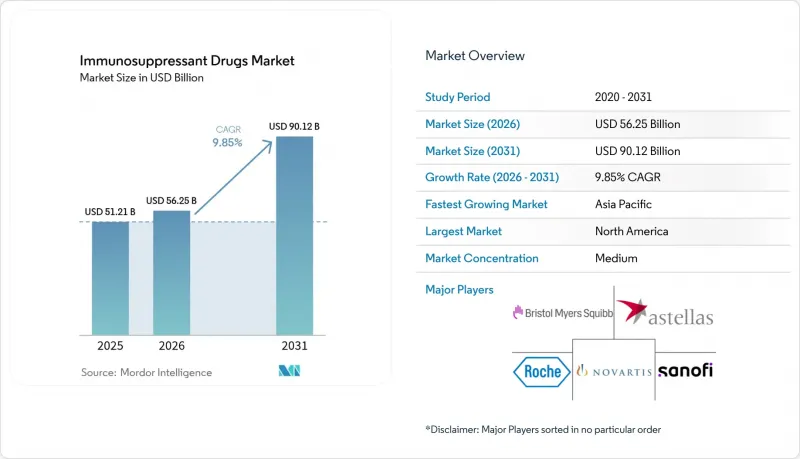
본 보고서는 약물 분류별(칼시뉴린 억제제, 항증식제, mTOR 억제제, 스테로이드, 기타 분류), 용도별(자가면역 질환, 장기 이식, 기타 용도), 유통 채널별(병원 약국, 소매 약국, 온라인 약국), 지역별(북미, 유럽, 아시아태평양, 기타)로 분류되어 있습니다. 시장 예측은 금액(달러) 기준으로 제시되어 있습니다.
세계의 면역억제제 시장 동향 및 인사이트
자가면역 질환 및 장기 이식 수술 유병률 증가
첨단 진단 기술로 인해, 그동안 발견되지 않았던 장기적인 약물 면역억제가 필요한 환자군이 드러남에 따라 자가면역질환에 대한 인식이 높아지고 있습니다. 미국에서는 2024년에 4만 8,000건 이상의 장기 이식이 이루어져 2023년 대비 3.3% 증가했으며, 이는 평생 유지 요법에 대한 새로운 수요 기준을 마련했습니다. 장기 보존 기술의 향상과 기증자 기준의 확대로 이식 건수는 더욱 증가하고 있으며, 2026년까지 연간 6만 건의 이식을 달성하겠다는 OPTN의 목표는 면역억제제에 대한 지속적인 수요를 뒷받침하고 있습니다. 선진국의 고령화는 치료 계획의 복잡성을 높이고, 환자 1인당 투여량을 증가시켜 총 지출을 끌어올리고 있습니다. 이러한 요인들이 결합되어 면역억제제 시장의 상승 추세를 뒷받침하고 있습니다.
조직 공학 및 이식 기술 분야의 기술적 진보
유전자 편집을 거친 돼지 장기는 개념 증명 단계에서 초기 임상 평가 단계로 진전되고 있으며, 이는 기증자 장기 부족을 완화하고 면역학적 프로토콜을 재정의할 가능성이 있는 패러다임의 전환을 시사합니다. 현재 FDA의 프레임워크에서는 이종 이식에 관한 신청에 대한 기대 사항이 상세하게 규정되어 있으며, 이를 통해 미국은 차세대 이식 의료의 최전선에 위치하고 있습니다. 동시에 생체 적합성 스캐폴드나 3D 바이오 프린팅 구조체와 같은 조직 공학의 혁신을 통해 면역원성이 감소하고, 생물학적 제제와 나노 입자 기반 전달 기술을 결합한 새로운 면역 억제 요법이 촉진되고 있습니다. 이러한 변화에 맞추어 연구개발 파이프라인을 조정하는 제약 기업들은 확대되는 면역억제제 시장에서 경쟁력을 강화하고 있습니다.
엄격한 다지역 규제 및 의약품 안전성 모니터링의 장벽
규제 차이로 인해 기업들은 서로 다른 승인 일정, 안전성 요건, 실세계 데이터(RWE) 제출 의무에 대응할 수밖에 없습니다. FDA의 심사는 현재 자궁 내 노출 연구까지 확대되어 임상 프로그램의 장기화와 비용 증가를 초래하고 있습니다. 대서양을 아우르는 규제 조화 노력으로 일관성은 향상되고 있지만, 지역별 특화된 의약품 안전성 모니터링(약물감시)에는 여전히 독자적인 인프라가 요구되며, 컴플라이언스 체제가 잘 갖춰진 기존 기업들에게 경쟁 우위가 쏠리고 있습니다. 종합적으로 볼 때, 이러한 복잡한 요인들이 이익률을 압박하고 있으며, 면역억제제 시장 전반에서의 사업 확장을 저해하고 있습니다.
부문 분석
칼시뉴린 억제제는 오랜 기간에 걸친 임상 실적과 폭넓은 지침에서의 권고 덕분에 2025년에도 면역억제제 시장 점유율의 43.83%를 유지했습니다. 그러나 신독성에 대한 우려로 인해 mTOR 억제제에 새로운 시장 기회가 창출되고 있으며, 이 부문은 10.52%의 연평균 성장률(CAGR)을 기록하며 2031년까지 가장 빠른 성장을 이룰 것으로 예측됩니다. mTOR 기반 치료 프로토콜에서 면역억제제 시장 규모는 간 및 신장 이식 환자의 양호한 신장 기능 예후에 힘입어 현저히 빠른 속도로 확대될 것으로 예측됩니다. 타크롤리무스와 사이클로스포린은 이식 직후 투여에서 계속해서 주류를 이룰 전망이지만, 베라타셉트와 에베로리무스는 다학제 이식 팀에게 매력적인 스테로이드 절약 요법을 주도하고 있습니다.
치료 모니터링 플랫폼이 칼시뉴린 억제제와 저용량 mTOR 억제제를 조합하여 거부 반응의 위험과 부작용 프로파일의 균형을 맞추면서, 정밀한 병용 요법으로의 전환이 가속화되고 있습니다. 미코페놀산 모페틸과 같은 항증식제나 새롭게 등장한 공동자극 억제제가 병용 요법을 보완함으로써, 여러 작용기전을 보유한 혁신적인 기업들에게 높은 경쟁 우위를 지닌 제품 포트폴리오를 형성하고 있습니다. 바이오시밀러 타크로리무스의 보급으로 단가가 하락하는 가운데, 혁신적인 기업들은 나노 입자 캡슐화나 주 1회 부착 패치와 같은 차별화된 투여 기술에 주력하며, 면역억제제 시장에서 자사 제품의 수익성을 지키려 하고 있습니다.
지역별 분석
북미는 견실한 이식 의료 생태계, 종합적인 메디케어 적용 범위, 새로운 투여 알고리즘에 관한 지침의 신속한 채택을 배경으로 2025년에도 40.42%의 시장 점유율을 유지했습니다. 임상 연구 네트워크 덕분에 후기 단계 제품의 상용화까지 걸리는 기간이 단축되어 개발 기업의 수익 확실성이 높아지고 있습니다. 캐나다 각 주의 처방약 목록 및 멕시코의 ‘세그로 포풀라르’ 제도 확충으로 시장 범위는 확대되고 있으나, 가격 차이로 인해 국경 간 조달 전략이 복잡해지고 있으며, 이는 면역억제제 시장 전체에서 무역 규정 준수에 대한 엄격한 모니터링이 필요한 요인이 되고 있습니다.
아시아태평양은 중국과 인도가 이식 능력을 확대하고 있으며, 일본의 고령화에 따라 자가면역 질환 환자 수가 증가하고 있어 2031년까지 10.58%라는 가장 빠른 연평균 성장률(CAGR)을 보이고 있습니다. 지역 규제 당국은 획기적인 생물학적 제제에 대한 신속 심사 절차를 마련하고 있으며, 이로 인해 과거 사례에 비해 시장 출시까지의 기간이 단축되고 있습니다. 현지에서 바이오시밀러를 제조함으로써 조달 비용이 절감되어 지방 도시에서도 그 이용이 확대되고 있습니다. 호주와 한국은 AI를 활용한 TDM 플랫폼 도입을 주도하며, 면역억제제 시장에서 환자 관리 체계를 한층 더 강화하고 있습니다.
유럽에서는 국민건강보험 제도와 견고한 의약품 안전성 모니터링 체계에 힘입어 꾸준한 성장을 보이고 있으나, 의료기술평가(HTA)에 따른 가격 상한선이 고가의 신규 진입 제품의 매출 성장을 억제하고 있습니다. 독일, 영국, 프랑스는 이식 건수에서 선두를 달리고 있는 반면, 남유럽 국가들은 자가면역 질환 치료 건수에서 다른 지역을 앞지르고 있습니다. FDA와의 규제 조화를 통해 여러 지역에 대한 신청 부담은 경감되었으나, 브렉시트 이후의 이중 신청은 범유럽 공급망을 운영하는 제조업체에게 새로운 장벽이 되고 있습니다. 중동 및 아프리카와 남미는 여전히 발전 단계에 있지만, 각각 이식 센터 인증 및 제네릭 의약품 제조에 막대한 투자를 하고 있어, 향후 세계 면역억제제 시장에서 중요한 역할을 할 것으로 예측됩니다.
기타 혜택
- 엑셀 형식 시장 예측(ME) 시트
- 3개월간의 애널리스트 지원
자주 묻는 질문
목차
제1장 서론
제2장 조사 방법
제3장 주요 요약
제4장 시장 구도
제5장 시장 규모 및 성장 예측
제6장 경쟁 구도
제7장 시장 기회 및 향후 전망
AJY 26.09.11According to Mordor Intelligence, the immunosuppressant drugs market size was valued at USD 51.21 billion in 2025 and estimated to grow from USD 56.25 billion in 2026 to reach USD 90.12 billion by 2031, at a CAGR of 9.85% during the forecast period (2026-2031).
This report is Segmented by Drug Class (Calcineurin Inhibitors, Antiproliferative Agents, MTOR Inhibitors, Steroids, Other Classes), Application (Autoimmune Diseases, Organ Transplant, Other Applications), Distribution Channel (Hospital Pharmacy, Retail Pharmacy, Online Pharmacy), and Geography (North America, Europe, Asia-Pacific, and More). The Market Forecasts are Provided in Terms of Value (USD).
Global Immunosuppressant Drugs Market Trends and Insights
Rising Prevalence of Autoimmune Diseases & Organ-Transplant Procedures
Autoimmune-disease recognition intensifies as advanced diagnostics uncover previously undetected patient pools requiring long-term pharmacologic suppression. The United States performed more than 48,000 organ transplants in 2024, a 3.3% rise over 2023, setting a new demand baseline for lifelong maintenance therapy . Enhanced organ-preservation technologies and expanded donor criteria raise procedure volumes further, while the OPTN target of 60,000 annual transplants by 2026 underscores sustained need for immunosuppressants. Aging demographics in developed economies add complexity to care plans, enlarging per-patient dosing and boosting aggregate spending. Collectively, these forces anchor the upward trajectory of the immunosuppressant drugs market.
Technological Advances in Tissue Engineering & Transplant Techniques
Gene-edited pig organs progress from proof-of-concept to early clinical evaluation, signaling a paradigm shift that could alleviate donor-organ scarcity and redefine immunologic protocols. FDA frameworks now detail expectations for xenograft submissions, positioning the United States at the forefront of next-generation transplant medicine. Concurrently, tissue-engineering innovations-such as biocompatible scaffolds and 3-D bioprinted constructs-lower immunogenicity, prompting novel immunosuppression regimens that blend biologics with nanoparticle-based delivery. Pharmaceutical companies that align R&D pipelines with these changes strengthen defensibility in an expanding immunosuppressant drugs market.
Stringent Multi-Regional Regulatory & Pharmacovigilance Hurdles
Regulatory divergence forces companies to navigate disparate approval timelines, safety requirements, and real-world-evidence obligations. FDA scrutiny now extends to in-utero exposure studies, lengthening clinical programs and escalating costs. Although trans-Atlantic harmonization efforts improve alignment, region-specific pharmacovigilance still mandates custom infrastructures, tilting competitive advantage toward incumbents with robust compliance resources. In aggregate, these complexities compress margins and temper expansion across the immunosuppressant drugs market.
Other drivers and restraints analyzed in the detailed report include:
- Launch of Next-Generation Biologics & Small-Molecule Formulations
- Wider Adoption of TDM-Driven Personalized Combination Regimens
- High Therapy Cost & Patchy Reimbursement
For complete list of drivers and restraints, kindly check the Table Of Contents.
Segment Analysis
Calcineurin inhibitors retained 43.83% immunosuppressant drugs market share in 2025 owing to long-standing clinical familiarity and broad guideline endorsement. Yet nephrotoxicity worries open white space for mTOR inhibitors, whose 10.52% CAGR marks the fastest segment growth to 2031. The immunosuppressant drugs market size for mTOR-based protocols is projected to expand at a notably brisk clip, helped by favorable renal-function outcomes among liver and kidney recipients. Tacrolimus and cyclosporine will continue to dominate early-post-transplant dosing, but belatacept and everolimus drive steroid-sparing approaches that appeal to multidisciplinary transplant teams.
Momentum toward precision combinations accelerates as therapeutic-drug-monitoring platforms pair calcineurin inhibitors with low-dose mTOR inhibitors to balance rejection risk and adverse-event profiles. Antiproliferative agents such as mycophenolate mofetil and emerging costimulation blockers round out cocktail regimens, creating high-moat portfolios for innovators that own multiple mechanisms of action. As biosimilar tacrolimus diffusion lowers unit prices, innovators lean on differentiated delivery technologies-nanoparticle encapsulation, once-weekly patches-to protect franchise economics inside the immunosuppressant drugs market.
Complete Report Scope:
- By Drug Class
- Calcineurin Inhibitors
- Antiproliferative Agents
- mTOR Inhibitors
- Steroids
- Other Classes
- By Application
- Autoimmune Diseases
- Organ Transplant
- Other Applications
- By Distribution Channel
- Hospital Pharmacy
- Retail Pharmacy
- Online Pharmacy
- By Geography
- North America
- United States
- Canada
- Mexico
- Europe
- Germany
- United Kingdom
- France
- Italy
- Spain
- Rest of Europe
- Asia-Pacific
- China
- Japan
- India
- Australia
- South Korea
- Rest of Asia-Pacific
- Middle East and Africa
- GCC
- South Africa
- Rest of Middle East and Africa
- South America
- Brazil
- Argentina
- Rest of South America
- North America
Geography Analysis
North America maintained 40.42% market share in 2025 grounded in robust transplant ecosystems, comprehensive Medicare coverage, and rapid guideline adoption for novel dosing algorithms. Clinical research networks speed time-to-practice for late-stage products, raising revenue certainty for developers. Canada's provincial formularies and Mexico's Seguro Popular upgrades extend reach, yet pricing differentials complicate cross-border procurement strategies, a factor requiring vigilant trade-compliance oversight across the immunosuppressant drugs market.
Asia-Pacific exhibits the most rapid 10.58% CAGR to 2031 as China and India scale transplant capacity and as Japan's aging demographics swell autoimmune caseloads. Regional agencies craft accelerated review pathways for breakthrough biologics, which improves launch windows relative to historic precedents. Local biosimilar manufacturing cuts acquisition costs, spurring broader usage even in secondary-tier cities. Australia and South Korea lead uptake of AI-enabled TDM platforms, further enriching patient-management frameworks within the immunosuppressant drugs market.
Europe posts steady gains aided by universal coverage and strong pharmacovigilance structures, but health-technology-assessment price caps curb top-line growth for high-ticket entrants. Germany, United Kingdom, and France represent transplant volume leaders, while Southern European nations outpace on autoimmune prescriptions. Regulatory convergence with FDA eases multi-regional filing burdens; however, post-Brexit dual submissions add friction for manufacturers operating pan-European supply chains. Middle East & Africa and South America remain nascent but invest heavily in transplant-center accreditation and generic manufacturing respectively, signaling future relevance to the worldwide immunosuppressant drugs market.
- Novartis
- Astellas Pharma
- Bristol-Myers Squibb
- Roche
- Pfizer
- Abbvie
- Sanofi
- Janssen (Johnson & Johnson)
- Viatris
- Accord Healthcare (Intas)
- Veloxis (Asahi Kasei)
- GlaxoSmithKline
- Teva Pharmaceutical Industries
- Sun Pharmaceuticals Industries
- Dr. Reddy's Laboratories
- Hikma Pharmaceuticals
- Lupin
- Mitsubishi Tanabe Pharma
- Fresenius
- Sandoz (Novartis Generics)
- CSL Behring
Additional Benefits:
- The market estimate (ME) sheet in Excel format
- 3 months of analyst support
TABLE OF CONTENTS
1 Introduction
- 1.1 Study Assumptions & Market Definition
- 1.2 Scope of the Study
2 Research Methodology
3 Executive Summary
4 Market Landscape
- 4.1 Market Overview
- 4.2 Market Drivers
- 4.2.1 Rising Prevalence of Autoimmune Diseases & Organ-Transplant Procedures
- 4.2.2 Technological Advances in Tissue Engineering & Transplant Techniques
- 4.2.3 Launch Of Next-Gen Biologics & Small-Molecule Formulations
- 4.2.4 Wider Adoption Of TDM-Driven Personalised Combination Regimens
- 4.2.5 Gene-Edited Xenotransplantation Breakthroughs
- 4.2.6 Off-Label Dermatology Use Surges in EMS
- 4.3 Market Restraints
- 4.3.1 Stringent Multi-Regional Regulatory & PV Hurdles
- 4.3.2 High Therapy Cost & Patchy Reimbursement
- 4.3.3 Curative Cell- & Gene-Therapy Substitutes
- 4.3.4 Rising AMR Burden Complicating Immunosuppression
- 4.4 Regulatory Landscape
- 4.5 Porters Five Forces Analysis
- 4.5.1 Threat of New Entrants
- 4.5.2 Bargaining Power of Buyers/Consumers
- 4.5.3 Bargaining Power of Suppliers
- 4.5.4 Threat of Substitute Products
- 4.5.5 Intensity of Competitive Rivalry
5 Market Size & Growth Forecasts (Value, USD)
- 5.1 By Drug Class
- 5.1.1 Calcineurin Inhibitors
- 5.1.2 Antiproliferative Agents
- 5.1.3 mTOR Inhibitors
- 5.1.4 Steroids
- 5.1.5 Other Classes
- 5.2 By Application
- 5.2.1 Autoimmune Diseases
- 5.2.2 Organ Transplant
- 5.2.3 Other Applications
- 5.3 By Distribution Channel
- 5.3.1 Hospital Pharmacy
- 5.3.2 Retail Pharmacy
- 5.3.3 Online Pharmacy
- 5.4 By Geography
- 5.4.1 North America
- 5.4.1.1 United States
- 5.4.1.2 Canada
- 5.4.1.3 Mexico
- 5.4.2 Europe
- 5.4.2.1 Germany
- 5.4.2.2 United Kingdom
- 5.4.2.3 France
- 5.4.2.4 Italy
- 5.4.2.5 Spain
- 5.4.2.6 Rest of Europe
- 5.4.3 Asia-Pacific
- 5.4.3.1 China
- 5.4.3.2 Japan
- 5.4.3.3 India
- 5.4.3.4 Australia
- 5.4.3.5 South Korea
- 5.4.3.6 Rest of Asia-Pacific
- 5.4.4 Middle East and Africa
- 5.4.4.1 GCC
- 5.4.4.2 South Africa
- 5.4.4.3 Rest of Middle East and Africa
- 5.4.5 South America
- 5.4.5.1 Brazil
- 5.4.5.2 Argentina
- 5.4.5.3 Rest of South America
- 5.4.1 North America
6 Competitive Landscape
- 6.1 Market Concentration
- 6.2 Market Share Analysis
- 6.3 Company Profiles (includes Global level Overview, Market level overview, Core Segments, Financials as available, Strategic Information, Market Rank/Share for key companies, Products & Services, and Recent Developments)
- 6.3.1 Novartis AG
- 6.3.2 Astellas Pharma Inc.
- 6.3.3 Bristol-Myers Squibb Co.
- 6.3.4 F. Hoffmann-La Roche Ltd.
- 6.3.5 Pfizer Inc.
- 6.3.6 AbbVie (Allergan)
- 6.3.7 Sanofi (Genzyme)
- 6.3.8 Janssen (Johnson & Johnson)
- 6.3.9 Viatris Inc.
- 6.3.10 Accord Healthcare (Intas)
- 6.3.11 Veloxis (Asahi Kasei)
- 6.3.12 GlaxoSmithKline plc
- 6.3.13 Teva Pharmaceutical Industries
- 6.3.14 Sun Pharmaceutical
- 6.3.15 Dr. Reddy's Laboratories
- 6.3.16 Hikma Pharmaceuticals
- 6.3.17 Lupin Ltd.
- 6.3.18 Mitsubishi Tanabe Pharma
- 6.3.19 Fresenius Kabi
- 6.3.20 Sandoz (Novartis Generics)
- 6.3.21 CSL Behring
7 Market Opportunities & Future Outlook
- 7.1 White-space & Unmet-need Assessment


