|
시장보고서
상품코드
2123687
습윤 상처 드레싱 시장 : 점유율 분석, 업계 동향과 통계, 성장 예측(2026-2031년)Moist Wound Dressings - Market Share Analysis, Industry Trends & Statistics, Growth Forecasts (2026 - 2031) |
||||||
 Mordor Intelligence
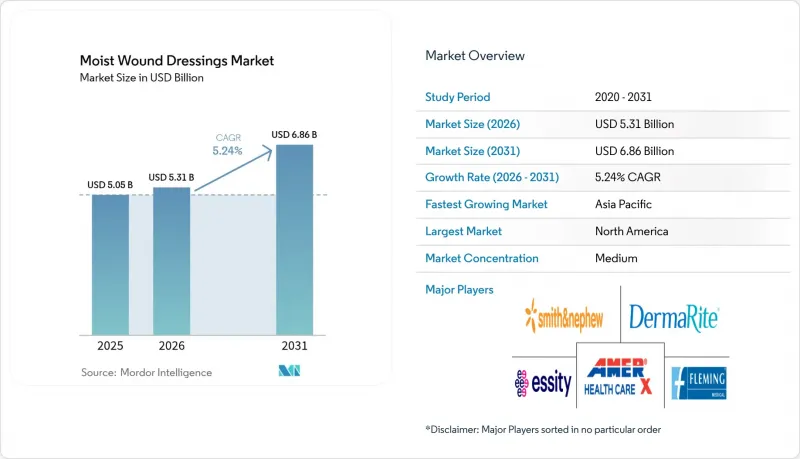
Mordor Intelligence에 의하면, 2026년 습윤 상처 드레싱 시장 규모는 53억 1,000만 달러로 추정되고 있어 2025년 50억 5,000만 달러에서 확대되어, 2031년에는 68억 6,000만 달러에 이를 것으로 예측됩니다.
2026년부터 2031년까지의 연평균 성장률(CAGR)은 5.24%가 될 것으로 전망됩니다.
본 보고서는 제품별(폼, 알긴산염, 하이드로콜로이드, 하이드로겔, 기타), 용도별(화상, 욕창, 당뇨성 궤양, 수술 상처, 기타),최종 용도별(병원, 재택 간호, 기타), 지역별(북미, 유럽, 아시아태평양, 중동 및 아프리카, 남미)로 분류되어 있습니다. 본 보고서에서는 상기 모든 부문에 대한 시장 규모(달러)를 제시하고 있습니다.
전 세계 습윤 상처 드레싱 시장 동향 및 인사이트
만성 및 급성 상처 발생률 증가
약 670만 명의 미국인이 만성 상처를 앓고 있으며, 말초동맥질환, 비만, 당뇨병이 고령화와 맞물려 이 인구는 더욱 증가할 것으로 예측됩니다. 미국심장협회는 2024년, 당뇨병성 족부 궤양 환자의 평생 위험이 25% 이상이며, 절단 후 5년 내 사망률이 70%에 달한다고 지적했습니다. 이러한 통계로 인해 의료 제공업체들은 치유 기간을 단축하고 재입원을 억제하기 위해 첨단 습윤 드레싱을 조기에 사용하려는 추세입니다. 유럽연합(EU)의 병원 비용 모델링에 따르면, 당뇨병성 족부 궤양으로 인한 입원 비용은 환자 1인당 평균 4,888유로(5,308달러)이며, 이 비용의 88%는 장기 입원에 기인합니다. 따라서 보험사는 보습 요법을 단순한 ‘선택 사항’이 아닌 비용 절감을 위한 수단으로 간주하고 있습니다.
고령화의 진행과 당뇨병 유병률 증가
아시아태평양에서는 매년 65세 이상 고령자가 4,500만 명 이상 증가하고 있으며, 이들 중 다수는 당뇨병, 말초 신경병증 또는 혈관 장애를 동반하고 있습니다. 『Scientific Reports』지의 조사에 따르면, 당뇨병 환자의 44.4%가 신경 손상을 발병하고, 21.7%가 절단 수술을 받았으며, 96.9%가 삶의 질 저하를 보고하고 있습니다. 고혈당은 산화 스트레스와 대식세포의 균형 교란을 유발하여 상처의 자연 치유 과정을 지연시킵니다. 첨단 습윤 드레싱은 내인성 성장 인자를 유지하고 삼출액 관리를 최적화함으로써 이러한 생물학적 과제를 해결하고 있으며, 많은 전문 클리닉에서 1순위 치료법으로 자리 잡고 있습니다.
제품 및 치료의 높은 비용
스페인에서는 3년 동안 1차 의료 분야의 만성 상처 치료에 3,499만 1,854유로(3,805만 7,000달러)가 지출되었으며, 그중 재료비만 845만 5,787유로(920만 3,000 달러)를 차지했으며, 나머지는 의료진의 진료 시간에 따른 비용이었습니다. 주당 여러 차례의 드레싱 교체는 보험사 및 환자에게 비용 부담을 가중시킵니다. 인도에서도 유사한 경향이 나타나며, 당뇨병성 족부 궤양 치료비는 본인 부담이 되는 경우가 많아, 고성능 드레싱에 대한 접근이 제한되고 있습니다. 가격대를 단계적으로 설정하거나 소용량 패키지를 도입하는 등 가격 격차를 해소하려는 시도가 이루어지고 있지만, 한편으로는 혁신적인 제품이 일반 상품화될 위험도 수반합니다.
부문 분석
2025년, 폼 드레싱은 습윤 상처 드레싱 시장 점유율의 23.54%를 차지하며, 수술 후 상처, 욕창, 외상성 상처 등 폭넓은 적용 범위를 반영하고 있습니다. 이 제품의 폴리우레탄 매트릭스는 높은 흡수성과 단열성을 동시에 갖추고 있어 드레싱 교체 빈도를 줄이고 상처 주변 피부를 보호합니다. 스미스 앤 네퓨(Smith & Nephew)사의 ‘ALLEVYN Ag+SURGICAL’과 같이, 은 이온과 유연한 3층 구조를 결합한 기술적 개선을 통해 임상적 매력이 높아지고 있습니다. 하이드로콜로이드 제제는 현재 매출 규모는 작지만 5.93%라는 가장 높은 연평균 성장률(CAGR)을 보이고 있습니다. 높은 겔 형성 능력과 7일간의 착용 기간 덕분에 하이드로콜로이드 제제는 특히 재택 간호 분야에서 움직일 수 없는 환자의 욕창 예방책으로 점점 더 선호되고 있습니다. FDA의 하이드로콜로이드 제제에 대한 510(k) 신청 간소화 조치는 시장 진입 장벽을 낮추고, 틈새 시장 업체들이 악취 제어, 투명성, 생분해성 등의 분야에서 혁신을 일으키는 계기가 되고 있습니다.
2026년부터 2031년까지, 알긴산염 및 하이드로겔 제품은 폼 제품에 정면으로 도전하기보다는 독자적인 역할을 확립해 나갈 것으로 예측됩니다. 알긴산염의 칼슘·나트륨 이온 교환 작용은 삼출물이 많은 상처에서 지혈 성능을 뒷받침하고 있으며, 응급 분야에서 필수적인 존재로 남을 것으로 확실시되고 있습니다. 냉각 및 진통 효과로 높이 평가받고 있는 하이드로겔 시트는 암 치료와 관련된 방사선 화상이나 괴사 조직의 데브리드먼트 분야에서 주류를 이루고 있습니다. 필름, 접촉층 및 복합 드레싱은 틈새 시장 지위에 머물러 있지만, 스마트 플랫폼용 센서 기판으로서 다시 주목받고 있습니다. 이러한 동향이 맞물리면서, 습윤 상처 드레싱 시장에서 확고한 입지를 다지려는 기업에게 다각적인 제품 포트폴리오 구축이 필수적이라는 점이 강조되고 있습니다.
지역별 분석
북미는 기술 혁신과 보험 급여 제도의 발전에서 계속해서 중심지 역할을 하고 있습니다. 이 지역의 지불 주체 구성, 즉 메디케어, 민간 보험사 및 재향군인 보건국(VA)이 맞물려 임상적으로 입증된 제품의 급속한 보급을 주도하고 있습니다. 의료 서비스 제공업체들은 폼 드레싱과 스마트폰 연동형 pH 센서를 결합한 원격 모니터링 키트를 점점 더 많이 도입하고 있어, 염증이 급격히 심해질 때 당일 개입이 가능해졌습니다. 미국-멕시코-캐나다 협정(USMCA) 덕분에 국경을 넘는 공급망은 탄력성을 유지하고 있지만, 각 제조업체는 관세 및 운송비 변동 위험을 완화하기 위해 생산의 현지화를 추진하고 있습니다.
아시아태평양의 동향은 역학과 정책의 융합을 반영하고 있습니다. 중국의 ‘건강 중국 2030’ 계획에서는 만성 질환 예방에 자금이 배정되고 있으며, 그 투자는 하이드로파이버 드레싱을 통해 상처 세척 빈도를 줄일 수 있는 당뇨병성 족부 병변 클리닉에 집중되고 있습니다. 인도에서는 주 차원의 건강보험 제도를 통해 사지 보존 수술을 받는 저소득 환자에 대한 첨단 드레싱의 보험 급여가 이루어지고 있으며, 이는 공공 부문의 입찰을 활성화시키고 있습니다. 일본 및 한국 시장에서는 초고령화 사회에서의 욕창 예방에 초점이 맞추어져 있으며, MRI 검사 중에도 파손되지 않도록 설계된 실리콘 폼 제 예방용 제품의 사용이 촉진되고 있습니다.
유럽에서는 지역별로 서로 다른 성장 추세가 나타나고 있습니다. 북유럽의 의료 제도에서는 재택 간호를 중시하고 있어, 간호사의 방문 횟수를 최소화하는 12일 착용 프로토콜을 갖춘 항균 폼의 도입이 급속히 진행되고 있습니다. 남유럽에서는 공공 예산의 제약으로 인해 비용 대비 효과 연구가 중시되고 있습니다. 최근 잉글랜드 국민보건서비스(NHS)의 실세계 데이터에 따르면, 일반 거즈에서 하이드로콜로이드 드레싱으로 전환함으로써 주당 드레싱 교체 횟수가 19% 감소하여 연간 170만 달러를 절감하는 결과를 가져왔습니다. 동유럽 국가들이 공동 조달 절차에 참여함에 따라 가격 통합이 진행되는 한편, 아시아태평양 공급업체들과의 경쟁도 격화되고 있어, 현지 기존 기업들은 지속가능성 인증이나 재활용 가능한 포장을 통해 차별화를 꾀해야 할 필요에 직면해 있습니다.
기타 혜택:
- 엑셀 형식 시장 예측(ME) 시트
- 3개월간의 애널리스트 지원
자주 묻는 질문
목차
제1장 서론
제2장 조사 방법
제3장 주요 요약
제4장 시장 구도
제5장 시장 규모와 성장 예측
제6장 경쟁 구도
제7장 시장 기회와 향후 전망
JHS 26.09.07According to Mordor Intelligence, moist wound dressings market size in 2026 is estimated at USD 5.31 billion, growing from 2025 value of USD 5.05 billion with 2031 projections showing USD 6.86 billion, growing at 5.24% CAGR over 2026-2031.
This report is Segmented by Product (Foam, Alginate, Hydrocolloid, Hydrogel, and Others), Application (Burn Wounds, Pressure Ulcers, Diabetic Ulcers, Surgical Wounds, and Others), End Use (Hospitals, Homecare, and Others), and Geography (North America, Europe, Asia-Pacific, The Middle East and Africa, and South America). The Report Provides the Value (USD) for all the Above-Mentioned Segments.
Global Moist Wound Dressings Market Trends and Insights
Increasing Incidence of Chronic & Acute Wounds
Roughly 6.7 million Americans live with a chronic wound, a population expected to climb as peripheral arterial disease, obesity, and diabetes intersect with older age. The American Heart Association noted in 2024 that diabetic foot ulcer patients face a >25% lifetime risk and a 70% five-year post-amputation mortality rate . Such statistics are steering providers toward early use of advanced moist dressings that shorten healing cycles and curb readmissions. Hospital cost modeling in the European Union shows diabetic foot ulcer admissions averaging EUR 4,888 (USD 5,308) per patient, with 88% of costs tied to prolonged stays. Payers therefore view moisture-retentive protocols not as optional extras but as cost-avoidance tools.
Growing Geriatric Population & Diabetes Prevalence
Asia-Pacific adds more than 45 million individuals aged >=65 each year, and many also live with diabetes, peripheral neuropathy, or vascular insufficiency. Scientific Reports found that 44.4% of diabetes patients developed neuropathy, 21.7% underwent amputations, and 96.9% reported poor quality of life . Hyperglycemia triggers oxidative stress and macrophage imbalance, slowing natural closure phases. Advanced moist dressings address such biological hurdles by preserving endogenous growth factors and optimizing exudate management, making them first-line therapy in many specialty clinics.
High Product & Procedure Cost
In Spain, chronic wound care consumed EUR 34,991,854 (USD 38,057,000) in primary care over three years, with materials alone costing EUR 8,455,787 (USD 9,203,000) and clinician time making up the remainder. Multiple dressing changes per week compound expenses for payers and patients. Similar patterns appear in India, where diabetic foot ulcer treatment is often paid out of pocket, shrinking access to advanced dressings. Tiered product ranges and smaller pack sizes aim to bridge price gaps but risk commoditizing innovations.
Other drivers and restraints analyzed in the detailed report include:
- Favorable Reimbursement Reforms in OECD Outpatient Settings
- Rise of Smart-Sensor Dressings Enabling Tele-Monitoring
- Limited Reimbursement in Emerging Economies
For complete list of drivers and restraints, kindly check the Table Of Contents.
Segment Analysis
Foam dressings accounted for 23.54% of moist wound dressings market share in 2025, reflecting their broad applicability across postoperative, pressure, and trauma wounds. Their polyurethane matrix balances high absorption with thermal insulation, reducing dressing changes and protecting peri-wound skin. Technological upgrades, such as Smith+Nephew's ALLEVYN Ag+ SURGICAL, which combines silver ions with a flexible trilaminate, strengthen clinical appeal. Hydrocolloid formats, although smaller in today's revenue terms, display the fastest 5.93% CAGR. High gel-forming capacity and seven-day wear time make hydrocolloids an increasingly preferred preventive measure for pressure injury in immobile patients, particularly in homecare. The FDA's streamlined 510(k) exemption for hydrocolloid formulations lowers entry barriers and sparks niche players to innovate on odor control, transparency, and biodegradability.
Over 2026-2031, alginate and hydrogel categories are expected to carve distinct roles rather than challenge foam outright. Alginate's calcium-sodium ion exchange underpins hemostatic performance in profusely exuding wounds, ensuring it remains indispensable in emergency departments. Hydrogel sheets, prized for cooling analgesic effects, dominate oncology-related radiation burns and necrotic tissue debridement. Film, contact-layer, and composite dressings retain niche status but gain renewed attention as sensor backings for smart platforms. Together these dynamics reinforce a multi-product portfolio imperative for firms seeking durable positions in the moist wound dressings market.
Complete Report Scope:
- By Product
- Foam Dressings
- Alginate Dressings
- Hydrocolloid Dressings
- Hydrogel Dressings
- Film Dressings
- Collagen Dressings
- Antimicrobial/Silver Dressings
- Contact-Layer Dressings
- Others
- By Application
- Burn Wounds
- Pressure Ulcers
- Diabetic Foot Ulcers
- Surgical / Traumatic Wounds
- Venous Leg Ulcers
- Other Applications
- By End User
- Hospitals
- Homecare Settings
- Others
- By Geography
- North America
- United States
- Canada
- Mexico
- Europe
- Germany
- United Kingdom
- France
- Italy
- Spain
- Rest of Europe
- Asia-Pacific
- China
- Japan
- India
- Australia
- South Korea
- Rest of Asia-Pacific
- Middle East & Africa
- GCC
- South Africa
- Rest of Middle East & Africa
- South America
- Brazil
- Argentina
- Rest of South America
- North America
Geography Analysis
North America remains the epicenter of technological and reimbursement evolution. The region's payer mix, Medicare, commercial insurers, and the Veterans Health Administration, collectively drives rapid diffusion of clinically proven products. Providers increasingly deploy remote monitoring kits that bundle foam dressings with smartphone-linked pH sensors, enabling same-day intervention when inflammation spikes. Cross-border supply chains are resilient due to the United States-Mexico-Canada Agreement, though manufacturers are localizing production to mitigate tariff and freight volatility.
Asia-Pacific's trajectory reflects a convergence of epidemiology and policy. China's Healthy China 2030 plan earmarks funds for chronic disease prevention, channeling investment into diabetic foot clinics where hydrofiber dressings cut debridement frequency. In India, state-level health insurance schemes reimburse advanced dressings for low-income patients undergoing limb-salvage surgery, stimulating public-sector tenders. Japanese and South Korean markets focus on pressure-injury prevention in super-aged populations, fostering adoption of silicone-foam prophylactics designed to remain intact during MRI scans.
Europe exhibits nuanced growth. Northern European health systems emphasize home-based care, prompting high uptake of antimicrobial foams with twelve-day wear protocols that minimize nurse visits. Southern Europe's constrained public budgets favor cost-effectiveness studies; recent NHS England real-world data showed a 19% reduction in weekly dressing changes when switching from plain gauze to hydrocolloid, saving USD 1.7 million annually. East European accession to common procurement procedures brings price harmonization but also intensifies competition from Asia-Pacific suppliers, pressuring local incumbents to differentiate through sustainability certifications and recyclable packaging.
- Smiths Group
- Molnlycke Health Care
- 3M (Health Care)
- Convatec
- Coloplast
- Essity AB (BSN medical)
- Cardinal Health
- B. Braun
- Medtronic plc (Acelity/KCI)
- Johnson & Johnson
- Lohmann & Rauscher GmbH
- Hartmann Group
- Urgo Medical
- Hollister
- Integra LifeSciences
- DermaRite Industries
- AMERX Health Care Corp.
- Fleming Medical Ltd.
- Derma Sciences (Nipro)
- Milliken Healthcare
Additional Benefits:
- The market estimate (ME) sheet in Excel format
- 3 months of analyst support
TABLE OF CONTENTS
1 Introduction
- 1.1 Study Assumptions & Market Definition
- 1.2 Scope of the Study
2 Research Methodology
3 Executive Summary
4 Market Landscape
- 4.1 Market Overview
- 4.2 Market Drivers
- 4.2.1 Increasing incidence of chronic & acute wounds
- 4.2.2 Growing geriatric population & diabetes prevalence
- 4.2.3 Accelerating adoption of home-based chronic-wound management
- 4.2.4 Favorable reimbursement reforms in OECD outpatient settings
- 4.2.5 Rise of smart-sensor dressings enabling tele-monitoring
- 4.2.6 Climate-linked uptick in burn & trauma cases
- 4.3 Market Restraints
- 4.3.1 High product & procedure cost
- 4.3.2 Limited reimbursement in emerging economies
- 4.3.3 Infection risk from improper moist-dressing usage
- 4.3.4 Stricter eco-toxicity rules on silver dressings
- 4.4 Value / Supply-Chain Analysis
- 4.5 Technological Outlook
- 4.6 Regulatory Landscape
- 4.7 Porter's Five Forces Analysis
- 4.7.1 Bargaining Power of Buyers/Consumers
- 4.7.2 Bargaining Power of Suppliers
- 4.7.3 Threat of New Entrants
- 4.7.4 Threat of Substitute Products
- 4.7.5 Intensity of Competitive Rivalry
5 Market Size & Growth Forecasts
- 5.1 By Product
- 5.1.1 Foam Dressings
- 5.1.2 Alginate Dressings
- 5.1.3 Hydrocolloid Dressings
- 5.1.4 Hydrogel Dressings
- 5.1.5 Film Dressings
- 5.1.6 Collagen Dressings
- 5.1.7 Antimicrobial/Silver Dressings
- 5.1.8 Contact-Layer Dressings
- 5.1.9 Others
- 5.2 By Application
- 5.2.1 Burn Wounds
- 5.2.2 Pressure Ulcers
- 5.2.3 Diabetic Foot Ulcers
- 5.2.4 Surgical / Traumatic Wounds
- 5.2.5 Venous Leg Ulcers
- 5.2.6 Other Applications
- 5.3 By End User
- 5.3.1 Hospitals
- 5.3.2 Homecare Settings
- 5.3.3 Others
- 5.4 By Geography
- 5.4.1 North America
- 5.4.1.1 United States
- 5.4.1.2 Canada
- 5.4.1.3 Mexico
- 5.4.2 Europe
- 5.4.2.1 Germany
- 5.4.2.2 United Kingdom
- 5.4.2.3 France
- 5.4.2.4 Italy
- 5.4.2.5 Spain
- 5.4.2.6 Rest of Europe
- 5.4.3 Asia-Pacific
- 5.4.3.1 China
- 5.4.3.2 Japan
- 5.4.3.3 India
- 5.4.3.4 Australia
- 5.4.3.5 South Korea
- 5.4.3.6 Rest of Asia-Pacific
- 5.4.4 Middle East & Africa
- 5.4.4.1 GCC
- 5.4.4.2 South Africa
- 5.4.4.3 Rest of Middle East & Africa
- 5.4.5 South America
- 5.4.5.1 Brazil
- 5.4.5.2 Argentina
- 5.4.5.3 Rest of South America
- 5.4.1 North America
6 Competitive Landscape
- 6.1 Market Concentration
- 6.2 Market Share Analysis
- 6.3 Company Profiles (includes Global level Overview, Market level overview, Core Segments, Financials as available, Strategic Information, Market Rank/Share for key companies, Products & Services, and Recent Developments)
- 6.3.1 Smith & Nephew plc
- 6.3.2 Molnlycke Health Care AB
- 6.3.3 3M (Health Care)
- 6.3.4 ConvaTec Group PLC
- 6.3.5 Coloplast A/S
- 6.3.6 Essity AB (BSN medical)
- 6.3.7 Cardinal Health Inc.
- 6.3.8 B. Braun Melsungen AG
- 6.3.9 Medtronic plc (Acelity/KCI)
- 6.3.10 Johnson & Johnson (Ethicon)
- 6.3.11 Lohmann & Rauscher GmbH
- 6.3.12 Hartmann Group
- 6.3.13 Urgo Medical
- 6.3.14 Hollister Incorporated
- 6.3.15 Integra LifeSciences
- 6.3.16 DermaRite Industries LLC
- 6.3.17 AMERX Health Care Corp.
- 6.3.18 Fleming Medical Ltd.
- 6.3.19 Derma Sciences (Nipro)
- 6.3.20 Milliken Healthcare
7 Market Opportunities & Future Outlook
- 7.1 White-Space & Unmet Need Assessment