|
시장보고서
상품코드
2123689
바이오메디컬 텍스타일 시장 : 점유율 분석, 업계 동향과 통계, 성장 예측(2026-2031년)Biomedical Textile - Market Share Analysis, Industry Trends & Statistics, Growth Forecasts (2026 - 2031) |
||||||
 Mordor Intelligence
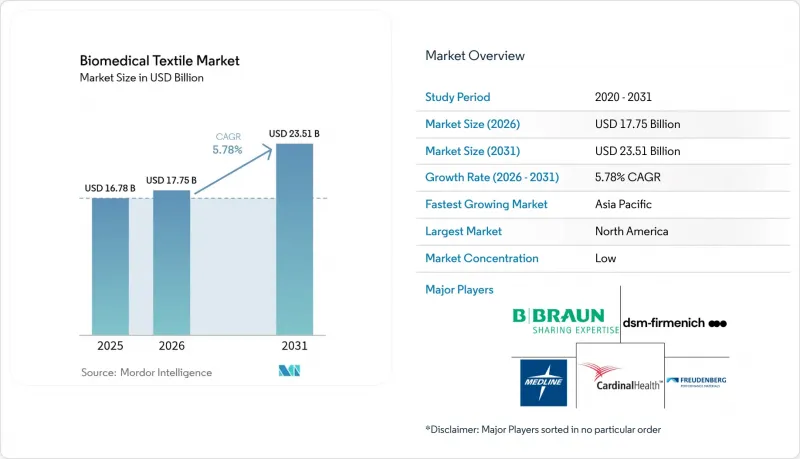
Mordor Intelligence에 의하면, 바이오메디컬 텍스타일 시장 규모는 2025년에 167억 8,000만 달러로 평가되었고 2026년에는 177억 5,000만 달러에서 성장하여 2031년까지 235억 1,000만 달러에 이를 것으로 예측되며, 예측 기간(2026-2031년) CAGR은 5.78%를 나타낼 전망입니다.
본 보고서는 섬유 유형(비생분해성 섬유, 생분해성 섬유), 원단 형태(부직포, 직물, 기타 원단 유형), 용도(비이식형, 이식형, 기타 이식형), 최종 사용자(병원·외과 센터, 외래수술센터(ASC) 등),및 지역(아시아태평양, 북미, 유럽 등)별로 분류되어 있습니다. 시장 예측은 금액(달러)으로 제시되어 있습니다.
세계 바이오메디컬 텍스타일 시장 동향 및 인사이트
수술 건수 증가
평균 연령의 상승과 선택적 수술에 대한 접근성이 높아짐에 따라 전 세계 수술 건수는 꾸준히 증가하고 있습니다. 원래 전장 의료를 목적으로 했던 미국 국방부의 나노패브릭 프로그램을 통해 항균성 실과 경량 혈관 이식편이 개발되었으며, 이러한 기술은 민간 수술실에도 도입되고 있습니다. 병원에서는 절개 부위의 온도와 pH를 기록하는 프로그래밍 가능한 섬유가 도입되어, 외과의는 붕대를 제거하지 않고도 감염 위험을 감지할 수 있게 되었습니다. 아시아태평양의 병원에서는 보험 적용 범위 확대로 인해 더 많은 중산층이 수술실을 찾게 되었고, 1건당 섬유 소비량이 증가함에 따라 도입이 가속화되고 있습니다.
고품질 상처 관리용 섬유에 대한 수요 증가
첨단 드레싱은 회복 기간을 단축하고, 재입원율을 낮추며, 간호 시간을 절감합니다. Spincare와 같은 일렉트로스피닝 방식을 이용한 나노섬유 제품은 임상시험에서 기존 거즈에 비해 재입원 없이 46.6%의 상피화를 달성했습니다. 중국 공장에서는 세균 증식을 억제하는 다기능 은 이온 매트의 국내 수요를 충족시키면서 수출용 생산량도 확대되고 있습니다. 현재 웨어러블 생체 센서에는 스펀본드 기판에 그래핀 미세 섬유가 내장되어 있어, 재택 간호사가 모바일 대시보드를 통해 원격으로 상처의 습윤 상태를 확인할 수 있게 되었습니다. 이러한 기능은 만성 상처 치료를 입원 병동에서 외래 또는 재택 환경으로 전환하라는 보험사 측의 요구와 부합합니다.
혈관 이식편 및 인공 피부의 높은 비용
조직공학을 통한 이식편 제조에는 무균 클린룸, 수 주간에 걸친 세포 접종, 그리고 정밀한 직조 공정이 필요하며, 그 결과 많은 의료 제도에서 가격이 보험 적용 상한선을 초과하고 있습니다. 미국 보험 지침에서는 여전히 수많은 생체공학 드레싱이 ‘임상시험 중’으로 분류되어 보험 적용이 제한되고, 규모의 경제가 저해되고 있습니다. 대량 생산이 실현되지 않는 한 단가는 높은 수준을 유지할 것이며, 이는 라틴아메리카 및 동남아시아 일부 지역의 병원에서의 조달을 방해하고 있습니다.
부문 분석
생분해성 실은 2025년 매출의 41.02%를 차지하고 있으며, 2031년까지의 연평균 성장률(CAGR)은 7.68%로 바이오메디컬 텍스타일 시장을 주도하고 있습니다. FDA가 폴리젖산 및 폴리카프로락톤의 흡수 프로파일을 승인함에 따라 규제상의 장벽이 제거되었으며, 외과의사들은 용해되어 수술 후 제거할 필요가 없는 스캐폴드를 높이 평가했습니다. 현재, 신생 기업들은 전신에 항생제를 투여하지 않고도 감염 관리 목표를 달성하기 위해 폴리젖산에 꿀 유래 항균제를 코팅하고 있습니다.
폴리에틸렌 테레프탈레이트(PET)와 같은 비생분해성 섬유는 인대 복원이나 탈장 메쉬 등 영구적인 하중 지지가 필수적인 분야에서 여전히 지배적인 위치를 유지하고 있습니다. 이들은 수십 년에 걸친 임상 데이터로 뒷받침되며, 바이오메디컬 텍스타일 시장의 58.98% 점유율을 차지하고 있습니다. 각 제조업체는 장기 매몰형 임플란트에서 입자 방출을 줄이는 저탈락성 실 처리 기술에 투자하고 있습니다. 이 두 가지 섬유 범주가 결합되어 공급업체의 제품 라인업을 확대하고, 조달 부서가 수술의 복잡성에 따라 적절한 재료를 선정할 수 있게 함으로써 바이오메디컬 텍스타일 시장의 회복력을 강화하고 있습니다.
부직포 제품 라인은 2025년 매출의 61.85%를 차지하며, 멜트블로우의 다용도성과 수분 균형을 조절하기 위한 하이드로겔 층을 삽입하는 인라인 라미네이션 기술 덕분에 해당 부문에서 가장 높은 연평균 성장률(CAGR) 8.14%를 달성하고 있습니다. 이러한 생산 규모를 바탕으로, 프로이덴베르크는 하루 700만 개의 PET 병을 재활용하여 ISO 13432 퇴비화 기준을 충족하는 일회용 드레이프를 제조하고 있습니다. 병원에서는 보풀이 적게 발생하고 신속하게 장벽을 형성할 수 있어 이러한 드레이프가 선호되고 있습니다.
직물 및 니트 제품은 정밀한 인장 강도와 제어된 다공성이 필요한 틈새 이식형 의료기기에 활용되고 있습니다. 현재 엔지니어들은 천연 혈관의 분지를 모방한 3D 분지 튜브를 직조하여, 섬유 기반 혈관 내 이식편의 적응증을 확대되고 있습니다. 경편 커버 사이에 멜트블로우 방식으로 제작된 항균 코어를 적층한 하이브리드 구조는 두 재료의 장점을 융합하고 있으며, 이러한 추세가 바이오메디컬 텍스타일 시장의 폭넓은 성장 지속에 기여하고 있습니다.
지역별 분석
북미는 광범위한 보험 적용과 연방 정부 자금 지원에 의한 섬유 연구가 상업적 공급망으로 신속하게 전환되고 있는 것을 배경으로, 2025년 매출의 37.72%를 차지하고 있습니다. 미국 국방부의 7,500만 달러 규모의 스마트 패브릭 프로그램을 통해 개발된 센서 실은 현재 민간 음압 상처 드레싱에 채택되고 있습니다. 2025년에 발표된 FDA의 생체 적합성 지침에 따라 승인 절차가 간소화되어, 현지 기업들이 선구자로서 계약을 따낼 수 있게 되었습니다. 스미스 앤 네퓨(Smith & Nephew)와 같은 대형 의료기기 제조업체들의 자본 투자가 매사추세츠주와 미네소타주의 지역 제조 클러스터 기반을 공고히 하고 있습니다.
아시아태평양에서는 각국 정부가 국민 건강보험을 확대하고 국내 의료 기술 생산을 촉진하고 있어, 2031년까지 연평균 성장률(CAGR) 7.06%를 기록할 전망입니다. 중국은 수출 주문과 국내 수요를 모두 충족하기 위해 나노섬유 생산 라인을 적극적으로 확대되고 있습니다. 한편, 일본은 센서가 내장된 거즈를 활용한 고령자 대상 원격 케어 시범 사업에 자금을 지원하고 있습니다. 아세안(ASEAN) 의료기기 지침에 따른 규제 조화로 진입 장벽이 점차 낮아지면서 다국적 기업과 지역 공급업체 모두를 지원하고 있습니다.
유럽에서는 선진적인 규제와 지속가능성에 대한 요구가 융합되고 있습니다. EU의 ‘일회용 플라스틱 지침’에 따라 특정 화석 유래 일회용 제품이 금지됨에 따라, 병원에서는 렌징(Lenzing)사의 셀룰로오스 스텐트 커버와 바이오 부직포 패드의 시범 도입이 진행되고 있습니다. 프로이덴베르크(Freudenberg)사는 헤이텍스(Heatex)사의 인수를 활용하여 음압 요법용 기기를 위한 폴리우레탄 코팅 기재를 공급하고 있습니다. 그러나 폐기물 감축 규제로 인해 규정 준수 비용이 상승하고 있으며, 공급업체들은 퇴비화 가능성 인증 및 폐쇄형 재활용 감사를 통해 성과를 거두고 있습니다.
남미 및 중동 및 아프리카은 시장 규모 면에서는 뒤처져 있지만, 3차 의료 기관의 개설과 정부의 외상 치료 네트워크 지원에 힘입어 판매량 증가세가 가속화되고 있습니다. 현지에서 재활용된 PET를 원료로 한, 비용이 최적화된 스펀본드 제 상처 패드는 가격에 민감한 수요층의 요구를 충족시키면서 충분한 차단 기능도 갖추고 있습니다. 국제 NGO는 조달 관련 교육을 지원하여 임상의가 근거 기반의 섬유 솔루션을 선택할 수 있도록 돕는 한편, 바이오메디컬 텍스타일 시장의 확대에 기여하고 있습니다.
기타 혜택:
- 엑셀 형식 시장 예측(ME) 시트
- 3개월간의 애널리스트 지원
자주 묻는 질문
목차
제1장 서론
제2장 조사 방법
제3장 주요 요약
제4장 시장 구도
제5장 시장 규모와 성장 예측
제6장 경쟁 구도
제7장 시장 기회와 향후 전망
JHS 26.09.07According to Mordor Intelligence, the biomedical textile market size was valued at USD 16.78 billion in 2025 and estimated to grow from USD 17.75 billion in 2026 to reach USD 23.51 billion by 2031, at a CAGR of 5.78% during the forecast period (2026-2031).
This report is Segmented by Fiber Type (Non-Biodegradable Fibers, Biodegradable Fibers), Fabric Form (Non-Woven, Woven, Other Fabric Types), Application (Non-Implantable, Implantable, Other Implantable), End-User (Hospitals & Surgical Centers, Ambulatory Care Centers, and More), and Geography (Asia-Pacific, North America, Europe, and More). The Market Forecasts are Provided in Terms of Value (USD).
Global Biomedical Textile Market Trends and Insights
Rising Number of Surgeries
Global surgical procedures continue to climb as median ages rise and elective interventions become more accessible. The U.S. Department of Defense's nanofabric programs, originally aimed at battlefield care, generate antimicrobial yarns and lightweight vascular grafts that transfer into civilian operating rooms. Hospitals integrate programmable fibers that record temperature and pH at incision sites, letting surgeons detect infection risk without removing dressings. Asia-Pacific hospitals accelerate adoption because improved insurance coverage brings larger middle-class cohorts into surgical theaters, amplifying textile consumption per case.
Growing Need for High-Quality Wound Care Textiles
Advanced dressings shorten recovery, lower readmissions, and reduce nursing time. Electro-spun nanofiber products, such as Spincare, achieved 46.6% epithelialization without rehospitalization versus conventional gauze in clinical trials. Chinese factories boost output for export while also meeting domestic demand for multifunctional silver-ion mats that limit bacterial growth. Wearable biosensors now embed graphene traces into spun-bond substrates, allowing home-care nurses to remotely read wound moisture on mobile dashboards. These capabilities align with payer pressure to shift chronic-wound treatment from inpatient wards to outpatient and home settings.
High Cost of Vascular Grafts & Artificial Skin
Tissue-engineered grafts require sterile cleanrooms, multi-week cell seeding, and precision weaving, driving prices beyond reimbursement caps in many health systems. Insurance guidelines in the United States still classify numerous bioengineered dressings as investigational, limiting coverage and slowing scale economies. Without volume, unit costs remain high, deterring procurement by hospitals in Latin America and parts of Southeast Asia.
Other drivers and restraints analyzed in the detailed report include:
- Rapid Aging Population
- Advances in Minimally-Invasive Implantable Textiles
- Electronic-Textile Integration Complexity
For complete list of drivers and restraints, kindly check the Table Of Contents.
Segment Analysis
Biodegradable threads account for 41.02% of 2025 revenue, yet are pacing the biomedical textile market at an 7.68% CAGR through 2031. FDA recognition of poly-lactic acid and poly-caprolactone resorption profiles opens regulatory doors, and surgeons value scaffolds that dissolve, eliminating follow-up retrieval. Start-ups now coat polylactic acid microfibers with honey-derived antimicrobials to meet infection control goals without systemic antibiotics.
Non-biodegradable fibers such as polyethylene terephthalate retain dominance where permanent load-bearing is vital, including ligament repairs and hernia meshes. They hold 58.98% of the biomedical textile market share, supported by decades of clinical data. Producers invest in low-shedding yarn treatments that reduce particle release during long implants. Together, these dual fiber classes widen supplier portfolios and let procurement teams match materials to procedure complexity, reinforcing the resilience of the biomedical textile market.
Non-woven lines posted 61.85% 2025 revenue and deliver the sector's highest 8.14% CAGR due to melt-blown versatility and inline lamination that embeds hydrogel layers for moisture balance. Production scale allows Freudenberg to recycle 7 million PET bottles daily into single-use drapes that meet ISO 13432 compostability thresholds. Hospitals favor these drapes for reduced lint and rapid barrier deployment.
Woven and knitted formats serve niche implantables that demand precise tensile strength and controlled porosity. Engineers now weave 3D bifurcated tubes that mimic natural blood-vessel branches, expanding indications for textile-based endovascular grafts. Hybrid constructions that laminate a melt-blown antimicrobial core between warp-knit covers converge benefits of both worlds, a trend that helps sustain broad-based growth in the biomedical textile market.
Complete Report Scope:
- By Fiber Type
- Non-biodegradable Fibers
- Biodegradable Fibers
- By Fabric Form
- Non-woven
- Woven
- Other Fabric Types (Knitted, Braided)
- By Application
- Non-implantable
- Implantable
- Other Implantable (Extracorporeal, etc.)
- By End-user
- Hospitals and Surgical Centers
- Ambulatory Care Centers
- Home Healthcare
- Sports Medicine and Orthopedic Clinics
- By Geography
- Asia-Pacific
- China
- India
- Japan
- South Korea
- Rest of Asia-Pacific
- North America
- United States
- Canada
- Mexico
- Europe
- Germany
- France
- United Kingdom
- Italy
- Rest of Europe
- South America
- Brazil
- Argentina
- Rest of South America
- Middle East and Africa
- Saudi Arabia
- South Africa
- Rest of Middle East and Africa
- Asia-Pacific
Geography Analysis
North America commands 37.72% 2025 revenue, driven by broad insurance coverage and rapid translation of federally funded textile research into commercial supply chains. The Department of Defense's USD 75 million smart-fabric program delivered sensor yarns now appearing in civilian negative-pressure wound dressings. FDA biocompatibility guidance released in 2025 streamlines approvals, letting local firms secure early-mover contracts. Capital investment from device majors such as Smith & Nephew anchors regional manufacturing clusters in Massachusetts and Minnesota.
Asia-Pacific posts a 7.06% CAGR to 2031 as governments expand universal health insurance and stimulate domestic medtech output. China aggressively scales nanofiber lines to meet both export orders and home demand, while Japan funds geriatric remote-care pilots that rely on sensor-integrated gauze. Regulatory harmonization through ASEAN Medical Device Directives gradually lowers entry barriers, supporting multinational and regional vendors alike.
Europe blends advanced regulation with sustainability imperatives. The EU Single-Use Plastics Directive bans certain fossil-based disposables, prompting hospitals to trial Lenzing's cellulosic stent covers and bio-based nonwoven pads. Freudenberg leverages the Heytex acquisition to supply polyurethane-coated substrates for negative-pressure therapy devices. Nonetheless, waste-reduction rules raise compliance costs; suppliers succeed by certifying compostability and closed-loop recycling audits.
South America and the Middle East & Africa trail on value but show accelerating unit growth as tertiary hospitals open and governments subsidize trauma networks. Cost-optimized spun-bond wound pads made from locally recycled PET balance price sensitives with adequate barrier function. International NGOs aid procurement training, helping clinicians choose evidence-backed textile solutions and broadening the biomedical textile market footprint.
- Ahlstrom
- ATEX TECHNOLOGIES INC.
- B. Braun SE
- Bally Ribbon Mills
- Cardinal Health
- CORTLAND BIOMEDICAL
- dsm-firmenich
- Freudenberg Performance Materials
- Lenzing AG
- Medline Industries LP
- Meister & Cie AG
- Milliken & Company
- Secant Group, LLC
- Smith+Nephew
Additional Benefits:
- The market estimate (ME) sheet in Excel format
- 3 months of analyst support
TABLE OF CONTENTS
1 Introduction
- 1.1 Study Assumptions and Market Definition
- 1.2 Scope of the Study
2 Research Methodology
3 Executive Summary
4 Market Landscape
- 4.1 Market Overview
- 4.2 Market Drivers
- 4.2.1 Rising number of surgeries
- 4.2.2 Growing need for high-quality wound-care textiles
- 4.2.3 Rapid ageing population in key economies
- 4.2.4 Advances in minimally-invasive implantable textiles
- 4.2.5 Bioresorbable electro-spun nanofiber dressings entering retail channels
- 4.2.6 Defense-funded sensor fabrics accelerating med-smart textile crossover
- 4.3 Market Restraints
- 4.3.1 High cost of vascular grafts and artificial skin
- 4.3.2 Electronic-textile integration complexity
- 4.3.3 Absent shelf-life standards for antimicrobial biotextiles
- 4.3.4 Regulatory backlash on single-use medical nonwovens waste
- 4.4 Value Chain Analysis
- 4.5 Porter's Five Forces Analysis
- 4.5.1 Threat of New Entrants
- 4.5.2 Bargaining Power of Buyers
- 4.5.3 Bargaining Power of Suppliers
- 4.5.4 Threat of Substitute Products
- 4.5.5 Degree of Competition
5 Market Size and Growth Forecasts (Value)
- 5.1 By Fiber Type
- 5.1.1 Non-biodegradable Fibers
- 5.1.2 Biodegradable Fibers
- 5.2 By Fabric Form
- 5.2.1 Non-woven
- 5.2.2 Woven
- 5.2.3 Other Fabric Types (Knitted, Braided)
- 5.3 By Application
- 5.3.1 Non-implantable
- 5.3.2 Implantable
- 5.3.3 Other Implantable (Extracorporeal, etc.)
- 5.4 By End-user
- 5.4.1 Hospitals and Surgical Centers
- 5.4.2 Ambulatory Care Centers
- 5.4.3 Home Healthcare
- 5.4.4 Sports Medicine and Orthopedic Clinics
- 5.5 By Geography
- 5.5.1 Asia-Pacific
- 5.5.1.1 China
- 5.5.1.2 India
- 5.5.1.3 Japan
- 5.5.1.4 South Korea
- 5.5.1.5 Rest of Asia-Pacific
- 5.5.2 North America
- 5.5.2.1 United States
- 5.5.2.2 Canada
- 5.5.2.3 Mexico
- 5.5.3 Europe
- 5.5.3.1 Germany
- 5.5.3.2 France
- 5.5.3.3 United Kingdom
- 5.5.3.4 Italy
- 5.5.3.5 Rest of Europe
- 5.5.4 South America
- 5.5.4.1 Brazil
- 5.5.4.2 Argentina
- 5.5.4.3 Rest of South America
- 5.5.5 Middle East and Africa
- 5.5.5.1 Saudi Arabia
- 5.5.5.2 South Africa
- 5.5.5.3 Rest of Middle East and Africa
- 5.5.1 Asia-Pacific
6 Competitive Landscape
- 6.1 Market Concentration
- 6.2 Strategic Moves
- 6.3 Market Share(%)/Ranking Analysis
- 6.4 Company Profiles (includes Global level Overview, Market level overview, Core Segments, Financials, Strategic Information, Market Rank/Share for key companies, Products and Services, and Recent Developments)
- 6.4.1 Ahlstrom
- 6.4.2 ATEX TECHNOLOGIES INC.
- 6.4.3 B. Braun SE
- 6.4.4 Bally Ribbon Mills
- 6.4.5 Cardinal Health
- 6.4.6 CORTLAND BIOMEDICAL
- 6.4.7 dsm-firmenich
- 6.4.8 Freudenberg Performance Materials
- 6.4.9 Lenzing AG
- 6.4.10 Medline Industries LP
- 6.4.11 Meister & Cie AG
- 6.4.12 Milliken & Company
- 6.4.13 Secant Group, LLC
- 6.4.14 Smith+Nephew
7 Market Opportunities and Future Outlook
- 7.1 White-space and Unmet-need Assessment