

|
시장보고서
상품코드
2123690
알코올 에톡실레이트 시장 : 점유율 분석, 업계 동향과 통계, 성장 예측(2026-2031년)Alcohol Ethoxylates - Market Share Analysis, Industry Trends & Statistics, Growth Forecasts (2026 - 2031) |
||||||
 Mordor Intelligence
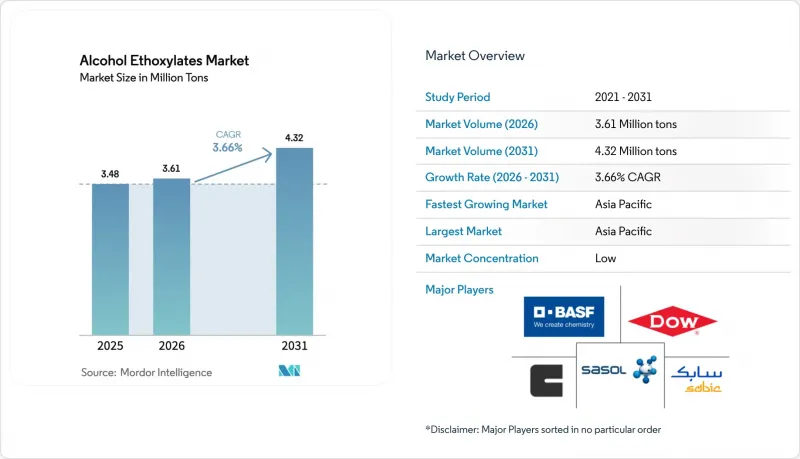
Mordor Intelligence에 의하면, 알코올 에톡실레이트 시장 규모는 2025년 348만 톤, 2026년 361만 톤에서, 2031년까지 432만 톤으로 확대될 것으로 예측되고 있어 2026년부터 2031년까지 연평균 복합 성장률(CAGR)은 3.66%를 나타낼 전망입니다.
본 보고서는 원료 유형(유지화학 유래, 석유화학 유래), 탄소 사슬 길이(C9-C11(직쇄 알코올 에톡실레이트),C12-C14(라우릴 알코올 에톡실레이트) 등), 형태(액체, 페이스트/고체), 용도(퍼스널케어, 비누 및 세제 등), 지역(아시아태평양, 북미 등)별로 분류되어 있습니다. 시장 예측은 수량(톤) 단위로 제시되어 있습니다.
전 세계 알코올 에톡실레이트 시장 동향 및 인사이트
아시아태평양 전반에 걸쳐 증가하는 퍼스널케어 및 홈 케어 수요
중국, 인도,및 아세안(ASEAN) 국가들의 도시화, 가처분 소득 증가, 그리고 정부 주도의 위생 프로그램으로 인해, 알코올 에톡실레이트가 지닌 저자극성, 거품 억제 효과, 그리고 냉수에서의 세정력을 활용한 액체 세제, 섬유 유연제, 그리고 씻어내는 유형의 퍼스널케어 제품의 1인당 소비량이 증가하고 있습니다. 중국의 2·3선 도시에서는 고형 비누에서 액체 손 비누로의 전환이 연평균 한 자릿수 중반의 속도로 진행되고 있는 반면,인도의 농촌 지역에서 세제의 보급률은 50% 미만이기 때문에 전자상거래 및 소비자 직배송형 물류를 통해 접근성이 확대됨에 따라 향후 수년에 걸쳐 성장 여지가 생겨나고 있습니다. 이 지역의 클린 뷰티 브랜드들은 황산염계 음이온 계면활성제에서 동등한 거품력을 가지면서도 피부 자극이 적은 C12-C14 알코올 에톡실레이트로 빠르게 전환하고 있으며, 이는 유럽과 미국에서의 배합 변경 추세를 반영한 것으로, 소셜 미디어의 영향으로 그 움직임이 가속화되고 있습니다. RSPO 인증을 받은 팜 커널 유래 라우릴 알코올에 대한 선호도는 석유화학 유래 대체품에 비해 공급망을 합리화하고 리드 타임을 단축함으로써 지역 원료의 우위를 확고히 하고 있습니다. 수요가 액체 제품이나 일회용 포드에 집중되는 가운데, 프리미엄 배합은 원료 가격 변동으로 인해 판매 마진이 압박을 받는 경우에도 가격 결정력을 유지하고 있습니다.
산업용 및 시설용 세정제 처방 확대
의료시설, 외식 업체, 호텔 체인은 팬데믹 이후의 기준과 그린 빌딩 인증을 준수하기 위해 위생 프로토콜을 강화하고 있으며, 이에 따라 자동 바닥 세척기 및 중앙 급액 시스템에서 저발포성 알코올 에톡실레이트의 채택이 확대되고 있습니다. 미국 환경보호청(EPA)의 ‘세이퍼 초이스(Safer Choice)’ 및 EU의 에코라벨 기준에서는 생분해성이 높은 비이온성 계면활성제가 우대받고 있으며, 이에 따라 알킬페놀 에톡실레이트에서 OECD 301 기준을 충족하는 직쇄형 등급으로의 전환이 진행되고 있습니다. 기관 구매 담당자들은 수경도의 변동과 관계없이 성능이 안정적이라는 점을 중시하고 있으며, 이를 통해 배합 제조업체는 원료 가격 변동을 흡수하고 이익률을 유지할 수 있게 됩니다. 이는 가격에 민감한 일반 소비자용 세제에서는 반드시 실현할 수 없는 강인성입니다. 농축 세정 캡슐에는 일반적으로 중량비로 10-15%의 알코올 에톡시레이트가 포함되어 있어, 이를 통해 판매업체는 기업의 ESG 방침에 따라 포장 폐기물을 줄일 수 있습니다. 제3자 인증을 받은 공급업체 네트워크가 확대됨에 따라 조달이 일원화되고, 기관용 채널에서 직쇄형 알코올 에톡실레이트가 표준적인 주력 계면활성제로서의 입지를 더욱 공고히 하고 있습니다.
원료 가격 변동
예기치 못한 크래커 가동 중단으로 인해 2024년 12월 미국 멕시코만 연안의 에틸렌옥사이드 현물 가격이 30% 상승했습니다. 한편, 말레이시아의 홍수와 인도네시아의 수출 할당량으로 인해 지방 알코올 가격은 전월 대비 25% 상승하여, 업스트림 부문을 통합하지 않은 에톡실레이트 제조업체의 이익률을 압박하는 요인이 되었습니다. 유럽 및 북미의 수탁 제조업체들은 동남아시아산 C12-C14 원료 수입과 에너지 가격 변동의 영향을 받는 지역의 에틸렌옥사이드 공급이라는 이중의 위험에 직면해 있습니다. 여러 분기에 걸친 공급 계약은 위험을 헤지해 주지만, 운전 자금을 묶어두기 때문에 특수 등급 제품 개발에 있어 유연성을 제한하게 됩니다. SABIC, Shell, Sasol 등 수직 통합형 기업들은 원료에 대한 지배력을 활용하여 독립 기업보다 저렴한 가격으로 공급하며 시장 점유율을 확보하고 있어, 업계 재편을 가속화하고 있습니다. 또한, 변동이 지속되는 상황에서 비용의 확실성이 성능 차별화보다 우선시될 경우, 배합 제조업체는 알킬폴리글루코사이드 등의 대체 계면활성제로 전환할 수밖에 없습니다.
부문 분석
2025년, 유지화학 유래 알코올 에톡실레이트는 수량 점유율의 58.32%를 차지할 것이며, 2031년까지 연평균 성장률(CAGR) 3.97%를 기록하며 석유화학 등급과의 격차를 더욱 벌릴 전망입니다. 이는 각 브랜드 소유사가 2030년까지 100% 재생 가능 탄소를 사용할 것을 공약하고 있기 때문입니다. 알코올 에톡실레이트 시장은 동남아시아의 수직 통합의 혜택을 받고 있습니다. 이 지역에서는 팜유 정제 업체들이 다운스트림 공정에서 지방 알코올 및 에톡실레이션으로 사업을 확장하여, 경쟁력 있는 비용 구조로 RSPO 물질 수지 인증을 확보하면서 부가가치를 창출하고 있습니다. 한편, 중동이나 미국 멕시코만 연안 지역에서는 석유화학제품이 여전히 필수적입니다. 이 지역에서는 자사 소유의 에틸렌 및 프로파일렌 생산 라인이 지속가능성 프리미엄을 상쇄하여, 범용 석유 제품 및 산업용 세정제에 대한 공급을 유지하고 있습니다. BASF와 다우(Dow)의 물질 수지 산정 방식은 세계 네트워크 전체에 걸쳐 재생 가능 원료 크레딧을 배분하는 하이브리드 경로를 제공하지만, 그 수용도는 인증 기관에 따라 다릅니다. 바이오에탄올로부터 에틸렌옥사이드를 합성하거나, 당을 직접 발효시켜 지방알코올을 생산하는 신기술은 추적성 비용이 생산 비용을 상회하는 의약품 첨가제 분야에서 프리미엄 가격을 확보할 수 있는 제3의 완전 바이오 경로를 시사하고 있습니다.
인드라마 벤처스(Indrama Ventures)가 옥시테노(Oxiteno)를 13억 달러에 인수함으로써, 지방알코올 사업의 라틴아메리카 진출을 실현하고, 상장이 기대되는 36억 달러 규모의 계면활성제 부문을 창출함으로써, 유지화학제품공급 탄력성을 더욱 강화했습니다. 윌머, KLK OLEO, 무시무 마스는 스코프 1 배출량을 감축하기 위해 재생 가능 전력 및 메탄 회수에 적극적으로 투자하고 있어, 동등한 ESG 점수를 달성하지 못하는 중소규모의 수탁 제조업체에 대한 진입 장벽이 높아지고 있습니다. 따라서 알코올 에톡실레이트 시장에서는 생산 이력을 인증받을 수 있고, 탄소 강도를 최적화하며, 원료 공급 차질이 발생하더라도 물류 유연성을 보장할 수 있는 생산자가 우대받습니다.
C12-C14 알코올 에톡실레이트는 2025년 판매량의 41.66%를 차지하며, 2031년까지 연평균 성장률(CAGR) 4.12%로 성장할 것으로 전망됩니다. 이는 친수성과 소수성의 균형이 12-15로, 뛰어난 세정력과 피부에 순한 거품을 생성하기 때문에 더 짧은 사슬 길이나 더 긴 사슬 길이의 부문보다 높은 성장률을 보일 것으로 전망됩니다. RSPO 인증을 받은 라우릴 알코올은 전 세계 C12-C14 지방 알코올 공급량의 약 70%를 차지하며, 대량 세제 및 프리미엄 퍼스널케어 용도 모두에 충분한 원료를 확보하고 있습니다. 목표 몰비 근처에 에틸렌옥사이드의 분포를 집중시킨 좁은 범위의 변종은 15-20%의 프리미엄 가격이 책정되어 있는데, 이는 배합 개발자들이 황산염 무첨가 샴푸에서 저자극 지수와 거품의 미관을 중요시하기 때문입니다. C9-C11 등급은 발포성이 낮아 경질 표면용 세제에 선호되지만, 화장품 용도에서는 냄새나 휘발성 문제가 있습니다. C15-C18 및 분지 스테릴 사슬은 100°C 이상에서 유화 안정성이 필수적인 고온 유전이나 중합 용도에 사용되지만, 에너지 전환 및 코팅 제품의 재조성으로 인해 그 확대 전망은 제한적입니다.
C12-C14 등급 수요는 저온 세탁용 세제를 권장하는 유럽의 에너지 효율 규제의 혜택도 받고 있습니다. 라우릴에톡실레이트는 20-30°C에서도 오염을 확실하게 제거하여 소비자의 전기세 절약으로 이어집니다. 신흥 시장인 아시아태평양에서는 액체 세제의 보급이 확대되면서 판매량이 증가하고 있습니다. 이는 액체 세제가 분말 세제보다 더 높은 유효 성분 함량을 필요로 하기 때문입니다. 역풍으로는 경쟁 관계에 있는 바이오 계면활성제나 알킬폴리글루코사이드 등이 꼽히지만, 비용과 성능의 차이로 인해 C12-C14 알코올 에톡시레이트는 여전히 주류 배합으로 자리 잡고 있습니다.
지역별 분석
아시아태평양은 2025년에 전 세계 판매량의 52.34%를 차지하며, 2031년까지 연평균 성장률(CAGR) 4.82%로 성장할 전망입니다. 이는 가처분 소득 증가, 도시로의 인구 이동, 그리고 중국, 인도, 주요 아세안(ASEAN) 시장에서의 위생 캠페인 확산에 따라 액체 세제 사용이 확대되고 있는 데서 그 근거를 찾을 수 있습니다. 중국에서는 지방 도시의 전자상거래 보급에 힘입어 고형 비누에서 액체 손비누로의 전환이 한 자릿수 중반의 속도로 지속되고 있습니다. 인도 농촌 지역의 세제 공급 부족은 정부의 위생 정책과 마이크로 유통 모델이 라스트 마일 접근성을 개선함에 따라 향후 몇 년간 성장 여지를 제공합니다. 인도네시아와 베트남 같은 아세안(ASEAN) 주요국에서는 수입 관세를 회피하고 밸류체인의 현지화를 도모하기 위해 에톡실레이션 분야에 대한 그린필드 투자가 유치되고 있습니다. 한편, 성숙 시장인 일본과 한국에서는 화장품용 고부가가치 틈새 등급 제품이 주요 타겟이 되고 있습니다.
북미 및 유럽에서는 시장의 성숙과 엄격한 생태독성 규제로 인해 생산량 증가가 억제되고 있습니다. 산업용 세정 분야에서의 직쇄 알코올 에톡실레이트 채택은 가속화되고 있지만, 고급 퍼스널케어 제품에서 바이오 계면활성제로의 대체가 진행되고 있어 전반적인 성장세는 완만해지고 있습니다. 두 지역 모두에서 EU의 ‘그린 딜(Green Deal)’ 및 미국의 ‘바이오프리퍼드(BioPreferred)’ 프로그램에 따른 인센티브를 확보하기 위해 바이오 에톡실레이션 생산 능력(쿠로다의 스네이스 공장 및 BASF의 루트비히스하펜 공장 개조 등)이 도입되고 있습니다. 규제 강화로 인해 규정을 완벽하게 준수하는 턴키형 계면활성제 시스템에 대한 수요가 증가하고 있으며, 이로 인해 통합형 대기업들이 소규모 지역 공급업체에 비해 우위를 점하고 있습니다.
남미 및 중동 및 아프리카에서는 알코올 에톡실레이트에 대한 수요가 증가하고 있습니다. 옥시테노(Oxiteno)사의 통합 시설을 중심으로 한 브라질의 유지화학 생태계는 현지 조달 및 RSPO 인증 공급을 중시하는 국내 농약 및 가정용 케어 분야에 제품을 공급하고 있습니다. 아르헨티나에서는 거시경제의 변동성으로 인해 계면활성제 수입이 제약을 받고 있는 반면, 중동에서는 저비용 에틸렌을 활용하여 석유화학 유래의 알코올 에톡시레이트를 아프리카로 수출하고 있어, 과거 아시아 생산자들이 누리던 운송 비용 측면의 우위가 점차 약화되고 있습니다. 남아프리카에서는 세제가 액체 유형으로 전환되는 경향이 보이지만, 인프라 부족과 가격에 대한 민감성으로 인해 사하라 이남 시장 전체에서는 여전히 분말 유형이 주류를 이루고 있습니다.
기타 혜택:
- 엑셀 형식 시장 예측(ME) 시트
- 3개월간의 애널리스트 지원
자주 묻는 질문
목차
제1장 서론
제2장 조사 방법
제3장 주요 요약
제4장 시장 구도
제5장 시장 규모와 성장 예측
제6장 경쟁 구도
제7장 시장 기회와 향후 전망
JHS 26.09.07According to Mordor Intelligence, the alcohol ethoxylates market size is projected to expand from 3.48 million tons in 2025 and 3.61 million tons in 2026 to 4.32 million tons by 2031, registering a CAGR of 3.66% between 2026 to 2031.
This report is Segmented by Origin Type (Oleochemical-Derived, and Petrochemical-Derived), Carbon Chain Length (C9-C11 (Linear Alcohol Ethoxylates), C12-C14 (Lauryl Alcohol Ethoxylates), and More), Form (Liquid, and Paste/Solid), Application (Personal Care, Soaps and Detergents, and More), and Geography (Asia-Pacific, North America, and More). The Market Forecasts are Provided in Terms of Volume (Tons).
Global Alcohol Ethoxylates Market Trends and Insights
Surging Personal- and Home-Care Demand Across Asia-Pacific
Urbanization, rising disposable incomes, and government-sponsored sanitation programs in China, India, and ASEAN economies are lifting per-capita consumption of liquid detergents, fabric softeners, and rinse-off personal-care products that rely on alcohol ethoxylates for mildness, foam control, and cold-water detergency. China's tier-2 and tier-3 cities are replacing bar soap with liquid handwash at a mid-single-digit annual pace, while India's rural detergent penetration sits below 50%, providing a multiyear runway as e-commerce and direct-to-consumer logistics expand access. Clean-beauty brands across the region are quickly swapping sulfated anionics for C12-C14 alcohol ethoxylates that deliver comparable lather with lower skin irritation, mirroring Western reformulation patterns but accelerating through social-media influence. The preference for RSPO-certified, palm-kernel-based lauryl alcohol streamlines supply chains and shortens lead times compared with petrochemical alternatives, locking in regional feedstock advantages. As demand concentrates in liquids and single-dose pods, premium formulations maintain pricing power even when feedstock volatility compresses merchant margins.
Expanding Industrial and Institutional Cleaning Formulations
Healthcare facilities, food-service operators, and hospitality chains are tightening hygiene protocols to comply with post-pandemic standards and green-building certifications, driving adoption of low-foaming alcohol ethoxylates in automated scrubbers and central dosing systems. U.S. EPA Safer Choice and EU Ecolabel criteria reward readily biodegradable nonionics, triggering a shift from alkylphenol ethoxylates to linear grades that meet OECD 301 benchmarks. Institutional buyers value performance consistency across variable water hardness, enabling formulators to absorb feedstock swings and preserve margin, a resilience not always feasible in price-sensitive consumer detergents. Concentrated cleaning capsules typically contain 10-15% alcohol ethoxylates by weight, letting distributors reduce packaging waste in line with corporate ESG mandates. The growing network of third-party-certified suppliers consolidates procurement, further entrenching linear alcohol ethoxylates as the default workhorse surfactant in the institutional channel.
Feedstock Price Volatility
Unplanned cracker outages drove U.S. Gulf Coast ethylene-oxide spot prices up 30% in December 2024, while Malaysian flooding and Indonesian export quotas lifted fatty-alcohol prices 25% month-on-month, creating a margin vice for ethoxylators without upstream integration. European and North American tollers face dual exposure: imported C12-C14 feedstocks from Southeast Asia and regional ethylene-oxide supply subject to energy-price shocks. Multi-quarter supply contracts hedge risk but tie up working capital, limiting flexibility for specialty-grade development. Vertically integrated players such as SABIC, Shell, and Sasol exploit their feedstock control to undercut independents and capture share, accelerating industry consolidation. Persistent volatility also nudges formulators toward alternative surfactants like alkyl polyglucosides when budget certainty outranks performance differentiation.
Other drivers and restraints analyzed in the detailed report include:
- Growing Agrochemical Use as Sustainable Adjuvants
- Rapid Build-Out of Dedicated EO/Alkoxylation Capacity
- Tightening Eco-Toxicity Regulations on Ethoxylates/NPEs
For complete list of drivers and restraints, kindly check the Table Of Contents.
Segment Analysis
Oleochemical alcohol ethoxylates held 58.32% volume share in 2025, and their 3.97% CAGR through 2031 is set to widen the gap over petrochemical grades as brand owners pledge 100% renewable carbon by 2030. The alcohol ethoxylates market benefits from Southeast-Asian vertical integration, where palm-oil refiners downstream into fatty-alcohols and ethoxylation, capturing value while guaranteeing RSPO mass-balance certification at competitive cost structures. Petrochemical variants remain essential in the Middle East and U.S. Gulf Coast, where captive ethylene and propylene chains offset sustainability premiums, sustaining supply into commodity oilfields and industrial cleaners. Mass-balance accounting schemes from BASF and Dow offer a hybrid pathway, allocating renewable-feedstock credits across global networks, though acceptance varies by certification body. Emerging technologies that synthesize ethylene oxide from bio-ethanol or ferment sugars directly into fatty alcohols hint at a third, fully bio-based pathway that could command premium pricing in pharma excipients where traceability outweighs cost.
Oleochemical supply resilience is reinforced by Indorama Ventures' USD 1.3 billion purchase of Oxiteno, which extended its fatty-alcohol footprint into Latin America and created a USD 3.6 billion surfactant segment potentially poised for a public listing. Wilmar, KLK OLEO, and Musim Mas invest aggressively in renewable electricity and methane-capture to lower scope-1 emissions, raising the barrier to entry for smaller tollers unable to achieve comparable ESG scores. The alcohol ethoxylates market, therefore, rewards producers that can certify chain-of-custody, optimize carbon intensity, and guarantee logistics agility during feedstock shocks.
C12-C14 alcohol ethoxylates accounted for 41.66% of volume in 2025 and are projected to grow at a 4.12% CAGR to 2031, outperforming shorter and longer chain segments due to their hydrophilic-lipophilic balance of 12-15 that yields superior detergency and skin-mild foam. RSPO-certified lauryl alcohol represents roughly 70% of global C12-C14 fatty-alcohol supply, ensuring ample feedstock for both bulk detergents and premium personal-care applications. Narrow-range variants that concentrate the ethylene-oxide distribution around the target molar ratio command 15-20% premiums, as formulators value lower irritation indexes and improved foam aesthetics in sulfate-free shampoos. C9-C11 grades, while lower-foaming and favored in hard-surface cleaners, face odor and volatility limitations in cosmetics. C15-C18 and branched steryl chains serve high-temperature oilfield and polymerization end-uses where emulsion stability at >100 °C is critical, but the energy transition and coatings reformulations cap their expansion prospects.
Demand for C12-C14 grades also benefits from European energy-efficiency mandates that encourage cold-wash detergents, where lauryl ethoxylates maintain soil removal at 20-30 °C, enabling electrical-utility savings for consumers. In emerging Asia-Pacific, increasing liquid-detergent penetration amplifies volume, as liquids require higher active-matter loading than powders. Headwinds include competing biosurfactants and alkyl polyglucosides, but cost and performance differentials keep C12-C14 alcohol ethoxylates entrenched in mainstream formulations.
Complete Report Scope:
- By Origin Type
- Oleochemical-derived
- Petrochemical-derived
- By Carbon Chain Length
- C9-C11 (Linear Alcohol Ethoxylates)
- C12-C14 (Lauryl Alcohol Ethoxylates)
- C15-C18 and Branched (Steryl Alcohol Ethoxylates)
- By Form
- Liquid
- Paste / Solid
- By Application
- Personal Care
- Soaps and Detergents
- Industrial and Institutional Cleaning
- Agricultural Chemicals
- Paints and Coatings
- Textile Processing
- Other Applications (Oil and Gas (EOR, drilling fluids))
- By Geography
- Asia-Pacific
- China
- India
- Japan
- South Korea
- ASEAN Countries
- Rest of Asia-Pacific
- North America
- United States
- Canada
- Mexico
- Europe
- Germany
- United Kingdom
- France
- Italy
- Rest of Europe
- South America
- Brazil
- Argentina
- Rest of South America
- Middle-East and Africa
- Saudi Arabia
- South Africa
- Rest of Middle-East and Africa
- Asia-Pacific
Geography Analysis
Asia-Pacific commanded 52.34% of global volume in 2025 and is poised to advance at a 4.82% CAGR through 2031, underscored by rising disposable incomes, urban migration, and sanitation campaigns proliferating liquid-detergent usage in China, India, and key ASEAN markets. China's transition from bar soaps to liquid handwash continues at a mid-single-digit pace, supported by e-commerce penetration in lower-tier cities. India's rural detergent gap offers multi-year upside as government hygiene initiatives and micro-distribution models bridge last-mile access. ASEAN hubs such as Indonesia and Vietnam attract greenfield ethoxylation investments to sidestep import tariffs and localize value chains, while mature Japan and South Korea target high-value narrow-range grades for cosmetics.
In North America and Europe, market maturity and stringent eco-toxicity rules limit incremental tonnage. Uptake of linear alcohol ethoxylates in institutional cleaning accelerates, yet biosurfactant substitution in premium personal-care products moderates overall growth. Both regions deploy bio-based ethoxylation capacity-Croda's Snaith plant and BASF's Ludwigshafen retrofit-to capture incentives under the EU Green Deal and U.S. BioPreferred program. Regulatory rigor fuels demand for turnkey, fully compliant surfactant systems, giving integrated majors an edge over smaller, regional suppliers.
South America and the Middle East and Africa are witnessing rising demand for alcohol ethoxylates. Brazil's oleochemical ecosystem, centered on Oxiteno's integrated facilities, serves domestic agrochemical and home-care sectors that value local content and RSPO-certified supply. Argentina's macroeconomic volatility constrains surfactant imports, while the Middle East leverages low-cost ethylene to export petrochemical-derived alcohol ethoxylates into Africa, eroding freight advantages once enjoyed by Asian producers. South Africa's detergent shift toward liquids is tempered by infrastructure gaps and price sensitivity that keep powder formats dominant across sub-Saharan markets.
- BASF
- Clariant
- Croda International plc
- Dow
- Evonik Industries AG
- Huntsman International LLC
- India Glycols Limited
- Indorama Ventures Public Company Limited
- Kao Chemicals Europe, S.L.U.
- Kemipex
- Mitsui Chemicals Inc.
- Nouryon
- Procter & Gamble
- SABIC
- Sasol Ltd
- Shell plc
- Stepan Company
- Syensqo
- Thai Ethoxylate Co., Ltd. (TEX)
Additional Benefits:
- The market estimate (ME) sheet in Excel format
- 3 months of analyst support
TABLE OF CONTENTS
1 Introduction
- 1.1 Study Assumptions and Market Definition
- 1.2 Scope of the Study
2 Research Methodology
3 Executive Summary
4 Market Landscape
- 4.1 Market Overview
- 4.2 Market Drivers
- 4.2.1 Surging personal- and home-care demand across Asia-Pacific
- 4.2.2 Expanding industrial and institutional cleaning formulations
- 4.2.3 Growing agrochemical use as sustainable adjuvants
- 4.2.4 Rapid build-out of dedicated EO/alkoxylation capacity
- 4.2.5 Shift to enzyme-catalysed, bio-based ethoxylation processes
- 4.3 Market Restraints
- 4.3.1 Feedstock (ethylene oxide and fatty alcohol) price volatility
- 4.3.2 Tightening eco-toxicity regulations on ethoxylates/NPEs
- 4.3.3 Competition from bio-based alternative surfactants
- 4.4 Value Chain Analysis
- 4.5 Porter's Five Forces
- 4.5.1 Bargaining Power of Suppliers
- 4.5.2 Bargaining Power of Buyers
- 4.5.3 Threat of New Entrants
- 4.5.4 Threat of Substitutes
- 4.5.5 Degree of Competition
5 Market Size and Growth Forecasts (Volume)
- 5.1 By Origin Type
- 5.1.1 Oleochemical-derived
- 5.1.2 Petrochemical-derived
- 5.2 By Carbon Chain Length
- 5.2.1 C9-C11 (Linear Alcohol Ethoxylates)
- 5.2.2 C12-C14 (Lauryl Alcohol Ethoxylates)
- 5.2.3 C15-C18 and Branched (Steryl Alcohol Ethoxylates)
- 5.3 By Form
- 5.3.1 Liquid
- 5.3.2 Paste / Solid
- 5.4 By Application
- 5.4.1 Personal Care
- 5.4.2 Soaps and Detergents
- 5.4.3 Industrial and Institutional Cleaning
- 5.4.4 Agricultural Chemicals
- 5.4.5 Paints and Coatings
- 5.4.6 Textile Processing
- 5.4.7 Other Applications (Oil and Gas (EOR, drilling fluids))
- 5.5 By Geography
- 5.5.1 Asia-Pacific
- 5.5.1.1 China
- 5.5.1.2 India
- 5.5.1.3 Japan
- 5.5.1.4 South Korea
- 5.5.1.5 ASEAN Countries
- 5.5.1.6 Rest of Asia-Pacific
- 5.5.2 North America
- 5.5.2.1 United States
- 5.5.2.2 Canada
- 5.5.2.3 Mexico
- 5.5.3 Europe
- 5.5.3.1 Germany
- 5.5.3.2 United Kingdom
- 5.5.3.3 France
- 5.5.3.4 Italy
- 5.5.3.5 Rest of Europe
- 5.5.4 South America
- 5.5.4.1 Brazil
- 5.5.4.2 Argentina
- 5.5.4.3 Rest of South America
- 5.5.5 Middle-East and Africa
- 5.5.5.1 Saudi Arabia
- 5.5.5.2 South Africa
- 5.5.5.3 Rest of Middle-East and Africa
- 5.5.1 Asia-Pacific
6 Competitive Landscape
- 6.1 Market Concentration
- 6.2 Strategic Moves
- 6.3 Market Share(%)/Ranking Analysis
- 6.4 Company Profiles (includes Global level Overview, Market level overview, Core Segments, Financials as available, Strategic Information, Products and Services, Recent Developments)
- 6.4.1 BASF
- 6.4.2 Clariant
- 6.4.3 Croda International plc
- 6.4.4 Dow
- 6.4.5 Evonik Industries AG
- 6.4.6 Huntsman International LLC
- 6.4.7 India Glycols Limited
- 6.4.8 Indorama Ventures Public Company Limited
- 6.4.9 Kao Chemicals Europe, S.L.U.
- 6.4.10 Kemipex
- 6.4.11 Mitsui Chemicals Inc.
- 6.4.12 Nouryon
- 6.4.13 Procter & Gamble
- 6.4.14 SABIC
- 6.4.15 Sasol Ltd
- 6.4.16 Shell plc
- 6.4.17 Stepan Company
- 6.4.18 Syensqo
- 6.4.19 Thai Ethoxylate Co., Ltd. (TEX)
7 Market Opportunities and Future Outlook
- 7.1 White-space and Unmet-Need Assessment


