|
시장보고서
상품코드
2123702
로봇 내시경 기기 시장 : 시장 점유율 분석, 업계 동향 및 통계, 성장 예측(2026-2031년)Robotic Endoscopy Devices - Market Share Analysis, Industry Trends & Statistics, Growth Forecasts (2026 - 2031) |
||||||
 Mordor Intelligence
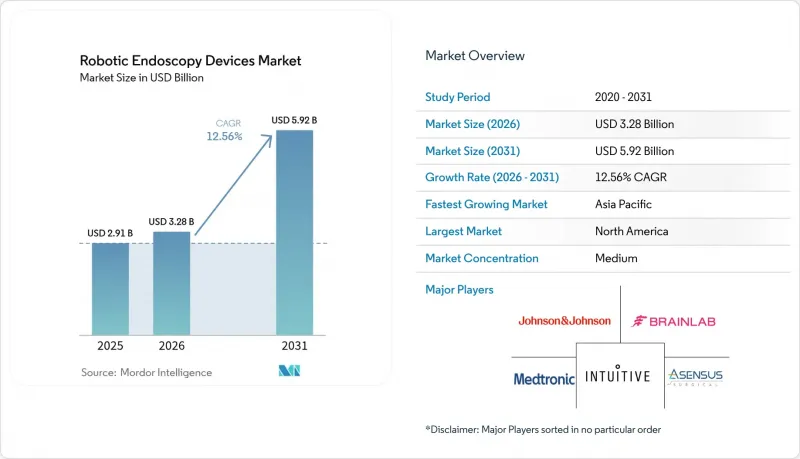
Mordor Intelligence에 의하면, 2026년 로봇 내시경 기기 시장 규모는 32억 8,000만 달러로 추정되고, 2025년 29억 1,000만 달러에서 확대해, 2031년에는 59억 2,000만 달러에 이를 것으로 예측됩니다.
2026-2031년 연평균 성장률(CAGR) 12.56%로 성장할 것으로 전망됩니다.
본 보고서는 제품별(진단용 로봇 내시경(캡슐 로봇 및 영상용 로봇), 치료용 로봇 내시경), 용도별(복강경 검사, 기관지경 검사, 기타), 최종 사용자별(병원, 외래수술센터(ASC), 전문 클리닉), 지역별(북미, 유럽, 아시아태평양, 기타)로 분류되어 있습니다. 시장 예측은 금액(달러) 기준으로 제시되어 있습니다.
세계의 로봇 내시경 기기 시장 동향 및 인사이트
저침습 로봇 수술의 급속한 보급
임상 증거에 따르면, 로봇 보조 수술은 기존 기술에 비해 합병증 발생률을 50% 감소시키고 회복 기간을 40% 단축하는 것으로 나타났습니다. 병원에서는 가치 기반 의료의 요건을 충족하기 위해 이러한 치료 성과를 점점 더 중요시하고 있으며, 그 결과 플랫폼 도입이 확대되고 시행 가능한 시술의 범위도 넓어지고 있습니다. 인튜이티브 서지컬(Intuitive Surgical)은 2025년 1분기에 시술 건수가 17% 증가했다고 보고했으며, 이는 전 세계적인 성장세를 뒷받침하는 것입니다. 또한, 첨단 3D 시각화 기능, 손떨림 보정 기능, 인체공학에 기반한 콘솔 덕분에 외과의사의 피로가 줄어들어 외래 환경에서 더 오랜 시간 동안 더 복잡한 증례를 처리할 수 있게 되었습니다. 이러한 이점들이 결합되어 적응증에 해당하는 환자층이 확대되고, 로봇 내시경 기기 시장의 경제적 매력이 더욱 높아지고 있습니다.
AI를 활용한 내비게이션과 영상 기술이 진단 정확도를 향상
딥러닝 모델을 통해 로봇 기관지경 검사의 진단 정확도는 85% 이상으로 향상되어, 기존 기관지경의 기준치인 67.8%를 크게 상회하고 있습니다. 존슨앤드존슨의 ‘MONARCH QUEST’ 플랫폼은 AI 기반 채널 계획 기능과 260% 향상된 연산 능력을 통합하여 병변 표적 식별 능력을 실시간으로 향상시키고 있습니다. 올림푸스의 ‘CADDIE’와 같은 클라우드 기반 시스템은 대장암 검진에서도 유사한 이점을 제공하며, AI를 통해 추가 수술 시간 없이 선종의 검출률을 높이고 있습니다. 정확도 향상으로 재검사 횟수가 줄어들고 치료 방침 결정이 신속해짐에 따라, 플랫폼 소유자에게는 명확한 경쟁 우위가 제공됩니다.
로봇 플랫폼의 높은 도입 비용과 건당 비용
시스템의 정가는 150만 달러에서 250만 달러이며, 여기에 연간 서비스료가 10만 달러를 초과하기 때문에 소규모 의료 기관에게는 큰 장벽이 되고 있습니다. 비교 연구에 따르면, 로봇을 이용한 서혜부 탈장 복구술의 비용은 2,810유로(3,242.01달러)인 반면, 복강경을 이용한 대체 수술법은 726유로(837.62달러)이며, 보험 환급이 지연되고 있는 상황에서는 투자 회수 문제가 부각되고 있습니다. CMR Surgical과 같은 신규 진출기업들은 기존 시스템보다 저렴한 모듈식 아키텍처를 통해 이러한 격차 해소를 목표로 하고 있지만, 저소득 지역의 광범위한 예산 제약이 여전히 도입을 억제하고 있습니다.
부문 분석
2025년, 치료용 로봇 내시경은 로봇 내시경 기기 시장의 54.83%를 차지한 것으로 평가되었으며, 이는 단일 시술로 진단과 치료를 결합한 시스템에 대한 의료 제공업체의 높은 수요를 뒷받침합니다. 주요 제품은 내시경 점막하층 박리술(ESL) 및 자연 개구부를 통한 관강 내시경 수술(NOTES)과 같은 복잡한 시술을 가능하게 하여, 환자와 지불자 모두에게 매력적인 흉터 없는 치료 결과를 실현하고 있습니다. 존슨앤드존슨의 ‘MONARCH’ 플랫폼은 이러한 프리미엄 위치를 구현하고 있는 반면, EndoQuest는 소화기 계통 시술용으로 유연한 싱글 포트 방식을 추구하고 있습니다. 치료용 기기가 시장을 독점하고 있지만, 진단용 디바이스에는 더 큰 성장 여지가 있습니다. AI를 활용한 영상 처리 기술로 암 조기 발견이 촉진되면서, 진단용 기기의 판매 대수는 연평균 성장률(CAGR) 14.79%로 증가하고 있습니다. 캡슐 내시경 시스템과 하이브리드 이미징 로봇의 활용 범위가 넓어지고 있으며, 향후 하나의 콘솔로 전체 치료 과정을 관리하는 통합화가 진행될 것으로 예측됩니다. 치료용 로봇 내시경 기기 시장 규모는 꾸준히 확대될 것으로 예상되지만, 예방 의료가 정책상의 우선순위가 됨에 따라 진단 부문의 혁신이 그 성장 속도를 앞지를 전망입니다.
진단 플랫폼은 여전히 시장 점유율이 작지만, 투자자들은 검사 시간을 단축하는 무선 캡슐 로봇이나 클라우드 기반 분석 기술에 자금을 쏟아붓고 있습니다. 삼킬 수 있는 펌프 제트식 카메라와 같은 초기 단계 프로젝트는 특히 본격적인 검사실이 부족한 지방 지역에서 소화기 계통 검진의 적용 범위를 확대되고 있습니다. 이러한 기기들이 규제 당국의 승인을 획득함에 따라, 진단 솔루션 분야의 로봇 내시경 기기 시장 점유율은 상승하고, 치료용 기기와 매출 격차는 줄어들 것으로 예측됩니다.
지역별 분석
북미는 메디케어(Medicare)의 결제 기준이 명확해졌고 숙련된 외과의사 인력이 풍부하다는 점에 힘입어 2025년 매출의 38.35%를 차지했습니다. 미국의 주요 의료 기관에서는 승인 후 몇 달 이내에 차세대 콘솔이 일상적으로 도입되고 있어 견조한 업그레이드 주기가 유지되고 있습니다. 캐나다도 비슷한 추세를 보이고 있지만, 멕시코의 민간 병원에서는 첨단 기기 도입 자금을 조달하기 위해 의료 관광객 유치에 주력하고 있습니다.
유럽은 큰 시장 점유율을 차지하고 있지만, 규제상의 역풍과 일회용 플라스틱에 대한 환경 정책상의 면밀한 검토에 직면해 있습니다. 독일, 프랑스, 영국이 도입 대수에서 선두를 달리고 있지만, 의료기기 규정에 따른 수년에 걸친 적합성 평가로 인해 신규 진출기업 시장 진입이 지연되고 있습니다. 북유럽 의료 시스템에서는 로봇을 이용한 탈장 교정술의 장점이 검토되고 있으나, 비용 대비 효과에 대한 의문이 남아 있어 급속한 확대를 억제하고 있습니다.
아시아태평양은 13.2%라는 지역별 최고 수준의 연평균 성장률(CAGR)을 보이고 있습니다. 중국은 유럽 및 미국의 동종 기업에 비해 30-40% 할인된 가격으로 콘솔을 제공하는 국내 대기업을 통해 성장세를 주도하고 있으며, 3차 의료기관 전반에 걸친 도입을 촉진하고 있습니다. 일본은 독자적인 플랫폼과 5G 대응 원격 수술 실증 실험을 선도하고 있는 반면, 한국은 국가 암 검진 프로토콜에서 로봇 기술의 활용을 중시하고 있습니다. 아세안(ASEAN)의 신흥 경제국과 인도의 민간 병원 체인은 로봇 기술을 인바운드 의료 관광의 차별화 요인으로 간주하며 적극적인 투자를 진행하고 있습니다. 그 결과, 아시아태평양의 로봇 내시경 기기 시장 규모는 예측 기간 말기에 유럽을 추월할 것으로 전망됩니다.
중동 및 아프리카에서는 로봇 기술을 플래그십 병원 건설 계획에 포함시키는 걸프협력회의(GCC) 프로젝트를 선두로, 아직 초기 단계이긴 하지만 유망한 도입이 진행되고 있습니다. 남아프리카공화국은 사하라 이남 아프리카의 도입을 주도하고 있습니다. 라틴아메리카에서는 브라질과 칠레에서 꾸준한 도입이 진행되고 있으나, 환율 변동이 더 광범위한 보급을 제약하고 있습니다. 이 지역 전체에서 벤더 파이낸싱 및 시술 기반 리스 모델은 추가 수요를 창출하는 데 매우 중요합니다.
기타 혜택
- 엑셀 형식 시장 예측(ME) 시트
- 3개월간의 애널리스트 지원
자주 묻는 질문
목차
제1장 서론
제2장 조사 방법
제3장 주요 요약
제4장 시장 구도
제5장 시장 규모 및 성장 예측
제6장 경쟁 구도
제7장 시장 기회 및 향후 전망
AJYAccording to Mordor Intelligence, robotic endoscopy devices market size in 2026 is estimated at USD 3.28 billion, growing from 2025 value of USD 2.91 billion with 2031 projections showing USD 5.92 billion, growing at 12.56% CAGR over 2026-2031.
This report is Segmented by Product (Diagnostic Robotic Endoscopes [Capsule Robots and Imaging Robots], Therapeutic Robotic Endoscopes), Application (Laparoscopy, Bronchoscopy, and More), End User (Hospitals, Ambulatory Surgical Centers, and Specialty Clinics) and Geography (North America, Europe, Asia-Pacific, and More). The Market Forecasts are Provided in Terms of Value (USD).
Global Robotic Endoscopy Devices Market Trends and Insights
Rapid Adoption Of Minimally-Invasive Robotic Procedures
Clinical evidence shows robotic-assisted surgeries cut complication rates by 50% and trim recovery times by 40% compared with traditional techniques. Hospitals increasingly prioritize these outcomes to meet value-based care mandates, leading to wider platform installs and broader procedural menus. Intuitive Surgical reported 17% procedure growth in Q1 2025, underscoring global momentum. Enhanced 3-D vision, tremor filtration, and ergonomic consoles also mitigate surgeon fatigue, allowing longer and more complex cases in outpatient settings. Collectively, these gains expand the eligible patient pool and reinforce the economic attractiveness of the robotic endoscopy devices market.
AI-Augmented Navigation & Imaging Boosts Diagnostic Yield
Deep-learning models now lift diagnostic yield in robotic bronchoscopy to over 85%, well above the 67.8% baseline of conventional scopes. Johnson & Johnson's MONARCH QUEST platform integrates 260% more compute power with AI-driven path-planning, improving lesion targeting in real time. Cloud-based systems such as Olympus CADDIE extend similar benefits to colorectal screening, where AI raises adenoma detection without extra procedure time. Higher accuracy reduces repeat procedures and accelerates therapeutic decision-making, giving platform owners a clear competitive edge.
High Capital & Per-Procedure Cost of Robotic Platforms
System list prices between USD 1.5 million and USD 2.5 million, plus annual service fees above USD 100,000, impose steep hurdles for smaller centers. Comparative studies show robotic inguinal hernia repair costs EUR 2,810 (USD 3,242.01) versus EUR 726 (USD 837.62) for laparoscopic alternatives, underscoring payback challenges where reimbursement lags. New entrants like CMR Surgical target this gap with modular architecture priced below legacy systems, yet widespread budget constraints in lower-income regions continue to suppress uptake.
Other drivers and restraints analyzed in the detailed report include:
- Favorable Reimbursement for Robotic GI & Pulmonary Interventions
- Demand for Single-Use Robotic Endoscopes to Curb Infections
- Stringent Regulatory Approvals for Patient Safety
For complete list of drivers and restraints, kindly check the Table Of Contents.
Segment Analysis
Therapeutic robotic endoscopes accounted for 54.83% of the robotic endoscopy devices market in 2025, underscoring provider demand for systems that combine diagnosis and intervention in a single sitting. Leading products execute complex maneuvers such as endoscopic submucosal dissection and natural-orifice transluminal surgery, enabling scar-free outcomes that appeal to both patients and payers. Johnson & Johnson's MONARCH platform illustrates this premium positioning, while EndoQuest pursues flexible, single-port concepts for GI procedures. Although therapeutic dominance prevails, diagnostic devices show greater headroom; AI-enhanced visualization lifts early cancer detection, pushing diagnostic unit sales at a 14.79% CAGR. Capsule systems and hybrid imaging robots widen access, hinting at future convergence where one console manages full care pathways. The robotic endoscopy devices market size for therapeutic systems is projected to broaden steadily, but diagnostic innovation is set to outpace as preventive medicine becomes policy priority.
Diagnostic platforms remain a smaller slice, yet investors funnel capital into wireless capsule robots and cloud-enabled analytics that shorten procedure times. Early-stage projects such as swallowable pump-jet cameras expand the reach of gastrointestinal screening, particularly in rural regions where full theaters are scarce. As these devices secure regulatory clearance, the robotic endoscopy devices market share for diagnostic solutions is expected to climb, narrowing the revenue gap versus therapeutic peers.
Complete Report Scope:
- By Product
- Diagnostic Robotic Endoscopes
- Capsule Robots
- Imaging/Visualization Robots
- Therapeutic Robotic Endoscopes
- Surgical Endoscopy Platforms
- Robotic Bronchoscopes
- NOTES & Transluminal Robots
- Diagnostic Robotic Endoscopes
- By Application
- Laparoscopy
- Bronchoscopy
- Colonoscopy
- Other Applications
- By End User
- Hospitals
- Ambulatory Surgical Centers
- Specialty Clinics
- Geography
- North America
- United States
- Canada
- Mexico
- Europe
- Germany
- United Kingdom
- France
- Italy
- Spain
- Rest of Europe
- Asia-Pacific
- China
- Japan
- India
- South Korea
- Australia
- Rest of Asia-Pacific
- Middle East and Africa
- GCC
- South Africa
- Rest of Middle East and Africa
- South America
- Brazil
- Argentina
- Rest of South America
- North America
Geography Analysis
North America generated 38.35% of 2025 revenue, supported by Medicare payment clarity and a mature surgeon talent pool. Flagship centers in the United States routinely adopt next-generation consoles within months of clearance, sustaining robust upgrade cycles. Canada follows similar patterns, while Mexico's private hospitals court medical tourists to finance advanced installations.
Europe holds significant share but confronts regulatory headwinds and green-policy scrutiny of single-use plastics. Germany, France, and the United Kingdom dominate installed bases, yet multi-year conformity assessments under the Medical Device Regulation delay market entry for new entrants. Nordic health systems investigate robotic hernia repair benefits, but cost-effectiveness questions remain open, tempering rapid scale-up.
Asia-Pacific exhibits the fastest regional CAGR at 13.2%. China anchors momentum through domestic champions offering consoles at discounts of 30%-40% relative to Western peers, spurring adoption across tertiary hospitals. Japan pioneers unique platforms and 5G-enabled telesurgery demonstrations, while South Korea emphasizes robotics in national cancer-screening protocols. Emerging ASEAN economies and India's private chains invest aggressively, seeing robotics as a differentiator for inbound medical tourism. Consequently, the robotic endoscopy devices market size for Asia-Pacific is forecast to overtake Europe near the end of the outlook window.
Middle East & Africa record nascent but promising uptake, led by Gulf Cooperation Council projects that bundle robotics into flagship hospital build-outs. South Africa spearheads sub-Saharan adoption. Latin America witnesses steady installations in Brazil and Chile, though currency volatility constrains wider diffusion. Across these regions, vendor financing and procedure-based leasing models are critical in unlocking incremental demand.
- Intuitive Surgical
- Johnson & Johnson (Auris Health)
- Medtronic
- Olympus
- Asensus Surgical
- CMR Surgical
- Medrobotics
- Brain Lab
- Avatera Medical
- AKTORmed
- Virtuoso Surgical
- Noah Medical
- EndoQuest Robotics
- Microbot Medical
- Titan Medical
- Fujifilm Holdings Corp.
- SHINVA Medical
- Apollo Endosurgery
- Stryker
- Karl Storz SE
Additional Benefits:
- The market estimate (ME) sheet in Excel format
- 3 months of analyst support
TABLE OF CONTENTS
1 Introduction
- 1.1 Study Assumptions & Market Definition
- 1.2 Scope of the Study
2 Research Methodology
3 Executive Summary
4 Market Landscape
- 4.1 Market Overview
- 4.2 Market Drivers
- 4.2.1 Rapid Adoption Of Minimally-Invasive Robotic Procedures
- 4.2.2 Rising Geriatric, Obese & Diabetic Population
- 4.2.3 Favorable Reimbursement For Robotic GI & Pulmonary Interventions
- 4.2.4 AI-Augmented Navigation & Imaging Boosts Diagnostic Yield
- 4.2.5 Surge In Dedicated Outpatient Robotic Bronchoscopy Suites
- 4.2.6 Demand For Single-Use Robotic Endoscopes To Curb Infections
- 4.3 Market Restraints
- 4.3.1 High Capital & Per-Procedure Cost Of Robotic Platforms
- 4.3.2 Stringent Regulatory Approvals For Patient-Safety
- 4.3.3 Shortage Of Surgeons Trained On Robotic Endoscopy
- 4.3.4 Sustainability Push Against Disposable Robotic Scopes
- 4.4 Technological Outlook
- 4.5 Porter's Five Forces
- 4.5.1 Threat of New Entrants
- 4.5.2 Bargaining Power of Buyers
- 4.5.3 Bargaining Power of Suppliers
- 4.5.4 Threat of Substitutes
- 4.5.5 Competitive Rivalry
5 Market Size & Growth Forecasts (Value, USD)
- 5.1 By Product
- 5.1.1 Diagnostic Robotic Endoscopes
- 5.1.1.1 Capsule Robots
- 5.1.1.2 Imaging/Visualization Robots
- 5.1.2 Therapeutic Robotic Endoscopes
- 5.1.2.1 Surgical Endoscopy Platforms
- 5.1.2.2 Robotic Bronchoscopes
- 5.1.2.3 NOTES & Transluminal Robots
- 5.1.1 Diagnostic Robotic Endoscopes
- 5.2 By Application
- 5.2.1 Laparoscopy
- 5.2.2 Bronchoscopy
- 5.2.3 Colonoscopy
- 5.2.4 Other Applications
- 5.3 By End User
- 5.3.1 Hospitals
- 5.3.2 Ambulatory Surgical Centers
- 5.3.3 Specialty Clinics
- 5.4 Geography
- 5.4.1 North America
- 5.4.1.1 United States
- 5.4.1.2 Canada
- 5.4.1.3 Mexico
- 5.4.2 Europe
- 5.4.2.1 Germany
- 5.4.2.2 United Kingdom
- 5.4.2.3 France
- 5.4.2.4 Italy
- 5.4.2.5 Spain
- 5.4.2.6 Rest of Europe
- 5.4.3 Asia-Pacific
- 5.4.3.1 China
- 5.4.3.2 Japan
- 5.4.3.3 India
- 5.4.3.4 South Korea
- 5.4.3.5 Australia
- 5.4.3.6 Rest of Asia-Pacific
- 5.4.4 Middle East and Africa
- 5.4.4.1 GCC
- 5.4.4.2 South Africa
- 5.4.4.3 Rest of Middle East and Africa
- 5.4.5 South America
- 5.4.5.1 Brazil
- 5.4.5.2 Argentina
- 5.4.5.3 Rest of South America
- 5.4.1 North America
6 Competitive Landscape
- 6.1 Market Concentration
- 6.2 Market Share Analysis
- 6.3 Company Profiles (includes Global level Overview, Market level overview, Core Business Segments, Financials, Headcount, Key Information, Market Rank, Market Share, Products and Services, and analysis of Recent Developments)
- 6.3.1 Intuitive Surgical Inc.
- 6.3.2 Johnson & Johnson (Auris Health)
- 6.3.3 Medtronic PLC
- 6.3.4 Olympus Corporation
- 6.3.5 Asensus Surgical Inc.
- 6.3.6 CMR Surgical Ltd
- 6.3.7 Medrobotics Corporation
- 6.3.8 Brainlab AG
- 6.3.9 Avatera Medical GmbH
- 6.3.10 AKTORmed GmbH
- 6.3.11 Virtuoso Surgical
- 6.3.12 Noah Medical
- 6.3.13 EndoQuest Robotics
- 6.3.14 Microbot Medical
- 6.3.15 Titan Medical
- 6.3.16 Fujifilm Holdings Corp.
- 6.3.17 SHINVA Medical
- 6.3.18 Apollo Endosurgery
- 6.3.19 Stryker Corp.
- 6.3.20 Karl Storz SE
7 Market Opportunities & Future Outlook
- 7.1 White-space & Unmet-Need Assessment