|
시장보고서
상품코드
2123703
줄기세포 제조 시장 : 점유율 분석, 업계 동향과 통계, 성장 예측(2026-2031년)Stem Cell Manufacturing - Market Share Analysis, Industry Trends & Statistics, Growth Forecasts (2026 - 2031) |
||||||
 Mordor Intelligence
Mordor Intelligence에 의하면, 줄기세포 제조 시장 규모는 2025년에 170억 3,000만 달러로 평가되었고 2026년 192억 달러에서 2031년까지 349억 8,000만 달러에 이를 것으로 예측되며, 예측 기간(2026-2031년) CAGR은 12.74%를 나타낼 전망입니다.
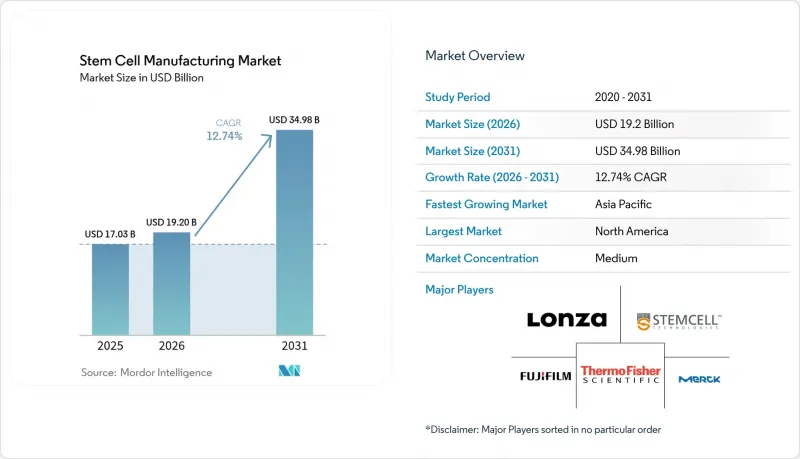
본 보고서는 제품 유형(배양 배지, 소모품, 장비, 줄기세포주, 서비스), 용도(줄기세포 치료, 신약 개발 및 독성학, 줄기세포 뱅크 등), 최종 사용자(제약·바이오기술 기업, 세포·조직은행 등), 지역(북미, 유럽 등)별로 분류되어 있습니다. 시장 전망은 금액(달러) 기준으로 제시되어 있습니다.
세계 줄기세포 제조 시장 동향 및 인사이트
자동화된 밀폐형 바이오리액터가 제조 패러다임을 혁신
자동화된 밀폐형 바이오리액터의 산업 도입으로 인해, 줄기세포 제조 시장 전체의 생산 경제성이 재정의되고 있습니다. 론자(Lonza)사의 ‘Cocoon’ 플랫폼은 GMP 준수를 유지하면서 인적 개입을 최대 70%까지 줄여, 숙련된 운영 인력의 전 세계적 부족 문제를 직접적으로 완화하고 있습니다. 바이오프로세스 엔지니어 채용 건수는 2019년부터 2023년 사이 400% 증가했으나, 여전히 인력 확보가 어려운 상황으로, 자동화의 시급성을 여실히 보여주고 있습니다. 일회용 어셈블리는 교차 오염을 줄이고 시설의 점유 면적을 축소하므로, 의료 현장에 가까운 곳에서 제조를 수행하는 분산형 생산 모델을 가능하게 합니다. 시드니 공과대학교의 3D 프린팅 기반 마이크로플루이딕스 수확기는 여러 공정을 하나의 장치에 통합함으로써 배치당 비용을 절감하고 세포 생존율을 향상시키고 있습니다. 이러한 혁신들이 결합되어 생산 능력의 장기적인 향상을 뒷받침하며, 시장의 연평균 성장률(CAGR) 12.96%라는 전망을 뒷받침하고 있습니다.
민관 협력에 의한 자금 조달 확대가 상용화를 가속화
정부 주도의 노력과 업계 협력 확대를 통해 첨단 시설 및 인재 양성 프로그램에 대한 자금 투자가 지속되고 있습니다. 국립 바이오의약품 제조 혁신 연구소(NIIMBL)는 규모 확대에 따른 과제를 완화하는 공동 프로젝트를 지원하는 한편, 신입 기술자에게 현장 실습 기회를 제공합니다. 대부분의 경우 학술 기관 내에 설치된 바이오파운드리 모델은 반복 주기를 단축하고, 중소기업이 막대한 설비 투자를 하지 않고도 최첨단 인프라를 이용할 수 있도록 합니다. 이러한 자금 흐름은 기술의 성숙도를 높이고 새로운 치료법의 상용화를 촉진함으로써, 줄기세포 제조 시장 전체의 장기적인 수요 기반을 공고히 하고 있습니다.
높은 GMP 운영 비용이 시장 진입을 저해
GMP 준수 시설을 건설 및 운영하려면 1,000만-5,000만 달러의 초기 투자가 필요하며, 운영비는 연간 수익의 15-25%를 차지하기 때문에 중소기업이나 신흥국에게는 큰 과제가 되고 있습니다. 기존 대형 기업들은 규모의 경제와 다양한 제품 포트폴리오를 활용하여 이러한 비용을 상쇄하고 있으며, 경쟁 격차를 확대되고 있습니다. Bio-Techne사의 동물 유래 성분 미사용 시약으로의 전환은 공급업체가 비용 절감과 균형을 맞추면서, 규정 준수를 중심으로 한 공정 개선에 지속적으로 투자해야 함을 보여줍니다. 세포 치료를 전문으로 하는 수탁 제조 기관(CMO)은 접근성 확산을 추진하고 있지만, 수요에 비해 생산 능력은 여전히 제한적입니다.
부문 분석
2025년, 소모품은 줄기세포 제조 시장 점유율의 46.58%를 차지하고 있으며, 이는 모든 생산 공정에서 배지, 시약, 일회용 어셈블리가 필수적임을 여실히 보여줍니다. 지속적인 수요로 인해 안정적인 현금 흐름이 확보되므로, 공급업체는 오염 위험을 줄이고 임박한 소 태아 혈청 부족 문제에 대처하기 위해 무혈청 및 화학적으로 정의된 제제에 투자할 수 있게 됩니다. 장비 부문은 현재 절대 매출 규모는 작지만, 시설에 밀폐형 바이오리액터, 자동 세포 선별 장치, AI 탑재 모니터링 프로브가 도입됨에 따라 2031년까지 연평균 성장률(CAGR) 13.59%를 나타낼 것으로 예측됩니다. 줄기세포 제조 업계에서는 장비 공급업체와 치료법 개발 기업 간의 전략적 제휴가 급증하고 있으며, 이를 통해 실시간 공정 최적화가 가능해져 배치 실패가 감소하고 있습니다.
신흥 플랫폼 기술은 장비 부문이 가져오는 혁신적인 특성을 여실히 보여주고 있습니다. Ori Biotech사의 IRO 시스템은 인건비를 70% 절감하고 비용을 50% 줄여, 스마트 하드웨어가 생산 비용의 기준을 어떻게 혁신할 수 있는지를 명확히 보여주고 있습니다. 바이오리액터에 머신러닝 모델을 통합함으로써 공급 속도나 산소 공급량을 동적으로 조정할 수 있게 되어 재현성이 향상되고 있습니다. 이에 반해 소모품 공급업체들은 센서와 사전 멸균된 백을 세트로 구성한 엔드투엔드 키트를 제공함으로써 검증을 간소화하고 있습니다. 이러한 동향들이 결합되어, 줄기세포 제조 시장 전반에 걸쳐 수익원의 다각화와 회복력 강화가 도모되고 있습니다.
지역별 분석
북미는 2025년에도 40.88%의 매출 점유율을 유지했습니다. 이는 세계 최대 규모의 세포 치료 개발 기업군, 풍부한 벤처 캐피털, 그리고 RMAT 및 신속 승인 등 FDA의 승인 경로를 통해 상용화까지의 리드타임이 단축되고 있기 때문입니다. 또한, 이 지역에는 CMO가 가장 집중되어 있어 소규모 후원사에게 유연한 생산 능력을 제공합니다. 그러나 바이오프로세스 엔지니어의 심각한 부족(구인 수가 적격 후보자의 3배에 달함)으로 인해, 인재 확보를 위한 노력이 더욱 진전되지 않는 한 설비 확장 계획에 제약이 따를 가능성이 있습니다. 커뮤니티 칼리지, NIIMBL, 산업계 간의 협력을 통해 기술자 양성은 가속화되고 있지만, mRNA 및 바이러스 벡터 관련 시설과의 경쟁으로 인해 채용 압박은 더욱 가중되고 있습니다.
아시아태평양은 가장 빠르게 성장하는 지역이며, 일본의 조건부 승인 제도와 중국의 막대한 성(省) 차원의 보조금 덕분에 현지 공장의 급속한 규모 확대가 촉진되어 연평균 성장률(CAGR) 14.06%를 나타낼 것으로 예측됩니다. 한국이 3개의 줄기세포 치료제를 포함한 16개의 세포 유래 제품을 승인한 것은 규제 측면의 성숙도를 입증하는 것이며, 이를 통해 한국은 제조 노하우 수출국으로서의 위상을 확립하고 있습니다. 또한, 중국과 인도의 비용 경쟁력이 있는 인력과 토지는 다국적 기업들을 위성 시설 설립으로 유인하여 공급망의 다각화를 촉진하고 있습니다. 그러나 아세안(ASEAN) 회원국 간 승인 절차에 차이가 있어 시장 출시까지의 과정에서 마찰이 발생하고 있으며, 다국적 후원 기업들은 이를 신중하게 회피해야 합니다.
유럽은 규모는 크지만, 규제가 더 엄격한 시장 환경을 형성하고 있습니다. 유럽의약품청(EMA)의 ATMP(첨단 치료 의약품) 프레임워크는 엄격한 품질 기준을 규정하고 있어, 이로 인해 개발 기간은 장기화되지만 제품의 안전성에 대한 전 세계적 신뢰는 높아집니다. 세포 유래 제품에 관한 유럽 약전(European Pharmacopoeia) 장의 시행으로 더 명확한 분석 기준이 제공되어, 검증 과정의 불확실성이 일부 해소되었습니다. ‘호라이즌 유럽(Horizon Europe)’ 및 각국 정부의 프로그램으로부터의 자금 지원으로 인프라 구축이 지속적으로 지원되고 있는 한편, 동물 유래 성분에 대한 일반 대중의 회의적인 시각이 화학적으로 정의된 배지의 채택을 가속화하고 있습니다. 중동 및 아프리카나 남미와 같은 소규모 지역에서는 새로운 지역 주도형 노력이 나타나고 있습니다-브라질과 남아프리카의 센터에서는 현재 줄기세포 이식 프로그램의 시범 사업이 진행 중입니다-하지만 자본과 기술 인프라가 제한적이기 때문에 단기적인 사업 확대 전망은 소극적입니다.
기타 혜택:
- 엑셀 형식 시장 예측(ME) 시트
- 3개월간의 애널리스트 지원
자주 묻는 질문
목차
제1장 서론
제2장 조사 방법
제3장 주요 요약
제4장 시장 구도
제5장 시장 규모와 성장 예측
제6장 경쟁 구도
제7장 시장 기회와 향후 전망
JHS 26.09.07According to Mordor Intelligence, the stem cell manufacturing market size was valued at USD 17.03 billion in 2025 and estimated to grow from USD 19.2 billion in 2026 to reach USD 34.98 billion by 2031, at a CAGR of 12.74% during the forecast period (2026-2031).
This report is Segmented by Product Type (Culture Media, Consumables, Instruments, Stem Cell Lines, and Services), Application (Stem Cell Therapy, Drug Discovery and Toxicology, Stem Cell Banking and More), End User (Pharmaceutical and Biotechnology Companies, Cell and Tissue Banks, and More), and Geography (North America, Europe, and More). The Market Forecasts are Provided in Terms of Value (USD).
Global Stem Cell Manufacturing Market Trends and Insights
Automated, Closed-System Bioreactors Transform Manufacturing Paradigms
Industrial deployment of automated, closed-system bioreactors is redefining production economics across the stem cell manufacturing market. Lonza's Cocoon platform cuts human intervention by up to 70% while maintaining GMP compliance, directly alleviating the global shortage of skilled operators. Job postings for bioprocess engineers climbed 400% between 2019 and 2023, yet remain difficult to fill, underscoring the urgency of automation. Single-use assemblies reduce cross-contamination and lower facility footprints, enabling distributed production models that place manufacturing closer to point-of-care delivery. The University of Technology Sydney's 3D-printed microfluidic harvester integrates multiple steps into one device, shrinking cost per batch and improving cell viability. Collectively, these innovations anchor a long-term uplift in capacity that underpins the market's 12.96% CAGR outlook.
Growing Public-Private Funding Accelerates Commercial Translation
Escalating government initiatives and industry alliances continue to channel capital into advanced facilities and workforce programs. The National Institute for Innovation in Manufacturing Biopharmaceuticals (NIIMBL) sponsors collaborative projects that de-risk scale-up challenges while offering experiential training to new technicians. Biofoundry models, often housed within academic settings, are shortening iteration cycles and enabling small firms to access state-of-the-art infrastructure without heavy capital outlay. These funding streams improve technology readiness levels and bring novel therapies closer to commercial launch, solidifying the long-term demand base across the stem cell manufacturing market.
High GMP Operational Costs Constrain Market Entry
Building and running GMP-compliant facilities requires USD 10-50 million in upfront investments, with operating expenses consuming 15-25% of annual revenue, challenging small firms and emerging nations. Larger incumbents leverage economies of scale and diversified product portfolios to absorb these costs, widening competitive gaps. Bio-Techne's transition to animal-free reagents illustrates how vendors must continuously invest in compliance-driven process upgrades while balancing cost containment. Contract manufacturing organizations (CMOs) specializing in cell therapies are beginning to democratize access, yet capacity remains limited relative to demand.
Other drivers and restraints analyzed in the detailed report include:
- Rising Chronic-Disease Burden Creates Sustained Demand Pull
- Public Awareness Drives Market Acceptance and Investment
- Complex Regulatory Frameworks Slow Global Market Development
For complete list of drivers and restraints, kindly check the Table Of Contents.
Segment Analysis
In 2025, consumables accounted for 46.58% of the stem cell manufacturing market share, underscoring the indispensability of media, reagents, and single-use assemblies to every production run. Recurrent demand ensures stable cashflows, allowing suppliers to invest in serum-free and chemically defined formulations that mitigate contamination risk and combat the looming fetal bovine serum shortage. Instruments, although smaller in absolute revenue today, are projected to register a 13.59% CAGR through 2031 as facilities install closed-system bioreactors, automated cell sorters, and AI-enabled monitoring probes. The stem cell manufacturing industry is witnessing a surge in strategic alliances between equipment vendors and therapy developers, enabling real-time process optimization and reducing batch failures.
Emerging platform technologies exemplify the transformational nature of the instrument segment. Ori Biotech's IRO system delivers 70% labor reduction and 50% cost savings, highlighting how smart hardware can reset production cost baselines. Integration of machine learning models into bioreactors allows dynamic adjustment of feed rates and oxygenation, elevating reproducibility. Consumable suppliers are responding by bundling sensors and pre-sterilized bags, creating end-to-end kits that simplify validation. Collectively, these trends diversify revenue pools and enhance resilience across the stem cell manufacturing market.
Complete Report Scope:
- By Product Type
- Culture Media
- Consumables
- Instruments
- Stem Cell Lines
- Services
- By Application
- Stem Cell Therapy
- Drug Discovery and Toxicology
- Stem Cell Banking
- Tissue Engineering and Regenerative Medicine
- By End User
- Pharmaceutical and Biotechnology Companies
- Academic and Research Institutes
- Cell and Tissue Banks
- Other End Users
- By Geography
- North America
- United States
- Canada
- Mexico
- Europe
- Germany
- United Kingdom
- France
- Italy
- Spain
- Rest of Europe
- Asia Pacific
- China
- Japan
- India
- Australia
- South Korea
- Rest of Asia Pacific
- Middle East and Africa
- GCC
- South Africa
- Rest of Middle East and Africa
- South America
- Brazil
- Argentina
- Rest of South America
- North America
Geography Analysis
North America retained 40.88% revenue share in 2025, driven by the world's largest cluster of cell therapy developers, abundant venture capital, and FDA pathways such as RMAT and accelerated approval that shorten commercialization lead times. The region also houses the highest concentration of CMOs, offering flexible capacity to smaller sponsors. Yet the acute shortfall of bioprocess engineers-vacancies outpace qualified candidates three-to-one-could restrain build-out plans unless workforce initiatives gain further traction. Partnerships among community colleges, NIIMBL, and industry accelerate technician training, but competition from mRNA and viral-vector facilities intensifies hiring pressures.
Asia Pacific is the fastest-growing territory, projected to log a 14.06% CAGR as Japan's conditional approval scheme and China's sizeable provincial subsidies encourage rapid scaling of local plants. South Korea's authorization of 16 cell-based products, including three stem cell therapies, underscores regulatory maturity and positions the peninsula as an exporter of manufacturing know-how. Furthermore, cost-competitive labor and land in China and India lure multinational firms to establish satellite facilities, diversifying supply chains. However, disparate approval procedures among ASEAN members still create time-to-market frictions that multinational sponsors must navigate carefully.
Europe commands a significant but more regulated market environment. The European Medicines Agency's ATMP framework sets stringent quality benchmarks, which extend development timelines yet elevate global confidence in product safety. Implementation of the European Pharmacopoeia chapter on cell-based products offers clearer analytical standards, easing some validation uncertainties. Funding from Horizon Europe and national programs continues to support infrastructure upgrades, while public skepticism toward animal-derived components accelerates adoption of chemically defined media. Smaller regions such as the Middle East and Africa and South America observe emergent local initiatives-Brazilian and South African centers now pilot stem cell transplant programs-yet limited capital and skills infrastructures temper near-term scale-up prospects.
- Thermo Fisher Scientific
- Merck
- Sartorius
- Lonza Group
- FUJIFILM Cellular Dynamics
- Stem Cell Technologies
- Beckton Dickinson
- Corning
- Miltenyi Biotec
- Takeda Pharmaceutical Co.
- Daiichi-Sankyo Co.
- Abbvie
- Pluri (Pluristem Therapeutics)
- Cytiva
- Bio-Rad Laboratories
- CellGenix
- BICO ( CELLINK )
Additional Benefits:
- The market estimate (ME) sheet in Excel format
- 3 months of analyst support
TABLE OF CONTENTS
1 Introduction
- 1.1 Study Assumptions & Market Definition
- 1.2 Scope of the Study
2 Research Methodology
3 Executive Summary
4 Market Landscape
- 4.1 Market Overview
- 4.2 Market Drivers
- 4.2.1 Automated, closed-system bioreactors & single-use tech
- 4.2.2 Growing public-private funding for stem-cell R&D
- 4.2.3 Rising chronic-disease burden fueling regenerative demand
- 4.2.4 Growing public awareness about the therapeutic potency of stem cell products
- 4.2.5 Favorable regulatory and policy support
- 4.2.6 Strategic collaborations and market expansion
- 4.3 Market Restraints
- 4.3.1 High GMP operational costs
- 4.3.2 Complex regulatory and ethical hurdles
- 4.3.3 Shortage of cell-manufacturing bioprocess engineers
- 4.3.4 Supply-chain bottlenecks for GMP growth factors and vectors
- 4.4 Regulatory Landscape
- 4.5 Technological Outlook
- 4.6 Porter's Five Forces Analysis
- 4.6.1 Threat of New Entrants
- 4.6.2 Bargaining Power of Buyers
- 4.6.3 Bargaining Power of Suppliers
- 4.6.4 Threat of Substitutes
- 4.6.5 Intensity of Rivalry
5 Market Size & Growth Forecasts (Value)
- 5.1 By Product Type
- 5.1.1 Culture Media
- 5.1.2 Consumables
- 5.1.3 Instruments
- 5.1.4 Stem Cell Lines
- 5.1.5 Services
- 5.2 By Application
- 5.2.1 Stem Cell Therapy
- 5.2.2 Drug Discovery and Toxicology
- 5.2.3 Stem Cell Banking
- 5.2.4 Tissue Engineering and Regenerative Medicine
- 5.3 By End User
- 5.3.1 Pharmaceutical and Biotechnology Companies
- 5.3.2 Academic and Research Institutes
- 5.3.3 Cell and Tissue Banks
- 5.3.4 Other End Users
- 5.4 By Geography
- 5.4.1 North America
- 5.4.1.1 United States
- 5.4.1.2 Canada
- 5.4.1.3 Mexico
- 5.4.2 Europe
- 5.4.2.1 Germany
- 5.4.2.2 United Kingdom
- 5.4.2.3 France
- 5.4.2.4 Italy
- 5.4.2.5 Spain
- 5.4.2.6 Rest of Europe
- 5.4.3 Asia Pacific
- 5.4.3.1 China
- 5.4.3.2 Japan
- 5.4.3.3 India
- 5.4.3.4 Australia
- 5.4.3.5 South Korea
- 5.4.3.6 Rest of Asia Pacific
- 5.4.4 Middle East and Africa
- 5.4.4.1 GCC
- 5.4.4.2 South Africa
- 5.4.4.3 Rest of Middle East and Africa
- 5.4.5 South America
- 5.4.5.1 Brazil
- 5.4.5.2 Argentina
- 5.4.5.3 Rest of South America
- 5.4.1 North America
6 Competitive Landscape
- 6.1 Market Concentration
- 6.2 Market Share Analysis
- 6.3 Company Profiles (includes Global level Overview, Market level overview, Core Segments, Financials as available, Strategic Information, Market Rank/Share for key companies, Products & Services, and Recent Developments)
- 6.3.1 Thermo Fisher Scientific Inc.
- 6.3.2 Merck KGaA
- 6.3.3 Sartorius AG
- 6.3.4 Lonza Group AG
- 6.3.5 FUJIFILM Cellular Dynamics
- 6.3.6 STEMCELL Technologies
- 6.3.7 Becton, Dickinson and Company
- 6.3.8 Corning Incorporated
- 6.3.9 Miltenyi Biotec
- 6.3.10 Takeda Pharmaceutical Co.
- 6.3.11 Daiichi-Sankyo Co.
- 6.3.12 AbbVie Inc.
- 6.3.13 Pluri (Pluristem Therapeutics)
- 6.3.14 Cytiva (Danaher)
- 6.3.15 Bio-Rad Laboratories
- 6.3.16 CellGenix GmbH
- 6.3.17 BICO ( CELLINK )
7 Market Opportunities & Future Outlook
- 7.1 White-space & Unmet-Need Assessment