

|
시장보고서
상품코드
2123704
혈장 분획 시장 : 시장 점유율 분석, 업계 동향 및 통계, 성장 예측(2026-2031년)Plasma Fractionation - Market Share Analysis, Industry Trends & Statistics, Growth Forecasts (2026 - 2031) |
||||||
 Mordor Intelligence
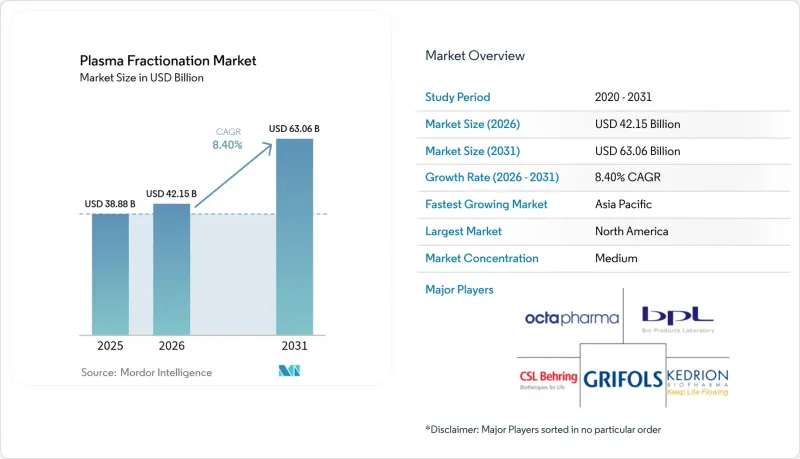
Mordor Intelligence에 의하면, 2026년 혈장 분획 시장 규모는 421억 5,000만 달러로 추정되고, 2025년 388억 8,000만 달러에서 확대해, 2031년에는 630억 6,000만 달러에 이를 것으로 예측됩니다.
2026-2031년 연평균 성장률(CAGR) 8.4%로 성장할 것으로 전망됩니다.
본 보고서에서는 산업을 제품별(면역글로불린, 혈소판 및 응고인자 농축물, 알부민, 기타 제품), 용도별(신경학, 기타), 최종 사용자별(병원 및 클리닉, 기타), 부문별(민간 분획 업체 및 공공 분획 업체), 지역별(북미, 유럽, 아시아태평양, 중동 및 아프리카, 남미)로 분류하고 있습니다.
세계의 혈장 분획 시장 동향 및 인사이트
민간 헌혈자용 혈장 수집 센터의 확대
세계 각국의 사업자들은 공급을 확보하기 위해 거점 확장을 지속적으로 가속화하고 있으며, 혈장 분획 시장을 재편하고 있습니다. CSL Plasma는 휴스턴에 ‘RIKA 혈장 기증 시스템’을 도입하여 1회 기증에 소요되는 시간을 15분 단축하는 동시에 기증자 처리 능력을 향상시켰습니다. 캐나다 혈액 서비스(Canadian Blood Services)는 국내 채혈량을 늘리기 위해 2025년 초에 선더베이를 포함한 새로운 센터를 개설할 예정입니다. 신흥 경제국들도 이에 발맞추고 있습니다. 인도네시아 카라왕에 건설될 인도네시아 최초의 분획 공장은 연간 60만 리터를 처리하여, 폐기되던 혈장을 의약품으로 전환할 예정입니다. 전 세계 면역글로불린(IG) 수요가 연평균 8-9% 증가하는 가운데, 이러한 움직임들이 맞물려 원료 공급 병목 현상이 완화되고 있습니다. 또한, 대규모의 첨단 기술을 활용한 센터의 설립을 통해 기업들은 조달처를 다각화하고, 지역별 기증자 부족 문제를 완화할 수 있게 되어 혈장 분획 시장 전체공급 탄력성이 강화되고 있습니다.
피하 면역글로불린(SCIG)의 도입 확대
재택 치료를 선호하는 환자 경향과 정맥 주사 비용 절감을 요구하는 압력으로 인해 SCIG의 보급이 급속히 진행되고 있습니다. 치료 경험이 없는 원발성 면역결핍증 환자를 위해 FDA가 승인한 최초의 20% SCIG인 ‘XEMBIFY’는 98% 이상의 IgG 순도와 우수한 내약성을 갖추고 있습니다. ‘HYQVIA’는 10%의 Ig와 재조합 히알루로니다제를 결합하여 93.3%의 생체 이용률을 실현함과 동시에 주사 부위의 수를 줄일 수 있습니다. 이러한 고농도 제제는 스마트 주입 펌프와 결합되어 자가 투여를 용이하게 하고, 병원의 수용 능력을 확보해 줍니다. SCIG는 진료 시간과 부대 비용을 절감하기 때문에 보험사로부터도 호의적으로 받아들여지고 있으며, 더 광범위한 보험 적용을 뒷받침하고 있습니다. 그 결과, 전문 약국과 수액 센터는 유통 네트워크를 확대하고 있으며, 혈장 분획 시장에서 분산형 치료로의 구조적 전환을 촉진하고 있습니다.
기증자 보상 상한선에 따른 공급 제약
유럽의 기증자 보상 관련 윤리적 상한선은 공급 안정성을 위협하고 있으며, 2025년까지 400만-800만 리터 공급 부족이 발생한 것으로 평가되었습니다. 이미 유럽 수요의 40%를 수입으로 충당하고 있어, 외부 충격에 대한 취약성이 부각되고 있습니다. 제안된 ‘인간 유래 물질’ 규제는 기증자 보호와 재료 확보 간의 균형을 도모하고 있지만, 단기적으로는 채혈량 부족이 지속되고 있습니다. 자발적인 헌혈을 기반으로 하는 호주에서는 국내 채혈량이 연간 수요의 8% 증가분을 따라잡지 못해, 2022-23 회계연도에 3억 9,920만 달러 상당의 면역글로불린을 수입했습니다. 이러한 제약으로 인해 혈장 분획 제조업체들은 조달처 다각화, 1리터당 수율 최적화, 채혈 기술에 대한 투자를 불가피하게 하고 있지만, 그럼에도 불구하고 혈장 분획 시장의 성장 전망은 소극적인 임베디드니다.
부문 분석
2025년, 면역글로불린은 혈장 분획 시장 점유율의 62.74%를 차지했으며, 이는 면역학 및 신경학 분야의 광범위한 치료 용도를 반영한 것입니다. 'Yimmugo'와 같은 고농도 제제의 출시로 인해 이 부문의 매출은 증가할 것으로 예상되며, 그리폴스(Grifols)사는 7년 내에 미국 내 매출이 10억 달러에 달할 것으로 전망하고 있습니다. 혈장 분획 시장은 만성 염증성 탈수초성 다발 신경염 등의 적응증 확대에 힘입어, 면역글로불린에 대한 안정적인 두 자릿수 수요의 혜택을 받고 있습니다. 동시에, 제조 공정의 개선-특히 Asahi Kasei 코퍼레이션 메디컬의 ‘Planova FG1’ 필터-을 통해 처리 능력이 향상되고 바이러스 돌파 위험이 감소하여 생산량 증가를 뒷받침하고 있습니다.
응고 인자는 매출의 기반으로는 작지만, 연평균 성장률(CAGR) 8.97%로 확대될 것으로 예측되며, 이는 각 제품 라인 중에서 가장 높은 성장률입니다. 예방 투여 프로토콜의 확대로 환자 1인당 소비량은 증가 추세에 있으며, 새로운 투여 플랫폼으로 인해 복약 순응도도 향상되고 있습니다. 재조합 제제 및 비인자 요법의 등장으로 가격 측면의 압박이 커지고 있습니다. 알부민은 중환자 치료에서의 역할, 특히 패혈증성 쇼크 시 조기 투여를 권장하는 프로토콜 업데이트가 진행 중인 아시아태평양에서 여전히 큰 시장 점유율을 유지하고 있습니다. 프로테아제 억제제(특히 α-1 항트립신)는 중증 결핍증에 대한 표준화된 치료 경로가 임상 현장에 도입됨에 따라 호흡기 내과 부문에서 성장세를 보이고 있습니다. 이를 종합해 보면, 제품의 다양화와 기술의 진보가 앞으로도 혈장 분획 시장의 경쟁적 위치를 결정짓게 될 것입니다.
신경학 부문의 용도는 2025년 매출의 41.66%를 차지했으며, 그 주된 원인은 CIDP 및 다발성 운동 신경 장애에서 정맥 내 및 피하 투여용 면역글로불린의 사용에 있습니다. HYQVIA의 93.3%에 달하는 생체 이용률은 투여 부위의 감소와 점적 빈도의 감소를 실현하여 치료법의 진화를 상징하고 있습니다. 질환에 대한 인지도가 높아짐에 따라 진단률도 상승하고 있으며, 이로 인해 혈장 분획 시장에서 신경학 부문의 우위가 더욱 공고해지고 있습니다. 유지 요법을 통해 기능 개선이 지속되고 재발 빈도가 감소함을 보여주는 실제 임상 데이터도 이러한 성장을 뒷받침하고 있습니다.
호흡기 내과는 가장 빠르게 성장하는 부문으로, 2031년까지 연평균 성장률(CAGR) 10.12%를 기록할 전망입니다. 이러한 급속한 성장을 주도하고 있는 것은 α-1 항트립신 보충 요법이며, 유럽의 합의 지침에 따라 환자 선정 및 투여량이 합리화되고 있습니다. 결핍증 환자에서 동맥경화와 심혈관 위험 간의 연관성을 보여주는 연구는 보다 광범위한 전신적 효과를 뒷받침하며, 새로운 보험 급여 채널을 개발할 가능성이 있습니다. 면역학은 계속해서 핵심 적응증 군으로 남아 있는 반면, 혈액학은 재조합 제제와의 경쟁에 직면해 있습니다. 외상 및 외과 수술 현장에서의 중환자 치료에 알부민이 도입되면서 부서 간 활용이 촉진되고 적응증의 다양성이 확대되고 있습니다. 이러한 동향들이 결합되어 혈장 분획 시장은 변화하는 임상적 우선순위에 계속해서 적절히 대응할 수 있을 것으로 보장됩니다.
지역별 분석
북미는 계속해서 혈장 분획 시장의 중심지이며, 2025년에는 매출의 53.05%를 차지한 것으로 평가되었습니다. 미국만으로도 전 세계 원혈장의 70%를 차지하고 있으며, 약 1,200곳에 달하는 촘촘한 센터 네트워크를 유지하는 기증자 보상 제도가 이를 뒷받침하고 있습니다. '국회 혈장 위원회(Congressional Plasma Caucus)'는 면역글로불린에 대한 끊임없는 접근에 대한 초당적 지지를 강조하고 있으며, 한편 CSL의 RIKA 시스템과 같은 기술적 업그레이드를 통해 헌혈 시간이 단축되고 처리 능력이 향상되고 있습니다. 고도의 규제 절차를 통해 차세대 필터 및 제제의 신속한 승인이 촉진되어, 해당 지역공급망 탄력성이 강화되고 있습니다.
아시아태평양은 가장 빠르게 성장하는 시장으로, 2031년까지 연평균 성장률(CAGR) 9.18%를 나타낼 것으로 예측됩니다. 인도네시아, 중국, 인도 각국 정부는 수입 의존도를 낮추기 위해 국내 혈장 분획 공장에 대한 투자를 추진하고 있습니다. 인도네시아 카라왕 시설에서는 연간 60만 리터의 혈장을 고부가가치 제품으로 가공할 예정이며, 이는 자급자족으로의 전환을 상징하는 사례입니다. 공급 불균형은 여전히 지속되고 있습니다. 호주는 2022-23년에 3억 9,920만 달러 상당의 면역글로불린을 수입했으며, 수요는 매년 8%씩 증가하고 있습니다. CSL이 우한의 혈장 포트폴리오를 1억 8,500만 달러에 에이세이 제약에 매각한 것과 같은 전략적 거래를 통해, 현지 시장 적응력을 높이기 위한 사업 전개 재검토가 진행되고 있습니다.
유럽에서는 헌혈자에 대한 보상 상한선이라는 구조적인 역풍에 직면해 있으며, 그 결과 혈장의 40%를 미국에 의존하는 상황이 되었습니다. 제안된 SoHO 규제는 윤리 기준을 유지하면서 헌혈자의 유지율을 높이는 것을 목적으로 하고 있지만, 단기적으로는 공급 부족이 여전히 현실적인 문제로 남아 있습니다. 제조 노하우와 확립된 유통 채널이 위험을 완화하고 있지만, 설비 가동률은 원료 공급 상황에 좌우됩니다. 라틴아메리카, 중동 및 아프리카의 3개 지역은 현재 시점에서 합쳐도 미미한 점유율에 그치고 있지만, 헬스케어 부문의 의료비 증가와 보험 적용 범위 확대로 인해 혈장 유래 치료에 대한 접근성이 확대되고 있습니다. 장기적인 성장 여지는 인프라 투자와 민관 파트너십에 있으며, 이를 통해 혈장 분획 시장의 지역별 점유율이 서서히 확대될 것으로 전망됩니다.
기타 혜택
- 엑셀 형식 시장 예측(ME) 시트
- 3개월간의 애널리스트 지원
자주 묻는 질문
목차
제1장 서론
제2장 조사 방법
제3장 주요 요약
제4장 시장 구도
제5장 시장 규모 및 성장 예측
제6장 경쟁 구도
제7장 시장 기회 및 향후 전망
AJY 26.09.11According to Mordor Intelligence, plasma fractionation market size in 2026 is estimated at USD 42.15 billion, growing from 2025 value of USD 38.88 billion with 2031 projections showing USD 63.06 billion, growing at 8.4% CAGR over 2026-2031.
This report Segments the Industry Into by Product (Immunoglobulins, Platelets and Coagulation Factor Concentrates, Albumin, Other Products), by Application (Neurology, and More), by End-User (Hospitals and Clinics, and More), by Sector (Private Fractionators and Public Fractionators), and Geography (North America, Europe, Asia-Pacific, Middle East and Africa, South America).
Global Plasma Fractionation Market Trends and Insights
Expansion of Private Donor Plasma Collection Centers
Global operators continue to accelerate site roll-outs to secure supply, reshaping the plasma fractionation market. CSL Plasma deployed the RIKA Plasma Donation System in Houston, trimming session times by 15 minutes and improving donor throughput. Canadian Blood Services is opening new centers-including Thunder Bay in early 2025-to increase domestic collections. Emerging economies are following suit; Indonesia's first fractionation plant in Karawang will process 600,000 liters a year, converting discarded plasma into medicines. These moves collectively ease the raw-material bottleneck as global IG demand grows 8-9% annually. Larger, technology-enabled centers also allow companies to diversify sourcing and mitigate region-specific donor constraints, reinforcing supply resilience across the plasma fractionation market.
Rising Adoption of Subcutaneous Immunoglobulin (SCIG)
Patient preference for home therapy and pressure to lower infusion costs are driving rapid uptake of SCIG. XEMBIFY, the first FDA-cleared 20% SCIG for treatment-naive primary immunodeficiency patients, offers >=98% IgG purity and favorable tolerability. HYQVIA pairs 10% IG with recombinant hyaluronidase to achieve 93.3% bioavailability while requiring fewer infusion sites. These high-concentration products, alongside smart infusion pumps, facilitate self-administration and free hospital capacity. Payers view SCIG favorably because it reduces chair time and ancillary costs, supporting broader reimbursement. Consequently, specialty pharmacies and infusion centers are scaling distribution networks, reinforcing a structural shift toward decentralized care within the plasma fractionation market.
Supply Constraints Due to Donor Compensation Caps
Europe's ethical ceilings on donor payments threaten supply stability, with forecasts pointing to a 4-8 million-liter shortfall by 2025. Imports already cover 40% of European demand, underscoring vulnerability to external shocks. The proposed Substances of Human Origin regulation seeks a balance between donor protection and material sufficiency, but near-term collection gaps persist. Australia, operating on voluntary donation, imported USD 399.2 million worth of immunoglobulin in 2022-23 as domestic volumes lagged 8% annual demand growth. These limitations compel fractionators to diversify sourcing, optimize yield per liter and invest in collection technology-yet they still temper growth projections for the plasma fractionation market.
Other drivers and restraints analyzed in the detailed report include:
- Increasing Albumin Utilization in Critical Care
- Government Funding for Hemophilia Treatment Programs
- Competition from Long-Acting Recombinant Coagulation Factors
For complete list of drivers and restraints, kindly check the Table Of Contents.
Segment Analysis
Immunoglobulins held 62.74% of the plasma fractionation market share in 2025, reflecting their broad therapeutic footprint in immunology and neurology. Launches of high-concentration formulations like Yimmugo are expected to lift segment revenues, with Grifols projecting USD 1 billion in U.S. sales over seven years. The plasma fractionation market benefits from stable double-digit demand for immunoglobulins, underpinned by expanding indications such as chronic inflammatory demyelinating polyneuropathy. At the same time, manufacturing upgrades-most notably Asahi Kasei Medical's Planova FG1 filter-raise throughput and lower virus breakthrough risk, supporting volume growth.
Coagulation factors, while representing a smaller revenue base, are forecast to expand at a 8.97% CAGR, the fastest among product lines. Extended prophylaxis protocols foster rising per-patient consumption, and new delivery platforms improve adherence. Nevertheless, recombinant alternatives and non-factor therapies introduce pricing pressure. Albumin retains a sizeable share due to its role in critical care, especially across Asia-Pacific where protocol updates recommend early administration in septic shock. Protease inhibitors, centred on alpha-1 antitrypsin, are gaining momentum in pulmonology as standardized pathways for severe deficiency enter clinical practice. Taken together, product diversification and technological advancement continue to define competitive positioning in the plasma fractionation market.
Neurology applications accounted for 41.66% of 2025 revenues, anchored by intravenous and subcutaneous immunoglobulin use in CIDP and multifocal motor neuropathy. HYQVIA's 93.3% bioavailability exemplifies modality evolution, offering fewer sites and lower infusion frequency. As disease awareness improves, diagnosis rates climb, further cementing neurology's primacy in the plasma fractionation market. Growth is reinforced by real-world data demonstrating sustained functional gains and reduced relapse frequency with maintenance dosing.
Pulmonology marks the fastest-growing segment, slated to post a 10.12% CAGR to 2031. Alpha-1 antitrypsin replacement therapy drives this surge, with European consensus guidelines streamlining patient selection and dosing. Research linking arterial stiffness to cardiovascular risk in deficiency patients underscores wider systemic benefits, potentially unlocking new reimbursement pathways. Immunology remains a core indication set, while hematology confronts recombinant competition. Critical-care adoption of albumin in trauma and surgical contexts bolsters cross-department utilization, broadening application diversity. Collectively, these dynamics ensure the plasma fractionation market stays responsive to shifting clinical priorities.
Complete Report Scope:
- By Product
- Immunoglobulins
- Intravenous Immunoglobulin (IVIG)
- Subcutaneous Immunoglobulin (SCIG)
- Other Immunoglobulins
- Coagulation Factors
- Albumin
- Protease Inhibitors (C1-Esterase, Alpha-1 Antitrypsin)
- Other Plasma-Derived Products
- Immunoglobulins
- By Application
- Neurology
- Immunology
- Hematology
- Pulmonology
- Critical Care & Trauma
- Other Applications
- By End-User
- Hospitals & Clinics
- Ambulatory Surgical Centers
- Plasma Collection Centers & Blood Banks
- Other End-Users
- By Sector
- Private Fractionators
- Public Fractionators
- Geography
- North America
- United States
- Canada
- Mexico
- Europe
- Germany
- United Kingdom
- France
- Italy
- Spain
- Rest of Europe
- Asia-Pacific
- China
- Japan
- India
- Australia
- South Korea
- Rest of Asia-Pacific
- Middle East & Africa
- GCC
- South Africa
- Rest of Middle East & Africa
- South America
- Brazil
- Argentina
- Rest of South America
- North America
Geography Analysis
North America remains the epicenter of the plasma fractionation market, holding 53.05% of revenue in 2025. The United States alone accounts for 70% of global source plasma, supported by donor compensation that sustains a dense network of nearly 1,200 centers. The Congressional Plasma Caucus spotlights bipartisan support for uninterrupted immunoglobulin access, while technological upgrades like CSL's RIKA system shorten donation times and improve throughput. Advanced regulatory processes facilitate rapid approval of next-generation filters and formulations, reinforcing the region's supply chain robustness.
Asia-Pacific represents the fastest-growing arena, anticipated to record a 9.18% CAGR to 2031. Governments in Indonesia, China and India are investing in domestic fractionation plants to reduce reliance on imports. Indonesia's Karawang facility will convert 600,000 liters annually into high-value products, exemplifying a shift toward self-sufficiency. Nonetheless, supply imbalances persist: Australia imported USD 399.2 million worth of immunoglobulin in 2022-23, with demand growing 8% each year. Strategic transactions, such as CSL's divestiture of its Wuhan plasma portfolio to Rongsheng Pharmaceutical for USD 185 million, realign footprints for better local market fit.
Europe faces structural headwinds from donor compensation caps, leading to 40% dependence on U.S. plasma. Proposed SoHO regulations aim to boost donor retention while preserving ethical standards, yet near-term scarcity remains a reality. Manufacturing expertise and established distribution channels temper risk, but capacity utilization hinges on raw material flows. Latin America, the Middle East and Africa collectively contribute a modest share today, yet rising healthcare expenditure and wider insurance coverage are opening access to plasma-derived therapies. Long-term upside lies in infrastructure investment and public-private partnerships, gradually enlarging regional slices of the plasma fractionation market.
- CSL Behring
- Grifols
- Takeda Pharmaceuticals
- Octapharma
- Kedrion Biopharma
- Biotest
- Bio Products Laboratory
- Shanghai RAAS Blood Products Co., Ltd.
- Sanquin Blood Supply Foundation
- LFB S.A.
- ADMA Biologics
- Kamada Ltd.
- Baxter
- Intas Biopharmaceuticals Ltd.
- PlasmaGen BioSciences
- Emergent Bio Solutions
- Biolife Plasma Services
Additional Benefits:
- The market estimate (ME) sheet in Excel format
- 3 months of analyst support
TABLE OF CONTENTS
1 Introduction
- 1.1 Study Assumptions & Market Definition
- 1.2 Scope of the Study
2 Research Methodology
3 Executive Summary
4 Market Landscape
- 4.1 Market Overview
- 4.2 Market Drivers
- 4.2.1 Expansion of Private Donor Plasma Collection Centers Globally
- 4.2.2 Rising Adoption of Subcutaneous Immunoglobulin (SCIG) for Home-Based Therapy
- 4.2.3 Increasing Utilization of Albumin in Critical-Care Management in Asia-Pacific
- 4.2.4 Favourable Government Funding for Hemophilia Treatment Programs
- 4.2.5 Accelerated Regulatory Approvals for Hyperimmune Globulins Targeting Emerging Viral Threats
- 4.2.6 Growth of Contract Fractionation Services Among Small Blood Banks in Emerging Economies
- 4.3 Market Restraints
- 4.3.1 Supply Constraints Due to Donor Compensation Caps
- 4.3.2 Competition from Long-Acting Recombinant Coagulation Factors in Hemophilia
- 4.3.3 High Batch Failure Rates with Chromatography-Intensive Fractionation Lines
- 4.3.4 Limited Reimbursement for IVIG in Low-Income Asian Countries
- 4.4 Regulatory Outlook
- 4.5 Porter's Five Forces Analysis
- 4.5.1 Bargaining Power of Suppliers
- 4.5.2 Bargaining Power of Buyers/Consumers
- 4.5.3 Threat of New Entrants
- 4.5.4 Threat of Substitute Products
- 4.5.5 Intensity of Competitive Rivalry
5 Market Size & Growth Forecasts (Value, USD)
- 5.1 By Product
- 5.1.1 Immunoglobulins
- 5.1.1.1 Intravenous Immunoglobulin (IVIG)
- 5.1.1.2 Subcutaneous Immunoglobulin (SCIG)
- 5.1.1.3 Other Immunoglobulins
- 5.1.2 Coagulation Factors
- 5.1.3 Albumin
- 5.1.4 Protease Inhibitors (C1-Esterase, Alpha-1 Antitrypsin)
- 5.1.5 Other Plasma-Derived Products
- 5.1.1 Immunoglobulins
- 5.2 By Application
- 5.2.1 Neurology
- 5.2.2 Immunology
- 5.2.3 Hematology
- 5.2.4 Pulmonology
- 5.2.5 Critical Care & Trauma
- 5.2.6 Other Applications
- 5.3 By End-User
- 5.3.1 Hospitals & Clinics
- 5.3.2 Ambulatory Surgical Centers
- 5.3.3 Plasma Collection Centers & Blood Banks
- 5.3.4 Other End-Users
- 5.4 By Sector
- 5.4.1 Private Fractionators
- 5.4.2 Public Fractionators
- 5.5 Geography
- 5.5.1 North America
- 5.5.1.1 United States
- 5.5.1.2 Canada
- 5.5.1.3 Mexico
- 5.5.2 Europe
- 5.5.2.1 Germany
- 5.5.2.2 United Kingdom
- 5.5.2.3 France
- 5.5.2.4 Italy
- 5.5.2.5 Spain
- 5.5.2.6 Rest of Europe
- 5.5.3 Asia-Pacific
- 5.5.3.1 China
- 5.5.3.2 Japan
- 5.5.3.3 India
- 5.5.3.4 Australia
- 5.5.3.5 South Korea
- 5.5.3.6 Rest of Asia-Pacific
- 5.5.4 Middle East & Africa
- 5.5.4.1 GCC
- 5.5.4.2 South Africa
- 5.5.4.3 Rest of Middle East & Africa
- 5.5.5 South America
- 5.5.5.1 Brazil
- 5.5.5.2 Argentina
- 5.5.5.3 Rest of South America
- 5.5.1 North America
6 Competitive Landscape
- 6.1 Market Concentration
- 6.2 Market Share Analysis
- 6.3 Company Profiles (includes Global level Overview, Market level overview, Core Business Segments, Financials, Headcount, Key Information, Market Rank, Market Share, Products and Services, and analysis of Recent Developments)
- 6.3.1 CSL Behring
- 6.3.2 Grifols S.A.
- 6.3.3 Takeda Pharmaceutical Company Ltd.
- 6.3.4 Octapharma AG
- 6.3.5 Kedrion S.p.A.
- 6.3.6 Biotest AG
- 6.3.7 Bio Products Laboratory Ltd.
- 6.3.8 Shanghai RAAS Blood Products Co., Ltd.
- 6.3.9 Sanquin Blood Supply Foundation
- 6.3.10 LFB S.A.
- 6.3.11 ADMA Biologics Inc.
- 6.3.12 Kamada Ltd.
- 6.3.13 Baxter International Inc.
- 6.3.14 Intas Biopharmaceuticals Ltd.
- 6.3.15 PlasmaGen BioSciences Pvt. Ltd.
- 6.3.16 Emergent BioSolutions Inc.
- 6.3.17 Biolife Plasma Services
7 Market Opportunities & Future Outlook
- 7.1 White-Space & Unmet-Need Assessment


