|
시장보고서
상품코드
2123705
의료용 커넥터 시장 : 점유율 분석, 업계 동향과 통계, 성장 예측(2026-2031년)Medical Connectors - Market Share Analysis, Industry Trends & Statistics, Growth Forecasts (2026 - 2031) |
||||||
 Mordor Intelligence
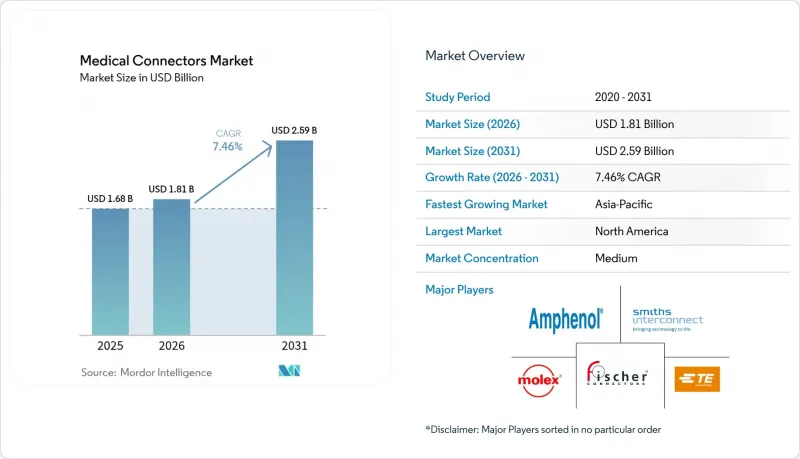
Mordor Intelligence에 의하면, 의료용 커넥터 시장 규모는 2025년 16억 8,000만 달러에서 2026년에는 18억 1,000만 달러로 확대되어 2026년부터 2031년까지 CAGR 7.46%로 성장을 지속하여, 2031년에는 25억 9,000만 달러에 이를 것으로 예측됩니다.
본 보고서는 제품별(플랫 실리콘 외과용 케이블, 임베디드 전자기기용 커넥터 등), 용도별(환자 모니터링 기기, 전기 수술용 장치 등), 최종 사용자별(병원, 외래수술센터(ASC), 기타 최종 사용자), 지역별(북미, 유럽,아시아태평양, 중동 및 아프리카, 남미)로 분류되어 있습니다. 시장 예측은 금액(달러) 기준으로 제시되어 있습니다.
전 세계 의료용 커넥터 시장 동향 및 인사이트
만성 질환 유병률 증가
심혈관 질환 및 당뇨병 유병률 증가로 인해, 견고하고 얇은 전기 인터페이스에 의존하는 실시간 모니터링에 대한 요구 사항이 더욱 엄격해지고 있습니다. 이식형 루프 레코더나 인슐린 주입 펌프의 경우, 장기간 착용 중에도 끊김 없는 원격 측정 통신을 지원하는 내습성 접점 도금에 대한 수요가 점점 더 높아지고 있습니다. 예측 분석을 추진하는 의료 시스템에서는 전자기 간섭을 받지 않고 높은 샘플링 주파수를 유지할 수 있는 커넥터가 필수적입니다. 병원의 업무 부담이 예방적 질환 관리로 전환됨에 따라, 아크 방전을 방지하고 커넥터의 피로를 줄여주는 자기식 퀵 커넥트 솔루션이 주목받고 있습니다. 또한, 지속적인 데이터 수집을 통해 사이버 보안 감시가 강화됨에 따라, 각 OEM 업체들은 물리적 키잉과 암호화 지원 배선 아키텍처를 통합한 차폐형 커넥터 하우징을 사양으로 지정하고 있습니다.
의료기기 도입 대수의 확대
아시아태평양의 병원 확장 및 로봇 기술에 대한 투자로 인해 누적 의료기기 보유 대수가 증가하고 있으며, 이에 따라 예비 부품 물류를 효율화하는 상호 운용 가능한 커넥터 폼 팩터에 대한 수요가 높아지고 있습니다. 캡슐 내시경이나 마이크로펌프 등으로 대표되는 의료기기의 소형화로 인해 기판상의 사용 가능한 공간이 축소되고 있어, 제조업체들은 리플로우 납땜이 가능한 실리콘 오버몰딩이 적용된 서브mm 피치의 헤더를 개발할 수밖에 없게 되었습니다. 구형 주입 펌프를 대상으로 한 개조 프로그램은 개정된 전기적 규격 및 생체 적합성 기준에 따라, 업데이트된 커넥터 블록의 인증을 취득할 수 있는 공급업체에게 개조를 통한 새로운 수익원을 제공합니다. 수술용 로봇을 도입하는 기업들은 도금 박리가 발생하지 않으면서 3,000회의 오토클레이브 처리를 견딜 수 있는 고주사수 커넥터를 요구하고 있습니다. 엔드투엔드 인증 데이터를 제공하는 공급업체는 OEM의 설계 주기를 단축하고 의료용 커넥터 시장에서 우위를 점할 수 있습니다.
엄격한 세계 및 지역별 규제 준수
FDA가 ISO 13485:2016을 준수하는 품질 경영 시스템 규제로의 전환을 추진함에 따라, 제조업체들은 문서 체계와 감사 절차를 근본적으로 재검토해야만 합니다. 유럽의 MDR 제도에서는 고유 의료기기 식별자(UDI)의 기재가 의무화되어 있어, 커넥터의 각 로트에 추적성 관련 비용이 추가되고 있습니다. 라틴아메리카 시장에서는 인증된 생체 적합성 보고서에 대한 수요가 증가하고 있으며, 폴리머 개정 승인 주기가 장기화되고 있습니다. 소규모 공급업체들은 여러 관할 구역에 걸친 동시 신청에 필요한 자금 조달에 어려움을 겪고 있어, 의료용 커넥터 시장의 업계 재편이 가속화되고 있습니다. 사이버 보안 조항의 적용 범위가 환자 식별 정보를 전송하는 커넥터로 확대됨에 따라, 암호화 테스트 절차가 도입되면서 제품 검증 기간이 길어지고 있습니다.
부문 분석
2025년, 플랫 실리콘 재질의 외과용 케이블은 의료용 커넥터 시장 점유율의 38.35%를 유지하며, 전기 수술용 핸드피스 및 복강경용 에너지 플랫폼 분야에서 지속적인 우위를 두드러지게 보여주었습니다. 이 부문은 실리콘의 유연성, 유전 안정성 및 오토클레이브 사이클에 대한 적합성이라는 특징을 활용하고 있으며, 이러한 특성 덕분에 유지보수 주기가 단축되고 전기적 무결성이 유지되고 있습니다. 다층 압출 성형 기술의 발전으로 손상을 즉시 육안으로 감지할 수 있는 투톤 절연체가 통합되어 병원의 위험 관리 프로토콜이 강화되고 있습니다. 자기식 의료용 커넥터는 현재 도입 대수가 적지만, 대전류 전송 시 아크 발생을 최소화하는 비접촉 결합 방식을 통해 연평균 성장률(CAGR) 8.48%를 나타낼 것으로 예측됩니다. 일회용 플라스틱 커넥터는 세척의 번거로움을 줄여주는 점이 감염 관리 요건과 부합하기 때문에 일회용 세척봉에 대한 채택이 확대되고 있습니다. 푸시-풀 방식은 일반 병동에서의 모니터링 용도로 계속해서 채택되고 있으며, 간호진이 신뢰하고 익숙한 촉각적 신호를 제공합니다. 하이브리드 원형 시스템은 로봇의 엔드 이펙터 내에서 전원, 광섬유, 공압 배관을 통합할 수 있게 하여, 수술 자동화 전문가들에게 설계의 자유도를 높여주고 있습니다. 이처럼 다양한 형태가 존재함으로써 의료용 커넥터 시장은 건전한 제품 구성의 역동성을 유지하고 있습니다.
자기식 대체품은 초기 투자 비용보다 마모가 없어 수명이 긴 점을 우선시함으로써 구매 기준을 새롭게 바꾸고 있습니다. 금·코발트 펠릿 등의 신규 합금은 자기 포화 한계를 향상시켜, 유지력을 저해하지 않으면서 소형화를 가능하게 하고 있습니다. 신속한 분리 기능은 낙상 방지 프로그램을 지원하며, 물리치료 기기에서 리드선을 강하게 당겨도 장치의 포트에 부담이 가해지지 않게 되었습니다. 커넥터 쉘에 내장형 EEPROM 칩을 통합한 공급업체는 플러그 앤 플레이를 통한 추적성을 실현하여, 기술자가 예측 유지보수 일정을 수립하는 데 도움을 주고 있습니다. 전기 수술용 케이블 공급업체는 과열을 시각적으로 표시하는 열변색성 재킷 연구를 진행하여 절연 파괴를 미연에 방지하고 있습니다. 다중 접점화로의 흐름은 서브어셈블리의 모듈화를 촉진하고 있으며, 각 OEM 업체들은 오버몰딩 공정을 ISO 14644-1 클린룸 인증을 취득한 커넥터 전문 업체에 외주하고 있습니다. 이러한 노력들이 결합되어 의료용 커넥터 시장에서 제품 혁신의 모멘텀을 유지하고 있습니다.
지역별 분석
북미는 2025년에도 매출의 40.62%를 차지하며 계속해서 1위를 유지했습니다. 이는 자본 설비 주기가 성숙기에 접어들었으며, 고사양 커넥터의 조기 도입을 뒷받침하는 확립된 규정 준수 체계가 반영된 결과입니다. 가치 기반 의료 지표에 따라 병원들은 커넥터 하우징 내에 예측 유지보수용 센서를 통합하도록 권장받고 있으며, 이를 통해 예기치 못한 가동 중단 시간을 줄이고 있습니다. 이 지역은 다른 지역보다 앞서 ISO 80369-7 도입을 추진하고 있어, 이에 따라 교체 수요가 가속화되고 있습니다. 미니애폴리스와 보스턴의 스타트업 생태계는 차세대 신경 자극 기기 개발을 촉진하고 있으며, 이는 해당 지역의 커넥터 설계 활동을 더욱 활성화시키고 있습니다. 국내 반도체 패키징에 대한 정책적 인센티브는 소형화된 전극 어레이를 통합하는 공급업체에 혜택을 주며, 의료용 커넥터 시장에서 기술적 우위를 유지하고 있습니다.
중국과 인도의 공적 의료보험 기관이 만성 질환 관리 기술에 대한 접근성 확대에 주력하고 있는 만큼, 아시아태평양은 2031년까지 연평균 성장률(CAGR) 8.64%를 기록하며 지역별 가장 빠른 성장 궤도를 그릴 것으로 예측됩니다. 현지 OEM 업체들은 주입 펌프의 생산 규모를 확대하고 있으며, 이에 따라 커넥터의 기초 소비량도 증가하고 있습니다. 싱가포르와 한국의 규제 당국은 미국 FDA와의 문서 요건을 조화시켜 세계 공급업체의 중복 업무를 줄이고 제품 출시를 가속화하고 있습니다. 국내 의료용 전자기기 제조에 대한 정부의 보조금으로 인해 수입 의존도가 낮아지면서, 다국적 기업들이 말레이시아와 베트남에 커넥터 조립 공장을 설립하는 움직임이 가속화되고 있습니다. 도시화가 진행됨에 따라 중규모 도시에서의 환자 모니터링 시스템 수요가 높아지고, 수요 규모가 1급 의료 거점 이외의 지역으로 확대되면서 의료용 커넥터 시장의 비즈니스 기회가 다양화되고 있습니다.
유럽에서는 재활용 가능한 커넥터 소재를 우선시하는 엄격한 환경 정책에 힘입어 꾸준한 성장이 이어지고 있습니다. 각국의 국민건강보험 서비스는 노후화된 의료기기의 교체를 추진하고 있으며, RoHS 및 REACH 준수가 의무화되어 있어 무할로겐 절연재가 선호되고 있습니다. 북유럽 국가들의 공동 조달 플랫폼은 단가 마진을 압박하는 한편, 수년에 걸친 공급량 확약을 보장하고 있습니다. 독일의 정밀 공학 기반은 수술용 로봇용 하이브리드 서큘러 커넥터 개발에서 계속해서 선구적인 역할을 하고 있으며, EU 자금 지원 연구가 재료 과학의 발전을 뒷받침하고 있습니다. 동유럽은 비용 경쟁력이 뛰어난 제조 거점으로 부상하고 있으며, 아시아태평양의 운송비 변동을 우려하는 서유럽 공급업체들에게 니어쇼어(인접 지역) 대안지로 자리 잡고 있습니다. 그 결과, 이 지역은 성능 면에서의 리더십과 지속가능성 노력 간의 균형을 유지하며 의료용 커넥터 시장에서 전략적 중요성을 지속하고 있습니다.
기타 혜택:
- 엑셀 형식 시장 예측(ME) 시트
- 3개월간의 애널리스트 지원
자주 묻는 질문
목차
제1장 서론
제2장 조사 방법
제3장 주요 요약
제4장 시장 구도
제5장 시장 규모와 성장 예측
제6장 경쟁 구도
제7장 시장 기회와 향후 전망
JHS 26.09.07According to Mordor Intelligence, the medical connectors market size is expected to grow from USD 1.68 billion in 2025 to USD 1.81 billion in 2026 and is forecast to reach USD 2.59 billion by 2031 at 7.46% CAGR over 2026-2031.
This report is Segmented by Product (Flat Silicone Surgical Cables, Embedded Electronics Connectors, and More), Application (Patient Monitoring Devices, Electrosurgical Devices, and More), End User (Hospitals, Ambulatory Surgical Centers, Other End Users), and Geography (North America, Europe, Asia-Pacific, Middle East and Africa, South America). The Market Forecasts are Provided in Terms of Value (USD).
Global Medical Connectors Market Trends and Insights
Rising Incidence of Chronic Diseases
Elevated cardiovascular and diabetes prevalence has intensified real-time monitoring requirements that depend on robust, low-profile electrical interfaces. Implantable loop recorders and insulin infusion pumps increasingly specify moisture-resistant contact plating that supports uninterrupted telemetry during extended wear periods. Health systems pursuing predictive analytics mandate connectors that sustain high sampling frequencies without electromagnetic interference. As hospital workloads migrate toward proactive disease management, magnetic quick-connect solutions gain traction because they avoid arcing and reduce connector fatigue. Continuous data capture also amplifies cybersecurity scrutiny, prompting OEMs to specify shielded connector housings that integrate physical keying with encryption-ready wiring architectures.
Expansion of the Medical Device Installed Base
Asia-Pacific hospital expansions and robotics investments enlarge the cumulative equipment fleet, driving preference for interoperable connector footprints that streamline spare-parts logistics. Device miniaturization, illustrated by capsule endoscopes and micro-pumps, compresses available board space, compelling manufacturers to develop sub-millimeter pitch headers with solder-reflowable silicone over-molds. Retrofit programs targeting legacy infusion pumps open retrofit revenue streams for vendors able to certify updated connector blocks under revised electrical and biocompatibility norms. Surgical robotics adopters request high-cycle connectors capable of surviving 3,000 autoclave passes without plating delamination. Suppliers that offer end-to-end qualification data shorten OEM design cycles and gain an edge in the medical connectors market.
Stringent Global and Regional Regulatory Compliance
The FDA's transition to the Quality Management System Regulation that aligns with ISO 13485:2016 compels manufacturers to overhaul documentation architectures and audit procedures. Europe's MDR regime imposes unique device identifier obligations, adding traceability costs to every connector batch. Markets in Latin America increasingly demand certified biocompatibility reports, elongating approval cycles for polymer revisions. Smaller suppliers struggle to finance concurrent submissions across multiple jurisdictions, accelerating consolidation within the medical connectors market. Cybersecurity clauses now extend to connectors that transmit patient identifiers, introducing encryption-testing steps that lengthen product validation timelines.
Other drivers and restraints analyzed in the detailed report include:
- Shift Toward Home-Care and Remote Monitoring Solutions
- Miniaturization and High-Density Multi-Contact Designs
- Sterilization-Induced Material Degradation Risk
For complete list of drivers and restraints, kindly check the Table Of Contents.
Segment Analysis
Flat silicone surgical cables retained a 38.35% stake in the medical connectors market share during 2025, underlining their continued primacy in electrosurgical handpieces and laparoscopic energy platforms. The segment benefits from silicone's flexibility, dielectric stability, and compatibility with autoclave cycles, characteristics that shorten maintenance intervals and uphold electrical integrity. Advancements in layered extrusion now integrate two-tone insulation that provides instant visual damage detection, reinforcing hospital risk-management protocols. Magnetic medical connectors, though presently smaller in installed base, are forecast to log an 8.48% CAGR due to their contactless coupling that minimizes arc formation during high-current transfers. Disposable plastic connectors expand reception in single-use irrigation wands, where eliminating cleaning overhead aligns with infection-control mandates. Push-pull formats continue to address general ward monitoring, delivering a familiar tactile cue that nursing staff trust. Hybrid circular systems enable combined power, fiber, and pneumatic routing within robotic end-effectors, enhancing design freedom for surgical automation specialists. This plurality of formats ensures that the medical connectors market retains healthy product-mix dynamism.
Magnetic alternatives are reshaping purchasing criteria by prioritizing zero-wear longevity over upfront capital cost. Novel alloys such as gold-cobalt pellets enhance magnetic saturation limits, allowing downsizing without compromising retention force. Rapid detachment supports fall-prevention programs, as yanking leads from physiotherapy equipment no longer stresses device ports. Vendors integrating on-board EEPROM chips into connector shells create plug-and-play traceability, which helps technicians schedule predictive maintenance. Electrosurgical cable suppliers are exploring thermochromic jackets that visually indicate overheating, pre-empting insulation failure. The drive toward multi-contact density has spurred sub-assembly modularization, with OEMs outsourcing over-molding processes to connector specialists that hold ISO 14644-1 cleanroom certifications. These initiatives collectively sustain momentum for product innovation within the medical connectors market .
Complete Report Scope:
- By Product
- Flat Silicone Surgical Cables
- Embedded Electronics Connectors
- Radio-Frequency Connectors
- Disposable Plastic Connectors
- Hybrid Circular Connector & Receptacle Systems
- Power Cords with Retention Systems
- Lighted Hospital-Grade Cords
- Magnetic Medical Connectors
- Push-Pull Connectors
- By Application
- Patient Monitoring Devices
- Electrosurgical Devices
- Diagnostic Imaging Devices
- Cardiology Devices
- Analysers & Processing Equipment
- Respiratory Devices
- Dental Instruments
- Endoscopy Devices
- Neurology Devices
- Enteral Devices
- Other Applications
- By End User
- Hospitals
- Ambulatory Surgical Centers
- Other End Users
- By Geography
- North America
- United States
- Canada
- Mexico
- Europe
- Germany
- United Kingdom
- France
- Italy
- Spain
- Rest of Europe
- Asia-Pacific
- China
- Japan
- India
- Australia
- South Korea
- Rest of Asia-Pacific
- Middle East and Africa
- GCC
- South Africa
- Rest of Middle East and Africa
- South America
- Brazil
- Argentina
- Rest of South America
- North America
Geography Analysis
North America retained 40.62% revenue leadership in 2025, reflecting mature capital equipment cycles and well-established compliance frameworks that reward early adoption of high-specification connectors. Value-based care metrics push hospitals to embed predictive maintenance sensors within connector housings, thereby reducing unplanned downtime. The region champions ISO 80369-7 implementation ahead of other geographies, accelerating replacement demand. Start-up ecosystems in Minneapolis and Boston foster next-generation neurostimulation devices, further lifting local connector design activity. Policy incentives for domestic semiconductor packaging benefit suppliers integrating miniaturized electrode arrays, maintaining technological headship for the medical connectors market.
Asia-Pacific will post the fastest regional trajectory at an 8.64% CAGR through 2031 as public health insurers in China and India commit to broadening access to chronic disease management technologies. Local OEMs are scaling infusion pump output, thereby enlarging baseline connector consumption. Regulatory agencies in Singapore and South Korea harmonize documentation with the US FDA, lowering duplication for global suppliers and hastening product launches. Government subsidies for indigenous medical electronics manufacturing reduce import dependency, prompting multinationals to establish connector assembly plants in Malaysia and Vietnam. Urbanization intensifies demand for patient monitoring systems in secondary cities, spreading volume beyond Tier 1 healthcare hubs and diversifying opportunity within the medical connectors market.
Europe maintains steady expansion driven by stringent environmental policies that prioritize recyclable connector materials. National health services renew aging device fleets, enforcing RoHS and REACH compliance that favors halogen-free insulation compounds. Collaborative purchasing platforms across the Nordics compress unit margins but guarantee multi-year volume commitments. Germany's precision-engineering base continues to pioneer hybrid circular connectors for surgical robotics, with EU-funded research propelling material science improvements. Eastern Europe emerges as a cost-competitive manufacturing locus, providing a near-shore alternative for Western suppliers concerned about Asia-Pacific freight volatility. Consequently, the region balances performance leadership with sustainability interventions, sustaining its strategic relevance in the medical connectors market.
- TE Connectivity
- Amphenol
- Smiths Group
- Fischer Connectors
- Molex
- ITT Interconnect Solutions
- Souriau (Souriau-Sunbank)
- Omnetics Connector
- KEL
- Qosina Corp
- Shenzhen Xime Connector Technology
- Salter Labs
- Lemo SA
- Samtec Inc.
- Aptiv PLC
- Rosenberger Hochfrequenztechnik
- ODU GmbH
- Neutrik AG
- Phoenix Contact
- Plastics One
Additional Benefits:
- The market estimate (ME) sheet in Excel format
- 3 months of analyst support
TABLE OF CONTENTS
1 Introduction
- 1.1 Study Assumptions & Market Definition
- 1.2 Scope of the Study
2 Research Methodology
3 Executive Summary
4 Market Landscape
- 4.1 Market Overview
- 4.2 Market Drivers
- 4.2.1 Rising incidence of chronic diseases
- 4.2.2 Expansion of the medical device installed-base
- 4.2.3 Shift toward home-care & remote monitoring solutions
- 4.2.4 Miniaturisation & high-density multi-contact designs
- 4.2.5 Hospital-grade magnetic quick-connect adoption
- 4.2.6 Integration of disposable fluid-path connectors in single-use OEM kits
- 4.3 Market Restraints
- 4.3.1 Stringent global & regional regulatory compliance
- 4.3.2 Sterilisation-induced material degradation risk
- 4.3.3 Connector mis-mating & cross-connection hazards
- 4.3.4 Supply-chain shortages of medical-grade resins & copper alloys
- 4.4 Regulatory Landscape
- 4.5 Porters Five Forces Analysis
- 4.5.1 Threat of New Entrants
- 4.5.2 Bargaining Power of Buyers
- 4.5.3 Bargaining Power of Suppliers
- 4.5.4 Threat of Substitutes
- 4.5.5 Intensity of Competitive Rivalry
5 Market Size & Growth Forecasts (Value, USD)
- 5.1 By Product
- 5.1.1 Flat Silicone Surgical Cables
- 5.1.2 Embedded Electronics Connectors
- 5.1.3 Radio-Frequency Connectors
- 5.1.4 Disposable Plastic Connectors
- 5.1.5 Hybrid Circular Connector & Receptacle Systems
- 5.1.6 Power Cords with Retention Systems
- 5.1.7 Lighted Hospital-Grade Cords
- 5.1.8 Magnetic Medical Connectors
- 5.1.9 Push-Pull Connectors
- 5.2 By Application
- 5.2.1 Patient Monitoring Devices
- 5.2.2 Electrosurgical Devices
- 5.2.3 Diagnostic Imaging Devices
- 5.2.4 Cardiology Devices
- 5.2.5 Analysers & Processing Equipment
- 5.2.6 Respiratory Devices
- 5.2.7 Dental Instruments
- 5.2.8 Endoscopy Devices
- 5.2.9 Neurology Devices
- 5.2.10 Enteral Devices
- 5.2.11 Other Applications
- 5.3 By End User
- 5.3.1 Hospitals
- 5.3.2 Ambulatory Surgical Centers
- 5.3.3 Other End Users
- 5.4 By Geography
- 5.4.1 North America
- 5.4.1.1 United States
- 5.4.1.2 Canada
- 5.4.1.3 Mexico
- 5.4.2 Europe
- 5.4.2.1 Germany
- 5.4.2.2 United Kingdom
- 5.4.2.3 France
- 5.4.2.4 Italy
- 5.4.2.5 Spain
- 5.4.2.6 Rest of Europe
- 5.4.3 Asia-Pacific
- 5.4.3.1 China
- 5.4.3.2 Japan
- 5.4.3.3 India
- 5.4.3.4 Australia
- 5.4.3.5 South Korea
- 5.4.3.6 Rest of Asia-Pacific
- 5.4.4 Middle East and Africa
- 5.4.4.1 GCC
- 5.4.4.2 South Africa
- 5.4.4.3 Rest of Middle East and Africa
- 5.4.5 South America
- 5.4.5.1 Brazil
- 5.4.5.2 Argentina
- 5.4.5.3 Rest of South America
- 5.4.1 North America
6 Competitive Landscape
- 6.1 Market Concentration
- 6.2 Market Share Analysis
- 6.3 Company Profiles (includes Global level Overview, Market level overview, Core Segments, Financials as available, Strategic Information, Market Rank/Share for key companies, Products & Services, Recent Developments)
- 6.3.1 TE Connectivity
- 6.3.2 Amphenol Corporation
- 6.3.3 Smiths Interconnect
- 6.3.4 Fischer Connectors SA
- 6.3.5 Molex LLC
- 6.3.6 ITT Interconnect Solutions
- 6.3.7 Souriau (Souriau-Sunbank)
- 6.3.8 Omnetics Connector Corp
- 6.3.9 KEL Corporation
- 6.3.10 Qosina Corp
- 6.3.11 Shenzhen Xime Connector Technology
- 6.3.12 Salter Labs
- 6.3.13 Lemo SA
- 6.3.14 Samtec Inc.
- 6.3.15 Aptiv PLC
- 6.3.16 Rosenberger Hochfrequenztechnik
- 6.3.17 ODU GmbH
- 6.3.18 Neutrik AG
- 6.3.19 Phoenix Contact
- 6.3.20 Plastics One
7 Market Opportunities & Future Outlook
- 7.1 White-Space & Unmet-Need Assessment