|
시장보고서
상품코드
2123707
바이오의약품 수탁 제조 시장 : 시장 점유율 분석, 업계 동향 및 통계, 성장 예측(2026-2031년)Biopharmaceuticals Contract Manufacturing - Market Share Analysis, Industry Trends & Statistics, Growth Forecasts (2026 - 2031) |
||||||
 Mordor Intelligence
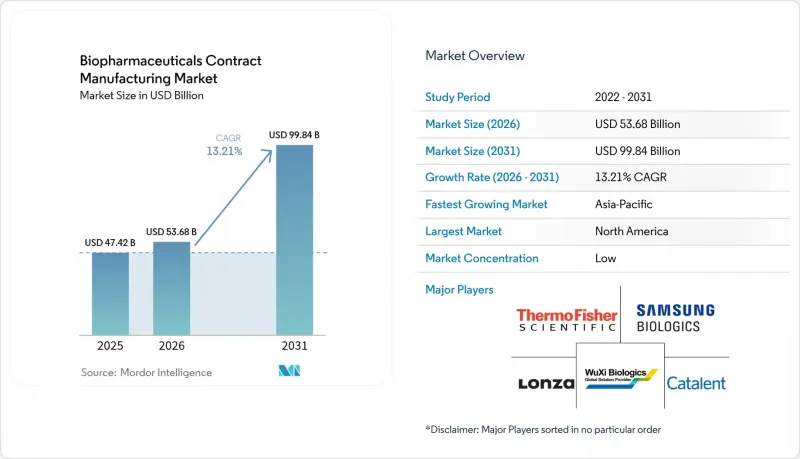
Mordor Intelligence에 의하면, 2026년 바이오의약품 수탁 제조 시장 규모는 536억 8,000만 달러로 추정되고, 2025년 474억 2,000만 달러에서 확대해, 2031년 예측은 998억 4,000만 달러로 예상되며, 2026-2031년 CAGR 13.21%로 성장할 전망입니다.
본 보고서는 제품 유형별(펩타이드/단백질, 항체, 백신, 기타), 서비스 유형별(공정 개발, cGMP 원료의약품 제조, 기타), 개발 단계별(전임상, 1상, 기타), 지역별(북미, 유럽, 아시아태평양, 기타)로 세분화되어 있습니다. 시장 규모 및 전망은 금액(달러) 기준으로 제시되어 있습니다.
세계의 바이오의약품 수탁 제조 시장 동향 및 인사이트
주요 바이오의약품 스폰서의 아웃소싱 급증
기업들이 유연성과 자본 효율성을 추구한 결과, 2024년에는 적어도 하나의 주요 업무를 외부에 위탁하고 있는 개발 기업의 비율이 86.9%로 상승했습니다. 스폰서 기업들은 틈새 전문 지식과 엄격한 규제 관리가 필요한 항체-약물 복합체(ADC)나 자가 세포 치료와 같은 복잡한 치료 방식에 대해 CDMO에 대한 의존도를 높이고 있습니다. 또한, 통합형 제공업체가 단일 품질 시스템 하에서 공정 개발, 분석, 상용 규모 확대를 제공함에 따라 아웃소싱은 임상 개발 기간 단축으로도 이어지고 있습니다. 수년에 걸친 마스터 서비스 계약(MSA)에 연계된 생산 능력 확보가 표준화되면서, 파이프라인 수요가 급증하는 상황에서도 우선적인 접근권을 확보할 수 있게 되었습니다. 이러한 요인들이 결합되어 CDMO와의 파트너십 모델이 기업의 제조 전략에 확고히 자리 잡으면서, 바이오의약품 수탁 제조 시장의 성장 궤도를 더욱 공고히 하고 있습니다.
생물학적 제제/바이오시밀러 파이프라인의 급속한 확대
2025년 현재, 700건 이상의 유전자 치료제와 450건 이상의 바이오시밀러 분자가 전 세계 개발 프로그램을 통해 진행 중입니다. 중소규모의 혁신 기업은 산업 규모의 제조 능력을 보유한 경우가 드물기 때문에 세포 배양 노하우, 세계 규제 대응 실적, 지역별 신청에 대응할 수 있는 기동력을 갖춘 외부 제조업체에 의존하고 있습니다. 미국, 유럽, 아시아태평양 주요 관할 구역의 지침 조화로 인해, 다국적 거점 네트워크를 보유한 CDMO에 대한 수요는 더욱 높아지고 있습니다. 바이오의약품의 복잡성이 증가함에 따라 차별화된 정제, 제형, 전달 기술이 중요한 가치 창출 요인이 되고 있으며, 제품 수명 주기 전반에 걸쳐 CDMO를 통합한 긴밀한 협력 및 기술 이전 체계가 촉진되고 있습니다.
엄격한 cGMP 및 데이터 무결성 준수에 따른 부담
EU GMP 부록 1의 시행으로 무균 제조 요건이 강화되어, 오염 관리 및 품질 모니터링의 대폭적인 개선이 요구되고 있습니다. 2024년 FDA의 경고 서한에서는 거버넌스상의 미비점 및 소프트웨어 검증 미비점이 지적되었으며, 규제 당국이 ALCOA+ 데이터 원칙에 주력하고 있음을 다시금 부각시켰습니다. 소규모 CDMO는 전자 배치 기록 시스템, 추적, 추적 가능성 플랫폼, 첨단 환경 모니터링 시스템을 도입할 때 불균형한 재정적 압박에 직면하고 있습니다. 이러한 규정 준수 부담으로 인해 시설 가동이 지연될 가능성이 있으며, 바이오의약품 수탁 제조 산업 전반에서 장기적인 품질 기준은 향상되는 반면, 단기적인 수익 성장은 둔화될 우려가 있습니다.
부문 분석
항체 부문은 2025년에 37.74%의 시장 점유율을 차지했으며, 종양학 및 자가면역 질환 적응증 분야에서 핵심 치료법으로서의 입지를 공고히 했습니다. 지속적인 임상 활동을 통해 높은 배치 생산량이 유지되는 한편, 공정 집약화를 통해 역가와 경제성이 향상되고 있습니다. 이와 동시에, 바이오시밀러 단일클론 항체는 라틴아메리카, 동유럽, 아시아 일부 지역에서 비용 중심의 의료 시스템으로 인해 추가적인 수요를 창출하고 있습니다.
세포 및 유전자 치료용 벡터는 GMP 준수 벡터 생산 능력 부족, 맞춤형 분석 기술, 엄격한 규제 감독으로 인해 연평균 성장률(CAGR) 17.76%로 확대되고 있으며, 이러한 요인들이 결합되어 전문 CDMO 기업에게 높은 수익 기회를 창출하고 있습니다. 차세대 AAV 혈청형 및 비바이러스성 전달 수단을 포함한 바이러스 벡터의 혁신은 서비스 범위를 확대하고, 바이오의약품 수탁 제조 시장에서 개발 및 제조 역량의 융합을 가속화하고 있습니다.
포유류 발현 플랫폼(주로 CHO 세포)은 2025년에 시장 점유율의 63.02%를 차지했습니다. 이는 세포주 공학, 벡터 설계, 배지 최적화의 발전으로 인해 비생산성이 향상되고, 당사슬 변형 단백질 및 복잡한 mAb 분야에서 이 플랫폼의 우위가 강화되었기 때문입니다.
세균 및 효모 시스템은 단순한 재조합 단백질이나 효소 생산에 있어 여전히 비용 효율성이 뛰어나며, 특히 가격 압박이 큰 신흥국 시장에서 그 강점을 발휘하고 있습니다. 식물 및 곤충 세포 기술은 틈새 용도에서 유망하게 평가되고 있지만, 규제 측면에 대한 이해 부족이 보급을 저해하고 있습니다. 각 공급업체는 고객의 요구를 충족시키면서 시설 이용률을 극대화하기 위해 각 시스템에 걸친 포트폴리오의 균형을 맞추고 있습니다. 일회용 스위트(single-use suite)를 통해 플랫폼 간 유연한 전환이 가능해짐에 따라, 이러한 균형 조정은 점점 더 중요한 요소가 되고 있습니다.
지역별 분석
북미는 2025년에도 바이오의약품 수탁 제조 시장에서 36.25%의 점유율을 차지했으며, 여전히 가장 규모가 큰 지역 기여 요인으로 자리 잡고 있습니다. 이는 풍부한 벤처 자금, 선진적인 규제 환경, 보스턴·캠브리지와 샌프란시스코 베이 지역의 탄탄한 인재 풀에 의해 뒷받침되고 있습니다. 후지필름 디오신스가 32억 달러를 투자한 노스캐롤라이나주 캠퍼스나 우시 바이오로직스의 매사추세츠주 거점과 같은 생산 능력 확대는 서비스 범위를 넓혀, 이 지역을 후기 임상시험 및 상용화 프로젝트의 최전선으로 계속 자리매김하게 하고 있습니다. ‘BIOSECURE 법안’의 통과 가능성은 국내 및 동맹국 공급업체에 우대 조치를 제공함으로써 공급업체 선정 방식을 바꿀 수 있지만, 견조한 수요와 다각화된 파이프라인 덕분에 모든 모달리티에서 긍정적인 전망이 유지되고 있습니다.
아시아태평양은 가장 빠르게 성장하는 지역으로, 2031년까지 연평균 성장률(CAGR) 11.18%로 확대될 전망입니다. 중국의 규제 개혁과 인프라 확충으로 초기 단계 생산을 위한 제조 거점으로서의 위상이 높아지고 있지만, 지정학적 긴장이 이중 조달 관행에 영향을 미치고 있습니다. 한국의 삼성바이오로직스는 2025년까지 누적 78만 4,000L의 생산 능력을 확보하여 전 세계의 주목을 받고 있으며, 이 지역의 부상을 부각시키고 있습니다. 인도는 비용 면에서의 우위와 영어권 인재를 활용하는 한편, 싱가포르는 엄격한 품질 관리와 정부의 우대 조치를 내세워 첨단 치료 프로젝트 수주를 목표로 하고 있습니다.
유럽은 론자, 베링거 인겔하임, 카탈렌트와 같은 기존 기업들을 통해 입지를 유지하고 있으며, 각사는 스위스, 독일, 오스트리아에 수십억 달러 규모의 투자를 통해 현지 생태계를 강화하고 있습니다. 바카빌 인수를 통해 론자의 네트워크에 33만 리터의 생산 능력이 추가되었으며, 브렉시트로 인한 공급망의 복잡성에도 불구하고 지속적인 노력이 두드러지고 있습니다. EMA의 조화로운 심사 절차와 강력한 지적 재산권 보호는 규제 측면에서의 다양화를 추구하는 미국 및 아시아의 고객들을 끌어들이고 있습니다. 성숙한 인프라, 자동화 노력, 친환경 제조에 대한 인센티브가 결합되어, 바이오의약품 수탁 제조 시장을 평가하는 다국적 스폰서의 전략 계획에서 유럽은 확고한 입지를 구축하고 있습니다.
기타 혜택
- 엑셀 형식 시장 예측(ME) 시트
- 3개월간의 애널리스트 지원
자주 묻는 질문
목차
제1장 서론
제2장 조사 방법
제3장 주요 요약
제4장 시장 구도
제5장 시장 규모 및 성장 예측(금액·생산 능력)
제6장 경쟁 구도
제7장 시장 기회 및 향후 전망
AJY 26.09.11According to Mordor Intelligence, biopharmaceuticals contract manufacturing market size in 2026 is estimated at USD 53.68 billion, growing from 2025 value of USD 47.42 billion with 2031 projections showing USD 99.84 billion, growing at 13.21% CAGR over 2026-2031.
This report is Segmented by Product Type (Peptides/Proteins, Antibodies, Vaccines, and More), Service Type (Process Development, CGMP Drug Substance Manufacturing, and More), by Development Phase (Pre-Clinical, Phase I, and More), and Geography (North America, Europe, Asia-Pacific, and More). The Market Sizes and Forecasts are Provided in Terms of Value (USD).
Global Biopharmaceuticals Contract Manufacturing Market Trends and Insights
Outsourcing Surge Among Large Bio-Pharma Sponsors
The proportion of developers outsourcing at least one major activity rose to 86.9% in 2024 as firms sought flexibility and capital efficiency. Sponsors increasingly turn to CDMOs for complex modalities such as antibody-drug conjugates and autologous cell therapies that require niche expertise and rigorous regulatory stewardship. Outsourcing also shortens clinical timelines, with integrated providers offering process development, analytics, and commercial scale-up under a single quality system. Capacity reservations tied to multi-year master service agreements have become the norm, ensuring priority access as pipeline demand surges. Together, these forces embed the CDMO partnership model firmly within corporate manufacturing strategies, reinforcing the growth trajectory of the biopharmaceuticals contract manufacturing market.
Rapid Expansion of Biologics / Biosimilar Pipelines
More than 700 gene-based therapies and 450 biosimilar molecules are advancing through global development programs in 2025. Small and mid-sized innovators rarely possess industrial-scale capability, so they depend on external manufacturers that bring cell-culture know-how, global regulatory track records, and agility to pivot among regional filings. Harmonized guidelines across the United States, Europe, and key Asia Pacific jurisdictions further reward CDMOs with multinational site networks. As biologics complexity rises, differentiated purification, formulation, and delivery technologies become critical value drivers, prompting deep collaboration and technology-transfer frameworks that embed CDMOs across the product life cycle.
Stringent cGMP & Data-Integrity Compliance Burden
Implementation of EU GMP Annex 1 heightens sterile-manufacturing requirements, compelling extensive contamination-control and quality monitoring upgrades. FDA warning letters in 2024 spotlighted governance lapses and software validation gaps, reinforcing regulators' focus on ALCOA+ data principles. Smaller CDMOs face disproportionate financial pressure when deploying electronic batch-record systems, track-and-trace platforms, and advanced environmental monitoring. The compliance load can delay facility utilization, tempering short-term revenue growth even as it lifts long-term quality standards across the biopharmaceuticals contract manufacturing industry.
Other drivers and restraints analyzed in the detailed report include:
- Adoption of Single-Use & Modular Bioprocess Skids
- Capacity Gap for Cell- & Gene-Therapy Vectors
- Global Shortage of Skilled Bioprocess Engineers
For complete list of drivers and restraints, kindly check the Table Of Contents.
Segment Analysis
The antibodies segment generated 37.74% market share in 2025, cementing its role as the anchor modality for oncology and autoimmune indications. Continued clinical activity sustains high batch volumes, while process intensification lifts titers and economics. In parallel, biosimilar monoclonal antibodies stimulate incremental demand from cost-sensitive health systems in Latin America, Eastern Europe, and parts of Asia.
Cell and gene therapy vectors are expanding at an 17.76% CAGR due to the scarcity of GMP vector capacity, bespoke analytics, and stringent regulatory oversight, which combine to create high-margin opportunities for specialized CDMOs. Viral vector innovation, including next-generation AAV serotypes and non-viral delivery alternatives, deepens the service scope and accelerates convergence between development and manufacturing skill sets in the biopharmaceuticals contract manufacturing market.
Mammalian expression platforms, chiefly CHO cells, held 63.02% of market share in 2025 as advances in cell-line engineering, vector design, and media optimization boost specific productivity, reinforcing this platform's dominance for glycosylated proteins and complex mAbs.
Bacterial and yeast systems remain cost-efficient for simple recombinant proteins and enzymes, especially in emerging economies where pricing pressure is acute. Plant and insect cell technologies show promise for niche applications, yet regulatory familiarity limits broader adoption. Providers balance portfolios across systems to meet client needs while maximizing facility utilization, an increasingly important lever as single-use suites enable flexible switching between platforms.
Complete Report Scope:
- By Product Type
- Peptides/Proteins
- Antibodies (mAbs & ADCs)
- Vaccines
- Biosimilars
- Other Biologics
- By Service Type
- Process Development
- cGMP Drug Substance Manufacturing
- Fill-Finish & Lyophilization
- Analytical & QC Services
- Packaging & Logistics
- By Expression System
- Mammalian
- Microbial
- Insect & Plant
- By Development Phase
- Pre-clinical
- Phase I
- Phase II
- Phase III & Commercial
- By Geography
- North America
- United States
- Canada
- Mexico
- Europe
- Germany
- United Kingdom
- France
- Italy
- Spain
- Rest of Europe
- Asia Pacific
- China
- Japan
- India
- South Korea
- Australia
- Rest of Asia Pacific
- Middle East and Africa
- GCC
- South Africa
- Rest of Middle East and Africa
- South America
- Brazil
- Argentina
- Rest of South America
- North America
Geography Analysis
North America remained the largest regional contributor with a 36.25% biopharmaceuticals contract manufacturing market share in 2025, sustained by deep venture funding, advanced regulatory ecosystems, and dense talent pools in Boston-Cambridge and the San Francisco Bay Area. Capacity expansions such as Fujifilm Diosynth's USD 3.2 billion North Carolina campus and WuXi Biologics' Massachusetts site broaden service breadth and keep the region at the forefront of late-stage and commercial projects. Potential enactment of the BIOSECURE Act could reshape vendor selection by favoring domestic and allied suppliers, yet strong demand and diversified pipelines maintain robust outlooks across modalities.
Asia Pacific is the fastest-growing territory, advancing at an 11.18% CAGR to 2031. China's regulatory reforms and infrastructure build-out elevate its status as a manufacturing option for early-stage runs, although geopolitical tensions influence dual-sourcing habits. South Korea's Samsung Biologics commands global attention with a cumulative capacity of 784,000 L by 2025, underscoring the region's ascent. India leverages cost advantages and English-language talent, while Singapore markets its stringent quality oversight and government incentives to capture advanced-therapy projects.
Europe sustains its position through incumbents such as Lonza, Boehringer Ingelheim, and Catalent, each reinforcing local ecosystems with billion-dollar investments in Switzerland, Germany, and Austria. The Vacaville acquisition adds 330,000 L of capacity to Lonza's network, highlighting continued commitment despite Brexit-related supply chain complexity. EMA's harmonized review pathways and robust IP protections entice U.S. and Asian clients seeking regulatory diversification. Collectively, mature infrastructure, automation initiatives, and green-manufacturing incentives place Europe firmly in the strategic plans of multinational sponsors evaluating the biopharmaceuticals contract manufacturing market.
- Samsung Group
- Lonza Group
- Wuxi Biologics
- Thermo Fisher Scientific (Patheon)
- Catalent Pharma Solutions
- Boehringer Ingelheim BioXcellence
- FUJIFILM
- AGC Biologics
- Siegfried Holding
- Recipharm
- ProBioGen
- AbbVie Contract Manufacturing
- Novartis (Lek)
- INCOG BioPharma Services
- Lotte Biologics
- Thermex (Merck Life Science)
- Emergent Bio Solutions
Additional Benefits:
- The market estimate (ME) sheet in Excel format
- 3 months of analyst support
TABLE OF CONTENTS
1 Introduction
- 1.1 Study Assumptions & Market Definition
- 1.2 Scope of the Study
2 Research Methodology
3 Executive Summary
4 Market Landscape
- 4.1 Market Overview
- 4.2 Market Drivers
- 4.2.1 Outsourcing Surge Among Large Bio-Pharma Sponsors
- 4.2.2 Rapid Expansion Of Biologics / Biosimilar Pipelines
- 4.2.3 Adoption Of Single-Use & Modular Bioprocess Skids
- 4.2.4 Capacity Gap For Cell- & Gene-Therapy Vectors
- 4.2.5 China-Plus-One Procurement Shift Benefiting Korean/EU CDMOs
- 4.2.6 AI-Driven Predictive Bioprocess Control Boosting Yield & Margins
- 4.3 Market Restraints
- 4.3.1 Stringent cGMP & data-integrity compliance burden
- 4.3.2 Global shortage of skilled bioprocess engineers
- 4.3.3 Sustainability pressure on single-use plastics
- 4.3.4 Over-building risk creating idle stainless & SU capacity
- 4.4 Value / Supply-Chain Analysis
- 4.5 Regulatory Landscape
- 4.6 Technological Outlook
- 4.7 Porter's Five Forces
- 4.7.1 Threat of New Entrants
- 4.7.2 Bargaining Power of Buyers
- 4.7.3 Bargaining Power of Suppliers
- 4.7.4 Threat of Substitutes
- 4.7.5 Intensity of Rivalry
5 Market Size & Growth Forecasts (Value & Capacity)
- 5.1 By Product Type
- 5.1.1 Peptides/Proteins
- 5.1.2 Antibodies (mAbs & ADCs)
- 5.1.3 Vaccines
- 5.1.4 Biosimilars
- 5.1.5 Other Biologics
- 5.2 By Service Type
- 5.2.1 Process Development
- 5.2.2 cGMP Drug Substance Manufacturing
- 5.2.3 Fill-Finish & Lyophilization
- 5.2.4 Analytical & QC Services
- 5.2.5 Packaging & Logistics
- 5.3 By Expression System
- 5.3.1 Mammalian
- 5.3.2 Microbial
- 5.3.3 Insect & Plant
- 5.4 By Development Phase
- 5.4.1 Pre-clinical
- 5.4.2 Phase I
- 5.4.3 Phase II
- 5.4.4 Phase III & Commercial
- 5.5 By Geography
- 5.5.1 North America
- 5.5.1.1 United States
- 5.5.1.2 Canada
- 5.5.1.3 Mexico
- 5.5.2 Europe
- 5.5.2.1 Germany
- 5.5.2.2 United Kingdom
- 5.5.2.3 France
- 5.5.2.4 Italy
- 5.5.2.5 Spain
- 5.5.2.6 Rest of Europe
- 5.5.3 Asia Pacific
- 5.5.3.1 China
- 5.5.3.2 Japan
- 5.5.3.3 India
- 5.5.3.4 South Korea
- 5.5.3.5 Australia
- 5.5.3.6 Rest of Asia Pacific
- 5.5.4 Middle East and Africa
- 5.5.4.1 GCC
- 5.5.4.2 South Africa
- 5.5.4.3 Rest of Middle East and Africa
- 5.5.5 South America
- 5.5.5.1 Brazil
- 5.5.5.2 Argentina
- 5.5.5.3 Rest of South America
- 5.5.1 North America
6 Competitive Landscape
- 6.1 Market Concentration
- 6.2 Market Share Analysis
- 6.3 Company Profiles (includes Global level Overview, Market level overview, Core Segments, Financials as available, Strategic Information, Market Rank/Share, Products & Services, Recent Developments)
- 6.3.1 Samsung Biologics
- 6.3.2 Lonza Group
- 6.3.3 WuXi Biologics
- 6.3.4 Thermo Fisher Scientific (Patheon)
- 6.3.5 Catalent Pharma Solutions
- 6.3.6 Boehringer Ingelheim BioXcellence
- 6.3.7 Fujifilm Diosynth Biotechnologies
- 6.3.8 AGC Biologics
- 6.3.9 Siegfried Holding
- 6.3.10 Recipharm
- 6.3.11 ProBioGen
- 6.3.12 AbbVie Contract Manufacturing
- 6.3.13 Novartis (Lek)
- 6.3.14 INCOG BioPharma Services
- 6.3.15 Lotte Biologics
- 6.3.16 Thermex (Merck Life Science)
- 6.3.17 Emergent BioSolutions
7 Market Opportunities & Future Outlook
- 7.1 White-space & Unmet-Need Assessment