

|
시장보고서
상품코드
2123712
의료용 전자기기 시장 : 시장 점유율 분석, 업계 동향 및 통계, 성장 예측(2026-2031년)Medical Electronics - Market Share Analysis, Industry Trends & Statistics, Growth Forecasts (2026 - 2031) |
||||||
 Mordor Intelligence
Mordor Intelligence에 의하면, 의료용 전자기기 시장 규모는 2025년에 113억 1,000만 달러로 평가되었고, 2026년에 119억 2,000만 달러로 추정되고, 2031년까지 164억 4,000만 달러에 이를 것으로 예측되며, 2026-2031년 CAGR 6.65%로 성장할 전망입니다.
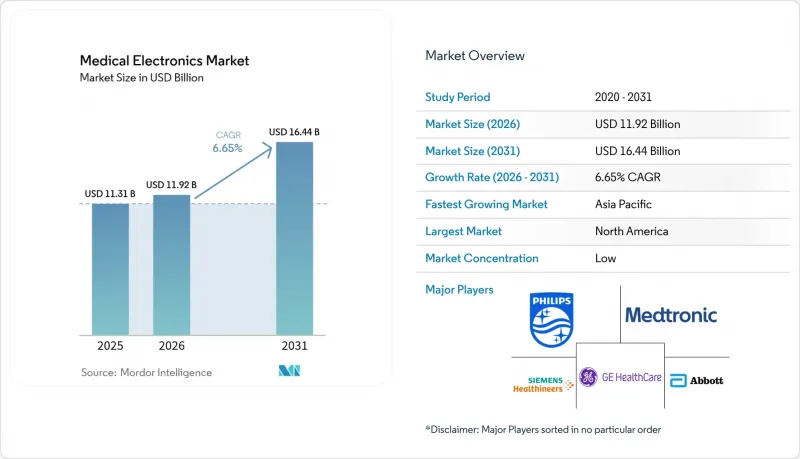
본 보고서는 제품 유형별(진단용 영상 기기, 모니터링 기기, 치료용 기기, 웨어러블 기기), 구성 요소별(센서, 파워 IC, 마이크로컨트롤러, 디스플레이), 최종 사용자별(병원, 재택치료, 당일 수술센터(ASC), 영상 센터), 임상 용도 분야별(순환기과, 신경과, 종양과, 정형외과), 연결 방식별(유선, 블루투스, Wi-Fi, 하이브리드), 지역별(북미, 기타)로 분류되어 있습니다. 시장 전망은 금액(달러)으로 표시되어 있습니다.
세계의 의료용 전자기기 시장 동향 및 인사이트
AI 탑재 영상 진단 기기의 급속한 보급
2024년 중반까지 FDA 승인을 받은 600대 이상의 AI 탑재 기기로 인해, 영상 분석 업무는 거의 실시간 워크플로우로 변화했으며, MRI 스캔 시간을 최대 50% 단축하는 동시에 처리되지 않은 영상 분량도 감소했습니다. 메디케어 어드밴티지(Medicare Advantage)와 유럽의 여러 보험사들이 AI를 활용한 영상 진단에 대해 가산 요금을 적용하여 보상하고 있기 때문에 의료 기관은 투자를 신속하게 회수하고 ROI를 향상시키는 동시에, 정당화 가능한 업그레이드 주기를 확립하고 있습니다.
재택 및 웨어러블 진단으로의 전환
2026년에 시행된 미국 원격 환자 모니터링 코드의 확대로 인해, 의사는 환자가 생성한 데이터를 검토하여 보상을 받을 수 있게 되었으며, 연결형 웨어러블 기기가 보험 적용 대상 자산이 되었습니다. 연속 혈당 모니터 및 커프리스 혈압 측정 장치에는 다중 매개변수 감지 기능과 모바일 연결 기능이 내장되어 있어, 임상의는 환자가 내원할 때까지 기다리지 않고도 치료법을 미세 조정할 수 있게 되었습니다.
2025년 이후 실리콘 공급망의 변동
파워 반도체의 리드타임은 2024년에 52주로 정점을 찍었으며, 많은 디바이스 OEM 업체들은 이익률을 압박하는 고가의 재설계나 현물 시장에서의 구매를 강요당했습니다. ‘CHIPS법’을 통해 자금을 지원받은 새로운 팹은 2027년 이후가 되어야 공급 제약을 완화할 수 있을 것입니다.
부문 분석
이미징 플랫폼은 2025년 매출의 39.68%를 차지했으며, 다년간의 서비스 계약 및 업그레이드 번들을 통해 의료용 전자기기 시장을 뒷받침하고 있습니다. 현재 이미징 장비 OEM 업체들은 재구성 자동화 및 스캔 주석 작성을 위해 장치 내에 AI를 통합하고 있으며, 과거에는 독립형 소프트웨어 공급업체로 흘러가던 가치를 되찾고 있습니다.
웨어러블 기기와 임플란트형 기기는 절대적인 매출 규모는 작지만, 2031년까지 연평균 성장률(CAGR) 10.73%로 확대될 것으로 예측됩니다. 지속적인 혈당 및 혈압 모니터링에 대한 보험 급여 확대와 더불어, 스마트폰 연동 기능 덕분에 평균 판매 가격이 상승하고 있습니다. 이러한 두 자릿수 성장세는 자본 부담이 적은 가정용 기기가 병원의 영상 진단 예산을 보완함에 따라 의료용 전자기기 시장을 꾸준히 끌어올릴 것으로 보입니다.
센서와 MEMS는 2025년 매출의 32.33%를 차지했으며, 연간 9.43%의 속도로 성장할 것으로 예상되는데, 이는 다른 모든 칩 분류를 능가하는 속도입니다. 소형화된 관성 센서와 생화학 센서 덕분에 블루투스나 Wi-Fi를 통해 여러 가지 생체 신호 데이터를 스트리밍하는 일회용 접착 패치가 가능해졌습니다. 전원 관리 IC의 성장은 다른 부문에 비해 뒤처지고 있지만, 배터리 구동형 기기에는 여전히 필수적입니다. 인공 와우 및 심장 임플란트에 고체 배터리가 조기에 도입됨에 따라 교체 주기가 길어질 것으로 예상되며, 이는 의료용 전자기기 시장의 애프터마켓 부품 매출을 견인할 것입니다.
지역별 분석
북미는 CMS(미국 의료보험서비스센터)의 보상 범위 확대와 AI 기반 의료기기에 대한 FDA(미국 식품의약국)의 패스트 트랙 제도의 지원에 힘입어 2025년 매출의 33.46%를 차지했습니다. 견실한 벤처 자금 조달 채널이 상품화를 가속화하여, 이미징 및 웨어러블 부문의 파이프라인에서 이 지역의 주도적 지위를 공고히 하고 있습니다.
유럽은 시장 점유율 면에서는 뒤처져 있지만, EU MDR에 따른 시장 접근의 조화가 이루어지고 있어 적합성이 확인되면 여러 국가에서의 출시 절차가 간소화됩니다. 독일의 ‘디지털 헬스케어법’은 디지털 치료용 체계적인 코딩을 제공하며, EU 내를 성과 연계형 결제 모델의 실증의 장으로 바꾸고 있습니다.
아시아태평양은 연평균 성장률(CAGR) 8.02%로 가장 빠르게 성장하고 있는 지역입니다. 중국의 고급 초음파 장비 및 MRI용 부품 현지화 추진과 인도의 생산 연계형 인센티브 제도 덕분에 OEM 조립 거점 및 연구개발 거점이 이 지역에 집적되어, 아시아태평양 전역의 의료용 전자기기 시장을 견인하고 있습니다.
기타 혜택
- 엑셀 형식 시장 예측(ME) 시트
- 3개월간의 애널리스트 지원
자주 묻는 질문
목차
제1장 서론
제2장 조사 방법
제3장 주요 요약
제4장 시장 구도
제5장 시장 규모 및 성장 예측
제6장 경쟁 구도
제7장 시장 기회 및 향후 전망
AJY 26.09.11According to Mordor Intelligence, the medical electronics market size is projected to be USD 11.31 billion in 2025, USD 11.92 billion in 2026, and reach USD 16.44 billion by 2031, growing at a CAGR of 6.65% from 2026 to 2031.
This report is Segmented by Product Type (Diagnostic Imaging, Monitoring, Therapeutic, Wearables), Component (Sensors, Power ICs, Mcus, Displays), End-User (Hospitals, Home-Healthcare, Ascs, Imaging Centers), Clinical Application (Cardiology, Neurology, Oncology, Orthopedics), Connectivity (Wired, Bluetooth, Wi-Fi, Hybrid), and Geography (North America, and More). Market Forecasts are in Value (USD).
Global Medical Electronics Market Trends and Insights
Rapid Adoption of AI-Enabled Imaging Modalities
More than 600 AI-enabled devices cleared by the FDA by mid-2024 have turned image-analysis tasks into near-real-time workflows, trimming MRI scan times by up to 50% and cutting interpretation backlogs. Providers recoup investments swiftly because Medicare Advantage and several European payers reimburse AI-assisted reads at premium rates, enhancing ROI while creating defensible upgrade cycles.
Shift Toward Home-Based and Wearable Diagnostics
Expanded U.S. remote patient-monitoring codes that came into force in 2026 pay physicians for reviewing patient-generated data, turning connected wearables into reimbursable assets. Continuous glucose monitors and cuff-less blood-pressure devices are embedding multi-parameter sensing and mobile links, allowing clinicians to titrate therapies without office visits.
Silicon Supply-Chain Volatility Post-2025
Lead-times for power semiconductors peaked at 52 weeks in 2024, forcing many device OEMs into expensive redesigns or spot-market buys that eroded margins. New fabs funded by the CHIPS Acts will not ease constraints until after 2027.
Other drivers and restraints analyzed in the detailed report include:
- Regulatory Push for IEC 60601-1 4th Edition Compliance
- Emergence of Printable & Flexible Bioelectronics
- Stringent Post-Market Surveillance Under EU MDR
For complete list of drivers and restraints, kindly check the Table Of Contents.
Segment Analysis
Diagnostic imaging platforms generated 39.68% of 2025 revenue, underpinning the medical electronics market through multiyear service contracts and upgrade bundles. Imaging OEMs now embed on-device AI to automate reconstruction and annotate scans, recapturing value that once flowed to stand-alone software vendors.
Wearables and implantables, while smaller in absolute revenue, are forecast to expand at a 10.73% CAGR through 2031. Reimbursement for continuous glucose and blood-pressure monitoring plus smartphone tethering is lifting average selling prices. This double-digit trajectory will steadily lift the medical electronics market as capital-light home devices supplement hospital imaging budgets.
Sensors and MEMS accounted for 32.33% of 2025 sales and will rise at 9.43% per year, a pace that outstrips every other chip class. Miniaturized inertial and biochemical sensors allow single-use adhesive patches that stream multi-vital data over Bluetooth or Wi-Fi. Power-management ICs lag on growth yet remain essential for battery-operated form factors. Early adoption of solid-state batteries in cochlear and cardiac implants promises longer replacement cycles, reinforcing aftermarket parts revenue in the medical electronics market.
Complete Report Scope:
- By Product Type
- Diagnostic Imaging Systems
- Patient Monitoring Devices
- Therapeutic & Surgical Devices
- Wearables & Implantables
- By Component
- Sensors & MEMS
- Power Management ICs & Batteries
- MCUs/MPUs & DSPs
- Displays & Optoelectronics
- By End-user
- Hospitals & Clinics
- Home-Healthcare Settings
- Ambulatory Surgical Centers
- Diagnostic Imaging Centers
- By Clinical Application
- Cardiology
- Neurology
- Oncology
- Orthopedics
- Others
- By Connectivity
- Wired (LAN/Field-bus)
- Wireless-Bluetooth/BLE
- Wireless-Wi-Fi/Cellular
- Hybrid (Wired + Wireless)
- By Geography
- North America
- United States
- Canada
- Mexico
- Europe
- Germany
- France
- United Kingdom
- Italy
- Spain
- Rest of Europe
- Asia-Pacific
- China
- Japan
- India
- South Korea
- Australia
- Rest of Asia-Pacific
- Middle East & Africa
- GCC
- South Africa
- Rest of Middle East & Africa
- South America
- Brazil
- Argentina
- Rest of South America
- North America
Geography Analysis
North America generated 33.46% of 2025 revenue, buoyed by CMS reimbursement expansion and the FDA's fast-track pathways for AI-based devices. Robust venture funding channels accelerate commercialization, sealing the region's leadership in both imaging and wearable pipelines.
Europe trails in share but boasts harmonized market access under EU MDR, simplifying multi-country launches once conformity is achieved. Germany's Digital Healthcare Act offers structured coding for digital therapeutics, turning the bloc into a proving ground for outcome-based payment models.
Asia-Pacific is the fastest-growing region at 8.02% CAGR. China's localization push for high-end ultrasound and MRI components and India's Production-Linked Incentive scheme draw OEM assembly and R&D footprints into the region, lifting the medical electronics market across APAC.
- Abbott Laboratories
- Analog Devices
- Boston Scientific
- Canon
- Dexcom
- FUJIFILM
- GE Healthcare
- Koninklijke Philips
- Masimo
- Medtronic
- NXP Semiconductors
- OMRON
- Renesas Electronics
- Samsung Group
- Shimadzu
- Siemens Healthineers
- STMicroelectronics
- TDK Corporation
- TE Connectivity
- Texas Instruments
Additional Benefits:
- The market estimate (ME) sheet in Excel format
- 3 months of analyst support
TABLE OF CONTENTS
1 Introduction
- 1.1 Study Assumptions & Market Definition
- 1.2 Scope of the Study
2 Research Methodology
3 Executive Summary
4 Market Landscape
- 4.1 Market Overview
- 4.2 Market Drivers
- 4.2.1 Rapid Adoption of AI-Enabled Imaging Modalities
- 4.2.2 Shift Toward Home-Based and Wearable Diagnostics
- 4.2.3 Regulatory Push for IEC 60601-1 4th Edition Compliance
- 4.2.4 Emergence of Printable & Flexible Bioelectronics
- 4.2.5 Growing Demand for Radiation-Hard Semiconductors in Proton-Therapy Systems
- 4.2.6 Expansion of Telehealth Reimbursement Accelerating Remote Patient-Monitoring Electronics
- 4.3 Market Restraints
- 4.3.1 Silicon Supply-Chain Volatility Post-2025
- 4.3.2 Stringent Post-Market Surveillance Under EU MDR
- 4.3.3 Cybersecurity Certification Bottlenecks for Connected Implants
- 4.3.4 Helium Shortage Increasing MRI Magnet Lead-Times and Costs
- 4.4 Value / Supply-Chain Analysis
- 4.5 Regulatory Landscape
- 4.6 Technological Outlook
- 4.7 Porter's Five Forces Analysis
- 4.7.1 Threat of New Entrants
- 4.7.2 Bargaining Power of Suppliers
- 4.7.3 Bargaining Power of Buyers
- 4.7.4 Threat of Substitutes
- 4.7.5 Intensity of Competitive Rivalry
5 Market Size & Growth Forecasts (Value in USD)
- 5.1 By Product Type
- 5.1.1 Diagnostic Imaging Systems
- 5.1.2 Patient Monitoring Devices
- 5.1.3 Therapeutic & Surgical Devices
- 5.1.4 Wearables & Implantables
- 5.2 By Component
- 5.2.1 Sensors & MEMS
- 5.2.2 Power Management ICs & Batteries
- 5.2.3 MCUs/MPUs & DSPs
- 5.2.4 Displays & Optoelectronics
- 5.3 By End-user
- 5.3.1 Hospitals & Clinics
- 5.3.2 Home-Healthcare Settings
- 5.3.3 Ambulatory Surgical Centers
- 5.3.4 Diagnostic Imaging Centers
- 5.4 By Clinical Application
- 5.4.1 Cardiology
- 5.4.2 Neurology
- 5.4.3 Oncology
- 5.4.4 Orthopedics
- 5.4.5 Others
- 5.5 By Connectivity
- 5.5.1 Wired (LAN/Field-bus)
- 5.5.2 Wireless-Bluetooth/BLE
- 5.5.3 Wireless-Wi-Fi/Cellular
- 5.5.4 Hybrid (Wired + Wireless)
- 5.6 By Geography
- 5.6.1 North America
- 5.6.1.1 United States
- 5.6.1.2 Canada
- 5.6.1.3 Mexico
- 5.6.2 Europe
- 5.6.2.1 Germany
- 5.6.2.2 France
- 5.6.2.3 United Kingdom
- 5.6.2.4 Italy
- 5.6.2.5 Spain
- 5.6.2.6 Rest of Europe
- 5.6.3 Asia-Pacific
- 5.6.3.1 China
- 5.6.3.2 Japan
- 5.6.3.3 India
- 5.6.3.4 South Korea
- 5.6.3.5 Australia
- 5.6.3.6 Rest of Asia-Pacific
- 5.6.4 Middle East & Africa
- 5.6.4.1 GCC
- 5.6.4.2 South Africa
- 5.6.4.3 Rest of Middle East & Africa
- 5.6.5 South America
- 5.6.5.1 Brazil
- 5.6.5.2 Argentina
- 5.6.5.3 Rest of South America
- 5.6.1 North America
6 Competitive Landscape
- 6.1 Market Concentration
- 6.2 Market Share Analysis
- 6.3 Company Profiles (includes Global level Overview, Market level overview, Core Segments, Financials as available, Strategic Information, Market Rank/Share for key companies, Products and Services, and Recent Developments)
- 6.3.1 Abbott Laboratories
- 6.3.2 Analog Devices
- 6.3.3 Boston Scientific
- 6.3.4 Canon Medical Systems
- 6.3.5 Dexcom, Inc.
- 6.3.6 Fujifilm Holdings
- 6.3.7 GE Healthcare
- 6.3.8 Koninklijke Philips N.V.
- 6.3.9 Masimo Corporation
- 6.3.10 Medtronic
- 6.3.11 NXP Semiconductors
- 6.3.12 Omron Healthcare
- 6.3.13 Renesas Electronics
- 6.3.14 Samsung Medison
- 6.3.15 Shimadzu Corporation
- 6.3.16 Siemens Healthineers
- 6.3.17 STMicroelectronics
- 6.3.18 TDK Corporation
- 6.3.19 TE Connectivity
- 6.3.20 Texas Instruments
7 Market Opportunities & Future Outlook
- 7.1 White-space & Unmet-need Assessment


