
|
시장보고서
상품코드
2123714
광학 렌즈 에저 시장 : 시장 점유율 분석, 업계 동향 및 통계, 성장 예측(2026-2031년)Optical Lens Edger - Market Share Analysis, Industry Trends & Statistics, Growth Forecasts (2026 - 2031) |
||||||
 Mordor Intelligence
Mordor Intelligence에 의하면, 광학 렌즈 에저 시장 규모는 2025년 6억 2,224만 달러로 평가되었고, 2026년에는 6억 5,365만 달러로 추정되고, 2026-2031년 CAGR 5.05%로 성장을 지속할 전망이며, 2031년까지 8억 3,628만 달러에 이를 것으로 예측됩니다.
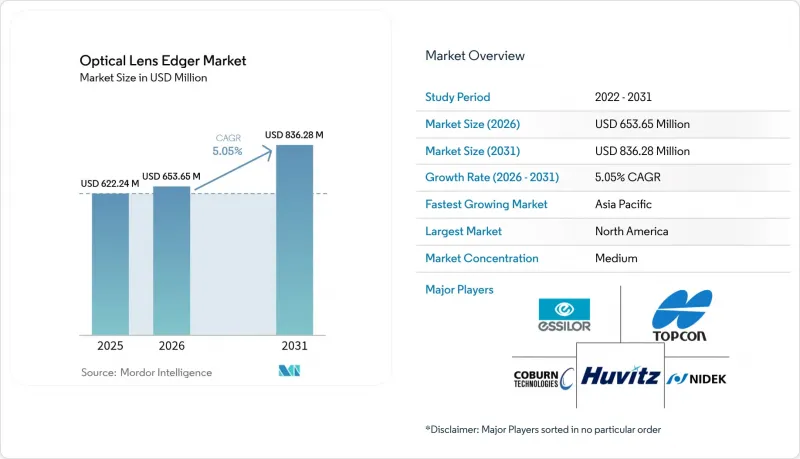
본 보고서는 유형별(수동식, 자동식, 기타), 용도별(안경 렌즈, 현미경 렌즈, 기타), 최종 사용자별(독립 안경점, 안과 병원 및 클리닉, 기타), 지역별로 분류되어 있습니다. 본 보고서에서는 상기 각 부문별 시장 규모(100만 달러)를 제시하고 있습니다.
세계의 광학 렌즈 에저 시장 동향 및 인사이트
근시 유병률의 급증과 화면 과다 노출
2020년에는 전 세계 인구의 약 30%가 근시를 앓고 있었습니다. 2050년까지 그 비율은 50%를 나타낼 것으로 예측되며, 여기에는 복잡한 도수의 복합 렌즈가 필요한 10억 명의 고도 근시 환자가 포함됩니다. 프리폼 에징 기술 덕분에 고굴절률 기판에서도 도수 요건을 충족하면서 얇은 두께를 유지할 수 있어, 광학 렌즈 에저 시장은 그 혜택을 누리고 있습니다. 재택근무의 확산으로 화면을 보는 시간이 늘어나고 야외 활동 시간이 줄어들고 있는데, 이 모든 요인이 근시의 진행을 가속화하고 있습니다. 경제적인 관점에서 볼 때, 아시아 성인들은 이미 근시 교정에 연간 3280억 달러를 지출하고 있으며, 이는 고도 마감 공구에 대한 지속적인 구매력을 보여줍니다. 새로운 에저에는 블루라이트 차단 렌즈의 제조를 용이하게 하는 알고리즘이 내장되어 있어, 렌즈 제조업체는 고부가가치 주문을 확보할 수 있게 됩니다.
신흥 시장의 시력 관리 소매 체인 급속한 확장
지역 체인점들은 매장 확장을 가속화하고, 소형 에징 랩을 병설함으로써 당일 배송을 실현하고 있습니다. 파리 미키는 일본 국내에 635개 매장, 해외에 74개 매장을 운영하고 있으며, 각 매장에 렌즈 마감 설비가 갖춰져 있어 외부 랩에 대한 위탁 비용을 절감하면서 서비스 신속화를 도모하고 있습니다. 병원 내 시스템은 건당 5-15달러의 비용 절감을 실현하며, 하루 50건 이상의 처리량이 있다면 단기간에 투자 비용을 회수할 수 있습니다. 장비 제조업체는 2만-5만 달러 대의 중급 자동 가공기를 라인업하여, 신규 시장 진출기업에게 합리적인 가격과 높은 정밀도를 동시에 제공합니다.
콘택트렌즈와 라식 수술에 대한 선호도 증가
2023년, 영국 소프트 콘택트렌즈 처방 건수 중 1일용 일회용 렌즈의 비율은 78.8%로 확대되었으며, 소비자들이 관리가 간편한 안경을 선호하는 경향을 반영하고 있습니다. EVO ICL과 같은 굴절 교정 수술은 젊은 사용자들에게 안경을 착용하지 않아도 되는 기간을 연장해 줍니다. 이러한 변화로 인해 성숙한 소매 채널에서의 렌즈 에징에 대한 대량 수요는 둔화되고 있지만, 산업용 및 진단용 광학 기기 부문은 여전히 영향을 받지 않고 있습니다.
부문 분석
2025년에는 자동 모델이 최대 수익원이 되어 광학 렌즈 에저 시장 점유율의 54.12%를 차지했습니다. 이러한 모델은 폐쇄 루프 서보 모터와 패턴리스 트레이스 기능을 통해 마감 시간을 단축하고 불량률을 낮출 뿐만 아니라, 다초점 렌즈의 당일 배송을 가능하게 합니다. 중소 소매업체들이 수동식 작업대에서 자동 플랫폼으로 전환함에 따라, 자동 플랫폼 관련 광학 렌즈 에저 시장 규모는 2031년까지 연평균 성장률(CAGR) 5.55%로 확대될 것으로 예측됩니다. 자본 예산이 제한된 곳에서는 여전히 수동식 기계가 사용되고 있지만, 재생된 자동식 장비가 중고 시장에 유입됨에 따라 그 점유율은 점차 축소되고 있습니다. 반자동 시스템은 기능과 비용의 균형을 맞추고 있지만, 점유율이 6.32%에 그치고 있는 것으로 보아 장기적인 매력에는 한계가 있는 것으로 확인되었습니다. 일체형 블로커 에저 설계는 설치 면적을 줄이고 워크플로우를 간소화하기 때문에 유닛 수 증가율이 가장 높습니다. 이는 공간 제약이 있는 도시 지역의 클리닉에 있어 중요한 지표입니다.
산업 통합이 진행됨에 따라, 공급업체들은 소프트웨어, 에지 가공, 코팅을 하나의 섀시에 통합하는 움직임을 보이고 있습니다. 프라운호퍼 IPT의 48시간 광학 셀은 성형, 레이저 어블레이션, 에지 마무리를 단일 공정으로 아우르는 ‘출하 준비 완료’ 상태의 블록이 차세대 제품 라인을 어떻게 주도할 수 있는지를 보여줍니다. 각 벤더는 AI 기반 매개변수 라이브러리를 통합함으로써 수동 재조정 없이 CR-39에서 폴리카보네이트로 전환할 수 있게 하고 있습니다. 이러한 기능은 하드웨어의 이익 마진이 축소되고 있음에도 불구하고 시스템의 가치가 높아지고 있는 이유를 여실히 보여줍니다.
지역별 분석
2025년에는 북미가 42.10%로 가장 큰 매출 점유율을 차지했습니다. 안과 검진에 대한 폭넓은 보험 적용, 프리미엄 코팅에 대한 소비자의 수용, 독립 안과 전문의들의 밀집된 네트워크가 장비 교체를 뒷받침하고 있습니다. 많은 개업의들이 1시간 서비스를 실현하기 위해 원내 실험실로 전환함에 따라 자동 에저의 보급률이 확대되었습니다. 또한, 이 지역에는 현지 서비스 거점을 운영하는 주요 제조업체가 존재하기 때문에 가동 중단으로 인한 손실을 최소화할 수 있어 기술 업데이트가 촉진되고 있습니다. 광선 노출에 관한 안전 지침에 따라 집진 기준이 엄격해지면서, 실험실에서는 최신 밀폐형 시스템으로의 전환이 진행되고 있습니다.
아시아태평양은 2026-2031년 연평균 성장률(CAGR) 6.95%를 기록하며 가장 빠른 성장을 보이고 있습니다. 싱가포르 등 시장에서는 도시 지역 10대 청소년의 근시 유병률이 80%를 초과하고 있어, 이것이 지속적인 처방전 수량을 뒷받침하고 있습니다. 에시롤 룩소티카는 해당 지역에서 8.2%의 매출 증가를 기록했는데, 이는 매장 내 렌즈 연마 서비스를 도입한 체인점의 확장을 반영한 것입니다. 중국에서는 가성비가 뛰어난 렌즈를 우선시하는 조달 규정에 따라 가격 압박이 완화되고 있으며, 이익률을 유지하기 위해 가공 업체들은 다초점 렌즈 가공으로 전환하고 있습니다. 일본의 파리 미키 체인은 정밀도를 중시하여 AI가 탑재된 블록 장치에 대한 수요를 뒷받침하고 있습니다. 인도와 동남아시아에서는 가처분 소득 증가에 따라 프리미엄 렌즈로의 업그레이드가 가능해지면서 새로운 시장이 개척되고 있습니다.
유럽에서는 기술 갱신 주기와 특수 용도에 힘입어 수요가 안정적입니다. 로덴스톡사가 마감 공정을 체코 공장으로 이전한 것은 비용 최적화를 중시하고 있음을 보여주지만, 품질 기준은 여전히 높은 수준을 유지하고 있습니다. 콘택트렌즈 보급률(유럽 전체 5.2% 증가)은 판매량 증가를 억제하는 한편, 높은 동심도를 필요로 하는 다초점 경질 렌즈 분야의 틈새 시장 기회를 자극하고 있습니다. 라틴아메리카와 중동에서는 도입 기반이 작음에도 불구하고, 민관 파트너십을 통한 시력 검진 사업에 대한 자금 지원으로 인해 판매량이 두 자릿수 성장을 보이고 있습니다.
기타 혜택
- 엑셀 형식 시장 예측(ME) 시트
- 3개월간의 애널리스트 지원
자주 묻는 질문
목차
제1장 서론
제2장 조사 방법
제3장 주요 요약
제4장 시장 구도
제5장 시장 규모 및 성장 예측
제6장 경쟁 구도
제7장 시장 기회 및 향후 전망
AJY 26.09.11According to Mordor Intelligence, the optical lens edger market size is expected to grow from USD 622.24 million in 2025 to USD 653.65 million in 2026 and is forecast to reach USD 836.28 million by 2031 at 5.05% CAGR over 2026-2031.
This report is Segmented by Type (Manual, Automatic, and More), Application (Eyeglass Lens, Microscope Lens, and More), by End User (Independent Optical Stores, Ophthalmology Hospitals & Clinics, and Others), and Geography. The Market Provides the Value (in USD Million) for the Above-Mentioned Segments.
Global Optical Lens Edger Market Trends and Insights
Soaring prevalence of myopia & hyper-screen exposure
Nearly 30% of the world's population lived with myopia in 2020; projections point to 50% by 2050, including 1 billion high myopes who rely on complex prescription lenses . The optical lens edger market benefits because freeform edging allows high-index substrates to retain thin profiles while meeting power requirements. Remote work culture amplifies screen time and shortens outdoor exposure, both linked to faster myopia progression. Economically, Asian adults already spend USD 328 billion yearly on myopia correction, signaling sustained purchasing power for advanced finishing tools. New edgers integrate algorithms to ease blue-light filter lens production, enabling labs to capture premium order value.
Rapid expansion of vision-care retail chains in emerging markets
Regional chains accelerate store rollouts and embed compact edging labs to promise same-day delivery. Paris Miki operates 635 outlets in Japan and 74 abroad, each equipped to finish lenses in-house, cutting external lab fees while improving service speed. In-office systems trim USD 5-15 per job, yielding quick payback when volumes exceed 50 pairs a day. Equipment makers position mid-tier automatic units at the USD 20,000-50,000 range, bridging affordability and precision for new entrants.
Growing preference for contact lenses & LASIK
Daily disposable lenses grew to 78.8% of UK soft-lens fits in 2023, reflecting consumer tilt toward lower maintenance eyewear . Refractive surgery options such as EVO ICL extend spectacle-free intervals for younger users. These shifts temper high-volume lens edging demand in mature retail channels, though industrial and diagnostic optics remain insulated.
Other drivers and restraints analyzed in the detailed report include:
- Uptick in geriatric population with presbyopia
- Rising demand from camera & imaging optics makers
- Plateauing incremental hardware innovation cycles
For complete list of drivers and restraints, kindly check the Table Of Contents.
Segment Analysis
Automatic models generated the largest revenue pool and captured 54.12% optical lens edger market share in 2025. Their closed-loop servo motors and patternless tracing shorten finishing time, reduce reject rates, and enable same-day delivery for multifocal lenses. The optical lens edger market size tied to automatic platforms is forecast to expand at 5.55% CAGR through 2031 as mid-tier retailers move away from manual benches. Manual machines persist where capital budgets are tight, yet their share faces erosion as refurbished automatic units enter the secondary market. Semi-automatic systems bridge capability and cost, but only 6.32% share confirms limited long-run appeal. Integrated blocker-edger designs post the highest unit growth because they cut floor space and streamline workflows, a key metric for urban clinics with limited real estate.
Consolidation drives suppliers to bundle software, edging, and coating in one enclosure. Fraunhofer IPT's 48-hour optics cell indicates how factory-ready blocks encompass forming, laser ablation, and edge finishing in a single track, a template that could spur next-generation product lines. Vendors embed AI-driven parameter libraries to switch from CR-39 to polycarbonate with no manual recalibration. Such features underscore why system value rises even as hardware margins compress.
Complete Report Scope:
- By Type
- Manual
- Semi-Automatic
- Automatic
- Patternless CNC
- Integrated Blocker-Edger Systems
- By Application
- Eyeglass Lens
- Microscope/Scientific Lens
- Camera & Imaging Lens
- Smartphone/AR-VR Lens
- By End User
- Independent Optical Stores
- Ophthalmology Hospitals & Clinics
- Others
- By Geography
- North America
- United States
- Canada
- Mexico
- Europe
- Germany
- United Kingdom
- France
- Italy
- Spain
- Rest of Europe
- Asia-Pacific
- China
- Japan
- India
- Australia
- South Korea
- Rest of Asia-Pacific
- Middle East & Africa
- GCC
- South Africa
- Rest of Middle East & Africa
- South America
- Brazil
- Argentina
- Rest of South America
- North America
Geography Analysis
North America generated the largest revenue slice at 42.10% in 2025. Strong insurance coverage for eye exams, consumer acceptance of premium coatings, and a dense network of independent optometrists fuel equipment turnover. Many practitioners shifted to in-office labs for one-hour service, extending automatic edger penetration. The region also hosts major manufacturers that offer local service hubs; therefore, downtime penalties remain low and encourage technology updates. Safety guidelines on optical-radiation exposure tighten dust-extraction standards, pushing labs to modern enclosed systems.
Asia-Pacific is the fastest riser at 6.95% CAGR from 2026-2031. Myopia incidences above 80% among urban teens in markets such as Singapore feed sustained prescription volumes. EssilorLuxottica logged 8.2% revenue lift in the region, mirroring chain expansion that embeds in-store edging. China moderates price pressure through procurement rules that favor value lenses, steering labs toward multifocal finishing to preserve margins. Japan's Paris Miki chain prioritizes precision, spurring demand for AI-enabled blockers. India and Southeast Asia open fresh lanes as disposable incomes permit premium lens upgrades.
Europe exhibits stable demand driven by technology refresh cycles and specialized applications. Rodenstock's migration of finishing to Czech plants underscores cost-optimization, yet quality bars remain high. Contact-lens adoption-up 5.2% across Europe-tempers unit volumes yet stimulates niche opportunities in multifocal hard lenses that need tight concentricity. Latin America and the Middle East start from small installed bases but post double-digit unit growth where public-private partnerships fund vision-screening initiatives.
- EssilorLuxottica
- Topcon Corp.
- Nidek
- Coburn Technologies
- Huvitz Corp.
- MEI Srl
- Santinelli International
- Satisloh (Buhler)
- Schneider Optical Machines
- OptoTech
- Briot-Weco (Luneau Tech)
- Supore Instruments
- National Optronics
- Visslo
- INNOVA Medical Ophthalmics
- Nanjing Laite Optical
- Veer Optronics
- DTC (Delco)
- Marmore Inc.
- Beijing HongDi
Additional Benefits:
- The market estimate (ME) sheet in Excel format
- 3 months of analyst support
TABLE OF CONTENTS
1 Introduction
- 1.1 Study Assumptions & Market Definition
- 1.2 Scope of the Study
2 Research Methodology
3 Executive Summary
4 Market Landscape
- 4.1 Market Overview
- 4.2 Market Drivers
- 4.2.1 Soaring prevalence of myopia & hyper-screen exposure
- 4.2.2 Rapid expansion of vision-care retail chains in EMs
- 4.2.3 Uptick in geriatric population with presbyopia
- 4.2.4 Rising demand from camera & imaging optics makers
- 4.2.5 Adoption of in-office finishing labs by independents
- 4.2.6 Shift to patternless CNC edgers for complex lenses
- 4.3 Market Restraints
- 4.3.1 Growing preference for contact lenses & LASIK
- 4.3.2 Plateauing incremental hardware innovation cycles
- 4.3.3 Tight supply of premium diamond-abrasive wheels
- 4.3.4 Stricter dust-emission norms for optical workshops
- 4.4 Value / Supply-Chain Analysis
- 4.5 Regulatory Landscape
- 4.6 Technological Outlook
- 4.7 Porter's Five Forces Analysis
- 4.7.1 Threat of New Entrants
- 4.7.2 Bargaining Power of Buyers
- 4.7.3 Bargaining Power of Suppliers
- 4.7.4 Threat of Substitutes
- 4.7.5 Competitive Rivalry
5 Market Size & Growth Forecasts (Value, USD Million)
- 5.1 By Type
- 5.1.1 Manual
- 5.1.2 Semi-Automatic
- 5.1.3 Automatic
- 5.1.4 Patternless CNC
- 5.1.5 Integrated Blocker-Edger Systems
- 5.2 By Application
- 5.2.1 Eyeglass Lens
- 5.2.2 Microscope/Scientific Lens
- 5.2.3 Camera & Imaging Lens
- 5.2.4 Smartphone/AR-VR Lens
- 5.3 By End User
- 5.3.1 Independent Optical Stores
- 5.3.2 Ophthalmology Hospitals & Clinics
- 5.3.3 Others
- 5.4 By Geography
- 5.4.1 North America
- 5.4.1.1 United States
- 5.4.1.2 Canada
- 5.4.1.3 Mexico
- 5.4.2 Europe
- 5.4.2.1 Germany
- 5.4.2.2 United Kingdom
- 5.4.2.3 France
- 5.4.2.4 Italy
- 5.4.2.5 Spain
- 5.4.2.6 Rest of Europe
- 5.4.3 Asia-Pacific
- 5.4.3.1 China
- 5.4.3.2 Japan
- 5.4.3.3 India
- 5.4.3.4 Australia
- 5.4.3.5 South Korea
- 5.4.3.6 Rest of Asia-Pacific
- 5.4.4 Middle East & Africa
- 5.4.4.1 GCC
- 5.4.4.2 South Africa
- 5.4.4.3 Rest of Middle East & Africa
- 5.4.5 South America
- 5.4.5.1 Brazil
- 5.4.5.2 Argentina
- 5.4.5.3 Rest of South America
- 5.4.1 North America
6 Competitive Landscape
- 6.1 Market Concentration
- 6.2 Market Share Analysis
- 6.3 Company Profiles (includes Global level Overview, Market level overview, Core Segments, Financials, Strategic Information, Market Rank/Share, Products & Services, Recent Developments)
- 6.3.1 EssilorLuxottica
- 6.3.2 Topcon Corp.
- 6.3.3 NIDEK Co., Ltd.
- 6.3.4 Coburn Technologies
- 6.3.5 Huvitz Corp.
- 6.3.6 MEI Srl
- 6.3.7 Santinelli International
- 6.3.8 Satisloh (Buhler)
- 6.3.9 Schneider Optical Machines
- 6.3.10 OptoTech
- 6.3.11 Briot-Weco (Luneau Tech)
- 6.3.12 Supore Instruments
- 6.3.13 National Optronics
- 6.3.14 Visslo
- 6.3.15 INNOVA Medical Ophthalmics
- 6.3.16 Nanjing Laite Optical
- 6.3.17 Veer Optronics
- 6.3.18 DTC (Delco)
- 6.3.19 Marmore Inc.
- 6.3.20 Beijing HongDi
7 Market Opportunities & Future Outlook
- 7.1 White-Space & Unmet-Need Assessment