

|
시장보고서
상품코드
2123718
치질 치료 기기 시장 : 시장 점유율 분석, 업계 동향 및 통계, 성장 예측(2026-2031년)Hemorrhoid Treatment Devices - Market Share Analysis, Industry Trends & Statistics, Growth Forecasts (2026 - 2031) |
||||||
 Mordor Intelligence
Mordor Intelligence에 의하면, 치질 치료 기기 시장 규모는 2025년 10억 6,000만 달러로 평가되었고, 2026년 11억 2,000만 달러에서 2031년까지 15억 달러로 확대될 것으로 예측되며, 2026-2031년 연평균 복합 성장률(CAGR)은 6.09%를 나타낼 전망입니다.

본 보고서는 제품 유형별(밴드 결찰기, 적외선 응고기, 직장경·항문경, 양극 프로브, 기타), 기술 플랫폼별(에너지 기반 의료기기, 기타), 치핵의 중증도별(I도, 기타), 시술법별(고무 밴드 결찰법, 기타), 최종 사용자별(병원, 기타), 지역별(북미, 기타)로 분류되어 있습니다. 시장 전망은 금액(달러) 기준으로 제시되어 있습니다.
세계의 치질 치료 기기 시장 동향 및 인사이트
치질 유병률 증가
50세 이상 성인의 최대 50%가 증상을 동반한 치질을 경험하고 있으며, 평균 수명의 연장에 따라 절대적인 환자 수가 증가하고 있습니다. 중국에서만 2040년까지 연간 140만 건의 대장암 사례가 예상됩니다. 전국적인 검진 도입으로 인해 우연히 치핵으로 진단되는 사례가 증가하고 있으며, 이는 신속한 치료로 이어지고 있습니다. 이와 유사한 검진 확대는 인도, 일본, 한국에서도 관찰됩니다. 의료계에서는 현재 진행을 막기 위해 II-III도 치질에 대해 조기에 의료기기를 이용한 중재를 권장하고 있으며, 이는 치질 치료 기기 시장에 장기적인 호재가 되고 있습니다.
저침습 외래 시술의 보급 확대
보험사는 입원이 수반되는 절제 수술에서 클리닉이나 외래수술센터(ASC)에서의 결찰술로 환자를 지속적으로 유도하고 있습니다. 메디케어는 2026년에 고무 밴드 결찰술(CPT 46221)에 대해 시설 1곳당 158.85달러를 지급할 예정이며, 이 수준은 진료 건수가 많은 클리닉에 경제적으로 유리합니다. Vizient의 예측에 따르면, 2024년부터 2034년까지 미국의 외래 수술 총 건수는 19% 증가할 것으로 보이며, 이러한 증가를 주도할 분야는 소화기 계통 수술이 될 전망입니다. 15분 정도의 통원 시간과 당일 퇴원이라는 편의성은 환자의 요구와 부합하며, 의료기기의 처리량과 수익 확대를 가속화할 것으로 보입니다.
스테이플러와 레이저 시스템의 높은 비용
레이저 콘솔 1대당 5만 달러를 넘는 설비 투자는 임상적 이점이 있음에도 불구하고, 자원이 제한된 병원의 도입을 저해하고 있습니다. 사하라 이남 아프리카나 중국의 지방 도시에서는 예산 위원회가 10분의 1 가격의 기계식 결찰기를 우선시하기 때문에 구매가 미뤄지는 경우가 일반적입니다. 자금 조달 프로그램이나 리스 모델이 등장하고 있지만, 많은 의료 기관에서 투자 회수 기간이 5년 이상 소요되기 때문에 에너지 플랫폼의 보급이 더딘 상황입니다.
부문 분석
밴드 결찰기는 2025년 매출의 41.55%를 차지했으며, 치질 치료 기기 시장의 기계식 핵심을 지탱하고 있습니다. 높은 처리 능력, CPT(진료 행위 코드)에 따른 보험 급여, 5분간의 진료실 회전 시간 덕분에 클리닉 및 외래수술센터(ASC)에서 수요는 견조한 추세를 보이고 있습니다. 또한, 제조업체들이 일회용 제품을 출시함에 따라 감염 관리 대책 강화도 이 부문에 호재로 작용하고 있습니다. 한편, 레이저 프로브는 뛰어난 진통 효과와 조기 직장 복귀를 뒷받침하는 설득력 있는 무작위 대조군 연구 데이터에 힘입어 연평균 성장률(CAGR) 9.01%가 예상됩니다. 대장직장 프로그램의 차별화를 꾀하는 병원들이 레이저 콘솔을 도입하고 있으며, 독일과 일본의 민간 보험사들도 현재 레이저 치핵 성형술에 대해 보험 적용을 하고 있어 보급률은 더욱 높아지고 있습니다.
기계식 시스템은 밴드 결찰기의 보급과 사용법 습득의 용이성으로 인해 2025년 치질 치료 기기 시장 규모의 53.74%를 차지했습니다. 라틴아메리카와 아프리카의 예산에 민감한 공립 병원에서는 여전히 이러한 플랫폼이 우선적으로 채택되고 있습니다. 에너지 기반 의료기기는 고가의 내시경 재처리가 필요 없는 양극 및 적외선 응고 장치를 필두로 연평균 성장률(CAGR) 8.92%로 추격하고 있습니다. 미국의 외래수술센터(ASC)에서는 많은 경우 일회용 프로브 비용을 시술 요금에 포함시키고 있으며, 이를 통해 자금적 제약이 완화되어 외과의사가 장비를 원활하게 업그레이드할 수 있게 되었습니다.
지역별 분석
북미는 2025년 매출의 33.43%를 차지하고 있으며, 이는 6,300곳의 메디케어 인증 ASC와 명확한 시술 보상 제도에 힘입은 것입니다. FDA의 의료기기 중시 정책은 계속해서 구매 동향에 영향을 미치고 있으며, 감염 관리 규정에 따라 많은 미국 병원에서 일회용 결찰기가 표준으로 자리 잡고 있습니다. 캐나다에서도 유사한 경향이 나타나고 있으나, 주 정부의 예산 사정으로 인해 설비 투자 주기는 미국 평균보다 1-2년 더 길어지고 있습니다.
아시아태평양은 2031년 연평균 성장률(CAGR)이 8.43%로 가장 빠르게 성장이 전망되는 시장입니다. 중국에서는 대장암 검진이 확대되고 있으며, 일부 시범 성에서는 레이저 치핵 성형술이 지역 보험 적용 대상이 되고 있습니다. 인도의 민간 병원 체인은 공공시설과의 차별화를 꾀하기 위해 당일 수술 전용 병동을 개설하고, 바이폴라 및 적외선 플랫폼을 도입하고 있습니다. 인도네시아 등 동남아시아 시장에서는 위암 대책 프로그램을 위해 구축된 내시경 인프라를 활용하고 있으며, 이것이 의료기기 수요를 더욱 끌어올리고 있습니다.
유럽은 성숙한 시장이지만 기술에 대한 수요가 높은 지역입니다. 독일과 프랑스에서는 에너지를 이용한 시술에 대해 기계적 결찰술보다 높은 보상률이 적용되고 있어, 5-7년 주기의 콘솔 교체 주기가 꾸준히 촉진되고 있습니다. 영국에서는 국민보건서비스(NHS) 자금을 감염 위험 저감에 할당하고 있어 일회용 의료기기가 전면에 부각되고 있습니다. 남유럽에서는 여전히 예산 제약이 남아 있어 도입까지의 기간이 길어지고 있지만, EU 전역의 감염 대책 지침에 따라 그 격차는 점차 좁혀지고 있습니다.
중동 및 아프리카와 남미는 합산 시장 점유율이 소폭이지만, 장기적으로는 중요한 성장 요인이 될 것입니다. 걸프협력회의(GCC) 회원국 병원들은 의료 관광객을 유치하기 위해 도플러 유도 및 레이저 기술로의 전환을 빠르게 추진하고 있는 반면, 브라질과 콜롬비아에서는 외래 결찰술에 대한 공적 보험 적용 범위가 확대되고 있습니다. 대장·직장 외과 의사의 만성적인 부족과 자금 측면의 제약이 성장을 억제하고 있지만, 원격 내시경 검사의 시범 사업과 민간 전문 클리닉이 잠재적인 수요를 발굴하기 시작하고 있습니다.
기타 혜택
- 엑셀 형식 시장 예측(ME) 시트
- 3개월간의 애널리스트 지원
자주 묻는 질문
목차
제1장 서론
제2장 조사 방법
제3장 주요 요약
제4장 시장 구도
제5장 시장 규모 및 성장 예측
제6장 경쟁 구도
제7장 시장 기회 및 향후 전망
AJY 26.09.11According to Mordor Intelligence, the hemorrhoid treatment devices market size is projected to expand from USD 1.06 billion in 2025 and USD 1.12 billion in 2026 to USD 1.5 billion by 2031, registering a CAGR of 6.09% between 2026 to 2031.
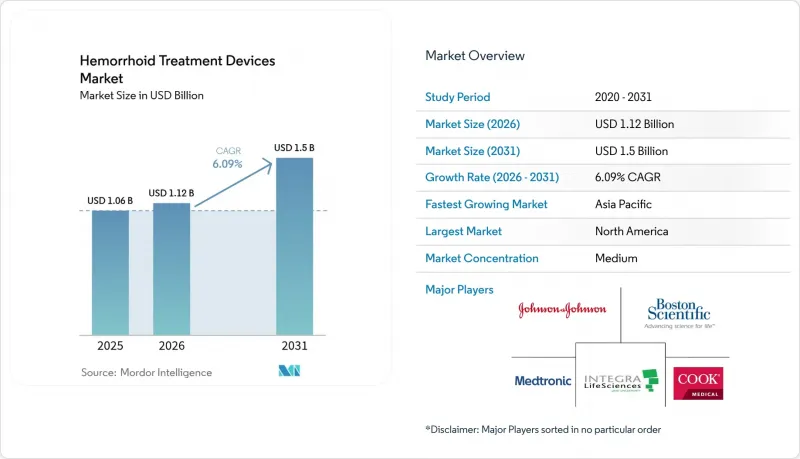
This report is Segmented by Product Type (Band Ligators, Infrared Coagulators, Proctoscopes & Anoscopes, Bipolar Probes, and More), Technology Platform (Energy-Based Devices, and More), Hemorrhoid Grade (Grade I, and More), Procedure (Rubber Band Ligation, and More), End User (Hospitals, and More), and Geography (North America, and More). The Market Forecasts are Provided in Terms of Value (USD).
Global Hemorrhoid Treatment Devices Market Trends and Insights
Rising Prevalence of Hemorrhoidal Disease
Up to 50% of adults older than 50 experience symptomatic hemorrhoids, and growing life expectancy is pushing absolute case numbers higher. China alone is bracing for 1.4 million annual colorectal cancer cases by 2040; national screening rollouts mean more incidental hemorrhoid diagnoses that move quickly to procedural care. Similar screening acceleration is visible in India, Japan, and South Korea. The clinical community now favors earlier device intervention for Grades II-III to prevent progression, anchoring a long-term tailwind for the hemorrhoid treatment devices market.
Growing Adoption of Minimally Invasive Outpatient Procedures
Payers continue to steer patients away from inpatient excisional surgery toward office or ASC-based ligation. Medicare reimburses rubber band ligation (CPT 46221) at USD 158.85 per facility case in 2026, a level that supports high-volume practice economics. Vizient forecasts a 19% jump in total U.S. outpatient surgery between 2024 and 2034, with gastrointestinal work leading the rise. The convenience of 15-minute visits and same-day discharge aligns with patient preference, accelerating device throughput and revenue.
High Cost of Stapling and Laser Systems
Capital outlays above USD 50,000 for a single laser console discourage adoption in resource-constrained hospitals despite clinical benefits. Deferred purchases are common in sub-Saharan Africa and lower-tier Chinese cities where budget committees favor mechanical ligators that cost one-tenth as much. Financing programs and leasing models are emerging, yet payback timelines stretch beyond five years for many facilities, slowing energy platform penetration.
Other drivers and restraints analyzed in the detailed report include:
- Technological Advances in Ligation and Energy Devices
- Expanding Healthcare Infrastructure in Emerging Economies
- Stringent FDA/CE Regulatory Pathways
For complete list of drivers and restraints, kindly check the Table Of Contents.
Segment Analysis
Band ligators owned 41.55% of 2025 revenue, underpinning the mechanical core of the hemorrhoid treatment devices market. High throughput, CPT-linked reimbursement, and a five-minute room turnaround keep demand brisk in physician offices and ASCs. The segment also benefits from infection-control upgrades as manufacturers roll out single-use variants. Laser probes, however, are set for a 9.01% CAGR, driven by compelling randomized evidence of superior pain relief and quicker return to work. Hospitals looking to differentiate colorectal programs are acquiring laser consoles, and private insurers in Germany and Japan now reimburse laser hemorrhoidoplasty, further lifting penetration.
Mechanical systems generated 53.74% of the hemorrhoid treatment devices market size in 2025 thanks to band ligator ubiquity and their minimal learning curve. Budget-sensitive public hospitals in Latin America and Africa still prioritize these platforms. Energy-based devices are catching up at an 8.92% CAGR, led by bipolar and infrared coagulators that eliminate costly endoscope reprocessing. ASCs in the U.S. often bundle a disposable probe into the procedure fee, easing capital constraints and smoothing the upgrade path for surgeons.
Complete Report Scope:
- By Product Type
- Band Ligators
- Infrared Coagulators
- Proctoscopes & Anoscopes
- Bipolar Probes
- Doppler-Guided Ligators
- Cryotherapy Devices
- Laser Probes
- Stapling Devices
- Other Emerging Devices
- By Technology Platform
- Energy-based Devices
- Mechanical Devices
- Hybrid/ Combination Devices
- By Hemorrhoid Grade
- Grade I
- Grade II
- Grade III
- Grade IV
- By Procedure
- Rubber Band Ligation
- Sclerotherapy
- Infrared Coagulation
- Laser Therapy
- Doppler-Guided Artery Ligation (DG-HAL)
- Stapled Hemorrhoidopexy
- Conventional Hemorrhoidectomy
- Other Procedures
- By End User
- Hospitals
- Clinics & Physician Offices
- Ambulatory Surgery Centers
- Home-Care Settings
- Others
- By Geography
- North America
- United States
- Canada
- Mexico
- Europe
- Germany
- France
- United Kingdom
- Italy
- Spain
- Rest of Europe
- Asia-Pacific
- China
- Japan
- India
- South Korea
- Australia
- Rest of Asia-Pacific
- Middle East & Africa
- GCC
- South Africa
- Rest of Middle East & Africa
- South America
- Brazil
- Argentina
- Rest of South America
- North America
Geography Analysis
North America generated 33.43% of 2025 revenue, underpinned by 6,300 Medicare-certified ASCs and clear procedural reimbursement. FDA device-intensive policies continue to influence purchasing, and infection-control rules make single-use ligators standard in many U.S. hospitals. Canada shows similar patterns, though provincial budgets extend capital cycles by one to two years longer than U.S. averages.
Asia-Pacific is the fastest-growing arena at 8.43% CAGR through 2031. China is scaling colorectal screening, and provincial insurance now covers laser hemorrhoidoplasty in several pilot provinces. India's private hospital chains are opening dedicated day-surgery wings, equipping them with bipolar and infrared platforms to differentiate from public facilities. Southeast Asian markets such as Indonesia are piggybacking on endoscopy infrastructure funded for gastric cancer programs, creating incremental device demand.
Europe represents a mature but technology-hungry region. Germany and France reimburse energy-based procedures at higher tariffs than mechanical ligation, encouraging steady console refresh cycles every five to seven years. The United Kingdom is channeling National Health Service capital toward infection-risk reduction, pushing single-use devices to the fore. In Southern Europe, lingering budget limits lengthen adoption timelines, though EU-wide infection directives are narrowing the gap.
The Middle East & Africa and South America together account for a modest share but are important long-run contributors. Gulf Cooperation Council hospitals have moved rapidly into Doppler-guided and laser techniques to attract medical tourists, while Brazil and Colombia are expanding public coverage of outpatient ligation. Persistent shortages of colorectal surgeons and capital constraints temper growth, yet tele-endoscopy pilots and private specialty clinics are beginning to unlock latent demand.
- A.M.I.
- B. Braun
- Bluesail Surgical
- Boston Scientific
- Conmed
- Cook Group
- Integra LifeSciences
- Johnson & Johnson
- Medline Industries
- Medtronic
- Micro-tech
- Olympus
- Privi Medical
- Sapi Med
- Sklar Surgical Instruments
- Smiths Group
- Surkon Medical
- Teleflex
- THD S.p.A.
- Victor Medical Instruments
Additional Benefits:
- The market estimate (ME) sheet in Excel format
- 3 months of analyst support
TABLE OF CONTENTS
1 Introduction
- 1.1 Study Assumptions & Market Definition
- 1.2 Scope of the Study
2 Research Methodology
3 Executive Summary
4 Market Landscape
- 4.1 Market Overview
- 4.2 Market Drivers
- 4.2.1 Rising Prevalence of Hemorrhoidal Disease
- 4.2.2 Growing Adoption of Minimally-Invasive Outpatient Procedures
- 4.2.3 Technological Advancements in Ligation and Energy-Based Devices
- 4.2.4 Expanding Healthcare Infrastructure & Expenditure in Emerging Economies
- 4.2.5 Tele-Endoscopy & Remote Guidance Enabling Rural Reach
- 4.2.6 Infection-Control Push Toward Single-Use Ligators
- 4.3 Market Restraints
- 4.3.1 High Cost of Advanced Stapling & Laser Systems
- 4.3.2 Stringent FDA/CE Regulatory Pathways
- 4.3.3 Competition from Topical Pharmacotherapy
- 4.3.4 Shortage of Colorectal Specialists in Developing Regions
- 4.4 Value / Supply-Chain Analysis
- 4.5 Regulatory Landscape
- 4.6 Technological Outlook
- 4.7 Porter's Five Forces Analysis
- 4.7.1 Bargaining Power of Suppliers
- 4.7.2 Bargaining Power of Buyers
- 4.7.3 Threat of New Entrants
- 4.7.4 Threat of Substitutes
- 4.7.5 Intensity of Competitive Rivalry
5 Market Size & Growth Forecasts (Value in USD)
- 5.1 By Product Type
- 5.1.1 Band Ligators
- 5.1.2 Infrared Coagulators
- 5.1.3 Proctoscopes & Anoscopes
- 5.1.4 Bipolar Probes
- 5.1.5 Doppler-Guided Ligators
- 5.1.6 Cryotherapy Devices
- 5.1.7 Laser Probes
- 5.1.8 Stapling Devices
- 5.1.9 Other Emerging Devices
- 5.2 By Technology Platform
- 5.2.1 Energy-based Devices
- 5.2.2 Mechanical Devices
- 5.2.3 Hybrid/ Combination Devices
- 5.3 By Hemorrhoid Grade
- 5.3.1 Grade I
- 5.3.2 Grade II
- 5.3.3 Grade III
- 5.3.4 Grade IV
- 5.4 By Procedure
- 5.4.1 Rubber Band Ligation
- 5.4.2 Sclerotherapy
- 5.4.3 Infrared Coagulation
- 5.4.4 Laser Therapy
- 5.4.5 Doppler-Guided Artery Ligation (DG-HAL)
- 5.4.6 Stapled Hemorrhoidopexy
- 5.4.7 Conventional Hemorrhoidectomy
- 5.4.8 Other Procedures
- 5.5 By End User
- 5.5.1 Hospitals
- 5.5.2 Clinics & Physician Offices
- 5.5.3 Ambulatory Surgery Centers
- 5.5.4 Home-Care Settings
- 5.5.5 Others
- 5.6 By Geography
- 5.6.1 North America
- 5.6.1.1 United States
- 5.6.1.2 Canada
- 5.6.1.3 Mexico
- 5.6.2 Europe
- 5.6.2.1 Germany
- 5.6.2.2 France
- 5.6.2.3 United Kingdom
- 5.6.2.4 Italy
- 5.6.2.5 Spain
- 5.6.2.6 Rest of Europe
- 5.6.3 Asia-Pacific
- 5.6.3.1 China
- 5.6.3.2 Japan
- 5.6.3.3 India
- 5.6.3.4 South Korea
- 5.6.3.5 Australia
- 5.6.3.6 Rest of Asia-Pacific
- 5.6.4 Middle East & Africa
- 5.6.4.1 GCC
- 5.6.4.2 South Africa
- 5.6.4.3 Rest of Middle East & Africa
- 5.6.5 South America
- 5.6.5.1 Brazil
- 5.6.5.2 Argentina
- 5.6.5.3 Rest of South America
- 5.6.1 North America
6 Competitive Landscape
- 6.1 Market Concentration
- 6.2 Market Share Analysis
- 6.3 Company Profiles (includes Global level Overview, Market level overview, Core Segments, Financials as available, Strategic Information, Market Rank/Share for key companies, Products and Services, and Recent Developments)
- 6.3.1 A.M.I. GmbH
- 6.3.2 B. Braun Melsungen
- 6.3.3 Bluesail Surgical
- 6.3.4 Boston Scientific Corporation
- 6.3.5 CONMED Corporation
- 6.3.6 Cook Medical
- 6.3.7 Integra LifeSciences
- 6.3.8 Johnson & Johnson (Ethicon)
- 6.3.9 Medline Industries
- 6.3.10 Medtronic plc
- 6.3.11 Micro-Tech Endoscopy
- 6.3.12 Olympus Corporation
- 6.3.13 Privi Medical
- 6.3.14 Sapi Med
- 6.3.15 Sklar Surgical Instruments
- 6.3.16 Smith & Nephew
- 6.3.17 Surkon Medical
- 6.3.18 Teleflex
- 6.3.19 THD S.p.A.
- 6.3.20 Victor Medical Instruments
7 Market Opportunities & Future Outlook
- 7.1 White-space & Unmet-Need Assessment


