

|
시장보고서
상품코드
2123726
소아용 휠체어 시장 : 점유율 분석, 업계 동향과 통계, 성장 예측(2026-2031년)Pediatric Wheelchairs - Market Share Analysis, Industry Trends & Statistics, Growth Forecasts (2026 - 2031) |
||||||
 Mordor Intelligence
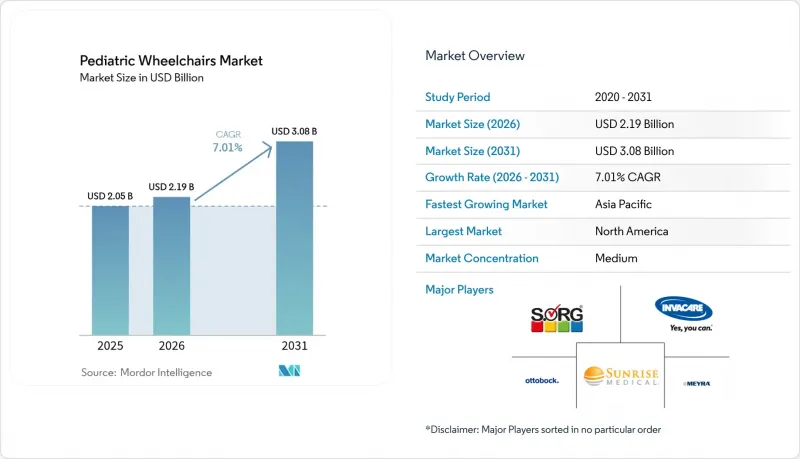
소아용 휠체어 시장 규모는 2025년에 20억 5,000만 달러로 평가되었고 2026년 21억 9,000만 달러에서 2031년까지 30억 8,000만 달러에 이를 것으로 예측되며, 예측 기간(2026-2031년) CAGR은 7.01%를 나타낼 전망입니다.
본 보고서에서는 업계를 제품 유형(수동식 및 전동식), 프레임 유형(강성형·접이식 및 틸트 인 스페이스형), 최종 사용자(병원, 재택 간호 시설, 재활센터, 기타 최종 사용자), 유통 채널(오프라인 및 온라인),지역(북미, 유럽, 아시아태평양, 중동 및 아프리카, 남미)별로 분류하고 있습니다. 시장 예측은 금액(달러) 기준으로 제시되어 있습니다.
전 세계 소아용 휠체어 시장 동향 및 인사이트
소아 장애 발생률 증가
신생아 의료의 발전으로 극심한 조산아의 생존율이 향상되고 있지만, 이들 중 상당수가 뇌성마비나 신경근 질환을 앓게 되어 장기적인 이동 지원이 필요합니다. 현재는 정기 검진 단계에서 조기 진단이 이루어지고 있어, 임상의가 더 빨리 휠체어를 처방할 수 있게 되었으며, 사용 기간 전체가 연장되고 있습니다. 이러한 인구 통계학적 추세는 아이들의 성장에 따라 휠체어를 여러 번 교체해야 하므로 소아용 휠체어 시장의 확대로 이어지고 있습니다. 미국 국립과학아카데미는 적절한 시기에 보조 기술을 제공하는 것이 활동 참여 및 미래 취업 전망을 향상시킨다고 강조하고 있습니다.
보조 기술에 대한 정부 지원 프로그램
‘장애인 교육법(IDEA)’ 등의 연방법에 따라, 개별 교육 계획(IEP)에 명시된 경우, 요건을 충족하는 아동들은 무료로 이동 보조 기구를 받을 수 있도록 보장받고 있습니다. 2024년 제504조 개정을 통해 제공업체의 의무가 명확해졌으며, 메디케이드, 학군, 비영리 대출 기관에 걸친 혜택 범위가 강화되었습니다. 또한, 48개 주에서 시행하는 보조 기술 프로그램은 저금리 대출 및 장비 교체를 제공하여 이용자의 본인 부담금을 경감시키고 있습니다. 재정 지원의 확대에 따라 고성능 모델의 도입이 촉진되어 소아용 휠체어 시장을 더욱 활성화시키고 있습니다.
신흥 시장의 높은 가격과 좁은 보험 적용 범위
많은 저소득 국가에서는 소아용 휠체어 가격이월소득 중앙값의 3배에서 5배에 달하기도 하여, 그 결과 가족들은 기능이 제한된 현지 대체품을 선택할 수밖에 없는 실정입니다. 장애 지원이 국민건강보험 제도에 포함되지 않은 지역에서는 여전히 보험 적용 대상이 아닌 상황이 지속되고 있으며, 이로 인해 고급 기기의 보급이 제한되고 소아용 휠체어 시장의 성장이 둔화되고 있습니다. 자금 출처가 분산되어 있는 특성상, 가족들은 여러 기관에 걸쳐 복잡한 신청 절차를 밟아야 하며, 그 결과 지연이나 행정적 부담이 발생하여 이동 지원 솔루션에 대한 적시 접근이 저해될 수 있습니다. 이러한 시장의 가격 민감성으로 인해, 고도의 기능을 갖추지는 않았지만 합리적인 가격으로 기본적인 이동 기능을 제공하는 단순화된 현지 생산 대체품에 대한 수요가 증가하고 있습니다.
부문 분석
수동식 모델은 2025년 매출의 60.85%를 차지했습니다. 저렴한 가격, 쉬운 유지보수, 그리고 상지 근력이 충분한 어린이들에게 주는 치료적 운동 효과 덕분에 여전히 인기를 끌고 있습니다. 이 부문의 막대한 도입 대수는 쿠션, 바퀴, 성장 대응 키트 등의 애프터마켓을 견고하게 뒷받침하고 있습니다.
연평균 성장률(CAGR) 9.18%로 성장을 지속하고, 있는 전동 휠체어는 중증 신경근 기능 장애가 있는 사용자를 대상으로 합니다. 최근 출시된 제품에는 미세 운동 기능의 개인 차이에 맞춘 비례식 조이스틱, 헤드 어레이, 쉴프 앤 퍼프식 조작 장치가 탑재되어 있습니다. 클라우드 텔레매틱스를 통해 주행 거리, 배터리 상태, 좌석 각도가 기록되게 되었으며, 의료진은 원격으로 매개변수를 조정하거나 예방 정비 일정을 수립할 수 있게 되었습니다. 2024년 SmartDrive의 스피드 다이얼 결함이 수정된 후, 각 OEM 업체들은 소프트웨어 검증을 강화하고 이중화된 브레이크 회로를 도입함으로써 간병인들의 신뢰를 높였습니다.
컴팩트한 인산철 리튬 배터리 기술의 혁신으로 경량화와 주행 거리 연장이 실현되어, 이전에는 유모차에 의존하던 취학 전 아동에게도 전동 휠체어가 실용적인 선택지가 되었습니다. 예측 기간 동안 소아용 전동 휠체어 시장 규모는 다른 어떤 카테고리보다 빠른 복합 성장률을 보일 것으로 예상되지만, 일부 지역의 보험 환급 장벽이 시장 침투를 둔화시킬 가능성이 있습니다.
접이식 프레임은 일상적인 휴대의 편의성 덕분에 2025년에는 매출의 48.76%를 차지했습니다. 개선된 퀵 릴리스식 크로스 브레이스 덕분에 접었을 때의 깊이가 줄어들어, 가족들은 소형 세단에도 휠체어를 실을 수 있게 되었습니다. 옵션으로 제공되는 한 손으로 조작 가능한 접이식 래치는 여러 명의 아이를 돌보는 보호자에게 도움을 줍니다.
연간 8.72%의 성장률을 보이는 ‘틸트 인 스페이스(Tilt-in-Space)’ 시스템은 욕창이나 호흡 기능 장애 위험이 있는 아동에게 처방되고 있습니다. 의료진은 식사나 활동 참여를 용이하게 하기 위해 45도의 후방 경사와 20도의 전방 경사를 중시합니다. 전자 액추에이터는 자주 사용하는 자세를 기억하므로, 교사는 수동으로 조작할 필요 없이 하루 수업 동안 자세를 변경할 수 있습니다. 가격은 비싸지만, 입원률 감소를 보여주는 임상적 증거가 보험사 등을 설득하고 있습니다. 그 결과, 소아용 휠체어 시장에서 ‘틸트 인 스페이스’의 점유율은 2031년까지 꾸준히 확대될 것으로 예측됩니다.
지역별 분석
2025년에는 북미가 매출의 39.02%를 차지하며 1위를 차지했습니다. ‘메디케이드(Medicaid)’의 ‘조기·정기적 선별 검사, 진단 및 치료(EPSD)’ 규정과 민간 보험사와의 대우 균등화법에 따른 광범위한 보험 적용이 높은 보급률을 뒷받침하고 있습니다. ADA(미국 장애인법) 준수에 따라 학교나 공원에서는 승하차 리프트 및 배리어프리 놀이기구와 연동 가능한 휠체어 구매가 증가하고 있습니다. 그러나 공급망 부족으로 인해 배터리 및 반도체 가격이 상승하고 있어, 공급업체들은 현지 조달로 방향을 전환하고 있습니다.
아시아태평양은 중국, 일본, 호주 등의 국가에서 국민건강보험 제도의 도입과 적극적인 장애인 포용 정책에 힘입어 11.72%라는 가장 높은 연평균 성장률(CAGR)을 기록하고 있습니다. 정부 보조금 및 세액 공제 덕분에 중산층 가구도 전동 모델을 구매할 수 있게 되어, 도시 지역의 소아용 휠체어 시장이 확대되고 있습니다. 말레이시아와 베트남의 조립 공장을 포함한 현지화 전략은 관세 위험을 줄이고 현지 조달률 요건을 충족시킴으로써 국내 보급을 촉진하고 있습니다.
유럽에서는 한 자릿수 초반의 꾸준한 성장이 나타나고 있습니다. 사회보험이 고가의 틸트-인-스페이스(Tilt-in-Space)식 시스템을 보장하고 있지만, 일부 회원국의 재정 긴축 정책으로 인해 상위 모델로의 교체 구매가 억제되고 있습니다. EU 의료기기 규정의 지속적인 개선으로 인해 규정 준수 비용은 높은 수준을 유지하고 있지만, 엄격한 시판 후 감시를 통해 사용자를 보호하고 있습니다. 남미 및 중동 및 아프리카에서는 여전히 보급률이 낮은 상황이지만, 인도주의 지원 단체와 새롭게 등장한 원격 재활 프로그램이 미래 성장을 위한 기반을 마련하고 있습니다.
기타 혜택:
- 엑셀 형식 시장 예측(ME) 시트
- 3개월간의 애널리스트 지원
자주 묻는 질문
목차
제1장 서론
제2장 조사 방법
제3장 주요 요약
제4장 시장 구도
제5장 시장 규모와 성장 예측
제6장 경쟁 구도
제7장 시장 기회와 향후 전망
JHS 26.09.11According to Mordor Intelligence, the pediatric wheelchairs market size was valued at USD 2.05 billion in 2025 and estimated to grow from USD 2.19 billion in 2026 to reach USD 3.08 billion by 2031, at a CAGR of 7.01% during the forecast period (2026-2031).
This report Segments the Industry Into by Product Type (Manual and Powered), Frame Type (Rigid Foldable, and Tilt-In-Space), End User (Hospitals, Homecare Settings, Rehabilitation Centers, and Other End Users), Distribution Channel (Offline and Online), and Geography (North America, Europe, Asia-Pacific, Middle East and Africa, South America). The Market Forecasts are Provided in Terms of Value (USD).
Global Pediatric Wheelchairs Market Trends and Insights
Rising Incidence of Pediatric Disabilities
Improved neonatal care is enabling more extremely premature infants to survive, yet many develop cerebral palsy or neuromuscular conditions that require long-term mobility assistance. Earlier diagnosis now occurs during routine well-baby visits, allowing clinicians to prescribe wheelchairs sooner and extend total years of use. This demographic trend enlarges the pediatric wheelchairs market because multiple chair replacements are required as children grow. The National Academies underline that timely assistive technology improves activity participation and later employment prospects.
Government Funding Programs for Assistive Technologies
Federal mandates such as the Individuals with Disabilities Education Act ensure that qualified children receive mobility devices at no cost when listed in their Individualized Education Program. The 2024 update to Section 504 clarified provider obligations, strengthening coverage across Medicaid, school districts, and nonprofit lenders. Forty-eight state assistive-technology programs additionally supply low-interest loans or equipment exchanges, lowering consumer out-of-pocket expenses. Expanded funding encourages adoption of higher-specification models, further stimulating the pediatric wheelchairs market.
High Price & Limited Insurance in Emerging Markets
A pediatric wheelchair can cost three to five times median monthly income in many lower-income countries, pushing families toward local, low-feature alternatives. Insurance gaps persist where disability support is not embedded in national health plans, limiting uptake of premium devices and tempering the pediatric wheelchairs market trajectory. The fragmented nature of funding sources requires families to navigate complex application processes across multiple agencies, creating delays and administrative burdens that can prevent timely access to mobility solutions. Price sensitivity in these markets has driven demand for simplified, locally-manufactured alternatives that may lack advanced features but provide basic mobility functionality at accessible price points.
Other drivers and restraints analyzed in the detailed report include:
- Technological Advances in Lightweight & Power-Assist Systems
- Higher Healthcare Spending and Home-Based Care Adoption
- Complex Hospital Procurement Regulations
For complete list of drivers and restraints, kindly check the Table Of Contents.
Segment Analysis
Manual models generated 60.85% of 2025 revenue. They remain favored for affordability, ease of maintenance, and the therapeutic exercise they provide to children with sufficient upper-body strength. The segment's large installed base sustains a steady aftermarket for cushions, wheels, and growth kits.
Powered wheelchairs, posting a 9.18% CAGR, address users with severe neuromuscular limitations. Recent releases offer proportional joystick, head-array, and sip-and-puff controls tailored to fine motor variability. Cloud telematics now logs mileage, battery health, and seating angles, allowing clinicians to adjust parameters remotely and schedule preventive service. After the 2024 correction of SmartDrive speed-dial faults, OEMs reinforced software validation and introduced redundant braking circuits, boosting caregiver confidence.
Innovation in compact lithium-iron-phosphate batteries cuts weight and extends range, making powered chairs viable for early-school children who previously relied on strollers. Over the forecast period, the pediatric wheelchairs market size for powered models is projected to compound faster than any other category, though reimbursement hurdles in some regions may temper penetration.
Foldable frames controlled 48.76% sales in 2025 due to everyday portability. Updated quick-release cross-braces trimmed folding depth, letting families stow chairs in small sedans. Optional one-hand fold latches support caregivers managing multiple children.
Tilt-in-space systems, growing 8.72% annually, are prescribed for children at risk of pressure ulcers or respiratory compromise. Clinicians value 45-degree posterior tilt and 20-degree anterior tilt to facilitate feeding and engagement. Electronic actuators memorize common positions, helping teachers shift posture throughout the school day without manual effort. Despite higher price, clinical proof of reduced hospitalization is convincing payers. Consequently, the pediatric wheelchairs market share for tilt-in-space is expected to widen steadily through 2031.
Complete Report Scope:
- By Product Type
- Manual
- Powered
- By Frame Type
- Rigid
- Foldable
- Tilt-in-Space
- By End User
- Hospitals
- Homecare Settings
- Rehabilitation Centers
- Other End Users
- By Distribution Channel
- Offline
- Online
- By Geography
- North America
- United States
- Canada
- Mexico
- Europe
- Germany
- United Kingdom
- France
- Italy
- Spain
- Rest of Europe
- Asia-Pacific
- China
- Japan
- India
- Australia
- South Korea
- Rest of Asia-Pacific
- Middle East & Africa
- GCC
- South Africa
- Rest of Middle East & Africa
- South America
- Brazil
- Argentina
- Rest of South America
- North America
Geography Analysis
North America led with 39.02% revenue in 2025. Broad insurance coverage under Medicaid Early and Periodic Screening, Diagnostic and Treatment provisions and private payer parity laws sustain high penetration. ADA compliance drives schools and parks to purchase chairs that integrate with transfer lifts and accessible playground structures. Supply chain stress, however, has raised battery and semiconductor prices, nudging providers toward local sourcing.
Asia-Pacific posts the fastest 11.72% CAGR, bolstered by universal health scheme rollouts and aggressive disability inclusion policy in countries such as China, Japan, and Australia. National subsidies and tax credits helped middle-income households afford powered models, enlarging the pediatric wheelchairs market in urban hubs. Localization strategies, including assembly plants in Malaysia and Vietnam, lower tariff exposure and meet local content rules, aiding domestic uptake.
Europe shows steady, low-single-digit expansion. Social insurance covers high-cost tilt-in-space systems, but austerity in certain member states restrains premium upgrades. Continuous improvement to EU Medical Device Regulation keeps compliance costs elevated, yet also protects users through strict post-market surveillance. South America and the Middle East & Africa remain underpenetrated, though humanitarian organizations and emerging tele-rehab programs are laying groundwork for future growth.
- Sunrise Medical
- Invacare
- Permobil
- Ottobock
- Meyra
- Ki Mobility
- Leckey
- Drive DeVilbiss Healthcare
- R82 (Etac)
- SORG Rollstuhltechnik
- AKCES-MED sp. z o.o.
- Medline Industries
- VELA Medical
- Smirthwaite
- Motion Composites
- Panthera
- Karma Medical
- Nissin Medical
- Karma Mobility
- Momentum Healthcare
Additional Benefits:
- The market estimate (ME) sheet in Excel format
- 3 months of analyst support
TABLE OF CONTENTS
1 Introduction
- 1.1 Study Assumptions & Market Definition
- 1.2 Scope of the Study
2 Research Methodology
3 Executive Summary
4 Market Landscape
- 4.1 Market Overview
- 4.2 Market Drivers
- 4.2.1 Rising Incidence of Pediatric Disabilities
- 4.2.2 Government Funding Programs for Assistive Technologies
- 4.2.3 Technological Advances in Lightweight & Power-Assist Systems
- 4.2.4 Higher Healthcare Spending and Home-Based Care Adoption
- 4.2.5 3d-Printed Custom Seating Accelerating Replacement Demand
- 4.2.6 Inclusive-School Mandates Requiring On-Site Mobility Devices
- 4.3 Market Restraints
- 4.3.1 High Price & Limited Insurance in Emerging Markets
- 4.3.2 Complex Hospital Procurement Regulations
- 4.3.3 Rapid Child Growth Shortening Product Life Cycle
- 4.3.4 Rare-Earth Motor Supply Volatility for Powered Models
- 4.4 Technological Outlook
- 4.5 Porter's Five Forces Analysis
- 4.5.1 Threat of New Entrants
- 4.5.2 Bargaining Power of Buyers
- 4.5.3 Bargaining Power of Suppliers
- 4.5.4 Threat of Substitutes
- 4.5.5 Competitive Rivalry
5 Market Size & Growth Forecasts (Value in USD)
- 5.1 By Product Type
- 5.1.1 Manual
- 5.1.2 Powered
- 5.2 By Frame Type
- 5.2.1 Rigid
- 5.2.2 Foldable
- 5.2.3 Tilt-in-Space
- 5.3 By End User
- 5.3.1 Hospitals
- 5.3.2 Homecare Settings
- 5.3.3 Rehabilitation Centers
- 5.3.4 Other End Users
- 5.4 By Distribution Channel
- 5.4.1 Offline
- 5.4.2 Online
- 5.5 By Geography
- 5.5.1 North America
- 5.5.1.1 United States
- 5.5.1.2 Canada
- 5.5.1.3 Mexico
- 5.5.2 Europe
- 5.5.2.1 Germany
- 5.5.2.2 United Kingdom
- 5.5.2.3 France
- 5.5.2.4 Italy
- 5.5.2.5 Spain
- 5.5.2.6 Rest of Europe
- 5.5.3 Asia-Pacific
- 5.5.3.1 China
- 5.5.3.2 Japan
- 5.5.3.3 India
- 5.5.3.4 Australia
- 5.5.3.5 South Korea
- 5.5.3.6 Rest of Asia-Pacific
- 5.5.4 Middle East & Africa
- 5.5.4.1 GCC
- 5.5.4.2 South Africa
- 5.5.4.3 Rest of Middle East & Africa
- 5.5.5 South America
- 5.5.5.1 Brazil
- 5.5.5.2 Argentina
- 5.5.5.3 Rest of South America
- 5.5.1 North America
6 Competitive Landscape
- 6.1 Market Concentration
- 6.2 Market Share Analysis
- 6.3 Company Profiles (includes Global level Overview, Market level overview, Core Segments, Financials as available, Strategic Information, Market Rank/Share for key companies, Products & Services, and Recent Developments)
- 6.3.1 Sunrise Medical
- 6.3.2 Invacare
- 6.3.3 Permobil
- 6.3.4 Ottobock
- 6.3.5 MEYRA GmbH
- 6.3.6 Ki Mobility
- 6.3.7 Leckey
- 6.3.8 Drive DeVilbiss Healthcare
- 6.3.9 R82 (Etac)
- 6.3.10 SORG Rollstuhltechnik GmbH
- 6.3.11 AKCES-MED sp. z o.o.
- 6.3.12 Medline Industries
- 6.3.13 VELA Medical
- 6.3.14 Smirthwaite
- 6.3.15 Motion Composites
- 6.3.16 Panthera
- 6.3.17 Karma Medical
- 6.3.18 Nissin Medical
- 6.3.19 Karma Mobility
- 6.3.20 Momentum Healthcare
7 Market Opportunities & Future Outlook
- 7.1 White-Space & Unmet-Need Assessment


