

|
시장보고서
상품코드
2123747
비닐 에스테르 시장 : 점유율 분석, 업계 동향과 통계, 성장 예측(2026-2031년)Vinyl Ester - Market Share Analysis, Industry Trends & Statistics, Growth Forecasts (2026 - 2031) |
||||||
 Mordor Intelligence
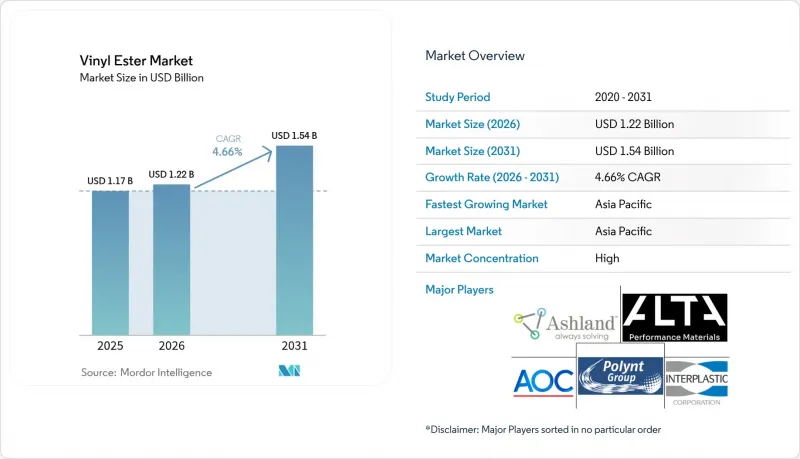
Mordor Intelligence에 의하면, 2026년 비닐 에스테르 시장 규모는 12억 2,000만 달러로 추정되고 있어 2025년 11억 7,000만 달러에서 확대되어, 2031년에는 15억 4,000만 달러에 이를 것으로 예측됩니다.
2026년부터 2031년까지 연평균 성장률(CAGR) 4.66%로 성장할 것으로 전망됩니다.
본 보고서에서는 업계를 ‘유형’(비스페놀 A 디글리시딜 에테르(DGEBA), 에폭시페놀 노보락(EPN), 기타), ‘용도’(파이프 및 탱크, 도료 및 코팅, 운송, 기타),‘지역’(아시아태평양, 북미, 유럽, 남미, 중동 및 아프리카)별로 분류하고 있습니다. 시장 전망은 금액(달러) 기준으로 제시되어 있습니다.
세계 비닐 에스테르 시장 동향 및 인사이트
뛰어난 내화학성 및 내식성
비닐 에스테르 수지는 강철, 콘크리트 또는 폴리에스테르 복합재료보다 산, 알칼리, 용제에 대한 내성이 뛰어나며, 화학 처리 설비, 폐수 처리 시설, 해양 플랫폼의 수명을 연장합니다. 에스테르 결합이 적어 가수분해가 억제되므로, 재료 파손 및 가동 중단에 따른 비용을 절감할 수 있습니다. 실리콘 카바이드 입자를 함유한 새로운 등급은 교반기 및 펌프 하우징의 내마모성을 향상시킵니다. 최종 사용자는 라이프사이클 전반에 걸친 경제성을 점점 더 중요시하게 되었으며, 가동 중단으로 인한 손실이 초기 투자액을 초과하는 경우 비닐 에스테르를 선택하는 경향이 강해지고 있습니다.
재생에너지 분야의 확대
풍력 터빈 블레이드에는 뛰어난 내피로성과 내습성을 갖춘 비닐 에스테르 복합재료가 채택되고 있습니다. 육상 및 해상 풍력 발전소의 설비 용량 확대로 인해 스퍼 캡 및 나셀 커버에 대한 수요가 수년 동안 견인되고 있습니다. 수소 저장 용기 제조업체는 파열 강도 규격을 충족하기 위해 유형 3 실린더에 고탄성률의 비닐 에스테르 랩 재료를 사용하고 있습니다. 95%의 태양광 반사율을 실현하는 주석 처리 유리/비닐 에스테르 재질의 반사판은 집광형 태양광 발전소에서 새로운 가능성을 열어가고 있습니다.
스티렌·에폭시 원료 가격 변동이 이익률을 압박
2024년, 스티렌 및 에폭시 모노머 가격이 급등함에 따라 수지 제조업체들은 비닐 에스테르 배합 수지의 정가를 인상할 수밖에 없었습니다. 현재 이익률 유지는 장기 공급 계약, 헤지 거래, 그리고 배합에 기반한 가격 전가 조항에 달려 있습니다. 또한, 스티렌 함유량을 줄이거나 스티렌을 포함하지 않는 블렌드에 대한 연구도 가속화되고 있습니다.
부문 분석
DGEBA 수지는 선박, 화학, 인프라용 적층판에 적합한 비용과 성능의 균형에 힘입어 2025년 비닐 에스테르 시장 점유율의 53.45%를 차지했습니다. 이 부문은 작업장 내 배출 규제를 완화하는 저스티렌 배합의 지속적인 개발에 힘입어 연평균 성장률(CAGR) 4.74%로 성장을 지속하고, 있습니다. 또한 각 제조업체는 환기 설비가 제한된 생산 현장에서의 채택 확대를 목표로, 스티렌이 포함되지 않은 DGEBA 변형 제품 개발도 추진하고 있습니다.
에폭시·페놀·노보락(EPN) 수지는 시장 규모는 작지만, 고온 스크러버 및 산 플랜트용 수주를 확보하고 있습니다. 브롬계 등급은 철도 차량 내장재의 화염 전파 관련 규격을 충족하고 있으며, 한편 엘라스토머 개질 수지는 충격 흡수성이 필요한 선체 부위에 공급되고 있습니다. 최근 UL 94 V0를 준수하는 컴파운드는 80 MPa를 초과하는 인장 강도를 유지하고 있으며, 이는 할로겐의 과도한 사용을 수반하지 않는 배합 기술의 진보를 반영하고 있습니다.
지역별 분석
아시아태평양은 2025년에 매출 점유율 55.60%를 유지하며, 2031년까지 연평균 4.85%라는 가장 높은 성장률을 보일 전망입니다. 중국과 인도의 정부 지원 철도 회랑, 해수 담수화 프로젝트, 육상 풍력 발전소가 수지 수요를 뒷받침하고 있습니다. 이 지역의 생산자들은 대양 횡단 운송의 위험을 피할 수 있는 현지화된 공급망의 혜택을 누리고 있습니다.
북미에서는 멕시코만 연안의 정유시설 개보수 및 해상 풍력 발전소에 대한 정부의 장려책이 시장을 견인하고 있습니다. 또한, 미국의 비닐 에스테르 시장 규모는 자산 수명을 75년 이상으로 연장하기 위해 내식성 복합재료의 사용이 지정된 교량 데크 교체 프로그램에 의해서도 증가하고 있습니다.
유럽에서는 재활용과 낮은 스티렌 배출이 중시되고 있어 차세대 배합재의 도입이 진행되고 있습니다. 독일과 네덜란드의 수소 실증 허브에 대한 보조금으로 인해 비닐 에스테르 라이너가 장착된 유형 3 탱크에 대한 수요가 가속화되고 있습니다.
남미에서는 브라질의 수처리 시설 확충 및 석유화학 플랜트의 생산 능력 증대에 따라 수주가 견조한 추세를 보이고 있습니다. 한편, 중동에서는 새로운 정제 복합 시설의 해수 담수화용 배관 및 화학 물질 취급 설비에 비닐 에스테르 복합재가 채택되고 있습니다. 아프리카 광업 부문에서는 구리 추출 회로의 내산성 향상을 목적으로 비닐 에스테르 라이너를 적용한 침출 탱크의 시범 운영이 진행되고 있습니다.
기타 혜택:
- 엑셀 형식 시장 예측(ME) 시트
- 3개월간의 애널리스트 지원
자주 묻는 질문
목차
제1장 서론
제2장 조사 방법
제3장 주요 요약
제4장 시장 구도
제5장 시장 규모와 성장 예측
제6장 경쟁 구도
제7장 시장 기회와 향후 전망
JHS 26.09.07According to Mordor Intelligence, vinyl ester market size in 2026 is estimated at USD 1.22 billion, growing from 2025 value of USD 1.17 billion with 2031 projections showing USD 1.54 billion, growing at 4.66% CAGR over 2026-2031.
This report Segments the Industry by Type (Bisphenol A Diglycidyl Ether (DGEBA), Epoxy Phenol Novolac (EPN), and Other Types), Application (Pipes and Tanks, Paints and Coatings, Transportation, and Other Applications), and Geography (Asia-Pacific, North America, Europe, South America, and Middle East and Africa). The Market Forecasts are Provided in Terms of Value (USD).
Global Vinyl Ester Market Trends and Insights
Superior Chemical and Corrosion Resistance
Vinyl ester resins resist acids, alkalis, and solvents better than steel, concrete, or polyester composites, enabling longer service life for chemical processing gear, wastewater assets, and marine platforms. Fewer ester linkages limit hydrolysis, cutting material failures, and shutdown costs. New grades containing silicon-carbide particles boost abrasion resistance for agitators and pump housings. End users increasingly weigh full lifecycle economics, favoring vinyl ester when downtime penalties exceed initial outlay.
Expansion of Renewable Energy Sector
Wind-turbine blades rely on vinyl ester composites for superior fatigue resistance and moisture tolerance. Capacity additions in onshore and offshore parks drive multi-year pull-through for spar caps and nacelle covers. Hydrogen-storage vessel builders use high-modulus vinyl ester wraps on Type 3 cylinders to meet burst-strength codes. Tin-treated glass/vinyl-ester reflectors achieving 95% solar reflectivity unlock scope in concentrated-solar plants.
Styrene/Epoxy Feedstock Price Volatility Pressuring Margins
Styrene and epoxide monomers faced sharp price spikes in 2024, prompting resin makers to raise list prices for vinyl-ester formulations. Margin protection now hinges on long-term supply deals, hedging, and formula-based pass-through clauses. Research into lower-styrene or styrene-free blends is also accelerating.
Other drivers and restraints analyzed in the detailed report include:
- Growing Demand in Infrastructure and Industrial Applications
- Advancements in Composite Manufacturing
- Availability of Substitutes
For complete list of drivers and restraints, kindly check the Table Of Contents.
Segment Analysis
DGEBA resins accounted for 53.45% vinyl ester market share in 2025, underpinned by a cost-to-performance balance suited to marine, chemical, and infrastructure laminates. The segment records a 4.74% CAGR, supported by the ongoing development of low-styrene mixes that ease workplace emission caps. Manufacturers are also pursuing styrene-free DGEBA variants to gain acceptance in tight-ventilation production halls.
Epoxy-phenol-novolac (EPN) resins, though smaller, secure orders for high-temperature scrubbers and acid plants. Brominated grades address flame-spread codes in rail interiors, while elastomer-modified resins supply hull sections needing impact damping. Recent UL 94 V0-compliant compounds maintain tensile strength above 80 MPa, reflecting formulation progress without halogen overuse.
Complete Report Scope:
- By Type
- Bisphenol A Diglycidyl Ether (DGEBA)
- Epoxy Phenol Novolac (EPN)
- Other Types
- By Application
- Pipes and Tanks
- Paints and Coatings
- Transportation
- Other Applications
- By Geography
- Asia-Pacific
- China
- India
- Japan
- South Korea
- Rest of Asia-Pacific
- North America
- United States
- Canada
- Mexico
- Europe
- Germany
- United Kingdom
- France
- Italy
- Rest of Europe
- South America
- Brazil
- Argentina
- Rest of South America
- Middle East and Africa
- Saudi Arabia
- South Africa
- Rest of Middle East and Africa
- Asia-Pacific
Geography Analysis
Asia-Pacific retained a 55.60% revenue share in 2025 and grows fastest at 4.85% through 2031. State-backed rail corridors, desalination projects, and onshore wind farms in China and India underpin the resin offtake. Regional producers benefit from localized supply chains that sidestep transocean freight risks.
North America is buoyed by refinery overhauls along the Gulf Coast and government incentives for offshore wind arrays. The vinyl ester market size in the United States is also lifted by bridge-deck replacement programs that specify corrosion-resistant composites to extend asset life beyond 75 years.
Europe emphasizes recycling and low-styrene emissions, prompting the adoption of next-generation formulations. Grants for hydrogen-demo hubs in Germany and the Netherlands accelerate demand for Type 3 vessels with vinyl-ester liners.
South America sees strong orders in Brazil's water-treatment build-outs and petrochemical capacity additions, while the Middle East applies vinyl-ester composites in desalination piping and chemical handling at new refining complexes. Africa's mining sector is trialing vinyl-ester lined leach tanks to improve acid resistance in copper extraction circuits.
- AOC
- Allnex GmbH
- ALTA Performance Materials
- Ashland Inc.
- Changzhou Tianma Group
- DIC Corporation
- Hexion Inc.
- Huntsman Corporation
- Interplastic Corporation
- Nan Ya Plastics
- Poliya Composite Resins
- Polynt-Reichhold Group
- Reichhold LLC2
- Resoltech
- Resonac Holdings Corporation
- Royal DSM
- Scott Bader Co. Ltd
- Sino Polymer Co. Ltd
- Sir Industriale
- Swancor Holding
Additional Benefits:
- The market estimate (ME) sheet in Excel format
- 3 months of analyst support
TABLE OF CONTENTS
1 Introduction
- 1.1 Study Assumptions and Market Definition
- 1.2 Scope of the Study
2 Research Methodology
3 Executive Summary
4 Market Landscape
- 4.1 Market Overview
- 4.2 Market Drivers
- 4.2.1 Superior Chemical and Corrosion Resistance
- 4.2.2 Growing Application in the Manufacture of Fiber Reinforced Plastic Tanks and Vessels
- 4.2.3 Expansion of Renewable Energy Sector
- 4.2.4 Growing Demand in Infrastructure and Industrial Applications
- 4.2.5 Advancements in Composite Manufacturing
- 4.3 Market Restraints
- 4.3.1 Styrene/Epoxy Feedstock Price Volatility Pressuring Margins
- 4.3.2 Availability of Substitutes
- 4.3.3 Limited Shelf Life
- 4.4 Value Chain Analysis
- 4.5 Porter's Five Forces
- 4.5.1 Threat of New Entrants
- 4.5.2 Bargaining Power of Buyers
- 4.5.3 Bargaining Power of Suppliers
- 4.5.4 Threat of Substitute Products
- 4.5.5 Degree of Competition
- 4.6 Import-Export Trends
- 4.7 Feedstock Analysis
- 4.8 Technological Snapshot
- 4.9 Price Analysis
5 Market Size and Growth Forecasts (Value)
- 5.1 By Type
- 5.1.1 Bisphenol A Diglycidyl Ether (DGEBA)
- 5.1.2 Epoxy Phenol Novolac (EPN)
- 5.1.3 Other Types
- 5.2 By Application
- 5.2.1 Pipes and Tanks
- 5.2.2 Paints and Coatings
- 5.2.3 Transportation
- 5.2.4 Other Applications
- 5.3 By Geography
- 5.3.1 Asia-Pacific
- 5.3.1.1 China
- 5.3.1.2 India
- 5.3.1.3 Japan
- 5.3.1.4 South Korea
- 5.3.1.5 Rest of Asia-Pacific
- 5.3.2 North America
- 5.3.2.1 United States
- 5.3.2.2 Canada
- 5.3.2.3 Mexico
- 5.3.3 Europe
- 5.3.3.1 Germany
- 5.3.3.2 United Kingdom
- 5.3.3.3 France
- 5.3.3.4 Italy
- 5.3.3.5 Rest of Europe
- 5.3.4 South America
- 5.3.4.1 Brazil
- 5.3.4.2 Argentina
- 5.3.4.3 Rest of South America
- 5.3.5 Middle East and Africa
- 5.3.5.1 Saudi Arabia
- 5.3.5.2 South Africa
- 5.3.5.3 Rest of Middle East and Africa
- 5.3.1 Asia-Pacific
6 Competitive Landscape
- 6.1 Market Concentration
- 6.2 Strategic Moves
- 6.3 Market Share Analysis
- 6.4 Company Profiles (includes Global level Overview, Market level overview, Core Segments, Financials as available, Strategic Information, Market Rank/Share for key companies, Products and Services, and Recent Developments)
- 6.4.1 AOC
- 6.4.2 Allnex GmbH
- 6.4.3 ALTA Performance Materials
- 6.4.4 Ashland Inc.
- 6.4.5 Changzhou Tianma Group
- 6.4.6 DIC Corporation
- 6.4.7 Hexion Inc.
- 6.4.8 Huntsman Corporation
- 6.4.9 Interplastic Corporation
- 6.4.10 Nan Ya Plastics
- 6.4.11 Poliya Composite Resins
- 6.4.12 Polynt-Reichhold Group
- 6.4.13 Reichhold LLC2
- 6.4.14 Resoltech
- 6.4.15 Resonac Holdings Corporation
- 6.4.16 Royal DSM
- 6.4.17 Scott Bader Co. Ltd
- 6.4.18 Sino Polymer Co. Ltd
- 6.4.19 Sir Industriale
- 6.4.20 Swancor Holding
7 Market Opportunities and Future Outlook
- 7.1 White-Space and Unmet-Need Assessment
- 7.2 Growing Application in Flue Gas Desulphurization


