

|
시장보고서
상품코드
2123754
제조 실행 시스템 시장 : 점유율 분석, 업계 동향과 통계, 성장 예측(2026-2031년)Manufacturing Execution Systems - Market Share Analysis, Industry Trends & Statistics, Growth Forecasts (2026 - 2031) |
||||||
 Mordor Intelligence
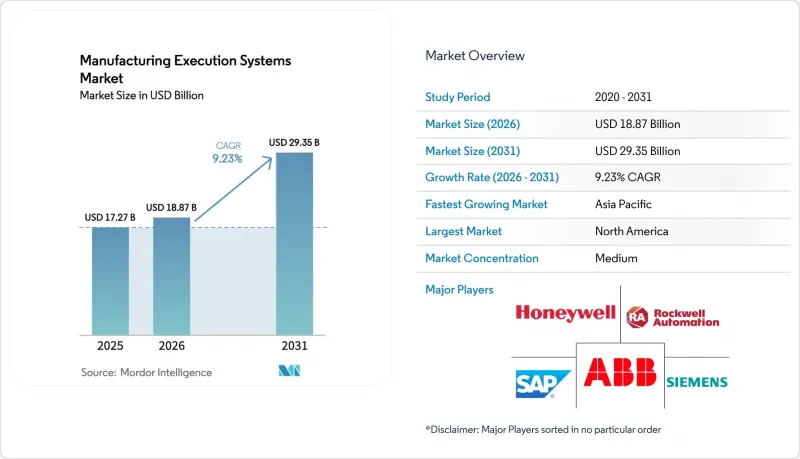
Mordor Intelligence에 의하면, 제조 실행 시스템(MES) 시장 규모는 2025년 172억 7,000만 달러에서 2026년에는 188억 7,000만 달러로 확대되어 2026년부터 2031년까지 CAGR 9.23%로 성장을 지속하여, 2031년까지 293억 5,000만 달러에 이를 것으로 예측됩니다.
본 보고서는 제공 형태(소프트웨어 및 서비스), 도입 형태(On-Premise, 클라우드, 엣지 기반), 최종 사용자 산업(식품 및 음료, 석유 및 가스, 자동차 등), 기업 규모(대기업, 중소기업(SME)), 공정 유형(이산형 제조, 공정 제조 등) 및 지역별로 분류되어 있습니다. 시장 예측은 금액(달러) 기준으로 제시되어 있습니다.
세계 제조 실행 시스템(MES) 시장 동향 및 인사이트
인더스트리 4.0 및 스마트 팩토리 도입
각국의 제조업 정책은 디지털 트윈에 대한 투자에 수반되는 위험을 지속적으로 줄이고 있습니다. 미국에서는 에너지부의 스마트 제조 혁신 연구소가 2025년에 에너지 집약도를 두 자릿수 비율로 절감하는 실증 시험에 자금을 지원했습니다. 독일의 ‘Manufacturing-X’ 프레임워크에서는 상호 운용 가능한 자산 관리 셸이 의무화되어 있어, 연결된 각 기계가 독자적인 노하우를 공개하지 않고도 상태를 공개할 수 있게 되었습니다. 아일랜드는 코크와 리머릭의 제약 클러스터를 대상으로 보조금을 배정했으며, 이를 통해 수탁 제조업체(CMO)들은 스프레드시트에서 모듈식 실행 플랫폼으로의 전환을 추진하고 있습니다. 영국은 혁신 바우처를 검증 가능한 불량률 감소와 연계하여 중견 공급업체들이 플랫폼에 구애받지 않는 데이터 모델을 채택하도록 장려하고 있습니다. 이러한 노력들은 전반적으로 추상적인 정책을 제조 실행 시스템(MES) 시장에 대한 직접적인 수요로 전환시키고 있습니다.
실시간 생산 가시화의 필요성
2024년공급망 혼란은 현장 데이터 지연이 초래하는 비용을 여실히 드러냈습니다. 현재 자동차 OEM 업체들은 Tier 1 공급업체에 1시간 단위의 전자 데이터 교환을 요구하고 있으며, 이는 종이 로그로는 대응할 수 없는 요건입니다. 반도체 팹에서는 계측값을 고급공정제어(APC) 알고리즘으로 스트리밍하는 엣지 게이트웨이를 도입하여, 이상 감지 시간을 몇 시간에서 몇 초로 단축하고 있습니다. 2025년까지 센서 비용은 노드당 5달러 미만으로 떨어질 전망이며, 다품종 소량 생산을 하는 수탁 제조업체에게도 지속적인 모니터링 도입이 정당화되었습니다. 에너지 관리 계층은 현재 기계 가동률과 시간대별 요금을 연동하고 있으며, 구간별 계량이 이루어지는 지역에서는 피크 시간대 요금을 15%-20% 절감하고 있습니다. 그 결과, 제조 실행 시스템 시장에서 실시간 대시보드는 차별화 요소가 아니라 필수 요건으로 자리 잡고 있습니다.
레거시 OT 및 ERP와의 초기 통합 비용
브라운필드 시설은 대개 최신 API보다 이전 시대부터 존재해 온 Modbus나 Profibus와 같은 독자적인 필드버스 네트워크에 의존하고 있습니다. 이러한 ‘고립된 섬’들을 연결하기 위해서는 프로토콜 게이트웨이와 맞춤형 스크립트가 필요하며, 2025년 MESA 조사에 따르면 이는 프로젝트 예산을 40%-60%까지 끌어올리는 결과를 초래합니다. 제약 공장에서는 검증에 따른 추가 비용이 발생합니다. 이곳에서는 모든 변경 사항에 대해 설치, 운영 및 성능 적격성 평가가 필요하며, 이는 수개월이 소요되고 수십만 달러의 비용이 듭니다. 이러한 통합 부담은 ROI 모델의 첫해 실적을 압박하고, 추가 모듈에 대한 이사회 승인을 지연시키며, 제조 실행 시스템(MES) 시장의 성장을 둔화시킬 가능성이 있습니다.
부문 분석
제조업체들이 통합, 검증 및 분석을 외부에 위탁함에 따라, 2031년까지 서비스 매출이 소프트웨어 매출을 넘어설 것으로 예측됩니다. 2025년에는 소프트웨어가 총 수요의 58.64%를 차지했지만, 여러 공장으로의 확장이 점점 더 복잡해짐에 따라 관리형 서비스는 두 자릿수 성장을 이루고 있습니다. 'Validation-as-a-Service(검증 서비스)' 번들 덕분에 제약 업계의 적합성 평가 기간이 9개월에서 12주로 단축되었으며, 이것이 제조 실행 시스템(MES) 시장 규모에서 전문적인 지원이 라이선스 비용을 상회하는 이유입니다. 예측 유지보수 및 전환 최적화를 통합한 원격 모니터링 패키지는 사내에 데이터 사이언스자를 보유하지 않은 자동차 업계의 티어 기업들 사이에서 특히 인기가 높습니다.
관리형 서비스는 인재의 가교 역할도 수행하고 있습니다. ISA-95 아키텍트 및 클라우드 네이티브 DevOps 엔지니어의 부족으로 인해 공장 측에서는 성과 기반 계약을 체결하고 있습니다. 벤더가 가동 시간, 패치 적용, 업그레이드에 대한 책임을 지게 됨으로써, 설비 투자를 사실상 운영 비용(OPEX)으로 전환하고 있습니다. 이러한 재편을 통해 기업의 현금 흐름 우선순위와 지속적인 개선 주기가 일치하게 되어, 제조 실행 시스템(MES) 시장을 견인하고 있습니다.
2025년, 제약 및 반도체 업계의 엄격한 검증 규정에 따라 On-Premise형 시스템은 제조 실행 시스템 시장에서 62.46%의 점유율을 차지했습니다. 그러나 중소기업 및 수탁 제조업체들이 서버 소유보다 신속한 구성을 중시함에 따라 클라우드 플랫폼은 연평균 10.12%의 성장률을 기록하고 있습니다. 엣지 네이티브 하이브리드 시스템은 시간 제약이 있는 루프 처리를 로컬에서 실행하면서 집계된 지표를 클라우드 대시보드에 동기화함으로써, 지연 시간 및 데이터 주권에 대한 우려를 해소합니다. ‘CHIPS and Science Act’는 분산된 팀이 접근할 수 있는 디지털 트윈 기반의 수율 대시보드에 대한 자금 지원을 규정하고 있어, 미국 내 신규 팹에서의 클라우드 도입을 촉진하고 있습니다.
사이버 보안은 여전히 가장 큰 장벽으로 남아 있습니다. 클라우드 서비스를 위한 IEC 62443 인증은 On-Premise 기준에 뒤처져 있으며, 제약 업계의 CMO(수탁 제조업체)는 서버 설치 위치를 고정하기 위해 데이터 거주 조항을 협상하고 있습니다. 그럼에도 불구하고, 유럽의 ‘디지털 제품 여권(Digital Product Passport)’ 및 유사한 규제에서는 보안이 보장된 API가 요구되고 있으며, 클라우드 인프라는 On-Premise 포털보다 비용 효율적으로 이를 제공합니다. 규제 체계가 강화됨에 따라 제조 실행 시스템(MES) 시장의 도입 형태는 하이브리드 클라우드로 기울고 있습니다.
지역별 분석
북미가 주도적인 위치를 차지하고 있는 배경에는 527억 달러에 달하는 반도체 산업에 대한 인센티브와 견고한 제약 산업 기반이 있습니다. 인텔의 오하이오주 및 애리조나주 팹과 TSMC의 피닉스 거점에서는 디지털 트윈을 활용한 수율 대시보드가 도입되어 있으며, 이것이 실행 예산의 기반이 되고 있습니다. 뉴저지주 및 푸에르토리코의 제약 허브에서는 FDA의 시리얼화 및 공정 검증 규정을 충족하기 위해 배치 스위트에 연속 반응 장치를 사후 도입하고 있습니다. 캐나다 온타리오주의 자동차 산업 회랑에서는 전기차 생산 대수가 증가함에 따라 배터리 팩의 추적 가능성이 통합되고 있는 반면, 멕시코 바히오 지역의 중소기업들은 IATF 16949 감사에 신속하게 대응하기 위해 클라우드 스위트를 도입하고 있습니다.
아시아태평양의 예상 연평균 성장률(CAGR) 11.94%는 정책 및 공급망의 변화를 반영하고 있습니다. 중국의 공업정보화부는 산업용 인터넷 시범 사업을 지원하고 있으며, 이러한 사업들은 본격적인 전개 단계로 접어들고 있습니다. 인도의 보조금 제도는 디지털화 증명을 조건으로 하고 있어, 이는 전자 및 제약 분야의 중소기업에서 디지털화를 추진하는 데 박차를 가하고 있습니다. 동남아시아는 단일 공급원 지역에서 이전해 오는 전자 및 자동차 생산 라인을 수용하고 있으며, 각 OEM은 공급업체의 진입 기준으로 실행 시스템의 준수를 의무화하고 있습니다. 일본은 노동력 부족에 대처하기 위해 예측 유지보수에 주력하고 있는 반면, 호주 및 뉴질랜드는 식품 수출 브랜드 보호를 위해 추적성을 도입하고 있습니다.
유럽은 규제의 압박 속에서 전진하고 있습니다. 독일에서는 디지털 여권 규정을 충족하기 위해 배터리 셀 생산 라인의 개조가 진행되고 있습니다. 영국의 제약 거점은 브렉시트로 인한 비용 압박을 상쇄하기 위해 연속 제조 시범 사업에 자금을 지원하고 있습니다. 프랑스의 방위 산업 관련 공장에서는 ITAR(국제무기거래규정) 준수를 위해 On-Premise 방식에 에어갭을 갖춘 시스템 도입이 선호되고 있습니다. 이탈리아의 PDO 인증 식품 가공업체는 실행 계층을 활용하여 원산지를 인증하고 있으며, 스페인의 1차 자동차 부품 공급업체는 국경을 초월한 공장 간 협력을 도모하기 위해 클라우드 플랫폼을 도입하고 있습니다. 러시아의 정유시설에서는 제재로 인해 서유럽의 라이선스 이용이 제한된 상황에서도 히스토리안과의 통합을 통해 운영 최적화를 도모하고 있습니다.
기타 혜택:
- 엑셀 형식 시장 예측(ME) 시트
- 3개월간의 애널리스트 지원
자주 묻는 질문
목차
제1장 서론
제2장 조사 방법
제3장 주요 요약
제4장 시장 구도
제5장 시장 규모와 성장 예측
제6장 경쟁 구도
제7장 시장 기회와 향후 전망
JHS 26.09.07According to Mordor Intelligence, the manufacturing execution systems market size is expected to grow from USD 17.27 billion in 2025 to USD 18.87 billion in 2026 and is forecast to reach USD 29.35 billion by 2031 at 9.23% CAGR over 2026-2031.
This report is Segmented by Offering (Software, and Service), Deployment (On-Premise, Cloud, and Edge-Based), End-User Industry (Food and Beverage, Oil and Gas, Automotive, and More), Enterprise Size (Large Enterprises, Small and Medium Enterprises (SMEs)), Process Type (Discrete Manufacturing, Process Manufacturing, and More), and Geography. The Market Forecasts are Provided in Terms of Value (USD).
Global Manufacturing Execution Systems Market Trends and Insights
Industry 4.0 And Smart-Factory Roll-outs
National manufacturing agendas continue to de-risk digital-twin investments. In the United States, the Department of Energy's Smart Manufacturing Innovation Institute funded live production trials in 2025 that cut energy intensity by double-digit percentages. Germany's Manufacturing-X framework requires interoperable asset-administration shells, ensuring that each connected machine can publish status without revealing proprietary know-how. Ireland earmarked grants for pharmaceutical clusters in Cork and Limerick, prompting contract manufacturers to swap spreadsheets for modular execution platforms. The United Kingdom tied innovation vouchers to verifiable scrap-rate reductions, prompting mid-tier suppliers to adopt platform-agnostic data models. Collectively, these initiatives convert abstract policy into direct demand for the manufacturing execution systems (MES) market.
Need For Real-Time Production Visibility
Supply-chain disruptions in 2024 exposed the cost of delayed shop-floor data. Automotive OEMs now require hourly electronic data interchange from tier-1 suppliers, an expectation that paper logs cannot meet. Semiconductor fabs deploy edge gateways that stream metrology readings to advanced process-control algorithms, shrinking excursion detection windows from hours to seconds. By 2025, sensor costs fell below USD 5 per node, enabling high-mix job shops to justify continuous monitoring. Energy-management layers now link machine utilization with time-of-use tariffs, carving 15%-20% off peak charges in regions with interval metering. As a result, live dashboards are becoming table stakes rather than differentiators in the manufacturing execution systems market.
Up-Front Integration Cost With Legacy OT And ERP
Brownfield facilities often rely on proprietary fieldbus networks such as Modbus or Profibus that predate modern APIs. Bridging these islands requires protocol gateways and custom scripts, inflating project budgets by 40%-60% according to a 2025 MESA survey. Pharmaceutical sites add validation overhead, where every change triggers installation, operational, and performance qualifications that consume months and hundreds of thousands of dollars. Such integration burdens can exhaust the first year of ROI models, delaying board approval for incremental modules and tempering growth in the manufacturing execution systems (MES) market.
Other drivers and restraints analyzed in the detailed report include:
- Compliance-Driven Digital Traceability
- SaaS Pricing Lowers CapEx Barriers
- Cyber-Security Risks In Cloud-Connected Plants
For complete list of drivers and restraints, kindly check the Table Of Contents.
Segment Analysis
Services revenue is set to outpace software through 2031 as manufacturers outsource integration, validation, and analytics. In 2025, software generated 58.64% of topline demand, yet the growing complexity of multi-plant roll-outs is unlocking double-digit expansion for managed services. Validation-as-a-service bundles shorten pharmaceutical qualification phases from nine months to twelve weeks, illustrating why professional support is eclipsing license fees in the manufacturing execution systems (MES) market size. Remote monitoring packages embedding predictive maintenance and changeover optimization are especially popular among automotive tiers that lack in-house data scientists.
Managed services also act as a talent bridge. Scarcity of ISA-95 architects and cloud-native DevOps engineers prompts factories to contract outcome-based agreements. Vendors assume responsibility for uptime, patching, and upgrades, effectively converting capital purchases into opex lines. This realignment aligns corporate cash-flow preferences with continuous improvement cycles, bolstering the manufacturing execution systems market.
On-premise systems held a 62.46% manufacturing execution systems market share in 2025 due to stringent pharma and semiconductor validation rules. Cloud platforms, however, are growing 10.12% annually as SMEs and contract manufacturers favor rapid configuration over server ownership. Edge-native hybrids satisfy latency and data-sovereignty concerns by performing time-critical loops locally while syncing aggregated metrics to cloud dashboards. The CHIPS and Science Act now ties funding to digital-twin yield dashboards accessible to distributed teams, catalyzing cloud adoption in new U.S. fabs.
Cybersecurity remains the chief hurdle. IEC 62443 certification for cloud services trails on-premise norms, and pharma CMOs negotiate data-residency clauses to lock server locations. Even so, Europe's Digital Product Passport and similar regulations require secure APIs that cloud infrastructure delivers more cost-effectively than on-premise portals. As regulatory glue hardens, the deployment mix within the manufacturing execution systems market is tilting toward hybrid-cloud.
Complete Report Scope:
- By Offering
- Software
- Services
- By Deployment Mode
- On-Premise
- Cloud
- Edge-Based
- By End-User Industry
- Food and Beverage
- Oil and Gas
- Pharmaceutical and Life Sciences
- Automotive
- Electronics and Semiconductor
- Chemicals
- Metals and Mining
- Pulp and Paper
- Aerospace and Defense
- Other End-User Industries
- By Enterprise Size
- Large Enterprises
- Small and Medium Enterprises
- By Process Type
- Discrete Manufacturing
- Process Manufacturing
- Hybrid
- By Geography
- North America
- United States
- Canada
- Mexico
- South America
- Brazil
- Argentina
- Rest of South America
- Europe
- Germany
- United Kingdom
- France
- Italy
- Spain
- Russia
- Rest of Europe
- Asia Pacific
- China
- Japan
- South Korea
- India
- Australia and New Zealand
- Rest of Asia Pacific
- Middle East
- Saudi Arabia
- United Arab Emirates
- Turkey
- Rest of Middle East
- Africa
- South Africa
- Nigeria
- Rest of Africa
- North America
Geography Analysis
North America's leadership stems from USD 52.7 billion in semiconductor incentives and a robust pharmaceutical base. Intel's Ohio and Arizona fabs and TSMC's Phoenix site embed digital-twin yield dashboards, anchoring execution budgets. Pharmaceutical hubs in New Jersey and Puerto Rico retrofit batch suites with continuous reactors to satisfy FDA serialization and process-verification rules. Canada's Ontario auto corridor now integrates battery-pack traceability as EV volumes scale, while Mexico's Bajio SMEs deploy cloud suites to meet IATF 16949 audits rapidly.
Asia Pacific's 11.94% forecast CAGR reflects policy and supply-chain shifts. China's Ministry of Industry and Information Technology backs industrial-internet pilots that graduate into full-scale deployments. India's subsidies hinge on proof of digitization, driving adoption among electronics and pharma SMEs. Southeast Asia absorbs electronics and automotive lines relocating from single-source geographies, and each OEM mandates execution-system compliance as supplier entry criteria. Japan focuses on predictive maintenance to counteract labor shortages, while Australia and New Zealand embed traceability to protect food-export brands.
Europe advances under the weight of regulation. Germany retrofits battery-cell lines to meet digital passport rules. United Kingdom pharma centers fund continuous-manufacturing pilots to offset Brexit-related cost pressures. France's defense plants favor on-premise, air-gapped deployments for ITAR compliance. Italy's PDO food processors use execution layers to authenticate provenance, and Spain's tier-1 automotive suppliers adopt cloud platforms to synchronize cross-border plants. Russia's refinery optimizations rely on historian integrations, even as sanctions curb Western licenses.
- Siemens AG
- Rockwell Automation Inc.
- SAP SE
- ABB Ltd.
- Honeywell International Inc.
- Dassault Systemes SE
- Schneider Electric SE
- Applied Materials Inc.
- Oracle Corporation
- GE Vernova
- Emerson Electric Co.
- Epicor Software Corp.
- Yokogawa Electric Corp.
- AVEVA Group plc
- Korber AG (Werum)
- MPDV Mikrolab GmbH
- Plex Systems
- iBASEt
- Parsec Automation Corp.
- Critical Manufacturing SA
- Aegis Software
- Aspen Technology Inc.
- Mitsubishi Electric Corp.
- Infor Inc.
- Tata Consultancy Services
- LandT Technology Services
Additional Benefits:
- The market estimate (ME) sheet in Excel format
- 3 months of analyst support
TABLE OF CONTENTS
1 INTRODUCTION
- 1.1 Study Assumptions and Market Definition
- 1.2 Scope of the Study
2 RESEARCH METHODOLOGY
3 EXECUTIVE SUMMARY
4 MARKET LANDSCAPE
- 4.1 Market Overview
- 4.2 Market Drivers
- 4.2.1 Industry 4.0 and Smart-Factory Roll-outs
- 4.2.2 Need for Real-Time Production Visibility
- 4.2.3 Compliance-Driven Digital Traceability
- 4.2.4 SaaS Pricing Lowers CapEx Barriers for Tier-2 Suppliers
- 4.2.5 Rise of Low-Code Composable MES Among SMEs
- 4.2.6 OEE-as-a-Service Linked to IIoT Edge Analytics
- 4.3 Market Restraints
- 4.3.1 Up-Front Integration Cost with Legacy OT and ERP
- 4.3.2 Cyber-Security Risks in Cloud-Connected Plants
- 4.3.3 OT and IT Skill-Gap Stalling Advanced MES Roll-outs
- 4.3.4 IP-Exposure Fears Among Contract Manufacturers
- 4.4 Industry Value / Supply-Chain Analysis
- 4.5 Regulatory Landscape
- 4.6 Technological Outlook
- 4.7 Impact of Macroeconomic Factors on the Market
- 4.8 Porter's Five Forces Analysis
- 4.8.1 Bargaining Power of Suppliers
- 4.8.2 Bargaining Power of Buyers
- 4.8.3 Threat of New Entrants
- 4.8.4 Threat of Substitute Products
- 4.8.5 Degree of Competition
5 MARKET SIZE AND GROWTH FORECASTS (VALUE)
- 5.1 By Offering
- 5.1.1 Software
- 5.1.2 Services
- 5.2 By Deployment Mode
- 5.2.1 On-Premise
- 5.2.2 Cloud
- 5.2.3 Edge-Based
- 5.3 By End-User Industry
- 5.3.1 Food and Beverage
- 5.3.2 Oil and Gas
- 5.3.3 Pharmaceutical and Life Sciences
- 5.3.4 Automotive
- 5.3.5 Electronics and Semiconductor
- 5.3.6 Chemicals
- 5.3.7 Metals and Mining
- 5.3.8 Pulp and Paper
- 5.3.9 Aerospace and Defense
- 5.3.10 Other End-User Industries
- 5.4 By Enterprise Size
- 5.4.1 Large Enterprises
- 5.4.2 Small and Medium Enterprises
- 5.5 By Process Type
- 5.5.1 Discrete Manufacturing
- 5.5.2 Process Manufacturing
- 5.5.3 Hybrid
- 5.6 By Geography
- 5.6.1 North America
- 5.6.1.1 United States
- 5.6.1.2 Canada
- 5.6.1.3 Mexico
- 5.6.2 South America
- 5.6.2.1 Brazil
- 5.6.2.2 Argentina
- 5.6.2.3 Rest of South America
- 5.6.3 Europe
- 5.6.3.1 Germany
- 5.6.3.2 United Kingdom
- 5.6.3.3 France
- 5.6.3.4 Italy
- 5.6.3.5 Spain
- 5.6.3.6 Russia
- 5.6.3.7 Rest of Europe
- 5.6.4 Asia Pacific
- 5.6.4.1 China
- 5.6.4.2 Japan
- 5.6.4.3 South Korea
- 5.6.4.4 India
- 5.6.4.5 Australia and New Zealand
- 5.6.4.6 Rest of Asia Pacific
- 5.6.5 Middle East
- 5.6.5.1 Saudi Arabia
- 5.6.5.2 United Arab Emirates
- 5.6.5.3 Turkey
- 5.6.5.4 Rest of Middle East
- 5.6.6 Africa
- 5.6.6.1 South Africa
- 5.6.6.2 Nigeria
- 5.6.6.3 Rest of Africa
- 5.6.1 North America
6 COMPETITIVE LANDSCAPE
- 6.1 Market Concentration
- 6.2 Strategic Moves
- 6.3 Market Share Analysis
- 6.4 Company Profiles (includes Global Level Overview, Market Level Overview, Core Segments, Financials as Available, Strategic Information, Market Rank/Share for Key Companies, Products and Services, and Recent Developments)
- 6.4.1 Siemens AG
- 6.4.2 Rockwell Automation Inc.
- 6.4.3 SAP SE
- 6.4.4 ABB Ltd.
- 6.4.5 Honeywell International Inc.
- 6.4.6 Dassault Systemes SE
- 6.4.7 Schneider Electric SE
- 6.4.8 Applied Materials Inc.
- 6.4.9 Oracle Corporation
- 6.4.10 GE Vernova
- 6.4.11 Emerson Electric Co.
- 6.4.12 Epicor Software Corp.
- 6.4.13 Yokogawa Electric Corp.
- 6.4.14 AVEVA Group plc
- 6.4.15 Korber AG (Werum)
- 6.4.16 MPDV Mikrolab GmbH
- 6.4.17 Plex Systems
- 6.4.18 iBASEt
- 6.4.19 Parsec Automation Corp.
- 6.4.20 Critical Manufacturing SA
- 6.4.21 Aegis Software
- 6.4.22 Aspen Technology Inc.
- 6.4.23 Mitsubishi Electric Corp.
- 6.4.24 Infor Inc.
- 6.4.25 Tata Consultancy Services
- 6.4.26 LandT Technology Services
7 MARKET OPPORTUNITIES AND FUTURE OUTLOOK
- 7.1 White-Space and Unmet-Need Assessment


