

|
시장보고서
상품코드
2123761
PD-1 및 PD-L1 억제제 시장 : 점유율 분석, 업계 동향과 통계, 성장 예측(2026-2031년)PD-1 And PD-L1 Inhibitors - Market Share Analysis, Industry Trends & Statistics, Growth Forecasts (2026 - 2031) |
||||||
 Mordor Intelligence
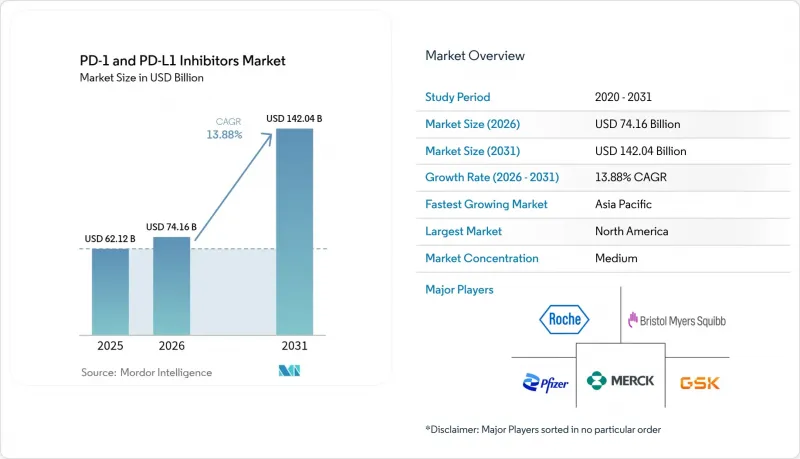
PD-1 및 PD-L1 억제제 시장 규모는 2025년에 621억 2,000만 달러, 2026년에 741억 6,000만 달러가 되어, 2031년까지 1,420억 4,000만 달러에 이를 것으로 예측되며, 2026년부터 2031년까지 CAGR 13.88%로 성장할 전망입니다.

본 보고서는 억제제 유형(PD-1 억제제 및 PD-L1 억제제), 적응증(비소세포폐암 등), 유통 채널(병원 약국, 소매 약국, 온라인 약국) 및 지역(북미, 유럽, 아시아태평양, 중동 및 아프리카, 남미)별로 분류되어 있습니다. 시장 전망은 금액(달러) 기준으로 제시되어 있습니다.
세계 PD-1 및 PD-L1 억제제 시장 동향 및 인사이트
면역종양학 약물에 대한 유리한 규제 경로
2024년 11월, Arcus Biosciences는 PD-L1 고발현 전이성 비소세포폐암을 대상으로 한 ‘돔바나리맙 + 진베렐리맙’ 병용 요법에 대해 신속 승인을 획득했습니다. 이 승인은 해당 회사가 2027년까지 제3상 임상시험을 통해 생존 기간 연장 효과를 입증하는 것을 조건으로 합니다. 마찬가지로, 중국의 조건부 승인 제도는 티슬레리주맙 등 국내 바이오의약품의 승인 절차를 가속화하는 한편, 시판 후 실세계 데이터(RWE) 제출을 의무화하고 있습니다. 이러한 신속 승인 경로는 초기 단계의 자본 리스크를 완화하는 한편, 중요한 평가 변수가 달성되지 않을 경우 승인이 취소될 위험도 높입니다. 예를 들어, 펨브롤리주맙의 삼중음성 유방암에 대한 적응증은 평가 변수 미달성으로 인해 2024년 3월에 취소되었습니다.
병용 면역요법의 수용 확대
PD-L1 발현이 낮은 경우나 면역학적으로 ‘콜드’한 종양 미세환경에서는 이중 체크포인트 억제 요법,면역요법(IO)과 화학요법의 병용, 그리고 면역요법(IO)과 티로신 키나제 억제제(TKI)의 병용이 단일 요법을 대체하는 경향이 강해지고 있습니다. 니볼루맙과 이필리무맙 병용 요법은 중등도 또는 고위험 신세포암(RCC)에서 전체 생존 기간(OS)의 중앙값이 55.7개월임을 입증했으며, 옵디보의 2024년 매출의 18%를 차지하고 있습니다. 미국에서는 펨브롤리주맙과 화학요법의 병용 요법이 전이성 비소세포폐암(NSCLC) 1차 치료의 62%를 차지하고 있으며, 그 배경에는 5년 생존율의 지속적인 개선 효과가 있습니다. 아테졸리주맙과 베바시주맙의 병용 요법은 절제 불가능한 간세포암(HCC) 시장을 선도하고 있으며, 47개국에서 보험 적용이 승인되었습니다. 3제 병용 요법은 후기 임상시험 단계로 진행되고 있으나, 중증 독성(3-4등급) 등의 과제도 존재합니다.
주요 체크포인트 억제제의 독점권 상실이 임박해 있습니다.
니볼루맙의 주요 항체 특허는 2026년 7월에 만료되며, 펨브롤리주맙의 특허는 2028년 6월에 만료되지만, 소아 적응증에 따른 연장으로 인해 2028년 12월까지 유효합니다. 8개의 바이오시밀러 개발 기업이 3상 임상시험을 진행 중이지만, FDA의 2024년 외삽에 관한 지침에 따라 다중 적응증에 대한 출시가 최대 18개월 지연될 가능성이 있습니다. 미국 내 순가격 하락률은 시장 진입 후 2년 동안 25-30%로 예측되며, 이는 아달리무맙의 사례보다 약간 낮은 수준입니다.
부문 분석
2025년 매출액 중 PD-1 억제제가 80.92%를 차지하고 있으며, 이는 20개 적응증에 걸친 펨브롤리주맙의 주도적 지위와 흑색종 및 신세포암(RCC) 분야에서 니볼루맙이 확고히 자리 잡은 것을 반영합니다. PD-1 및 PD-L1 억제제 시장은 2026년 600억 달러에서 2031년까지 1,081억 달러로 연평균 성장률(CAGR) 12.7%를 기록하며 확대될 것으로 예측됩니다. PD-L1 억제제는 시장 전체의 성장률을 상회하는 속도로 확대되어 연간 15.43%의 성장률이 예상됩니다. 이는 듀르발마브가 절제 불가능한 3기 비소세포폐암(NSCLC) 분야에서 입지를 공고히 하고, 아테졸리주맙·베바시주맙이 47개국에서 간세포암에 대한 보험 적용을 획득했기 때문입니다.
듀르발마브는 PACIFIC 임상시험 결과를 바탕으로 2024년에 전 세계 매출 32억 달러를 달성할 것으로 예상되며, 2032년 특허 만료 시까지 직접적인 경쟁 제품이 존재하지 않습니다. 아테졸리주맙은 2025년 중반까지 간세포암(HCC)의 1차 치료에서 신규 투여의 48%를 차지하며, PD-1 및 PD-L1 억제제 시장에서의 점유율을 확대했습니다. 피하 투여 제제에는 추가적인 성장 여지가 있습니다. ‘테센트릭 SC’의 제3상 임상시험에서는 5분 내 주사 완료를 목표로 하고 있으며, 이를 통해 정맥 주사가 외래 진료나 재택치료로 전환될 가능성이 있습니다.
지역별 분석
북미는 메디케어의 보상 제도와 탄탄한 임상시험 인프라에 힘입어 2025년 매출의 43.21%를 차지했습니다. ‘인플레이션 억제법’에 따라 2027년 펨브롤리주맙의 가격이 재협상될 예정이며, 이에 따라 미국의 매출 성장률은 한 자릿수 중반으로 둔화될 가능성이 있습니다. 캐나다에서는 평균 35%의 리베이트 조건으로 전국적인 공적 보험 적용이 확보되었으나, 멕시코에서는 PD-L1 50% 이상의 비소세포폐암(NSCLC)에 대한 펨브롤리주맙의 적용이 추가되었음에도 불구하고, 소규모 주에서는 공급 부족에 직면하고 있습니다.
유럽은 28%의 점유율로 2위를 차지했습니다. 독일과 프랑스에서는 ‘상당한’ 또는 ‘중요한’ 유효성 평가를 받아 비교 대상 약물에 비해 15-28%의 가격 프리미엄이 적용되고 있지만, 영국에서는 상당한 비공개 할인이 요구되고 있습니다. 이탈리아 시장 진입 관리 계약과 스페인의 보험 급여 승인까지의 기간이 비교적 짧은 점이 3차 의료기관 이외 시장으로의 확산을 촉진하고 있습니다.
아시아태평양은 2031년까지 연평균 성장률(CAGR) 14.65%로 확대될 것으로 예측됩니다. 이는 중국의 국내 4개 제제(티슬렐리주맙, 신틸리맙, 트리파리맙, 셀풀리맙)가 40-60% 할인된 가격으로 책정되어 현재 전국적으로 보험 적용되고 있는 것이 원동력이 되고 있습니다. 일본에서는 보조금 상한선을 인상하고 환자의 본인 부담금을 3분의 1로 줄임으로써 고령자의 치료 시작이 촉진되고 있습니다. 인도에서는 2027년까지 60% 저렴한 비용으로 시장에 출시될 전망인 국산 펨브롤리주맙 바이오시밀러의 3상 임상시험이 승인되어, 공립 병원으로의 보급이 진행되고 있습니다.
중동 및 아프리카 및 남미를 합치면 시장 점유율의 6%를 차지하고 있습니다. 아랍에미리트(UAE)는 2024년에 펨브롤리주맙을 전국적으로 보험 적용 대상으로 지정했으며, 남아프리카공화국은 머크사와 기술 이전 라이선스 계약을 체결하여 70% 저렴한 가격으로 현지 생산을 진행하게 되었습니다. 브라질의 ANVISA는 새로운 적응증을 승인했으나, SUS(브라질 공적 의료 제도)에 의한 보험 적용은 아직 결정되지 않은 상태이며, 민간 보험 가입 환자의 접근에 제한이 발생하고 있습니다.
기타 혜택:
- 엑셀 형식 시장 예측(ME) 시트
- 3개월간의 애널리스트 지원
자주 묻는 질문
목차
제1장 서론
제2장 조사 방법
제3장 주요 요약
제4장 시장 구도
제5장 시장 규모와 성장 예측
제6장 경쟁 구도
제7장 시장 기회와 향후 전망
JHS 26.09.11According to Mordor Intelligence, the PD-1 and PD-L1 inhibitors market size is projected to be USD 62.12 billion in 2025, USD 74.16 billion in 2026, and reach USD 142.04 billion by 2031, growing at a CAGR of 13.88% from 2026 to 2031.
This report is Segmented by Type of Inhibitors (PD-1 Inhibitors and PD-L1 Inhibitors), Application (Non-Small Cell Lung Cancer, and More), Distribution Channel (Hospital Pharmacies, Retail Pharmacies, and Online Pharmacies), and Geography (North America, Europe, Asia-Pacific, Middle East & Africa, and South America). The Market Forecasts are Provided in Terms of Value (USD).
Global PD-1 And PD-L1 Inhibitors Market Trends and Insights
Favorable Regulatory Pathways for Immuno-Oncology Agents
In November 2024, Arcus Biosciences achieved accelerated approval for its drug combination, domvanalimab + zimberelimab, targeting PD-L1-high metastatic NSCLC. This approval is contingent on the company demonstrating survival benefits through Phase III trials by 2027. Similarly, China's conditional approval framework accelerates the approval process for domestic biologics, such as tislelizumab, while requiring post-marketing real-world evidence (RWE) submissions. These expedited pathways reduce early-stage capital risks but also increase exposure to potential withdrawal if critical endpoints are not met. For instance, pembrolizumab's indication for triple-negative breast cancer was rescinded in March 2024 due to unmet endpoints.
Growing Acceptance of Combination Immunotherapies
Dual checkpoint blockade, IO-chemotherapy, and IO-TKI pairings are increasingly replacing monotherapy in cases of low PD-L1 expression or immunologically "cold" tumor microenvironments. The combination of nivolumab and ipilimumab has demonstrated a median overall survival (OS) of 55.7 months in intermediate- or poor-risk renal cell carcinoma (RCC), contributing 18% to Opdivo's 2024 revenue. In the United States, pembrolizumab with chemotherapy accounts for 62% of first-line metastatic non-small cell lung cancer (NSCLC) treatments, driven by its durable 5-year survival benefits. Atezolizumab combined with bevacizumab leads the market for unresectable hepatocellular carcinoma (HCC) and has achieved reimbursement in 47 countries. While triplet regimens are advancing into late-stage trials, challenges such as high-grade toxicities (grades 3-4).
Imminent Loss of Exclusivity for Leading Checkpoint Inhibitors
Nivolumab's core antibody patent expired in July 2026, and pembrolizumab's patent expires in June 2028, with a pediatric extension to December 2028. Eight biosimilar sponsors are in Phase III, but the FDA's 2024 extrapolation guidance may delay multi-indication launches by up to 18 months. Net U.S. price erosion is projected at 25-30% over the two years post-entry, slightly below the adalimumab experience.
Other drivers and restraints analyzed in the detailed report include:
- Advancements in Predictive Biomarkers and Diagnostics
- Expanding Clinical Application Across Multiple Tumor Types
- Stringent Health Technology Assessments on Cost Effectiveness
For complete list of drivers and restraints, kindly check the Table Of Contents.
Segment Analysis
PD-1 agents represented 80.92% of 2025 revenue, reflecting pembrolizumab's leadership across 20 indications and nivolumab's entrenchment in melanoma and RCC. The PD-1 and PD-L1 inhibitor market is projected to grow from USD 60.0 billion in 2026 to USD 108.1 billion by 2031, at a 12.7% CAGR. PD-L1 inhibitors are set to outpace overall expansion, rising 15.43% annually as durvalumab consolidates its role in unresectable stage III NSCLC, and atezolizumab-bevacizumab secures reimbursement for hepatocellular carcinoma in 47 nations.
Durvalumab achieved USD 3.2 billion in global sales in 2024 under the PACIFIC paradigm and faces no direct rivals before the 2032 patent expiry. Atezolizumab captured 48% of first-line HCC starts by mid-2025, lifting its share inside the PD-1 and PD-L1 inhibitors market. Subcutaneous formulations offer further upside: Phase III Tecentriq SC aims for a five-minute injection that could shift infusions to outpatient clinics or even home care.
Complete Report Scope:
- By Type Of Inhibitors
- PD-1 Inhibitors
- PD-L1 Inhibitors
- By Application
- Non-Small Cell Lung Cancer
- Melanoma
- Kidney Cancer
- Hodgkin Lymphoma
- Other Cancers
- By Distribution Channel
- Hospital Pharmacies
- Retail Pharmacies
- Online Pharmacies
- Geography
- North America
- United States
- Canada
- Mexico
- Europe
- Germany
- United Kingdom
- France
- Italy
- Spain
- Rest of Europe
- Asia-Pacific
- China
- Japan
- India
- Australia
- South Korea
- Rest of Asia-Pacific
- Middle East & Africa
- GCC
- South Africa
- Rest of Middle East & Africa
- South America
- Brazil
- Argentina
- Rest of South America
- North America
Geography Analysis
North America accounted for 43.21% of 2025 revenue, driven by Medicare reimbursement and a dense clinical-trial infrastructure. The Inflation Reduction Act will negotiate pembrolizumab prices for 2027, potentially trimming U.S. sales growth to mid-single digits. Canada secured nationwide public reimbursement with an average 35% rebate, while Mexico added pembrolizumab for PD-L1 >= 50% NSCLC but faces supply gaps in smaller states.
Europe placed second at 28% share. Germany and France granted "considerable" or "important" benefit ratings, translating into 15-28% premiums relative to comparators, whereas the U.K. demands deep confidential discounts. Italy's managed-entry contracts and Spain's shorter reimbursement lags facilitate penetration beyond tertiary centers.
Asia-Pacific is projected to add 14.65% CAGR through 2031, propelled by China's domestic quartet-tislelizumab, sintilimab, toripalimab, and serplulimab-priced at 40-60% discounts and now reimbursed nationwide. Japan broadened subsidy ceilings to cut patient co-pays by one-third, boosting initiation among seniors. India green-lit Phase III studies for a local pembrolizumab biosimilar that could arrive by 2027 at 60% lower cost, extending reach into public hospitals.
The Middle East & Africa, plus South America, jointly represent 6% share. The UAE listed pembrolizumab nationally in 2024, and South Africa signed a tech-transfer license with Merck for local manufacture at 70% lower prices. Brazil's ANVISA approved new labels but SUS reimbursement remains pending, limiting access to privately insured patients.
- Akeso Inc.
- Amgen
- Arcus Biosciences
- AstraZeneca
- BeiGene Ltd.
- Bristol-Myers Squibb
- Coherus BioSciences
- Daiichi Sankyo Co., Ltd.
- Eli Lilly and Company
- Roche
- GlaxoSmithKline
- Henlius Biotech
- Hengrui Medicine
- Innovent Biologics
- Leap Therapeutics
- Merck
- Novartis
- Pfizer
- Regeneron Pharmaceuticals
- Sanofi
- Shanghai Junshi Biosciences
- Zai Lab Ltd.
Additional Benefits:
- The market estimate (ME) sheet in Excel format
- 3 months of analyst support
TABLE OF CONTENTS
1 Introduction
- 1.1 Study Assumptions & Market Definition
- 1.2 Scope of the Study
2 Research Methodology
3 Executive Summary
4 Market Landscape
- 4.1 Market Overview
- 4.2 Market Drivers
- 4.2.1 Expanding Clinical Application across Multiple Tumor Types
- 4.2.2 Favorable Regulatory Pathways for Immuno-Oncology Agents
- 4.2.3 Growing Acceptance of Combination Immunotherapies
- 4.2.4 Advancements in Predictive Biomarkers and Diagnostics
- 4.2.5 Increasing Oncology Healthcare Expenditures Worldwide
- 4.2.6 Rising Partnerships and Licensing Deals in Immuno-Oncology
- 4.3 Market Restraints
- 4.3.1 High Development and Manufacturing Costs of Monoclonal Antibodies
- 4.3.2 Imminent Loss of Exclusivity for Leading Checkpoint Inhibitors
- 4.3.3 Stringent Health Technology Assessments on Cost Effectiveness
- 4.3.4 Intensifying Competition from Novel Checkpoint Modalities
- 4.4 Value / Supply-Chain Analysis
- 4.5 Regulatory Landscape
- 4.6 Technological Outlook
- 4.7 Porter's Five Forces Analysis
- 4.7.1 Bargaining Power Of Suppliers
- 4.7.2 Bargaining Power Of Buyers
- 4.7.3 Threat Of New Entrants
- 4.7.4 Threat Of Substitutes
- 4.7.5 Intensity Of Competitive Rivalry
5 Market Size & Growth Forecasts (Value, USD)
- 5.1 By Type Of Inhibitors
- 5.1.1 PD-1 Inhibitors
- 5.1.2 PD-L1 Inhibitors
- 5.2 By Application
- 5.2.1 Non-Small Cell Lung Cancer
- 5.2.2 Melanoma
- 5.2.3 Kidney Cancer
- 5.2.4 Hodgkin Lymphoma
- 5.2.5 Other Cancers
- 5.3 By Distribution Channel
- 5.3.1 Hospital Pharmacies
- 5.3.2 Retail Pharmacies
- 5.3.3 Online Pharmacies
- 5.4 Geography
- 5.4.1 North America
- 5.4.1.1 United States
- 5.4.1.2 Canada
- 5.4.1.3 Mexico
- 5.4.2 Europe
- 5.4.2.1 Germany
- 5.4.2.2 United Kingdom
- 5.4.2.3 France
- 5.4.2.4 Italy
- 5.4.2.5 Spain
- 5.4.2.6 Rest of Europe
- 5.4.3 Asia-Pacific
- 5.4.3.1 China
- 5.4.3.2 Japan
- 5.4.3.3 India
- 5.4.3.4 Australia
- 5.4.3.5 South Korea
- 5.4.3.6 Rest of Asia-Pacific
- 5.4.4 Middle East & Africa
- 5.4.4.1 GCC
- 5.4.4.2 South Africa
- 5.4.4.3 Rest of Middle East & Africa
- 5.4.5 South America
- 5.4.5.1 Brazil
- 5.4.5.2 Argentina
- 5.4.5.3 Rest of South America
- 5.4.1 North America
6 Competitive Landscape
- 6.1 Market Concentration
- 6.2 Market Share Analysis
- 6.3 Company Profiles {(Includes Global Level Overview, Market Level Overview, Core Segments, Financials as Available, Strategic Information, Market Rank/Share for Key Companies, Products & Services, and Recent Developments)}
- 6.3.1 Akeso Inc.
- 6.3.2 Amgen Inc.
- 6.3.3 Arcus Biosciences
- 6.3.4 AstraZeneca PLC
- 6.3.5 BeiGene Ltd.
- 6.3.6 Bristol-Myers Squibb
- 6.3.7 Coherus BioSciences
- 6.3.8 Daiichi Sankyo Co., Ltd.
- 6.3.9 Eli Lilly And Co.
- 6.3.10 F. Hoffmann-La Roche AG
- 6.3.11 GSK Plc
- 6.3.12 Henlius Biotech
- 6.3.13 Hengrui Medicine
- 6.3.14 Innovent Biologics
- 6.3.15 Leap Therapeutics
- 6.3.16 Merck & Co.
- 6.3.17 Novartis AG
- 6.3.18 Pfizer Inc.
- 6.3.19 Regeneron Pharmaceuticals Inc.
- 6.3.20 Sanofi SA
- 6.3.21 Shanghai Junshi Biosciences
- 6.3.22 Zai Lab Ltd.
7 Market Opportunities & Future Outlook
- 7.1 White-Space & Unmet-Need Assessment


