|
시장보고서
상품코드
2123762
비뇨기과용 레이저 시장 : 점유율 분석, 업계 동향과 통계, 성장 예측(2026-2031년)Urology Laser - Market Share Analysis, Industry Trends & Statistics, Growth Forecasts (2026 - 2031) |
||||||
 Mordor Intelligence
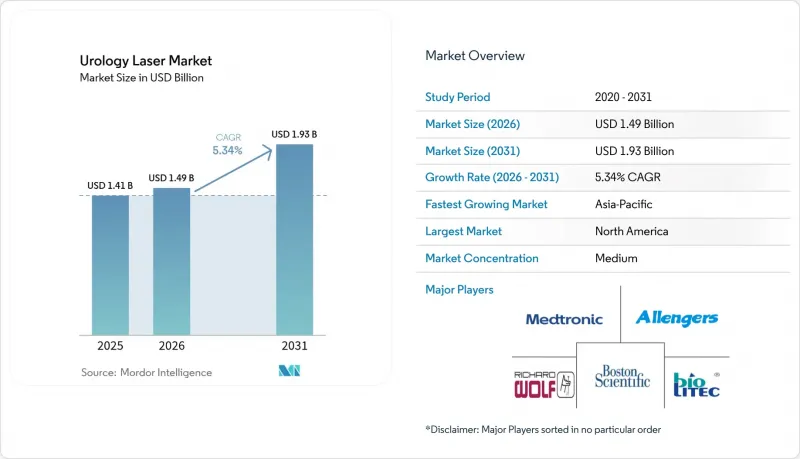
비뇨기과용 레이저 시장 규모는 2025년 14억 1,000만 달러에서 2026년에는 14억 9,000만 달러로 확대되어 2026년부터 2031년까지 CAGR 5.34%로 성장을 지속하여, 2031년에는 19억 3,000만 달러에 이를 것으로 예측됩니다.
본 보고서는 레이저 유형(홀뮴:YAG 레이저, 툴륨 파이버 레이저, 그린라이트(KTP/LBO) 레이저, 다이오드 레이저, 기타), 용도(체외 충격파 쇄석술, 전립선 비대증(BPH),요관경 검사, 방광 종양 절제술, 기타), 최종 사용자(병원, ASC, 전문 클리닉, 기타), 지역(북미, 유럽, 아시아태평양, 남미, 기타)별로 분류되어 있습니다. 시장 예측은 금액(달러)으로 표시되어 있습니다.
전 세계 비뇨기과용 레이저 시장 동향 및 인사이트
저침습성 전립선 비대증(BPH) 수술의 보급 확대
레이저 절제술은 지속적인 증상 완화, 적은 출혈량, 그리고 10년간의 추적 조사에서 재수술률이 1% 미만이라는 점 때문에 전립선 비대증(BPH)의 치료법으로 경요도적 절제술을 대체하며 주류로 자리 잡고 있습니다. MOSES 펄스 변조 기술로 효율이 더욱 향상되어, 치료를 받은 남성의 90% 이상이 당일 퇴원할 수 있게 됨에 따라 입원 비용 절감과 수술실 유휴 시간 확보로 이어지고 있습니다. 메디케어 진료비 개정에 따른 유리한 조건이 경제적 실행 가능성을 뒷받침하며, 장비 구매 주기를 가속화하고 있습니다. 개정된 미국비뇨기과학회(AUA) 지침에서는 전립선 크기와 관계없이 홀뮴 레이저 절제술이 1순위 치료법으로 제시됨에 따라, 첨단 치료 플랫폼을 갖춘 의료기관으로의 의뢰 건수가 증가하고 있습니다. 이러한 임상적·정책적 호재가 맞물려 시술 건수를 늘리고, 광섬유의 지속적인 판매를 촉진하며, 비뇨기과용 레이저 시장의 기반을 뒷받침하고 있습니다.
펄스 변조 Ho:YAG 시스템의 기술적 진보
MOSES 기술은 파이버 선단에 증기 기포를 형성하여 에너지 전달을 향상시키는 동시에 결석의 후방 역류를 줄여줍니다. 임상시험에서 표준 홀뮴 펄스와 비교하여 전립선 절제술 시 치료 시간이 약 40% 단축되고 지혈 효과가 현저히 향상된 것으로 입증되었습니다. 수술 시간 단축은 외과의사의 수술 건수 처리 능력을 높여, 레이저 콘솔 1대당 수익 증가로 이어집니다. 결석 파쇄에서 연조직 절제로 원활하게 전환할 수 있는 다목적성은 설비 투자 수익률을 향상시키며, 병원이 분산되어 있던 장비를 단일 고출력 워크스테이션으로 통합하는 추세를 뒷받침하고 있습니다. 조기 도입 기관들로부터는 조직 밀도나 해부학적 구조가 다른 경우에도 치료 결과가 표준화되어 있다는 보고가 있으며, 이로 인해 복잡한 증례에서의 학습 곡선이 완화되어 보다 광범위한 보급이 촉진되고 있습니다. 주요 벤더들은 펄스 변조 시스템에 AI 알고리즘을 통합하여 조직의 피드백을 기반으로 매개변수를 자동으로 조정하는 데 주력하고 있으며, 이는 성능 향상의 다음 물결을 예고하는 것입니다.
높은 초기 투자 및 유지 관리 비용
고성능 레이저 워크스테이션의 가격은 30만 달러를 초과하는 경우도 있으며, 고정밀 파이버, 연간 유지보수 계약, 정기적인 소프트웨어 업그레이드가 필요하기 때문에 소유 비용이 연간 15-20% 더 증가합니다. 소규모 지역 병원이나 진료소에서는 이러한 투자를 상각할 만한 충분한 환자 수가 부족한 경우가 많아, 그로 인해 교체 주기가 지연되고 시장 침투가 저해되고 있습니다. 특히 신흥국에서는 수입 관세와 환율 변동으로 인해 가격이 더욱 치솟고 있어 이러한 경향이 두드러집니다. 각 벤더사는 종량제나 수익 분배형 계약 형태로 대응하고 있지만, 재무 부서 임원들은 여전히 레이저 장비와 영상 진단 시스템, 로봇 시스템과 같은 경쟁적인 설비 투자 수요를 저울질하며 검토하고 있습니다. 예산에 민감한 지역에서 가격이 하락하거나 환급액이 인상될 때까지는 재정적 장벽이, 본래라면 견조했을 비뇨기과용 레이저 시장의 성장을 둔화시킬 것입니다.
부문 분석
홀뮴: YAG 시스템은 2025년에 비뇨기과용 레이저 시스템 시장 점유율 71.62%를 유지했습니다. 이는 오랜 기간에 걸친 임상적 입증과 외과 의사의 숙련도를 반영한 결과입니다. 그러나 복잡한 결석에 대해 후방 밀림을 줄이거나 미세한 분쇄를 요구하는 의료 기관이 늘어남에 따라, 툴륨 파이버 장치는 연평균 성장률(CAGR) 5.55%를 기록하며 증분 수익을 창출할 것으로 예측됩니다. 툴륨 솔루션의 비뇨기과용 레이저 시스템 시장 규모는 특히 아시아태평양에서 확대될 것으로 예상되는데, 이는 해당 지역에서 최신 기술을 우선시하는 신규 병원 건설과 장비 교체 주기가 겹치고 있기 때문입니다.
GreenLight 칼륨 티타닐 인산염 레이저는 항응고 요법을 받고 있는 환자에 대한 광선택적 증발술에서 여전히 선호되는 선택지이며, 특정 틈새 시장에서 입지를 유지하고 있습니다. 다이오드 레이저는 소규모 클리닉에 경제적인 도입 수단을 제공하지만, 출력이 낮아 시술 범위에 한계가 있습니다. 현재 연구가 진행 중인 블루라이트 시스템은 전립선 비대증(BPH) 수술 후 성기능 유지에 유망한 것으로 평가되어, 향후 틈새 시장의 확대를 시사하고 있습니다. 그러나 고출력 전립선 치료와 결석 분쇄술 모두에서 홀뮴 레이저가 지닌 범용성 덕분에, 특정 적응증 분야에서 파이버 레이저가 점차 시장 점유율을 빼앗아가고 있는 상황에서도 비뇨기과용 레이저 시스템 시장에서 홀뮴 레이저의 주도적 지위는 흔들리지 않습니다.
지역별 분석
북미는 2025년 비뇨기과용 레이저 시스템 시장 매출의 37.05%를 차지했습니다. 이는 메디케어 및 민간 보험사의 일관된 보험 적용, 탄탄한 외과 의사 연수 체계, 그리고 안전성과 신속한 승인 간의 균형을 유지하는 FDA 규제에 힘입은 결과입니다. 미국의 주요 대학 병원이 확립한 시술 기준은 지역 병원으로도 확산되어, MOSES 펄스 변조 및 AI를 통한 매개변수 선택과 같은 혁신 기술의 보급을 가속화하고 있습니다. 통합된 공동 구매는 대규모 콘솔 도입을 더욱 촉진하고 있으며, 이를 통해 공급업체와의 파트너십이 공고해지면서 파이버 레이저의 보급이 가속화되고 있습니다.
아시아태평양은 2031년까지 연평균 성장률(CAGR) 6.01%를 나타낼 것으로 예측되며, 비뇨기과용 레이저 시스템 시장에서 가장 높은 성장률을 보일 지역이 될 것입니다. 중국의 병원 현대화 추진과 인도의 보험 보급률 확대가 시술 건수 증가를 뒷받침하는 한편, 각 제조업체는 수입 비용을 절감하기 위해 지역별 조립 라인을 증설하고 있습니다. 이미 첨단 기기 사용에 능숙한 일본과 한국의 외과의사들은 툴륨 파이버 및 AI 강화형 콘솔의 초기 도입자가 되고 있습니다. 태국과 싱가포르를 비롯한 의료 관광 거점에 대한 정부의 적극적인 투자가 최첨단 레이저 치료실 수요를 촉진하고 있으며, 비뇨기과용 레이저 시스템 시장의 지리적 범위를 더욱 확대되고 있습니다.
유럽에서는 근거 기반 의료를 중시하는 국민건강보험제도의 뒷받침을 받아 한 자릿수 중반대의 꾸준한 성장을 유지하고 있습니다. 독일과 영국은 방광 종양의 엔블록 절제술 도입을 주도하고 있는 반면, 북유럽 국가들에서는 로봇 수술 프로그램의 일환으로 AI를 활용한 레이저의 시범 운영이 진행되고 있습니다. CE 요건의 통일에 따라 EU 역내에서 공급업체의 제품 출시 절차는 간소화되었으나, 남유럽 국가들의 재정 긴축으로 인해 설비 투자는 다소 억제되고 있습니다. 남미와 중동 및 아프리카와 같은 신흥 지역에서는 비뇨기과용 레이저 시스템 시장 침투율이 여전히 낮은 수준이지만 상승 추세를 보이고 있으며, 외국인 거주자나 부유층 현지 주민을 대상으로 하는 민간 의료 기관이 주도적인 역할을 하고 있습니다.
기타 혜택:
- 엑셀 형식 시장 예측(ME) 시트
- 3개월간 애널리스트의 지원
자주 묻는 질문
목차
제1장 서론
제2장 조사 방법
제3장 주요 요약
제4장 시장 구도
제5장 시장 규모와 성장 예측
제6장 경쟁 구도
제7장 시장 기회와 향후 전망
JHS 26.09.11According to Mordor Intelligence, the urology laser market size is expected to grow from USD 1.41 billion in 2025 to USD 1.49 billion in 2026 and is forecast to reach USD 1.93 billion by 2031 at 5.34% CAGR over 2026-2031.
This report is Segmented by Laser Type (Holmium:YAG Laser, Thulium Fiber Laser, Greenlight (KTP/LBO) Laser, Diode Laser, Others), Application (Lithotripsy, BPH, Ureteroscopy, Bladder Tumor Resection, Others), End User (Hospitals, Ascs, Specialty Clinics, Others), and Geography (North America, Europe, Asia-Pacific, South America, and More). The Market Forecasts are Provided in Terms of Value (USD).
Global Urology Laser Market Trends and Insights
Growing Adoption of Minimally Invasive BPH Surgery
Laser enucleation has replaced transurethral resection as the favored BPH therapy because it yields durable symptom relief, minimal bleeding, and reoperation rates below 1% at 10-year follow-up. MOSES pulse modulation further boosts efficiency, allowing over 90% of treated men to leave on the same day, which trims inpatient costs and frees operating room capacity. Favorable Medicare fee-schedule updates reinforce economic viability and accelerate equipment purchase cycles. Updated American Urological Association guidelines now list holmium laser enucleation as a first-line option for glands of any size, strengthening referral volumes to centers with advanced platforms. Collectively, these clinical and policy tailwinds elevate procedure counts and stimulate recurring fiber sales, underpinning the urology laser market.
Technological Advancements in Pulse-Modulated Ho:YAG Systems
MOSES technology shapes a vapor bubble at the fiber tip, enhancing energy transfer and lowering stone retropulsion. Clinical trials document treatment-time reductions near 40% and demonstrably better hemostasis during prostate enucleation compared with standard holmium pulses. Shorter case times lift surgeon throughput, translating into higher revenue per laser console. Multi-application capability-moving seamlessly from lithotripsy to soft-tissue ablation-improves return on capital investment, prompting hospitals to consolidate disparate devices into a single high-power workstation. Early adopters report standardized outcomes across varied tissue densities and anatomy, dampening the learning curve for complex cases and catalyzing broader uptake. Leading vendors are layering AI algorithms on pulse-modulated systems to auto-adjust parameters based on tissue feedback, pointing to the next wave of performance gains.
High Capital and Maintenance Costs
Advanced laser workstations can list above USD 300,000 and require precision fibers, annual service contracts, and periodic software upgrades that raise ownership costs by another 15-20% per year. Smaller community hospitals and clinics often lack the case volume to amortize such investments, delaying replacement cycles and inhibiting penetration-especially in emerging economies where import tariffs and currency swings inflate prices further. Vendors have responded with pay-per-use and revenue-share arrangements, but senior finance teams still weigh lasers against competing capital needs such as imaging or robotic systems. Until pricing falls or reimbursement rises in budget-sensitive regions, fiscal barriers will temper the otherwise robust growth of the urology laser market.
Other drivers and restraints analyzed in the detailed report include:
- Rising Prevalence of Urolithiasis
- Hospital CAPEX and Reimbursement Tailwinds
- Steep HoLEP Learning Curve
For complete list of drivers and restraints, kindly check the Table Of Contents.
Segment Analysis
Holmium:YAG systems retained a 71.62% slice of the urology laser systems market share in 2025, reflecting long-standing clinical proof and surgeon comfort. Yet thulium fiber units are projected to log a 5.55% CAGR and capture incremental revenue as centers seek lower retropulsion and finer dusting for complex calculi. The urology laser systems market size for thulium solutions is forecast to widen particularly in Asia-Pacific where replacement cycles coincide with green-field hospital builds that favor the newest technology.
GreenLight potassium-titanyl-phosphate lasers remain the preferred choice for photoselective vaporization in anticoagulated patients, preserving a focused niche. Diode lasers provide economical entry points for smaller clinics, though their lower power limits procedural breadth. Blue-light systems under investigation show promise for preserving sexual function after BPH surgery, hinting at future niche expansion. Holmium's versatility in both high-power prostate work and lithotripsy, however, secures its leadership in the urology laser systems market, even as fiber lasers nibble share in select indications.
Complete Report Scope:
- By Laser Type
- Holmium:YAG Laser
- Thulium Fiber Laser
- GreenLight (KTP/LBO) Laser
- Diode Laser
- Others (Er:YAG, CO2, etc.)
- By Application
- Lithotripsy
- Benign Prostatic Hyperplasia (BPH)
- Ureteroscopy
- Bladder Tumor Resection
- Others (Stricture, Caruncle, Soft-tissue)
- By End User
- Hospitals
- Ambulatory Surgical Centers
- Specialty Clinics
- Others (Academic/Research Labs)
- By Geography
- North America
- United States
- Canada
- Mexico
- Europe
- Germany
- United Kingdom
- France
- Italy
- Spain
- Rest of Europe
- Asia-Pacific
- China
- India
- Japan
- South Korea
- Australia
- Rest of Asia-Pacific
- South America
- Brazil
- Argentina
- Rest of South America
- Middle East and Africa
- GCC
- South Africa
- Rest of Middle East and Africa
- North America
Geography Analysis
North America captured 37.05% of urology laser systems market revenue in 2025, underpinned by consistent Medicare and private-payer reimbursement, robust surgeon training pipelines, and FDA regulation that balances safety with timely clearances. Academic flagships in the United States set procedural standards that ripple across community hospitals, accelerating diffusion of innovations such as MOSES pulse modulation and AI-guided parameter selection. Consolidated group purchasing further supports large-scale console rollouts that lock in vendor partnerships and boost fiber pull-through.
Asia-Pacific is projected to advance at a 6.01% CAGR through 2031, the fastest regional clip in the urology laser systems market. China's hospital-modernization push and India's expanding insurance penetration are swelling procedure volumes, while manufacturers add regional assembly lines that temper import costs. Surgeons in Japan and South Korea-already adept with high-tech devices-are early adopters of thulium fiber and AI-enhanced consoles. Favorable government investments in medical tourism hubs, notably in Thailand and Singapore, foster demand for cutting-edge laser suites, further expanding the geographic footprint of the urology laser systems market.
Europe maintains steady mid-single-digit growth powered by universal coverage schemes that emphasize evidence-based care. Germany and the United Kingdom spearhead adoption of en-bloc bladder tumor resection, while the Nordic countries pilot AI-driven lasers within robotic programs. Harmonized CE requirements simplify vendor launches across the bloc, though budget austerity in Southern Europe slightly tempers capital spending. In emerging regions of South America and the Middle East & Africa, urology laser systems market penetration remains low but rising, led by private-sector centers catering to expatriate and affluent local populations.
- Boston Scientific
- Olympus
- Dornier MedTech
- Richard Wolf
- Karl Storz
- El.En.
- Lumenis
- Allengers Medical Systems Ltd.
- Jena GmbH
- OmniGuide Holdings
- Convergent Laser Technologies Inc.
- GIGAALASER (Shenzhen Gigaa Optronics)
- Cook Group
- Boston Medical Devices Inc.
- IPG Photonics
- Beckton Dickinson
- Coherent Corp.
Additional Benefits:
- The market estimate (ME) sheet in Excel format
- 3 months of analyst support
TABLE OF CONTENTS
1 Introduction
- 1.1 Study Assumptions & Market Definition
- 1.2 Scope of the Study
2 Research Methodology
3 Executive Summary
4 Market Landscape
- 4.1 Market Overview
- 4.2 Market Drivers
- 4.2.1 Rising prevalence of urolithiasis
- 4.2.2 Growing adoption of minimally invasive BPH surgery
- 4.2.3 Technological advancements (e.g., pulse-modulated Ho:YAG)
- 4.2.4 Hospital CAPEX & reimbursement tailwinds
- 4.2.5 ASC day-case surge for laser procedures
- 4.2.6 AI-driven laser parameter optimisation
- 4.3 Market Restraints
- 4.3.1 High capital & maintenance costs
- 4.3.2 Steep HoLEP learning curve
- 4.3.3 Intra-renal thermal-injury concerns
- 4.3.4 Rare-earth crystal supply-chain risk
- 4.4 Value / Supply-Chain Analysis
- 4.5 Regulatory Landscape
- 4.6 Technological Outlook
- 4.7 Porter's Five Forces
- 4.7.1 Bargaining Power of Buyers
- 4.7.2 Bargaining Power of Suppliers
- 4.7.3 Threat of New Entrants
- 4.7.4 Threat of Substitutes
- 4.7.5 Competitive Rivalry
5 Market Size & Growth Forecasts (Value, USD)
- 5.1 By Laser Type
- 5.1.1 Holmium:YAG Laser
- 5.1.2 Thulium Fiber Laser
- 5.1.3 GreenLight (KTP/LBO) Laser
- 5.1.4 Diode Laser
- 5.1.5 Others (Er:YAG, CO2, etc.)
- 5.2 By Application
- 5.2.1 Lithotripsy
- 5.2.2 Benign Prostatic Hyperplasia (BPH)
- 5.2.3 Ureteroscopy
- 5.2.4 Bladder Tumor Resection
- 5.2.5 Others (Stricture, Caruncle, Soft-tissue)
- 5.3 By End User
- 5.3.1 Hospitals
- 5.3.2 Ambulatory Surgical Centers
- 5.3.3 Specialty Clinics
- 5.3.4 Others (Academic/Research Labs)
- 5.4 By Geography
- 5.4.1 North America
- 5.4.1.1 United States
- 5.4.1.2 Canada
- 5.4.1.3 Mexico
- 5.4.2 Europe
- 5.4.2.1 Germany
- 5.4.2.2 United Kingdom
- 5.4.2.3 France
- 5.4.2.4 Italy
- 5.4.2.5 Spain
- 5.4.2.6 Rest of Europe
- 5.4.3 Asia-Pacific
- 5.4.3.1 China
- 5.4.3.2 India
- 5.4.3.3 Japan
- 5.4.3.4 South Korea
- 5.4.3.5 Australia
- 5.4.3.6 Rest of Asia-Pacific
- 5.4.4 South America
- 5.4.4.1 Brazil
- 5.4.4.2 Argentina
- 5.4.4.3 Rest of South America
- 5.4.5 Middle East and Africa
- 5.4.5.1 GCC
- 5.4.5.2 South Africa
- 5.4.5.3 Rest of Middle East and Africa
- 5.4.1 North America
6 Competitive Landscape
- 6.1 Market Concentration
- 6.2 Market Share Analysis
- 6.3 Company Profiles (includes Global overview, Market overview, Core Segments, Financials, Strategic Info, Market Rank/Share, Products & Recent Developments)
- 6.3.1 Boston Scientific Corporation
- 6.3.2 Olympus Corporation
- 6.3.3 Dornier MedTech GmbH
- 6.3.4 Richard Wolf GmbH
- 6.3.5 KARL STORZ SE & Co. KG
- 6.3.6 El.En. S.p.A.
- 6.3.7 Lumenis Be Ltd.
- 6.3.8 Allengers Medical Systems Ltd.
- 6.3.9 Jena GmbH
- 6.3.10 OmniGuide Holdings Inc.
- 6.3.11 Convergent Laser Technologies Inc.
- 6.3.12 GIGAALASER (Shenzhen Gigaa Optronics)
- 6.3.13 Cook Medical LLC
- 6.3.14 Boston Medical Devices Inc.
- 6.3.15 IPG Photonics Corporation
- 6.3.16 Becton Dickinson and Company
- 6.3.17 Coherent Corp.
7 Market Opportunities & Future Outlook
- 7.1 White-space & Unmet-need Assessment