

|
시장보고서
상품코드
2123777
의료용 카트 시장 : 점유율 분석, 업계 동향과 통계, 성장 예측(2026-2031년)Medical Carts - Market Share Analysis, Industry Trends & Statistics, Growth Forecasts (2026 - 2031) |
||||||
 Mordor Intelligence
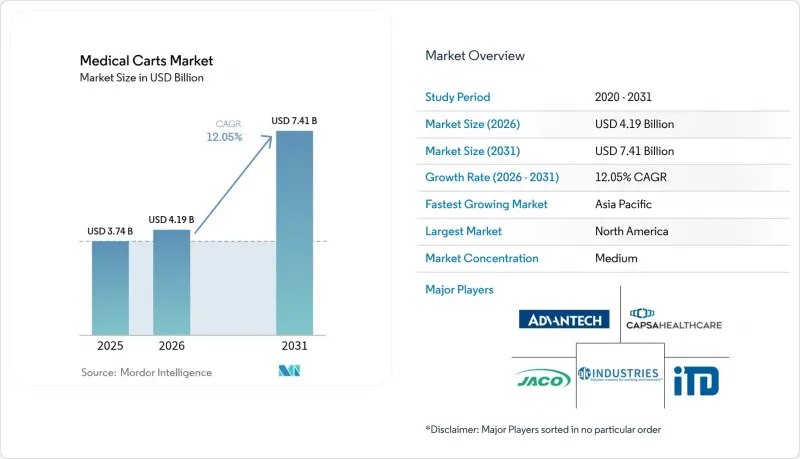
Mordor Intelligence에 의하면, 의료용 카트 시장 규모는 2025년 37억 4,000만 달러에서 2026년에는 41억 9,000만 달러로 확대되어 2026년부터 2031년까지 CAGR 12.05%로 성장을 지속하여, 2031년까지 74억 1,000만 달러에 이를 것으로 예측됩니다.
본 보고서는 카트 유형(마취 카트, 응급 카트, 시술용 카트, 약품 카트 등), 동력원(전동 카트, 비전동 카트), 재질(알루미늄, 스테인리스 스틸, 폴리머/복합재, 기타), 최종 사용자(병원, 외래수술센터(ASC), 전문 클리닉, 기타), 지역(북미, 유럽, 아시아태평양, 중동 및 아프리카, 남미)별로 분류되어 있습니다.
전 세계 의료용 카트 시장 동향 및 인사이트력
의료 인프라 및 가치 중심 의료에 대한 투자 확대
병원의 영업 이익률은 모바일 워크스테이션이 제공하는 실시간 데이터 수집에 점점 더 의존하고 있으며, 의료용 카트 시장은 자본 위원회에 있어 우선순위가 높은 항목이 되고 있습니다. 현재 통합형 카트에는 RFID, 바코드 스캔, 자동 약품 추출 기능이 기본으로 장착되어 있어, 이를 통해 기록 작성 시간 단축, 추적 및 추적성 감사 실시, 그리고 약품 관련 유해 사건의 억제가 가능해졌습니다. 미국, 캐나다, 독일의 의료 시스템에서는 병상에서의 전자건강기록(EHR) 입력이 전사 오류를 최대 55%까지 줄인다고 보고되고 있으며, 동시에 주 2회 전체 간호 근무 시간에 해당하는 시간과 노력을 절약하고 있습니다. 유럽연합(EU)의 인프라 지원 프로그램은 하드웨어, 차량 관리 소프트웨어 및 다년 서비스 계약을 결합한 일괄 입찰을 더욱 촉진하고 있습니다.
고령화에 따른 만성 질환 부담 증가와 응급실 내원 증가
응급실에서는 심장 질환, 당뇨병, 호흡기 질환의 사례 수가 급증하고 있어, 제세동기, 주입 펌프, 기도 확보 키트를 갖춘 견고한 응급 카트에 대한 수요가 높아지고 있습니다. 인력 부족으로 인해 기존에는 2명이 담당하던 업무를 1명의 의료진이 완수할 수 있도록 인체공학에 기반한 레이아웃의 필요성이 높아지고 있으며, 오토리프트 컬럼과 270도 열리는 서랍을 갖춘 카트에 대한 지출이 증가하고 있습니다. 미국에서만 해도 2024년에는 65세 이상 환자의 응급실 내원자 수가 전년 대비 6.4% 증가했으며, 이러한 추세는 일본과 이탈리아에서도 마찬가지로 나타나고 있습니다. 최신 응급 카트에는 젖산 및 트로포닌을 측정하는 현장 진단(Point-of-Care) 검사 모듈이 통합되어 있어, 검사 결과 확인까지 걸리는 시간을 평균 20분 단축하고 있습니다.
고급 카트를 조작할 수 있는 숙련된 인력 부족
AI 탑재 카트의 복잡한 사용자 인터페이스를 조작하려면 정식 기술 향상 교육이 필요하지만, 많은 지방이나 자금 부족 의료기관에서는 그 비용을 마련하지 못해 결과적으로 첨단 기능이 충분히 활용되지 못하는 상황이 발생하고 있습니다. 태국과 베트남에서 실시한 조사에 따르면, 임상 직원 중 단 43%만이 다중 매개변수 도킹 모듈의 교정에 자신감을 가지고 있는 것으로 나타났습니다. 그 결과, 도입 일정이 지연되고 투자 회수 기간(ROI)이 장기화되고 있습니다. 현재 각 제조업체들은 e-러닝 플랫폼과 증강현실(AR)을 활용한 튜토리얼을 세트로 제공하고 있으며, 이를 통해 도입까지 걸리는 시간을 최대 40% 단축할 수 있는 반면, 솔루션 전체의 가격은 상승하고 있습니다.
부문 분석
2025년, 응급 카트는 의료용 카트 시장의 40.92%를 차지했습니다. 이러한 압도적인 점유율은 모든 중환자실 및 수술실에서 응급 대응용 장비를 손이 닿는 곳에 상시 비치하도록 요구하는 규제 요건에 기인합니다. 반면, 바퀴가 달린 모바일 컴퓨팅 워크스테이션은 14.15%라는 가장 높은 연평균 성장률(CAGR)을 기록했으며, 이는 처리 능력 향상 측면에서 병상에서의 디지털 기록이 고정형 단말기를 대체하고 있음을 보여줍니다. 워크스테이션용 의료용 카트 시장 규모는 고성능 GPU가 필요한 AI 기반 트리아지 도구의 부흥에 힘입어 2025년 9억 8,000만 달러에서 2031년에는 21억 7,000만 달러로 확대될 것으로 전망됩니다. 마찬 인터내셔널(Machan International)의 ‘BAILDIA 스마트 IoT 약품 카트’는 99.7%가 재활용 가능한 소재로 제작되어 지속가능성과 IoT 연동을 위한 설계 전환을 상징하는 제품이며, 주의가 필요한 약품의 검색 시간을 25% 단축하고 있습니다.
일상적인 병동 회진을 지원하는 처치용 카트나 약품 카트의 경우 수요 다변화가 지속되고 있는 반면, 노인병학과 정신과 병동에서는 전문적인 원격 의료용 카트의 존재감이 커지고 있습니다. 많은 의료 제공업체는 카트 시리즈 전체에 대해 수량 할인을 확보하기 위해 일괄 조달을 진행하고 있으며, 이러한 접근 방식을 통해 개별 구매 시에 비해 수명 주기 비용을 12% 절감할 수 있습니다. 이처럼 의료용 카트 시장은 통합된 제어 소프트웨어와 호환 가능한 액세서리 레일을 통해 표준화 목표를 추진하는 ‘플랫폼형’ 시장으로 진화하고 있습니다.
2025년에는 비전동형이 의료용 카트 시장의 52.63% 점유율을 차지했습니다. 이는 주로 정가가 저렴하고 유지보수가 용이하기 때문입니다. 그러나 리튬 이온 배터리의 충방전 횟수가 2,000회를 넘어 교체 빈도가 대폭 감소함에 따라 이러한 우위는 약화되고 있습니다. 전동 모델은 연평균 성장률(CAGR) 13.05%로 성장하고 있으며, 2031년까지 28억 6,000만 달러를 넘어설 것으로 예측됩니다. 전동 모델의 의료용 카트 시장 규모는 2025년에 13억 5,000만 달러에 달할 것으로 보이며, 5년 이내에 두 배로 증가할 것으로 전망됩니다. 이러한 변화는 더 안전하고 재활용 가능한 배터리 모듈의 사용을 의무화하는 EU 규정 2023/1542에 의해 더욱 가속화되고 있습니다. 통합형 스마트 충전기는 배터리 상태를 유지하기 위해 자동으로 출력을 조절하도록 개선되었습니다. 또한 예측 분석을 통해 용량이 80% 미만으로 떨어지기 전에 교체 일정을 설정할 수 있게 되었습니다.
음극재 관련 공급망 혼란에도 불구하고, 전 세계 조립 제조업체들은 한국과 폴란드 두 곳에서 조달 체계를 유지하고 있으며, 출하 지연은 대부분의 경우 4주 이내로 억제되고 있습니다. 각 제조업체는 여전히 임상 업무 흐름을 간소화하고, 한눈에 상태를 파악할 수 있는 SOC(충전 상태) LED 표시 및 음성 안내를 중시하고 있습니다. 예측 기간 동안, 병원들이 각국의 기후 변화 대응 공약에 부합하는 탈탄소화 목표를 추구함에 따라 전력 효율은 입찰 시 주요 평가 기준이 될 것입니다.
지역별 분석
북미는 성숙한 IT 기반, 대규모 전자의무기록(EHR) 도입 의무, 그리고 디지털 효율성을 평가하는 지불자 구성을 배경으로 2025년 매출의 42.74%를 차지했습니다. 농촌 응급 병원(Rural Emergency Hospital) 지정을 지원하는 연방 정부의 보조금은 광대역망을 통해 멀리 떨어진 전문의와 연결되는 소형 원격 진료 카트의 구매를 더욱 촉진하고 있습니다. 이 지역의 의료용 카트 시장에서는 엄격한 검사 체계를 충족하기 위해 UL 인증 배터리 어셈블리 및 FIPS 인증 암호화 모듈과 같은 안전 대책이 지속적으로 도입되고 있습니다.
아시아태평양은 14.92%라는 가장 높은 연평균 성장률(CAGR)을 기록하고 있으며, 중국, 인도, 호주가 도입 초기부터 차량 관리 대시보드를 통합한 병원의 확장을 주도하고 있습니다. 민관 협력 이니셔티브를 통해 다양한 임상 직원을 지원하기 위한 다국어 UI 오버레이가 탑재된 카트 구매가 지원되고 있습니다. 선전, 푸네, 오사카의 국내 생산 거점을 바탕으로, 아시아태평양의 의료용 카트 시장 규모는 2031년까지 21억 8,000만 달러를 넘어설 것으로 예측됩니다. 유럽에서는 항생제 적정 사용 및 탄소 발자국에 관한 지침이 경량 복합 소재로의 전환을 촉진하고 있어, 꾸준한 교체 주기가 관찰되고 있습니다. 주요 제조업체들은 순환형 경제의 인센티브를 활용하기 위해 독일과 네덜란드에 재활용 센터를 개설하고 있습니다. 중동 및 아프리카에서는 사우디아라비아, 아랍에미리트, 이집트의 신규 병원 건설이 초기 구매를 뒷받침하고 있지만, 공급망 지연과 관세 제도로 인해 단기적인 성장 가속화는 억제되고 있습니다. 남미의 성장률은 한 자릿수 중반을 기록하고 있으며, 특히 브라질에서는 민간 보험사가 종양학 주사실용으로 전동식 WoW를 지정하고 있는 점이 성장의 견인차 역할을 하고 있습니다.
기타 혜택:
- 엑셀 형식 시장 예측(ME) 시트
- 3개월간의 애널리스트 지원
자주 묻는 질문
목차
제1장 서론
제2장 조사 방법
제3장 주요 요약
제4장 시장 구도
제5장 시장 규모와 성장 예측
제6장 경쟁 구도
제7장 시장 기회와 향후 전망
JHS 26.09.07According to Mordor Intelligence, the medical carts market size is expected to grow from USD 3.74 billion in 2025 to USD 4.19 billion in 2026 and is forecast to reach USD 7.41 billion by 2031 at 12.05% CAGR over 2026-2031.
This report is Segmented by Cart Type (Anesthesia Carts, Emergency Carts, Procedure Carts, Medication Carts, and More), by Power Source (Powered Carts, Non-Powered Carts), by Material (Aluminum, Stainless Steel, Polymer/Composite, Others), by End User (Hospitals, Ambulatory Surgical Centers, Specialty Clinics, Others), by Geography (North America, Europe, Asia-Pacific, Middle East and Africa, South America).
Global Medical Carts Market Trends and Insights
Rising investments in healthcare infrastructure & value-based care
Hospital operating margins rely increasingly on real-time data capture that mobile workstations provide, making the medical carts market a priority line item for capital committees. Integrated carts now ship with RFID, bar-code scanning and automated medication drawers to shorten documentation time, allow track-and-trace audits and curb adverse drug events. Health systems in the United States, Canada and Germany report that bedside EHR input lowers transcription errors by up to 55%, while enabling time-and-motion savings equivalent to two full nursing shifts per week. Infrastructure grant programs in the European Union further stimulate bulk tenders that blend hardware, fleet-management software and multi-year service contracts.
Growing chronic disease burden & emergency visits among ageing populations
Emergency departments treat escalating volumes of cardiac, diabetic and respiratory cases, intensifying demand for rugged emergency carts stocked with defibrillators, infusion pumps and airway kits. Staffing shortages heighten the need for ergonomic layouts that let one clinician complete formerly two-person tasks, reinforcing spend on carts with auto-lift columns and 270-degree drawer access. In the United States alone, ED arrivals from patients aged >= 65 grew 6.4% year-over-year in 2024, a trend mirrored in Japan and Italy. Advanced crash carts now integrate point-of-care testing modules for lactate or troponin, trimming lab turnaround by 20 minutes on average.
Limited skilled operators for advanced carts
Complicated user interfaces on AI-enabled carts require formal upskilling that many rural or under-funded facilities cannot afford, leading to underutilization of premium features. Surveys in Thailand and Vietnam found that only 43% of clinical staff felt confident calibrating multi-parameter docking modules, resulting in delayed adoption schedules and extended ROI horizons. Manufacturers now bundle e-learning platforms and augmented-reality tutorials, reducing onboarding time by up to 40% yet raising total solution price.
Other drivers and restraints analyzed in the detailed report include:
- EMR/EHR adoption drives Workstations-on-Wheels (WoWs)
- Surge in tele-medicine carts for hybrid care models
- Cyber-security concerns over connected carts
For complete list of drivers and restraints, kindly check the Table Of Contents.
Segment Analysis
Emergency carts captured 40.92% of the medical carts market in 2025. Their dominant footprint stems from regulatory mandates that every critical-care bay and operating suite maintain crash-ready gear within one arm's reach. Mobile computing workstations-on-wheels, meanwhile, post the highest 14.15% CAGR, illustrating how bedside digital documentation now supersedes fixed terminals for throughput gains. The medical carts market size for workstations is projected to climb from USD 0.98 billion in 2025 to USD 2.17 billion in 2031, buoyed by AI-driven triage tools that require high-processing GPUs. Machan International's BAILDIA Smart IoT Medication Trolley, made of 99.7% recyclable materials, highlights design shifts toward sustainability and IoT linkage, cutting search cycles for high-alert drugs by 25%.
Demand diversification persists across procedure and medication carts that support routine ward rounds, while specialty tele-medicine carts gain visibility inside geriatric and psychiatric wings. Many providers bundle procurement to secure volume discounts across cart families, an approach that can slice lifecycle costs 12% below piecemeal buying. The medical carts market is thus evolving into a platform play where unified control software and interchangeable accessory rails advance standardization goals.
Non-powered formats held 52.63% of the medical carts market share in 2025, chiefly because they carry lower sticker prices and simpler maintenance regimens. That advantage weakens as lithium-ion chemistry attains >2,000 charge cycles, slashing replacement frequency. Powered units are growing at a 13.05% CAGR and are forecast to top USD 2.86 billion by 2031. The medical carts market size for powered variants equated to USD 1.35 billion in 2025 and is expected to double within five years, a shift further prompted by EU Regulation 2023/1542, which compels safer, recyclable battery modules. Integrated smart chargers now self-throttle to extend battery health, while predictive analytics schedule swap-outs before capacity dips below 80%.
Despite supply-chain hiccups around anode materials, global assemblers maintain dual sourcing in South Korea and Poland, limiting shipment delays to under four weeks in most cases. Providers still favor at-a-glance SOC (state of charge) LEDs and audible prompts that simplify clinical workflows. Over the forecast interval, power efficiency will become a core tender criterion as hospitals chase decarbonization targets aligned with national climate pledges.
Complete Report Scope:
- By Cart Type
- Anesthesia Carts
- Emergency Carts
- Procedure Carts
- Medication Carts
- Mobile Computing / WoW Carts
- Other Cart Types
- By Power Source
- Powered Carts
- Non-Powered Carts
- By Material
- Aluminum
- Stainless Steel
- Polymer / Composite
- Others
- By End User
- Hospitals
- Ambulatory Surgical Centers
- Specialty Clinics
- Others
- By Geography
- North America
- United States
- Canada
- Mexico
- Europe
- Germany
- United Kingdom
- France
- Italy
- Spain
- Rest of Europe
- Asia-Pacific
- China
- Japan
- India
- Australia
- South Korea
- Rest of Asia-Pacific
- Middle East and Africa
- GCC
- South Africa
- Rest of Middle East and Africa
- South America
- Brazil
- Argentina
- Rest of South America
- North America
Geography Analysis
North America commanded 42.74% of 2025 revenue on the strength of mature IT backbones, large-scale EHR mandates and a payer mix that rewards digital efficiency. Federal grants supporting the Rural Emergency Hospital designation further spur purchases of compact tele-treatment carts that link distant specialists via broadband. The region's medical carts market continues to introduce safeguards such as UL-listed battery assemblies and FIPS-validated encryption modules to satisfy stringent inspection regimes.
Asia-Pacific records the fastest 14.92% CAGR, with China, India and Australia spearheading hospital build-outs that integrate fleet-management dashboards from day one. Public-private initiatives subsidize cart acquisitions equipped with multilingual UI overlays to accommodate diverse clinical workforces. The medical carts market size in Asia-Pacific is projected to exceed USD 2.18 billion by 2031, supported by domestic production clusters in Shenzhen, Pune and Osaka. Europe shows steady replacement cycles as directives on antimicrobial stewardship and carbon footprints drive swap-outs to lightweight composites. Tier-one manufacturers open refurbishing centers in Germany and the Netherlands to capture circular-economy incentives. In the Middle East and Africa, greenfield hospital construction in Saudi Arabia, the United Arab Emirates and Egypt fuels first-time purchases, though supply-chain latency and tariff regimes temper near-term acceleration. South American growth hovers in mid-single digits, led by Brazil where private insurers specify powered WoWs for oncology infusion suites.
- Advantech
- AFC Industries
- Capsa Healthcare
- ITD
- The Harloff Company
- Joson-Care Enterprise Co. Ltd
- JACO Inc. (GCX Corporation)
- Bergmann Group
- Midmark
- Ergotron
- MPE Inc.
- Omnicell
- Enovate Medical
- Waterloo Healthcare
- Howard Medical
- Bytec Ltd
- InterMetro Industries Corporation
- TouchPoint Medical
Additional Benefits:
- The market estimate (ME) sheet in Excel format
- 3 months of analyst support
TABLE OF CONTENTS
1 Introduction
- 1.1 Study Assumptions & Market Definition
- 1.2 Scope of the Study
2 Research Methodology
3 Executive Summary
4 Market Landscape
- 4.1 Market Overview
- 4.2 Market Drivers
- 4.2.1 Rising investments in healthcare infrastructure & value-based care
- 4.2.2 Growing chronic disease burden & emergency cases among ageing population
- 4.2.3 EMR / EHR adoption drives demand for Work-stations-on-Wheels (WoWs)
- 4.2.4 Surge in tele-medicine carts for hybrid care models
- 4.2.5 24-hr lithium-ion power modules slash downtime & TCO
- 4.2.6 Antimicrobial-surface mandates after COVID-19
- 4.3 Market Restraints
- 4.3.1 Limited skilled operators for advanced carts
- 4.3.2 High capital & maintenance outlay, esp. in LMICs
- 4.3.3 Cyber-security concerns over connected carts
- 4.3.4 Lithium-cell supply-chain bottlenecks
- 4.4 Value / Supply-Chain Analysis
- 4.5 Regulatory Landscape
- 4.6 Technological Outlook
- 4.7 Porter's Five Forces Analysis
- 4.7.1 Threat of New Entrants
- 4.7.2 Bargaining Power of Buyers
- 4.7.3 Bargaining Power of Suppliers
- 4.7.4 Threat of Substitutes
- 4.7.5 Intensity of Competitive Rivalry
5 Market Size & Growth Forecasts (Value)
- 5.1 By Cart Type
- 5.1.1 Anesthesia Carts
- 5.1.2 Emergency Carts
- 5.1.3 Procedure Carts
- 5.1.4 Medication Carts
- 5.1.5 Mobile Computing / WoW Carts
- 5.1.6 Other Cart Types
- 5.2 By Power Source
- 5.2.1 Powered Carts
- 5.2.2 Non-Powered Carts
- 5.3 By Material
- 5.3.1 Aluminum
- 5.3.2 Stainless Steel
- 5.3.3 Polymer / Composite
- 5.3.4 Others
- 5.4 By End User
- 5.4.1 Hospitals
- 5.4.2 Ambulatory Surgical Centers
- 5.4.3 Specialty Clinics
- 5.4.4 Others
- 5.5 By Geography
- 5.5.1 North America
- 5.5.1.1 United States
- 5.5.1.2 Canada
- 5.5.1.3 Mexico
- 5.5.2 Europe
- 5.5.2.1 Germany
- 5.5.2.2 United Kingdom
- 5.5.2.3 France
- 5.5.2.4 Italy
- 5.5.2.5 Spain
- 5.5.2.6 Rest of Europe
- 5.5.3 Asia-Pacific
- 5.5.3.1 China
- 5.5.3.2 Japan
- 5.5.3.3 India
- 5.5.3.4 Australia
- 5.5.3.5 South Korea
- 5.5.3.6 Rest of Asia-Pacific
- 5.5.4 Middle East and Africa
- 5.5.4.1 GCC
- 5.5.4.2 South Africa
- 5.5.4.3 Rest of Middle East and Africa
- 5.5.5 South America
- 5.5.5.1 Brazil
- 5.5.5.2 Argentina
- 5.5.5.3 Rest of South America
- 5.5.1 North America
6 Competitive Landscape
- 6.1 Market Concentration
- 6.2 Market Share Analysis
- 6.3 Company Profiles (includes Global level Overview, Market level overview, Core Segments, Financials as available, Strategic Information, Market Rank/Share for key companies, Products & Services, and Recent Developments)
- 6.3.1 Advantech Co. Ltd
- 6.3.2 AFC Industries Inc.
- 6.3.3 Capsa Healthcare
- 6.3.4 ITD GmbH
- 6.3.5 The Harloff Company
- 6.3.6 Joson-Care Enterprise Co. Ltd
- 6.3.7 JACO Inc. (GCX Corporation)
- 6.3.8 Bergmann Group
- 6.3.9 Midmark Corporation
- 6.3.10 Ergotron Inc.
- 6.3.11 MPE Inc.
- 6.3.12 Omnicell Inc.
- 6.3.13 Enovate Medical
- 6.3.14 Waterloo Healthcare
- 6.3.15 Howard Medical
- 6.3.16 Bytec Ltd
- 6.3.17 InterMetro Industries Corporation
- 6.3.18 TouchPoint Medical
7 Market Opportunities & Future Outlook
- 7.1 White-space & Unmet-Need Assessment


