|
시장보고서
상품코드
2123778
프로그레싱 캐비티 펌프 시장 : 점유율 분석, 업계 동향과 통계, 성장 예측(2026-2031년)Progressing Cavity Pump - Market Share Analysis, Industry Trends & Statistics, Growth Forecasts (2026 - 2031) |
||||||
 Mordor Intelligence
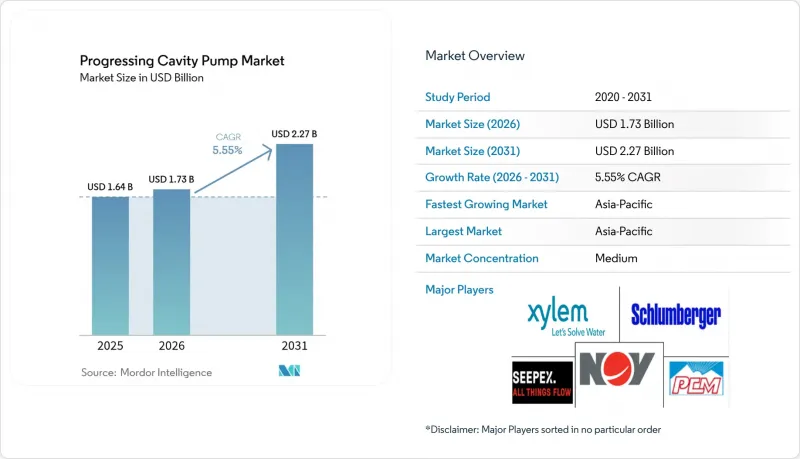
프로그레싱 캐비티 펌프 시장 규모는 2025년 16억 4,000만 달러에서 2026년에는 17억 3,000만 달러로 확대한다고 전망되고 있어 2026년부터 2031년까지 CAGR 5.55%로 성장을 지속하여, 2031년에는 22억 7,000만 달러에 이를 것으로 예측됩니다.
본 보고서는 정격 출력(50 HP 이하, 51-150 HP, 150 HP 초과), 토출량(500 GPM 이하, 501-1000 GPM, 기타),단수(단단, 다단), 최종 사용자 산업(상하수도, 석유 및 가스, 기타), 지역(북미, 남미, 기타)별로 분류되어 있습니다. 시장 예측은 금액(달러) 기준으로 제시되어 있습니다.
전 세계 프로그레싱 캐비티 펌프 시장 동향 및 인사이트
상하수도 인프라에서 수요 증가
주요 지방자치단체의 사업 계획에 따라, 슬러지 이송, 농축 및 약액 주입에 사용되는 프로그레싱 캐비티 펌프에 대한 수주가 견조한 추세를 보이고 있습니다. 마닐라 워터(Manila Water)는 비낭고난(Binangonan) 지역의 가구에 하루 5,000만 리터의 물을 공급하는 4억 3,573만 달러 규모의 펌프장을 가동했습니다. 일본의 ‘워터 2040 기금’(100억 달러)은 영양염 회수를 위해 고정밀 프로그레싱 캐비티 펌프(PCP)를 활용하는 분산형 재활용 시스템에 자금을 지원하고 있습니다. 유럽연합(EU)의 개정 ‘도시 하수 처리 지침’은 2045년까지 에너지 중립적인 처리장 도입을 의무화하고 있으며, 고효율 프로그레싱 캐비티 펌프(PCP)가 규제 준수를 위한 수단이 되고 있습니다. 인도네시아의 새로운 자본 프로젝트에서는 향후 200만 명의 주민을 수용하기 위해 첨단 슬러지 처리 기술이 요구되고 있어, 지역적 수요를 뒷받침하고 있습니다. 이러한 사업들은 전반적으로 설비의 교체 주기를 연장하는 동시에, 탈수 케이크를 처리하고 설치 면적을 최소화하는 호퍼식 PCP의 개조 기회를 창출하고 있습니다.
고점도 및 다상 유체에 대한 적합성
프로그레싱 캐비티 펌프는 전단에 민감한 유체, 모래가 포함된 유체 또는 가스가 혼입된 유체를 거의 일정한 유량으로 이송할 수 있으며, 그 성능은 원심 펌프나 기어 펌프와 비교할 수 없습니다. NETZSCH사의 새로운 원추형 로터 설계는 모래나 가스 함량이 높은 조건에서도 75-90%의 부피 효율을 달성했습니다. 캐나다의 SAGD(증기 보조 중유 추출) 생산자는 회수율을 80% 이상으로 높였습니다. 이로 인해 운영자가 중질 에멀젼을 지상으로 끌어올릴 때, 유정당 PCP 가동 시간이 증가했습니다. 부탄·프로판 혼합 가스를 사용하는 새로운 용매 SAGD 방식에서는 점도 관련 과제가 더욱 커지고 있지만, 이러한 상황이야말로 PCP 채택을 뒷받침하고 있습니다. 식품 가공업체들도 점도가 높은 소스의 식감을 유지하기 위해 PCP를 채택하고 있으며, 한편 화학 기업들은 금속 재질에 비해 엘라스토머 재질 스타터의 내식성을 높이 평가했습니다.
높은 도입 및 유지 비용
라이프사이클 비용은 특히 가격에 민감한 플랜트에서 보급의 장벽이 되고 있습니다. 스테이터의 교체 주기는 고형분 부하에 따라 6개월에서 3년 사이이며, 엘라스토머 비용이 예산상 주요 항목으로 꼽히고 있습니다. 기계식 씰, 대형 스키드 베이스, 센서 패키지로 인해 설치 비용은 저전단형 대체 제품보다 높습니다. Graco사의 비교 연구에 따르면, 유사한 투여 작업에서 PCP가 페리스탈틱 펌프에 비해 유지보수에 소요되는 시간이 더 길다는 점이 지적되었습니다. 개발도상 지역의 소규모 유틸리티 사업자의 경우, 전문 기술자나 예비 부품이 부족하여 설비 교체가 지연되고 있으며, 투자 회수 기간이 길어지고 있습니다.
부문 분석
2025년 시점에서 50 HP 이하 등급은 프로그레싱 캐비티 펌프 시장 점유율의 43.62%를 차지했습니다. 이는 소규모 상수도 시설이나 경공업이 적당한 전력 소비를 선호하기 때문입니다. 그러나 51-150 HP 구간은 연평균 성장률(CAGR) 8.05%로 확대되고 있으며, 디지털 컨트롤러를 통한 효율 향상과 가동 중단 시간 단축으로 그 격차가 좁혀질 전망입니다. 중출력 모터와 결합된 가변 주파수 드라이브는 20-30%의 에너지 절감 효과를 실현하고 있으며, 이러한 이점은 단계별 요금제를 채택하는 지자체 운영자들에게 매력적으로 다가오고 있습니다.
동일한 출력 범위 내에서 전동 수중 펌프의 보급도 확대되고 있어, 로드 스트링의 설치 공간에 제약이 있었던 업스트림 분야에서 새로운 용도를 개척하고 있습니다. 최적의 마력을 예측하는 머신러닝을 활용한 사이징 도구의 정확도는 더욱 향상되어 오차율이 불과 0.1%까지 낮아졌습니다. 이를 통해 엔지니어는 적절한 크기의 장비를 채택하여 과도한 지출을 방지할 수 있습니다. 이러한 분석 기술이 성숙해짐에 따라, 프로그레시브 캐비티 펌프 시장에서는 신규 수주의 더 큰 비중이 51-150 HP 범주에 할당될 것으로 예상되지만, 구형 시설에서는 저마력 유닛이 계속해서 주류를 이룰 것입니다.
501-1,000 GPM 범위의 대용량 시스템은 인구 증가에 대응하기 위해 지자체가 노후화된 설비를 더 큰 유닛으로 교체함에 따라 8.52%라는 가장 높은 연평균 성장률(CAGR)을 기록했습니다. 마닐라 워터(Manila Water)의 이스트 베이(East Bay) 시설에는 하루 5,000만 리터를 이송하기 위해 여러 대의 대구경 PCP가 설치되어 있어, 신규 프로젝트의 규모를 여실히 보여주고 있습니다. 2025년에도 500 GPM 이하 부문은 여전히 매출의 46.78%를 차지했습니다. 이는 수천 개에 달하는 식품 및 화학 산업용 플랜트와 소규모 처리 시설이 이 유량 범위 내에서 가동되고 있기 때문입니다.
고도의 CFD 모델링을 통해 제조업체는 각 유량 대역에 맞추어 로터 형상을 최적화할 수 있으며, 전체 용량 범위에서 체적 효율을 75-90%까지 향상시킬 수 있습니다. 디지털 트윈은 예측 분석 기능을 제공하여 캐비테이션이 발생하기 전에 운영자에게 이상을 경고합니다. 이러한 발전들이 결합되어 수명 주기 비용을 절감하는 동시에, 과거에는 원심 펌프로만 제한되었던 고유량 용도 분야로 프로그레싱 캐비티 펌프 시장의 진출을 촉진하고 있습니다.
지역별 분석
아시아태평양은 2025년 단일 축 편심 스크류 펌프 시장의 34.21%를 차지하고 있으며, 2031년까지 연평균 성장률(CAGR) 8.72%로 확대될 것으로 예측됩니다. 중국의 100억 달러 규모 ‘Water 2040 Fund’와 일본의 니어 클로즈드 루프(near-closed loop)형 재활용 시스템이 지속 가능한 지자체 지출을 뒷받침하고 있습니다. 인도네시아의 신수도 누산타라에서는 슬러지 처리 및 약액 주입 설비와 관련된 다년간의 입찰 프로젝트가 예정되어 있습니다. 인도와 베트남과 같은 고성장 제조 거점에서의 산업용 수주가 더해져, 지역의 수익을 다각화하고 있습니다.
북미에서는 중질 원유 생산과 상수도 인프라 개보수로 인해 견고한 기반을 유지하고 있습니다. 2025년 캐나다의 SAGD 생산량은 하루 평균 165만 배럴에 달할 것으로 예상되며, 이는 양수 시스템의 갱신 및 확장을 주도하고 있습니다. 미국에서는 EPA가 제안한 배수 지침이 완전히 시행되면 연간 2억 3,200만 달러의 규정 준수 비용이 발생하게 되며, 이는 상수도 유틸리티자들이 에너지 효율이 높은 PCP로 교체하도록 촉진하는 요인이 되고 있습니다.
유럽 시장은 규제 준수 및 효율 목표를 중심으로 전개되고 있습니다. ‘도시 폐수 처리 지침’의 에너지 중립 요건은 엄격한 기한을 정하고 있어, 이는 저슬립 PCP의 채택을 뒷받침하고 있습니다. 독일과 영국은 약품 주입 및 소화조 공급과 관련된 기술 업그레이드에 막대한 투자를 하고 있는 반면, 프랑스의 원자력 발전소에서는 견고하고 누출이 없는 펌프가 요구되고 있습니다. 동유럽 및 러시아에서는 지정학적 불확실성이 있음에도 불구하고, 석유 생산 프로젝트를 통해 수익 증가가 예상됩니다.
기타 혜택:
- 엑셀 형식 시장 예측(ME) 시트
- 3개월간의 애널리스트 지원
자주 묻는 질문
목차
제1장 서론
제2장 조사 방법
제3장 주요 요약
제4장 시장 구도
제5장 시장 규모와 성장 예측
제6장 경쟁 구도
제7장 시장 기회와 향후 전망
JHS 26.09.11According to Mordor Intelligence, the progressing cavity pump market size is expected to grow from USD 1.64 billion in 2025 to USD 1.73 billion in 2026 and is forecast to reach USD 2.27 billion by 2031 at 5.55% CAGR over 2026-2031.
This report is Segmented by Power Rating (Up To 50 HP, 51-150 HP, Above 150 HP), Pumping Capacity (Up To 500 GPM, 501-1000 GPM, and More), Stage Type (Single-Stage, Multistage), End-User Industry (Water and Wastewater, Oil and Gas, and More), and Geography (North America, South America, and More). The Market Forecasts are Provided in Terms of Value (USD).
Global Progressing Cavity Pump Market Trends and Insights
Rising demand from water and wastewater infrastructure
Major municipal programs have been driving steady orders for progressing cavity pumps used in sludge transfer, thickening, and chemical dosing. Manila Water commissioned a USD 435.73 million pumping station that delivers 50 million liters per day to Binangonan households. Japan's USD 10 billion Water 2040 Fund channels capital into decentralized recycling systems that rely on high-precision PCPs for nutrient recovery. The European Union's revised Urban Wastewater Treatment Directive mandates energy-neutral plants by 2045, turning efficient PCPs into compliance tools. Indonesia's new capital project reinforces regional demand by requiring advanced sludge technology for 2 million future residents. These programs collectively lengthen replacement cycles and open retrofit opportunities for hopper-type PCPs that handle dewatered cakes with minimal footprint.
Suitability for high-viscosity and multiphase fluids
Progressing cavity pumps transfer shear-sensitive, sand-laden, or gas-cut fluids at near-constant flow, a performance unmatched by centrifugal or gear pumps. NETZSCH's new conical rotor design reached 75-90% volumetric efficiency even under high sand and gas content. Canadian SAGD producers raised recovery rates above 80%, which in turn lifted PCP run hours per well as operators lifted heavy emulsions to surface. Emerging solvent-SAGD schemes using butane-propane blends heighten viscosity challenges that favor PCP adoption. Food processors also deploy PCPs to protect texture in viscous sauces, while chemical firms value the elastomer stator's corrosion resistance over metal alternatives.
High deployment and maintenance cost
Life-cycle economics remain a hurdle for widespread adoption, especially in price-sensitive plants. Stator replacement intervals ranged from 6 months to 3 years depending on solids load, making elastomer cost a major budget item. Mechanical seals, large skid bases, and sensor packages push installed costs beyond low-shear alternatives. Comparative studies by Graco noted higher maintenance hours for PCPs versus peristaltic pumps in similar dosing duties. Small utilities in developing regions delay upgrades because specialized technicians and spares are scarce, extending payback periods.
Other drivers and restraints analyzed in the detailed report include:
- Investments in heavy-oil artificial-lift projects
- Electric-submersible PCPs lowering power use
- Abrasive wear in sand-laden produced fluids
For complete list of drivers and restraints, kindly check the Table Of Contents.
Segment Analysis
The up to 50 HP class retained 43.62% of the progressing cavity pump market share in 2025 because small water plants and light industry favor modest power draws. The 51-150 HP bracket, however, is expanding at an 8.05% CAGR and is set to close the gap as digital controllers raise efficiency and cut downtime. Variable-frequency drives paired with mid-range motors achieve 20-30% energy savings, a benefit that appeals to municipal operators with tiered electricity tariffs.
Electric-submersible formats thrive in the same power window, opening new upstream uses where rod strings were space-constrained. Machine-learning sizing tools that predict optimal horsepower now deliver higher accuracy, with chances of error being as low as 0.1%, thus helping engineers use the right-size equipment and prevent overspend. As these analytics mature, the progressing cavity pump market is expected to allocate a greater share of new orders to the 51-150 HP category while low-horsepower units remain dominant in legacy facilities.
High-capacity systems ranging from 501-1,000 GPM posted the fastest 8.52% CAGR as municipalities replaced aging equipment with larger units to keep pace with population growth. Manila Water's East Bay facility installed multiple large-bore PCPs to move 50 million L/day, illustrating the scale of new projects. The <=500 GPM segment still controlled 46.78% of revenue in 2025 because thousands of food, chemical, and small treatment plants operate within that flow envelope.
Advanced CFD modeling lets manufacturers optimize rotor geometry for each flow band, raising volumetric efficiency to 75-90% across capacities. Digital twins add predictive insights that alert operators to deviations before cavitation sets in. Together, these advances keep life-cycle costs in check and sustain the progressing cavity pump market's penetration into high-flow duties once reserved for centrifugal machines.
Complete Report Scope:
- By Power Rating
- Up to 50 HP
- 51 - 150 HP
- Above 150 HP
- By Pumping Capacity
- Up to 500 GPM
- 501 - 1000 GPM
- Above 1000 GPM
- By Stage Type
- Single-stage (< 12 stages)
- Multistage (> 12 stages)
- By End-User Industry
- Water and Wastewater
- Oil and Gas
- Chemicals and Petrochemicals
- Food and Beverage
- Other End-Users
- By Geography
- North America
- United States
- Canada
- Mexico
- South America
- Brazil
- Argentina
- Rest of South America
- Europe
- Germany
- United Kingdom
- France
- Russia
- Rest of Europe
- Asia-Pacific
- China
- Japan
- South Korea
- India
- Rest of Asia-Pacific
- Middle East and Africa
- Middle East
- Saudi Arabia
- United Arab Emirates
- Turkey
- Rest of Middle East
- Africa
- South Africa
- Nigeria
- Rest of Africa
- Middle East
- North America
Geography Analysis
Asia-Pacific held 34.21% of the progressing cavity pump market in 2025 and is projected to expand at a 8.72% CAGR to 2031. China's USD 10 billion Water 2040 Fund and Japan's near-closed-loop recycling systems underpin sustained municipal spending. Indonesia's new capital Nusantara opens a multiyear tender pipeline for sludge and dosing equipment. High-growth manufacturing hubs in India and Vietnam add industrial orders that diversify regional revenue.
North America maintains a strong base through heavy-oil production and water infrastructure refurbishment. Canadian SAGD production averaged 1.65 million bpd in 2025, driving lift system replacements and expansions. The United States faces USD 232 million in annual compliance costs once the EPA's proposed effluent guidelines take full effect, incentivizing utilities to upgrade to energy-efficient PCPs.
Europe's market revolves around regulatory compliance and efficiency targets. The Urban Wastewater Treatment Directive's energy-neutral mandate sets a hard deadline that favors low-slip PCPs. Germany and the United Kingdom invest heavily in technology upgrades for chemical dosing and digester feed, while France's nuclear plants demand robust, leak-free pumps. Eastern Europe and Russia provide incremental revenue through oil production projects despite geopolitical uncertainty.
- Schlumberger Limited
- National Oilwell Varco, Inc.
- Xylem Inc.
- NETZSCH Holding GmbH & Co. KG
- PCM S.A.
- Weatherford International plc
- Halliburton Company
- Seepex GmbH
- ChampionX Corporation
- Moyno, LLC
- Roto Pumps Limited
- Pumpenfabrik Wangen GmbH
- Leistritz Pumpen GmbH
- Liberty Process Equipment, Inc.
- Verder Liquids BV
- Borets International Limited
- Canadian Advanced ESP Inc.
- John Crane Production Solutions, Inc.
- Baker Hughes Company
- C-Flex Pump Company
- Allweiler GmbH (CIRCOR Intl.)
- Atlas Copco AB (Varisco PCP line)
- Graco Inc.
- NETCO Pumps & Equipment Pty Ltd
- BBP Pumps BV
- Shanley Pump & Equipment, Inc.
Additional Benefits:
- The market estimate (ME) sheet in Excel format
- 3 months of analyst support
TABLE OF CONTENTS
1 INTRODUCTION
- 1.1 Study Assumptions and Market Definition
- 1.2 Scope of the Study
2 RESEARCH METHODOLOGY
3 EXECUTIVE SUMMARY
4 MARKET LANDSCAPE
- 4.1 Market Overview
- 4.2 Market Drivers
- 4.2.1 Rising demand from water and wastewater infrastructure
- 4.2.2 Suitability for high-viscosity and multiphase fluids
- 4.2.3 Investments in heavy-oil artificial-lift (PCP) projects
- 4.2.4 Electric-submersible PCPs lowering power use (under-radar)
- 4.2.5 IoT-enabled predictive maintenance for stator-rotor wear (under-radar)
- 4.2.6 Sludge-dewatering regulations spurring hopper-type PCP retrofits (under-radar)
- 4.3 Market Restraints
- 4.3.1 High deployment and maintenance cost
- 4.3.2 Abrasive wear in sand-laden produced fluids
- 4.3.3 Elastomer supply-chain volatility (under-radar)
- 4.3.4 Peristaltic-hose pump substitution in low-flow dosing (under-radar)
- 4.4 Impact of Macroeconomic Factors
- 4.5 Value Chain Analysis
- 4.6 Regulatory Landscape
- 4.7 Technological Outlook
- 4.8 Porter's Five Forces Analysis
- 4.8.1 Bargaining Power of Suppliers
- 4.8.2 Bargaining Power of Buyers
- 4.8.3 Threat of New Entrants
- 4.8.4 Threat of Substitutes
- 4.8.5 Intensity of Competitive Rivalry
- 4.9 Assessment of Impact of Macroeconomic Factors
5 MARKET SIZE AND GROWTH FORECASTS (VALUE)
- 5.1 By Power Rating
- 5.1.1 Up to 50 HP
- 5.1.2 51 - 150 HP
- 5.1.3 Above 150 HP
- 5.2 By Pumping Capacity
- 5.2.1 Up to 500 GPM
- 5.2.2 501 - 1000 GPM
- 5.2.3 Above 1000 GPM
- 5.3 By Stage Type
- 5.3.1 Single-stage (? 12 stages)
- 5.3.2 Multistage (> 12 stages)
- 5.4 By End-User Industry
- 5.4.1 Water and Wastewater
- 5.4.2 Oil and Gas
- 5.4.3 Chemicals and Petrochemicals
- 5.4.4 Food and Beverage
- 5.4.5 Other End-Users
- 5.5 By Geography
- 5.5.1 North America
- 5.5.1.1 United States
- 5.5.1.2 Canada
- 5.5.1.3 Mexico
- 5.5.2 South America
- 5.5.2.1 Brazil
- 5.5.2.2 Argentina
- 5.5.2.3 Rest of South America
- 5.5.3 Europe
- 5.5.3.1 Germany
- 5.5.3.2 United Kingdom
- 5.5.3.3 France
- 5.5.3.4 Russia
- 5.5.3.5 Rest of Europe
- 5.5.4 Asia-Pacific
- 5.5.4.1 China
- 5.5.4.2 Japan
- 5.5.4.3 South Korea
- 5.5.4.4 India
- 5.5.4.5 Rest of Asia-Pacific
- 5.5.5 Middle East and Africa
- 5.5.5.1 Middle East
- 5.5.5.1.1 Saudi Arabia
- 5.5.5.1.2 United Arab Emirates
- 5.5.5.1.3 Turkey
- 5.5.5.1.4 Rest of Middle East
- 5.5.5.2 Africa
- 5.5.5.2.1 South Africa
- 5.5.5.2.2 Nigeria
- 5.5.5.2.3 Rest of Africa
- 5.5.5.1 Middle East
- 5.5.1 North America
6 COMPETITIVE LANDSCAPE
- 6.1 Market Concentration
- 6.2 Strategic Moves
- 6.3 Market Share Analysis
- 6.4 Company Profiles (includes Global level Overview, Market level overview, Core Segments, Financials as available, Strategic Information, Market Rank/Share for key companies, Products and Services, and Recent Developments)
- 6.4.1 Schlumberger Limited
- 6.4.2 National Oilwell Varco, Inc.
- 6.4.3 Xylem Inc.
- 6.4.4 NETZSCH Holding GmbH & Co. KG
- 6.4.5 PCM S.A.
- 6.4.6 Weatherford International plc
- 6.4.7 Halliburton Company
- 6.4.8 Seepex GmbH
- 6.4.9 ChampionX Corporation
- 6.4.10 Moyno, LLC
- 6.4.11 Roto Pumps Limited
- 6.4.12 Pumpenfabrik Wangen GmbH
- 6.4.13 Leistritz Pumpen GmbH
- 6.4.14 Liberty Process Equipment, Inc.
- 6.4.15 Verder Liquids BV
- 6.4.16 Borets International Limited
- 6.4.17 Canadian Advanced ESP Inc.
- 6.4.18 John Crane Production Solutions, Inc.
- 6.4.19 Baker Hughes Company
- 6.4.20 C-Flex Pump Company
- 6.4.21 Allweiler GmbH (CIRCOR Intl.)
- 6.4.22 Atlas Copco AB (Varisco PCP line)
- 6.4.23 Graco Inc.
- 6.4.24 NETCO Pumps & Equipment Pty Ltd
- 6.4.25 BBP Pumps BV
- 6.4.26 Shanley Pump & Equipment, Inc.
7 MARKET OPPORTUNITIES AND FUTURE OUTLOOK
- 7.1 White-space and Unmet-Need Assessment