

|
시장보고서
상품코드
2123780
파라세타몰 시장 : 점유율 분석, 업계 동향과 통계, 성장 예측(2026-2031년)Paracetamol - Market Share Analysis, Industry Trends & Statistics, Growth Forecasts (2026 - 2031) |
||||||
 Mordor Intelligence
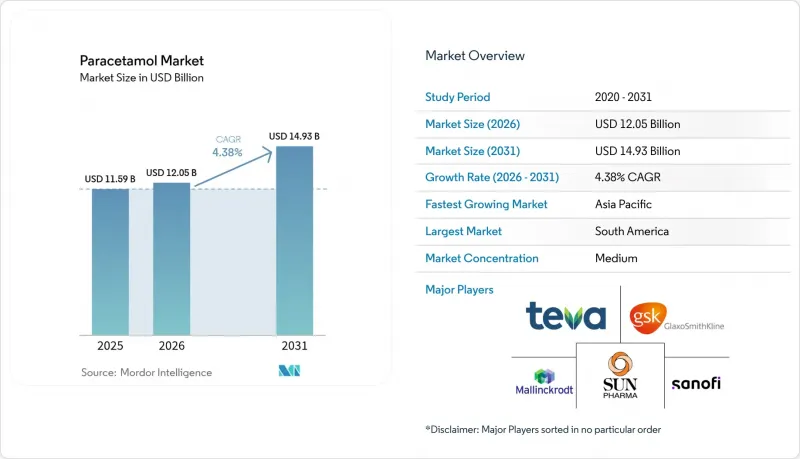
파라세타몰 시장 규모는 2025년에 115억 9,000만 달러로 평가되었고 2026년 120억 5,000만 달러에서 2031년까지 149억 3,000만 달러에 이를 것으로 예측되며, 예측 기간(2026-2031년) CAGR은 4.38%를 나타낼 전망입니다.
본 보고서는 제형(정제, 캡슐, 액상 현탁액, 분말 및 과립), 용도(통증 관리, 해열 등),투여 경로(경구, 직장, 정맥 내), 유통 채널(소매 약국 등), 지역(북미, 유럽, 아시아태평양, 중동 및 아프리카, 남미)별로 분류되어 있습니다. 시장 예측은 금액(달러) 기준으로 제시되어 있습니다.
전 세계 파라세타몰 시장 동향 및 인사이트
통증 및 발열 관련 질환의 유병률 증가
업데이트된 CDC 지침에서는 NSAIDs나 오피오이드보다 먼저 아세트아미노펜이 명시적으로 언급되어 있어, 파라세타몰 시장의 임상적 중요성이 더욱 강화되고 있습니다. 소아 예방접종 프로그램에서는 접종 후 증상에 대한 권장 해열제로 아세트아미노펜이 여전히 자리 잡고 있어, 간헐적인 수요를 창출하고 있습니다. 전 세계 평균 수명이 늘어남에 따라 퇴행성 관절염, 암성 통증, 수술 후 회복이 지속적인 기본 판매량을 견인하고 있습니다. 판매량은 증가하고 있지만, 수익 확보를 위해서는 자체 브랜드와의 경쟁 및 저비용 제네릭 의약품을 우선시하는 보험사의 단계적 치료 방침에 대응하는 것이 핵심이 됩니다.
OTC를 통한 자가 치료 붐과 소매 채널의 확대
2024년에 시작된 잉글랜드의 ‘Pharmacy First’ 프로그램 등, 약사가 치료를 시작할 수 있도록 하는 규제상의 움직임으로 인해 수백만 건의 보험 적용 대상 상담이 발생했으며, 그중 상당수에서 일반의약품이 권장되고 있습니다. 동시에, 2024년에 전면 시행된 독일의 전국적인 전자 처방전 시스템으로 인해 온라인 약국의 잠재 고객층이 확대되었고, 가정용 OTC 상비약 구매액이 증가하고 있습니다. 미국의 소매업체들은 로열티 데이터를 활용하여 타겟팅된 디지털 제안을 전개하고, 쇼핑객을 자사 브랜드의 아세트아미노펜 제품군으로 유도하고 있습니다. 이러한 동향으로 인해, 기존 약국이 방문객 수 감소에 직면하고 있음에도 불구하고, 파라세타몰 시장의 비처방약 부문은 확대되고 있습니다.
간독성 및 과다 복용에 대한 안전 규제 강화
호주에서는 연간 평균 225건의 입원과 50건의 과다 복용으로 인한 사망이 발생한 것을 계기로, 2025년 2월 일반의약품의 포장 크기에 제한을 두었습니다. 이는 이전에 영국에서 시행된 규제를 반영한 것입니다. 미국 FDA가 2024년 6월에 제안한 일반용 진통제에 관한 명령안에서는 소아용 투여량 및 생명을 위협하는 피부 반응이 다루어졌으며, 최종 규정은 2025년 말까지 공포될 전망입니다. 이 규제의 시행에 따라 라벨 재표기가 의무화되고, 고농도 제제의 판매가 제한될 가능성이 있습니다. 임신 중 신경 발달에 미치는 영향과 관련된 소송은 주요 브랜드들에게 추가적인 평판 리스크가 되고 있습니다.
부문 분석
2025년, 파라세타몰 시장에서 정제의 점유율은 46.83%를 차지했습니다. 이는 소비자에게 친숙한 제품이라는 점, 기계적으로 안정적인 보관 기간, 그리고 저렴한 단가를 반영한 결과입니다. 반면, 액상 제제는 2031년까지의 예측 연평균 성장률(CAGR)이 4.86%로 가장 높으며, 소아용 투여량에 대한 수요와 현재 99%의 봉입 효율을 달성하고 있는 첨단 맛 마스킹 기술이 이를 뒷받침하고 있습니다. 즉방성 제품에 비해 중앙값 기준으로 45% 높은 가격 책정이 이루어지는 서방형 2층 정제는 성숙한 유럽 및 미국 시장에서 소매업체의 이익률을 지켜주고 있지만, 신흥 경제국에서는 비용에 대한 민감성으로 인해 여전히 일반 제네릭 의약품이 선호되고 있습니다.
용매를 사용하지 않는 볼 밀 아세틸화 등의 친환경 화학 제조법은 최대 96%의 전환율을 실현함과 동시에 Scope 3 배출량을 감축하고 있으며, 이러한 특징은 유럽의 입찰에서 점점 더 중요하게 여겨지고 있습니다. 소매업체들이 자사 브랜드 상품의 라인업을 확대함에 따라, 일반 정제와 부가가치가 높은 액상 제형을 모두 공급할 수 있는 제제 제조업체는 판매량과 수익성의 균형을 최적으로 맞출 수 있는 입장에 있습니다. 프리미엄 츄어블 정제와 속용성 제제도 편의성을 추구하는 성인 소비자를 끌어들이고 있어, 파라세타몰 시장을 더욱 확대시키고 있습니다.
통증 관리 분야는 2025년 시장 가치의 39.27%를 차지하고 있으며, 그 배경에는 미국의 5,000만 명에 달하는 만성 통증 환자와 유럽 및 일본의 유사한 유병률 패턴이 있습니다. 해열 요법은 규모는 작지만, 백신 관련 예방 조치와 약국에서의 예방 접종 증가에 힘입어 연평균 6.63%의 성장이 예상됩니다. 감기·독감용 복합 제품은 아세트아미노펜과 충혈 완화제, 항히스타민제를 조합한 것으로, 겨울철에 점차 시장 점유율을 확대하며 장바구니 내 상향 판매를 촉진하고 있습니다.
지역 약국에서의 현장 검사 빈도가 높아짐에 따라, 증상이 있는 환자들이 직접 OTC 제품 구매 경로로 유도되고 있습니다. 그러나 포장 크기 상한선 설정 및 안전 관련 표시 확대에 따라 발열 관련 제품의 판매량 증가세가 둔화될 가능성이 있습니다. 이는 파라세타몰 업계가 생산 능력을 계획할 때 주목해야 할 요인입니다.
지역별 분석
북미는 2025년 매출의 34.12%를 차지하고 있으며, 이는 확립된 OTC 인프라와 정맥 주사용 아세트아미노펜을 포함한 광범위한 병원 처방집에 의해 뒷받침되고 있습니다. FDA의 향후 약전 개정에 따라 표시 비용은 상승할 전망이지만, 판매량에 실질적인 지장을 초래하지는 않을 것으로 예측됩니다. 킴벌리 클라크사가 켄뷰사를 487억 달러에 인수하는 움직임 등 업계 재편이 진행되고 있으며, 소송 문제의 소동에도 불구하고 유서 깊은 브랜드의 전략적 가치가 입증되고 있습니다. 원료의약품(API) 자급률은 여전히 낮은 수준이며, 이 지역은 관세 변동이나 중국의 생산량 변동에 민감한 상황에 놓여 있습니다.
유럽에서는 견고한 규제 감독 체제와 급속히 확대되는 온라인 조제 채널이 특징입니다. 독일에서는 2024년에 전자 처방전이 전면 도입되면서 즉시 전자 약국의 매출이 증가했고, 디지털 편의성에 대한 잠재적 수요가 부각되었습니다. 2025년 말까지 본격 가동이 예정된 프랑스 Seqens사의 연간 1만 톤 규모 공장은 EU가 API 수입 의존도를 낮추려는 의지를 여실히 보여주고 있습니다. 환경 기준은 점점 더 엄격해지고 있으며, ECHA(유럽화학물질청)의 2025년 우선순위 목록은 파라세타몰 폐기물 유동에 대한 배출 제한법 제정 가능성을 시사하고 있습니다.
아시아태평양은 연평균 성장률(CAGR) 7.76%로 가장 빠르게 성장하고 있는 지역이며, 그 원동력은 방대한 인구, 보험 적용 범위 확대, 그리고 정부의 제네릭 의약품 정책입니다. 인도만 해도 전국적으로 저가 파라세타몰을 소매 판매하는 ‘자나우샤디’ 매장이 8,787곳 운영되고 있습니다. 2025년 7월 발효된 인도-영국 자유무역협정에 따라 의약품 수출의 99%에 대한 관세가 철폐되어, 인도 제조업체들에게 유럽의 고부가가치 시장으로의 문이 열렸습니다. 중국은 여전히 API(유효 성분)의 주요 수출국이며, 국내 소비는 ‘건강 중국 2030’의 예방 의료 우선 정책의 혜택을 받고 있습니다.
중동 및 아프리카에서는 서로 다른 추세가 나타납니다. GCC 국가들은 의무 보험 확대에 따라 의약품 생산을 현지화하고 있는 반면, 사하라 이남 아프리카 국가들은 기부금에 의한 조달에 의존하고 있습니다. 남미는 통화 변동으로 어려움을 겪고 있지만, 브라질의 공공 프로그램을 통해 필수 진통제공급 기반이 확보되어 있습니다. 전반적으로 신흥 시장은 가격 측면의 제약이 있음에도 불구하고, 파라세타몰 시장에 두 자릿수 성장 여지를 제공합니다.
기타 혜택:
- 엑셀 형식 시장 예측(ME) 시트
- 3개월간의 애널리스트 지원
자주 묻는 질문
목차
제1장 서론
제2장 조사 방법
제3장 주요 요약
제4장 시장 구도
제5장 시장 규모와 성장 예측
제6장 경쟁 구도
제7장 시장 기회와 향후 전망
JHS 26.09.11According to Mordor Intelligence, the paracetamol market size was valued at USD 11.59 billion in 2025 and is estimated to grow from USD 12.05 billion in 2026 to reach USD 14.93 billion by 2031, at a CAGR of 4.38% during the forecast period (2026-2031).
This report is Segmented by Dosage Form (Tablets, Capsules, Liquid Suspensions, Powders & Granules), Application (Pain Management, Fever Reduction, and More), Route of Administration (Oral, Rectal, Intravenous), Distribution Channel (Retail Pharmacies, and More), and Geography (North America, Europe, Asia-Pacific, Middle East & Africa, South America). The Market Forecasts are Provided in Terms of Value (USD).
Global Paracetamol Market Trends and Insights
Rising Prevalence of Pain- & Fever-Related Disorders
The updated CDC guideline explicitly lists acetaminophen before NSAIDs or opioids, reinforcing the paracetamol market's clinical relevance. Pediatric vaccination programs add episodic demand because acetaminophen remains the recommended antipyretic for post-injection symptoms. As global life expectancy rises, osteoarthritis, cancer pain, and post-operative recovery drive sustained baseline volumes. Although unit sales grow, profit capture depends on navigating private-label competition and insurer step-therapy policies that favor low-cost generics.
OTC Self-Medication Boom & Retail Channel Expansion
Regulatory moves that enable pharmacists to initiate therapy, such as England's Pharmacy First program launched in 2024, have generated millions of reimbursed consultations, often resulting in over-the-counter analgesic recommendations. Simultaneously, Germany's nationwide e-prescription system, fully enforced in 2024, has expanded the addressable online pharmacy audience, boosting basket sizes for household OTC staples. U.S. retailers capitalize on loyalty data to place targeted digital offers, steering shoppers toward exclusive-label acetaminophen ranges. These dynamics expand the paracetamol market's non-prescription footprint, even as traditional drugstores confront foot traffic leakage.
Hepatotoxicity/Over-Dose Safety Tightening
Australia limited non-prescription pack sizes in February 2025 after averaging 225 hospitalizations and 50 overdose deaths per year, mirroring earlier U.K. curbs. The U.S. FDA's June 2024 proposed order for OTC analgesics addresses pediatric dosing and life-threatening skin reactions, with a final rule expected by late 2025. Implementation will force relabeling and could discourage high-strength formats. Litigation over potential neuro-developmental effects during pregnancy is adding further reputational risk for leading brands.
Other drivers and restraints analyzed in the detailed report include:
- Capacity Expansion of API & Finished-Dose Plants
- Extended/Rapid-Release Formulation Innovation
- Intense Generic Price Competition
For complete list of drivers and restraints, kindly check the Table Of Contents.
Segment Analysis
Tablets held 46.83% of the paracetamol market share in 2025, reflecting consumer familiarity, a mechanically stable shelf life, and low unit costs. Liquids, however, registered the highest forecast CAGR at 4.86% through 2031, propelled by pediatric dosing needs and advanced taste-masking science that now achieves 99% encapsulation efficiency. Extended-release bilayer tablets priced at a median 45% premium over immediate-release lines defend retailer margins in mature Western markets, though cost sensitivity in emerging economies still favors plain generics.
Green-chemistry manufacturing routes such as solvent-free ball-mill acetylation yield up to 96% conversion while trimming Scope 3 emissions, a feature increasingly cited in European tenders. As retailers expand their private-label offerings, formulators that can supply both commodity tablets and value-added liquids are best positioned to balance volume with profitability. Premium chewable and fast-dissolving variants also attract adult consumers seeking convenience, further widening the paracetamol market.
Pain management contributed 39.27% of the 2025 value, anchored by 50 million U.S. chronic-pain sufferers and similar prevalence patterns across Europe and Japan. Fever-reduction therapies, though smaller, are slated to grow 6.63% annually, buoyed by vaccine-related prophylaxis and rising pharmacy-administered immunizations. Cold-and-flu combination SKUs bundle acetaminophen with decongestants or antihistamines, capturing incremental share in winter seasons and driving basket upselling.
Higher frequency of point-of-care testing at community pharmacies channels symptomatic patients directly into OTC purchase pathways. Yet, possible pack-size caps and safety labeling expansions could blunt fever-related volume upside, a factor the paracetamol industry must monitor when planning capacity.
Complete Report Scope:
- By Dosage Form
- Tablets
- Capsules
- Liquid Suspensions
- Powders & Granules
- By Application
- Pain Management
- Fever Reduction
- Cold & Flu
- Others (Dental, Post-operative, etc.)
- By Route of Administration
- Oral
- Rectal
- Intravenous
- By Distribution Channel
- Retail Pharmacies
- Hospital Pharmacies
- Online Pharmacies
- By Geography
- North America
- United States
- Canada
- Mexico
- Europe
- Germany
- United Kingdom
- France
- Italy
- Spain
- Rest of Europe
- Asia-Pacific
- China
- Japan
- India
- Australia
- South Korea
- Rest of Asia-Pacific
- Middle East & Africa
- GCC
- South Africa
- Rest of Middle East & Africa
- South America
- Brazil
- Argentina
- Rest of South America
- North America
Geography Analysis
North America accounted for 34.12% of 2025 revenue, underpinned by entrenched OTC infrastructures and extensive hospital formularies that include intravenous acetaminophen. FDA's forthcoming monograph amendments will likely raise labeling costs but are not expected to materially impede volume. Consolidation is underway as Kimberly-Clark moves to acquire Kenvue for USD 48.7 billion, signaling the strategic value of heritage brands despite litigation noise. API self-sufficiency remains low, making the region sensitive to tariff turbulence and Chinese output fluctuations.
Europe features robust regulatory oversight and rapidly expanding online dispensing channels. Germany's full e-prescription rollout in 2024 immediately lifted electronic pharmacy turnover, illustrating latent demand for digital convenience. France's 10,000-ton Seqens plant, scheduled to be fully online by end-2025, exemplifies the bloc's bid to cut API import exposure. Environmental standards are tightening, with ECHA's 2025 priority list foreshadowing possible discharge-limit legislation for paracetamol waste streams.
Asia-Pacific is the fastest-growing region, with a 7.76% CAGR, driven by large populations, improving insurance coverage, and government generic-medicine schemes. India alone operates 8,787 Janaushadhi stores that retail low-cost paracetamol nationwide. The India-U.K. Free Trade Agreement, which entered into force in July 2025, eliminated tariffs on 99% of pharma exports, opening a premium European market for Indian producers. China remains the dominant API exporter, while its domestic consumption benefits from Healthy China 2030's preventive-care priorities.
The Middle East & Africa show divergent patterns: GCC states localize drug manufacturing under mandatory insurance expansion, while Sub-Saharan countries rely on donor-funded procurement. South America grapples with currency volatility, yet Brazil's public-sector programs secure a baseline for essential analgesics. Overall, emerging markets collectively provide the paracetamol market with double-digit growth headroom despite pricing constraints.
- Anqiu Lu'an Pharmaceutical
- Bayer
- Dr. Reddy's Laboratories
- GlaxoSmithKline
- Granules India Ltd.
- Hebei Jiheng Pharmaceutical
- Johnson & Johnson
- Mallinckrodt Pharmaceuticals
- Novartis
- Perrigo Company
- Sanofi
- Seqens SAS
- Shanghai Laser & Optics Century (SLOC)
- Sun Pharmaceuticals Industries
- Teva Pharmaceutical Industries
- Viatris
- Zhejiang Kangle Pharmaceutical
Additional Benefits:
- The market estimate (ME) sheet in Excel format
- 3 months of analyst support
TABLE OF CONTENTS
1 Introduction
- 1.1 Study Assumptions & Market Definition
- 1.2 Scope of the Study
2 Research Methodology
3 Executive Summary
4 Market Landscape
- 4.1 Market Overview
- 4.2 Market Drivers
- 4.2.1 Rising Prevalence of Pain- & Fever-Related Disorders
- 4.2.2 OTC Self-Medication Boom & Retail Channel Expansion
- 4.2.3 Capacity Expansion of API & Finished-Dose Plants
- 4.2.4 Extended/Rapid Release Innovation in Formulation
- 4.2.5 Opioid-Sparing Surgical Protocols Driving IV Paracetamol Uptake
- 4.2.6 Green-Chemistry Incentives/Local API Re-Shoring
- 4.3 Market Restraints
- 4.3.1 Hepatotoxicity/Over-Dose Safety Tightening Global Regulations
- 4.3.2 Intense Generic Price Competition Compressing Margins
- 4.3.3 API Supply-Chain Concentration & Tariff/Trade-Risk Exposure
- 4.3.4 Pack-Size / Access Restrictions Curbing Per-Capita Consumption
- 4.4 Regulatory Landscape
- 4.5 Technological Outlook
- 4.6 Porter's Five Forces Analysis
- 4.6.1 Threat of New Entrants
- 4.6.2 Bargaining Power of Buyers
- 4.6.3 Bargaining Power of Suppliers
- 4.6.4 Threat of Substitute Products
- 4.6.5 Intensity of Competitive Rivalry
5 Market Size & Growth Forecasts
- 5.1 By Dosage Form
- 5.1.1 Tablets
- 5.1.2 Capsules
- 5.1.3 Liquid Suspensions
- 5.1.4 Powders & Granules
- 5.2 By Application
- 5.2.1 Pain Management
- 5.2.2 Fever Reduction
- 5.2.3 Cold & Flu
- 5.2.4 Others (Dental, Post-operative, etc.)
- 5.3 By Route of Administration
- 5.3.1 Oral
- 5.3.2 Rectal
- 5.3.3 Intravenous
- 5.4 By Distribution Channel
- 5.4.1 Retail Pharmacies
- 5.4.2 Hospital Pharmacies
- 5.4.3 Online Pharmacies
- 5.5 By Geography
- 5.5.1 North America
- 5.5.1.1 United States
- 5.5.1.2 Canada
- 5.5.1.3 Mexico
- 5.5.2 Europe
- 5.5.2.1 Germany
- 5.5.2.2 United Kingdom
- 5.5.2.3 France
- 5.5.2.4 Italy
- 5.5.2.5 Spain
- 5.5.2.6 Rest of Europe
- 5.5.3 Asia-Pacific
- 5.5.3.1 China
- 5.5.3.2 Japan
- 5.5.3.3 India
- 5.5.3.4 Australia
- 5.5.3.5 South Korea
- 5.5.3.6 Rest of Asia-Pacific
- 5.5.4 Middle East & Africa
- 5.5.4.1 GCC
- 5.5.4.2 South Africa
- 5.5.4.3 Rest of Middle East & Africa
- 5.5.5 South America
- 5.5.5.1 Brazil
- 5.5.5.2 Argentina
- 5.5.5.3 Rest of South America
- 5.5.1 North America
6 Competitive Landscape
- 6.1 Market Concentration
- 6.2 Market Share Analysis
- 6.3 Company Profiles (includes Global Level Overview, Market Level Overview, Core Segments, Financials as Available, Strategic Information, Market Rank/Share for Key Companies, Products & Services, and Recent Developments)
- 6.3.1 Anqiu Lu'an Pharmaceutical
- 6.3.2 Bayer AG
- 6.3.3 Dr. Reddy's Laboratories
- 6.3.4 GlaxoSmithKline plc
- 6.3.5 Granules India Ltd.
- 6.3.6 Hebei Jiheng Pharmaceutical
- 6.3.7 Johnson & Johnson
- 6.3.8 Mallinckrodt Pharmaceuticals
- 6.3.9 Novartis AG
- 6.3.10 Perrigo Company
- 6.3.11 Sanofi SA
- 6.3.12 Seqens SAS
- 6.3.13 Shanghai Laser & Optics Century (SLOC)
- 6.3.14 Sun Pharmaceutical Industries Ltd.
- 6.3.15 Teva Pharmaceuticals, Inc.
- 6.3.16 Viatris Inc.
- 6.3.17 Zhejiang Kangle Pharmaceutical
7 Market Opportunities & Future Outlook
- 7.1 White-space & Unmet-Need Assessment


