|
시장보고서
상품코드
2123788
에폭시 경화제 : 시장 점유율 분석, 업계 동향 및 통계, 성장 예측(2026-2031년)Epoxy Curing Agent - Market Share Analysis, Industry Trends & Statistics, Growth Forecasts (2026 - 2031) |
||||||
 Mordor Intelligence
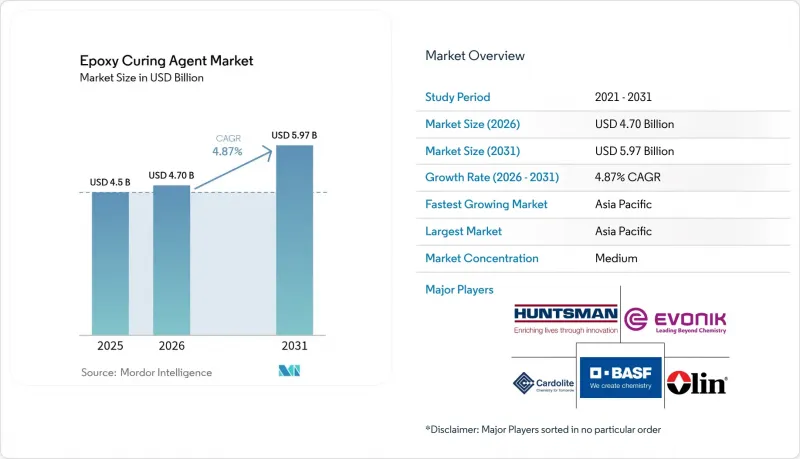
에폭시 경화제 시장 규모는 2025년 45억 달러로 평가되었습니다. 2026년에는 47억 달러로 확대되어 2031년까지 59억 7,000만 달러에 이를 것으로 예상되고 2026년부터 2031년에 걸쳐 CAGR 4.87%로 성장할 전망입니다.
본 보고서는 유형별(아민, 폴리아미드, 무수물 및 기타(페날카민,아미도아민 등), 용도별(페인트 및 코팅, 접착제 및 실란트, 복합재료, 전기 및 전자기기, 기타), 지역별(아시아태평양, 북미, 유럽, 남미, 중동 및 아프리카)로 분류되어 있습니다. 시장 예측은 금액(달러) 기준으로 제시되어 있습니다.
세계의 에폭시 경화제 시장 동향 및 인사이트
인프라 건설 붐이 고성능 바닥용 코팅재 수요를 견인
중국, 인도 및 걸프협력회의(GCC) 국가들의 물류, 제약, 데이터센터 건설 증가로 인해 무용제 및 고고형분 에폭시 바닥재의 출하량이 증가하고 있습니다. 중국 당국은 휘발성 유기 화합물(VOC) 배출 상한선을 80 g/L 미만으로 설정하고 있으며, 이에 따라 습기에 대한 민감성이라는 단점이 있음에도 불구하고 배합 제조업체들은 수성 폴리아미드 첨가제의 채택을 추진하고 있습니다. 인도의 클린룸 기준에서는 VOC 배출량이 50 g/L로 제한되어 있어, 이로 인해 무용제 에폭시 모르타르의 보급이 가속화되고 있습니다. GCC의 메가 프로젝트에서는 40°C 이상의 주변 온도에서 경화되는 시클로알파틴계 제품이 지정되어 있어, 신속한 시공과 내화학성이 확보되고 있습니다.
아시아태평양 및 유럽의 풍력 터빈 블레이드 생산 급증
2024년, 유럽연합(EU)의 풍력 발전 설비 용량은 241.7 GW에 달했으나, 블레이드 제조는 수지와 인건비가 비교적 저렴한 중국과 인도에 집중되어 있습니다. 80미터를 초과하는 블레이드의 진공 주입 성형에서는 포트 라이프가 80-120분인 중간 반응성 아민이 주류를 이루고 있습니다. EU에서는 2030년까지 35만 톤에 달할 것으로 예상되는 사용 후 폐기물 문제로 인해, 스완코(Swanco)사의 ‘EzCiclo’와 같이 용매 분해를 통해 탄소섬유를 회수할 수 있는 절단형 경화제의 도입이 가속화되고 있습니다.
용제계 아민 시스템에 대한 VOC 규제 강화
휘발성 유기 화합물(VOC)에 관한 규제로 인해 용제계 폴리아미드 및 아민계 경화제의 이익률이 압박받고 있으며, 포트 라이프나 도막 두께를 희생해야 하는 경우가 많은 수성 또는 고고형분 유형의 대체품으로의 재조성이 불가피해지고 있습니다. EU 지침 2004/42/EC에서는 VOC 함유량을 원팩 도료의 경우 40 g/L, 멀티팩 도료의 경우 65 g/L로 제한하고 있어, 기존의 폴리아미드 경화제는 시대에 뒤처지게 되었습니다. 북미와 중국에서도 유사한 규제가 검토되고 있어, 원자재 비용이 높음에도 불구하고 수요는 수성 폴리아미드 첨가제나 폴리아스파라긴산계 하이브리드 제품으로 이동하고 있습니다.
부문별 분석
2025년에는 아민계가 매출의 41.91%를 차지했으며, 에폭시 경화제 시장에서의 점유율은 2031년까지 연평균 성장률(CAGR) 5.21%로 확대될 것으로 전망됩니다. 시클로알파테릭 아민은 두꺼운 복합재에 필수적인 자외선 안정성과 낮은 점도를 실현하기 때문에 30-50%의 가격 프리미엄이 붙습니다. 폴리아미드는 오염된 표면에 사용하는 데 여전히 선호되지만, 폴리아스파라긴산계 하이브리드가 제공하는 ‘2시간 후 상도 도장 가능’이라는 특징에는 미치지 못하는 것이 현실입니다. 무수물은 200°C를 넘는 유리 전이 온도를 가지고 있어 전기용 적층판 시장에서 주류를 이루고 있지만, 150°C에서 경화가 필요하기 때문에 현장에서의 용도는 제한적입니다. 캐슈넛 껍질 액에서 얻어지는 페날카민은 뛰어난 염수 분무 시험 성능과 유연성을 갖추고 있어 틈새 시장인 선박 및 해양 공사 분야에서 채택이 확대되고 있는 반면, 아미도아민은 겨울철 파이프라인 프로젝트를 위해 저온 경화를 가능하게 합니다.
‘기타’로 분류되는 에폭시 경화제 시장 점유율은 수명 주기 비용 절감을 목적으로 고객이 20-40%의 할증 가격을 수용함에 따라 상승할 전망입니다. 채용 여부는 현지에서의 입수 가능성에 달려 있는데, 8주간의 수입 리드타임과 7.5-10%의 관세가 프로젝트 일정을 압박하기 때문입니다. 캡슐화된 이미다졸에 관한 특허 동향은 냉장 보관 없이 6개월의 보관 기간을 실현하는 잠재 아민의 도입이 임박했음을 시사하며, 이는 적층 가공 및 현장 수리 키트에 있어 획기적인 변화가 될 것입니다.
지역별 분석
아시아태평양은 2025년 에폭시 경화제 시장의 35.51%를 차지하며, 2031년까지 연평균 성장률(CAGR) 5.77%를 기록할 전망입니다. 중국은 부동산 부문의 역풍에도 불구하고 물류 허브 및 데이터센터용 바닥 코팅 시장에서 계속해서 지배적인 위치를 유지하고 있으며, 한편 생태환경부의 규제로 인해 VOC(휘발성 유기 화합물) 상한선이 설정됨에 따라 수성 도료에 대한 수요가 증가하고 있습니다. 인도의 반도체 산업 확대, 타타(Tata)사의 300mm 팹, 그리고 마이크론(Micron)사의 27억 5,000만 달러 규모의 조립 공장에서는 10%의 관세와 60일간의 수입 기간을 피하기 위해 국내산 저보이드율 봉지재가 필요합니다. 일본과 한국은 실링 재료 분야에서 기술적 리더십을 유지하고 있지만, 중국과 인도의 현지화 노력으로 인해 그 격차는 점차 좁혀지고 있습니다.
북미에서는 항공우주용 복합재료와 ‘인프라 투자 및 고용법(IIJA)’에 따른 자금 지원을 받은 인프라 확충이 호재로 작용하고 있습니다. 항공우주 OEM 각사는 120°C에서 경화되는 진공 백 전용 프리프레그의 지정을 늘리고 있으며, 개질 방향족 아민계 경화제가 선호되고 있습니다. 대서양 연안의 해상 풍력 발전 프로젝트에서는 블레이드 재활용 의무화에 대응하기 위해 절단이 가능한 경화제가 요구되고 있습니다. 멕시코의 자동차 생산 대수 증가로 인해 접착제 출하량은 증가하고 있지만, 수입 경화제에 대한 의존으로 인해 1kg당 0.15달러의 운송 비용이 추가되고 있습니다.
유럽에서는 해상 풍력 발전 및 자동차 경량화로 인해 안정적인 수요가 나타나고 있지만, VOC(휘발성 유기 화합물) 규제 강화로 인해 용제계 경화제의 이익률이 압박받고 있습니다. 풍력 블레이드 제조는 아시아로 이전되고 있으며, 유럽공급업체들은 EU가 안고 있는 35만 톤의 사용 후 블레이드 폐기물이라는 과제에 대응하기 위해 재활용 가능한 에폭시 매트릭스에 주력하고 있습니다. 남미에서는 브라질의 보호 코팅 수요가 주도적인 역할을 하고 있지만, 향후 10년간 4조 3,000억 달러 규모로 예상되는 걸프협력회의(GCC) 국가들의 건설 프로젝트에서는 40°C의 주변 온도에서도 경화 가능한 아민이 요구되고 있습니다.
기타 혜택 :
- 엑셀 형식 시장 예측(ME) 시트
- 3개월간의 애널리스트 지원
자주 묻는 질문
목차
제1장 서론
제2장 조사 방법
제3장 주요 요약
제4장 시장 구도
제5장 시장 규모 및 성장 예측
제6장 경쟁 구도
제7장 시장 기회 및 향후 전망
KTH 26.09.16According to Mordor Intelligence, the epoxy curing agent market size is expected to increase from USD 4.5 billion in 2025 to USD 4.70 billion in 2026 and reach USD 5.97 billion by 2031, growing at a CAGR of 4.87% over 2026-2031.
This report is Segmented by Type (Amines, Polyamides, Anhydrides, and Other Types (Phenalkamines, Amidoamines, and More)), Application (Paints and Coatings, Adhesives and Sealants, Composites, Electrical and Electronics, and Others), and Geography (Asia-Pacific, North America, Europe, South America, and the Middle East and Africa). The Market Forecasts are Provided in Terms of Value (USD).
Global Epoxy Curing Agent Market Trends and Insights
Infrastructure Boom Driving Demand for High-Performance Floor Coatings
Rising logistics, pharmaceutical, and data-center construction across China, India, and Gulf Cooperation Council countries is lifting solvent-free and high-solids epoxy flooring volumes. Authorities in China have set volatile organic compound (VOC) limits below 80 g/L, prompting formulators to adopt waterborne polyamide adducts despite humidity-sensitivity trade-offs. India's cleanroom standards cap VOC emissions at 50 g/L, accelerating solvent-free epoxy mortars. GCC mega-projects specify cycloaliphatic amine systems that cure at ambient temperatures above 40°C, ensuring rapid turnaround and chemical resistance.
Wind-Turbine Blade Production Surge in APAC & Europe
Installed wind capacity rose to 241.7 GW in the European Union during 2024, while blade manufacture is concentrating in China and India, where resin and labor costs are lower. Medium-reactivity amines offering 80-120 minute pot life dominate vacuum infusion of 80 m-plus blades. End-of-life waste, forecast at 350,000 t by 2030 in the EU, is accelerating the adoption of cleavable hardeners such as Swancor's EzCiclo that allow solvolysis recovery of carbon fiber.
Stricter VOC Caps on Solvent-Borne Amine Systems
Volatile organic compound regulations are compressing margins for solvent-borne polyamide and amine hardeners, forcing reformulation toward waterborne and high-solids alternatives that often sacrifice pot life or film build. EU Directive 2004/42/EC limits VOCs to 40 g/L in one-pack and 65 g/L in multi-pack coatings, rendering legacy polyamide hardeners obsolete. Similar caps are pending in North America and China, steering demand toward waterborne polyamide adducts and polyaspartic hybrids despite higher raw-material costs.
Other drivers and restraints analyzed in the detailed report include:
- Miniaturization of Electronics Requiring Ultra-Low-Void Encapsulants
- Lightweight CFRP Adoption in Automotive & Aerospace
- Volatile Epichlorohydrin & Benzyl-Amine Feedstock Prices
For complete list of drivers and restraints, kindly check the Table Of Contents.
Segment Analysis
Amines captured 41.91% revenue in 2025, and their share of the epoxy curing agents market is projected to expand at a 5.21% CAGR to 2031. Cycloaliphatic amines command 30-50% price premiums because they deliver ultraviolet stability and low viscosity essential for thick-section composites. Polyamides remain preferred for contaminated surfaces, but cannot match the two-hour overcoat readiness offered by polyaspartic hybrids. Anhydrides dominate electrical laminates thanks to glass-transition temperatures above 200°C, though their 150°C cure requirement limits field application. Phenalkamines, derived from cashew nutshell liquid, are winning niche marine and offshore jobs due to superior salt-fog performance and flexibility, while amidoamines offer a low-temperature cure for winter pipeline projects.
The epoxy curing agents market share of "Other Types" is set to climb as customers accept 20-40% upcharges for lifecycle cost savings. Adoption hinges on local availability because import lead times of eight weeks and tariffs of 7.5-10% erode project schedules. Patent activity in encapsulated imidazoles signals impending latent amine introductions that promise a six-month shelf life without refrigeration, a game-changer for additive manufacturing and field repair kits.
Complete Report Scope:
- By Type
- Amines
- Polyamides
- Anhydrides
- Other Types (Phenalkamines, Amidoamines, etc.)
- By Application
- Paints and Coatings
- Adhesives and Sealants
- Composites
- Electrical and Electronics
- Others (Industrial Flooring and Repairs, etc.)
- By Geography
- Asia-Pacific
- China
- India
- Japan
- South Korea
- ASEAN
- Rest of Asia-Pacific
- North America
- United States
- Canada
- Mexico
- Europe
- Germany
- United Kingdom
- France
- Italy
- Rest of Europe
- South America
- Brazil
- Argentina
- Rest of South America
- Middle East and Africa
- Saudi Arabia
- South Africa
- Rest of Middle East and Africa
- Asia-Pacific
Geography Analysis
Asia-Pacific held 35.51% of the epoxy curing agents market in 2025 and is set to post a 5.77% CAGR through 2031. China continues to dominate floor coatings for logistics hubs and data centers, despite property-sector headwinds, while the Ministry of Ecology and Environment rules cap VOCs, boosting waterborne demand. India's semiconductor expansion, Tata's 300 mm fab, and Micron's USD 2.75 billion assembly plant, will require domestic low-void encapsulants to avoid 10% tariffs and 60-day imports. Japan and South Korea retain technology leadership in sealing materials, but localization efforts in China and India are narrowing the gap.
North America benefits from aerospace composites and infrastructure upgrades funded by the Infrastructure Investment and Jobs Act. Aerospace OEMs increasingly specify vacuum-bag-only prepregs cured at 120°C, favoring modified aromatic amines. Offshore wind projects along the Atlantic demand cleavable hardeners to enable blade recycling mandates. Mexico's vehicle output pushes adhesive volumes higher, yet reliance on imported curing agents adds USD 0.15 kg freight cost.
Europe shows steady demand from offshore wind and automotive lightweighting, but stricter VOC caps erode margins for solvent-borne hardeners. Wind-blade manufacturing is migrating toward Asia, leaving European suppliers focused on recyclable epoxy matrices to meet the Union's 350,000 t end-of-life blade waste challenge. South America is led by Brazil's protective-coating needs, while Gulf Cooperation Council construction, valued at USD 4.3 trillion over the next decade, requires amines that can cure in 40°C ambient conditions.
- Aditya Birla Group
- Air Products Inc.
- Atul Ltd.
- BASF
- Cardolite Corporation
- DIC Corporation
- Evonik Industries AG
- Huntsman International LLC
- KUKDO CHEMICAL CO., LTD.
- Kumho P&B Chemicals Inc.
- Mitsubishi Chemical Group Corporation
- Olin Corporation
- Shandong Deyuan Epoxy Resin Co. Ltd
- Toray Industries Inc.
- Westlake Corporation
Additional Benefits:
- The market estimate (ME) sheet in Excel format
- 3 months of analyst support
TABLE OF CONTENTS
1 Introduction
- 1.1 Study Assumptions & Market Definition
- 1.2 Scope of the Study
2 Research Methodology
3 Executive Summary
4 Market Landscape
- 4.1 Market Overview
- 4.2 Market Drivers
- 4.2.1 Infrastructure boom driving demand for high-performance floor coatings
- 4.2.2 Wind-turbine blade production surge in APAC & Europe
- 4.2.3 Miniaturisation of electronics requiring ultra-low-void encapsulants
- 4.2.4 Light-weight CFRP adoption in automotive & aerospace
- 4.2.5 Emergence of ultra-fast latent systems enabling 3-D printing of thermosets
- 4.3 Market Restraints
- 4.3.1 Stricter VOC caps on solvent-borne amine systems
- 4.3.2 Volatile epichlorohydrin & benzyl-amine feedstock prices
- 4.3.3 Supply crunch in cashew-derived phenalkamine feedstock
- 4.4 Value Chain Analysis
- 4.5 Porter's Five Forces
- 4.5.1 Bargaining Power of Suppliers
- 4.5.2 Bargaining Power of Buyers
- 4.5.3 Threat of New Entrants
- 4.5.4 Threat of Substitutes
- 4.5.5 Competitive Rivalry
5 Market Size & Growth Forecasts (Value)
- 5.1 By Type
- 5.1.1 Amines
- 5.1.2 Polyamides
- 5.1.3 Anhydrides
- 5.1.4 Other Types (Phenalkamines, Amidoamines, etc.)
- 5.2 By Application
- 5.2.1 Paints and Coatings
- 5.2.2 Adhesives and Sealants
- 5.2.3 Composites
- 5.2.4 Electrical and Electronics
- 5.2.5 Others (Industrial Flooring and Repairs, etc.)
- 5.3 By Geography
- 5.3.1 Asia-Pacific
- 5.3.1.1 China
- 5.3.1.2 India
- 5.3.1.3 Japan
- 5.3.1.4 South Korea
- 5.3.1.5 ASEAN
- 5.3.1.6 Rest of Asia-Pacific
- 5.3.2 North America
- 5.3.2.1 United States
- 5.3.2.2 Canada
- 5.3.2.3 Mexico
- 5.3.3 Europe
- 5.3.3.1 Germany
- 5.3.3.2 United Kingdom
- 5.3.3.3 France
- 5.3.3.4 Italy
- 5.3.3.5 Rest of Europe
- 5.3.4 South America
- 5.3.4.1 Brazil
- 5.3.4.2 Argentina
- 5.3.4.3 Rest of South America
- 5.3.5 Middle East and Africa
- 5.3.5.1 Saudi Arabia
- 5.3.5.2 South Africa
- 5.3.5.3 Rest of Middle East and Africa
- 5.3.1 Asia-Pacific
6 Competitive Landscape
- 6.1 Market Concentration
- 6.2 Strategic Moves
- 6.3 Market Share (%)/Ranking Analysis
- 6.4 Company Profiles (includes Global level Overview, Market level overview, Core Segments, Financials as available, Strategic Information, Products & Services, and Recent Developments)
- 6.4.1 Aditya Birla Group
- 6.4.2 Air Products Inc.
- 6.4.3 Atul Ltd.
- 6.4.4 BASF
- 6.4.5 Cardolite Corporation
- 6.4.6 DIC Corporation
- 6.4.7 Evonik Industries AG
- 6.4.8 Huntsman International LLC
- 6.4.9 KUKDO CHEMICAL CO., LTD.
- 6.4.10 Kumho P&B Chemicals Inc.
- 6.4.11 Mitsubishi Chemical Group Corporation
- 6.4.12 Olin Corporation
- 6.4.13 Shandong Deyuan Epoxy Resin Co. Ltd
- 6.4.14 Toray Industries Inc.
- 6.4.15 Westlake Corporation
7 Market Opportunities & Future Outlook
- 7.1 White-Space & Unmet-Need Assessment
- 7.2 Bio-Based Epoxy Curing Agents