|
시장보고서
상품코드
2123799
전기 상용차 시장 : 시장 점유율 분석, 업계 동향 및 통계, 성장 예측(2026-2031년)Electric Commercial Vehicle - Market Share Analysis, Industry Trends & Statistics, Growth Forecasts (2026 - 2031) |
||||||
 Mordor Intelligence
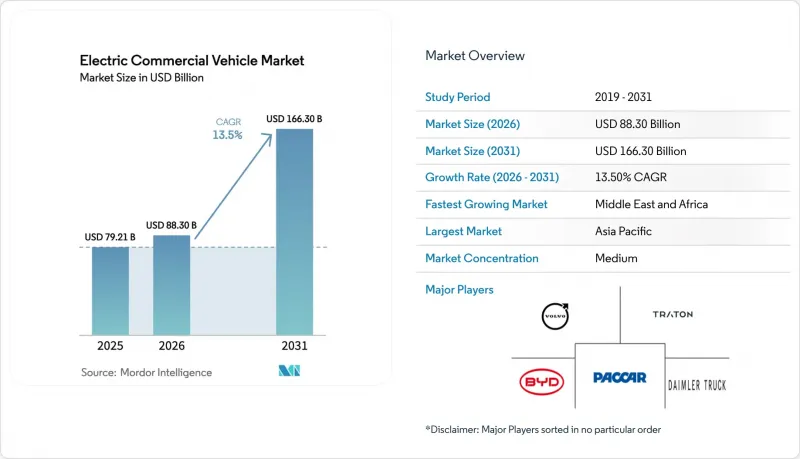
Mordor Intelligence에 의하면, 전기 상용차 시장 규모는 2025년 792억 1,000만 달러로 평가되었고, 2026년에는 883억 달러로 추정되고, 2031년까지 1,663억 달러에 이를 것으로 예상되며, 2026-2031년 CAGR 13.5%로 성장할 전망입니다.
본 보고서는 차량 유형별(버스, 트럭 등), 구동 방식별(배터리식 전기차, 하이브리드 전기차 등), 출력별(150kW 미만, 150-250kW, 기타), 배터리 용량별(100kW시 미만, 100-200kW시, 기타), 주행 거리별, 최종 이용 산업별, 충전 방식별 및 지역별로 분류되어 있습니다. 시장 전망은 금액(달러) 및 수량(대)으로 제시되어 있습니다.
세계의 전기 상용차 시장 동향 및 인사이트
kWh당 100달러 미만으로 떨어지는 급속한 배터리 비용 하락이 TCO의 손익분기점을 낮추고 있습니다.
2025년 초, 인산철 리튬 배터리 가격은 중요한 전환점에 도달하여 장거리 트럭의 TCO(총 소유 비용) 손익분기점을 넘어섰습니다. CATL의 최신 세대 배터리는 에너지 밀도와 비용 효율성이 향상되어 차축 중량 제한을 초과하지 않으면서도 주행 거리를 연장할 수 있습니다. 연료비와 유지보수비 절감을 고려할 때, 다임러 트럭(Daimler Trucks)의 ‘eCascadia’는 캘리포니아주 지역 노선에서 디젤 차량에 비해 뚜렷한 비용 우위를 보이고 있습니다. 시장 역학의 변화를 반영하여, PACCAR사는 2025년 수주의 상당 부분이 보조금에 의존하지 않고 성사되었다고 보고했으며, 이는 이러한 기술들의 경제적 실현 가능성이 높아지고 있음을 여실히 보여줍니다. 향후 몇 년 동안 추가적인 비용 절감이 예상되며, 대부분의 운영 시나리오에서 구매 인센티브의 필요성이 사라질 가능성이 있습니다.
정부 자금에 의한 무공해 차량 조달 의무
유럽연합 집행위원회의 개정된 대형 차량용 CO₂ 배출 기준에는 2030년까지 45%, 2040년까지 90% 감축이 규정되어 있어, 이로 인해 중형급 신형 디젤 차량의 도입은 사실상 종료될 것입니다. 중국의 듀얼 크레딧 제도는 기준을 초과 달성할 경우 보상을 제공하는 구조로 되어 있으며, BYD사는 2025년 국내 상용차 판매의 상당 부분을 이 인센티브 제도에 기인할 것으로 전망하고 있습니다. 인도의 FAME-III에서는 특히 델리, 뭄바이, 방갈로르에 중점을 두고 전기 버스 및 충전 인프라에 막대한 자금이 배정되었습니다. 이러한 프로그램은 자연스러운 수요 증가만으로는 달성할 수 없는 속도로 일괄 조달을 촉진하고, 학습 곡선을 가속화하며, 공급망을 강화하고 있습니다.
고속도로 화물 운송 회랑 내 상용용 급속 충전기 네트워크 제약
미국에서는 350kW를 초과하는 대형 DC 충전기의 가동 수가 제한적이어서 운송 회랑의 요건을 충족하지 못하고 있습니다. 유럽에서는 계통 연계 대기 시간이 현저히 길어 설치 장소로의 전력 공급이 지연되고, 차량들이 지역 노선으로 밀려나고 있습니다. 일렉트리파이 아메리카(Electrify America)는 계획 중인 트럭용 충전 거점 상당수가 변전소 업그레이드가 필요하며, 각각에 막대한 비용이 소요된다고 지적하고 있습니다. 한편, 인도 국가고속도로청은 계획했던 트럭용 충전 플라자 중 극히 일부만 가동하고 있으며, 본격적인 운영 개시는 현재 지연되고 있습니다. 이러한 전력망의 병목 현상은 메가와트급 충전이 더욱 보편화될 때까지 장거리 배터리식 전기 트럭의 보급 가능성을 저해하는 요인으로 작용하고 있습니다.
부문 분석
2025년 매출액 중 버스가 54.12%를 차지했습니다. 이는 조달 주기가 긴 점과 도시 교통 시스템 내 차량 전체의 도입을 뒷받침하는 정부 보조금이 반영된 결과로, 전기 상용차 시장 규모는 버스를 중심으로 기반을 다지고 있습니다. 한편, 트럭은 대형 전자상거래 기업들이 라스트 마일 및 지역 간 배송 노선을 전기화함에 따라 2031년까지 연평균 성장률(CAGR) 17.15%로 성장할 전망입니다. 최근 BYD는 전 세계에 다수의 전기 버스를 납품하고 있으며, 그 대부분은 대기질 규제로 인해 중국 각 지방 자치단체에 배정되고 있습니다. 반면, 포드는 북미 전역에서 ‘E-Transit’ 밴 판매에서 눈부신 성장을 이루고 있습니다. 적재량 제약으로 인해 장거리 대형 트럭 분야의 배터리식 전기차 도입은 저해되고 있지만, 그와 동시에 단거리 지역 운송 분야에서는 단기적인 성장이 예상됩니다. 적재 용량을 유지하는 모듈식 배터리 패키지의 이점을 누리는 밴은 소포 배송 업체에게 없어서는 안 될 존재가 되었습니다. 특히 DHL의 ‘Streetscooter’ 차량군은 최근 몇 년간 대폭 확대되고 있습니다.
신흥 시장에서는 지자체의 지속적인 자금 지원으로 버스의 우위가 유지되고 있지만, 물류 차량의 교체 주기가 4-6년으로 짧기 때문에 2028년 이후에는 연간 판매 대수에서 트럭이 버스를 추월할 전망입니다. UPS, 아마존, JD Logistics 등의 차량 운영 사업자들은 경량 전기 섀시의 중고 시장을 창출하고 있으며, 기존의 버스 중심 OEM 제조업체를 넘어 공급업체의 다양화가 진행되고 있습니다. 한편, 폐기물 관리 당국 및 유틸리티자는 잦은 정차와 출발이 반복되는 업무 주기에 맞추어 전용 전기 섀시를 채택하고 있어 트럭 수요를 더욱 확대시키고 있습니다. 공급망이 성숙해지고 섀시의 범용성이 향상됨에 따라, 트럭은 특히 이용률이 높은 소포 배송 및 지자체 서비스 노선에서 전기 상용차 시장의 판매 대수를 견인하는 원동력이 될 전망입니다.
2025년에는 성숙한 공급망과 셀 가격의 급락에 힘입어 배터리식 전기 파워트레인이 82.36%의 점유율을 차지했으며, 전기 상용차 시장에서 명확한 기술적 우위를 확립했습니다. 그럼에도 불구하고, 연료전지 전기차는 2031년까지 연평균 성장률(CAGR) 25.01%를 나타낼 것으로 예측되며, 배터리 무게가 적재량의 경제성을 저해하는 대형 차량의 이용 사례를 목표로 하고 있습니다. 현대자동차의 ‘XCIENT’ 트럭은 연료 보급을 받으며 500만 킬로미터 이상을 주행하고 있어, 장거리 운송에서 수소 이용의 비즈니스 타당성을 입증하고 있습니다. 미국 수소 허브 프로그램에서는 2028년까지 캘리포니아주 항만을 대상으로 1,000대의 연료전지 트럭을 도입할 예정이며, 이는 공공 부문이 이 로드맵에 대해 확신을 가지고 있음을 보여줍니다. 플러그인 하이브리드 차량은 주행 거리에 제약이 있는 지역에서 활용되고 있으며, 볼보의 플러그인 하이브리드형 FH 모델은 2024년 유럽 내 볼보의 전기차 판매 대수에서 미미한 비중을 차지했습니다.
도시 및 지방의 차량 군에서는 차량 기지에서의 충전과 저렴한 에너지 가격 덕분에 비용 우위가 유지되므로, 배터리식 전기 구동이 계속해서 주류를 이룰 것입니다. 연료전지의 보급은 수소의 비용 경쟁력 확보에 달려 있지만, 향후 몇 년간 재생에너지를 이용한 전기분해가 확대됨에 따라 그 실현이 기대되고 있습니다. 규제 당국이 더욱 엄격한 제로 배출 기준을 시행함에 따라 하이브리드 차량과 비플러그인형 차량은 감소할 전망입니다. 추진 시스템의 상황이 변화하는 가운데, 도시 지역 노선에서는 배터리가 주류를 이룰 전망입니다. 동시에, 수소는 더 무거운 장거리 화물 운송에 활용될 것으로 보이며, 이는 전기 상용차 시장을 확대시킬 것입니다.
150-250 kW 출력 대역은 2025년 인도 대수의 46.25%를 차지했으며, 이는 지역 배송에 사용되는 클래스 6-7 트럭과 일치합니다. 250 kW를 초과하는 구동 시스템은 2031년까지 연평균 성장률(CAGR) 15.23%를 나타낼 것으로 예측되며, 그 원동력은 다임러의 ‘eActros 600’과 테슬라의 ‘Semi’입니다. 이들 모두 주요 화물 운송 노선에서의 주행 거리 우려를 해소하고 있습니다. 150kW 미만 시스템은 리비안의 ‘EDV’와 같은 소형 밴에서 주류를 이루고 있으며, 저출력 덕분에 합리적인 가격과 효율성을 실현하고 있습니다.
고출력 시스템에는 800볼트 아키텍처가 필요하며, 이로 인해 부품 비용이 15-20% 증가하지만, 클래스 8 트랙터에 필수적인 기능인 1메가와트 충전이 가능해집니다. 메가와트급 인프라가 5번 주간 고속도로, 95번 주간 고속도로 및 유럽의 TEN-T 회랑에 보급됨에 따라, 고출력 부문은 전기 상용차 시장에서 더 큰 점유율을 차지하게 될 것입니다. 중출력 시스템은 야간에 차고에서 충전하는 것으로 충분한 지자체 및 지역 차량 군에서 계속해서 주류를 이룰 것입니다.
지역별 분석
아시아태평양은 2025년 매출의 62.18%를 차지했습니다. 이는 중국의 도시형 신형 버스 수주에서 전기 버스의 점유율이 대폭 확대된 것과 인도의 버스 및 화물 운송 차량에 대한 FAME-III 보조금에 힘입은 결과입니다. 일본의 이스즈와 미쓰비시 후소(Mitsubishi Fuso)는 도쿄와 오사카의 저공해 구역을 주요 대상으로 전기 트럭을 수 대 납품했습니다. 한국은 ‘XCIENT’ 수소연료전지 트럭을 수출하며 국내 수소 기술력을 한층 더 높였습니다. 이 지역은 통합된 조달 체계, 고밀도 도시화, 그리고 공공버스 도입을 가속화하는 대기질 개선 요구 등의 혜택을 받고 있습니다.
중동 및 아프리카은 2031년까지 연평균 성장률(CAGR) 14.18%를 기록하며 가장 빠른 성장이 예상됩니다. ‘비전 2030’에 따라 사우디아라비아 공공투자기금(PIF)은 전기 버스 및 전기 트럭 공장 설립에 막대한 자금을 배정하고 있으며, 향후 몇년내에 연간 생산량을 대폭 늘리는 것을 목표로 하고 있습니다. 더반시는 아프리카개발은행을 통해 여러 대의 전기 버스 도입 자금을 조달한 반면, 이집트는 유럽부흥개발은행(EBRD)의 대출을 활용하여 2028년까지 카이로의 상당수 버스를 전기화하겠다는 목표를 세웠습니다. 국내 OEM(원천 장비 제조업체) 기반이 취약한, 야심 찬 탈탄소화 계획을 가진 시장에서 성장은 정부 자금과 다자간 금융 기관의 대출에 의해 뒷받침되고 있습니다.
북미와 유럽은 규제의 엄격성과 인프라 과제 면에서 서로 유사합니다. 캘리포니아주의 ‘첨단 청정 트럭(ACT)’ 규정은 제조업체들에게 2024년 모델 연도(MY)부터 연간 판매 대수 중 제로 배출 차량(ZEV)의 비율을 단계적으로 높여, 2035년 MY까지 클래스 2b-3에서 55%,클래스 4-8 스트레이트 트럭의 경우 75%, 트랙터의 경우 40%에 도달하도록 의무화하고 있습니다. 캐나다는 2026-27년까지 5,000대의 버스를 전동화하기 위해 27억 5,000만 캐나다 달러(약 20억 달러)를 예산에 편성했습니다. 2030년까지 유럽 대형 차량의 CO₂ 배출량을 45% 감축하겠다는 목표는 독일의 트럭 보조금과 프랑스 및 영국의 저배출 구역 확장에 힘입어 추진되고 있습니다. 두 대륙 모두 고속도로 연선의 전력망 연결 지연으로 인해 장거리 운송 분야로의 보급이 주춤하고 있지만, 정책의 확실성과 구매 인센티브 덕분에 2030년까지 급속한 보급이 궤도에 오르고 있습니다.
기타 혜택 :
- 엑셀 형식 시장 예측(ME) 시트
- 3개월간의 애널리스트 지원
자주 묻는 질문
목차
제1장 서론
제2장 조사 방법
제3장 주요 요약
제4장 시장 구도
제5장 시장 규모 및 성장 예측
제6장 경쟁 구도
제7장 시장 기회 및 향후 전망
AJY 26.09.11According to Mordor Intelligence, the electric commercial vehicle market size is expected to increase from USD 79.21 billion in 2025 to USD 88.30 billion in 2026 and reach USD 166.30 billion by 2031, growing at a CAGR of 13.5% over 2026-2031.
This report is Segmented by Vehicle Type (Bus, Trucks, and More), Propulsion (Battery Electric Vehicles, Hybrid Electric Vehicles, and More), Power Output (Less Than 150 KW, 150-250 KW, and More), Battery Capacity (Less Than 100 KWh, 100-200 KWh, and More), Range, End-Use Industry, Charging Type, and Geography. The Market Forecasts are Provided in Terms of Value (USD) and Volume (Units).
Global Electric Commercial Vehicle Market Trends and Insights
Rapid Battery-Cost Decline Below USD 100/kWh Driving TCO Breakeven
In early 2025, lithium-iron-phosphate cell prices reached a significant milestone, crossing the breakeven threshold for high-mileage trucks. CATL's latest-generation cells offer enhanced energy density and cost efficiency, enabling extended ranges without exceeding axle-weight limits. When considering fuel and maintenance savings, Daimler Trucks' eCascadia demonstrates a notable cost advantage over diesel alternatives on regional routes in California. Reflecting a shift in market dynamics, PACCAR reported that a substantial portion of its 2025 orders were placed without relying on subsidies, highlighting the growing economic feasibility of these technologies. Projections suggest further cost reductions in the coming years, potentially eliminating the need for purchase incentives across most operational scenarios.
Government-funded Zero-Emission Fleet Procurement Mandates
The European Commission's revised heavy-duty CO2 standards stipulate a 45% cut by 2030 and a 90% cut by 2040, effectively sunsetting new diesel in medium-duty classes. China's dual-credit scheme rewards over-compliance, prompting BYD to attribute a significant share of its 2025 domestic commercial sales to the incentive framework. India's FAME-III allocates substantial funding to electric buses and charging infrastructure, with a particular focus on Delhi, Mumbai, and Bengaluru. Such programs spur bulk procurement, accelerate learning curves, and tighten supply chains faster than organic demand growth alone.
Commercial-grade Fast-Charger Grid Constraints on Highway Freight Corridors
The United States operates a limited number of heavy-duty DC chargers above 350 kW, falling short of corridor requirements. In Europe, interconnection queues are significantly long, delaying site energization and pushing fleets onto regional routes. Electrify America notes that a significant portion of its planned truck sites require substation upgrades, each of which entails substantial costs. Meanwhile, India's National Highways Authority has activated only a fraction of its planned truck-charging plazas, with full commissioning now delayed. These grid bottlenecks hinder the potential for long-haul battery-electric penetration until megawatt charging becomes more prevalent.
Other drivers and restraints analyzed in the detailed report include:
- E-commerce-led Surge in Urban Last-Mile Delivery Vehicles
- Hydrogen Hub Investments Accelerating Fuel-cell Trucks
- Payload Penalties from Large Battery Packs in Long-haul Segments
For complete list of drivers and restraints, kindly check the Table Of Contents.
Segment Analysis
Buses accounted for 54.12% of 2025 revenue, reflecting long procurement cycles and public subsidies that favor fleet-wide deployment in city transit systems, giving the electric commercial vehicle market size a bus-centred foundation. Trucks, however, are growing at 17.15% CAGR through 2031 as e-commerce giants electrify last-mile and regional routes. In recent years, BYD has delivered a significant number of electric buses globally, with the majority allocated to Chinese municipalities due to air-quality mandates. Meanwhile, Ford has experienced notable growth in the sales of its E-Transit vans across North America. While payload penalties hinder the adoption of battery-electric vehicles in long-haul heavy trucks, they steer near-term growth toward regional hauls within a limited radius. Vans, benefiting from modular battery packaging that maintains cargo volume, have become essential for parcel carriers. Notably, DHL's Streetscooter fleet has expanded substantially in recent years.
Continued municipal funding sustains bus dominance in emerging markets, yet the shorter four- to six-year replacement cycles in logistics fleets position trucks to overtake buses in annual volumes after 2028. Fleet operators such as UPS, Amazon, and JD Logistics are creating a secondary market for lightweight electric chassis, expanding supplier diversity beyond traditional bus-focused OEMs. Meanwhile, waste-management authorities and utilities adopt specialized electric chassis for stop-and-go duty cycles, further broadening truck demand. As supply chains mature and chassis versatility improves, trucks are set to become the volume engine of the electric commercial vehicle market, particularly in high-utilization parcel and municipal service routes.
Battery electric powertrains captured an 82.36% share in 2025, benefiting from mature supply chains and the rapid decline in cell pricing, giving the electric commercial vehicle market a clear technology incumbent. Fuel-cell electric vehicles nonetheless post a 25.01% CAGR through 2031, targeting heavy-duty use cases where battery mass erodes payload economics. Hyundai's XCIENT trucks have clocked more than 5 million kilometers with refueling, validating the business case for hydrogen in long-haul applications. The United States hydrogen hub program earmarks 1,000 fuel-cell trucks for California ports by 2028, signaling public-sector confidence in the pathway. Plug-in hybrids serve range-constrained regions; Volvo's plug-in FH variant made up a nominal share of its European electric sales in 2024.
Battery-electric traction will remain dominant in urban and regional fleets because depot charging and low energy prices preserve its cost advantage. Fuel-cell adoption depends on achieving cost competitiveness for hydrogen, which is expected as renewable electrolysis scales in the coming years. As regulators enforce stricter zero-emission standards, hybrid and non-plug-in variants are likely to decline. In the shifting propulsion landscape, batteries are expected to dominate urban routes. At the same time, hydrogen is poised to serve heavier, long-distance freight, expanding the market for electric commercial vehicles.
The 150-250 kW band held 46.25% of 2025 deliveries, aligning with Class 6-7 trucks used for regional distribution. Greater-than-250 kW drivetrains grow at 15.23% CAGR to 2031, catalyzed by Daimler's eActros 600 and Tesla's Semi, both of which eliminate range anxiety on major freight corridors. Less-than-150 kW systems dominate light vans such as Rivian's EDV, where lower power improves affordability and efficiency.
High-power systems require 800-volt architectures that add 15-20% component cost yet enable one-megawatt charging, a critical feature for class 8 tractors. As megawatt infrastructure spreads across Interstate 5, Interstate 95, and European TEN-T corridors, high-power segments will capture a larger slice of the electric commercial vehicle market. Mid-range power will remain prevalent in municipal and regional fleets, where overnight depot charging is sufficient.
Complete Report Scope:
- By Vehicle Type
- Bus
- Trucks
- Pick-up Trucks
- Vans
- By Propulsion
- Battery Electric Vehicles (BEV)
- Hybrid Electric Vehicles (HEV)
- Plug-in Hybrid Electric Vehicles (PHEV)
- Fuel-cell Electric Vehicles (FCEV)
- By Power Output
- Less than 150 kW
- 150-250 kW
- Greater than 250 kW
- By Battery Capacity
- Less than 100 kWh
- 100-200 kWh
- Greater than 200 kWh
- By Range
- Less than 150 miles
- 150-300 miles
- More than 300 miles
- By End-use Industry
- Urban Transit
- Logistics and Delivery
- Waste Management
- Utilities and Construction
- By Charging Type
- Depot (AC)
- Opportunity / En-route (DC)
- By Geography
- North America
- United States
- Canada
- Rest of North America
- South America
- Brazil
- Argentina
- Rest of South America
- Europe
- Germany
- United Kingdom
- France
- Italy
- Spain
- Nordics
- Rest of Europe
- Asia-Pacific
- China
- India
- Japan
- South Korea
- Rest of Asia-Pacific
- Middle East and Africa
- United Arab Emirates
- Saudi Arabia
- Turkey
- Egypt
- South Africa
- Rest of Middle East and Africa
- North America
Geography Analysis
Asia-Pacific controlled 62.18% of 2025 revenue, underpinned by China's significant electric share of new urban bus orders and India's FAME-III subsidy for buses and goods carriers. Japan's Isuzu and Mitsubishi Fuso delivered several electric trucks focused on Tokyo and Osaka's low-emission zones. South Korea exported XCIENT fuel-cell trucks, sharpening domestic hydrogen expertise. The region benefits from centralized procurement, dense urbanization, and air-quality imperatives that accelerate public bus rollouts.
The Middle East and Africa region is expected to record the fastest growth, with a 14.18% CAGR by 2031. Under Vision 2030, Saudi Arabia's Public Investment Fund has allocated significant resources to establish electric bus and truck plants, aiming for substantial annual production in the coming years. Durban financed several e-buses through the African Development Bank, while Egypt aims to electrify a significant number of Cairo buses by 2028 with EBRD loans. Growth rides on sovereign capital and multilateral facilities in markets that lack domestic OEM depth but possess ambitious decarbonization agendas.
North America and Europe mirror each other in regulatory stringency and infrastructure challenges. California's Advanced Clean Trucks (ACT) regulation requires manufacturers to sell ZEVs as an increasing share of annual sales starting MY2024, reaching 55% (Class 2b-3), 75% (Class 4-8 straight trucks), and 40% (tractors) by MY2035. Canada set aside CAD 2.75 billion (~USD 2 billion) to electrify 5,000 buses by 2026-27. Europe's 45% heavy-duty CO2 cut by 2030 is reinforced by German truck subsidies and expanding low-emission zones in France and the United Kingdom. Both continents face grid connection delays along highway corridors, slowing long-haul penetration, yet policy certainty and purchase incentives keep uptake on track for a rapid climb through 2030.
- BYD Auto Co., Ltd.
- Daimler Truck AG
- AB Volvo
- Traton SE
- Zhengzhou Yutong Bus Co., Ltd
- Ford Motor Company
- Tesla Inc.
- Proterra Inc.
- Rivian Automotive Inc.
- Tata Motors Limited
- Olectra Greentech Limited
- PACCAR Inc.
- Nikola Corporation
- NFI Group Inc. (New Flyer)
- Hyundai Motor Company
- Isuzu Motors Limited
- Mitsubishi Fuso Truck & Bus Corporation
Additional Benefits:
- The market estimate (ME) sheet in Excel format
- 3 months of analyst support
TABLE OF CONTENTS
1 Introduction
- 1.1 Study Assumptions & Market Definition
- 1.2 Scope of the Study
2 Research Methodology
3 Executive Summary
4 Market Landscape
- 4.1 Market Overview
- 4.2 Market Drivers
- 4.2.1 Rapid Battery-Cost Decline Below USD 100/kWh Driving TCO Breakeven
- 4.2.2 Government-funded Zero-Emission Fleet Procurement Mandates
- 4.2.3 E-commerce-led Surge in Urban Last-Mile Delivery Vehicles
- 4.2.4 Hydrogen Hub Investments Accelerating Fuel-cell Trucks
- 4.2.5 Dedicated E-Bus Financing Programs by Multilateral Agencies
- 4.2.6 Municipal Anti-Noise Regulations Boosting Night-time e-Freight Adoption
- 4.3 Market Restraints
- 4.3.1 Commercial-grade Fast-Charger Grid Constraints on Highway Freight Corridors
- 4.3.2 Payload Penalties from Large Battery Packs in Long-haul Segments
- 4.3.3 Limited Residual-Value Benchmarking for Used e-Trucks
- 4.3.4 Scarcity of Trained Technicians for High-Voltage Drivetrains in Emerging Markets
- 4.4 Supply-Chain Analysis
- 4.5 Regulatory or Technological Outlook
- 4.6 Porter's Five Forces
- 4.6.1 Threat of New Entrants
- 4.6.2 Bargaining Power of Buyers
- 4.6.3 Bargaining Power of Suppliers
- 4.6.4 Threat of Substitutes
- 4.6.5 Intensity of Competitive Rivalry
- 4.7 Electric Vehicle Charging Infrastructure Development Across the Region
5 Market Size & Growth Forecasts (Value (USD) and Volume (Units))
- 5.1 By Vehicle Type
- 5.1.1 Bus
- 5.1.2 Trucks
- 5.1.3 Pick-up Trucks
- 5.1.4 Vans
- 5.2 By Propulsion
- 5.2.1 Battery Electric Vehicles (BEV)
- 5.2.2 Hybrid Electric Vehicles (HEV)
- 5.2.3 Plug-in Hybrid Electric Vehicles (PHEV)
- 5.2.4 Fuel-cell Electric Vehicles (FCEV)
- 5.3 By Power Output
- 5.3.1 Less than 150 kW
- 5.3.2 150-250 kW
- 5.3.3 Greater than 250 kW
- 5.4 By Battery Capacity
- 5.4.1 Less than 100 kWh
- 5.4.2 100-200 kWh
- 5.4.3 Greater than 200 kWh
- 5.5 By Range
- 5.5.1 Less than 150 miles
- 5.5.2 150-300 miles
- 5.5.3 More than 300 miles
- 5.6 By End-use Industry
- 5.6.1 Urban Transit
- 5.6.2 Logistics and Delivery
- 5.6.3 Waste Management
- 5.6.4 Utilities and Construction
- 5.7 By Charging Type
- 5.7.1 Depot (AC)
- 5.7.2 Opportunity / En-route (DC)
- 5.8 By Geography
- 5.8.1 North America
- 5.8.1.1 United States
- 5.8.1.2 Canada
- 5.8.1.3 Rest of North America
- 5.8.2 South America
- 5.8.2.1 Brazil
- 5.8.2.2 Argentina
- 5.8.2.3 Rest of South America
- 5.8.3 Europe
- 5.8.3.1 Germany
- 5.8.3.2 United Kingdom
- 5.8.3.3 France
- 5.8.3.4 Italy
- 5.8.3.5 Spain
- 5.8.3.6 Nordics
- 5.8.3.7 Rest of Europe
- 5.8.4 Asia-Pacific
- 5.8.4.1 China
- 5.8.4.2 India
- 5.8.4.3 Japan
- 5.8.4.4 South Korea
- 5.8.4.5 Rest of Asia-Pacific
- 5.8.5 Middle East and Africa
- 5.8.5.1 United Arab Emirates
- 5.8.5.2 Saudi Arabia
- 5.8.5.3 Turkey
- 5.8.5.4 Egypt
- 5.8.5.5 South Africa
- 5.8.5.6 Rest of Middle East and Africa
- 5.8.1 North America
6 Competitive Landscape
- 6.1 Market Concentration
- 6.2 Strategic Moves
- 6.3 Market Share Analysis
- 6.4 Company Profiles (Includes Global Level Overview, Market Level Overview, Core Segments, Financials as Available, Strategic Information, Market Rank/Share for Key Companies, Products and Services, SWOT Analysis, and Recent Developments)
- 6.4.1 BYD Auto Co., Ltd.
- 6.4.2 Daimler Truck AG
- 6.4.3 AB Volvo
- 6.4.4 Traton SE
- 6.4.5 Zhengzhou Yutong Bus Co., Ltd
- 6.4.6 Ford Motor Company
- 6.4.7 Tesla Inc.
- 6.4.8 Proterra Inc.
- 6.4.9 Rivian Automotive Inc.
- 6.4.10 Tata Motors Limited
- 6.4.11 Olectra Greentech Limited
- 6.4.12 PACCAR Inc.
- 6.4.13 Nikola Corporation
- 6.4.14 NFI Group Inc. (New Flyer)
- 6.4.15 Hyundai Motor Company
- 6.4.16 Isuzu Motors Limited
- 6.4.17 Mitsubishi Fuso Truck & Bus Corporation
7 Market Opportunities & Future Outlook
- 7.1 White-space & Unmet-need Assessment