|
시장보고서
상품코드
2123987
마찰재 시장 : 시장 점유율 분석, 업계 동향 및 통계, 성장 예측(2026-2031년)Friction Material - Market Share Analysis, Industry Trends & Statistics, Growth Forecasts (2026 - 2031) |
||||||
 Mordor Intelligence
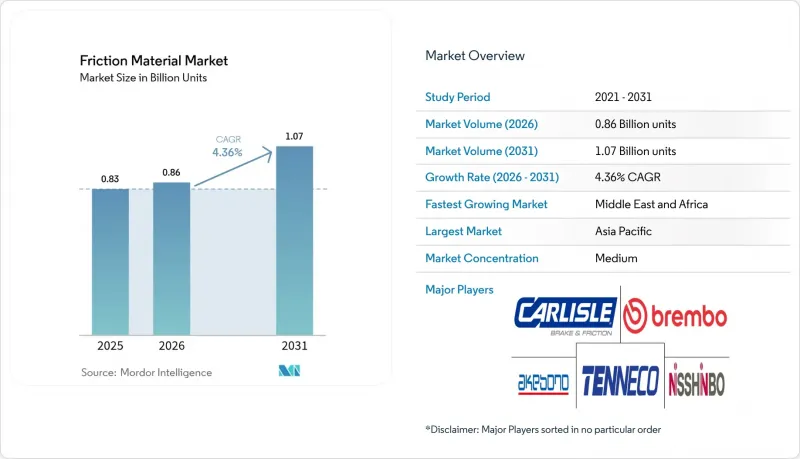
Mordor Intelligence에 의하면, 마찰재 시장 규모는 2025년 8억 3,000만 유닛으로 평가되었고, 2026년 8억 6,000만 유닛으로부터, 2031년까지 10억 7,000만 유닛으로 확대될 것으로 예측되며, 2026-2031년 연평균 복합 성장률(CAGR)은 4.36%를 나타낼 전망입니다.
본 보고서는 소재별(세미메탈릭, 세라믹 등), 제품 유형별(패드, 디스크, 라이닝, 기타 제품 유형), 용도별(클러치 및 브레이크 시스템, 기어 시스템, 기타 용도), 최종 사용자 산업별(자동차, 철도, 항공우주 등), 지역별(아시아태평양, 북미, 유럽 등)로 분류되어 있습니다. 시장 예측은 수량(단위) 기준으로 제시되어 있습니다.
세계의 마찰재 시장 동향 및 인사이트
전 세계 자동차 보유 대수의 급증과 브레이크 패드 교체 주기
2025년, 아시아태평양의 운행 차량 수는 8억 5,000만 대를 넘어설 것이며, 각 차량은 사용 상황에 따라 30,000-70,000km마다 브레이크 패드 교체가 필요하게 됩니다. 현재, 인도 차량 총수의 35%를 차지하는 구형 차량의 경우, 정비를 미루는 것이 마모를 가속화하기 때문에 애프터마켓에서의 소비량이 2배로 증가하고 있습니다. 이러한 상황으로 인해, OEM 각사가 공장 출하 시 세라믹을 채택하고 있음에도 불구하고, 비용 최적화된 세미메탈릭 패드 수요가 견조하게 유지되며 마찰재 시장은 확대되고 있습니다. 상용차 사업자들은 규제가 엄격해지기 전까지는 여전히 구리 함유량을 용인하고 있으며, 이로 인해 기존 공급업체들은 기존 재고를 소진할 유예 기간을 확보하고 있습니다. 따라서 소재 전환이 임박했음에도 불구하고, 이러한 차량 대수의 급증은 시장의 근본적인 성장을 뒷받침하고 있습니다.
더 엄격한 ‘무구리’ 및 ‘저소음’ 기준이 소재 재조성을 가속화
캘리포니아주의 SB 346 및 워싱턴주의 ‘베터 브레이크 법(Better Brake Act)’에 따라 2025년 이후 구리 함량은 중량비 0.5%로 제한되며, 패드 제조업체들은 LeafMark 인증을 획득한 아라미드,세라믹, 소결 청동의 혼합 소재로 전환해야만 합니다. 이러한 배합 변경으로 인해 1세트당 원자재 비용이 2-4달러 상승했으며, 1차 공급업체들은 연간 가격 협상을 통해 이러한 비용 증가를 상쇄하려고 시도하고 있습니다. 아라미드 공급은 과점 상태에 있기 때문에 공급 중단이 발생하면 60일 이내에 컴파운드 공장에 즉시 공급난이 발생합니다. 유럽의 도로 소음 상한선 74dB 규제도 저금속 함유 및 세라믹 배합을 촉진함으로써 이와 같은 방향성을 뒷받침하고 있으며, 배합의 복잡성은 증가하고 있지만 사내에 소재 연구소를 보유한 기업에게는 프리미엄 틈새 시장이 열리고 있습니다.
구리, 아라미드, 세라믹 섬유의 가격 변동
2025년, 구리의 거래 가격은 1미터톤당 9,250-9,800달러 사이에서 형성되었으며, 필요량의 60-70%만 헤지한 공급업체의 매출 총이익률은 최대 300베이시스포인트 변동했습니다. kg당 25-35달러인 아라미드 섬유는 주로 2개 생산 업체에서 조달되고 있기 때문에 공급 중단이 발생하면 몇 주 이내에 마찰재 시장 전체로 파급됩니다. 이와 유사한 집중화가 알루미나·실리카계 세라믹 섬유에도 영향을 미치고 있으며, 2024년 홍해 봉쇄와 같은 물류 혼란으로 인해 6주간의 지연이 발생했습니다. 중소규모 기업들은 추가 비용을 고객에게 전가하고 있어, 자사 내에 재료 연구소와 구매력을 보유한 통합형 OEM 제조업체에 대한 경쟁 우위가 약화되고 있습니다.
부문 분석
2025년, 세미메탈릭 제품은 독립형 애프터마켓 채널에서의 비용 면에서의 우위를 바탕으로 마찰재 시장 점유율 37.97%를 유지했습니다. 카본·세라믹 및 카본·카본·하이브리드에 이르는 세라믹 배합 제품은 연평균 6.02%의 속도로 확대되고 있으며, 특히 항공우주 분야와 고급 자동차 프로그램에서 1kg당 가격이 가장 높습니다.
북미에서 구리 함유량 상한 규제가 시행되고, 유럽에서 분진 배출 기준이 엄격해짐에 따라 수요의 양극화가 진행되고 있습니다. 각 컴파운더 업체들은 아라미드가 풍부하게 함유된 혼합재의 인증 획득을 위해 분주히 움직이고 있지만, 2개 섬유 제조업체공급 집중으로 인해 때때로 가격이 급등하여 이익률을 압박하고 있습니다. 그 때문에 마찰재 업계에서는 구리를 포함하지 않는 블렌드의 시제품 제작을 신속하게 진행하기 위해 사내 연구소에 대한 투자가 진행되는 한편, 중소규모 기업들은 원료 공급업체와 제휴하여 원료의 안정적인 공급을 확보하고 있습니다.
패드는 여전히 2025년 출하량의 40.88%를 차지했으며, 승용차에서의 보급 현황을 반영하고 있지만, 풍력 터빈, 광업, 오프로드 장비 분야에서 600°C의 열 부하를 방산하기 위해 더 큰 표면적이 채택됨에 따라, 디스크는 2031년까지 5.63%의 성장이 예상됩니다. 주로 철도 및 대형 드럼 브레이크에 사용되는 블록과 라이닝은 교체 주기에 따라 점차 시장 점유율을 확대하고 있으나, 트럭이 디스크 브레이크로 전환됨에 따라 점유율을 잃고 있습니다.
디스크용 마찰재 시장 규모는 특히 가동 시간 손실이 큰 비용이 되는 광산에서 운영자가 페이드 현상 감소와 모듈식 유지보수의 용이성을 중시하고 있기 때문에 더욱 빠르게 확대될 것으로 예측됩니다. 칼라일의 EL121 습식·건식 디스크용 컴파운드는 이미 석탄 및 구리 광산에 널리 보급되어 있으며, 이는 안전 규정과 가동 시간의 경제성이 디스크 채택을 뒷받침하고 있음을 보여줍니다.
지역별 분석
아시아태평양은 2025년에 전 세계 출하량의 45.97%를 차지했으며, 마찰재 시장의 중심축으로 자리매김하고 있습니다. 아세안(ASEAN) 국가들의 막대한 내연기관 장착 오토바이 보유 대수가 세미메탈릭 패드 수요를 견조하게 뒷받침하는 한편, 중국과 인도에서 전기차(EV)가 급증하면서 구리가 포함되지 않은 세라믹 소재로의 전환이 촉진되고 있습니다. 일본과 한국은 선진적인 소재 기술 노하우를 경쟁 우위로 활용하여 미국과 유럽에 규제 적합 패드를 수출하고 있습니다.
북미에서는 캘리포니아주 및 워싱턴주의 구리 함량 규제로 인해 원자재 비용이 세트당 2-4달러 상승하여, 신속한 배합 변경이 불가피했습니다. 멕시코의 저비용 생산 거점은 USMCA(미국·멕시코·캐나다 협정) 규정에 따라 규제 준수 제품을 북미 시장에 공급하고 있습니다. 한편, 캐나다의 광산용 트럭에는 영하의 환경 조건을 견딜 수 있는 고온용 라이닝이 요구되고 있습니다. 밀폐형 변속기의 보급으로 클러치 수요는 감소하고 있지만, 동시에 디스크의 수명에 대한 신뢰성에 대한 기대가 높아지고 있습니다.
유럽에서는 유로 7 기준에 따른 가장 엄격한 브레이크 먼지 규제가 도입되어, 각 OEM 업체들은 초저마모 세라믹 소재의 채택을 피할 수 없게 되었습니다. 독일의 연구개발 생태계에서는 카본 세라믹 솔루션이 공동 개발되고 있으며, 브렘보(Brembo)는 폴란드에 7억 유로를 투자해 공장을 건설 중이며, 지역 OEM 업체를 대상으로 인근에서 디스크를 공급할 체제를 갖추고 있습니다. 중동 및 아프리카는 연평균 성장률(CAGR) 4.68%로 성장하고 있으며, 사우디아라비아와 UAE에서는 조립의 현지화가 진행되고 있습니다. 한편, 남미는 상용차 생산 대수와 프라스 레(Fraser-Le)사의 지역 공장 네트워크에 힘입어 성장하고 있습니다.
기타 혜택 :
- 엑셀 형식 시장 예측(ME) 시트
- 3개월간의 애널리스트 지원
자주 묻는 질문
목차
제1장 서론
제2장 조사 방법
제3장 주요 요약
제4장 시장 구도
제5장 시장 규모 및 성장 예측
제6장 경쟁 구도
제7장 시장 기회 및 향후 전망
AJYAccording to Mordor Intelligence, the friction material market size is projected to expand from 0.83 Billion units in 2025 and 0.86 Billion units in 2026 to 1.07 Billion units by 2031, registering a CAGR of 4.36% between 2026 to 2031.
This report is Segmented by Material (Semi-Metallic, Ceramic, and More), Product Type (Pads, Discs, Linings, and Other Product Types), Application (Clutch and Brake Systems, Gear Tooth Systems, and Other Applications), End-User Industry (Automotive, Railway, Aerospace, and More), and Geography (Asia-Pacific, North America, Europe, and More). The Market Forecasts are Provided in Terms of Volume (Units).
Global Friction Material Market Trends and Insights
Surging Global Vehicle Parc and Brake-Pad Replacement Cycles
Asia-Pacific's on-road fleet exceeded 850 million vehicles in 2025, each requiring pad changes every 30,000-70,000 km depending on duty cycle. Older vehicles, now 35% of India's parc, double their aftermarket consumption rate as deferred maintenance accelerates wear. These conditions enlarge the friction material market by sustaining brisk volumes of cost-optimized semi-metallic pads even while OEMs adopt ceramics at factory install. Commercial operators still tolerate copper content until enforcement tightens, permitting traditional suppliers a window to exhaust existing inventories. This demographic bulge therefore underpins baseline market growth despite imminent material resets.
Stricter Copper-Free and Low-Noise Norms Accelerating Material Reformulation
California SB 346 and Washington's Better Brakes Law limited copper to 0.5 wt% from 2025, forcing pad makers to pivot to aramid, ceramic, and sintered-bronze blends that carry LeafMark certification. Reformulation lifts raw-material cost by USD 2-4 per set, which tier-one suppliers try to offset through annual price-down talks. Aramid supply is oligopolistic, so any outage quickly strains compounding plants within 60 days. European 74 dB road-noise caps reinforce the same direction by promoting low-metallic and ceramic recipes, multiplying formulation complexity but opening premium niches for firms with in-house materials labs.
Volatile Prices of Copper, Aramid and Ceramic Fibers
Copper traded between USD 9,250 and USD 9,800 per metric ton during 2025, swinging gross margins by up to 300 basis points for suppliers that hedge only 60-70% of needs. Aramid fiber at USD 25-35 kg is sourced mainly from two producers, so outages ripple across the friction material market within weeks. Similar concentration affects alumina-silica ceramic fibers, while logistical shocks such as the 2024 Red Sea blockage added six-week delays. Smaller firms pass surcharges to customers, eroding their edge over integrated OEMs that internalize materials labs and purchasing power.
Other drivers and restraints analyzed in the detailed report include:
- Rapid Electrification of Two-Wheelers and Micro-Mobility Fleets in Asia
- Rise of Autonomous Warehouse Robots Needing Micro-Brake Modules
- OEM Shift to Sealed, Maintenance-Free Transmissions Cutting Clutch Demand
For complete list of drivers and restraints, kindly check the Table Of Contents.
Segment Analysis
The semi-metallic retained 37.97% of the friction material market share in 2025, anchored by cost advantages in independent aftermarket channels. Ceramic formulations, spanning carbon-ceramic and carbon-carbon hybrids, are expanding at 6.02% annually and pull the highest price per kilogram, particularly in aerospace and premium automotive programs.
Demand divergence widens as North America enforces copper caps and Europe tightens dust limits; compounders scramble to qualify aramid-rich mixes, yet supply concentration among two fiber producers sends occasional price spikes that squeeze margins. The friction material industry therefore invests in in-house labs to prototype copper-free blends rapidly, while smaller firms ally with raw-material providers to secure feedstock continuity.
Pads still generated 40.88% of 2025 shipments, reflecting their ubiquity in passenger cars, but discs are forecast to grow 5.63% through 2031 as wind-turbine, mining, and off-highway equipment adopt larger surface areas to dissipate 600 °C heat loads. Blocks and linings, mainly used in rail and heavy-duty drums, inch forward on replacement cycles but lose share as trucks convert to discs.
The friction material market size for discs is projected to expand faster because operators value lower fade and easier modular servicing, especially in mines where runtime losses are costly. Carlisle's EL121 wet and dry disc compound already penetrates coal and copper pits, illustrating how safety regulations and uptime economics reinforce disc uptake.
Complete Report Scope:
- By Material
- Semi-metallic
- Ceramic (incl. carbon-ceramic and carbon-carbon)
- Asbestos
- Sintered Metals
- Aramid Fibers
- Other Materials
- By Product Type
- Pads
- Discs
- Blocks
- Linings
- Other Product Types
- By Application
- Clutch and Brake Systems
- Gear Tooth Systems
- Other Applications
- By End-user Industry
- Automotive
- Railway
- Aerospace (Commercial and Defense)
- Mining
- Other End-user Industries
- By Geography
- Asia-Pacific
- China
- India
- Japan
- South Korea
- ASEAN Countries
- Rest of Asia-Pacific
- North America
- United States
- Canada
- Mexico
- Europe
- Germany
- United Kingdom
- France
- Italy
- Spain
- Russia
- NORDIC Countries
- Rest of Europe
- South America
- Brazil
- Argentina
- Rest of South America
- Middle-East and Africa
- Saudi Arabia
- United Arab Emirates
- South Africa
- Rest of Middle-East and Africa
- Asia-Pacific
Geography Analysis
Asia-Pacific held 45.97% of global volume in 2025 and remains the anchor of the friction material market. Massive internal-combustion motorcycle fleets in ASEAN keep semi-metallic pad demand buoyant while China and India's EV surge sparks a shift toward copper-free ceramics. Japan and South Korea export compliant pads to the United States and Europe, using advanced materials know-how as a competitive wedge.
In North America, copper-content laws in California and Washington lifted raw-material costs by USD 2-4 per set and forced rapid reformulation. Mexico's low-cost production bases funnel compliant products northward under USMCA rules, while Canada's mining trucks require high-temperature linings that withstand sub-zero ambient conditions. The sealed-transmission trend trims clutch demand but simultaneously raises expectations for lifetime disc reliability.
Europe incubates the strictest brake-dust limits under Euro 7, which compel OEMs to adopt ultra-low-wear ceramics. Germany's R&D ecosystem co-develops carbon-ceramic solutions, and Brembo is erecting a EUR 700 million plant in Poland to near-source discs for regional OEMs. The Middle-East and Africa region is growing at 4.68% CAGR Saudi Arabia and the UAE localize assembly, while South America rides on commercial-vehicle output and Fras-le's regional plant network.
- ABS Friction
- AKEBONO BRAKE INDUSTRY CO., LTD.
- ASK FRAS-LE FRICTION PVT LTD.
- Brembo N.V.
- Carlisle Brake & Friction (CentroMotion)
- ContiTech Deutschland GmbH
- DRiV Incorporated
- EBC Brakes
- Haldex
- Hindustan Composites Ltd.
- ITT Inc.
- Japan Brake Industrial Co., Ltd.
- Miba AG
- Nisshinbo Holdings Inc.
- SGL Carbon
- Tenneco Inc.
- Yantai Haina Brake Technology Co., Ltd.
Additional Benefits:
- The market estimate (ME) sheet in Excel format
- 3 months of analyst support
TABLE OF CONTENTS
1 Introduction
- 1.1 Study Assumptions and Market Definition
- 1.2 Scope of the Study
2 Research Methodology
3 Executive Summary
4 Market Landscape
- 4.1 Market Overview
- 4.2 Market Drivers
- 4.2.1 Surging global vehicle parc and brake-pad replacement cycles
- 4.2.2 Stricter copper-free and low-noise norms accelerating material reformulation
- 4.2.3 Rapid electrification of two-wheelers and micro-mobility fleets in Asia
- 4.2.4 Rise of autonomous warehouse robots needing micro-brake modules
- 4.2.5 Demand surge for high-temp friction materials in wind-turbine yaw and pitch systems
- 4.3 Market Restraints
- 4.3.1 Volatile prices of copper, aramid and ceramic fibres
- 4.3.2 OEM shift to sealed, maintenance-free transmissions cutting clutch demand
- 4.3.3 EU brake-particulate limits favouring ultra-low-wear solutions
- 4.4 Value Chain Analysis
- 4.5 Porter's Five Forces
- 4.5.1 Bargaining Power of Suppliers
- 4.5.2 Bargaining Power of Buyers
- 4.5.3 Threat of New Entrants
- 4.5.4 Threat of Substitute Products and Services
- 4.5.5 Degree of Competition
5 Market Size and Growth Forecasts (Volume)
- 5.1 By Material
- 5.1.1 Semi-metallic
- 5.1.2 Ceramic (incl. carbon-ceramic and carbon-carbon)
- 5.1.3 Asbestos
- 5.1.4 Sintered Metals
- 5.1.5 Aramid Fibers
- 5.1.6 Other Materials
- 5.2 By Product Type
- 5.2.1 Pads
- 5.2.2 Discs
- 5.2.3 Blocks
- 5.2.4 Linings
- 5.2.5 Other Product Types
- 5.3 By Application
- 5.3.1 Clutch and Brake Systems
- 5.3.2 Gear Tooth Systems
- 5.3.3 Other Applications
- 5.4 By End-user Industry
- 5.4.1 Automotive
- 5.4.2 Railway
- 5.4.3 Aerospace (Commercial and Defense)
- 5.4.4 Mining
- 5.4.5 Other End-user Industries
- 5.5 By Geography
- 5.5.1 Asia-Pacific
- 5.5.1.1 China
- 5.5.1.2 India
- 5.5.1.3 Japan
- 5.5.1.4 South Korea
- 5.5.1.5 ASEAN Countries
- 5.5.1.6 Rest of Asia-Pacific
- 5.5.2 North America
- 5.5.2.1 United States
- 5.5.2.2 Canada
- 5.5.2.3 Mexico
- 5.5.3 Europe
- 5.5.3.1 Germany
- 5.5.3.2 United Kingdom
- 5.5.3.3 France
- 5.5.3.4 Italy
- 5.5.3.5 Spain
- 5.5.3.6 Russia
- 5.5.3.7 NORDIC Countries
- 5.5.3.8 Rest of Europe
- 5.5.4 South America
- 5.5.4.1 Brazil
- 5.5.4.2 Argentina
- 5.5.4.3 Rest of South America
- 5.5.5 Middle-East and Africa
- 5.5.5.1 Saudi Arabia
- 5.5.5.2 United Arab Emirates
- 5.5.5.3 South Africa
- 5.5.5.4 Rest of Middle-East and Africa
- 5.5.1 Asia-Pacific
6 Competitive Landscape
- 6.1 Market Concentration
- 6.2 Strategic Moves
- 6.3 Market Share(%)/Ranking Analysis
- 6.4 Company Profiles (includes Global level Overview, Market level overview, Core Segments, Financials as available, Strategic Information, Products and Services, and Recent Developments)
- 6.4.1 ABS Friction
- 6.4.2 AKEBONO BRAKE INDUSTRY CO., LTD.
- 6.4.3 ASK FRAS-LE FRICTION PVT LTD.
- 6.4.4 Brembo N.V.
- 6.4.5 Carlisle Brake & Friction (CentroMotion)
- 6.4.6 ContiTech Deutschland GmbH
- 6.4.7 DRiV Incorporated
- 6.4.8 EBC Brakes
- 6.4.9 Haldex
- 6.4.10 Hindustan Composites Ltd.
- 6.4.11 ITT Inc.
- 6.4.12 Japan Brake Industrial Co., Ltd.
- 6.4.13 Miba AG
- 6.4.14 Nisshinbo Holdings Inc.
- 6.4.15 SGL Carbon
- 6.4.16 Tenneco Inc.
- 6.4.17 Yantai Haina Brake Technology Co., Ltd.
7 Market Opportunities and Future Outlook
- 7.1 White-space and Unmet-Need Assessment