|
시장보고서
상품코드
2123991
IoT 보험 시장 : 점유율 분석, 업계 동향과 통계, 성장 예측(2026-2031년)IoT Insurance - Market Share Analysis, Industry Trends & Statistics, Growth Forecasts (2026 - 2031) |
||||||
 Mordor Intelligence
Mordor Intelligence에 의하면, IoT 보험 시장 규모는 2025년에 527억 8,000만 달러로 평가되었고 2026년 682억 7,000만 달러에서 2031년까지 2,475억 8,000만 달러에 이를 것으로 예측되며, 예측 기간(2026-2031년) CAGR은 29.40%를 나타낼 전망입니다.
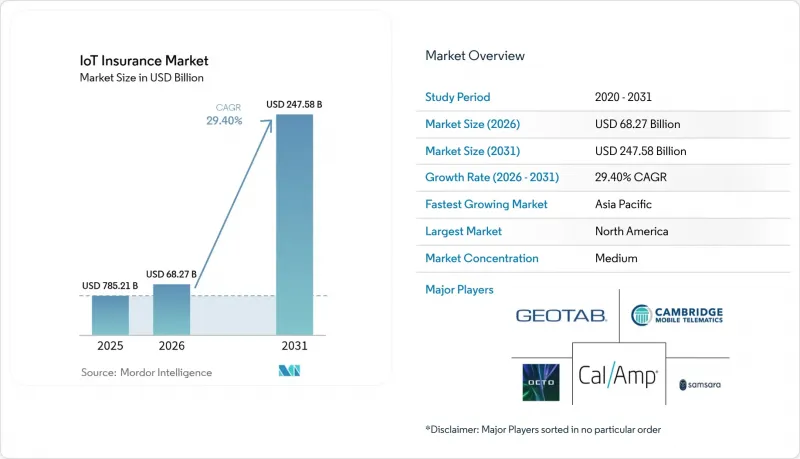
본 보고서는 도입 모델(클라우드 및 On-Premise), 보험 유형(손해보험, 생명보험 등), IoT 기술 유형(차량 텔레매틱스, 스마트 홈 센서, 웨어러블 및 헬스케어 기기 등), 최종 사용자 산업(소매·상업, 주택, 자동차, 산업 등) 및 지역별로 분류되어 있습니다. 시장 전망은 금액(달러) 기준으로 제시되어 있습니다.
세계 IoT 보험 시장 동향 및 인사이트
사용량 기반 보험(UBI)의 보급
텔레매틱스를 활용한 UBI는 정적인 인구통계학적 요인 대신 실시간 운전 행동이 중시됨에 따라 개인 및 상용 자동차 보험료를 재정의하고 있습니다. 프로그레시브(Progressive)는 2025년 2월 66억 8,400만 달러의 순보험료를 기록하여 전년 대비 17% 증가했습니다. 이는 주로 해당 회사의 보험 인수액의 18%를 차지하게 된 텔레매틱스 보험 계약 덕분입니다. 차량 운용 업체들도 유사한 성과를 거두고 있습니다. 한 고급 운송 서비스 제공업체는 Samsara의 커넥티드 운영 제품군을 도입한 결과, 보험 비용을 15% 절감했습니다. 이는 기업 측이 세밀한 행동 점수 산정을 강력히 요구하고 있음을 뒷받침합니다. AI를 활용한 패턴 인식을 통해 충돌 위험이 높은 운전 조작을 사전에 예측할 수 있게 되었으며, 예방적 지도를 통해 보험금 청구 빈도를 낮추고, 궁극적으로는 보험사의 손해율을 절감하는 데 기여하고 있습니다.
스마트 홈 및 산업용 센서 도입
누수, 화재, 기기 고장은 재산·산업 분야 손해의 대부분을 차지합니다. 저비용 센서는 피해가 확대되기 전에 사용자나 보험사에 경고를 발령함으로써 이러한 과제를 해결합니다. 스테이트 팜(State Farm)은 200만 개의 ‘Ting’ 전기 화재 센서를 출하했으며, 70만 가구의 커넥티드 홈에서 관련 보험금 청구 건수가 80% 감소했다고 보고했습니다. 상업시설에서는 HSB사의 ‘Relayr’ 애널리틱스 제품군이 사업 중단을 방지하는 예측 유지보수를 통해 엘리베이터 유지보수 파트너의 수익을 12% 향상시켰습니다. 보험사는 이러한 예방 조치의 효과에 상응하는 형태로 5%에서 20%의 보험료 할인을 적용하여, 기기의 더 광범위한 도입을 촉진하고 있습니다.
데이터 개인정보 보호 및 사이버 보안 위험
2024년 7월에 발생한 전 세계 IT 시스템 장애는 850만 대의 시스템에 영향을 미쳐 100억-150억 달러의 경제적 손실을 초래했습니다. 이는 상호 연결된 기기가 초래하는 시스템적 위험을 여실히 드러내는 사례입니다. 취리히는 전자기기 제조업체가 직면한 상위 5대 위험 중 하나로 사이버 위협을 꼽으며, 펌웨어 침해로 인해 보험사와 피보험자 모두에게 연쇄적인 손실이 발생할 수 있다고 경고하고 있습니다. 유럽에서 조만간 시행될 ‘사이버 복원력 법(Cyber Resilience Act)’을 준수하지 못한 공급업체에는 최대 1,500만 유로의 벌금이 부과될 수 있으며, 이는 도입의 장벽이 되는 한편, 사전에 안전한 아키텍처를 구축한 기업에게는 경쟁 우위가 될 것입니다.
부문 분석
클라우드 환경은 IoT 보험 시장의 63.20%를 차지하고 있으며, 연평균 성장률(CAGR) 30.70%로 확대되어 2031년까지 클라우드 플랫폼용 IoT 보험 시장 규모는 1,663억 1,000만 달러에 달할 것으로 전망됩니다. 탄력적인 컴퓨팅, API 개방성 및 관리형 보안 패치를 통해 보험사는 자본 집약적인 데이터센터의 유지 관리에서 해방될 수 있습니다. Samsara의 커넥티드 운영 클라우드는 2025년 4분기에 ARR(연간 반복 수익)이 14억 5,800만 달러에 달하며, 확장 가능한 텔레메트리 아키텍처가 기업의 도입으로 어떻게 이어지는지를 보여주고 있습니다.
규제가 엄격한 관할 구역이나 데이터 주권 관련 법령으로 인해 해외 처리가 금지된 지역에서는 여전히 On-Premise 도입이 지속되고 있습니다. 그럼에도 불구하고 FedRAMP High 및 ISO 27018과 같은 보안 인증을 통해 멀티테넌트형 클라우드에 대한 위험 인식이 완화되면서 로컬 서버에서 단계적으로 전환이 진행되고 있습니다. 엣지 노드는 클라우드 스택과의 통합이 진행되고 있으며, 자율주행차 보험 적용 범위에서 초저지연을 확보하는 동시에 중앙 분석 시스템이 가격 책정 알고리즘을 최적화하고 있습니다. 하이브리드 모델이 성숙해짐에 따라, 보험사는 통합된 보험 수리적 감독을 훼손하지 않으면서도 상황에 따른 유연성을 확보하고 있습니다.
손해보험 분야는 2025년 매출의 47.80%를 차지하며, 상품 분류별로는 최대 규모의 IoT 보험 시장을 자랑합니다. 스마트 홈 및 산업용 센서는 구체적인 손해 방지 효과를 가져오기 때문에 손해보험은 당연히 가장 먼저 도입된 분야가 되었습니다. 한편, 생명보험 인수 부문은 연평균 성장률(CAGR) 33.20%로 성장하고 있으며, 지속적인 웨어러블 데이터를 활용하여 사망률 가정을 정교화하고, 동적인 보험료 설정을 통해 건강한 행동을 장려하고 있습니다.
법인 보험 분야에서는 산업용 IoT가 산재보험에 점점 더 많이 통합되고 있으며, 예측 유지보수를 통해 부상 발생 빈도가 감소하고 있습니다. 사후적인 보험금 지급 조정에서 예방적 분석으로의 전환은 복합비율을 낮추며, 입증 가능한 포트폴리오의 원격 측정 데이터를 추구하는 재보험사에게 매력적인 요소입니다. 장기적으로는 단일 센서 스위트를 중심으로 생명보험, 자동차보험, 주택보험을 결합하는 등 보험 유형을 초월한 번들링을 통해 기존의 상품 경계가 모호해지고, 데이터 중심 플랫폼이 우위를 점하게 될 것입니다.
지역별 분석
2025년 북미가 차지할 매출 점유율 37.20%는 확립된 텔레매틱스 규제와 소비자의 폭넓은 수용에 기인합니다. 스테이트 팜(State Farm)의 팅(Ting) 센서 대규모 도입과 프로그레시브(Progressive)사의 유효 계약 건수가 18% 증가한 것은 센서를 통한 가치 제안으로의 광범위한 전환을 보여줍니다. 캐나다 규제 당국은 혁신과 소비자 주권 간의 균형을 맞추기 위해 AIDA 및 CPPA 개인정보 보호법을 조정하고 있으며, 완만하지만 꾸준한 기기 보급을 촉진하고 있습니다.
유럽에서는 EU 데이터법 및 향후 시행될 사이버 복원력법을 통해 27개 회원국 전체에서 기기의 보안과 데이터 공유가 표준화되어 일관된 성장이 나타나고 있습니다. EIOPA에 따르면, 보험사의 17%가 이미 IoT 연동형 자동차 보험을 제공하고 있으며, 규정 준수 체계가 소비자의 신뢰를 높여감에 따라 보급률은 더욱 상승할 것으로 예측됩니다. 독일, 프랑스, 영국이 도입을 주도하는 한편, EU의 신규 회원국들은 대규모 IoT 구축에 필요한 광대역 커버리지를 확대하는 결속 기금의 혜택을 받고 있습니다.
아시아태평양에서는 다국적 기업의 자본 유치를 이끌어내는 인도의 외국인 직접 투자(FDI) 한도 100% 상향 조정과, AI 및 데이터 거버넌스 규칙을 정한 중국의 NFRA 가이드라인에 힘입어 연평균 성장률(CAGR) 33.00%로 성장을 지속하고, 있습니다. 호주 및 뉴질랜드의 텔레매틱스 단말기 대수는 2023년 160만 대에서 2028년에는 270만 대로 증가하여, 해당 지역의 자동차 분야에서의 우위를 공고히 할 전망입니다. 일본에서는 미쓰이 스미토모 해상 등 보험사에서 치밀한 리스크 관리 문화를 보완하는 형태로 생성형 AI의 단계적 실증 실험이 진행되고 있으며, 이를 통해 급격한 업무 전환을 피하고 있습니다.
라틴아메리카, 중동 및 아프리카는 여전히 발전 도상국이지만, 미래 전망은 밝습니다. 멕시코의 5G 커버리지 확대와 브라질의 오픈 인슈어런스 제도를 통해 도입 지연이 단축될 것으로 예측됩니다. 걸프협력회의(GCC) 회원국들은 스마트 시티 메가 프로젝트에 투자하고 있으며, 여기에 통합된 센서 네트워크는 인프라, 부동산, 사이버 보험 분야의 상용 IoT 적용 범위와 자연스럽게 연계되고 있습니다.
기타 혜택:
- 엑셀 형식 시장 예측(ME) 시트
- 3개월간의 애널리스트 지원
자주 묻는 질문
목차
제1장 서론
제2장 조사 방법
제3장 주요 요약
제4장 시장 구도
제5장 시장 규모와 성장 예측
제6장 경쟁 구도
제7장 시장 기회와 향후 동향
JHS 26.09.07According to Mordor Intelligence, the IoT insurance market size was valued at USD 52.78 billion in 2025 and estimated to grow from USD 68.27 billion in 2026 to reach USD 247.58 billion by 2031, at a CAGR of 29.40% during the forecast period (2026-2031).
This report is Segmented by Deployment Model (Cloud and On-Premise), Insurance Line (Property and Casualty, Life, and More), Iot Technology Type (Vehicle Telematics, Smart-Home Sensors, Wearables and Health Devices, and More), End-User Industry (Retail and Commercial, Residential, Automotive, Industrial, and More), and Geography. The Market Forecasts are Provided in Terms of Value (USD).
Global IoT Insurance Market Trends and Insights
Proliferation of Usage-Based Insurance (UBI)
Telematics-enabled UBI is redefining personal and commercial auto premiums as real-time driver behavior replaces static demographic factors. Progressive wrote USD 6.684 billion in net premiums during February 2025, a 17% year-over-year rise driven chiefly by telematics policies that now represent 18% of its book. Fleet operators replicate those gains; a luxury transport provider cut insurance spend by 15% after implementing Samsara's connected-operations suite, confirming enterprise appetite for granular behavioral scoring. AI-driven pattern recognition further predicts collision-prone maneuvers, enabling proactive coaching that lowers claims frequency and ultimately reduces loss ratios for carriers.
Adoption of Smart-Home and Industrial Sensors
Water escape, fire, and equipment failure account for a majority of property and industrial losses; low-cost sensors address these pain points by alerting users and insurers before damage escalates. State Farm has shipped 2 million Ting electrical-fire sensors, reporting an 80% reduction in related claims across 700,000 connected homes. In commercial settings, HSB's Relayr analytics suite lifts revenue for elevator maintenance partners by 12% through predictive servicing that prevents business interruption. Insurers match these preventive gains with premium discounts ranging from 5% to 20% to encourage wider device adoption.
Data-Privacy and Cybersecurity Exposure
A global IT outage in July 2024 struck 8.5 million systems and inflicted USD 10-15 billion in economic loss, underscoring the systemic risk of interconnected devices. Zurich lists cyber threats among the top five risks facing electronics manufacturers, warning that compromised firmware can trigger cascading losses for both carriers and insureds. Compliance with Europe's forthcoming Cyber Resilience Act can cost non-conforming vendors up to EUR 15 million in penalties, creating adoption friction yet offering a competitive moat for firms that build secure architectures upfront.
Other drivers and restraints analyzed in the detailed report include:
- Rapid Fall in IoT Hardware and Connectivity Costs
- Regulatory Push for Data-Driven Pricing
- Legacy-Core Integration Complexity
For complete list of drivers and restraints, kindly check the Table Of Contents.
Segment Analysis
Cloud environments control 63.20% of the IoT insurance market and will expand at a 30.70% CAGR, lifting the IoT insurance market size for cloud platforms to USD 166.31 billion by 2031. Elastic compute, API openness, and managed security patches free carriers from maintaining capital-intensive data centers. Samsara's connected-operations cloud reached USD 1.458 billion in ARR in Q4 2025, illustrating how scalable telemetry architectures translate into enterprise adoption.
On-premise deployments persist in heavily regulated jurisdictions or where data sovereignty statutes prohibit offshore processing. Even so, security certifications such as FedRAMP High and ISO 27018 have reduced the perceived risk of multi-tenant clouds, prompting phased migration away from local servers. Edge nodes are increasingly integrated into cloud stacks, ensuring ultra-low latency for autonomous vehicle coverage while central analytics refine pricing algorithms. As hybrid models mature, carriers gain situational flexibility without compromising centralized actuarial oversight.
Property and Casualty lines hold 47.80% of 2025 revenue, representing the largest IoT insurance market size by product class. Smart-home and industrial sensors deliver tangible loss-avoidance, making P&C a natural first adopter. However, life underwriters are growing at 33.20% CAGR; they leverage continuous wearable data to refine mortality assumptions and incentivize healthy behavior through dynamic premiums.
Commercial lines increasingly embed industrial IoT into workers' compensation, where predictive maintenance lowers injury frequency. The shift from retrospective claims adjustment to preventive analytics compresses combined ratios and appeals to reinsurers seeking demonstrable portfolio telemetry. Longer term, cross-line bundling-such as combining life, auto, and home policies around a single sensor suite-will blur historic product boundaries and reward data-centric platforms.
Complete Report Scope:
- By Deployment Model
- Cloud
- On-Premise
- By Insurance Line
- Property and Casualty
- Life
- Health
- Commercial Lines
- By IoT Technology Type
- Vehicle Telematics
- Smart-Home Sensors
- Wearables and Health Devices
- Industrial IoT Gateways
- Environmental and Parametric Sensors
- By End-user Industry
- Retail and Commercial
- Residential (Smart-homes)
- Automotive
- Industrial
- Healthcare
- Public Infrastructure
- Logistics and Navigation
- Other End-user Industries
- By Geography
- North America
- United States
- Canada
- Mexico
- South America
- Brazil
- Argentina
- Chile
- Rest of South America
- Europe
- Germany
- United Kingdom
- France
- Italy
- Spain
- Russia
- Rest of Europe
- Asia-Pacific
- China
- India
- Japan
- South Korea
- Singapore
- Malaysia
- Australia
- Rest of Asia-Pacific
- Middle East and Africa
- Middle East
- United Arab Emirates
- Saudi Arabia
- Turkey
- Rest of Middle East
- Africa
- South Africa
- Nigeria
- Egypt
- Rest of Africa
- Middle East
- North America
Geography Analysis
North America's 37.20% revenue share in 2025 derives from well-established telematics regulations and widespread consumer acceptance. State Farm's mass deployment of Ting sensors and Progressive's 18% policy-in-force growth illustrate a broad shift toward sensor-mediated value propositions. Canadian regulators are tailoring AIDA and CPPA privacy laws to balance innovation with consumer sovereignty, fostering gradual yet steady device uptake.
Europe experiences cohesive growth through the EU Data Act and forthcoming Cyber Resilience Act, which standardize device security and data sharing across 27 member states. EIOPA notes that 17% of carriers already offer motor insurance linked to IoT and expects penetration to climb as compliance frameworks build consumer confidence. Germany, France, and the United Kingdom spearhead adoption, while newer EU members benefit from cohesion funds that expand broadband coverage required for massive IoT roll-outs.
Asia-Pacific records a 33.00% CAGR, driven by India's FDI ceiling lift to 100% that invites multinational capital, and China's NFRA guidelines that delineate AI and data-governance rules. Australian and New Zealand fleets will rise from 1.6 million telematics units in 2023 to 2.7 million by 2028, cementing regional auto dominance. Japan pursues incremental generative-AI pilots within insurers like Mitsui Sumitomo to complement meticulous risk cultures, thereby avoiding abrupt operational shifts.
Latin America and the Middle East and Africa remain nascent yet promising. Mexico's improving 5G coverage and Brazil's open-insurance regime are expected to shorten the adoption lag. Gulf Cooperation Council countries invest in smart-city megaprojects where embedded sensor grids naturally dovetail with commercial IoT coverage for infrastructure, property, and cyber lines.
- Octo Telematics S.p.A.
- Cambridge Mobile Telematics, Inc.
- Geotab Inc.
- CalAmp Corp.
- Samsara Inc.
- Trak Global Group Ltd
- Zubie, Inc.
- Mojio Inc.
- Queclink Wireless Solutions Co. Ltd
- Telit Cinterion PLC
- Sensata Technologies Holding plc
- Laird Connectivity LLC
- Kuantum Pvt Ltd (Kruzr)
- Smart Things Lab Co. Ltd
- Roost Inc.
- Notion (fka Iris Inc.)
- Eddy Solutions Inc.
- HSB ("Sensor Solutions by HSB")
- ThingCo Global Ltd
- LexisNexis Risk Solutions Group
- Flow Insurance Ltd
- Kinsa Inc.
- Metromile Enterprise Solutions
- Safehub, Inc.
- Parsyl, Inc.
Additional Benefits:
- The market estimate (ME) sheet in Excel format
- 3 months of analyst support
TABLE OF CONTENTS
1 INTRODUCTION
- 1.1 Study Assumptions and Market Definition
- 1.2 Scope of the Study
2 RESEARCH METHODOLOGY
3 EXECUTIVE SUMMARY
4 MARKET LANDSCAPE
- 4.1 Market Overview
- 4.2 Market Drivers
- 4.2.1 Proliferation of usage-based insurance (UBI)
- 4.2.2 Adoption of smart-home and industrial sensors
- 4.2.3 Rapid fall in IoT hardware and data-connectivity costs
- 4.2.4 Regulatory push for data-driven premium pricing
- 4.2.5 Emergence of parametric, trigger-based P and C products
- 4.2.6 Reinsurers' demand for continuous portfolio telemetry
- 4.3 Market Restraints
- 4.3.1 Data-privacy and cybersecurity exposure
- 4.3.2 Legacy-core integration complexity
- 4.3.3 Sensor-data reliability and calibration drift
- 4.3.4 Antitrust scrutiny on OEM-insurer data exchange
- 4.4 Industry Value Chain Analysis
- 4.5 Regulatory Landscape
- 4.6 Technological Outlook
- 4.7 Industry Attractiveness - Porter's Five Forces Analysis
- 4.7.1 Bargaining Power of Suppliers
- 4.7.2 Bargaining Power of Buyers
- 4.7.3 Threat of New Entrants
- 4.7.4 Threat of Substitutes
- 4.7.5 Intensity of Competitive Rivalry
- 4.8 Impact of Macroeconomic Factors on the Market
5 MARKET SIZE AND GROWTH FORECASTS (VALUES)
- 5.1 By Deployment Model
- 5.1.1 Cloud
- 5.1.2 On-Premise
- 5.2 By Insurance Line
- 5.2.1 Property and Casualty
- 5.2.2 Life
- 5.2.3 Health
- 5.2.4 Commercial Lines
- 5.3 By IoT Technology Type
- 5.3.1 Vehicle Telematics
- 5.3.2 Smart-Home Sensors
- 5.3.3 Wearables and Health Devices
- 5.3.4 Industrial IoT Gateways
- 5.3.5 Environmental and Parametric Sensors
- 5.4 By End-user Industry
- 5.4.1 Retail and Commercial
- 5.4.2 Residential (Smart-homes)
- 5.4.3 Automotive
- 5.4.4 Industrial
- 5.4.5 Healthcare
- 5.4.6 Public Infrastructure
- 5.4.7 Logistics and Navigation
- 5.4.8 Other End-user Industries
- 5.5 By Geography
- 5.5.1 North America
- 5.5.1.1 United States
- 5.5.1.2 Canada
- 5.5.1.3 Mexico
- 5.5.2 South America
- 5.5.2.1 Brazil
- 5.5.2.2 Argentina
- 5.5.2.3 Chile
- 5.5.2.4 Rest of South America
- 5.5.3 Europe
- 5.5.3.1 Germany
- 5.5.3.2 United Kingdom
- 5.5.3.3 France
- 5.5.3.4 Italy
- 5.5.3.5 Spain
- 5.5.3.6 Russia
- 5.5.3.7 Rest of Europe
- 5.5.4 Asia-Pacific
- 5.5.4.1 China
- 5.5.4.2 India
- 5.5.4.3 Japan
- 5.5.4.4 South Korea
- 5.5.4.5 Singapore
- 5.5.4.6 Malaysia
- 5.5.4.7 Australia
- 5.5.4.8 Rest of Asia-Pacific
- 5.5.5 Middle East and Africa
- 5.5.5.1 Middle East
- 5.5.5.1.1 United Arab Emirates
- 5.5.5.1.2 Saudi Arabia
- 5.5.5.1.3 Turkey
- 5.5.5.1.4 Rest of Middle East
- 5.5.5.2 Africa
- 5.5.5.2.1 South Africa
- 5.5.5.2.2 Nigeria
- 5.5.5.2.3 Egypt
- 5.5.5.2.4 Rest of Africa
- 5.5.5.1 Middle East
- 5.5.1 North America
6 COMPETITIVE LANDSCAPE
- 6.1 Market Concentration
- 6.2 Strategic Moves
- 6.3 Market Share Analysis
- 6.4 Company Profiles (includes Global level Overview, Market level overview, Core Segments, Financials as available, Strategic Information, Market Rank/Share for key companies, Products and Services, and Recent Developments)
- 6.4.1 Octo Telematics S.p.A.
- 6.4.2 Cambridge Mobile Telematics, Inc.
- 6.4.3 Geotab Inc.
- 6.4.4 CalAmp Corp.
- 6.4.5 Samsara Inc.
- 6.4.6 Trak Global Group Ltd
- 6.4.7 Zubie, Inc.
- 6.4.8 Mojio Inc.
- 6.4.9 Queclink Wireless Solutions Co. Ltd
- 6.4.10 Telit Cinterion PLC
- 6.4.11 Sensata Technologies Holding plc
- 6.4.12 Laird Connectivity LLC
- 6.4.13 Kuantum Pvt Ltd (Kruzr)
- 6.4.14 Smart Things Lab Co. Ltd
- 6.4.15 Roost Inc.
- 6.4.16 Notion (fka Iris Inc.)
- 6.4.17 Eddy Solutions Inc.
- 6.4.18 HSB ("Sensor Solutions by HSB")
- 6.4.19 ThingCo Global Ltd
- 6.4.20 LexisNexis Risk Solutions Group
- 6.4.21 Flow Insurance Ltd
- 6.4.22 Kinsa Inc.
- 6.4.23 Metromile Enterprise Solutions
- 6.4.24 Safehub, Inc.
- 6.4.25 Parsyl, Inc.
7 MARKET OPPORTUNITIES AND FUTURE TRENDS
- 7.1 White-Space and Unmet-Need Assessment